IMPACT OF USING BACK BELTS AND BACK PHYSIOTHERAPY ON REDUCING LOW BACK PAIN
AMONG OPERATIVE ROOM
1
Mosab S. Amoudi and
Health Sciences Department, Arab American University, Palestine
Nursing College, Arab American University, Palestine
ARTICLEINFO ABSTRACT
Objectives:
and performing back massage in reducing low back pain among operative room nurses. In addition to determine the risk factors that contributed low back pain among opera
Interventional study method was used (pre
physiotherapy and using back belts in preventing and reducing low back pain among operative nurses. Assessment in the pre
participated nurses had sessions of back physiotherapy twice weekly for 3 months addition to using back belts during their working hours. In post
the interventional methods was performed.
relationship between using back belt and performing back physiotherapy in preventing and reducing back pain among operative nurses.
location of pain and intensity of pain. Bending w
pain, this result was manipulated by using the interventional methods of the study. Previous supported the findings of this study as documented that physical therapy and support low back may be helpful in reducing back pain, while other studies revealed that the low back pain is a psychosomatic symptom which is relieved by rest or sleep.
Copyright©2019, Mosab S. Amoudi and Rasmieh N. Anabtawi
permits unrestricted use, distribution, and reproduction in any medium, provided the original work
INTRODUCTION
Low back pain (LBP) can be defined as unpleasant sensation, muscle tension, and/or stiffness localized below the costal margin and above the inferior gluteal folds (Witte
back pain is the most common cause for seeking medical care
(Amano et al., 2016), it is also a major health problem with
high prevalence in many countries with no specific cause (Gaubitz et al., 2016). There were high prevalence of LBP among health care providers all over the world in which 75% of nurses in Tunisia hospitals, 74% in Tanzania, and 69% in Nigeria (Abdulmujeeb and Olaniyan, 2017
many other studies that revealed 60-80% of all nurses had at least one episode of back pain during their working lives (Ulrich, 2011). It was reported that nursing staff
risk for being vulnerable to musculoskeletal injuries mainly in
the lumber region (Roupa et al., 2008). Nurses as professionals
have high incidents of LBP and traumas in the lumbar area, as they are exposed to a combination of mechanical and psychological stress of work. The position of nurses during their workin certain units might be uncomfortable either due to lack of space or due to movement restrictions, such units’ dialysis, operating theatre, and intensive care unit
and Bamishaiye, 2012). Risk factors that contribute high rate
ISSN: 0975-833X
Article History:
Received 19th February, 2019
Received in revised form 24th March, 2019
Accepted 19th April, 2019
Published online 30th May, 2019
Citation: Mosab S. Amoudi and Rasmieh N. Anabtawi operative room nurses in north palestinian hospitals”, Key Words:
low back pain, operative nurses, back belts, back physiotherapy.
*Corresponding author: Rasmieh N. Anabtawi
RESEARCH ARTICLE
IMPACT OF USING BACK BELTS AND BACK PHYSIOTHERAPY ON REDUCING LOW BACK PAIN
AMONG OPERATIVE ROOM NURSES IN NORTH PALESTINIAN HOSPITALS
Mosab S. Amoudi and
*,2Rasmieh N. Anabtawi
Health Sciences Department, Arab American University, Palestine
Nursing College, Arab American University, Palestine
ABSTRACT
Objectives: The main objective of the study was to determine the effectiveness of using back belts, and performing back massage in reducing low back pain among operative room nurses. In addition to determine the risk factors that contributed low back pain among opera
Interventional study method was used (pre-test and post-test) to evaluate the effectiveness of back physiotherapy and using back belts in preventing and reducing low back pain among operative nurses. Assessment in the pre-test was performed to identify the operative nurses who had low back pain, the participated nurses had sessions of back physiotherapy twice weekly for 3 months
addition to using back belts during their working hours. In post-test evaluation for the the interventional methods was performed. Results: The results showed that there
relationship between using back belt and performing back physiotherapy in preventing and reducing back pain among operative nurses. Discussion: there were changes in the results according to the location of pain and intensity of pain. Bending was the highest risk factor that
pain, this result was manipulated by using the interventional methods of the study. Previous supported the findings of this study as documented that physical therapy and support low back may be helpful in reducing back pain, while other studies revealed that the low back pain is a psychosomatic symptom which is relieved by rest or sleep.
Mosab S. Amoudi and Rasmieh N. Anabtawi. This is an open access article distributed under the Creative Commons Attribution License, which permits unrestricted use, distribution, and reproduction in any medium, provided the original work is properly cited.
Low back pain (LBP) can be defined as unpleasant sensation, muscle tension, and/or stiffness localized below the costal Witte, 2013). Low back pain is the most common cause for seeking medical care , it is also a major health problem with high prevalence in many countries with no specific cause were high prevalence of LBP among health care providers all over the world in which 75% 74% in Tanzania, and 69% in , 2017). In addition to 80% of all nurses had at least one episode of back pain during their working lives It was reported that nursing staff are at high-risk for being vulnerable to musculoskeletal injuries mainly in
Nurses as professionals have high incidents of LBP and traumas in the lumbar area, as they are exposed to a combination of mechanical and ychological stress of work. The position of nurses during their workin certain units might be uncomfortable either due to lack of space or due to movement restrictions, such units’ dialysis, operating theatre, and intensive care unit (Hinmikaiye
. Risk factors that contribute high rate
of LBP include lack of experience, and lack of knowledge about lifting and handling
Manyother risk factors among hospital workers may increase the rate of developing LBP, these factors include gender, age, lifestyle, physical demands of workplace, psychosocial, and
pain perception (Wong et al., 2010
on the prevalence and risk factors of low back pain among nurses, which estimated 12% of nurses
annually as a result of back injuries, and more than half of them developed chronic back pain, lifting and moving patients manually have been identified to be a high risk factors
and Nawajha, 2011). Lifting was the highest percent
that contribute nurses to lower back pain in their working (90%), standing hours (88.9%), moving heavy equipment’s (81.5%), bedside procedure (75.3%) and rolling patients’ position (72.8%) as found in one of the studies
2015). Poor working environment is considered also to be responsible in developing LBP among nurses
2017). Physical load and body posture during work, psychosocial factors have been found to be risk of back pain among nurses, work task and work
also significant risks in individual studies
2007). LBP is still being a major problem among nurses with and the same intensity of complaine, therefore LBP was
International Journal of Current Research
Vol. 11, Issue, 05, pp.3596-3600, May, 2019
DOI: https://doi.org/10.24941/ijcr.35382.05.2019
Mosab S. Amoudi and Rasmieh N. Anabtawi. 2019. “Impact of using back belts and back physiotherapy on reducing low back pain among , International Journal of Current Research, 11, (05), 3596-3600.
IMPACT OF USING BACK BELTS AND BACK PHYSIOTHERAPY ON REDUCING LOW BACK PAIN
NURSES IN NORTH PALESTINIAN HOSPITALS
Health Sciences Department, Arab American University, Palestine
The main objective of the study was to determine the effectiveness of using back belts, and performing back massage in reducing low back pain among operative room nurses. In addition to determine the risk factors that contributed low back pain among operative room nurses. Methods:
test) to evaluate the effectiveness of back physiotherapy and using back belts in preventing and reducing low back pain among operative nurses. s performed to identify the operative nurses who had low back pain, the participated nurses had sessions of back physiotherapy twice weekly for 3 months’ duration, in test evaluation for the effectiveness of The results showed that there was no significant relationship between using back belt and performing back physiotherapy in preventing and reducing there were changes in the results according to the as the highest risk factor that contribute low back pain, this result was manipulated by using the interventional methods of the study. Previous studies supported the findings of this study as documented that physical therapy and support low back may be helpful in reducing back pain, while other studies revealed that the low back pain is a psychosomatic
This is an open access article distributed under the Creative Commons Attribution License, which
of LBP include lack of experience, and lack of knowledge
about lifting and handling (Barkhordari et al., 2013).
Manyother risk factors among hospital workers may increase P, these factors include gender, age, lifestyle, physical demands of workplace, psychosocial, and ., 2010). Previous studies focused on the prevalence and risk factors of low back pain among nurses, which estimated 12% of nurses leave their work annually as a result of back injuries, and more than half of them developed chronic back pain, lifting and moving patients manually have been identified to be a high risk factors (Aljeesh . Lifting was the highest percentage factor that contribute nurses to lower back pain in their working (90%), standing hours (88.9%), moving heavy equipment’s (81.5%), bedside procedure (75.3%) and rolling patients’
position (72.8%) as found in one of the studies(Farooq et al.,
r working environment is considered also to be
responsible in developing LBP among nurses (Sanjoy et al.,
Physical load and body posture during work, psychosocial factors have been found to be risk of back pain among nurses, work task and work organizational factors are
also significant risks in individual studies (Dawson et al.,
LBP is still being a major problem among nurses with and the same intensity of complaine, therefore LBP was INTERNATIONAL JOURNAL OF CURRENT RESEARCH
suggested to be a recurrent rather than an aggravating course, and this should be taken in consideration in management of
LBP among healthcare providers (Maul et al., 2003).
Furthermore, strategies were included in work institutions to reduce musculoskeletal disorders among nurses, the most common strategies include education, training in transferring patient handling techniques, using mechanical devices, exercise programs, learning relaxation techniques, and improve
work conditions (Alexandre et al., 2001). Only a few studies
have focused on the natural course of developing LBP in detail without interventions, and no studies have focused on LBP in
detail after intervention (Rasmussen et al., 2013). The main
objective of this study was to determine the effectiveness of using back belts, and performing back massage in reducing low back pain among operative room nurses. In addition, this study determined the risk factors that contribute low back pain among operative room nurses.
MATERIALS AND METHODS
Interventional study method was used (pre-test and post-test) to evaluate the effectiveness of back physiotherapy and using back belts in preventing and reducing low back pain intensity among operative nurses. The study was conducted in Nablus hospitals at the north of Palestine that consisted of five hospitals which were included in this study. All nurses who are working in operative rooms in the mentioned hospitals and have LBP were included in the study, and they were observed within three months of the study for the effectiveness of the measured used during the study. Data was collected in two phases pre-test and post-test, the tool for collecting data was self-developed based on previous studies and revised by specialists. Pilot study was conducted to test the reliability of the questions in the questionnaire, for ethical considerations a permission to conduct the study in the hospitals were obtained from the authorized personnel in all hospitals included in the study, and consent form were signed from each nurse who were included in the studied sample. The questionnaire included three parts; Part one: includes demographic data that include 16 items. Part two: includes 8 questions as pre/post questionnaire to determine the characteristics of the pain in low back among operative nurses. And part three: includes 23 items that described the LBP. The study was conducted in two phases: phase one (pre-test) in which all nurses who are working in operative rooms were assessed for having LBP by self-administering questionnaire, the number of nurses during the study who were assessed were 58 nurses only, the assessment revealed that 20 of the operative nurses were attend to have LBP and who were included in phase two of the study. Phase two (post-test) which is the intervention phase of the study that include arrangement with two physiotherapy centers for performing back physiotherapy for the studied sample who had LBP, back physiotherapy was done two times per week for three months by physiotherapist, these sessions were documented in a record for following up. In addition to, the studies sample were provided by back belts and instructions how to use them were explained, the nurses were asked to use the back belts during their working hours, they were reviewed periodically for using the back belts appropriately and they confirmed their usage of the back belts. After three months of using back belts and having back physiotherapy, evaluation was performed to examine the effectiveness of using the interventional methods in reducing LBP by conducting the same self-administrator questionnaire for the second time for
comparison purposes. And then analyzing for the data was done by using SPSS version 21. The research results are expected to provide evidence on the size of problem (low back pain among operative room nurses) in addition to, providing recommendations for using protective measures which may help in reducing LBP among operative room nurses.
RESULTS
Descriptive statistics: All nurses working in operative rooms
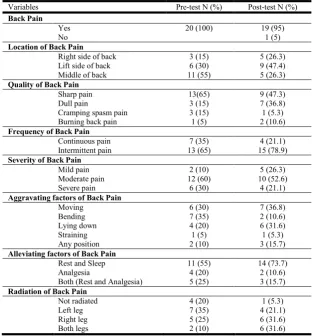
were assessed for having low back pain who were 58 nurses, 20 nurses of them had low back pain and were included in the interventional phase of the study, 38 of the assessed nurses were excluded in phase two of the study as they didn’t have any symptoms of LBP according to their pre-test response. All Participates were working at the operation room. Of the included nurses (N=20), 50% (n=10) were female and 50% (n=10) were male. The age distribution among participants’ nurses was5% (n=1) of nurses were aged between 20-25 years old, 20% (n=4) of nurses were aged between 26-30 years old, 20% (n=4) of nurses were aged between 30-35 years old, 15% (n=3) of nurses were aged between 35-40 years old, and 40% (n=8) of nurses were aged equal and more than 41 years old. The result showed that 65% (n=13) of nurses have diploma degree in nursing, while 30% (n=6) of nurses have baccalaureate degree in nursing. 5% (n=1) of nurses have Master degree in nursing. 45% (n=9) of nurses working at private hospital and 55% (n=11) of nurses working at public hospital. Regarding to clinical experience the results showed 5% (n=1) have 0-3 years, 10% (n=6) have 4-7, and 85% (n=17) have more than 7 years of clinical experience at hospital. While the clinical experience at operation room was 0-3years, 4-7years and more 7 years, and the results showed 20% (n=4), 10% (n=2) and 70% (n=14) respectively. Also the result revealed 60% (n=12) of participants were standing more than 5 hours, 30% (n=6) were standing 3-5 hours, and 10% (n=2) were standing less than 3 hours as shown in Table (1). The back pain characteristics were investigated among participants in both study phases, the result showed that all of participants included in the interventional methods had back pain in pre-test phase, while in post-test phase95% (n=19) of participant still have back pain while 5% (n=1)didn’t have back pain.
52.6% (n=10) and 21.1% (n=4) respectively. The back pain was aggravated in pre-test phase among30% (n=6) of participants with movement, 35% (n=7) with bending, 20% (n=4) with lying down, 5% (n=1) with straining, and 10% (n=2) with any position, while in post-test phase aggravated 36.8% (n=7) with movement, 10.6% (n=2) with bending, 31.6% (n=6) with lying down, 5.3% (n=1) with straining, and 15.7% (n=3) with any position.
[image:3.595.167.417.79.329.2]The result showed that 55% (n=11) of participants used sleep and rest to relieve their back pain, while another 20% (n=4) of participants use analgesic medication to relieve their back pain, and 25% (n=5) of them use both of these technique to relieve their back pain in pre-test phase, while result showed that 73.7% (n=14) of participants used sleep and rest to relieve their back pain, while another 10.6% (n=2) of participants use analgesic medication to relieve their back pain, and 15.7%
Table 1. Description of the characteristics of nurses’ participants (N=20)
Variables N (%)
Gender
Male 10 (50)
Female 10 (50)
Age
20 - 25 years old 1 (5)
26 - 30 years old 4 (20)
31 - 35 years old 4 (20)
36 - 40 years old 3 (15)
> 40 years 8 (40)
Academic Qualification
Diploma Degree 13 (65)
Baccalaureate Degree 6 (30)
Master Degree 1 (5)
Clinical experience at hospital
0-3 years 1 (5)
4-7 years 2 (10)
> 7 years 17 (85)
Clinical experience at operation room
0-3 years 4(20)
4-7 years 2 (10)
> 7 years 14 (70)
Standing hours continuously
< 3 hours 2 (10)
3-5 hours 6 (30)
> 5 hours 12 (60)
Table 2. Description of Pain characteristics among nurses’ participants’ (N=20)
Variables Pre-test N (%) Post-test N (%)
Back Pain
Yes 20 (100) 19 (95)
No 1 (5)
Location of Back Pain
Right side of back 3 (15) 5 (26.3)
Lift side of back 6 (30) 9 (47.4)
Middle of back 11 (55) 5 (26.3)
Quality of Back Pain
Sharp pain 13(65) 9 (47.3)
Dull pain 3 (15) 7 (36.8)
Cramping spasm pain 3 (15) 1 (5.3)
Burning back pain 1 (5) 2 (10.6)
Frequency of Back Pain
Continuous pain 7 (35) 4 (21.1)
Intermittent pain 13 (65) 15 (78.9)
Severity of Back Pain
Mild pain 2 (10) 5 (26.3)
Moderate pain 12 (60) 10 (52.6)
Severe pain 6 (30) 4 (21.1)
Aggravating factors of Back Pain
Moving 6 (30) 7 (36.8)
Bending 7 (35) 2 (10.6)
Lying down 4 (20) 6 (31.6)
Straining 1 (5) 1 (5.3)
Any position 2 (10) 3 (15.7)
Alleviating factors of Back Pain
Rest and Sleep 11 (55) 14 (73.7)
Analgesia 4 (20) 2 (10.6)
Both (Rest and Analgesia) 5 (25) 3 (15.7)
Radiation of Back Pain
Not radiated 4 (20) 1 (5.3)
Left leg 7 (35) 4 (21.1)
Right leg 5 (25) 6 (31.6)
[image:3.595.135.448.364.701.2](n=3) of them use both of these technique to relieve their back pain in post-test phase. Regarding to back pain radiation in pre-test phase the result revealed that 35% (n=7) of participants their back pain radiated to left leg, 25% (n=5) radiated to right leg, 10% (n=2) radiated to both legs, 10% (n=2) radiated to both arms, 20% (n=4) did not radiated to any of legs and arms.40% (n=8) of participant consider the comfortable position is sitting position, 10% (n=2) standing, 25% (n=5) laying down, 40% (n=8) no position to be comfortable for him. In post-test phase the result revealed that 21.1% (n=4) of participants their back pain radiated to left leg, 31.6% (n=6) radiated to right leg, 31.6% (n=6) radiated to both legs, 5.3% (n=1) did not radiated to any of legs as shown in Table (2). Also result shows that 75% (n=15) of participants under want back physiotherapy and using back belt while they are working at operation room, but 25% (n=5) of participants using only back belt while they are working at operation room.
Inferential Statistic
The result of study showed that there is no statistically
significant (X2: 3.158, df: 1, P: 0.076) effect of using back belt
or back belt with back physiotherapy in preventingor reducing back pain among nurses included in the study and who are working in operative rooms. The result shown there is no
statistical significant (X2: 1.853, df: 2, P: 0.369) superior effect
of using back belt alone or back belt with back physiotherapy on reducing the severity of back pain among operative nurses. In addition to the comparison between study phases showed no
statistical significant (X2: 4.143, df: 4, P: 0.387), (X2: 3.033 df:
2, P: 0.22) effect of using back belt alone or back belt with
back physiotherapy on the severity and frequency of back pain respectively.
DISCUSSION
The finding of this study showed that 84.1% of healthcare providers experience their LBP after starting work at hospital (9), this result is consistence with a study that showed 95% of the operative nurses developed their back pain symptoms after starting work in hospital. Although the result of this study lost the significant relationship between using back belts with or without performing back massage for the nurses who are working in operative rooms and the effect of using these methods in reducing of LBP, this lost significant might be due to the small number of studied sample included, as the number of nurses is limited who are actually work in operative rooms,
so nurses had double shifts and sometimes they are unable to had their annual leaves because of nurses shortage in such department.. In the contrary the results showed some changes in the characteristics of pain among the studied sample as shown in the tables. These changes include the location of pain which was changed from being located in the middle of the back to be radiated to either right leg or left leg. The majority of nurses had their pain in the lower area of their back
(Shawashi et al., 2014). 65% of operative room nurses who
reported in the pre-test that they have sharp pain sensation, post-test this percentage decreased to be just 46.3%, this change in pain sensation may be as a result of using the interventional methods used in the study (back belt and physiotherapy), this result is not consistence with a study that concluded lumbar support was ineffective in preventing LBP
(Dawson et al., 2007). 35% of nurses who had continuous low
back pain decreased to be 21.1%, while who had intermittent pain increased to be 78.9% instead of 65%, this mean an improvement in the characteristics of pain which might be as a result of using back belt and physiotherapy intervention, also the severity of pain from being sever and moderate to be mild pain, exercise or sports are not a significant as documented in a
study (Wong et al., 2010), physiotherapy with exercise might
be helpful as reported in another study (Ulrich, 2011).
The highest risk factors that contribute LBP was bending with 35% in the pre-test, this percentage was decreased to be 10.6% after having back physiotherapy and using back belts during the studied research period, this result is standby a study that revealed exercising applied in using body mechanism correctly strengthen the low back (Tosunoz and Oztune, 2017). Rest and sleep may also alleviate LBP as showed in the results, psychosocial factors and the presence of psychosomatic symptoms have been found to increase risk of back pain
among nurses (Dawson et al., 2007). The radiation of LBP to
left leg decreased, to the right leg increased, and for both legs increased after using the interventional methods, this result is consistence with a study that reported lumber support that used to prevent back injuries among nurses is limited evidence
(Dawson et al., 2007). The findings also showed that 75%
[image:4.595.62.538.78.258.2](n=15) of participants under went back physiotherapy and using belt while they are working at operation room, but 25% (n=5) of participants used only back belt while they are working at operation room. Preventing LBP among nurses by exercise should beunder healthy and safe environment is recommended, nurses who are responsible for health they
Table 3. Frequencies of participants nurse responses to the questions regarding to back pain (N=20)
Question Pre-test Post-test
Yes: N (%) No: N (%) Yes: N (%) No: N (%)
Do have experienced back pain before you start your work in this hospital? 7 (35) 13 (65) 10 (50) 10 (50)
Do you feel uncomfortable when standing for long time? 19 (95) 1 (5) 20 (100) -
Do you have pain in your upper back and neck? 13 (65) 7 (35) 13 (65) 7 (35)
Do you have pain in your lower back? 20 (100) - 19 (95) 1 (5)
Do you have pain in your lower back and legs? 17 (85) 3 (15) 16 (80) 4 (20)
Did you complain of numbness or paresthesia in your leg or foot? 11 (55) 9 (45) 13 (65) 7 (35)
Do you feel of muscle spasm in your lower back after standing for long time? 17 (85) 3 (15) 18 (90) 2 (10)
Do you thing that long standing has a relation with your low back pain? 20 (100) - 20 (100) -
Did you leave your shift because of back pain? 9 (45) 11 (55) 9 (45) 11 (55)
Did your back pain awake you from sleep? 12 (60) 8 (40) 15 (75) 5 (25)
Do you have rest when you feel pain during shift? 9 (45) 11 (55) 14 (70) 6 (30)
Is the back pain enforcing you to change your work? 10 (50) 10 (50) 12 (60) 8 (40)
Do you use preventive techniques in your work to prevent back pain? 7 (35) 13 (65) 16 (80) 4 (20)
Do you use medications to relieve back pain? 15 (75) 5 (25) 18 (90) 2 (10)
Have you ever had Physiotherapy? 12 (60) 8 (40) 14 (70) 6 (30)
Have you had Cryotherapy? 2 (10) 18 (90) 1 (5) 19 (95)
should concern first about their health (Tosunoz and Oztune, 2017).
Conclusion
One of the most common problems among operative room nurses is low back pain, which can be related to many risk factors during their work including lifting, supporting and moving patients manually without using proper aids, improper handling of equipment’s, and long standing hours. Alternative or complementary interventions may be used to decrease incidence of low back pain among operative room nurses, managing LBP with physiotherapy and exercise in addition of using back belt for supporting the back might be helpful and have a positive effect in reducing the intensity of pain. One of the limitations of this study is the small number of the studied sample which is due to shortage of nurses who are working in operative rooms in the hospitals that were included in the study. So it is recommended for further study which may include hospitals from different cities in Palestine.
Acknowledgement
The authors acknowledge the institutions that provide back
physiotherapy for the studied sample; OsamAwwad
Physiotherapy Centre, Specialized Al-IbtIsameh Al-Jamelah. Physiotherapy Centre, and Al-Baraka Pharmacy for their contribution in the availability of the back belts. Great thanks for all nurses who participate in this study, and grateful for Mr. Bahaa’eddin Hammad for his assistance in analysing the data of the study. This study was funded by Arab American University Palestine.
Conflicts of interest: the authors declare that there is no
conflict of interest.
REFERENCES
Abdulmujeeb, A. and Olaniyan, L. 2017. Prevalence and Factors Associated with Low Back Pain among Healthcare Workers in Kibuli Muslim Hospital Kampala, Uganda.
Epidemiology, (Sunnyvale) 7:1.
Alexandre, N., Moraes, M., Filho, H. and Jorge, S. 2001. Evaluation of a Program to Reduce Back Pain in Nursing
Personnel. Rev. Saude Publica., 53 (4).
Aljeesh, Y. and Nawajha, S. 2011. Determine of Low Back
Pain among Operating Room Nurses in Gaza
Governmental Hospitals. Journal of Al Azhar
University-Gaza.
Amano, S, et al., 2016. Effectiveness of Blood Flow
Restricted Exercise Compared with Standard Exercise in Patients with Recurrent Back Pain: Study Protocol for a
Randomized Controlled Trial. Biomed Central., 17:81.
Barkhordari A., Halvani, G. and Barkhordari, M. 2013. The Prevalence of Low Back Pain among Nurses in Yazd,
Southeast Iran. International Journal of Occupational
Hygiene.
Dawson, A., McLennan, S., Schiller, S., Jull, G., Hodges P. and Stewart, S. 2007. Interventions to Prevent Back Pain and Back Injuries in Nurses: A systematic Review.
Occupational and Environmental Medicine.
Farooq, M., Awwal, L., Musa, H. and Mustapha, G. 2015. Work-Related Risk Factors for Lower Back Pain Among Nurses In Ahmadu Bello University Teaching Hospital
(ABUTH), Zaria – Nigeria. IOSR Journal of Nursing and
Health Science, (IOSR-JNHS). 4(3): 20-25.
Gaubitz, et al., 2016. Efficacy and Safety of
Nicoboxil/Nonvamide Ointment for the Treatment of Acute Pain in the Low-Back- A Randomized, Controlled Trial.
European Journal of Pain., 263-273.
Ghilan, K, et al., 2013. Low Back Pain among Nurse in
Yemen. International Journal of Occupational Medicine
and Environmental Health, 26(4): 605-614.
Hinmikaiye, C. and Bamishaiye, E. 2012. The Incidence of
Low Back Pain among Theatre Nurses: A case study of
University of Ilorin and Obafemi AWolowo University Teaching hospital. Nigeria.
Lin, P., Tsai, Y., Chen, W. and Huang, S. 2012. Prevalence, Characteristics, and Work-Related Risk Factors of Low Back Pain among Nurses in Taiwan: A Cross- Sectional
Survey. International Journal of Occupational Medicine
and Environmental Health. 25(1):41-50.
Maul, I., Laubil, T., Klipstein, A. and Krueger, H. 2003. Course of Low Back Pain among Nurses: A Longitudinal Study across Eight Years. Germany.
Rasmussen, C., Holtermann, A., Mortensen, O., K., Sogaard, K. and Jørgensen, M. 2013. Prevention of Low Back Pain and its Consequences among Nurses Aids in Elderly Care: A Stepped-Wedge Multi-Faceted Cluster-Randomized
Controlled Trial. BMC Public Health. 13:1088.
Roupa, Z., Vassilopoulos, A., Sotiropoulou, P., et al., 2008.
The problem of lower back pain in nursing staff and its
effect on human activity. Health science journal, 2 (4).
Sanjoy, S., Ahsan, G., Nabi, H., et al., 2017. occupational
Factors and Low Back Pain: A cross-Sectional Study of Bangladeshi Female Nurses. BMC Research Notes; 10:173.
Shawashi, T., Subih, M., Alhadid, L and Adas, M. 2014. Occupational-Related Back Pain among Jordanian Nurses:
A Descriptive Study. International Journal of Nursing
Practice.
Tosunoz, I. and Oztune, G. 2017. Low Back Pain in Nurses.
International Journal of Caring Science, 10(3):1728. Ulrich, S. 2011. Prevention and Management of Back Pain in
Nurses. International Labour Organization, Geneva.
Witte, A. 2013. Treatment options in managing chronic low back pain. University of the Incarnate Word.
Wong, TS., Teo, N. and Kyaw, M. 2010. Prevalence and Risk Factors Associated with Low Back Pain among Health
Care Providers in a District Hospital. Malaysian
Orthopaedic Journal.