Electronic and Structural Properties of Li
3
AlP
2
and
Li3AlAs2 from First Principles
Mehrdad Dadsetani*, Shirin Namjoo
Physics Department, Faculty of Science, University of Lorestan, Lorestan, Iran E-mail:*[email protected], [email protected]
Received February 28, 2011; revised April 26, 2011; accepted May 12,2011
Abstract
A detailed analysis of the electronic and structural properties of the filled tetrahedral semiconductors Li3AlP2 and Li3AlAs2 has been performed, using the full potential linearized augmented plane wave method within the density functional theory. Experimental results about the structural properties, involves the positions of the elements Al and P(As). Since there were not any other efforts about the positions of the Li elements in these compounds, so to our knowledge there was no theoretical study about them till now. In the first step the interactional forces between atoms were minimized. The calculated internal coordinations of atoms agree well with the experimental results. Using these positions we obtained the equilibrium lattice constants, bulk modulus and their pressure derivative. In the second step the electronic properties of Li3AlP2 and Li3AlAs2 have been studied. The study of total and partial electronic DOS indicate the main contribution of DOS con-sists of P(As) 3p(4p) and P(As) 3s(4s) states. Our band structure calculation verifies that Li3AlP2 is an
indi-rect gap semiconductor with a value of about 2.36 eV between valance band maximum occuring at H point and conduction band minimum occuring at Г point; though the difference between the direct (2.38 eV) and indirect (2.36 eV) is very small. We also found that Li3AlAs2 is a direct band gap (1.49 eV) in the center of BZ.
Keywords: Filled Tetrahedral Semiconductors, Electronic Properties, FP-LAPW, DFT
1. Introduction
Li3AlP2 and Li3AlAs2 are filled tetrahedral Nowotny-
Juza compounds [1,2] with an orthorhombic structure and belong to the space group Ibca (73) [3] in contrast to cubic nitride semiconductors such as Li3AlN2 and
Li3GaN2 [1,3]. Crystal structure of Li3AlP2 depicted by
Juza et al. [3] and has been grown by direct reaction of Li, Al, and P in an evacuated quartz ampoule [4]. A filled tetrahedral compound (such as Li3AlP2) can be viewed as
zincblend-like (Li0.5Al0.5P)– lattice filled with He-like Li+
ions at the empty tetrahedral sites. The available experi-mental studies on Li3AlP2 are limited to growth and
op-tical band gap [4]. Kuriyama et al. have grown Li3AlP2 by
direct reaction between Li, Al and P using photoacoustic spectroscopy method and obtained a band gap of 2.75 eV. (Unfortunately we do not have any experimental or theoretical information about Li3AlAs2). From theoretical
point of view, to our knowledge, there is no theoretical research on electronic and structural properties. More-
over, it seems that there is a lack of both experimental and theoretical data on electronic and structural proper-ties of Li3AlP2 and Li3AlAs2. In this work, we present the
results of a systematic study of the electronic and struc-tural properties of Li3AlP2 and Li3AlAs2 obtained by full
potential linearized augmented plane wave (FP-LAPW) method with the generalized gradient approximation (GGA) for the exchange correlation potential, within the density functional theory. This work is along the latest study that is peformed on Li3AlN2 and Li3GaN2 about the
electronic and optical properties of these compounds [5]. Our calculated results could serve as a reference for fu-ture theoretical and experimental works on these com-pound. The rest of this paper organized as follows. A brief description of our calculation method is given in Section 2. Section 3 contains the results and the conclu-sions are given in Section 4.
2. Calculation Method
using the full potential linearized augmented plan wave (FP-LAPW) method. In this method no shape approxi-mation on the potential or on the electronic charge den-sity is made. The calculations of the electronic and structural properties have been done relativistically. We use the WIEN2K [6] implementation of the method which allows the inclusion of local orbitals in the basis, improving upon linearization and making possible a con-sistent treatment of the semicore and valence states in an energy window, hence ensuring proper orthogonality. The exchange correlation potential within the general-ized gradient approximation (GGA) is calculated using the scheme of Perdew et al. [7]. The convergence pa-rameter , (the product of the smallest of the atomic sphere radii
min max
MT
R k
MT and the plane wave cutoff
pa-rameter max) which controls the size of the basis sets in
these calculations, was set to 8. The maximum quan-tum number for the wave function expansion inside the atomic sphere is confined to max = 10. The max
pa-rameter was taken to be 12.0 Bohr–1. Brillouin-zone (BZ)
integrations within the self-consistency cycles were per-formed via a tetrahedron method [8], using 170 K points in the irreducible BZ. For the calculation of the density of states (DOS) however, a denser sampling of the BZ was needed, where we used 427 K points. The muffin- tin radii of Lithium (Li), Aluminium (Al) Phosphor (P) and Arsenide (As) were chosen as MT MT MT =
(2.32, 2.16, 2.16) a.u. for Li3AlP2 and (2.41, 2.26, 2.26)
for Li3AlAs2. All these values have been chosen in a way
to ensure the convergence of the results.
R k
l
G
P
R
l
Li , Al , (As)
R R
3. Results and Discussions
In this section, we express the structural and electronic properties of Li3AlP2 and Li3AlAs2. The results of
studing electronic and structural properties are in Sec-tions 3.1 and 3.2 respectively.
3.1. Total Energy Calculations
The orthorhombic phase of Li3AlP2 and Li3AlAs2 has 96
atoms, 48 Li, 16 Al and 32 P (As), per primitive cell. A Point worth to mention is that the similar phosphors (Arsenides) in the cell are not equivalent. The Wyckoff position [3] of Li, Al, and P1 (As1), P2 (As2), P3 (As3) and
P4 (As4) atoms are as follows:
Li: 16f (x1, y1, z1) Al: 16f (x2, y2, z2)
P1 (As): 8a (0, 0, 0) P2 (As): 8c (u, 0, 0.25)
P3 (As): 8d (0.25, v, 0) P4 (As): 8e (0, 0.25, w)
The structure of Li3AlP2 (Li3AlAs2) is characterized
by three Lattice parameters a, b and c, and the internal parameters of atoms.
In our Literature survey, we did not find any theoreti-cal works on theoreti-calculating the lattice parameters and inter-nal parameters for these compounds and nor any theo-retical work on electronic and structural properties of them. Therefore to our knowledge, this part of the work can be considered as the first ab initio calculation for these compounds.
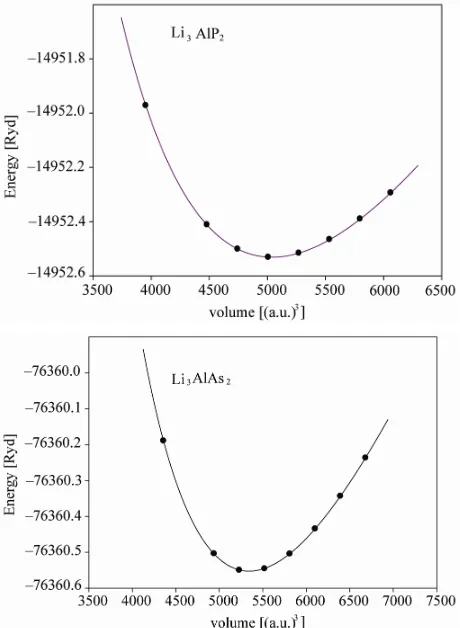
Experimental information about these compounds volves the positions of Al and P(As) and there is no in-formation about the position of Li, In this work we first optimized the internal parameters by relaxing the atomic positions inside a unit cell using experimental lattice parameters [3]; the force on each atom after relaxation decreased to less than 0.5 mryd/a.u. We then used the optimized internal parameters to calculate the total en-ergy of primitive unit cell as a function of their volume and fitted the results with Murnaghan equation of state [9] (Figure 1).
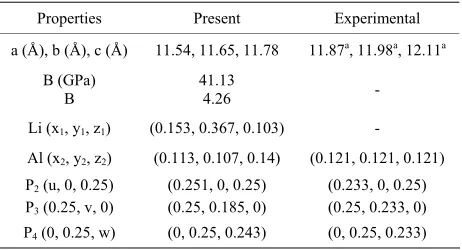
Our optimized internal parameters and lattice parame-ters are compared with experimental results in Tables 1
and 2.
[image:2.595.309.539.379.693.2]It is evident from this data that our results agree rather well with experimental work. By calculating the total energy at different volumes and fitting the results with
eters, atomic position, bulk modulus (B) and its pressure derivative (B) of Li3AlP2. Experimental
Table 1. Lattice param
results are included for comparison.
Experimental Present
Properties
11.47a, 11.61a, 11.73a
11. b
11.29, 1.55
a (Å Å)
43b, 11.93b, 12.03
11.43, 1 ), b (Å), c (
- 46.35 4.161 B (GPa) B - (0.162 10) L )
(0.121, 0.121, 0.121) (0.121, .129)
Al (x , z2)
(0.233, 0.25) , 0.37, 0.
i (x1, y1, z1
0.10, 0
2, y2
0, (0.24, 0, 0.25)
P2 (u, 0, 0.25)
(0.25, 0.233, 0) (0.25, 0.19, 0)
P3 (0.25, v, 0)
(0, 0.25, 0.233) (0, 0.25, 0.20)
P4 (0, 0.25, w) aRe
e parameters, atomic position, bulk modulus (B) and its pressure derivative (B) of Li3AlAs2.
Experimen-f [3]; bRef [4].
Table 2. Lattic
tal results are included for comparison.
Experimental Present
Properties
11.87a a 11a
11.54, 78
a (Å), b (Å), c (Å) 11.65, 11. , 11.98 , 12.
- 41.13 4.26 B (GPa) B - (0.153, 103) L )
(0.121, 0.121, 0.121) (0.233, 0.25) 0.367, 0.
i (x1, y1, z1
(0.113, 0.107, 0.14) (0.251, 0, 0.25) Al (x2, y2, z2)
P (u, 0, 0.25) 2 0,
P3 (0.25, v, 0) (0.25, 0.185, 0) (0.25, 0.233, 0)
(0, 0.25, 0.233) (0, 0.25, 0.243)
P4 (0, 0.25, w) aRe
han equation of state. We obtained the equilib-rium lattice constants, bulk modulus and their pressure
tronic Structure
es (DOS) and electronic and structure for Li AlP and Li AlAs are given in
–10 (–11) eV for Li
28) for Li3AlP2 (Li3AlAs2) is a broad
f [3].
Murnag
derivative. We show the energy—volume curve for Li3AlP2 and Li3AlAs2 structure in Figure 1 and compare
the results with available experimental results in Tables 1 and 2.
3.2. Elec
Our calculated density of stat
b 3 2 3 2
Figures 2 and 3. Due to the close similarity between the
results obtained for these compounds, the Partial Dos are given only for Li3AlP2. Major contribution to occupied
part of the DOS come from the P (As) 3s (4s) and 3p (4p) states along with Al 3s and 3p states.
The first structure in the low lying energy side of the DOS consists of a peak centered on
3AlP2 (Li3AlAs2) and originates from P (As) s states
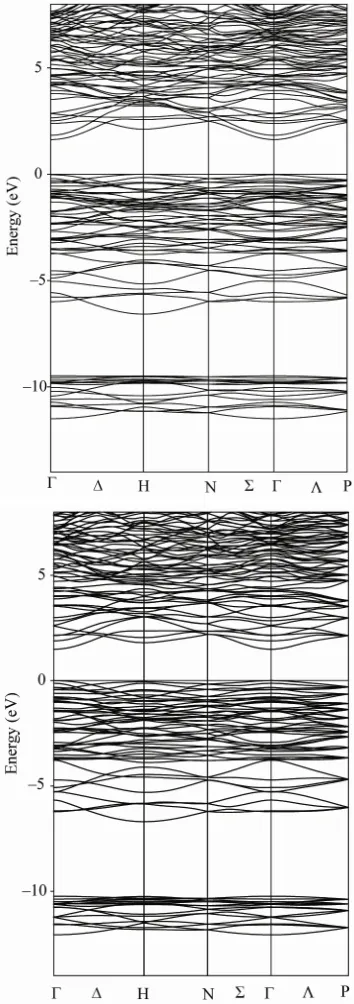
and Al s and p states, corresponding to the lowest lying bands in Figure 3.
[image:3.595.56.287.115.230.2]The next structure which is separated from the first by a gap of 2.53 eV (3.
Figure 2. Total DOS for two compounds (left) and partial density of states for Li3AlP2 (right).
.7 (–7.0) eV and the Fermi level, corresponding, to the valence bands shown
peak peak that is situated between –6
in the band structure in Figure 3. From the partial DOS,
it is seen that just below the Fermi level, the bands are dominated by the P (As) p states and Al p states.
[image:3.595.57.288.289.414.2]Figure 3. Energy band structure of Li3AlP2 (left)
Li3AlAs2 (right).
tes of Aluminium (below 5 eV) and p and s states of Lithium (above 5 eV).
mum occurring at th
lusions
P-LAPW method to study the elec-onic and structural properties of the filled tetrahedral
Hund, “Die Ternaren Nitride Li3AlN2 und Li3GaN2,” Zeitschrift für Anorganische und Allgemeine
thium,” Angewandte
and
from p and s sta
In Li3AlP2 we found an indirect band gap between the
top of phosphor valence P bands maxi
e H point and the bottom of the Al s bands occurring at the Γ point. The difference between the calculated indi-rect band gap and the diindi-rect band gap at the center of BZ is too small. The indirect band gap value is 2.36 eV
while the direct is 2.38 eV. The calculated values of the band gap for Li3AlP2 confirms the well known
expecta-tion that the theoretical band gaps are on the whole un-derestimated within GGA, in comparison with experi-mental value (2.75 eV) [4]. In Li3AlAs2 we found a
di-rect band gap (1.49 eV) at the BZ center. Unfortunately we do not have any experimental information for com-parison.
4. Conc
We have applied F tr
semiconductors Li3AlP2 and Li3AlAs2 within density
functional theory. During this study the positions of Li, Al, and P (As) have been obtained for the first time. Us-ing these positions the structural parameters such as equilibrium lattice constants, bulk modulus and their pressure derivative have been calculated. The electronic properties such as total and partial electronic DOS and band structure have been calculated. The study of density of states indicated the main contribution of DOS consists of P (As) 3p (4p) and P (As) 3s (4s) states. The nature of the fundamental gap in Li3AlAs2 was found to be direct.
According to our results, Li3AlP2 could be considered a
material with a direct gap, because the difference be-tween the direct (2.38 eV) and indirect (2.36 eV bebe-tween H and Γ points) gap is very small. The calculated value of the band gap is in good agreement with experimental value (2.75 eV). Unfortunately in Li3AlAs2 we do not
have any experimental result for comparison.
5. References
[1] R. Juza and F.
Chemie, Vol. 257, 1948, pp. 13-25.
[2] R. Juza, K. Langer and K. V. Benda, “Ternary Nitrides, Phosphides and Arsenides of Li
Chemie International Edition, Vol. 7, No. 5, 1968, pp.
360-370. doi:10.1002/anie.196803601
[3] R. Juza and W. Schulz, “Herstellung und Eigenschaften der Verbindungen Li3AlP2 und Li3AlAs2,” Zeitschrift
e Filled Tetrahedral Semiconductor of
d Tetrahedral Compounds Li3AlN2 and Li3GaN2,”
für Anorganische und Allgemeine Chemie, Vol. 269,
1952, pp. 1-12.
[4] K. Kuriyama, J. Anzawa and K. Kushida, “Growth and Band Gap of th
Li3AlP2,” Crystal Growth, Vol. 310, 2008, pp. 2298-
2300.
[5] M. Dadsetani, S. Namjoo and H. Nejati, “Optical Study of Fille
Electronic Materials, Vol. 39, No. 8, 2010, pp. 1186-
1193.
uitz, “Wien2k: An Augmented Plane Wave Plus and J. L
Local Orbitals Program for Calculating Crystal Proper-ties,” Vienna University of Technology, Vienna, 2001. [7] P. Perdew, K. Burke and M. Ernzerhof, “Generalized
Gradient Approximation Made Simple,” Physical Review Letters, Vol. 77, 1996, pp. 3865-3868.
doi:10.1103/PhysRevLett.77.3865
[8] O. Jepsen and O. K. Andersen, “Improved Tetrahedron
ubic Crystals,” Method for Brillouin-Zone Integrations,” Physical Re-view B, Vol. 49, 1994, pp. 16223-16233.
[9] F. Birch, “Finite Elastic Strain of C
Physical Review B, Vol. 71, 1947, pp. 809-824.