Worst-input Mutation Approach to Web Services Vulnerability Testing
based on SOAP Messages
Jinfu Chen1,2 +, Huanhuan Wang 1, Dave Towey 3, Chengying Mao 2,4, Rubing Huang 1,5 , Yongzhao Zhan 1 1 (School of Computer Science and Telecommunication Engineering, Jiangsu University,
Zhenjiang, 212013, China)
2(Faculty of Information and Communication Technologies, Swinburne University of Technology, Hawthorn, Victoria 3122, Australia)
3 (School of Computer Science, The University of Nottingham Ningbo China, Ningbo, 315100, China) 4 (School of Software and Communication Engineering, Jiangxi University of Finance and Economics,
Nanchang,330013, China)
5 (School of Computer Science and Technology, Huazhong University of Science and Technology, Wuhan, 430074, China)
+Corresponding email: [email protected]
Abstract—The growing popularity and application of Web services have led to an increase in attention to the vulnerability of software based on these services. Vulnerability testing examines the trustworthiness, and reduces the security risks of software systems, however such testing of Web services has become increasing challenging due to the cross-platform and heterogeneous characteristics of their deployment. This paper proposes a worst-input mutation approach for testing Web service vulnerability based on SOAP (Simple Object Access Protocol) messages. Based on characteristics of the SOAP messages, the proposed approach uses the farthest neighbor concept to guide generation of the test suite. The test case generation algorithm is presented, and a prototype Web service vulnerability testing tool described. The tool was applied to the testing of Web services on the Internet, with experimental results indicating that the proposed approach, which found more vulnerability faults than other related approaches, is both practical and effective.
Keywords-Web service vulnerability; SOAP message; Test case generation; Mutation operator; Security testing I.
I
NTRODUCTIONDue to the rapid development and wide application of the Internet, use of the service-oriented architecture (SOA) for distributed Web systems has been increasing. Although Web services are the typical form of SOA, and have been the focus of widespread attention and application, their quality and reliability problems represent significant obstacles to further development. Furthermore, due to some Web service characteristics, traditional software testing approaches are not easily applied. Some factors that contribute to the difficulty in application include: (1) different development and application environments (which increases the testing difficulty before the Web services are deployed); (2) the characteristics of Web service distribution, discovery, and dynamic bindings, as well as the uncertain and invisible processes; and (3) the need for a service interface for the Web service design and implementation when applying automatic testing methods and techniques.
To address the issue of testing Web service vulnerability, we propose an approach based on SOAP message mutation and the worst-input technique. The worst-input mutation method, which uses characteristics of SOAP messages, is presented in detail in this paper. The corresponding automatic test case generation algorithm, namely the test case generation based on the farthest neighbor (TCFN), is also discussed. The method involves partitioning the input domain into sub-domains according to the number and type of SOAP message parameters in the TCFN, and then selecting the candidate test case whose distance is farthest from all executed test cases and applying it to test the Web service. Finally, a prototype Web service vulnerability testing tool is implemented and applied to a number of real Web services, with experimental results showing that the proposed approaches are both effective and practical.
The main contributions of this paper are as follows:
We propose a set of mutation operators which can automatically mutate Web service SOAP messages based on security rules and message parameter types.
Using the farthest neighbor concept, we propose a worst-input mutation method to test Web service vulnerability, and present test case generation algorithms based on the number and type of SOAP message parameters.
We implement the proposed approach in a Web service vulnerability testing system (WSVTS) tool, which we further evaluate through comparison with other Web service testing approaches. The results show that in most cases the proposed approach can detect more faults.
The remainder of the paper is organized as follows: some related Web service testing work is discussed in Section II. The mutation operators and security rules are presented in Section III. The details of the proposed approach are presented in Section IV, with some experiments to evaluate it reported on in Section V. The future work and conclusion are given in Section VI.
II.
R
ELATEDW
ORKCurrently, research into Web service vulnerability testing remains limited, with studies focusing mainly on functionality testing [2,5,6], reliability analysis [3], data perturbation [7-9], and Web service rule mutation [10-12].
Takase & Tajima [2] proposed an approach to the functional testing of Web services by first extracting the SOAP message using the WSDL converter, and then exchanging messages using the SOAP message binding framework. A disadvantage of this approach, however, is that it only bundled some of the input parameters to obtain the return value for a single message, rather than bundling multiple interdependent functions. If the combined services could be processed on the physical machine at the same time, then the process could be more efficient. Sun et al. [5,6] have proposed a metamorphic relations-based approach to testing Web services in the context of SOA without the need for oracles. An alternative approach based on fault injection was proposed by Wu et al. [3], but the working mode of SOAP documents could not be tested; multiple mistakes could not be injected at the network layer; and the fault injection messages could not be authenticated. An approach based on data communication perturbation was proposed by Almeida & Vergilio [7], where the perturbation operators were designed according to characteristics of the SOAP message. Experiments were conducted using their proposed mutation operators and SMAT-WS [7] tools, but it was found that the designed mutation operators were not sufficient for comprehensive testing. Fuzzy approaches to generating perturbation test cases have also been studied [8, 9], but to date, an appropriately feasible test case generation algorithm has still not yet been presented.
We previously proposed a combinatorial mutation approach for testing the interactive faults of Web services [13]. The proposed approach defines the corresponding combinatorial strategies based on SOAP message mutation and combinatorial testing, allowing multiple mutants to be injected at one time to help uncover interactive faults. However, if the tested Web services have only one service method or one method parameter, then the combinatorial mutation approach cannot offer its full potential advantage. In order to test different kinds of Web services, we propose a worst-input mutation method based on the farthest neighbor concept, which, as a complementary approach to combinatorial mutation, can also enhance the effectiveness of Web service vulnerability detection.
III.
M
UTATIONO
PERATORS ANDS
ECURITYR
ULESThe appropriate design of mutation operators is critical for mutation testing based on SOAP messages, and for it to be successful, the object and the purpose of mutation should be explicitly clear. SOAP is a message protocol based on an XML document, which forms the basis of the mutation object. A formal description for the XML modeling of a SOAP message was given by Novak & Zamulin [14]. Offutt & Xu [10] extended the regular tree grammar (RTG) model to <E, N, D, P, A, ns>, but no specific parameter type
information or classification were provided for the general characteristics of the XML document. Based on these models, we have improved and extended the RTG to an eRTG (extended regular tree grammar), which is a 6-tuple <E, N, DT, P, A, ns>, where: E is a finite set of elements; N is a finite set of non-terminals; DT is
a finite set of data types defined as {int, string, bool, numerical, char, object};P is a finite set of production rules; ns is the starting non-terminal; and A is a 2-tuple <n, type> with n as the number of parameters, and
type as the parameter type, one of {rec, cir, cur}, where: rec is the rectangular input domain, cir is the circular input domain, and cur is the curved input domain. Given a set of all element instances N, a mutation operator is r = f(n1, n2, ..., ni), where f is a function, i1, each n1, n2, ..., ni∈N and has an arbitrary data type,
and r outputs the mutated n1,...,ni with the same data type as the input n1,...,ni.
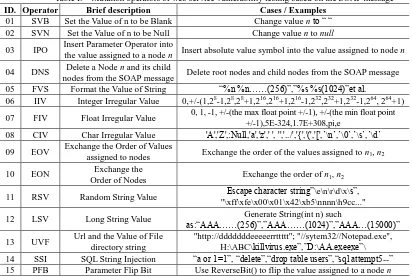
[image:3.595.73.485.439.715.2]Although a set of interference operators had been introduced previously [15, 16], the uncertainty and randomness of an initial object led to data redundancy and low efficiency after mutation. We have therefore designed a total of 15 mutation operators for SOAP parameter types combined with Web services features, as shown in Table I.
Table I. Mutation operators of web service vulnerability testing based on the SOAP message ID. Operator Brief description Cases / Examples
01 SVB Set the Value of n to be Blank Change value n to ― ― 02 SVN Set the Value of n to be Null Change value n to null
03 IPO Insert Parameter Operator into
the value assigned to a node n Insert absolute value symbol into the value assigned to node n 04 DNS Delete a Node n and its child
nodes from the SOAP message Delete root nodes and child nodes from the SOAP message 05 FVS Format the Value of String ―%n %n……(256)‖,‖%s %s(1024)‖et al.
06 IIV Integer Irregular Value 0,+/-(1,28-1,28,28+1,216,216+1,216-1,232,232+1,232-1,264, 264+1)
07 FIV Float Irregular Value 0, 1, -1, +/-(the max float point +/-1), +/-(the min float point +/-1),5E-324,1.7E+308,pi,e
08 CIV Char Irregular Value 'A','Z',:Null,'a','z',' ', '','../','{','(','[',’\n’,’\0’,’\s’,’\d’ 09 EOV Exchange the Order of Values
assigned to nodes Exchange the order of the values assigned to n1, n2 10 EON Exchange the
Order of Nodes Exchange the order of n1, n2 11 RSV Random String Value Escape character string‖\e\n\r\d\x\s‖,
"\xff\xfe\x00\x01\x42\xb5\nnnn\h9cc..." 12 LSV Long String Value Generate String(int n) such
as:―AAA……(256)‖,‖AAA……(1024)‖,‖AAA…(15000)‖ 13 UVF Url and the Value of File
directory string
"http://dddddddeeeeerrttttt"; "//sytem32//Notepad.exe", H:\ABC\killvirus.exe‖,‖D:\AA.exeexe‖\ 14 SSI SQL String Injection ―a or 1=1‖, ―delete‖,―drop table users‖,―sql attempt5--‖ 15 PFB Parameter Flip Bit Use ReverseBit() to flip the value assigned to a node n
We defined a security rule for testing the vulnerability of Web services based on the proposed mutation operators as follows: the vulnerability of Web services is Vws= G(r), where r = f(n1, n2, ..., ni) is the
ni∈N are the Web service input parameters. When the tested Web services accept the input parameters, if
any exceptions are triggered by the mutation operators, then the tested Web service is deemed to have some vulnerability flaws.
It is usual to encapsulate data in a SOAP protocol format, and a SOAP message can be expressed as two parts: input parameters and security control rules. Based on the SOAP message input parameters, a worst-input mutation approach to SOAP message mutation testing is proposed and presented in the following section.
IV.
W
ORST-
INPUTM
UTATIONA
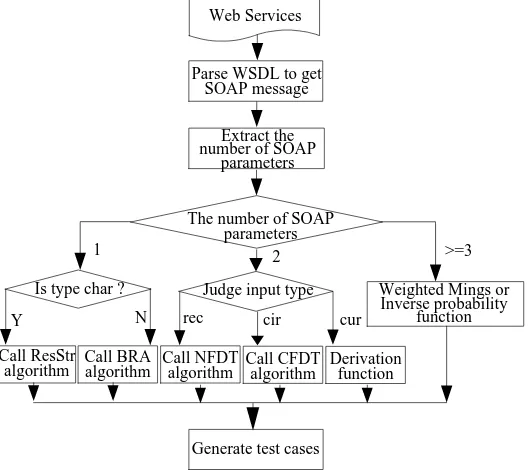
PPROACHWith regular mutation [7], the mutant can be obtained through a small modification of the legitimate input. Taking the opposite perspective, we identify the farthest neighbor sequence from the legitimate input as the test data to generate test cases according to the SOAP message types. Effective test cases should have the greatest possible test coverage, typical representation for triggering faults, and low redundancy. The farthest neighbor idea is similar to the concept of adaptive random testing (ART) [17], which is based on various empirical observations showing that many program faults result in failures manifesting in contiguous areas of the input domain. Therefore suggesting that, if previously executed test cases have not revealed a failure, new test cases should be as far away from the already executed non-failure causing test cases as possible. Intuitively speaking, the farthest test cases have higher probability of detecting Web service security exceptions. Hence, we investigate some farthest algorithms to detect the security exceptions of Web services based on related ART algorithms and mutation.
1
N
Generate test cases Y
Call ResStr algorithm
Web Services
Parse WSDL to get SOAP message
Extract the number of SOAP
parameters
>=3
Weighted Mings or Inverse probability
function 2
Is type char ? Judge input type The number of SOAP
parameters
Call BRA
algorithm Call NFDT algorithm Call CFDT algorithm Derivation function
[image:4.595.167.431.338.573.2]rec cir cur
Figure 1. Flow chart of test case generation using the farthest neighbor algorithm
Algorithm 1: TCFN
Input: the input domain D (Xmin, Ymin) (Xmax, Ymax) of the SOAP message parameter.
Output: the set of test cases S={e1,e2,...,en}.
(1) if (n==1) then
(2) { if ( DT is numerical )
(3) call BRA algorithm and related mutation operators; (4) if (DT is string) then
(5) call ResStr algorithm and related mutation operators; (6) }
(7) else
(8) if (n==2) then
(9) { divide the type of the input region according to parameter’s value; (10) if (type==rec) then
(11) call the NFDT Algorithm; (12) else
(13) if (type==cir) then (14) call the CFDT Algorithm; (15) else
(16) if (type==cur) then
(17) generate the max-value and the min-value of the same interval of the function according to input region distribution function and related mutation operators;
(18) } (19) else
(20) if ( n >=3 ) then (21) {
(22) call the inverse probability distribution or weighted Ming distance algorithms based on parameter features;
(23) }
(24) output the set of test cases S={e1,e2,...,en}.
The input region is divided into subregions based on the number and type of message parameters, and then the appropriate algorithm is selected to generate test cases to test the Web service. The main sub-algorithms of the TCFN algorithm are as follows:
(1) BRA Algorithm
When the input parameter data type is Integer (int), the BRA algorithm and related mutation operators are used to generate the farthest test cases. The BRA algorithm flips all bits (from 0 to 1, and 1 to 0).
(2) ResStr Algorithm
The ResStr algorithm calculates the length of the string, reverses it, and uses the CIV mutation operator to increase or decrease the length of the reversed string. The Web service SOAP message can be mutated using the reversed string, after which the response information of the client is examined to determine the vulnerability.
(3) NFDT Algorithm
The NFDT algorithm is based on the adaptive random testing (ART) family of algorithms [19]. The test cases are divided into sets E (Executed) and C (Candidate), both of which are initially empty, but as testing progresses, E contains n executed test cases {el, e2, e3,...,en}, and C contains k random candidate test cases
{cl, c2, c3,...,ck}. ART research suggests that changes in the Candidate set size have little impact on the
speed of detecting the first failure when k≥10, so as with previous studies, we set k to 10 in this experiment [19]. At the start of testing, when E is empty, a test case e is generated randomly, executed, and then appended to E. The next test case, cj, can be selected from C by calculating the distance between each
element of C, and the executed test case e, and then selecting that element (cj) which has the greatest
distance. The NFDT algorithm is shown in Algorithm 2.
Algorithm 2: NFDT
Input: the input domain D (Xmin,Ymin)(Xmax,Ymax) of the SOAP message parameter.
(1) input the region D of soap message {(Xmin, Ymin) (Xmax, Ymax)} (2) set E={}, C={}.
(3) randomly generate the first test case e(x, y) by using related mutation strategies and operators, and divide D into T and L by e’ x-value.
(4) select T{(i, j),(s,t)}from D,(eT),DD-T;
(5) while (D != NULL) do
(6) { if(T!=L)
(7) { if ( (x-i)≥(s-x))
(8) the next test case is generated from T{(i, j),(x, t)}, then D=D∪{(i,j),(x,t)}; (9) else
(10) the next test case is generated from L{(x, j),(s, t)},then D=D∪{(x,j),(s,t)}; (11) }
(12) else
(13) select a field T or L randomly;
(14) select a big field Tˊ∈D, and randomly generate k test cases {c1,c2,....,ck} by using related mutation strategies and operators, C=C∪{c1,c2,...,ck}.
(15) sort the set of x value from small to large;
(16) find a test case e∈E, find Cjby using improved binary search method , whose x-axis is nearer to e (17) calculate the distance d x2 y2;
(18) calculate all the distancesxibetween e and all the test cases behind Cj; (19) for each Ci from Cj to Ckdo
(20) { if (dxi) (21) d=dnew (22) else
(23) stop calculating according to d x x2 y2 ; (24) }
(25) for each Cifrom C1 to Cjdo (26) { if (d xi)
(27) d=dnew (28) else
(29) stop calculating according to d x x2 y2 ; (30) }
(31) search the max value d corresponding test case Cjas the next test case, Cj→e and E=E∪e, the two fields divided by Cj are joined in D;
(32) DD-T ; (33) }
(34) return the set of test cases S={e1,e2,...,en}.
The original binary search algorithm [20] is improved in step 13 to increase the search efficiency and to verify its effectiveness. Since the input region is finite set, as the number of test cases grows, so too does their density in the corresponding input region – the distance between a new test case and the nearest executed test case becomes much smaller. The candidate test cases can be considered when the distance between test cases (d ) is relatively large. A ratio parameter is then defined on the basis of the binary search algorithm as follows: an array [N] is an ordered integer array whose values range from small to large, and the sub-array from array [L] to array [H] is one sub-array of the ordered array, and the element array [mid] is the value which is the nearest to target value x. The mid is then selected. Hence, the ratio parameter formula is R=(x-array[L])/(array[H]-array[L]), then the formula (x-array[L])/(array[H]-array[L])=(mid-L)/(H-L) can be deduced, and mid can be obtained using mid=L+R*(H-L).
(4) CFDT Algorithm
The CFDT algorithm uses the restricted adaptive random testing technique [22] to select the next test case, using an exclusion region radius. Generally speaking, the selected test cases have better detection capability for finding the security exceptions of Web services than general test cases. There are two reasons for this. Firstly, the selected test cases are always away from previously executed test cases that have been generated outside the exclusion region: more distant test cases can more easily find security exceptions than normal test cases [16]. Secondly, the selected test cases have been mutated based on mutation operators designed to detect special security exceptions.
Two parameters, A and P, are defined to measure the SOAP input domain, when it is a circle or an ellipse. A and P represent the area and perimeter of an ellipse, A=πab, P(3(ab) / 2 ab), respectively
[23,24] (a and b are the radii of the ellipse; when a = b, the ellipse is a circle). S is the set of test cases to be tested; C is the set of test cases randomly generated; and N is the number of test cases in S. The first test case is randomly generated, and the subsequent ones are generated using an iterative approach [22]. A parameter R = A / (2n ) is used to determine the size of the exclusion region. Each test case in S is set as
the center of a region, with R as the radius of the circular exclusion region. The first generated test case not falling in an excluded region is then selected as the next test case. An adjustment parameter r is introduced to compensate for the effects of overlapping zones and portions of zones lying outside the input domain. R is set as Ar/ (2n). The CFDT algorithm is shown in Algorithm 3.
Algorithm 3: CFDT
Input: the circle center e1(x, y) and radius R of SOAP message input region
Output: the set of test cases S= {e1,e2,...,en}
(1) set S={},C={}, n=0, r=1;
(2) randomly generate e1by using related mutation strategies and operators and S=S∪e1;
(3) while ( R !=0 ) do
(4) { find an exclusion circle (ei (i=1,2,3....), R A/ (2n)), randomly generate k test cases {c1, c2, …., ck} and then {c1, c2, ..., ck}(ei, R A/ (2n)) C=C∪{c1,c2,...,ck};
(5) sort the k test cases according to x-value from small to large, calculate all distances di, and then find the test case ei whose distance is the largest and S=S∪ei, n=n+1;
(6) set r to adjust the exclusion region; (7) }
(8) return the set of test cases S={e1, e2,..., en}.
(5) Weighted Ming distance
If the number of SOAP parameters (n) is three or more, then the inputs are regarded as the n-tuple data set (T), with each t=(x1, x2, …, xn), t∈T being a single input from T. When a test case (e) is generated
randomly, a new coordinate system is defined based on it, with each previously executed point (test case) translated appropriately. Without loss of generality, the following explanation of this method is in 2D, but the method applies to higher dimensions: Lines L1 and L2 are perpendicular axes through the point e,
dividing the area that includes all points within the neighborhood of e into four sub-areas M, N, S and O. The four sub-areas are marked as the neighborhood areas of point e. Lines L1 and L2 are also seen as the
boundaries between the four areas, with the corners formed by the lines being called neighborhood angles. Across from each neighborhood angle a diagonal is formed, enclosing the neighborhood area. Any points in the neighborhood area should be filtered using related algorithms [18]. Based on the neighborhood areas and some rules [18][25], the weighted Ming distance (WD) between a point t and e is defined as
n n
2 1/2
i i i i
i=1 i=1
WD=(
|x -y | w ) /
w , where wi represents the corresponding weight for every input parameter todefine the contribution of different parameter. The formula can measure the distance between different inputs. Given a current test case (e), the Furthest Neighbor (FN) formula is used to select the next test case, and is defined as FN e( ) {r T| t T WD e r: ( , )WD t r( , )}. The formula guarantees that the distance between the current and next test case is always greater than or equal to the distance between the next test case and any test case of T.
(6) Inverse probability distribution
unconventional test cases to detect security exceptions. Generally speaking, unconventional inputs can effectively trigger the security exceptions for Web services. The input distribution function is usually a probability density function, whose output ranges from 0 to 1, where 0 means that it is impossible to select inputs from the input domain, and 1 means that the inputs from the input domain are 100% available. The main steps needed to get the inverse probability distribution function are as follows [26].
Step 1: Describe the probability of each input (an ordered n-tuple) as a value in the n+1th dimension; Step 2: Determine the hyper-plane which is defined by setting the n+1 dimension value to a constant, 1/K, where K is the cardinality of the input space;
Step 3: Reflect the input distribution through this hyper plane;
Step 4: If any of the resulting values in the n+1th dimension are negative, translate the graph by a vector of magnitude C, so that all the values in the n+1 dimension are non-negative;
Step 5: Normalize the resulting graph in n+1 space, dividing each value by the total volume. At the end of this step, the value in n+1 space associated with each n-tuple is the probability of selection in the inverse probability distribution function.
The SOAP message is obtained by parsing the WSDL file of the Web services being tested, and is then transformed into a DOM tree. Based on the number and type of SOAP parameters, the appropriate TCFN algorithm is called to generate test cases. The complexity of the TCFN algorithm is mainly determined by the BRA algorithm, ResStr, NFDT, CFDT, weighted Ming distance and inverse probability distribution algorithms. In the BRA algorithm, flipping all bits (from 0 to 1, and 1 to 0) is time consuming. If the bit length of the integer is n, then the complexity of BRA algorithm is O(n). In the ResStr algorithm, traversing the entire string is time consuming. If the length of the string is n, then the complexity of ResStr algorithm is O(n). In the NFDT algorithm, a set of test case candidates randomly generated in the input domain is maintained. Each time a new test case is required, the candidate test case that is farthest from all previously executed test cases is selected. The runtime of the NFDT algorithm when generating n test cases is in the order of O(n2). The main time cost of the CFDT algorithm is the large number of distance calculations which are performed when new test cases are selected. The runtime of the CFDT algorithm when generating n test cases is in the order of O(n2·logn). The time complexity of both weighted Ming distance algorithm and inverse probability distribution algorithm is respectively O(n2). The total time complexity of the TCFN algorithm is therefore O(n)+O(n)+O(n2)+O(n2)+O(n2)+O(n2·logn) = O(n2·logn).
V.
E
XPERIMENT ANDA
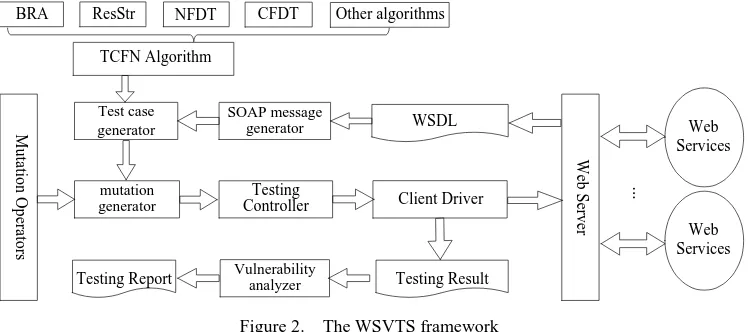
NALYSIS A. Experimental implementationTo investigate and evaluate the proposed TCFN algorithm, a Web service vulnerability testing system (WSVTS) was implemented. The WSVTS framework is shown in Figure 2. WSVTS obtains the interface information by parsing the uniform resource locator (URL) of the Web service, and gets the SOAP message by parsing the WSDL document.
Test case generator SOAP message generator mutation generator Testing Controller Testing Result Testing Report Vulnerability analyzer
Web Services Web Services W eb S er v er WSDL Client Driver
BRA ResStr NFDT CFDT
[image:8.595.113.487.527.693.2]TCFN Algorithm M u ta tio n O p er at o rs Other algorithms ...
Figure 2. The WSVTS framework
1)SOAP message generator
The input to the SOAP message generator is a WSDL file of the Web service being tested, and consists of the response message data type, the transmission protocol and the Web service address information. The output is a Web service SOAP message.
2) SOAP message mutation generator
Based on mutation operators designed for different fault types, the mutation module mutates the SOAP message parameter type and value. The parameter type and number are obtained from the SOAP message generator, and the test cases are obtained from the test case generator.
3)Test case generator
The test case generator provides a convenient interface for the tester to input test cases, and can also use different algorithms based on the SOAP message parameter number, as analyzed by the SOAP message generator.
4) Vulnerability analyzer
The vulnerability analyzer generates a vulnerability report after testing the Web services. It analyzes the Web service vulnerability based on the security specifications, and reports the number of security exceptions and faults found.
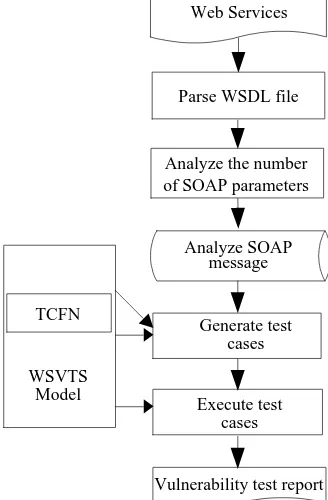
As can be seen in the WSVTS flow chart (Figure 3), the SOAP message is obtained by parsing the WSDL file of the Web services being tested. Then, using an XML analysis technique, the number and type of SOAP message parameters are extracted, based on which, the appropriate TCFN algorithm is called to generate test cases. The Web services are tested based on the testing controller and client driver, using the generated test cases. Finally, the vulnerability testing report is obtained based on observations of the response messages received from the client of the Web services being tested.
Vulnerability test report Analyze SOAP
message
Generate test cases
Execute test cases Web Services
Analyze the number of SOAP parameters Parse WSDL file
[image:9.595.218.382.402.652.2]WSVTS Model TCFN
Figure 3. Flow chart of the Web service vulnerability testing system
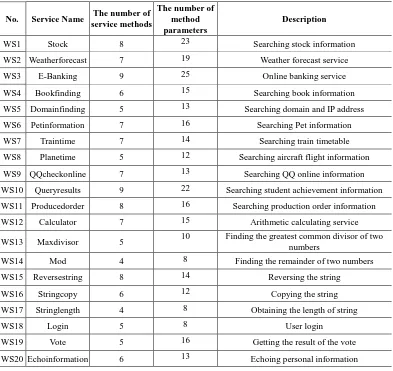
In the experiments, in addition to several open Web services, some specifically written services were also analyzed. The list of tested Web services is shown in Table II.
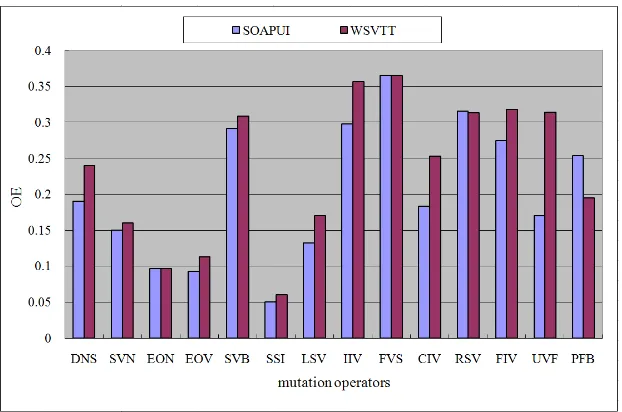
generated by the same perturbation operator was also only counted once. The operator efficiency (OE) defines the efficiency of an operator in terms of finding faults, and is calculated as OE=EF/TC, where EF is the number of faults found and TC is the total number of test cases generated by the operators. The efficiency of the mutation operators is shown in Figure 4. Different mutation operators have different efficiency, with the FVS operator having the highest (36.52%).
B. Experimental results and analysis
Web service vulnerabilities were found by the proposed approaches. Although the proposed mutation operators are applicable to related approaches, the test case generation rules may differ. Also, the continuous types of test case generation are more complex than the discrete types, and test cases for the continuous types can be adapted to the discrete types but not vice versa. We next compare our proposed approach with two others, SOAPUI [27] and SMAT-WS [7].
1) Comparison of WSVTS and SOAPUI
[image:10.595.74.467.358.729.2]A total of 20 kinds of specially designed Web services were investigated using the two approaches based on the SOAP message parameter type. The SOAPUI [27] is an open source Web service testing tool, and WSVTS is a testing tool based on the approach proposed in this paper. Table III shows the experimental results for the open source tool SOAPUI, in which the test cases are manually entered according to the SOAP message parameter type; and Table IV shows the results for WSVTS. Based on these results, the overall efficiency (OE) of the mutation operators generated by the two approaches are calculated to be approximately 21.1% and 23.7%, respectively, confirming the feasibility of our proposed approach, and the validity of the test cases generated.
Table II. The tested Web services
No. Service Name The number of service methods
The number of method parameters
Description
WS1 Stock 8 23 Searching stock information
WS2 Weatherforecast 7 19 Weather forecast service
WS3 E-Banking 9 25 Online banking service
WS4 Bookfinding 6 15 Searching book information
WS5 Domainfinding 5 13 Searching domain and IP address
WS6 Petinformation 7 16 Searching Pet information
WS7 Traintime 7 14 Searching train timetable
WS8 Planetime 5 12 Searching aircraft flight information WS9 QQcheckonline 7 13 Searching QQ online information WS10 Queryresults 9 22 Searching student achievement information WS11 Producedorder 8 16 Searching production order information WS12 Calculator 7 15 Arithmetic calculating service WS13 Maxdivisor 5 10 Finding the greatest common divisor of two
numbers
WS14 Mod 4 8 Finding the remainder of two numbers
WS15 Reversestring 8 14 Reversing the string
WS16 Stringcopy 6 12 Copying the string
WS17 Stringlength 4 8 Obtaining the length of string
WS18 Login 5 8 User login
WS19 Vote 5 16 Getting the result of the vote
Figure 4. Efficiency of the mutation operators
Table III. Test results of the SOAPUI tool Mutation
operators DNS SVN EON EOV SVB SSI LSV IIV FVS CIV RSV FIV UVF PFB Total OE Number of test
cases generated 42 124 113 97 130 40 211 151 115 197 98 102 41 118 1579 21.1% Faults found 8 19 11 9 38 2 28 45 42 36 31 28 7 30 334
Table IV. Test results of WSVTS tool Mutation
operators DNS SVN EON EOV SVB SSI LSV IIV FVS CIV RSV FIV UVF PFB Total OE Number of test
[image:11.595.143.454.523.729.2]cases generated 42 118 113 97 123 33 164 126 115 150 99 88 35 118 1421 23.7% Faults found 10 19 11 11 38 2 28 45 42 38 31 28 11 23 337 Figure 5 gives a comparison of the efficiency of the two approaches, showing that for most operators, the number of faults found by the WSVTS approach is higher than that found by the SOAPUI tool (exceptions being the EON, FVS, RSV, and PFB operators). The UVF operator appears particularly efficient. The faults found consist of some common vulnerability faults such as memory leak, buffer overflow, cross-boundary access, and arithmetic security faults including dividing by zero and out-of-range operand values. Thus, the designed operators and our approach are confirmed to be very effective.
2) Comparison of SMAT-WS, WSVTS, and SOAPUI
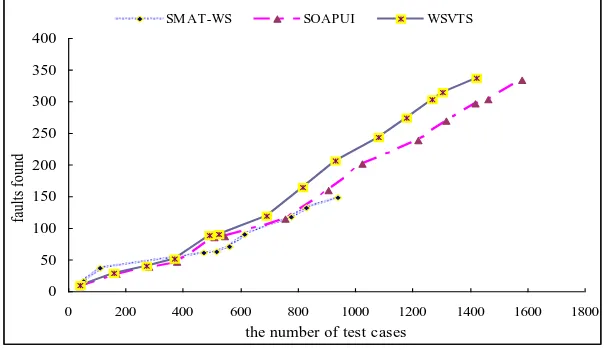
[image:12.595.146.450.262.437.2]Research on SOAP message mutation testing is still not common. The experimental results of SOAP message perturbation reported by Almeida & Vergilio [7] is reproduced here in Table V. Their proposed mutation operators are different from ours because of the different Web services, therefore we compare the approaches based on the overall efficiency of the mutation operators: the overall effectiveness of the test cases generated by the SMAT-WS testing tool is 15.7%. A comparison of all three methods is shown in Figure 6.
Table V. SMAT-WS test results [7]
Mutation operators I N BE IN VI S B U ML Total OE Number of test cases
generated 54 54 363 43 45 54 162 54 108 937 15.7% Faults found 16 21 24 2 8 19 27 16 15 148
Mutation Operators: Incomplete (I), Null (N), Boundary Extension (BE), Inversion (IN), Value Inversion (VI), Space(S), Unauthorized (U), Mod_Len(ML), Boundary(B)
0 50 100 150 200 250 300 350 400
0 200 400 600 800 1000 1200 1400 1600 1800
the number of test cases
fa
ul
ts
f
oun
d
SM AT-WS SOAPUI WSVTS
Figure 6. Comparison of the SMAT-WS, SOAPUI, and WSVTS tools
The experimental results in Figure 6 show that SMAT-WS finds more faults at the earlier stage of testing, but that the rate of faults found by WSVTS increases fastest, supporting the validity of this approach. The fault-finding abilities of the SMAT-WS and SOAPUI approaches are similar within a certain range. Although the three approaches (SMAT-WS, SOAPUI and WSVTS) are all based on SOAP message mutation, the corresponding proposed mutation operators are different because the Web services tested with SMAT-WS are different from those tested by SOAPUI and WSVTS. In general, the number of test cases generated is different because of the different mutation operators applied to different situations as well as the number of faults.
Compared with the other methods, the advantages of the WSVTS tool include that the mutation operators expand according to the characteristics of the SOAP message in the experiment – in other words, the testing is more comprehensive; and the algorithm is automatically called to generate test cases according to the number of parameters and the SOAP message type. The targeted faults consist of buffer overflow faults, cross-boundary access faults and arithmetic security faults.
VI.
C
ONCLUSIONSResearch on Web service vulnerability testing remains limited, partly due to their cross-platform and differing characteristics. In this paper we have presented mutation operators designed for SOAP messages, and a mutation testing algorithm for the automated generation of test cases.
automatically, using legal and illegal input parameters and mutation operators. The effectiveness of the proposed approach has been shown to be higher than that of other available approaches. The efficiency of the proposed mutation operators is higher than other approaches such as SMAT-WS. In addition, the approach can detect more vulnerability faults than other approaches with the same test cases.
In the future, we would like to continue research in the following areas: firstly, we will do more experiments to verify the reliability of the proposed approaches. Secondly, we will research how to further reduce the redundant test cases after mutating. Thirdly, the automatic process of test case generation and mutation also need to be further improved to enhance the testing efficiency.
ACKNOWLEDGMENTS
We would like to thank T. Y. Chen for his insightful discussion and suggestions. This work is partly supported by the National Natural Science Foundation of China (NSFC) under Grant No. 61202110 and Natural Science Foundation of Jiangsu Province under Grant No. BK2012284.
REFERENCES
[1] S. Hanna, M. Munro, An approach for wsdl-based automated robustness testing of web services. The 16th International Conference on Information Systems Development (ICISD’2009), Springer, 2009, pp.1093-1104.
[2] T. Takase, K. Tajima, Efficient Web Service Message Exchange by SOAP Bounding Framework. The 11th IEEE International Enterprise Distributed Object Computing (EDOC’2007), IEEE Computer Society, 2007, pp.63-72. [3] L.Wu, X.K. Li, H. Wang. Research on the Reliability Testing of Web Service Based on Fault Injection Technology.
Journal of Chinese Computer System, 2007, 28(1):127-131. (in Chinese)
[4] M. Palacios, J. Garcia-Fanjul, J. Tuya, Testing in service oriented architectures with dynamic binding: a mapping study. Information and Software Technology, 2011, 53(3): 171–189.
[5] C.A. Sun, G. Wang, B.H. Mu, H. Liu, Z.S. Wang, T. Y. Chen, A Metamorphic Relation-Based Approach to Testing Web Services Without Oracles. International Journal of Web Services Research, 2012, 9(1): 51-73.
[6] C.A. Sun, G. Wang, B.H. Mu, H. Liu, Z.S. Wang, T. Y. Chen, Metamorphic testing for web services: framework and a case study. The IEEE International Conference on Web Services (ICWS’2011), IEEE Computer Society, 2011, pp. 283-290.
[7] L.F. de Almeida, S.R. Vergilio, Exploring Perturbation Based Testing for Web Services. The IEEE International Conference on Web Services (ICWS’2006), IEEE Computer Society, 2006, pp.717-726.
[8] H. C. Kim, Y. H. Choi, D. H. Lee, Efficient File Fuzz Testing Using Automated Analysis of Binary File Format. Journal of Systems Architecture, 2011, 57(3):259-268.
[9] S. Bekrar, C. Bekrar, R. Groz, L. Mounier, Finding Software Vulnerabilities by Smart Fuzzing. Proceeding of the Fourth IEEE International Conference on Software Testing, Verification and Validation (STVV’2011), IEEE Computer Society, 2011, pp. 427-430.
[10] J. Offutt, W. Xu, Generating Test Cases for Web Services Using Data Perturbation. ACM SIGSOFT Software Engineering Notes, 2004, 29(5):1-10.
[11] A. C.V. de Melo, P. Silveira, Improving data perturbation testing techniques for Web Services. Information Science, 2011,181 (03):600-619.
[12] P. Silveira, A. C. V. de Melo, Exploring XML Perturbation Techniques for Web Services Testing. International Conference on Web Engineering (ICWE’2009), Spinger LNCS, 2009, v. [5648]:355-369.
[13] J.F. Chen, Q. Li, C.Y. Mao, D. Towey, Y.Z. Zhan, H.H. Wang: A Web services vulnerability testing approach based on combinatorial mutation and SOAP message mutation. Service Oriented Computing and Applications, 2014, 8(1):1-13. [14] L. Novak, A. Zamulin, A formal model for XML schema. Proceedings of the 21st International Conference on Data
Engineering Workshops (ICDEW’2005), IEEE Computer Society, 2005, pp.1283-1293.
[15] W. Xu, J. Offutt, J. Luo, Testing Web Services by XML Perturbation. Proceedings of the 16th IEEE International Symposium on Software Reliability Engineering (ISSRE’2005), IEEE Computer Society, 2005, pp.257-266.
[16] J.F. Chen, Y.S. Lu, X.D. Xie, Component Security Testing Approach by Using Interface Fault Injection. Journal of Chinese Computer System, 2010, 31(6):1090-1096. (in Chinese)
[18] C. Böhm, S. Berchtold, and D. A. Keim, Searching in high-dimensional spaces: Index structures for improving the performance of multimedia databases. ACM Computing Surveys, 2001, 33(3): 322-373.
[19] T. Y. Chen, F.-C. Kuo, R. G. Merkel and T. H. Tse, Adaptive Random Testing: the ART of Test Case Diversity. Journal of Systems and Software, 2010, 83(1):60-66.
[20] M. H. Alsuwaiyel, Algorithms: Design Techniques and Analysis. Publisher: World Scientific Pub Co Inc, November 1998.
[21] K. P. Chan, T. Y. Chen, and D. Towey, Adaptive Random Testing with Filtering: An Overhead Reduction Technique. The 17th International Conference on Software Engineering and Knowledge Engineering (SEKE'05), Taipei, Taiwan, China, IEEE Computer Society, 2005, pp. 292-299.
[22] K. P. Chan, T. Y. Chen and D. Towey, Restricted Random Testing: Adaptive Random Testing by Exclusion. International Journal of Software Engineering and Knowledge Engineering, 2006, 16(4):553-584.
[23] T.Y. Chen, F.-C. Kuo, C.A. Sun, Impact of the Compactness of Failure Regions on the Performance of Adaptive Random Testing. Journal of Software, 2006, 17(12):2438-2449.
[24] I.N. Bronshtein, K.A. Semendyayev, G. Musiol and H.Mühlig, Handbook of Mathematics. Publisher: Springer, 5th edition, October 2007.
[25] B.H. Li, Z.X. Hao. Efficient Filtration and Query Algorithm of Reverse Furthest Neighbor. Journal of Chinese Computer Systems, 2009, 30 (10): 1948-1951. (in Chinese)
[26] J. M. Voas, K. W. Miller, Predicting software's minimum-time-to-hazard and mean-time-to-hazard for rare input events. The Sixth International Symposium on Software Reliability Engineering (ISSRE’1995), IEEE Computer Society, 1995, pp.229-238.