REVIEW
Distance software: design and analysis of distance
sampling surveys for estimating population size
Len Thomas*
,1, Stephen T. Buckland
2, Eric A. Rexstad
1, Jeff L. Laake
3,
Samantha Strindberg
4, Sharon L. Hedley
2, Jon R.B. Bishop
1, Tiago A. Marques
1and Kenneth P. Burnham
51
Research Unit for Wildlife Population Assessment, Centre for Research into Ecological and Environmental Modelling, University of St. Andrews, St. Andrews KY16 9LZ, UK;2Centre for Research into Ecological and Environmental Modelling, University of St. Andrews, St. Andrews KY16 9LZ, UK;3National Marine Mammal Laboratory, Alaska Fisheries Science Center, National Marine Fisheries Service, 7600 Sand Point Way NE F⁄AKC3, Seattle, WA 98115 6349, USA;4Wildlife Conservation Society, 2300 Southern Boulevard, Bronx, NY 10460, USA; and5Colorado Cooperative Fish and Wildlife Research Unit, Department of Fish, Wildlife and Conservation Biology, Colorado State University, Fort Collins, CO 80523, USA
Summary
1. Distance sampling is a widely used technique for estimating the size or density of biological populations. Many distance sampling designs and most analyses use the software Distance.
2. We briefly review distance sampling and its assumptions, outline the history, structure and capabilities of Distance, and provide hints on its use.
3. Good survey design is a crucial prerequisite for obtaining reliable results. Distance has a survey design engine, with a built-in geographic information system, that allows properties of different pro-posed designs to be examined via simulation, and survey plans to be generated.
4. A first step in analysis of distance sampling data is modelling the probability of detection. Distance contains three increasingly sophisticated analysis engines for this: conventional distance sampling, which models detection probability as a function of distance from the transect and assumes all objects at zero distance are detected; multiple-covariate distance sampling, which allows covariates in addition to distance; and mark–recapture distance sampling, which relaxes the assumption of certain detection at zero distance.
5. All three engines allow estimation of density or abundance, stratified if required, with associated measures of precision calculated either analytically or via the bootstrap.
6. Advanced analysis topics covered include the use of multipliers to allow analysis of indirect surveys (such as dung or nest surveys), the density surface modelling analysis engine for spatial and habitat modelling, and information about accessing the analysis engines directly from other software.
7. Synthesis and applications. Distance sampling is a key method for producing abundance and density estimates in challenging field conditions. The theory underlying the methods continues to expand to cope with realistic estimation situations. In step with theoretical developments, state-of-the-art software that implements these methods is described that makes the methods accessible to practising ecologists.
Key-words: distance sampling, line transect sampling, point transect sampling, population abundance, population density, sighting surveys, survey design, wildlife surveys
Introduction
Distance sampling comprises a set of methods in which distances from a line or point to detections are recorded, from which the density and⁄or abundance of objects is
*Correspondence author. E-mail: [email protected]
estimated. Objects are usually animals or animal groups (termed clusters), but may be plants or inanimate objects. Detections are usually of animals or clusters, but may be of cues (such as whale blows or bird songbursts) or sign (such as dung or nests). Conventional distance sampling (CDS) methods are described by Buckland et al. (2001), and various extensions are considered in Buckland et al. (2004). An extensive distance sampling reference list, covering both methodological developments and practical application of the methods, is available at http://www.ruwpa.st-and. ac.uk/distancesamplingreferences/.
Most distance sampling surveys are analysed, and many are designed, using the software Distance (http://www.ruwpa. st-and.ac.uk/distance/). In this paper, we describe version 6 of the software and its capabilities, and give guidance on how to use it to design and analyse surveys.
What is distance sampling?
T Y P E S O F D I S T A N C E S A M P L I N G
The most widely used form of distance sampling is line transect sampling. A survey region is sampled by placing a number of lines at random in the region or, more commonly, a series of systematically spaced parallel lines with a random start point. An observer travels along each line, recording any animals detected within a distance w of the line. In the standard method, we assume all animals on the line are detected, but detection probability decreases with increasing distance from the line. Hence, not all animals in the strip of half-widthwneed to be detected. In addition, the distance of each detected ani-mal from the line is recorded. We use the distribution of these distances to estimate the proportion of animals in the strip that is detected, which allows us to estimate animal density and abundance. If animals occur in well-defined clusters (e.g. flocks or herds), then detections refer to clusters rather than to indi-vidual animals.
A second common form, particularly for surveys of breeding songbirds, is point transect sampling, where the design is based on randomly placed points rather than lines.
Several other variations exist. In indirect surveys, animal signs are surveyed by one of the above methods, and sign den-sity is converted to animal denden-sity using estimates of sign pro-duction and decay rates (Marqueset al.2001). In cue count surveys (nearly) instantaneous cues are surveyed, e.g. whale blows (Hiby 1985) or bird songbursts (Buckland 2006), and the resulting estimate of number of cues per unit time per unit area is converted to estimated animal density using an estimate of the cue rate per animal. In trapping webs or trapping line transects (Lukacs, Franklin & Anderson 2004), a network of traps is placed around the point or line, and if an animal enters a trap, its recorded distance is the distance of that trap from the point or line. In trapping or lure point transect sampling, a single trap or lure is placed at each point of the design, and the probability of detecting a given animal is estimated by con-ducting separate trials on animals with known location (Buck-landet al.2006).
A S S U M P T I O N S
We briefly summarize the key assumptions of the basic method (for a more detailed discussion, see Bucklandet al.2001:29– 37). Many of the recent advances of distance sampling allow one or more of these assumptions to be relaxed. There are just three key assumptions.
1. Objects on the line or point are detected with cer-tainty. Most surveys are conducted with a single observer, or a single observation ‘platform’ consisting of multiple observers but with data pooled across them. In cases where it is impor-tant to relax assumption 1, double-observer or double-plat-form surveys may be conducted (Laake & Borchers 2004). In these, observers either search independently of each other or there may be ‘one-way’ independence, with one observer being unaware of detections made by the other, but not vice versa. Such methods are quite often used for marine mammal sur-veys. The mark–recapture distance sampling (MRDS) engine of Distance can be used to analyse such double-observer data.
2. Objects do not move. Conceptually, distance sampling is a ‘snapshot’ method: we would like to freeze animals in position while we conduct the survey. In practice, non-responsive movement in line transect surveys is not problematic provided it is slow relative to the speed of the observer. Non-responsive movement is more problematic for point transect surveys, leading to overestimation of density (Buckland et al. 2001:173). Responsive movement before detection is problem-atic because animals are assumed to be located independently of the position of the line or point (see below); implications are addressed by Fewsteret al.(2008).
3. Measurements are exact. Untrained observers tend to be poor at estimating distances by eye or ear (Alldredge, Simons & Pollock 2007). Wherever possible, training and technology (e.g. laser rangefinders) should be used to ensure adequate accuracy. Provided distance measurements are approximately unbiased, bias in line transect estimates tends to be small in the presence of measurement errors, but larger for estimates from point transect surveys (Bucklandet al.2001:264–265). In some line transect surveys, particularly shipboard surveys, direct ani-mal-observer distanceris recorded together with sighting angle
h from the transect line and perpendicular distance is then calculated as rsinh. In this case, it is important to obtain accurate angles, particularly for small angles, and an angle board can be used to help achieve this. In addition to exact distances, if animals occur in clusters, we assume cluster sizes are accurately recorded, at least for those close to the line or point. We also assume species are not misidentified.
also assume detections are independent events, but our analysis methods are very robust to failures of this assumption (except in the case of double-platform designs, where independence between duplicate detections of the same animal at zero dis-tance is required).
D E S I G N - B A S E D A N D M O D E L - B A S E D E S T I M A T I O N
In the case of strip transect sampling, where all animals within the strip of half-widthware assumed to be detected, estimation of abundance within the survey region can be achieved using an entirely design-based framework. To do this successfully, it is critical to place the strips at random throughout the survey region, to ensure that we count representative strips. We can then assume the density in the strips is an unbiased estimate of density in the wider survey region; no model is needed. Standard distance sampling also uses design-based inference to extrapo-late from the sampled plots (strips for line transect sampling or circles for point transect sampling) to the survey region. However, we do not know the true number of animals in the plots. We therefore fit a detection model, which allows us to estimate this number. Standard distance sampling is thus a hybrid, blending model-based (within the plots) and design-based (extrapolation from the plots) inference (Fewster & Buckland 2004). We could adopt a fully model-based approach. The simplest would be to assume that animals are uniformly and independently distributed throughout the survey region. This leads to the same abundance estimate as for the hybrid approach, but estimates of precision would change. This strat-egy is not usually adopted because the estimates of precision are not robust to the failure of the model assumptions made about the spatial distribution of animals. However, there is increasing interest in modelling how animal density varies spatially, and fully model-based approaches that make more reasonable assumptions are an active area of research (e.g. Hedley & Buckland 2004; Johnson, Laake & VerHoef 2009). It is possible to fit relatively simple spatial models in Distance 6 (see below).
Historical development
The Distance software evolved from two earlier software developments. The first was the program TRANSECT (Laake, Burnham & Anderson 1979) for fitting Fourier series and other models to line transect distance data. The methods on which the software was based were developed in a series of publications, culminating in the first monograph on distance sampling (Burnham, Anderson & Laake 1980). The second development was of an algorithm for maximum likelihood fit-ting of models to line or point transect distance data, based on a parametric key function multiplied by series adjustments (Buckland 1992). Code implementing this algorithm was merged with TRANSECT to create Distance (Laake et al. 1993), which provided analysis of line and point transect data. The methods were comprehensively documented in a second monograph (Bucklandet al.1993). Distance versions 1.0–2.2 were DOS-based applications that were controlled using a command language to invoke various program options
appropriate for the sampling used, and analysis options desired. Version 3.0 was a Microsoft Windows console appli-cation, but retained the command language structure.
With funds from British research funding councils, a pro-gramming team developed a version of Distance with fully integrated, Windows-based graphical user interface. This ver-sion, Distance 3.5, became generally available in 1998. Subse-quent versions saw the addition of more features: Distance 4 (in 2002) the multiple-covariate distance sampling (MCDS) and automated survey design engines, Distance 5 (in 2005) the MRDS engine and Distance 6 (in 2009) the density surface modelling (DSM) engine. The basic methods in Distance 6 are described in a third monograph (Bucklandet al.2001), which is essentially an updated version of the second one; the more advanced methods are described in an edited volume (Buck-landet al.2004), and in additional references given below.
Users downloading Distance are asked to register their email address and country. Distance versions 3.5, 4 and 5 together have been registered by over 19 000 users from 135 countries.
Program structure and overview
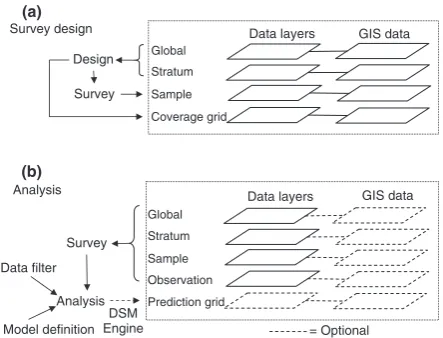
From the users’ perspective, Distance consists of a graphical interface that allows users to enter, import and view data, design surveys and run analyses. Users begin by creating a Dis-tance project, which contains information about a single study. Wizards are available to help in setting up a project and enter-ing data, or importenter-ing it from delimited text files. Data are organized into nested layers: global (for data that relates to the whole study area), stratum (data relating to individual survey strata), sample (data relating to individual survey lines or points) and observation (data relating to single observations). More complex nested structures are possible. Geographical data, in the form of ESRI shapefiles, can also be associated with each layer. Having entered or imported data, users under-take one of two tasks: design of a new survey or analysis of already-collected survey data (Fig. 1).
A design is an algorithm for laying out samples within the study area; multiple designs can be created using the design engine in Distance, and their properties examined by simula-tion. A single realization of a design is called in Distance a survey, and this consists of the position of a set of sample lines or points together with the survey methods (e.g. collection of perpendicular distances to clusters of animals). Line or point positions can be readily exported from Distance and used for navigation in the field. Results can also be viewed within Distance in the form of simple maps and text output contain-ing summary statistics.
diagnostic plots and summary statistics. These are readily exported to other software.
Conceptually, Distance projects contain all the data and results relating to a single study. Physically, a project comprises a project file and an associated data folder; the latter contains a data file, geographical shapefiles and a folder containing files generated by analysis engines that use the statistical software R. As a project consists of many parts, Distance provides a convenient mechanism for packing the project into a single (zip) file to make it easy to archive and transfer.
A full electronic user manual comes with the software, and there is an email-based discussion list for users (http://www. jiscmail.ac.uk/distance-sampling).
From the programming perspective, the visual interface, written in Microsoft Visual Basic (Microsoft Corporation 2000), is highly modular, and runs the analysis engines in sepa-rate processes to enhance stability and make use of multi-core hardware. The survey design engine is also written in Visual Basic, using ESRI’s MapObjects library (ESRI 2004) for the GIS functionality. The CDS and MCDS analysis engines are written in FORTRAN (Compaq Computer Corporation 2001) and the MRDS and DSM engines in R (R Development Core Team 2009). For data storage, both project and data files are in Microsoft Access format. More details of the internal structure of the software are given in appendices to the user manual.
Survey design
As with any sampling exercise, obtaining reliable results from a distance sampling survey depends critically on good survey design. This relies upon the fundamental sampling principles of replication and randomization. Sufficient replicate lines or points ensure that variation in encounter rate (number of objects detected per unit survey effort) can be adequately esti-mated. The lines or points should not be placed subjectively; rather a randomization scheme should be employed that gives all locations in the study region a known, non-zero probability of being covered by a transect (the ‘coverage probability’). Standard analyses in Distance assume uniform coverage
probability. We recommend that a systematic survey design with a random start be used to afford better spatial coverage and lower variance. For such a design, Fewsteret al.(2009) describe methods to estimate this variance with low bias, and these methods are available in the Distance analysis engines.
The layout of transects across the study region deserves careful thought. Parallel, equally spaced transects with a ran-dom start provide designs with uniform coverage. However, if survey platform cost is high, then not collecting data while moving between transects can be wasteful. Hence, sawtooth or zigzag designs can be employed; however, when study regions are non-rectangular, these designs can produce unequal coverage probability (Strindberg & Buckland 2004). All else being equal, more, shorter transect lines yield more precise estimates of the encounter rate variance than do a few long lines; segmented transects are often used, where the distance between sections of survey effort along a transect is roughly equal to the separation between successive parallel transects (Bucklandet al.2004:204). Where there are known density gradients within the study region, stratification can be used to reduce variance; alternatively (or in addition) transect lines can be placed parallel to this gradient. In highly complex study regions, the ratio of study area perime-ter to area may be quite high. Then, edge effects can cause significantly lower coverage probability near the perimeter of the study area, so that sampling into a buffer zone (‘plus sampling’) is advisable (Strindberg, Buckland & Thomas 2004:192–194, 200–201). Further discussion of design issues is given by Bucklandet al.(2001:228–317), Strindberg et al. (2004) and Thomas, Williams & Sandilands (2007).
In all of these situations, it is advisable to employ the auto-mated survey design engine in Distance to examine the cover-age properties of candidate survey designs prior to their implementation. For a given design, Distance can generate a map showing coverage probabilities estimated by simulation, to allow users to determine whether standard analyses in Dis-tance are appropriate or whether other analysis options are preferable to avoid potential bias (for example, the Horvitz-Thompson estimator described below; Rexstad 2007). Other outputs include the minimum, mean and maximum number of survey lines or points, and distance travelled per stratum. These can be useful in determining if a design is feasible, and whether there is sufficient effort to produce enough sightings for reliable analysis. Once a design is selected, a realization (survey plan) can be generated, and sample coordinates exported for use in implementing the survey.
Estimating the detection function
Version 6 of Distance has three different analysis engines for estimating the detection function. (The fourth engine is covered in the next section.)
T H E C D S E N G I N E
The CDS engine is a FORTRAN program based on the code in earlier versions of Distance. CDS assumes that detection of
(a)
(b)
Model definition Survey Analysis
Stratum
Data layers Global
GIS data
Sample
Observation Analysis
Data filter
Prediction grid
= Optional DSM
Engine Stratum Global
Data layers
Sample
GIS data
Survey Design Survey design
[image:4.595.65.287.83.252.2]Coverage grid
an animal on the line or point is certain. The same detection function is assumed to apply for all animals; this seems unreal-istic, but the ‘pooling robustness’ property of CDS estimators ensures that moderate amounts of unmodelled heterogeneity cause little bias (Buckland et al. 2004:389–392). The CDS engine implements the flexible semi-parametric detection func-tion modelling framework proposed by Buckland (1992), where a parametric key function is paired with zero or more series adjustment terms. Four key functions are available: uni-form, half-normal, hazard-rate and negative exponential. Adjustments can be cosine terms, or Hermite or simple polyno-mials. Selection of the appropriate combination can be done using standard model selection techniques (see Analysis hints, below).
T H E M C D S E N G I N E
The MCDS engine is an extension of the CDS FORTRAN program that allows inclusion of covariates other than distance from the line or point in the detection function (Marques & Buckland 2003, 2004). This is useful in four circumstances (Marqueset al.2007): first, when we wish to estimate density for a subset of the data (e.g. a stratum), but there are too few observations to fit a separate detection function to each subset; secondly, when pooling robustness does not hold (e.g. too much heterogeneity in detection probability); thirdly, because it can reduce the variance of the density estimate; and fourthly, if the covariate distribution is of interest in its own right. Only two key functions are allowed: the half-normal and the hazard-rate. Both of these have a scale parameter, which is modelled as a function of the covariates. The covariates may relate to the individual detections (e.g. cluster size or animal behaviour), the observer (e.g. observer ID) or the environment (e.g. habitat or weather), and can be either continuous covari-ates or qualitative factors.
T H E M R D S E N G I N E
The MRDS engine is an R package for use primarily with dou-ble-platform line transect data, where the assumption of cer-tain detection on the line can be relaxed (Laake & Borchers 2004). Double-platform methods are widely used in both aerial and shipboard surveys of marine mammals (e.g. Borcherset al. 2006), but are potentially useful in many situations where objects at zero distance are difficult to detect. Users wishing to run this engine need to have R installed in addition to Distance. As with the MCDS engine, covariates can be incor-porated into the detection function model; however, inclusion of adjustment functions is not supported at present. Every attempt should be made to include all covariates that have a large effect on detectability, because unlike CDS and MCDS, estimation is not robust to the effects of unmodelled heteroge-neity at zero distance when detection on the line is not certain.
Single platform surveys can also be analysed using the MRDS engine, but this is only really useful when calling the engine from R (where the CDS and MCDS engines are not readily available).
Other data analysis issues
E S T I M A T I N G A B U N D A N C E
Consider first the case that detections are of single animals. Estimated abundance (N^) may be formulated in terms of a Horvitz-Thompson estimator, but with the inclusion probabil-ities estimated (Borchers & Burnham 2004):
^
N¼X
n
i¼1
1
^
Pi
eqn 1
whereP^i is the estimated inclusion probability for animal iandnis the number of observations.P^ihas two compo-nents: first the probability that animal i falls within the sampled plots (the ‘coverage probability’ previously intro-duced) and secondly an estimate of its probability of detection, given that it is within the plots.
When animals occur in clusters, we can estimate abundance as ):
^
N¼X
n
i¼1
si
^
Pi
eqn 2
wheresiis the size of cluster i,i= 1, ...,n. Alternatively,
we can multiply estimated cluster abundance by an esti-mateE^ðsÞof mean cluster size in the population:
^
N¼E^ðsÞX
n
i¼1
1
^
Pi
eqn 3
If the CDS engine is selected, the detection function is assumed to be the same for all detections, so that eqn 1 sim-plifies to N^¼nP^. For clustered populations, the CDS engine uses a simplification of eqn 3. The default method for estimating mean cluster size is the regression method of Buckland et al. (2001:73–75) in which log cluster size is regressed on estimated probability of detection. This is designed to remove any effect of ‘size bias’, which occurs when larger clusters are easier to detect than small ones at large distances, so the simple mean of observed cluster sizes is a positively biased estimate of population mean cluster size. It also corrects for bias that arises when cluster size tends to be underestimated at large distances, so mean observed cluster size is a negatively biased estimate of popu-lation mean cluster size.
The MCDS and MRDS engines allow the detection func-tion (but not coverage probability) to vary, so that eqn 1 applies when detections are of single animals. Equation 2 is used for clustered populations.
E S T I M A T I N G P R E C I S I O N
a grid of points is placed at each of a number of random loca-tions (called ‘cluster sampling’), where the grid is the appropri-ate unit to resample. This is achieved by defining each grid of points as a stratum, and resampling strata. The user can also opt to resample individual detections, although this is not rec-ommended. Multi-level bootstrapping is also allowed but is not recommended as resampling by line or point gives a better representation of the variability induced by the sampling pro-cess (Davison & Hinkley 1997:100–102).
For the CDS engine, the analytical variance of a density or abundance estimate is estimated by the delta method (Bucklandet al.2001:52), and comprises three components, corresponding to estimation of encounter rate, the detection function and mean cluster size in the population (for clus-tered populations). For details of how the three components are obtained and combined, see Buckland et al. (2001:76– 79). However, the formulae for estimating encounter rate variance given by Bucklandet al. (2001:78–79) are not the default option in Distance version 6, following work by Few-steret al.(2009) showing an alternative estimator gives more robust estimates of variance when there are strong spatial trends through the survey region. By default, the estimators assume lines or points were laid down at random. This leads to overestimates of variance where systematic designs are used. For systematic parallel designs, estimators based on post-stratification (Fewster et al. 2009) are available, and these produce more reliable (and usually lower) estimates for that design.
For the MCDS and MRDS engines, detection probability is allowed to depend on covariates other than distance, and a different, more integrated approach to variance estimation is required. For the MCDS engine, see Marques & Buckland (2003, 2004:38–43) and Marqueset al.(2007); for the MRDS engine, see Borcherset al.(2006).
S T R A T I F I C A T I O N ( I N C L U D I N G P O S T - S T R A T I F I C A T I O N )
Geographical stratification can be used to improve precision of estimates by subdividing the study region into blocks that are likely to be similar in animal density. Stratification can also be used when there is management interest in estimating density in sub-sections of the study region. The overall estimate of den-sity is obtained as the mean of the stratum-specific estimates, weighted by the respective areas of the strata.
If the same study area is surveyed repeatedly, then survey-level strata could be defined. If a study area is surveyed by say two ships, an analysis with ships as strata can be performed. In this latter case, the overall estimate of density would be the mean of stratum-specific density estimates, weighted by the effort carried out by each ship.
In some cases, strata can be defined using criteria not avail-able during survey design. For example, it may be of scientific interest to produce sex-specific estimates of density in the study area if the animals can be identified by gender. However, if the genders mix freely within the study area, the survey cannot be designed to account for sex-specific estimation. This type of stratification is called post-stratification, and can be
accom-plished using Distance. The overall density would then be esti-mated as the sum of the stratum-specific estimates.
A current limitation of Distance is that it can only handle one level of stratification.
A N A L Y S I S H I N T S
There are typically three phases in analysing data in Distance: exploratory data analysis, followed by model selection, and then final analysis and inference. We focus here on CDS analy-ses; suggestions for MCDS analyses were given by Marques et al.(2007).
Exploratory data analysis
Initially, exploratory data analysis is carried out to aid under-standing of the data and identify any problems. This phase should be started while the data are being collected, as this allows any problems with data collection to be identified and rectified. If exact distances are recorded (rather than grouped or interval distance data), it is useful to plot histograms of the distances with many cutpoints.
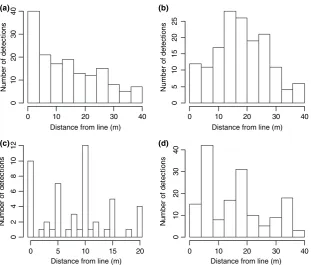
In Fig. 2, we show examples of problematic line transect data sets. Figure 2a shows an example of ‘spiked’ data. For such data, different models will give very different estimates of density, so it is important to understand what has caused the spike, and to modify field procedures accordingly. A common cause in shipboard surveys is inaccurate estimation of sighting angles for detections ahead of the vessel. With inadequate training and⁄or aids, observers often record most detections within perhaps 10of the line as 0, leading to rounding of many perpendicular distances to zero.
Spiked data might also arise if animals are attracted towards the observer. It is important that detections are made before any responsive movement occurs.
Spiked data may arise even when there has been no failure of an assumption. For example, in surveys of breeding songbirds, singing males may be much more detectable than (non-singing and cryptic) females. In that case, the spike arises because females are only detectable close to the line. The simplest solution in this case is to additionally record whether the bird was singing. An analysis can then be conducted for singing birds, allowing estimation of the number of territories. If females are certain to be detected when on the line, then a separate analysis of females could be conducted, if sample size is adequate, or sex could be included as a covariate in an MCDS analysis. Similar issues apply for point transect surveys.
Another possible cause of this pattern of observed distances is animal movement away from the line before detection. In this case, attempts should be made to detect animals sooner, e.g. by searching ahead instead of to the side in aerial surveys, or by searching with binoculars in shipboard surveys. For surveys of terrestrial mammals, nocturnal surveys using a thermal imager can be effective.
Figure 2c shows considerable variability in the frequency counts. In this case, high frequency counts correspond to inter-vals containing distances that are a multiple of 10. This is caused by rounding of estimated distances. Better observer training, together with aids to estimation (e.g. laser rangefind-ers for terrestrial surveys or reticles for shipboard surveys), can usually minimize this problem. Given sufficient data, rounding does not usually compromise estimation unless there is exces-sive rounding to distance zero (see above). However, judicious choice of cutpoints is needed for testingv2goodness-of-fit, so that most rounded distances remain in their correct distance interval.
Figure 2d is similar to Fig. 2c, except that the large frequen-cies do not occur at any obvious values to which distances might be rounded. Data like these indicate over-dispersion, and may occur for example if animals occur in clusters, but are recorded as individuals. This can occur when it is not easy to locate the centre of a cluster of animals (a common problem with primates), or to detect all animals in a cluster; in such cir-cumstances, a recommended field protocol is to record each detected animal separately. This violates the independence assumption, but estimation is remarkably robust to even gross violations of this assumption. However, model selection is more problematic, because the usual tools such as Akaike
Information Criterion (AIC) and goodness-of-fit statistics are invalidated by the failure of independence. It may be better to analyse clusters for model selection, then having selected a model, fit it to data for individuals for estimating abundance. The same problem arises when analysing cue count data, as multiple cues from the same animal may all be at similar dis-tances, especially when cue counting is conducted from points, rather than along lines (Buckland 2006).
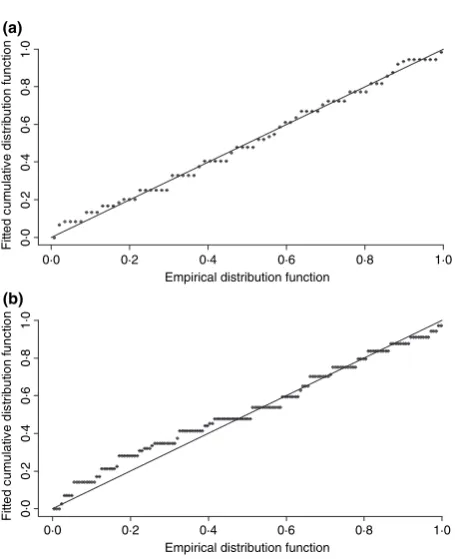
In Fig. 3a, we show a quantile–quantile (q–q) plot corre-sponding to the fit of a half-normal detection function model to distances from the line for a line transect survey. If the model is good, we expect to see approximately a straight line. This plot shows no systematic curvature, but has ‘steps’ – a clear indication that distances have been rounded. When distances are analysed as exact (as distinct from grouped), Distance gen-erates q–q plots; these can be useful for diagnosing problems with the data (as here) or poor model fit (next section).
Model selection
The second phase of analysis is model selection. Included in this phase is selection of a suitable truncation distancewfor the distance data. We truncate because otherwise extra adjust-ment terms may be needed to fit a long tail to the detection function. This reduces precision for little gain, as data a long way from the line or point contribute little to the abundance estimate (Bucklandet al. 2001:103–108, 151–153). We typi-cally truncate around 5% of distances for line transect sam-pling, and more for point transect sampling (for which a higher proportion of detections corresponds to the tail of the detec-tion funcdetec-tion, Bucklandet al.2001:151). If grouped distance
Distance from line (m)
s
n
oit
c
et
e
d
f
o
r
e
b
m
u
N
0
(a) (b)
(d) (c)
4
0
3
0
2
0
1
0
Distance from line (m)
Number of detections
0 10 20 30 40 0 10 20 30 40
5
2
0
2
5
1
0
1
5
0
Distance from line (m)
s
n
oit
c
et
e
d
f
o
r
e
b
m
u
N
2
1
0
1
8
6
4
2
0
Distance from line (m)
s
n
oit
c
et
e
d
f
o
r
e
b
m
u
N
0 5 10 15 20 0 10 20 30 40
0
4
0
3
0
2
0
1
[image:7.595.144.456.81.346.2]0
data are collected, choice ofwis restricted to the cutpoints defining the intervals.
Having selectedw, cutpoints should be set for the distance data. If data are recorded in intervals, the cutpoints will be predetermined. If data are recorded as ‘exact’, but in fact are subject to substantial rounding, there may be merit in assigning the distances to intervals for analysis, where cutpoints are defined well away from favoured rounding distances, so that few observations will be recorded in the wrong interval. This is achieved by setting cutpoints in the data filter of Distance. More usually, we will wish to analyse the data as exact (even if there is rounding, provided it is not severe), but set cutpoints for presenting histograms and conductingv2goodness-of-fit tests. This is achieved by setting cutpoints in the diagnostics section of the detection function model definition.
When selecting a suitable model, it is worth bearing in mind that it is only an approximation to the true detection function. There is little point in throwing every possible model at the data – this risks over-fitting. If the data are of high quality, many possible model and adjustment combinations will give very similar estimates. In our experience, the following combi-nations often perform well and there is rarely any need to try others: uniform key with cosine adjustments; half-normal key with cosine adjustments; half-normal key with Hermite poly-nomial adjustments; hazard-rate key with simple polypoly-nomial adjustments. We would never recommend using the negative exponential key, which is present in Distance largely for histor-ical reasons.
Having fitted several models, visual assessment of model fit can be performed by examining histograms. For example, the hazard-rate model can fit implausible shapes for some data sets, especially for spiked data and for some point transect data sets. There may therefore be reasons to reject that model even if it fits the data well, for example because the estimated proba-bility of detection falls off more quickly with distance than is consistent with how the observer searches. For those models that give a reasonable fit, compare the goodness-of-fit mea-sures. Distance providesv2goodness-of-fit tests. If exact dis-tances are recorded, it also gives test statistics for the Kolmogorov–Smirnov and Crame´r-von Mises tests and a q–q plot (Bucklandet al.2004:385–389). Figure 3b is an example of where the model (the half-normal in this case) provides a poor fit to the data, as can be seen by the departure from a straight line. These data have too few observations close to the line relative to mid-distances to be well modelled by a half-nor-mal; a model with a flatter ‘shoulder’ to the detection function is needed.
The AIC provides a relative measure of fit. The model with the smallest AIC provides, in some sense, the best fit to the data. AIC values are only comparable if they are applied to exactly the same data – in Distance, this means that runs made using the same survey and data filter are comparable. For such sets, Distance provides theDAIC values, which are AIC values with the AIC of the best-fitting model subtracted. Thus DAIC = 0 for the best model. Other model selection criteria are also available.
Final analysis and inference
The third phase of analysis is to select the best model, and extract summary analyses and plots for reporting. If choice of model is uncertain and influential, an analysis in which more than one model is selected can be run, and the option to esti-mate the variance by bootstrap selected. For each bootstrap resample, the best model will be selected (using AIC by default), so that different models may be selected for the analy-sis of different resamples. Resulting variances and confidence intervals then reflect model uncertainty. An example is given by Williams & Thomas (2009).
More advanced analysis options
M U L T I P L I E R S
Multipliers provide a simple means of extending standard dis-tance sampling methods. They may be added in Disdis-tance via the project set-up wizard, or later in the multipliers section of the model definition.
Indirect surveys of animal sign are often conducted, e.g. dung surveys of deer or elephants, or nest surveys of apes. Sign density is converted to animal density by dividing by an esti-mate of the sign production rate per animal, and an estiesti-mate of the mean time to decay of the sign. These estimates can be added as multipliers, with the divide operator option (hence they are actually ‘dividers’), together with estimates of their
0·0 0·2 0·4 0·6 0·8 1·0
1·0
0·8
0·6
0·4
0·2
0·0
Empirical distribution function
0·0 0·2 0·4 0·6 0·8 1·0 Empirical distribution function
n
oit
c
n
uf
n
oit
u
bi
rt
si
d
e
vit
al
u
m
u
c
d
ett
i
F
(b)
1·0
0·8
0·6
0·4
0·2
0·0
n
oit
c
n
uf
n
oit
u
bi
rt
si
d
e
vit
al
u
m
u
c
d
ett
i
F
[image:8.595.63.291.75.355.2](a)
standard errors. If the degrees of freedom associated with the estimated standard error are known, they may also be added.
Cues are instantaneous, or at least very short-lived, signs, such as a whale blow or a songburst. Point transect methods may be used to estimate the number of cues per unit area per unit time, and this may be converted to estimated animal den-sity by entering a divider equal to the estimated number of cues per unit of time per animal. For whale cue count surveys (Bucklandet al.2001:191–197), only a sector of the full circle is surveyed; the fraction of the circle surveyed may be entered as an additional divider, but in this case as it is a known con-stant no standard error would be entered.
For trapping and lure point transect sampling (Buckland et al.2006), the detection function is estimated by setting up trials with animals at known locations. We record whether or not each trial results in detection of the animal, and use logistic regression to estimate the detection function (in general, with probability of detection at the point allowed to be less than unity). This allows the effective area covered around each point to be estimated, and counts of animals from the main survey can be converted to estimated animal density by dividing by the effective area, by setting up the appropriate multiplier in Distance. Similarly, if too few detections are made in a distance sampling survey to allow reliable estimation of the detection function, but an estimate is available from another survey that is considered appropriate, counts can be converted to estimates of animal density in the same way.
T H E D S M E N G I N E
If transects are not positioned according to a random design, design-based extrapolation of densities to the wider region may be unreliable. Even if a randomized design is used, we may wish to model animal density as a function of spatially indexed environmental covariates – so called ‘spatial model-ling’ or ‘habitat modelmodel-ling’. This is also useful for estimating abundance in small regions of the study area, for which there is inadequate sampling effort to produce a stand-alone esti-mate.
The DSM analysis engine implements the ‘count method’ of Hedley & Buckland (2004), in which the segment counts (seg-ments having been defined outside Distance) are modelled as a function of covariates such as habitat type, altitude or bottom depth, distance from human access, land-use type, latitude and longitude. This is commonly done using generalized additive models (GAM) (Wood 2006) with overdispersed Poisson error structure and a log link, with effective area of the segment (defined as actual area multiplied by the estimated proportion of animals counted in the segment) serving as an offset. Other modelling strategies for DSM are also available in Distance. The counts within each segment can be converted to estimates of abundance within each segment, and the area of the segment (out to truncation distancew) is the offset. Alternatively, esti-mated density can be used as the response variable, no offset, and the area of the segment used as a weight.
To use this engine, Distance requires that transect lines are divided into segments and that covariates to be included in the
model are attached to each segment. Once a density surface model has been built, density or abundance can be estimated over any area of interest within the study area by predicting over a grid of points to which the same covariates are attached. To build this grid, Distance requires that the global data layer be associated with a shapefile.
A C C E S S I N G A N A L Y S I S E N G I N E S F R O M O T H E R
S O F T W A R E
Sometimes analyses are required that are too complex to carry out within Distance. In this case, the graphical user interface of Distance can be circumvented. For the CDS and MCDS engines, data and descriptions of the models are passed to the FORTRAN program via a data file and a command file. Results of an analysis are placed into a statis-tics (‘stats’) file, which can be read by software written by a researcher to extract useful parameter estimates for further analysis. Bootstrapping, for example, can be accomplished by resampling the data, and rewriting the data file presented to MCDS. This process is somewhat streamlined for researchers familiar with R, using the MRDS engine. With this approach, data are read into R only once, and the re-sampling and accumulation of parameter estimates are all conducted within R without the use of intermediate text files. Likewise, the DSM engine can be accessed directly from within R. The command languages of all four engines are documented in an appendix to the Users’ Guide (CDS and MCDS) and R help files (MRDS and DSM).
Future plans
Theoretical developments in distance sampling continue to occur, and we endeavour to incorporate these into Distance. The most recent enhancements include the DSM engine and the improved estimator of encounter rate variance of Fewster et al.(2009). In future, we hope to incorporate a simulation engine into Distance, so practitioners can more readily exam-ine the behaviour of distance sampling estimators for their par-ticular situation. Other enhancements we hope to make include: advances in estimating the effects of treatments (in the sense of designed experiments) that are relevant to many impact assessment studies (Bucklandet al.2009); assessment of time trends in abundance or density from repeated surveys (Thomas, Burnham & Buckland 2004); and unequal coverage estimators (Rexstad 2007).
There are some challenges associated with modelling density surfaces, including variance estimation associated with the two stages of the modelling process, autocorrelation in the counts, potential for unreasonable extrapolation of the density surface, and ‘bleeding’ of abundance estimates to areas spatially proxi-mate but separated by adverse topography. Subsequent ver-sions of Distance may incorporate the refinements developed by Wood, Bravington & Hedley (2008), which makes substan-tial progress in tackling the latter two issues.
evolve, to address more complex ecological applications and make use of further statistical developments.
Acknowledgements
We are grateful to the organizations that have funded the development of Dis-tance, an up-to-date list of whom can be found on the software web pages. The creation and maintenance of the software is a large, collaborative project; in addition to the authors of this paper, contributions have been made by David Anderson, David Borchers, Louise Burt, Julian Derry, Rachel Fewster, Fer-nanda Marques, David Miller and John Pollard. We thank Stuart Newson, an anonymous reviewer and E.J. Milner-Gulland for their helpful comments on an earlier draft.
References
Alldredge, M.W., Simons, T.R. & Pollock, K.H. (2007) A field evaluation of distance measurement error in auditory avian point count surveys.Journal of Wildlife Management,71, 2759–2766.
Borchers, D.L. & Burnham, K.P. (2004) General formulation for distance sam-pling.Advanced Distance Sampling(eds S.T. Buckland, D.R. Anderson, K.P. Burnham, J.L. Laake, D.L. Borchers & L. Thomas), pp. 6–30. Oxford University Press, Oxford.
Borchers, D.L., Laake, J.L., Southwell, C. & Paxton, C.G.M. (2006) Accom-modating unmodeled heterogeneity in double-observer distance sampling surveys.Biometrics,62, 372–378.
Buckland, S.T. (1992) Fitting density functions using polynomials.Applied Sta-tistics,41, 63.
Buckland, S.T. (2006) Point transect surveys for songbirds: robust methodolo-gies.The Auk,123, 345–357.
Buckland, S.T., Anderson, D.R., Burnham, K.P. & Laake, J.L. (1993)Distance Sampling: Estimating Abundance of Biological Populations. Chapman & Hall, London.
Buckland, S.T., Anderson, D.R., Burnham, K.P., Laake, J.L., Borchers, D.L. & Thomas, L. (2001)Introduction to Distance Sampling. Oxford University Press, Oxford.
Buckland, S.T., Anderson, D.R., Burnham K.P., Laake, J.L., Borchers, D.L. & Thomas L (eds) (2004)Advanced Distance Sampling. Oxford University Press, Oxford.
Buckland, S.T., Summers, R.W., Borchers, D.L. & Thomas, L. (2006) Point transect sampling with traps or lures.Journal of Applied Ecology,43, 377– 384.
Buckland, S.T., Russell, R.E., Dickson, B.G., Saab, V.A., Gorman, D.G. & Block, W.M. 2009. Analysing designed experiments in distance sampling.
Journal of Agricultural, Biological and Environmental Statistics, DOI:
10.1198/jabes.2009.08030.
Burnham, K.P., Anderson, D.R. & Laake, J.L. (1980) Estimation of density from line transect sampling of biological populations.Ecological Mono-graphs,72, 1–202.
Compaq Computer Corporation (2001)Compaq Visual Fortran. Version 6.6. Compaq Computer Corporation, Houston, Texas, USA.
Davison, A.C. & Hinkley, D.V. (1997)Bootstrap Methods and Their Applica-tion. Cambridge University Press, Cambridge, UK.
ESRI, Inc. (2004)MapObjects 2.3. Environmental Systems Research, Institute Inc., Redlands, CA, USA.
Fewster, R.M. & Buckland, S.T. (2004) Assessment of distance sampling esti-mators.Advanced Distance Sampling(eds S.T. Buckland, D.R. Anderson, K.P. Burnham, J.L. Laake, D.L. Borchers & L. Thomas), pp. 281–306. Oxford University Press, Oxford.
Fewster, R.M., Southwell, C., Borchers, D.L., Buckland, S.T. & Pople, A.R. (2008) The influence of animal mobility on the assumption of uniform dis-tances in aerial line transect surveys.Wildlife Research,35, 275–288. Fewster, R.M., Buckland, S.T., Burnham, K.P., Borchers, D.L., Jupp, P.E.,
Laake, J.L. & Thomas, L. (2009) Estimating the encounter rate variance in distance sampling.Biometrics,65, 225–236.
Hedley, S.L. & Buckland, S.T. (2004) Spatial models for line transect sampling.
Journal of Agricultural, Biological and Environmental Statistics,9, 181–199. Hiby, A.R. (1985) An approach to estimating population densities of great
whales from sighting surveys.IMA Journal of Mathematics Applied in Medi-cine and Biology,2, 201–220.
Johnson, D., Laake, J. & VerHoef, J. (2009) A model-based approach for mak-ing ecological inference from distance samplmak-ing data.Biometrics, DOI: 10.1111/j.1541-0420.2009.01265.x.
Laake, J.L. & Borchers, D.L. (2004) Methods for incomplete detection at dis-tance zero.Advanced Distance Sampling(eds S.T. Buckland, D.R. Anderson, K.P. Burnham, J.L. Laake, D.L. Borchers & L. Thomas), pp. 108–189. Oxford University Press, Oxford.
Laake, J.L., Burnham, K.P. & Anderson, D.R. (1979)User’s Manual for
Pro-gram TRANSECT. Utah State University Press, Logan, UT.
Laake, J.L., Buckland, S.T., Anderson, D.R. & Burnham, K.P. (1993)
DIS-TANCE User’s Guide V2.0. Colorado Cooperative Fish and Wildlife
Research Unit, Colorado State University, Fort Collins, CO, 72 pp. Lukacs, P.M., Franklin, A.B. & Anderson, D.R. (2004) Passive approaches to
detection in distance sampling.Advanced Distance Sampling(eds S.T. Buck-land, D.R. Anderson, K.P. Burnham, J.L. Laake, D.L. Borchers & L. Tho-mas), pp. 260–280. Oxford University Press, Oxford.
Marques, F.F.C. & Buckland, S.T. (2003) Incorporating covariates into stan-dard line transect analyses.Biometrics,59, 924–935.
Marques, F.F.C. & Buckland, S.T. (2004) Covariate models for the detection function.Advanced Distance Sampling(eds S.T. Buckland, D.R. Anderson, K.P. Burnham, J.L. Laake, D.L. Borchers & L. Thomas), pp. 31–47. Oxford University Press, Oxford.
Marques, F.F.C., Buckland, S.T., Goffin, D., Dixon, C.E., Borchers, D.L., Mayle, B.A. & Peace, A.J. (2001) Estimating deer abundance from line tran-sect surveys of dung: sika deer in southern Scotland.Journal of Applied Ecol-ogy,38, 349–363.
Marques, T.A., Thomas, L., Fancy, S.G. & Buckland, S.T. (2007) Improving estimates of bird density using multiple covariate distance sampling.The Auk,127, 1229–1243.
Microsoft Corporation (2000)Visual Basic 6. Microsoft Corporation, Red-mond, Washington, USA.
R Development Core Team (2009)R: A Language and Environment for
Statisti-cal Computing. R Foundation for Statistical Computing, Vienna. ISBN
3-900051-07-0. http://www.R-project.org.
Rexstad, E. (2007)Non-Uniform Coverage Estimators for Distance Sampling. Technical Report 2007-1. Centre for Research into Ecological and Environ-mental Modelling, St. Andrews University. http://hdl.handle.net/10023/628/. Strindberg, S. & Buckland, S.T. (2004) Zigzag survey designs in line transect sampling.Journal of Agricultural, Biological and Environmental Statistics,9, 443–461.
Strindberg, S., Buckland, S.T. & Thomas, L. (2004) Design of distance sam-pling surveys and Geographic Information Systems.Advanced Distance
Sampling(eds S.T. Buckland, D.R. Anderson, K.P. Burnham, J.L. Laake,
D.L. Borchers & L. Thomas), pp. 190–228. Oxford University Press, Oxford.
Thomas, L., Burnham, K.P. & Buckland, S.T. (2004) Temporal inferences from distance sampling surveys.Advanced Distance Sampling(eds S.T. Buckland, D.R. Anderson, K.P. Burnham, J.L. Laake, D.L. Borchers & L. Thomas), pp. 71–107. Oxford University Press, Oxford.
Thomas, L., Williams, R. & Sandilands, D. (2007) Designing line transect sur-veys for complex survey regions.Journal of Cetacean Research and Manage-ment,9, 1–13.
Williams, R. & Thomas, L. (2009) Cost-effective abundance estimation of rare marine animals: small-boat surveys for killer whales in British Columbia, Canada.Biological Conservation,142, 1542–1547.
Wood, S. N. (2006)Generalized Additive Models: An Introduction with R. Chap-man & Hall, Boca Raton, FL.
Wood, S.N., Bravington, M.V. & Hedley, S.L. (2008) Soap film smoothing.
Journal of the Royal Statistical Society B,70, 931–955.