Implementation dynamics in EU ‘Mobility’ Partnerships
Natasja Reslow
Faculty of Law Maastricht University
Email: [email protected]
Paper prepared for the EUSA Fourteenth Biennial Conference, Boston, 5-7 March 2015
WORK IN PROGRESS – PLEASE DO NOT CITE OR CIRCULATE
Abstract
1. Introduction
Since the early 2000s, EU policy documents emphasise the importance of cooperating with
non-EU countries on migration issues. Policy instruments have been created and brought
together under the Global Approach to Migration and Mobility (Commission, 2011), and
project funding has been made available under successive EU funding instruments. This has
spawned a sizeable literature on EU external migration policy, with scholars examining policy
content and policy-making dynamics (e.g. Boswell, 2003; Coleman, 2009; Weinar, 2011).
And yet at the same time the literature on implementation of EU external migration policy has
remained extremely limited (Wunderlich, 2013; 2012). This is puzzling, and unsatisfactory.
Implementation research matters because, simply put, “putting a piece of legislation or a
government programme into practice does not happen automatically, nor is it a purely
technical or apolitical affair” (Treib, 2006, p.5). Policy in theory (on paper) is one thing;
policy in practice may be quite another (Versluis, 2004, p.13). Implementation research in EU
external migration policy matters because the policy area is so salient. Given that cooperation
with third countries on migration continues to be stressed in EU policy documents (e.g.
Commission, 2014b), there is a pressing need to understand how this policy is implemented in
practice. This paper provides a first step in this direction, by assessing the potential for
successful implementation of the EU’s Mobility Partnerships. The Mobility Partnerships are
selected as the object of study because they are the “main strategic, comprehensive and
long-term cooperation framework for migration management with third countries”.1 Section 2
introduces the Mobility Partnership instrument and argues that a definitive assessment of
implementation is premature. Section 3 distils some central concepts from the implementation
literature, which are applied in section 4 in order to determine the potential for successful
implementation of the Mobility Partnerships. The conclusion argues that, although the
voluntary nature of the policy instrument might remove several obstacles to implementation, a
blanket assessment of the Mobility Partnerships is not possible: outcomes will depend on the
specific third country and project concerned.
2. The ‘Mobility’ Partnerships
The concept of Mobility Partnerships was introduced by the Commission in 2007
(Commission, 2007). The aim was to create “novel approaches to improve the management of legal movements of people between the EU and third countries” (p.2). The central idea is that
1
legal migration opportunities will be offered to third countries in return for their cooperation
on preventing irregular migration (p.3); in practice, this has come to mean that Mobility
Partnerships include the signature of both readmission and visa facilitation agreements
(Commission, 2011, p.11). Indeed, the fact that the communication setting out the Mobility
Partnership concept also addresses circular migration seems to emphasise the centrality of
‘mobility’ for this policy instrument. To date, Mobility Partnerships have been signed with
Moldova (2008), Cape Verde (2008), Georgia (2009), Armenia (2011), Morocco (2013),
Azerbaijan (2013), and Tunisia (2014).
Mobility Partnerships are signed as political declarations, setting out the intent of the
Commission, the third country concerned, and participating member states to cooperate on
migration issues. Appended to this declaration is a list of projects for implementation; projects
may be proposed by any of the parties to a Mobility Partnership, but in reality most projects
have been carried out by member states (Reslow, 2013, p.138). A Mobility Partnerships is
best understood as an ‘umbrella’, bringing together the various individual projects.
Participation by member states is voluntary, which has led to varied patterns of opting in and
out by the different member states, ranging from France (which participates in all
partnerships) to Austria, Finland, Ireland and Malta (which do not participate in any
partnerships). All other member states are located somewhere between these extremes,
participating in some, but not all, partnerships.2
Once a Mobility Partnership has been negotiated and signed (see Reslow, 2013,
p.129), it is implemented through the implementation of the projects proposed.
Implementation is monitored at the EU level through a Mobility Partnership task force, and at
the local level through a cooperation platform in the third country concerned. The
Commission plays a key role in the task force by organising meetings and updating the
scoreboard – a document produced for each Mobility Partnership which shows all the projects
being implemented and their state of play. Member states’ embassies, EU delegations and third countries’ authorities meet in the framework of cooperation platforms to monitor
implementation of the projects (Commission, 2009a, pp.5-6).
The literature on the implementation of EU external migration policy is extremely
limited. Initial academic assessments of the Mobility Partnerships have focused on the
decision-making process. Member states ‘wrangle’ amongst themselves to ensure that EU
policy favours third countries with which they have a special relationship (Parkes, 2009,
p.343). At the same time, they maintain strict control over the form and content of the
Mobility Partnerships, thus severely limiting the Commission’s room for manoeuvre (Reslow,
2013, p.229). The exclusion of the European Parliament from the policy-making process has
“marginalised any sort of democratic accountability” of this policy instrument (Carrera and
Hernández i Sagrera, 2011, p.106). Carrera and Hernández i Sagrera (2011) also consider the
human rights implications of the Mobility Partnerships: they label these partnerships
‘insecurity partnerships’ because “they undermine the coherence of EU policy on labour immigration and increase the vulnerability of third country workers’ human rights in Europe”
(p.97).
Despite their name and the centrality of the idea of mobility as put forward by the
Commission (see above), several authors argue that labour mobility schemes have been
lacking in the Mobility Partnerships concluded to date (Carrera and Hernández i Sagrera,
2011; Lavenex and Stucky, 2011; Parkes, 2009; Reslow, 2013; see, however, Cassarino,
2009, who characterises Mobility Partnerships as ‘a new generation of temporary
labour-migration schemes’). These judgements are based on a reading of the Mobility Partnership
texts only; however, due to their non-binding nature, full implementation of the proposed
projects cannot be guaranteed (Carrera and Hernández i Sagrera, 2011, p.110). On the other
hand, given that Commission officials see each Mobility Partnership as a ‘living document’
(Reslow, 2013, p.136), implementation in practice may not precisely reflect the text of the
agreement: new projects on mobility may be added later, that were not originally foreseen.
Given the (at least nominal) importance attached to the concept of mobility, and the
rather sceptical initial assessments by scholars, it makes sense to judge Mobility Partnerships
in terms of their contribution to mobility.3 This can be done in different ways, for instance in
terms of nationals of Mobility Partnership countries moving and taking up residence in the
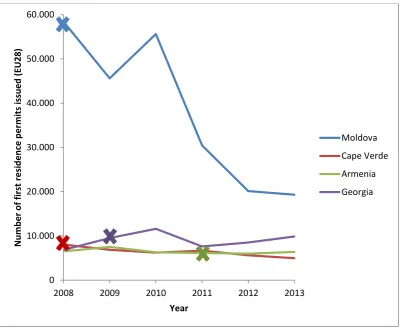
EU. Figure 1 shows the number of first residence permits issued by the 28 EU member states
to citizens of the Mobility Partnership countries, based on Eurostat data. The cross on each
line indicates when the Mobility Partnership with the country concerned was signed. Eurostat
3
data is currently only available up to 2013; Morocco, Azerbaijan and Tunisia are therefore not
included, as their Mobility Partnerships were agreed in 2013 and 2014. Eurostat data is only
available from 2008; the Mobility Partnerships with Moldova and Cape Verde were agreed in
2008, meaning that for these two countries the data does not show the situation before.
Nevertheless, it shows very clearly in the case of Moldova that, since 2008, the number of
first residence permits issued by EU member states has dropped significantly. None of the
Mobility Partnership countries has seen a consistent and significant increase in the number of
residence permits being issued. This may be a very crude measurement of ‘mobility’, but it
nevertheless implies that the Mobility Partnerships have not led to greater numbers of citizens
from these countries moving to EU countries.
Figure 1: Number of residence permits issued by the EU 28 member states to citizens of Mobility Partnership countries (source: Eurostat). The data concerns residence permits issued for more than 3 months, for all purposes (family reunification, remunerated activities, education, and other purposes).
Visa facilitation agreements are an important component of the Mobility Partnerships,
and the Commission has made clear that the dual signature of visa facilitation and
readmission agreements is what sets the Mobility Partnerships apart from other instruments,
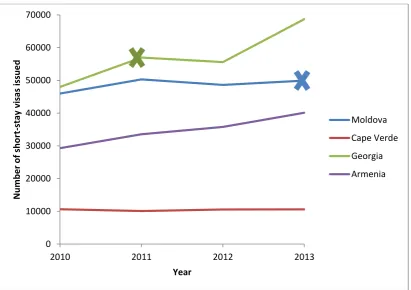
such as the Common Agenda on Migration and Mobility (Commission, 2011, p.11). Figure 2 0
10.000 20.000 30.000 40.000 50.000 60.000
2008 2009 2010 2011 2012 2013
N
u
m
b
e
r
o
f fi
rst
re
si
d
e
n
ce
p
e
rm
its
issue
d
(
EU2
8)
Year
Moldova
Cape Verde
Armenia
[image:5.595.72.475.295.623.2]therefore attempts to assess this aspect of mobility, by charting the numbers of short-stay
visas issued to citizens of Mobility Partnership countries. This is based on data by the
European Commission; however this data is only available for 2010-2013.4 This is the biggest
hurdle to assessing visa facilitation agreements: they were mostly agreed after the Mobility
Partnerships had been signed, meaning ratification and implementation are ongoing or at an
early stage.5 Therefore, figure 2 is only meaningful for the case of Georgia, where the visa
facilitation agreement entered into force in 2011.
It is therefore, at this stage of implementation, not possible to definitively determine
the contribution of Mobility Partnerships to mobility. Definitive assessments of
implementation success/failure may take years because of the data and evidence required to
make such an assessment (Ripley and Franklin, 1982, p.203). Instead, this paper will apply
the literature on implementation in a ‘backward’ fashion: instead of beginning from an
observed successful/failed policy implementation and tracing this back to the implementation
dynamics, the paper begins from the implementation dynamics in order to determine what we
might expect from the implementation of the Mobility Partnerships. Such an analysis can
facilitate projections about the performance and impact of a particular policy (p.204). As this
approach is ambivalent regarding the final outcome of implementation, it also avoids the
accusation commonly levelled at implementation scholars that they focus too much on policy
failures (deLeon, 1999, p.329). The following section distils some central explanatory
concepts from the literature on implementation.
4 Available at
http://ec.europa.eu/dgs/home-affairs/what-we-do/policies/borders-and-visas/visa-policy/index_en.htm. The data suffers from several additional weaknesses: it does not include the UK, Ireland or Croatia; data for Romania, Bulgaria and Cyprus is patchy, therefore these have been excluded, although this is problematic as e.g. Romania issues a significant number of short-stay visas to Moldovan citizens; and the data concerns visas issued by location of member states’ embassies, not according to citizenship of the person receiving the visa.
5
Figure 2: Number of short-stay visas issued to citizens of Mobility Partnership countries (source: Commission; author’s own calculations).
3. Defining and assessing implementation
This paper borrows from the literature on the implementation of public policy in order to
develop an analytical framework for assessing the implementation of EU external migration
policy. Firstly, it is important to define precisely what is meant by implementation. This is
especially so given that some authors writing on EU external migration policy claim to
analyse ‘implementation’ whilst actually studying decision-making or policy-making.
Wunderlich (2012), for instance, examines why Morocco and Ukraine “have agreed to
co-operation on illegal migration” (p.1423), and highlights the concerns of Moroccan and
Ukrainian actors concerning migration flows and the requirements of an EU readmission
agreement. His analysis therefore concerns broader processes motivating these governments’
decisions and relationship with the EU, but not how implementation of specific projects is
functioning. Seeberg’s (2014) article refers to the implementation of the Mobility Partnerships
in the title, but actually concerns the prospect of conclusion of new partnership in the future,
which belongs rather to the decision-making than implementation stage. Naturally it may be
difficult to draw a firm distinction between policy-making and policy implementation, to the
extent that implementation processes feed into policy formation in an iterative process of
feedback and evaluation (Hill and Hupe, 2002, p.139; Nakamura, 1987). Nevertheless, this 0
10000 20000 30000 40000 50000 60000 70000
2010 2011 2012 2013
N
u
m
b
e
r
o
f sh
o
rt
-stay
v
isas
issue
d
Year
Moldova
Cape Verde
Georgia
paper attempts to draw such a distinction, by differentiating between the process leading up to
the signature of individual Mobility Partnerships (decision-making) and everything that
happens afterwards (implementation).
It is also necessary to differentiate ‘implementation’ from the notions of ‘impact’ or ‘policy effectiveness’. ‘Impact’ refers to the consequences of a policy decision (i.e. “what happened”) and ‘implementation’ refers to the dynamics and factors which explain programme performance (i.e. “why did it happen in this way”). Policy impact is therefore the
extent to which policy objectives were achieved, and implementation studies examine the
factors contributing to this realisation/non-realisation of policy objectives (van Meter and van
Horn, 1975, p.448). Some scholars also distinguish between ‘outputs’ (implementation
behaviour) and ‘outcomes’ (goal achievement), although Hill and Hupe (2002, p.146) note
difficulties with accurately measuring outcomes and correctly attributing them to the policy
concerned. Section 2 above argued that it is too early to assess the impact of the Mobility
Partnerships on mobility. Instead, this paper focuses on implementation dynamics.
The literature on EU compliance suffers from the problem that it has focussed
extensively on the implementation of EU legislation (e.g. Skjærseth and Wettestad, 2008; Bursens, 2002; Hartlapp, 2007). Bursens (2002), for instance, focuses on the transposition of
directives into member states’ national law, and defines implementation as “the whole of the
actions exercised by the various relevant authorities of the member state in order to effect
European legislation within that member state” (p.175). This is problematic for EU external
migration policy for two main reasons: it is unhelpful in terms of what to look for, and where
to look. EU external migration policy is not based on legislation, and little of it is
legally-binding (apart from readmission and visa facilitation agreements, which are international
agreements). It is thus futile to look for evidence of member states adopting supportive
national legislation. Equally, focusing on EU legislation reduces implementation to an internal
EU affair and a matter of the dynamics at play between the EU institutions and the member
states, and within the member states national administrations. EU external migration policy,
however, relies on third countries for implementation (Wunderlich, 2013, p.409).
This paper therefore looks to the broader public policy literature on implementation,
which has highlighted a number of factors required for successful policy implementation.6
These factors draw on both the top-down perspective (analysing those factors that central
6 This paper does not engage with the ‘top-down versus bottom-up’ debate within implementation research (see
policy-makers can control) and the bottom-up perspective (analysing those factors outside the
control of central policy-makers). Successful policy implementation depends firstly on the
tractability of the problem being addressed: there must be a clear understanding of the link
between the problem and the solutions which can address this problem, and existing practices
causing the problem should not be diverse (Sabatier and Mazmanian, 1980, pp.541-544;
Goggin et al., 1990, p.35).
Secondly, successful policy implementation is more likely if the new policy does not
deviate substantially from previous policies: “incremental changes are more likely to
engender a positive response than will drastic ones” (van Meter and van Horn, 1975, p.458;
cf. Sabatier and Mazmanian, 1980, p.543; Skjærseth and Wettestad, 2008, p.277). Knill and
Lenschow (2000, p.32) refer to a ‘bounded space for innovation’, which is the fine line between requiring “something, but not too much”.
Thirdly, policy objectives which are clear and are ranked in terms of their relative
importance are more likely to be successfully implemented (Sabatier and Mazmanian, 1980,
p.545; Goggin et al., 1990, p.35).7
Fourthly, implementing agencies must have financial and organisational resources
(meaning an adequate number of skilled staff) available to ensure successful implementation
(Sabatier and Mazmanian, 1980, p.545; van Meter and van Horn, 1975, p.471).
Fifthly, successful implementation is more likely if implementing agencies are
integrated in a single hierarchical structure (Sabatier and Mazmanian, 1980, p.546; van Meter
and van Horn, 1975, pp.466-467). In political systems where multiple actors are in charge of
implementing a single policy, “command from the centre, control by the centre, and obedience by those commanded and controlled” cannot be taken for granted (Ripley and
Franklin, 1982, p.188). This is not surprising given that these political systems (like the
United States federal structure and the European Union) were designed to limit the authority
of central government (Hill and Hupe, 2002, p.72). The degree of hierarchical integration
amongst implementing agencies depends on the number of actors who have the opportunity to
prevent policy objectives being achieved, and on the availability of inducements and sanctions
to ensure that actors act in accordance with policy objectives (Sabatier and Mazmanian, 1980,
p.546). These inducements/sanctions can take various forms: the threat of punishment for
non-compliance; the transfer of knowledge and resources to actors facing difficulties
complying; and persuading actors to change their underlying norms and values (Hartlapp,
7
2007). Sanctions and punishment are most effective when there is a direct hierarchical
relationship between the two sets of actors concerned (Matland, 1995, p.164).
Sixthly, an understanding of the interests and motives of implementing officials is
necessary for a full understanding of the implementation process (Hill and Hupe, 2002,
p.152). Implementation is more likely to be successful if implementing officials agree with
the policy objectives. This can be ensured by their inclusion in the policy-making process
(Sabatier and Mazmanian, 1980, p.547; van Meter and van Horn, 1975, pp.459).
Finally, economic, social and political conditions can all affect the public and political
support for a policy. Changing socio-economic conditions can make the problem being
addressed by the policy relatively less important, and thus decrease public and political
support. Media attention affects the perception of importance of an issue, and so policies
which receive sustained media coverage are more likely to be successfully implemented.
Public opinion influences the political agenda, and so a policy which has high support
amongst the public and is perceived as being highly salient is more likely to be successfully
implemented. Interest groups and elites mobilising in favour of a policy also affect
implementation (Sabatier and Mazmanian, 1980, pp.548-550; van Meter and van Horn, 1975,
pp.471-472; Goggin et al., 1990, p.39).
Figure 3 below summarises the framework outlined above, and in particular the
direction of the effect expected for each factor.8 This figure also shows implementation as a continuum between ‘failed’ and ‘successful’, in order to escape the tendency in
implementation research to assume and focus on policy failure (Hill and Hupe, 2002, p.140).
In the following section, these factors will be applied to the Mobility Partnerships, in order to
determine whether the implementation of these partnerships is likely to be successful.
8
Successful Failed
implementation implementation
| - - - -|
1. Valid causal theory Invalid causal theory
2. Incremental change Substantial change
3. Clear policy objectives Ambiguous policy objectives 4. Sufficient financial/organisational resources Lacking financial/organisational resources 5. Single hierarchical structure No hierarchical integration 6. Positive disposition of implementers Negative disposition of implementers 7. Favourable socio-economic conditions Unfavourable socio-economic conditions
8. Media coverage No sustained media coverage
9. Supportive public opinion Public opinion opposed
10. Interest groups/elites mobilising in favour Interest groups/elites mobilising against
Figure 3: Assessing implementation
4. Implementation dynamics in EU Mobility Partnerships 4.1 Link between problem and solution
An analysis of EU policy documents suggests that, at least within the EU, there is a clear
understanding that the problem to be addressed is the management of migration flows to the
EU, and the solution to this problem is cooperation with third countries. Since the early
2000s, EU policy documents argue that cooperation with third countries is the key to
preventing irregular migration to the EU (e.g. Commission, 2001), and that such cooperation
needs to be incentivised, for instance by linking the signature of readmission agreements to
visa facilitation agreements (Council, 2005). However, it is not clear that third countries
necessarily share this view. Cooperating with the EU on the prevention of irregular migration
may be coupled with high social, political and economic costs (Weinar, 2011; Coleman, 2009;
Ellermann, 2008). For third countries the issue is not one of preventing irregular emigration,
but rather about securing better access for their citizens to EU territory.
Existing practices by member states in the area of external migration policy are
diverse. France, for instance, has signed agreements with third countries on the management
of migration flows, which are very similar to Mobility Partnerships in that they encompass
legal migration, visas, readmission, police cooperation, reintegration, and development
(European Migration Network, 2010a, p.45). The Austrian government, on the other hand,
implements assisted voluntary return programmes and information campaigns about the
dangers of irregular migration (European Migration Network, 2010b), but does not facilitate
temporary or circular migration to Austria due to the experiences with the guest-worker
schemes in the 1960s and 1970s. Whilst the literature on implementation suggests that such
Partnerships might mitigate this: member states whose existing policy practices do not match
well with the Mobility Partnership approach may well choose not to participate, as is the case
with Austria (Reslow, 2013). Whether this makes for a smoother implementation process
must be established empirically in future research.
4.2 Nature of change required
Mobility Partnerships sit at the crossroads of migration policy and foreign policy. These two
policy areas are politically sensitive and important to state sovereignty. Control over entry
into a country’s territory “is often seen as one of the last bastions of national sovereignty”
(Lavenex, 2011, p.2). EU migration policy is filled with caveats, particularly references to
member states’ continued competence to admit third-country nationals to their labour markets
(see e.g. article 1(b) of the Single Permit Directive). Foreign policy is at the core of national
sovereignty, and although member states conduct a significant amount of their foreign policy
objectives through the EU context, they maintain their own distinct priorities, preferences, and
privileged relationship with individual third countries.
A policy instrument requiring any change in this nexus between migration policy and foreign policy might then be expected to engender opposition. The overall objective of the
Mobility Partnerships to enhance migration opportunities for citizens of the third country
concerned certainly does not seem to fit well with the tendency by most member states
towards restrictive immigration policies. However, Mobility Partnerships do not in reality
require all that much change by member states, given their voluntary nature. Member states are free in their choice of which projects to propose; indeed, despite the overall aim of the
Mobility Partnerships to combine cooperation on irregular and legal migration, the Mobility
Partnerships with Moldova, Cape Verde and Georgia did not include many projects aiming to
create new channels of migration (Reslow, 2013, p.138).
A separate issue concerns the nature of change required by the other partner in the
implementation process, namely the third country concerned. This will depend on the
particular third country. The most onerous requirement associated with a Mobility Partnership
is the signature of a readmission agreement. However, with some third countries (like
Moldova) a readmission agreement may already exist before the signature of a Mobility
Partnership. The change required for such a country will be less than for a country (like
Morocco) that has been in arduous, drawn-out negotiations with the EU over a readmission
4.3 Clarity of policy objectives
Although the overall objective of the Mobility Partnerships – better legal migration
opportunities for third countries that commit themselves to cooperating with the EU on
preventing irregular migration – is relatively unambiguous, the Commission communication
lists many possible types of projects that could fall under a Mobility Partnership (see
Commission, 2007, pp.4-8). Member states might for instance suggest projects in the area of
legal migration, capacity building, preventing brain drain, or visas. The communication is also
rather vague regarding the legal nature of Mobility Partnerships, stating only that they “will
necessarily have a complex legal nature” (p.3). The very name ‘Mobility Partnership’ caused
confusion at the outset of the policy instrument, with member states being concerned that they
would be forced to offer legal migration opportunities (Reslow, 2013, p.127). The
Commission communication does not rank the different types of projects in terms of their
relative importance, and does not assign more weight to either the commitments by third
countries on irregular migration or the commitments by member states on legal migration.
The clarity of policy objectives is further compromised by the preamble to each
individual Mobility Partnership, which states the aims of cooperation. While these are largely
similar, some differences emerge. A Mobility Partnership is always linked to the existing
frameworks of cooperation, and this differs amongst third countries. In other words, the
framing of a Mobility Partnership is not fixed but depends in the particular third country
concerned. In addition, the first Mobility Partnerships did not include asylum as one of the
pillars of cooperation (e.g. Council, 2008), but the later Mobility Partnerships do (e.g.
Council, 2013). Overall then, the specific policy objectives are too numerous and potentially
competing to be defined as ‘clear’. When the sub-goals of a policy are so numerous and
varied, disagreement over implementation is likely to arise between actors with different
training (Matland, 1995, p.169). In the case of the Mobility Partnerships, civil servants in
interior/justice ministries might have different proposals for implementation than civil
servants in foreign ministries.
4.4 Financial and organisational resources available for implementation
A consideration of the financial and organisational resources available for implementation
must take place across three levels, as three sets of actors are involved in implementing
Mobility Partnerships: the EU, the member states, and the third country concerned. For the
EU level, this is a seemingly straight-forward task and answers can be sought in the
resources set aside for Mobility Partnerships. The Commission’s organisational capacity on
migration has certainly increased: from only a small task force working on justice and home
affairs matters prior to 1999 (Lavenex, 2009, p.259), to the creation of DG JLS, and the later
separation into what is now DG Migration and Home Affairs, with a staff of 275 on 1 January
2014 and 295 on 1 February 2015 (Commission 2015; 2014a). The budget allocated to the
EU’s area of freedom security and justice has also increased, from just under €580 million in
2006,9 to just over €1 billion for 2010,10 to €1.2 billion for 2014.11 The 2014 work programme of the EU’s Asylum, Migration and Integration Fund set aside €3 million to support the
implementation of the Mobility Partnerships, focussing on Azerbaijan, Morocco, Jordan and
Tunisia (Commission, 2014b, p.11).
For member states and third countries, however, it is more difficult to make firm
statements. In small member states with small administrations, one individual civil servant
might be responsible for a number of tasks which in a larger member state would be shared
between several people (cf. Engelmann, 2015, p.211). In newer member states, where
migration as a policy area is a relatively new phenomenon, experience and expertise might be
lacking (p.129). However, it is not the case that only large/old member states are choosing to
join the Mobility Partnerships; for example, in the Mobility Partnership with Azerbaijan,
participating member states include Bulgaria, the Czech Republic, Lithuania, Poland,
Slovenia and Slovakia (Council, 2013). Further research is required to establish whether there
is a causal link between member states’ organisational capacity and their participation in
Mobility Partnerships, and to examine the link between member states’ organisational
capacity and implementation of the Mobility Partnerships.
It is equally difficult to come to a general conclusion regarding third countries.
Empirical research has shown that both Cape Verde (which signed a Mobility Partnership)
and Senegal (which refused to sign a Mobility Partnership) have limited organisational
capacity in the area of migration: competence is shared between several ministries, with little
inter-ministerial communication or coordination. It has been shown that this did not affect
these countries’ preferences on whether or not to participate in the Mobility Partnerships
(Reslow, 2012); however, the literature on implementation suggests this limited
9 Final adoption of the general budget of the European Union for the financial year 2007, OJ L 77 volume 50,
p.1409.
10 Definitive adoption of the European Union’s general budget for the financial year 2010. OJ L 64 volume 53,
p.1007
11
organisational capacity will negatively affect implementation. Future research must establish
empirically whether such a link exists.
4.5 Relationship between implementing agencies
EU external migration policy can be characterised as a ‘three-level game’, because three sets
of actors are involved in making and implementing such policy: the EU, the member states,
and the third countries. However, these actors are not integrated in a single hierarchical
structure. The relationship between the EU institutions and the EU member states is
determined by the nature of the policy area: neither migration policy nor foreign policy is
fully communitarised (see also section 4.2 above), so competence is shared. The Mobility
Partnerships are not legally binding international agreements, but rather political declarations
(Commission, 2009a, p.4). This has meant that the Commission has been unable to force
member states to implement the partnerships in a certain way. For instance, Commission
officials favour multilateral projects over bilateral initiatives, and the funding allocated to
Mobility Partnerships under the thematic programme for cooperation with third countries in
the areas of migration and asylum was partly conditional on partnership between member
states (Commission, 2009b, p.10). This inducement has not been sufficient, as the Mobility
Partnerships are dominated by bilateral projects (Reslow, 2013, p.137). The Commission
maintains a scoreboard of each Mobility Partnership, containing information about all the
projects falling under the partnership and the state of implementation (Commission, 2009a,
p.5). In theory, these scoreboards might serve a ‘naming and shaming’ function; however instances of projects being duplicated implies that member states’ officials do not pay too
close attention to the scoreboards (Reslow, 2013, p.237).
The relationship between the EU and the third country is more difficult to characterise,
and may well depend on the particular third country concerned. Countries in the EU’s
immediate neighbourhood with deep ties to the EU through several frameworks (such as the
European Neighbourhood Policy) may have more of a stake, including financially, in
cooperation with the EU. By contrast, countries further away with less well-developed
relations with the EU or for which cooperation with the EU is not a domestic priority, may be
less inclined to participate in the Mobility Partnerships (see e.g. Chou and Gibert, 2012, on
the case of Senegal). The implementation of Mobility Partnerships is overseen by local
cooperation platforms, bringing together representatives of the government of the third
examination of the nature of the interactions within these cooperation platforms would
increase our understanding of the relationship between the actors in the Mobility Partnerships.
4.6 Disposition of implementing officials
As indicated above, three sets of actors are involved in implementing the Mobility
Partnerships. Their dispositions towards this policy instrument are likely to be very different.
As the idea originated in the European Commission, starting with a speech by
then-Commissioner for Justice, Freedom and Security Franco Frattini (Frattini, 2006), officials in
DG Migration and Home Affairs might be expected to view Mobility Partnerships positively.
The Commission has long emphasised the need to offer third countries a real incentive in
return for their cooperation on preventing irregular migration, and this is what the Mobility
Partnerships aim to do. DG Home maintains the scoreboards and has a coordinating role in
the implementation of the partnerships. However, the position of the European External
Action Service should also be considered, as the EU delegations (which fall under the EEAS)
play a key role in the local cooperation platforms that oversee implementation. Boswell
(2003) argues that then-DG JLS had very different priorities in relation to external migration
policy than did DGs Relex and Development, and the same argument has been made with
regard to national administrations: whereas interior ministries are ‘inward-looking’ and might
seek to prevent entry to the national territory through the signature of readmission
agreements, foreign ministries might view such agreements suspiciously because they spoil
good diplomatic relations (van Selm, 2005; Pawlak, 2009). The EEAS emphasises the need to
see the positive contributions of migration and makes no mention of ‘illegal’ migration
(EEAS, n.d.), but in order to uncover officials’ true disposition in-depth interviews will be
required.
The voluntary nature of the Mobility Partnerships, although potentially problematic in
some respects (see e.g. section 4.5), may be linked to a positive disposition of implementing
officials towards the policy instrument. Member states that participate have voluntarily signed
up to do so, and have been included in the policy-making process (see Reslow, 2013). In
many cases the projects implemented under Mobility Partnerships are not new; rather member
states have rephrased existing initiatives that they would have carried out anyway
(pp.136-137). While this may not be very ambitious (cf. Skjærseth and Wettestad, 2008), it might
ensure successful implementation of these projects. On the other hand, given the initial lack of
clarity over the nature and aims of the Mobility Partnerships (see section 4.3 above), it is
consequences of this. Future research should try to establish links between officials’
dispositions in the decision-making stage and actual implementation process.
Despite having signed up to the Mobility Partnerships, empirical research has shown
that officials in third countries are not necessarily positive about all aspects of this policy
instrument. Cape Verdean government officials, for instance, were critical of the pressure put
on them to sign the readmission agreement, because it makes them responsible for readmitting
migrants who have merely transited through Cape Verde on their way to the EU (Reslow,
2013, pp.207-209). Given that a Mobility Partnership encompasses various types of projects,
covering all pillars of the Global Approach to Migration and Mobility, it is possible that some
projects will be more successfully implemented than others.
4.7 Effect of socio-economic conditions
The Commission communication on Mobility Partnerships makes clear that “mechanisms to
facilitate economic migration should be based on the labour needs of interested member
states, as assessed by them” (Commission, 2007, p.5). The economic crisis in Europe, which
took hold just as the first Mobility Partnerships started to be signed, led to many EU member
states making immigration policy more restrictive, clamping down on irregular migration, and
encouraging return migration (e.g. IOM, 2010; Kuptsch, 2012). In addition, the Commission
communication stresses that projects within Mobility Partnerships will respect the legal
principle of preference for EU citizens (Commission, 2007, p.5). All in all, the Mobility
Partnerships are being implemented in unfavourable circumstances, as these socio-economic
conditions are not conducive to the creation of new channels of immigration from non-EU
countries.
4.8 Media coverage
The Mobility Partnerships link two issues: irregular migration, and legal immigration. There
is plenty of media coverage of the problem of irregular migration at Europe’s borders, with
recent coverage focusing on the fate of migrants who get into trouble in the Mediterranean
Sea (see e.g. EUObserver, 2015; The Guardian, 2015; Euronews, 2015). However, legal
migration is not mentioned as a solution to this problem. In fact, immigration from outside the
EU is often negatively portrayed (see e.g. De Telegraaf, 2010; Jyllands-Posten, 2014), and
recently the free movement of EU citizens has also been called into question (see e.g. The
Telegraph, 2014; Financial Times, 2013). There has been no media coverage of the Mobility
4.9 Public opinion
As there has been no media coverage of the Mobility Partnerships and no public
communication about this policy instrument by either the Commission or member states’
governments, there is no public knowledge of this policy instrument, making it impossible to
judge public opinion. Public opinion on irregular migration and legal immigration in general,
however, may be a useful proxy measure. It is clear that many Europeans are sceptical about
immigration from non-EU countries (e.g. Eurobarometer, 2012, p.20; The Guardian, 2011;
Pew Research Center, 2014), and even about free movement of EU citizens (e.g. Avisen.dk,
2014; Migration Watch UK, 2014).
In third countries, public opposition can be expected to the commitments on irregular
migration contained in a Mobility Partnership, in particular the requirement to sign a
readmission agreement. In Senegal, for example, a readmission agreement that had been
agreed with Switzerland was not submitted to the parliament for ratification due to intense
public opposition (Ellermann, 2008, p.168). This partly explains why the Senegalese
government decided not to participate in the Mobility Partnership (Reslow, 2013, p.218).
However, governments armed with the knowledge of negative public opinion may choose not
to sign a Mobility Partnership in the first place. The voluntary nature of this policy instrument
may thus have a positive effect on the implementation process. Future research should
examine the nature of public opinion in third countries that have agreed to a Mobility
Partnership.
4.10 Mobilisation of interest groups and elites
The mobilisation of interest groups and elites has been shown to be a deciding factor in the
decision-making process on Mobility Partnerships (Reslow, 2013). However, no general
conclusion can be drawn in this respect as elites’ positions vary across countries: the French
government, for instance, was very committed to getting this new policy instrument off the
ground, whilst the Austrian government was concerned that Mobility Partnerships resembled
the old guest-worker schemes and therefore vigorously opposed them at EU level. Even
within a single member state, elites may be up against one another: in the Netherlands (which
has joined some of the Mobility Partnerships), the Ministry of Social Affairs and Employment
was opposed to participation, but could not prevent it in the face of support from the
functions in countries where elites are divided is a highly pertinent one for future research on
the Mobility Partnerships.
5. Conclusion
This paper has assessed the prospects for successful implementation of the Mobility
Partnerships, and finds reason to be optimistic. The voluntary nature of this policy instrument
may eliminate some of the obstacles identified by the implementation literature, in particular
in the member states. Member states choose to participate in a Mobility Partnership and have
been included in the policy-making process. They are also free to suggest projects for
implementation. Implementing officials might therefore be expected to have a positive
disposition towards this policy instrument. However, Knill and Lenschow (2000, pp.26-27)
caution against placing too much faith in ‘new’ policy tools, which incorporate some degree
of flexibility or voluntary participation: these instruments still share characteristics with
traditional policy tools, and cannot be expected to eliminate their problems. Indeed, they may
actually be “too passive in their design to mobilise either the administration or the general
public… Flexible design and open institutional and procedural structures may create
confusion rather than incentives to act”.
Third countries also choose to sign the Mobility Partnership, and may weigh negative
public opinion against the incentives for cooperating with the EU. However, the analysis
showed that implementation may depend on the specific third country concerned, and the type
of project being implemented. Financial and organisational capacities vary between countries,
and even those third countries that sign a Mobility Partnership are concerned about certain of
the commitments it entails, particularly on readmission. There is thus a real need to learn from
past experience, in order to develop a best practice for implementation of Mobility
Partnerships. Given that the last official evaluation of this policy instrument was carried out
by the Commission in 2009, such an exercise is long overdue. Scholars should focus on the
disposition of implementing officials, the nature of public opinion, and the interactions
between the actors involved in implementation. Given the lack of information in the public
domain about the Mobility Partnerships (the scoreboards, for instance, are not publically
Bibliography
Avisen.dk (2014, 20 March). Dansekere siger nej til fri bevægelighed i EU. Available at:
http://www.avisen.dk/danskere-siger-nej-til-fri-bevaegelighed-i-eu_260291.aspx
Boswell, C. (2003). The ‘external dimension’ of EU immigration and asylum policy.
International Affairs, 79 (3), pp.619-638.
Bursens, P. (2002). Why Denmark and Belgium Have Different Implementation Records: On Transposition Laggards and Leaders in the EU. Scandinavian Political Studies, 25 (2),
pp.173-195.
Carrera, S. and Hernández i Sagrera, R. (2011). Mobility Partnerships. ‘Insecurity
partnerships’ for policy coherence and migrant workers’ human rights in the EU. In R. Kunz, S. Lavenex and M. Panizzon (Eds.), Multilayered Migration Governance. The promise of partnership (pp.97-115). London: Routledge.
Cassarino, J.-P. (2009). EU Mobility Partnerships: Expression of a New Compromise.
Migration Information Source, 15 September.
Chou, M.-H. and Gibert, M. (2012). The EU-Senegal mobility partnership: from launch to suspension and negotiation failure. Journal of Contemporary European Research, 8 (4), pp.408-427.
Coleman, N. (2009). European Readmission Policy. Third Country Interests and Refugee Rights. Leiden: Martinus Nijhoff.
Commission (2015). Statistical Bulletin – Off & TA. Distribution of active officials and
temporary agents by DG and gender (all budgets). Available at: http://ec.europa.eu/ civil_service/docs/europa_sp2_bs_cat-sexe_x_dg_en.pdf
Commission (2014a). Human Resources Key Figures Card. Staff Members. Available at:
http://ec.europa.eu/civil_service/docs/hr_key_figures_en.pdf
Commission (2014b). Annex to the Commission implementing decision concerning the
adoption of the work programme for 2014 and the financing for Union actions and emergency assistance within the framework of the Asylum, Migration and Integration Fund. COM (2014) 5652. Brussels: European Commission.
Commission (2011). The Global Approach to Migration and Mobility. COM (2011) 743. Brussels: European Commission.
Commission (2009a). Mobility Partnerships as a tool of the Global Approach to Migration.
SEC (2009) 1240. Brussels: European Commission.
Commission (2009b). Thematic programme for cooperation with third countries in the areas of migration and asylum. Restricted Call for Proposals 2009-2010. Guidelines for grant applicants. Available at:
https://webgate.ec.europa.eu/europeaid/online-services/index.cfm?ADSSChck=1252051189272&do=publi.getDoc&documentId=96 699&pubID=128764
Commission (2007). On circular migration and Mobility Partnerships between the European Union and third countries.COM (2007) 248. Brussels: European Commission.
Commission (2001). A common policy on illegal immigration. COM (2001) 672. Brussels: European Commission.
Council (2013). Joint Declaration on a Mobility Partnership between the Republic of
Azerbaijan and the European Union and its participating Member States. 16399/13. Brussels: Council of the European Union.
Council (2008). Joint Declaration on a Mobility Partnership between the European Union and the Republic of Moldova. 9460/08 ADD 1. Brussels: Council of the European Union.
Council (2005). Common approach on visa facilitation. 16030/05. Brussels: Council of the European Union.
http://www.telegraaf.nl/binnenland/20443383/__Immigratie_kost_jaarlijks_7_miljard __.html
DeLeon, P. (1999). The Missing Link Revisited: Contemporary Implementation Research.
Policy Studies Review, 16 (3-4), pp.311-338).
EEAS (n.d.). Migration and Asylum in External Relations. Available at: http://eeas.europa.eu/ migration/index_en.htm
Ellermann, A. (2008). The Limits of Unilateral Migration Control: Deportation and Inter-state Cooperation. Government and Opposition, 43 (2), pp.168-189.
Engelmann, C. (2015). Common standards via the backdoor. The domestic impact of asylum policy coordination in the European Union. Ph.D. thesis: Maastricht University. EUObserver (2015, 18 February). Lampedusa Tragedy: An SOS the EU can no longer ignore.
Available at: https://euobserver.com/opinion/127698
Eurobarometer (2012). Special Eurobarometer 380. Awareness of Home Affairs. Available at:
http://ec.europa.eu/public_opinion/archives/ebs/ebs_380_en.pdf
Euronews (2015, 19 February). EU extends Mediterranean rescue mission until 2015.
Available at: http://www.euronews.com/2015/02/19/eu-extends-mediterranean-rescue-mission-until-2015/
European Migration Network (2014). Good practices in the return and reintegration of
irregular migrants: Member States’ entry bans policies and use of readmission agreements between member states and third countries. Available at:
http://ec.europa.eu/dgs/home-affairs/what-we-do/networks/european_migration_ network/reports/docs/emn-studies/emn_study_reentry_bans_and_readmission_ agreements_final_december_2014.pdf
European Migration Network (2010a). Political Report 2009. Available at:
http://ec.europa.eu/dgs/home-affairs/what-we-do/networks/european_migration_ network/reports/docs/annual-policy/2009/09a._france_annual_policy_report_2009_ final_version_12mar10_en.pdf
European Migration Network (2010c). The Organisation of Asylum and Migration Policies in Austria. Available at: http://ec.europa.eu/dgs/home-affairs/what-we-do/networks/ european_migration_network/reports/docs/emn-studies/migration-policies/01._ austria_national_report_organisation_of_asylum_and_migration_policies_final__versi on_2feb10.pdf
Financial Times (2013, 26 November). Free movement within Europe needs to be less free.
Available at: http://www.ft.com/intl/cms/s/0/add36222-56be-11e3-ab12-00144feabdc0.html#axzz3SGywawht
Frattini, F. (2006). Migration and Development: time for creative and courageous approaches. Speech to the EU-Africa Ministerial Conference on Migration and Development, Tripoli, 22 November. Available at: http://europa.eu/rapid/press-release_SPEECH-06-728_en.htm?locale=en
Goggin, M. L., Bowman, A. O’M., Lester, J. P. and O’Toole Jr., L. J. (1990). Implementation Theory and Practice. Toward a Third Generation. Glenview: Scott, Foresman/Little, Brown Higher Education.
Hartlapp, M. (2007). On Enforcement, Management and Persuasion: Different Logics of Implementation Policy in the EU and the ILO. Journal of Common Market Studies, 45 (3), pp.653-674.
Hill, M. and Hupe, P. (2002). Implementing Public Policy: Governance in Theory and in Practice. London: Sage.
Jyllands-Posten (2014, 30 January). 5.000 nye ikke-vestlige indvandrere koster 2,1 mia.
Available at: http://jyllands-posten.dk/indland/ECE6449723/5.000+nye+ikke+ vestlige+indvandrere+koster+2,1+mia./
Knill, C. and Lenschow, A. (2000). On deficient implementation and deficient theories: the need for an institutional perspective in implementation research. In C. Knill and A. Lenschow (Eds.), Implementing EU environmental policy. New directions and old problems (pp.9-35). Manchester: Manchester University Press.
Kuptsch, C. (2012). The Economic Crisis and Labour Migration Policy in European Countries. Comparative Population Studies, 37 (1-2), pp.15-32.
Lavenex, S. (2011). Venue-Shopping in Global Migration Policy: Multileveling EU External Governance. Paper presented at the EUSA Twelfth Biennial conference, Boston, 3-5 March.
Lavenex, S. (2009). Transgovernmentalism in the Area of Freedom, Security and Justice. In I. Tömmel (Ed.), Innovative governance in the European Union: the politics of multi-level policymaking (pp.255-271). Boulder: Lynne Rienner.
Lavenex, S. and Stucky, R. (2011). ‘Partnering’ for migration in EU external relations. In R. Kunz, S. Lavenex and M. Panizzon (Eds.), Multilayered Migration Governance. The promise of partnership (pp.116-142). London: Routledge.
Matland, R. E. (1995). Synthesizing the Implementation Literature: The Ambiguity-Conflict Model of Policy Implementation. Journal of Public Administration Research and Theory, 5(2), pp.145-174.
Meter, D. S. van and Horn, C. E. van (1975). The Policy Implementation Process. A Conceptual Framework. Administration & Society, 6 (4), pp.445-488.
Migration Watch UK (2014). Opinion Poll Results on Immigration. Available at:
http://www.migrationwatchuk.org/briefingPaper/document/249
Nakamura, R. T. (1987). The Textbook Policy Process and Implementation Research. Policy Studies Review, 7 (1), pp.142-154.
Parkes, R. (2009). EU Mobility Partnerships: A Model of Policy Coordination? European Journal of Migration and Law, 11 (4), pp.327-345.
Pawlak, P. (2009). The External Dimension of the Area of Freedom, Security and Justice: Hijacker or Hostage of Cross-pillarization. Journal of European Integration, 31 (1),
pp.25-44.
Pew Research Center (2014). Most Support Limiting Immigration. Available at:
http://www.pewglobal.org/2014/05/12/chapter-3-most-support-limiting-immigration/
Reslow, N. (2013). Partnering for mobility? Three-level games in EU external migration policy. Ph.D. thesis: Maastricht University.
Reslow, N. (2012). The Role of Third Countries in EU Migration Policy: The Mobility Partnerships. European Journal of Migration and Law, 14 (4), pp.393-415. Ripley, R. B. and Franklin, G. A. (1982). Bureaucracy and Policy Implementation.
Homewood, Illinois: The Dorsey Press.
Sabatier, P. (1986). Top-Down and Bottom-Up Approaches to Implementation Research: a Critical Analysis and Suggested Synthesis. Journal of Public Policy, 6(1), pp.21-48. Sabatier, P. and Mazmanian, D. (1980). The Implementation of Public Policy: A Framework
of Analysis. Policy Studies Journal, 8 (4), pp.538-560.
Seeberg, P. (2014). Mobility Partnerships and the EU, Part I: Where are we regarding
implementation and what will be the consequences? Odense: Centre for Contemporary Middle East Studies. Available at: http://static.sdu.dk/mediafiles/4/B/4/%7B4B 436E70-4E30-4E2B-8D82-2CDBDD9926E1%7D060714_Mobility_Seeberg1.pdf
national institutional settings for migration policy making and implementation. Global Migration Perspectives, 37. Geneva:Global Commission on International Migration. Skjærseth, J. B. and Wettestad, J. (2008). Implementing EU emissions trading: success or
failure? International Environmental Agreements, 8 (3), pp.275-290.
The Guardian (2015, 18 February). Surge in number of migrants trying to reach Italy from Libya. Available at: http://www.theguardian.com/world/2015/feb/18/thousands-of-migrants-nearly-die-in-a-week-trying-to-reach-italy-from-libya
The Guardian (2011, 13 March). Most Europeans see themselves as liberal, Guardian poll shows. Available at: http://www.theguardian.com/world/2011/mar/13/european-union-immigration-survey?intcmp=239
The Telegraph (2014, 22 July). EU free movement rules being exploited by drugs runners and human traffickers, says Government study. Available at: http://www.telegraph.co.uk/ news/politics/10983892/EU-free-movement-rules-being-exploited-by-drugs-runners-and-human-traffickers-says-Government-study.html
Treib, O. (2006). Implementing and complying with EU governance outputs. Living Reviews in European Governance, 1 (1). Available at http://europeangovernance.livingreviews. org/Articles/lreg-2006-1/
Versluis, E. (2004). Explaining Variations in Implementation of EU Directives. European Integration Online Papers, 8 (19).
Weinar, A. (2011). EU Cooperation Challenges in External Migration Policy. Florence: Robert Schuman Centre for Advanced Studies.
Wunderlich, D. (2013). Implementing EU external migration policy: Security-driven by default? Comparative European Politics, 11 (4), pp.406-427.