near 1.55
µ
m
M. Syperek,1L. Dusanowski,1
M. Gawe lczyk,1, 2
G. S¸ek,1
A. Somers,3
J.P. Reithmaier,3, 4
S. H¨ofling,3, 5 and J. Misiewicz1
1)Laboratory for Optical Spectroscopy of Nanostructures, Division of Experimental Physics,
Faculty of Fundamental Problems of Technology, Wroc law University of Science and Technology, Wybrze˙ze Wyspia´nskiego 27, 50-370 Wroc law, Poland
2)Division of Theoretical Physics, Faculty of Fundamental Problems of Technology,
Wroc law University of Science and Technology, Wybrze˙ze Wyspia´nskiego 27, 50-370 Wroc law, Poland
3)Technische Physik, University of W¨urzburg and Wilhelm-Conrad-R¨ontgen-Research Center for Complex Material
Systems, Am Hubland, D-97074 W¨urzburg, Germany
4)Institute of Nanostructure Technologies and Analytics (INA), CINSaT, University of Kassel, Heinrich-Plett-Str. 40,
34132 Kassel, Germany
5)SUPA, School of Physics and Astronomy, University of St. Andrews, North Haugh, KY16 9SS St. Andrews,
United Kingdom
(Dated: 6 October 2016)
Exciton spin and related optical polarization in self-assembled InAs/In0.53Ga0.23Al0.24As/InP(001) quantum
dashes emitting at 1.55µm are investigated by means of polarization- and time-resolved photoluminescence as well as photolumienescence excitation spectroscopy in cryogenic temperatures. We investigate the influence of highly non-resonant and quasi-resonant optical spin pumping conditions on the spin polarization and memory of the quantum dash ground state. We show the spin pumping scheme, utilizing the longitudinal optical phonon-mediated coherent scattering process, can lead to the polarization degree of nearly 50%. We discuss the role of intrinsic asymmetries in the dash that influence values of the degree of polarization and its time evolution.
PACS numbers: 78.55.Cr, 78.67.Hc, 78.47.jg, 78.47.jd,
78.47.D-Self-assembled InAs quantum dashes (QDashes) epi-taxially grown on InP(001) substrate resemble quantum dots (QDs), however, strongly elongated in one of the in-plane dimensions.1–4So far, such QDashes have been
ex-ploited mostly as a gain medium in semiconductor lasers, amplifiers, or superluminescent diodes suited for telecom technology operating at 1.3 and 1.55 µm low-loss spec-tral windows of silica fibers.5–7Recent research promises
new possible applications of QDashes in long-haul secure quantum data transmission lines.8,9 An InAs/InP(001)
QDash-based non-classical single photon emitter operat-ing at 1.55µm has been demonstrated8along with a
pos-sibility to tune the exciton fine structure splitting down to zero by applying external magnetic field9. While the
former demonstrates a capability of QDashes to generate a single photon at a time, the latter can lead to the gen-eration of polarization-entangled photon pairs at telecom wavelengths essential for, e.g., quantum repeater technol-ogy. Since semiconductor QDashes can be considered as a bridge platform between the solid-state quantum in-formation storage/operation and the quantum state of light, it is therefore crucial to investigate properties of confined spin states that can mediate the exchange pro-cess of quantum information.
The effects concerning spin excitation and spin-related phenomena in self-assembled quasi-0D quantum systems capable of generating photons at 1.55 µm wavelength have not been investigated very extensively so far. Ex-isting reports address only the problem of either
ex-citon or electron/hole g-factors in InAs/InP QDs.10–13
However, issues such as the longitudinal or transverse spin relaxation or the role of a spin pumping scheme on the spin memory effect in this particular quan-tum system have not been explored up to date. In this letter, we investigate properties of polarized emis-sion and spin states of excitons confined in an ensem-ble of InAs/In0.53Ga0.23Al0.24As/InP(001) QDashes by
means of polarization- and time-resolved photolumines-cence (TRPL), and photoluminesphotolumines-cence excitation spec-troscopy (PLE). We demonstrate various schemes of spin injection and their impact on the spin memory effect in QDashes emitting near 1.55 µm. The investigated structure was grown in an EIKO gas source molecular-beam epitaxy system on a sulfur-doped InP(001) sub-strate. The structure consists of QDashes formed in the Stranski-Krastanow growth process by a deposition of nominally 1.3 nm-thick InAs layer at 470◦C onto a
200 nm-thick In0.53Ga0.23Al0.24As barrier. QDashes were
covered by 100 nm of In0.53Ga0.23Al0.24As and the layer
sequence was finalized by a 10 nm-thick InP cap layer. Both In0.53Ga0.23Al0.24As barriers are lattice matched to
InP and were grown at 500◦C. Structural data reveal that
QDashes are triangular in a cross-section with 20 nm in base width and 3.5 nm in height. The length varies be-tween 50 and hundreds of nanometers. The areal density of QDashes is ∼5×1010cm−2. QDashes are nominally
photoluminescence (TRPL) experiments the structure was held in a continuous flow liquid helium cryostat at T=4.2 K and was illuminated through a microscope ob-jective (NA=0.4) by a train of laser pulses with a pulse duration of ∼2 ps and 76 MHz repetition frequency. In the case of resonant excitation conditions the pulse train was generated by an optical parametric oscillator syn-chronously pumped by a mode-locked Ti:Sapphire laser. This system provides a tuneability of the photon energy in the range of 0.82-1.24 eV (1.51-1.00 µm). In highly non-resonant excitation conditions only the Ti:Sapphire laser operating at 1.49 eV (0.83 µm) photon energy was used. Photons emitted from the QDash structure were collected by a microscope objective and directed to a spectral analyzer consisting of a 0.3 m-focal length monochromator and an InGaAs-based multichannel de-tector or a state-of-the-art nitrogen-cooled streak camera system from Hamamatsu operating in a photon count-ing mode. The streak camera system covers a spectral range of 1.0-1.7 µm and provides a temporal resolution on the level of ∼20 ps. The linear polarization of exci-tation was controlled by a calcite polarizer with the ex-tinction ratio of 105:1 and a multi-order half-waveplate.
Polarization of emission was analyzed in front of the monochromator where the incident light passes through a multi-order half-waveplate first, and then through a cal-cite polarizer set in a fixed position. It let to eliminate possible impact of the internal elements of monochro-mator on the light analysis process. A low tempera-ture PL spectrum obtained from the ensemble of studied InAs/In0.53Ga0.23Al0.24As/InP(001) QDashes is shown
in Fig.1(a). It was collected under the non-resonant ex-citation, where e-h pairs are photogenerated mainly in the In0.53Ga0.23Al0.24As barrier and in the InP capping
layer and subsequently populate the ensemble of QDash states after the energy dissipation and total angular mo-mentum relaxation. Since the excitation was rather weak (∼1 e-h pair/QDash), the observed PL spectrum is pro-duced mainly by the recombination of confined neutral excitons, possibly partially affected by the presence of negatively charged excitons (trions) and biexcitons. The observed ∼35 meV broadening of the PL band reflects the ensemble non-uniformity caused by fluctuations in, e.g., QDash size, strain and chemical composition. Most of QDashes are preferentially aligned and elongated along the [1¯10] crystallographic direction, with the in-plane as-pect ratio exceeding 2.5. Despite of other effects, such a geometrical property of a QDash, especially the lack of in-plane rotational symmetry, can directly suggest ex-istence of polarization anisotropy in the light emission process from the ground state (GS)14, and hence it must
be addressed before the analysis of any spin properties of the system. In order to examine the optical anisotropy, the structure was excited in the barrier by linearly po-larized pulses with two directions of polarization axis: V ([1¯10])- along the QDash , and H ([110]) - in a perpen-dicular direction. Two linearly polarized components of emission, labeled as IV andIH, were measured with
re-1.65 1.6 1.55 1.5 1.45 1.4
0.76 0.78 0.80 0.82 0.84 0.86 0.88 0.90
P
L
i
n
t
e
n
si
t
y
Energy (eV) T=4.2 K
V
:
[
1
-1
0
]
H: [110]
(a) QDash
in-plane geometry
W av elength ( m)
0.80 0.85 0.0
0.5 1.0
P
L
i
n
t
e
n
si
t
y
(
a
r
b
.
u
n
i
t
s)
Energy (eV)
Excitation in
the barrier (b)
DOP V
DOP
H
0.79 0.80 0.81
DOP
H
Excitation in the W L (c)
DOP V
-60 -40 -20 0 20 40 60
D
O
P
(
%
)
1.6 1.5 1.4
W av elength ( m)
1.56 1.54 1.52
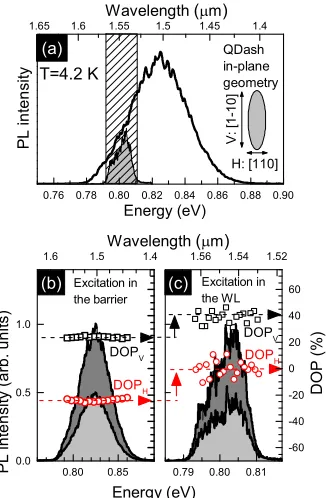
FIG. 1. (a) Low temperature (T=4.2 K) PL spectrum of InAs/In0.53Ga0.23Al0.24As/InP(001) QDashes (Eexc=1.49 eV,
Pexc=0.4µW/µm−2). Shaded area shows the spectral range defined by the bandpass filter. (b), (c) The degree of linear polarization (DOP) for the two in-plane directions (H, V) obtained under the pulse excitation in the barrier (Eexc=1.49 eV), and in the WL (Eexc=1.1 eV), respectively. (Color online)
spect to these directions. Fig.1(b) collects the results, which clearly confirm a strong polarization anisotropy of the emission process as the two cross-polarized PL spec-tra exhibit significant difference in their peak intensities. For a quantitative discussion one can introduce the de-gree of linear polarization (DOP), defined by
DOPV(H)=
IV(H)−IH(V)
IV(H)+IH(V)
. (1)
In the above-mentioned case, the
DOPV(H)
reaches
[image:2.595.361.524.56.305.2]820 825 830 835 840 794
796 798 800 802 804 806 808
Excitation energy - E
exc
(m eV)
D
e
t
e
ct
i
o
n
e
n
e
r
g
y
-E
d
e
t
(
m
e
V
)
25 31 36 42 48 53 59 64 70
DOP
V
(%)
1LO
(a)
20 25 30 35 40 40
45 50 55 60 65 70
E
exc.
- E
d et.
(m eV)
D
O
P
V
(
%
)
(b)
1LO
~20%
E det
=
794.5 meV 800.5 meV
20 25 30 35 40 0 5 10 15 20 25 30 35 E
det =
794.5 meV 800.5 meV
D
O
P
H
(
%
)
(c)
1LO
~20%
FIG. 2. (a) A 2D intensity map of the DOPV measured in the exciton-LO phonon excitation scheme inT=4.2 K. Dashed line indicates position of the LO resonance across the QDash emission. (b), (c) vertical profiles of the 2D map at a given detection energy indicating enhancement of theDOP at the LO phonon resonance for the|Viand|Hispin state pumping, respectively. (Color online)
point of view these asymmetries with respect to V and H axes lead to a light-hole (|↓/↑i) admixture to a nomi-nally purely heavy-hole (|⇑/⇓i) state, producing new hole eigenstates19, i.e. |⇑′/⇓′i ∝ |⇑/⇓i ±iε|↓/↑i. It converts
excitons’ polarizations from circular to elliptical with ma-jor axes tilted towards the V axis in the case of both states. The same holds for trions preventing them to be efficiently addressed by the linearly polarized light due to the lack of an e-h exchange interaction. In case of neutral excitons, the presence of an e-h exchange inter-action lifts the degeneracy between excitonic states. For an in-plane anisotropy introduced between V and H axes it produces two bright,|H/Vi ∝ |↓⇑′i ±i|↑⇓′i, and two
dark eigenstates, |D1/2i ∝ |↑⇑′i ± |↓⇓′i. Calculation of
interband dipole moments20,d
inter, for the bright states
indicate that they should couple to the light field lin-early polarized along H and V axes, respectively, with unequal oscillator strengths (fV/fH ∝εfor small light-hole admixtures). It is considered to be a reason for a substantial value of the intrinsic DOP at the QDash GS. Since the intrinsicDOP is known, one can measure an excess DOP that may result from a certain optical spin pumping scheme. In the following case, the exci-tation is energetically tuned to the wetting layer (WL) of the QDash structure in order to decrease the role of spin scattering events leading to a collapse of the
de-sired spin state. Excitons are expected to be created in one of the earlier defined states (|Hi or |Vi) by setting up the certain polarization of excitation. Partially, trion states are also addressed. However, as trion emission is polarized independently of the excitation, it should not contribute to the excessDOP, apart from acting as a background which weakens the observed effect. The emission was analyzed in a similar way as in the highly non-resonant excitation case, however, the PL spectrum was filtered out around 0.80 eV which allows for elimina-tion of the unwanted scattered laser light. TheDOPV(H)
obtained according to Eq.1 is plotted with open points in Fig.1(c). One may notice that under such an optical pumping scheme the DOP increased up to ∼40% and
∼0% in the case ofDOPV andDOPH, respectively. This leads us to a conclusion that the injected spin state is par-tially preserved during carriers’ relaxation to the QDash GS, so the memory of the excitation process is present to some extent. Further, it was verified an even more reliable spin pumping procedure in which the excitation is quasi-resonant with the QDash GS, namely the pump-ing via a longitudinal optical (LO) phonon was used to assure minimal excess energy and nearly immediate in-jection of a spin state to the QDash GS. Fig. 2(a) presents a 2D map of theDOPV obtained by scanning the laser photon energy (Eexc) towards the QDash emission band
defined by the spectral filter. One can notice a well re-solved intensity feature across the detection energy (Edet)
that shifts parallel to the Eexcwhile keeping the constant
distance of∼30 meV between excitation and the charac-teristic energy of the feature. The energetic distance is close to the LO-phonon energy in InAs. The upper-left corner of the 2D map reveal also another intensity fea-ture that may be related to a transverse-optical-phonon excitation in InAs, however, we skip it in a further dis-cussion. For the concerning experiment the sample was patterned by a 5×5 µm mesa structure. The discrete character of the map along its vertical axis corresponds to the fact that with the small ensemble size within the mesa and under quasi-resonant excitation single emission lines from individual QDashes can be seen. Figures 2(b), and (c) present examples of horizontal profiles, registered for the case of V and H pumping, respectively, which were cut-out from the 2D map at two different Edet. As
may be easily noticed, at the 1LO-phonon feature the DOP is strongly enhanced by∼20% with respect to the DOP measured for the WL excitation and∼35% as com-pared to the intrinsic DOP. It leads us to an initial conclusion that the creation of exciton accompanied by emission of a LO phonon can significantly preserve coher-ence within the injected spin state as it is realized likely by a coherent inelastic Stokes Raman scattering process. Although the spin memory effect is clearly present, the DOP value is expected to be much higher, up to the limit of 100%21. The lack of full polarization of
[image:3.595.93.264.59.315.2]0 1 2 3 4 5 6 7 8 V-V
PL =1.1 0.1 ns
L
o
g
.
P
L
i
n
t
e
n
si
t
y
Tim e (ns)
H-H PL
= 1.40.1 ns
T=4.2 K
(a) E
det
-E
exc
=30meV
0 1 2 3 4 -20
0 20 40 60
I
V -H P L
D
O
P
(
%
)
Tim e (ns)
(b)
DOP
V
I
V -V P L
I
H-V P L
I
H-H P L
P
L
i
n
t
e
n
si
t
y
(c )
DOP
H
0 1 2 3 4
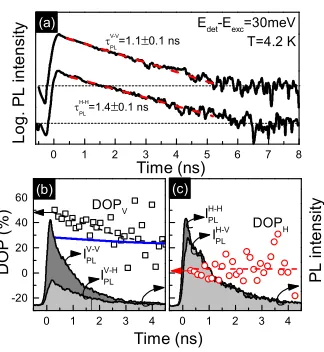
FIG. 3. (a) Low temperature TRPL traces measured within the exciton-1LO phonon excitation scheme for two configu-rations of the linear polarization of excitation and detection: V-V (upper trace) and H-H (lower-trace). Dashed red line shows the fit to a decay function. (b), and (c) TRPL traces taken for various excitation-detection schemes: V-V, V-H, H-H, H-V and resultant temporal evolution of theDOP: DOPV (black open squares in (b)),DOPH (red open circles in (c)). The blue solid line in (b) shows a temporal evolution of the in-trinsicDOP. Edet=799.4 meV,T=4.K, Pexc=30µW. (Color online)
QDash18, (iii) elliptically polarized emission from trion
states8 independent of polarization of excitation, acting
as a background for excitonic emission. A more unex-pected issue, which needs to be addressed here is the asymmetry between V-V and H-H configurations man-ifested in a significantly lower values of DOPH. This phenomenon, not present in the literature, has not been fully understood yet, however, we propose an initial ex-planation. Based on the preliminary discussion of exci-tonic states, polarization injection might be expected to be equally effective for H and V cases as interband dipole moments of the two bright states are collinear with re-spective axes. The interband contribution to the dipole moment is commonly regarded as dominant22, however,
the usually neglected intraband term may become sub-stantial for structures of a large volume. The macro-scopic character of this contribution (dintra∝ hψe|r|ψhi,
where|ψe/hiare the e/h envelope functions) in
combina-tion with a significant elongacombina-tion of QDashes promote the V component ofdintraapproximately to the same extent
for both bright states. Such contribution strongly affects polarization properties of the |Hi state as it is perpen-dicular to its dinter, which is not the case for the |Vi
state. For|dintra|/|dinter| ∼1/2 we were able to
approx-imately reproduceDOP values both cases of excitation: the quasi-resonant one (DOPV ≈48%, DOPH ≈12%) and non-resonant (DOPV /H ≈ ±21%).
Let us shift the discussion towards dynamical proper-ties of the spin excitation in QDashes. In Figure 3(a) we present TRPL traces registered at Edet=799.4 meV under
the exciton-1LO phonon spin pumping scheme. As pre-dicted from the light-hole admixture considerations, the obtained PL lifetimes (τ ∝f−1) for both states slightly
differ: τV−V=1.1±0.1 ns vs. τH−H=1.4±0.1 ns. The average exciton lifetime is surprisingly low as compared to a theoretically predicted one that is expected to be approximately 2.0 ns23 for the strong confinement limit.
In this case one has to take into account a dense struc-ture of hole states induced by the QDash size, as indi-cated by calculations of the QDash band structure18,19,23,
that influences the exciton radiative lifetime. In order to study a temporal evolution of theDOP, additional two TRPL traces were measured in the following excitation-detection configurations: V-H, and H-V. Subsequently, theDOP was calculated according to Eq.1 and the re-sults are presented in Fig. 3(b) (open black squares) - for theDOPV, and Fig. 3(c) - for the DOPH. The asym-metry between DOPH and DOPV discussed for time-integrated spectra is naturally present also here. Unfor-tunately, the amplitude of theDOPHis so small that it is registered with a rather large uncertainty in the present experiment. The DOPV decays from ∼50% to ∼27% within a time interval of ∼4.5 ns from the excitation, which gives ∼1.7 ns of the decay time constant. This time is not related to the spin polarization lifetime since it results from the difference in oscillator strengths along H and V directions. However, the observation of purely monoexponential decays (up to 6 ns) allows us to es-timate, basing on a rate equation model, that any spin relaxation process present in the system has to be slower than 15 ns.
In conclusion, we investigated the impact of vari-ous schemes of the optical spin pumping in the self-assembled InAs/In0.53Ga0.23Al0.24As/InP(001) quantum
dash structure emitting at 1.55µm on spin memory at the ground state. The highly non-resonant spin pump-ing did not lead to a preservation of the spin memory of an excitation, however, the registered polarization degree of∼25% pointed to an important intrinsic property of a QDash confinement caused by the valence band mixing and anisotropic exchange interaction. In the case of spin injection into the WL of QDashes, the DOP increased considerably by more than 15% with respect to the in-trinsicDOP, which means the presence of spin memory effect. However, the best results were achieved in the case of exciton-1LO pumping scheme, for which the resultant DOP reached∼50%.
This research was supported by The National Science Center grant MAESTRO No. 2011/02/A/ST3/00152. The authors acknowledge technical support from Hama-matsu Co. in near infrared streak camera apparatus. MG would like to thank Prof. P. Machnikowski for valuable discussion. LD acknowledge financial support from the Foundation for Polish Science within the START fellow-ship.
1J. Brault, M. Gendry, G. Grenet, G. Hollinger, Y. Desi´eres, and
[image:4.595.95.257.53.229.2]2H. Li, T. Daniel-Rice, and M.-A. Hasan, Appl. Phys. Lett.80,
1367 (2002).
3A. Sauerwald, T. Kmmell, G. Bacher, A. Somers, R.
Schwert-berger, J. P. Reithmaier, and A. Forchel, Appl. Phys. Lett.86,
253112 (2005).
4J. P. Reithmaier, A. Somers, S. Deubert, R. Schwertberger, W.
Kaiser, A. Forchel, M. Calligaro, P. Resneau, O. Parillaud, S. Bansropun, M. Krakowski, R. Alizon, D. Hadass, A. Bilenca, H. Dery, V. Mikhelashvili, G. Eisenstain, M. Gioannini, I. Montros-set, T. W. Berg, M. van der Poel, J. Mork, and B. Tromborg, J. Phys. D: Appl. Phys.38, 2088 (2005).
5M. Z. M. Khan, T. K. Ng, B. S. Ooi, Prog. Quantum Electronics
38, 237 (2014).
6F. Lelarge, B. Dagens, J. Renaudier, R. Brenot, A. Accard, F.
van Dijk, D. Make, O. Le Gouezigou, J.-G. Provost, F. Poingt, J. Landreau, O. Drisse, E. Derouin, B. Rousseau, F. Pommereau, and G.-H. Duan, J. Sel. Top. Quantum Electron.13, 111 (2007).
7J. P. Reithmaier, G. Eisenstein, and A. Forchel, Proc. IEEE95,
1779 (2007).
8 L. Dusanowski, M. Syperek, P. Mrowi´nski, W. Rudno-Rudzi´nski,
J. Misiewicz, A. Somers, S. H¨ofling, M. Kamp, J. P. Reithmaier, and G. S¸ek, Appl. Phys. Lett.105, 021909 (2014).
9P. Mrowi´nski,A. Musia l, A. Mary´nski, M. Syperek, J. Misiewicz,
A. Somers, J.P. Reithmaier, S. H¨ofling, and G. S¸ek, Appl. Phys. Lett.106, 053114 (2015).
10Weidong Sheng and Pawel Hawrylak Phys. Stat. Sol (c)3, 3744
(2006).
11N. A. J. M. Kleemens, J. van Bree, M. Bozkurt, P. J. van
Veld-hoven, P. A. Nouwens, R. N¨otzel, A. Yu. Silov, and P. M. Koen-raad, M. E. Flatt´e Phys. Rev. B79, 045311 (2009).
12D. Kim, W. Sheng, P. J. Poole, D. Dalacu, J. Lefebvre, J.
La-pointe, M. E. Reimer, G. C. Aers, R. L. Williams Phys. Rev. B
79, 045310 (2009).
13V. V. Belykh, A. Greilich, D. R. Yakovlev, M. Yacob, J. P.
Re-ithmeier, M. Benyoucef, and M. Bayer Phys. Rev. B92, 165307
(2015).
14Single Quantum Dot: Fundamentals, Applications, and New
Concepts, eds. Peter Michler (Springer-Verlag Berlin Heidelberg, 2003).
15R. Seguin, A. Schliwa, S. Rodt, K. P¨otschke, U.W. Pohl, and D.
Bimberg Phys. Rev. Lett.95,257402 (2005).
16L. He, M. Gong, Ch.-F. Li, G.-C. Guo, A. Zunger Phys. Rev.
Lett.101, 157405 (2008).
17Ch.-H. Lin, T. You, H.-Y. Chou, S.-J. Cheng, S.-D. Lin,
W.-H. Chang Phys. Rev. B83, 075317 (2011).
18A. Musia l, P. Kaczmarkiewicz, G. S¸ek, P. Podemski, P.
Mach-nikowski, J. Misiewicz Phys. Rev. B.85035314 (2012).
19P. Kaczmarkiewicz, A. Musia l, G. S¸ek, P. Podemski, P.
Mach-nikowski, J. Misiewicz, Acta. Phys. Pol. A119, 633 (2011)
20Spin-Orbit Coupling Effects in Two-Dimensional Electron and
Hole Systems, R. Winkler, Vol. 191 of Springer Tracts in Modern Physics (Springer, Berlin, 2003).
21Optical Orientation, ed. F. Meier and B. Zakharchenya, Modern
Problems in Condensed Matter Science Vol. 8 (North-Holland, 1984).
22J. Andrzejewski, G. S¸ek, E. OReilly, A. Fiore, and J. Misiewicz,
J. Appl. Phys.107, 073509 (2010).
23M. Syperek, L. Dusanowski, J. Andrzejewski, W.
Rudno-Rudzi´nski, G. S¸ek, J. Misiewicz, and F. Lelarge Appl. Phys. Lett.