This content has been downloaded from IOPscience. Please scroll down to see the full text.
Download details:
IP Address: 138.251.162.208
This content was downloaded on 26/05/2015 at 09:53
Please note that terms and conditions apply.
Quantum tight-binding chains with dissipative coupling
View the table of contents for this issue, or go to the journal homepage for more 2015 New J. Phys. 17 043065
PAPER
Quantum tight-binding chains with dissipative coupling
D Mogilevtsev1,2, G Ya Slepyan3, E Garusov2, S Ya Kilin2and N Korolkova4
1 Centro de Ciências Naturais e Humanas, Universidade Federal do ABC, Santo André, SP, 09210-170, Brazil 2 Institute of Physics, Belarus National Academy of Sciences, Nezavisimosty Ave. 68, Minsk 220072, Belarus
3 Department of Physical Electronics, School of Electrical Engineering, Faculty of Engineering, Tel Aviv University, Tel Aviv 69978, Israel 4 School of Physics and Astronomy, University of St Andrews, North Haugh, St Andrews KY16 9SS, UK
E-mail:[email protected]
Keywords:spin chain, dissipative coupling, non-exponential decay, random walk
Abstract
We present a one-dimensional tight-binding chain of two-level systems coupled only through
common dissipative Markovian reservoirs. This quantum chain can demonstrate anomalous
thermodynamic behavior contradicting Fourier law. Population dynamics of individual systems of the
chain is polynomial with the order determined by the initial state of the chain. The chain can simulate
classically hard problems, such as multi-dimensional random walks.
1. Introduction
Coherent chains of interacting quantum systems represent a wide class of physical objects that define the behavior of matter under different physical conditions. Study of theoretical models for these objects, which was started by the epoch-making works by Hubbard [1] and Ising [2], covers both new forms of matter and new types of interactions [3]. One can coherently chain cooled atoms in optical lattices [3], Josephson qubits in microwave transmission lines [4], semiconductor quantum dots, etc. Interactions between systems can be of quite different physical nature: spin-exchange interactions or pseudospin interactions corresponding to the dipole optical transitions [5], tunneling [6], dipole–dipole interactions [7,8], photonic interactions (Jaynes– Cummings–Hubbard model [9]) and many others. Recent applications of these models led to a number of new fundamental results. For example, 1D—chain of tunnel-coupled systems with two ends connected to heat reservoirs served as a model to justify the Fourier heat conduction law from thefirst principles and to provide microscopic definition of temperature [11,12]. Other results to be mentioned are the directivity of collective spontaneous emission [7,13]), possibility to transfer quantum states [16], the spatial propagation of Rabi oscillations (Rabi-waves) [14,15], and quantum optical nonreciprocity of the medium in timed Dicke state [17].
It is of particular importance to study new types of interactions that determine the coherent behavior of coupled systems. Here we suggest to couple them in a chain by connecting them pair-wisely to common dissipative reservoirs. It is already well-known that coupling several quantum systems to the same dissipative reservoir allows to obtain a number of highly non-trivial effects. First of all, such a coupling can create a decoherence-free subspace [18,19]. An arbitrary initial state is eventually transferred into this subspace. Thus, it is possible to produce non-classical and entangled states via dissipative dynamics even without any direct interaction between quantum systems [20]. This effect has many potential applications. For example, it was recently used in practice to protect the highly entangled initial polarization states of photons from dephasing in opticalfibers [21]. Moreover, combining coupling to the same reservoir with the nonlinear interaction between quantum systems, it is possible to produce nonlinear loss generating robustly a wide variety of non-classical states [22–24]. By adding external driving, a generated non-classical state can be preserved in the presence of an arbitrarily large linear loss [25].
Here we show that by coupling a set of quantum systems through common Markovian reservoirs and forming one-dimensional tight-binding chain, it is possible to produce highly non-trivial dynamics. Such a dissipatively coupled set of just a few two-level system renders a possibility to reproduce dynamics of far more complex systems, such as classical heat reservoirs and multi-dimensional random networks. This dynamics can be‘tuned’by choice of the initial state of the system.
OPEN ACCESS
RECEIVED 11 December 2014
REVISED 24 March 2015
ACCEPTED FOR PUBLICATION 31 March 2015
PUBLISHED 30 April 2015
Content from this work may be used under the terms of theCreative Commons Attribution 3.0 licence.
Any further distribution of this work must maintain attribution to the author(s) and the title of the work, journal citation and DOI.
We demonstrate that even for a few systems in the chain certain groups of matrix elements of the chain density matrix evolve according to equations formally coinciding with the equations describing classical random walks. For no more than one initial excitation in the chain, matrix elements of the single-excitation subspace evolve according to the equation describing two-dimensional classical random walk. Simultaneously, matrix elements describing coherences between the single-excitation and zero-excitation subspaces evolve according to the equation describing one-dimensional random walk. Taking more than one initial excitation in the chain, one is able to obtain dynamics governed by equations describing multi-dimensional classical random walks. This fact leads to a number of quite-counterintuitive consequences. Notwithstanding the Markovianity of reservoirs, a decay of excitation in any system of the chain is polynomial with the same power. By choosing the initial states, it is possible to obtain a population decay law1 t2m+1, for an arbitrarym>0, provided that the
chain is long enough. The sum of density matrix elements described by the random walk equation is conserved. So, one can observe rather peculiar thermodynamics-like behaviour of the chain. Despite seemingly classical character, this‘thermodynamics’is quite anomalous. The stationary state of the chain can be entangled. Moreover, energyflow through the chain is not described by the Fourier law, whereas theflow of coherences is governed by it.
The outline of paper is as follows. In the section2we introduce the concept of tight-binding dissipatively coupled quantum chain. Also, we show how this‘quantum gadget’can be built in practice from usual tight-binding unitary chain by selectively applying strong dissipation to certain systems in the chain. In the section3
we derive equations for the simplest case of the chain dynamics corresponding to an initial state with no more than just one excitation. Already in this case the chain exhibits a rich variety of highly unusual phenomena. We highlight the thermodynamical analogies in the section4. In the section5we analyze in more details possibilities of having different polynomial decay for specific choices of initial states of the chain. Then, in the section6we discuss the dynamics of the chain in the case of multiple initial excitations demonstrating how conservation of coherences might arise in this case, too.
2. The chain
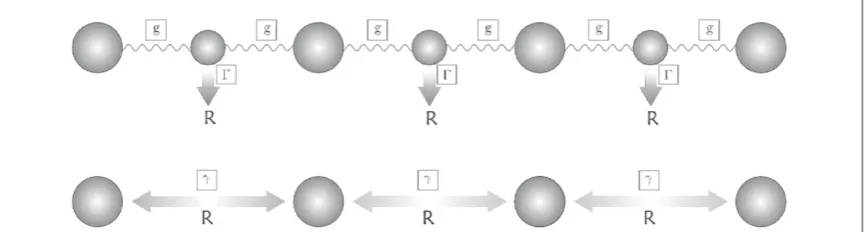
Here we are discussing dynamics of a set of quantum objects coupled only through common dissipative reservoirs. We are interested in dynamics arising for the case when our set is rather large (with the number of objects,N≫1). In this paper we consider one of the simplest cases of such a set, namely, a tight-binding one-dimensional chain of identical two-level systems (TLS), e.g., spins or pseudo-spins. The general scheme of such an arrangement is as follows. Each spin is supposed to be coupled to common Markovian reservoirs with one of two neighbors:jth TLS and(j+1)th TLS are coupled to commonjth reservoir,(j−1)th TLS andjth TLS are coupled to(j−1)th reservoir, etc. Reservoirs are supposed to be independent (seefigure1(below)). Thus, we are considering here dynamics of the compound object described by the following generic effective master equation:
∑
ρ= γ ρ −ρ − ρ
=
− + + − + −
(
)
t S S S S S S
d
d 2 , (1)
j N
j j j j j j j
1
where Linbdlad operators are
σ σ
= −
− − + −
Sj j j 1
andσj±= ∣ ± 〉〈 ∓ ∣j j are rasing/lowering operators for thejth TLS. Vectors∣ ± 〉j describe excited/ground
[image:3.595.121.554.63.179.2]consider thefinite-size homogeneous chain, thus we take
γ = γ ⩽ ⩽
⩽ ⩾ +
j N
j j N
, 1 ,
0, 0, 1. (2)
j ⎧ ⎨ ⎩
Whereγis a given constant andN+1is the total number of TLS in the chain, whereasNis the total number of reservoirs. The definition (2) corresponds to the total insulation of the chain from the outside areas of space, i.e., the absence of quantumflux over the chain boundaries.
Notice that equation (1) is the quite general and describes a 1D set of pairwise dissipatively coupled system. A number of different physical models can lead to such an equation. For example, similar band structure of dissipators can arise in a graphene-like model based on a honeycomb lattice with nearest-neighbor and next nearest-neighbor couplings (Haldane model) [26]. Now let us discuss some examples to demonstrate feasibility of dissipatively coupled chain and possibility to realize it in practice.
First of all, let us point out that the dissipatively coupled chain can be produced just by subjecting some elements of a usual tight-binding chain with exchange interaction (like dipole–dipole or spin–spin interactions) to strong Markovian loss. Such a lattice with the regular pattern of dissipative sites (the every second one) were considered recently in the context of quantum walks and was shown to exhibit such non-trivial effects as topological transitions [33]. So, let us consider a simple example of a tight-binding 1D chain of TLS with every second TLS coupled to the separate bosonic reservoir (seefigure1(above)). Such a system is described by the following Hamiltonian
= + + +
Htotal( )t H0 Hchain Hreservoirs Vreservoirs, (3)
where the HamiltonianH0describes non-interacting chain systems with the transition frequencyω0(we are
using the system units with≡1)
∑
ω σ σ
= + −
H , (4)
l l l
0 0
and the Hamiltonian of direct spin–spin (or dipole–dipole) interaction is
∑
σ σ σ σ=
(
++ −− + +−)
H ig . (5)
l
l l l l
chain 1 1
The Hamiltonian,Hreservoirs, describes modes of independent bosonic reservoirs coupled to the corresponding TLS of the chain
∑
ω=
H b b , (6)
lk
lk lk lk
reservoirs †
whereωlkis the frequency of the bosonic mode described by the annihilation operator,blk, and the creation operatorblk†. The operatorVreservoirsdescribes coupling of the chain systems to dissipative reservoirs, and can be represented as
∑
σ=
(
+ +)
V g b h.c. , (7)
lk
lk l lk
reservoirs
whereglkis the interaction constant for coupling of thelth chain systems with the modeblk.
In the interaction picture with respect to the bosonic reservoirs Hamiltonian,Hreservoirs, and the chain Hamiltonian,H0, the total Hamiltonian (3) becomes
= +
Htotal( )t Hchain V t( ), (8)
where
∑
σ=
(
+ +)
V t( ) R t( ) h.c. , (9)
l l l
and reservoir operators are
∑
ω ω=
{
− −}
R tl( ) v b exp i( ) .t (10)
k
lk lk lk 0
We assume that our bosonic reservoirs are Markovian, mutually independent, and initially in the vacuum state. So, the following relations hold
τ δ Γ δ τ
τ τ
≈ −
= =
R t R t
R t R R t R
( ) ( ) ( ),
( ) ( ) ( ) ( ) 0,
l k lk l
l k l k
†
whereΓlis the decay rate intolth reservoir,δ(t−τ)is the Dirac delta-function and the averaging denoted by
〈…〉is carried over the states of reservoirs.
Now let us suggest that only the every second system of the reservoir is subjected to loss, i.e.Γ2l+1≡ 0. Also, we assume that losses are occurring on the time-scale much shorter than the dynamics of the excitation exchange described by the Hamiltonian (5). Then, taking for simplicity equal decay rates,Γl ≡Γ, in the basis rotating with
the frequencyω0, one arrives at the following master equation
∑
ρ= − ρ + Γ
(
σ ρσ− +−ρσ σ+ −−σ σ ρ+ −)
t H
d
d ¯ i , 2 ¯ ¯ ¯ , (11)
l
l l l l l l
chain 2 2 2 2 2 2
⎡⎣ ⎤⎦
Let us assume that TLS corresponding to dissipative sites are initially in the ground states. If the dissipation rate,Γ, is high enough in comparison with the strengths of direct interaction between neighboring spins,g, variables corresponding to TLS with even numbers can be adiabatically eliminated. Indeed, in this case for the dissipative sites we have
σ σ σ τ σ σ τ
σ σ τ δ Γ τ
= = =
≈ − −
− − − + −
− +
t t t
t t
( ) 0, ( ) ( ) ( ) ( ) 0,
( ) ( ) exp{ 2 ( )}.
l l m l m
l m lm
2 2 2 2 2
2 2
Then, taking TLS in dissipative sites as reservoirs and deriving the master equation up to the second order with respect to the ratiog2 Γ(see, for example, [34]), one can obtain from the master equation (11) the master equation equation (1) describing dissipatively coupled tight-binding chain with the dissipative rateγ≈g22Γ.
Thus, we have demonstrated one of the ways to obtain the dissipatively coupled chain. One can get it as the limiting case of a usual tight-binding chain with some sites subjected to losses. Such a bipartite dissipative lattice shown infigure1(b) can be realized in practice in a lot of different ways. For example, it can be build using a chain of color-center defects in diamond microcrystallites [35]. For color-center defects in diamond
microcrystallites it is typical to have very low decoherence rates even at room temperature. Such objects can be manipulated with high precision and addressed individually by applied external electromagneticfields [36]. Also, chains of individually manipulated atoms deposited on the metallic surface can be used for the purpose [37–39]. Among possible perspective candidates one can mentions schemes with trapped ions in optical lattices [40,41], photonic structures described by Jaynes–Cummings–Hubbard model [9], coupled system of optical waveguides [10], Bose–Einstein condensates in multiple-well potentials [22], or even networks of pigments in light-harvesting molecules [42,43].
To realize the chain it is not necessary to manipulate‘chain links’with high precision and address them individually. In our example, one can avoid coupling strongly dissipative reservoirs to the every second TLS in the chain. Restrictions imposed on precision of individual addressing can be significantly relaxed, if one considers a strongly coupled sufficiently long sub-chain instead of just one TLS as a lossy system to be adiabatically eliminated (an example of realistic consideration of such a dissipative sub-chain one can see, for example, in [27]).
3. Single-excitation equations
To clarify essential features of dynamics prescribed by the master equation (1), let us consider the initial chain state confined to the single-excitation subspace. Then, as follows from equation (1), the single-excitation matrix elements
ρkl = 1k ρ 1 ,l
satisfy the following equation:
ρ γ γ γ γ ρ
γ ρ γ ρ γ ρ γ ρ
= − + + +
+ + + +
− −
+ − − + − −
(
)
t
d d
, (12)
kl k k l l kl
k k l k k l l k l l k l
1 1
1, 1 1, , 1 1 , 1
where the relaxation rates,γk, are defined in accordance with conditions (2). Away from the edges, equation (12) coincides with a standard equation for a discrete classical random walk in two-dimensions in continuous time, and describes diffusive propagation of the excitation through the chain mediated by emission to reservoirs and re-absorption from them [28].
As follows from equation (1), the coherences between the single-excitation subspace and the vacuum
∏
ρ = ρ = −
= +
1 0 , 0
k k
k N
k
0
satisfy the standard classical equation for the one-dimensional discrete classical random walk:
ρ = −
(
γ +γ−)
ρ +γ ρ+ +γ− ρ−t
d
d k0 k k 1 k0 k k 1,0 k 1 k 1,0. (13)
The immediate consequence of the classical form of both equations (12) and (13) is the conservation of sums of corresponding matrix elements:
∑
∑
∑
∑
ρ ρ ρ ρ = = = = = + = + = + = + W t F t( ) (0),
( ) (0). (14)
k l N kl k l N kl k N k k N k , 1 1 , 1 1 1 1 0 1 1 0
Equation (14) are a consequence of collective character of coupling to reservoirs. The chain described by the master equation (1) has another pure stationary state in addition to the usual lowest-energy one. This state satisfies the equationSj−∣ 〉 =Ψ 0, for allj. It is a pure and an entangled state. It describes the equal superposition of single-excitation states. For a chain withN+ 1elements this state is
∑
Ψ = + = + N 11 j 1 , (15)
N j 1 1 where
∏
= + − ≠1j j .
k j k
So, the state (15) describes just one excitation‘spread’homogeneously over all the systems of the chain. Equations (12) and (13) can be easily solved analytically [44]. For example, the solution for the elements
ρkl( )t can be written as
∑
ρ = α −λ
= +
{
}
t t
( ) exp , (16)
kl
m n N
mnkl m n
, 1 1
,
where the eigenvalues for equation (12) are
λ = γ π π
+ + + m N n N 4 sin
1 sin 1 .
m n, 2⎜ ⎟ 2⎜ ⎟
⎧ ⎨ ⎩ ⎛ ⎝ ⎞ ⎠ ⎛ ⎝ ⎞ ⎠ ⎫ ⎬ ⎭
The coefficientsαmnkl are defined from the initial state:
αmnkl =νkm lnν Φm ρ(0) Φn ,
where the coefficients are
ν = −δ π
+
+
(
2)
cos N2 k m1 .
km k N, 1
⎛ ⎝
⎜ ⎞⎠⎟
The symbolδijdenotes Kronecker delta, and the vectors are
∑
Φ = ν
+ =
+
N
1
1 1 . (17)
l n N ln n 1 1
Vectors (17) are mutually orthogonal,〈Φ Φm∣ n〉 =δmn. However, they do not diagonalize the density matrix,ρ.
SinceλN+1,N+1=0, the vector∣ΦN+1〉is the stationary state∣ 〉Ψ , see equation (15).
Solution of equation (13) is similar to the solution of equation (12). Equation (12) can also be viewed as a discretization of the standard heat-transfer equation in the squareL×L, whereL=Na 2is the chain length, andais the doubled distance between neighboring systems in the original chain (the one depicted above in
figure1). The later one can be obtained by assumingak→x,al→y:
ρ ≈ γ ∂ ρ ρ
∂ +
∂ ∂
t x y t a
x y t x
x y t y
d
d ( , ; )
( , ; ) ( , ; ) . (18) 2 2 2 2 2 ⎛ ⎝ ⎜ ⎞ ⎠ ⎟
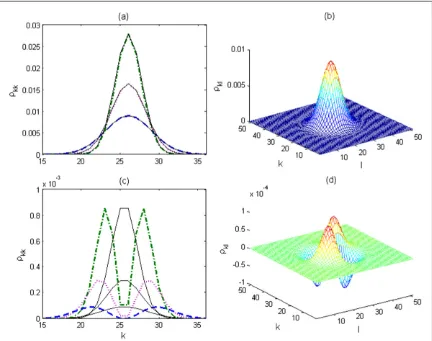
transfer. Infigure2(a) examples of dynamics are shown for the case of just one TLS being initially completely excited. Even for modest number of TLS in the chain (N= 51 for our example depicted infigure2) solutions of equation (12) given by equation (16) are very close to the fundamental solution of equation (18) obtained in the limit of infinitely length chain
ρ
γ γ
=
{
− − + −}
x y t
a t x x y y a t
( , ; ) 1
4 exp ( ) ( ) 2 , (19)
0 2 ⎡⎣ 0 2 0 2⎤⎦ 2
forγt>1. Herex0,y0denote the position of the initial excitation.
A continuous approximation for equation (13) is the 1D heat-transfer equation
ρ ≈ γ∂ρ
∂
t z t a
z t z
d
d ( ; )
( ; )
. (20)
2 2 2
All the consideration given above can be extended for this case, too. So, our dissipatively coupled 1D chain can simulate simultaneously both 1D and 2D classical random walk, or heat transfer.
[image:7.595.120.552.61.402.2]Non-exponential decay in our chain is stipulated by nonlocality of Lindblad operators in equations (12) and (13)). It is interesting and instructive to compare the dynamics of population decay in our chain with dynamics of collective spontaneous emission of dense atomic cloud with dipole–dipole interaction [7,8]. The continuous limit of master equation correspondent to the model considered in [7,8] is given by equation (A.5) in the appendixA. Equation (A.5) looks similar to equation (18) and also manifests an algebraic law of population decay,1 γt[7]. However, it holds in 3D-space, and describes quite different physical process. The reason for it is the formal equivalence of equation (A.5) to the master equation with nonlocal Lindblad operators. This nonlocality arises from non-conservation of the excitation number and from accounting for quantum states corresponding to two excited atoms and one virtual photon with‘negative’energy [7].
Figure 2.(a) A solution of the master equation equation (12) for diagonal elements,ρkk, for only one TLS initially excited (the one in
the middle of the chain,j= 26). Dashed–dotted, dotted and dashed curves correspond to the timesγt=3, 5, 9. Thin solid lines depict results equation (19) given by the heat equation. (b) A solution of equation (12) for all elements,ρkl, for only one TLS initially excited
4. Anomalous heat transfer
Equations (12) and (13) tell us that elements of the density matrix in the energy eigenstates basis evolve according to classical equations. However, despite this fact, the energyflow through the 1D chain cannot be described by the 1D classical Fourier law even in the limit of the large number of TLS in the chain. This holds even in the case, where the density matrix elements of the initial single-excitation state are non-negative. Indeed, as it was shown in the previous section (see equation (14)), the sum of matrix elements
∑
ρ == +
W ,
k l N
kl
, 1 1
is preserved. Simultaneously, the total upper-state population of the chain does decay. As it follows from equations (12), for example, for the initial state being just one completely excited TLS, the total population behaves in the following way:
∑
∑
ργ
= ∝
= +
= +
t
1 1 1 .
k N
k k k N
kk
1 1
1 1
A physical reason for breaking the classical Fourier heat conductivity law is rather simple. Besides the energy transport occurring in one-dimension (along the chain), there is an additional motion. Fourier law is always breaking down in presence of additional motions (the simplest example is the convection in liquids [29]). In our case this additional motion is aflow of quantum coherence. Indeed, in the continuous approximation the energy
flux along the chain reads as
ρ
∝ ∂
∂
→
J x x
x x y t
( , ) lim ( , ; ). (21)
y x
The right-hand part of this equation cannot be represented in the form of the gradient of a scalar function satisfying the 1D heat-transfer equation. Thus, the right-hand part of equation (21), or the energy per TLS,
ρ( , ; )x x t , cannot be associated with classical temperature [29]. Since in our chain not only energy is
transported, but also quantum coherences, it is possible to introduce the concept of the effective 2D‘quantum temperature’and 2D quantumflux as, correspondingly
ρ
ρ
=
⃗ ∝
T x y t x y t
J x y t x y t
( , ; ) ( , ; ),
( , ; ) ( , ; ).
q
q xy
The value of the real energyflux corresponds to thex-component of quantumflux,ex⃗ ·J x x tq⃗( , ; ), whereex⃗ is
the unit vector along the chain, while they-component describes the coherences transfer. This additional motion produces a second dimension in the heat transfer equation and leads to the anomalous thermodynamics. A number of examples of an anomalous thermodynamical behavior for quantum structures is known (see, for example, [30–32]). But the dissipatively coupled chain differs starkly by the nature of anomaly. One can retrieve classical thermodynamics and establish connection between‘classical’and‘quantum’temperatures by
neglecting the additional motions in equation (18), i.e. by averaging out some coherences. Indeed, introducing the averaged temperature and averaged energyflux as
∫
ρ=
Tclass( ; )x t ( , ; )d ,x y t y (22)
∫
⃗ = ⃗
Jclass( ; )x t J x y tq( , ; )dy (23)
one obtains 1D heat transfer equation for temperature and relation between the temperature and energyflux
⃗ = ⃗ ∂
∂
J x t e
xT x t
( ; ) x ( ; ),
class class
in full agreement with Fourier heat conductivity theory. But there is no convincing reasons for such
approximation to be done and for the association of the integrals (22), (23) with a real physical temperature and a real energyflux. As it will be shown below, use of such classical model in our case leads to the disappearance of some important observable regimes.
5. Polynomial decay of populations
law on the type of initial state gives one an opportunity of identifying initial states of the chain by measuring the population of just one TLS.
We have obtained that for the simple 1D set of TLS coupled to common Markovian reservoirs and the single initially excited TLS, the upper-state population decay for chain TLS occurs polynomially, according the the1 t law. Let us now demonstrate by just adjusting the initial state of the chain, one can obtain a population decay law
+
t
1 2m 1for an arbitrarym⩾0. Interestingly, we can arrange initial conditions that are hardly possible in the classical case. In particular, it is possible to create equivalents of neighboring regions with‘positive’and
‘negative’temperatures (or even‘imaginary’ones). It can be done by choosing an initial state with components orthogonal to the stationary state (15). An example ofρkldynamics for such a state is demonstrated in
figure2(c), where the solutions of equation (12) are shown for entangled initial states:
ρ± = ψ± ψ± , ψ± =
(
± +)
1
2 1j 1j 1 . (24)
The solution for the stateρ+behaves itself‘classically‘: both closely situated initial peaks are soon merged together in one Gaussian shape. However, dynamics with the initial stateρ−is drastically different: negative elements,ρkl, do persist (figure2(d)), and initially close peaks are distancing from each other with time. Moreover, excitation displacement for the initial stateρ−appears to be faster than for the initial stateρ+. Such a difference can be quite simply illustrated with the solution of the continuous approximation (18). The continuous analog ofρ±can be represented as
ρ δ δ δ δ
δ δ δ δ
= ∝ − − + − + − +
± − + − ± − − +
±
(
) (
)
(
)
(
)
(
)
(
)
(
)
(
)
x y t x x y y x x a y y a
x x a y y x x y y a
( , ; 0) ( ) ( )
( ) ( ) ,
0 0 0 0
0 0 0 0
whereδ( )x is the delta-function. It is easy to see that when the excitation has spread for distancesx,ysuch that
− + − ≫
x x y y a
( 0)2 ( 0)2 ,
the solution for the initial stateρ+is given by equation (19). However, for the initial stateρ−dynamics is quite different. When the excitation has spread far enough, the solution for the initial stateρ−is
ρ( , ; )x y t ≈2ρ0( , ; )(x y t x−x0)(y−y0) (2a tγ) .3
Thus, just by choosing the initial state to beρ−, we get the population decay law1 t3. This state doesn’t exist
within the bounds of quasiclassical Fourier theory. Indeed, the averaging of this state following (22), (23) leads to the trivial solution: the temperature as well as energyflux equal to zero at arbitrary point of space for every moment of time. It is not hard to see that the population decay law can be further varied by choice of the initial state. Let us consider pure initial states of the general form
∑
ϕ = −
=
+
f
( 1) 1 , (25)
i m
i i k i
0
wherefiare some scalar coefficients, and the excitation is assumed to be well localized,m≪N. Taking the continuous approximation and using the quantitym tγ ≪1as small parameter, from equation (25) we straightforwardly obtain the following approximation:
∑
∑
ρ ρ
γ
≈
× − − + −
= ∞
= +
(
)
x y t x y t
n a t
f f x x j y y
( , ; ) ( , ; ) 1
! 2
( 1) i( ) ( ) . (26)
n
n
i j m
i j i j
n
0
0 2
, 0
0 0
⎡⎣ ⎤⎦
Starting with the initial state (25) and choosing the coefficientsfiin the form of the normalized binomial coefficients,fi ∝ m i m! ! ( −i)!, we get thefirst non-zero term in the approximation (26) of the order of
+
t
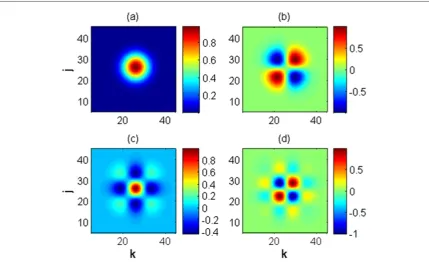
1 2m 1. Examples of exact solutions for initial states (25) are shown infigure3. The panels ((a)–(d)) corresponds tom= 0, 1, 2, 3.
Notice, that the states (25) are non-correctly described within the bounds of the quasiclassical Fourier theory. The‘classical’averaging of states (25) as it is done in equations (22) and (23) can lead to the drastic deformation of them (for example, the states orthogonal to the stationary state will be reduced to zero by such averaging). Mind that polynomial decay regimes considered here are taking place for times, when initially localized excitation has spread far enough. However, we do not consider here an influence of edges. That is, we limit ourselves to the time intervals satisfyingam<v t( )<aN, wherev(t) is the variance of the distribution
6. Multi-excitation dynamics
It is easy to surmize from equation (1) that there is a profound difference between chain dynamics in cases of one and multiple initial excitations. Indeed, the state with multiple excitations will inevitable decay toward mixture of the stationary state (15) and the vacuum state. Generally, for the initial state with no more thanNexcitation, equations of density elements corresponding to theN-excitation subspace describe2N-dimensional classical random walk with losses (see equations for an arbitrary number of initial excitations given in appendixB). However, even in this case one can still model lossless multi-dimensional random walks within some limited period of time and for some specific classes of initial states. Moreover, there are regimes when one can have preservation of coherences, where the chain behaves itself in quite‘thermodynamic’way.
Let us illustrate our consideration with the case of no more than two initial excitations in the chain . Two-excitation matrix elements are
ρm nk l,, = 1 , 1k l ρ 1 , 1 ,m n
where
∏
= + + −
≠
1 , 1k l k l .
j k l j
,
In difference with equation (12), there are two different kinds of equations for the matrix elementsρm nk l,, . For the elements without neighboring indexes, i.e. fork≠l±1andm≠n±1, from equation (1) one gets the following system of equations (for the sake of illustration we are giving here equations only for the internal TLS of the chain, i.e.k l m n, , , ≠1, N+ 1):
γ ρ ρ ρ ρ
ρ ρ ρ
ρ ρ ρ
= − + +
+ + +
+ + +
+ −
− +
−
+ − +
t
1 d
d 8
. (27)
m n k l
m n k l
m n k l
m n k l
m n k l
m n k l
m n k l
m n k l
m n k l
m n k l
, ,
, ,
, 1,
, 1, ,
, 1 , , 1
1, , 1,
,
, 1 ,
, 1 ,
Obviously, equation (27) coincides with the equation for 4D classical random walk and in the continuous limit transforms to the 4D heat-transfer equation.
[image:10.595.121.551.61.323.2]The situation is quite different for the matrix elements with neighboring indexes. Let us assume, for example, thatl= k+ 1. Then, instead of equation (27) one has
Figure 3.Contour plots of exact solutions of the master equation equation (12) for initial states (25). For the panel (a) the initial state is the just one completely excited system,m= 0. For the panel (b)m= 1,f0=f1=1 2. For the panel (c)m= 2,f0=f2=1 6,
=
γ ρ ρ ρ ρ
ρ ρ ρ ρ
= − + +
+ + + +
+ + − + +
− + − +
t
1 d
d 8
. (28)
m n k k
m n k k
m n k k
m n k k
m n k l
m n k l
m n k l
m n k l
, , 1
, , 1
, 1, 1
, , 2 1,
,
1, ,
, 1 ,
, 1 ,
Equation (28) does not coincide with the equation for classical random walk. It contains terms describing loss. It can be easily seen in the continuous limit, since then, for example, one has
ρ −ρ → ∂ ρ
∂
+ +
→ a x
(
x x y z t)
lim , , , ; ,
m n k k
m n k k
x x
, , 2
, , 1
2
1 2
2 1
where variablesx x1, 2, ,y zcorrespond to the indexesk l m n, , , , respectively. Of course, it should be expected.
Multi-excitation state does decay toward the single-excitation one.
Equations (27) and (28) point to a number of quite counter-intuitive conclusions. First of all, if the initially excited TLS are far from each other, the spread of coherences occurs as for lossless multi-dimensional random walk till the excitation spreads to neighboring TLS. Notice, that it will take place even in the case of entangled initial state of several TLS. If one has initially several uncorrelated excited TLS being far from another, the whole chain behaves like a set of unconnected chains with just one excitation per chain till the excitation spreads to neighboring TLS. So, it means that one might have a sort of conservation of coherences in this case, too.
Let us demonstrate an appearance of such a‘conservation law of a sorts’with the example of two initially non-interacting chains with no more that one excitation in each. So, we take that there are chains ofMandN
TLS with bothM N, ≫1. Also, corresponding sums of coherences (14), denoted asWMandWNare supposed to be much less than number of TLS,WX≪X,X=M N, . We assume that the chains are initially in the
stationary states
ρ = W Ψ Ψ + −
X
W
X V V
1 , (29)
X st X
X X ⎜ X⎟ X X
⎛ ⎝
⎞ ⎠
whereX= M N, , the vectors∣ΨX〉are given by equation (15) and vectors∣VX〉describe the lowest energy state
of corresponding chains.
Now let us assume that the chains are coupled by the common dissipative reservoir connecting the last TLS of thefirst chain and thefirst TLS of the second chain (the rate of decay to this reservoir we take to be the sameγ as the rates for all other reservoirs). Then, the stationary state of compound chain will be obviously given also by equation (29) withX=M+ N. It is easy to get from equations (27) and (28) that the sum of coherences for the new stationary state is
= + + + ≈ +
+
W W W O W W
M N W W
1 1
. (30)
N M N M N M⎜ ⎟ N M
⎛ ⎝
⎜ ⎛⎝ ⎞⎠⎞⎠⎟
Notice that the expression (30) becomes exact in the limitM N, → ∞. So, the sum of coherences for the stationary state of the compound chain is indeed approximately equal to the same of coherences of parts. Moreover, if one disconnects chains and they settle into stationary states again, the value of matrix elements of single-excitation density matrix (the‘quantum temperature’as introduced in the section4) for both part will remain to be equal,ρklX =(WM N+ (M+N) )2 .
7. Conclusions
We have suggested and discussed a tight-binding dissipatively coupled quantum chain. It consists of TLSs pairwise coupled to the same Markovian reservoirs. We have shown that despite being composed of a comparatively few systems forming the simplest one-dimensional chain, such a chain can model a multi-dimensional random walk, or model a solution of multi-multi-dimensional heat-transfer equation. In difference to the classical‘original’, it is possible to model heatflow from initial distributions with regions of positive and negative temperatures. Such possibility of quantum stimulations in many-body physics corresponds to the long-standing ideafirst proposed by Feinman and recently cited by Cohen-Tannoudji and Guery-Odelin as a conclusive remark to their book [3]. This model exhibits anomalous thermodynamics behavior, such as non-Fourier heat conductivity and non-existence of temperature in the classical meaning. The population dynamics of all TLS in the chain is always non-exponential and exhibit polynomial character. By the choice of the initial state, different power laws of decay,1 t2m+1, for an arbitrarym>0can be achieved. The suggested chain can be used as an
Acknowledgments
GS acknowledges support from the EU FP7 projects FP7 People 2009 IRSES 247007 CACOMEL and FP7 People 2013 IRSES 612285 CANTOR. This work was also supported by the National Academy of Sciences of Belarus through the program‘Convergence’, by the External Fellowship Program of the Russian Quantum Center at Skolkovo (D M, S K and E G) and by FAPESP grant 2014/21188-0 (D M), NK and DM acknowledge the support provided by the Scottish Universities Physics Alliance (SUPA). The research leading to these results has received funding from the European Community Seventh Framework Programme (FP7/2007-2013) under grant agreement n. 270843 (iQIT). Authors are thankful to Dr B W Lovett, Dr Sh Starobinets and Prof Miguel A Martin-Delgado for helpful discussions and pointing to relevant references.
Appendix A. Comparison of dissipatevely coupled quantum chain with spontaneously
emitted atomic cloud
It is interesting and constructive to compare single-excitation dynamics of the dissipatively coupled quantum chain with collective spontaneous emission in the dense atomic cloud with dipole–dipole interactions (see [8]). In [8] in the main text a system ofNTLS is considered. Initially, one of them is in the excited state, while all others are in the ground state. TLS are placed at positionsrj⃗,j=1, 2…N. Multi-mode electromagneticfield is
interacting with all TLS. Initially, thisfield is in the vacuum state,∣vac〉. The solution of the Schrodinger equation for the atoms andfield can be represented as
∑
Ψ = β + Ψ
=
t t t
( ) ( ) 1 vac ( ) , (A.1)
j N
j j
1
rest
where the coefficientsβj( )t are amplitudes of havingjth TLS completely excited; the wave function∣Ψrest( )t 〉 denote components of the total wave function,∣Ψ( )t 〉, having other then single excited TLS and thefield vacuum. Notice that in [8] of the main text the rotating-wave approximation was not used to describe TLS-field interaction. So, the function∣Ψrest( )t 〉includes also components with the number of excitations larger than one.
Using standard approximations about the reservoir, in [8] the following system of equations was obtained
∑
β = −γβ + γ β
≠
t t t t K
d
d j( ) j( ) i ( ) , (A.2)
k j
k jk
=
− ⃗ − ⃗
⃗ − ⃗
{
}
K
k r r
k r r
exp i
, (A.3)
jk
k j
k j
0 0
wherek0=ω0c,ω0is the TLS transition frequency,γis the decay rate into thefield reservoir.
Equation (A.2) can be easily transformed to the form similar to equation (12) of the main text. Indeed, introducing the matrix elementsρjk = β βj k*, from equation (A.2) it follows that
∑
∑
ρ = − γρ + γ ρ − ρ
≠ ≠
t K K
d
d jk 2 jk i l j jl jl l k lk lk . (A.4)
*
⎛
⎝ ⎜ ⎜
⎞
⎠ ⎟ ⎟
Continuous analog of equation (A.4) reads
∫
∫
ρ γρ
γ ρ
γ ρ
⃗ ⃗‵ = − ⃗ ⃗‵
+ ⃗
− ⃗ − ⃗
⃗ − ⃗
⃗ ⃗‵
− ⃗
⃗‵ − ⃗
⃗‵ − ⃗
⃗ ⃗
{
}
( )
( )
( )
{
}
(
)
t r r r r
N
V R
k r R
k r R R r
i N
V R
k r R
k r R
r R
d
d , 2 ,
i d exp i ,
d
exp i
, , (A.5)
V
V
3 0
0 3
0 0
=
⃗ − ⃗
⃗ − ⃗
{
}
K
k r r
k r r
i sin (A.6) jk k j k j 0 0
As a result, equation (A.4) is not of Liouville type. It is equal (as equation (26) in the main text) to the master equation with non-local Linblad operators. However, it describes rather different physical process. Thus, as it was shown in [8] in the main text, collective spontaneous emission manifests for some types of boundary conditions algebraic law of population decay. Such behavior is stipulated by the virtual photons with‘negative’ energy and disappears in the rotation-wave approximation (done by replacing equation (A.3) with
equation (A.6)).
Appendix B. Equations for the matrix elements for the case of multiple excitations
Here we write down equations for matrix elements corresponding to states with the highest possible number of excitations. Let us assume that initially we have no more thanmexcitations in the chain (for example,mTLS in completely excited state). From equation (1) it is not hard to obtain the following set of equations for the matrix elements corresponding tom-excitation subspace
∑
ρ = λ +μ
… …
= +
t m m
d
d k k k l l l , (B.1)
i N i i , , , , , , 1 1 m m
1 2 1 2
where
λ γ
γ ρ
μ ρ γ
γ = − + − = − + − δ δ δ δ + − + − − −
{
}
{
}
(
)
(
)
(
)
(
)
{
}
{ }
{
}
{ }
{ }
{ }
{
}
{ }
{
}
{ }
m mm m m
m m m
m m
,
. (B.2)
i k k k
k k k l
i k l l l
l 1 l l
i j j i j
i j j i j i
i i j j i j
i j j i j
,
1 ,
,
,
Here the state∣m{ }lj 〉 = ∣ml l1 2, ,…,lm〉is the state withmTLS with numbersl l1, 2,…,lmbeing completely excited. Also,∣m{lj±δj i,}〉 = ∣ml l1 2, ,… ± …,li 1, ,lm〉. As it is in equation (3) of the main body of the paper, we are assuming thatγ0≡0, andγk>0≡γ. Notice that in case when the indexes are neighbors, i.e. whenki+1=ki+1,
one has
λ γ ρ
γ ρ ρ
λ γ ρ
γ ρ γ ρ
= − + − = − − δ δ − + + − + + +
{ }
{ }
{
}
{ }
{ }
{ }
{
}
{ }
{ }
{ }
{ }
{ }
m mm m m m
m m
m m m m
,
.
i k k l
k k l k l
i k k l
k k l k k l
1
i j i
i j j i i j i
i j j i i
i j i i j i
1 ,
1 , 1
1
The same holds for the case of neighboringliandli+1. For indexes equal to 1 orN+1correspondingλs are
λ γ ρ
λ γ ρ
= − = − + + −
(
)
(
)
{ }
{ }
m m m
m m m
,
.
k k k k k k k l
N k k k k k k k l
1 1, ,..., , ,...,
1 , ,..., 1 , ,...,
m m i
N m m i
1 1 2 1 2
1 2 1 2
For matrix elements without neighboring excitations, i.e.ki≠kj± 1,li≠lj± 1,∀k ki, j, one obtains that
equation (B.1) is the discretization of the following2m-dimensional heat-transfer equation
∑
∑
ρ γ ρ γ ρ ≈ ∂ ∂ + ∂ ∂ = =(
)
(
)
(
)
t x y t a
x y t
x
a
x y t
y
d
d { }, { };
References
[1] Hubbard J 1963Proc. R. Soc.276 238 [2] Ising E 1925Z. Physik31253
[3] Cohen-Tannoudji C and Guery-Odelin D 2011Advances in Atomic Physics: An Overview(Singapore: World Scientific) [4] You J Q and Nori F 2011Nature474589
[5] Scully M O and Zubairy M S 1997Quantum Optics(Cambridge: Cambridge University Press) [6] Jaksch D, Bruder D C, Cirac J, Gardiner C and Zoller P 1998Phys. Rev. Lett.813108 [7] Scully M O 2009Phys. Rev. Lett.102143601
[8] Svidzinsky A A, Chang J-T and Scully M O 2010Phys. Rev.A81053821 [9] Schmidt S and Blatter G 2009Phys. Rev. Lett.103086403
[10] Owens J Oet al2011New J. Phys.13075003
[11] Michel M, Mahler G and Gemmer J 2005Phys. Rev. Lett.95180602 [12] Dubi Y and di Ventra M 2009Phys. Rev.E79042101
[13] Rohlsberger R, Schlage K, Sahoo B, Couet S and Ruffer R 2010Science3281248 [14] Slepyan G Y, Yerchak Y, Hoffmann A and Bass F G 2010Phys. Rev.B81085115
[15] Slepyan G Y, Yerchak Y, Maksimenko S A, Hoffmann A and Bass F G 2012Phys. Rev.B85245134 [16] Bose S 2003Phys. Rev. Lett.91207901
[17] Slepyan G Y and Boag A 2013Phys. Rev. Lett111023602
[18] Lidar D A, Chuang I L and Whaley K B 1998Phys. Rev. Lett.812594
[19] Kwiat P G, Berglund A J, Altepeter J B and White A G 2000Science290498–501 [20] Braun D 2002Phys. Rev. Lett.89277901
[21] Xiang G-Y, Hou Z-B, Li C-F, Guo G-C, Breuer H-P, Laine E-M and Piilo J 2014Europhys. Lett.10754006 [22] Shchesnovich V S and Mogilevtsev D S 2010Phys. Rev.A82043621
[23] Mogilevtsev D and Shchesnovich V S 2010Opt. Lett.353375
[24] Mikhalychev A, Mogilevtsev D and Kilin S 2011J. Phys. A: Math. Theor.812
[25] Mogilevtsev D, Mikhalychev A, Shchesnovich V S and Korolkova N 2013Phys. Rev.A87063847 [26] Rivas O V and Martin-Delgado M A 2013Phys. Rev.B88155141
[27] Ping Y, Lovett B W, Benjamin S C and Gauger E M 2013Phys. Rev. Lett.110100503 [28] Kempe J 2003Contemp. Phys.44307
[29] Landau L D and Lifshitz E M 1985Fluid Mechanics(Course of Theoretical Physicsvol 6) (Oxford: Pergamon) [30] Volz S G 2001Phys. Rev. Lett.87074301
[31] Dubi Y and di Ventra M 2011Rev. Mod. Phys.83131
[32] Celani A, Bo S, Eichhorn R and Aurell E 2012Phys. Rev. Lett.109260603 [33] Rudner M S and Levitov L S 2009Phys. Rev. Lett.102065703
[34] Breuer H-P and Petruccione F 2007The Theory of Open Quantum Systems(Oxford: Oxford University Press) [35] Jelezko F and Wrachtrup J 2006Phys. Stat. Sol.A2033207
[36] Rittweger E, Han K Y, Irvine S E, Eggeling C and Hell S W 2009Nat. Photonics3144 [37] Khajetoorians A A, Wiebe J, Chilian B and Wiesendanger R 2011Science3321062 [38] Khajetoorians A Aet al2013Science33955
[39] Khajetoorians A A, Schlenk T, Schweflinghaus B, dos Santos Dias M, Steinbrecher M, Bouhassoune M, Lounis S, Wiebe J and Wiesendanger R 2013Phys. Rev. Lett.111157204
[40] Friedenauer H, Schmitz H, Glueckert J T, Porras D and Schaetz T 2008Nat. Phys.4757 [41] Enderlein M, Huber T, Schneider Ch and Schaetz T 2012Phys. Rev. Lett.109233004 [42] Chin A W, Datta A, Caruso F, Huelga S F and Plenio M B 2010New J. Phys.12065002 [43] Strumpfer J and Schulten K 2011J. Chem. Phys.134095102