Clim. Past, 9, 1331–1343, 2013 www.clim-past.net/9/1331/2013/ doi:10.5194/cp-9-1331-2013
© Author(s) 2013. CC Attribution 3.0 License.
Natural Hazards
and Earth System
Sciences
Open AccessAtmospheric
Chemistry
and Physics
Open AccessAtmospheric
Chemistry
and Physics
Open Access DiscussionsAtmospheric
Measurement
Techniques
Open AccessAtmospheric
Measurement
Techniques
Open Access DiscussionsBiogeosciences
Open Access Open Access
Biogeosciences
Discussions
Climate
of the Past
Open Access Open Access
Climate
of the Past
Discussions
Earth System
Dynamics
Open Access Open Access
Earth System
Dynamics
DiscussionsGeoscientific
Instrumentation
Methods and
Data Systems
Open Access
Geoscientific
Instrumentation
Methods and
Data Systems
Open Access DiscussionsGeoscientific
Model Development
Open Access Open Access
Geoscientific
Model Development
DiscussionsHydrology and
Earth System
Sciences
Open AccessHydrology and
Earth System
Sciences
Open Access DiscussionsOcean Science
Open Access Open Access
Ocean Science
DiscussionsSolid Earth
Open Access Open Access
Solid Earth
DiscussionsThe Cryosphere
Open Access Open Access
The Cryosphere
DiscussionsNatural Hazards
and Earth System
Sciences
Open Access
Discussions
Documentary-derived chronologies of rainfall variability in Antigua,
Lesser Antilles, 1770–1890
A. J. Berland, S. E. Metcalfe, and G. H. Endfield
School of Geography, University of Nottingham, University Park, NG7 2RD, UK Correspondence to: A. J. Berland ([email protected])
Received: 26 February 2013 – Published in Clim. Past Discuss.: 25 March 2013 Revised: 26 May 2013 – Accepted: 27 May 2013 – Published: 25 June 2013
Abstract. This paper presents the first extensive reconstruc-tion of precipitareconstruc-tion variability in the Lesser Antilles using historical documentary sources. Over 13 250 items of docu-mentation pertaining to Antigua from the period 1769–1890 were consulted, including missionary, plantation and gov-ernmental papers as well as contemporary scholarly pub-lications. Based on the predominant meteorological con-ditions observed throughout the island, each “rain-year” (December–November) was assigned one of five classifica-tions (very wet, wet, “normal”, dry and very dry). Local weather references relating to seven plantations in central-eastern Antigua were grouped according to dry (December– April) and wet seasons (May–November), each of which were also categorised in the aforementioned manner. Re-sults comprise individual island-wide and central-eastern Antiguan chronologies of relative precipitation levels, span-ning the rain-years 1769–70 to 1889–90 and 1769–70 to 1853–54 respectively. The former is compared with avail-able instrumental data for the years 1870–1890. Significant dry phases are identified in the rain-years 1775–80, 1788–91, 1820–22, 1834–37, 1844–45, 1859–60, 1862–64, 1870–74 and 1881–82, while wet episodes were 1771–74, 1833–34, 1837–38, 1841–44, 1845–46 and 1878–81. Evidence for ma-jor wet and dry spells is presented and findings are evaluated within wider historical and palaeoclimatic contexts.
1 Introduction
The Lesser Antilles, in the Southern Caribbean, are sub-ject to highly variable interannual precipitation and pro-longed periods of rainfall abundance or deficiency, which can have profound socio-economic consequences. Widespread drought in 2009–2010 witnessed a 20 % drop in total agri-cultural production in St. Vincent and the Grenadines, the loss of nearly half the Dominican banana crop and serious water shortages, food price increases and wildfire damage in many islands (Farrell et al., 2010). Furthermore, the In-tergovernmental Panel on Climate Change has identified the circum-Caribbean as a region of “increased vulnerability to extreme events” of this nature in the future (Magrin et al., 2007: p. 606).
findings and scope for comparison with other palaeoclimate records are discussed.
2 Study location and climatic setting
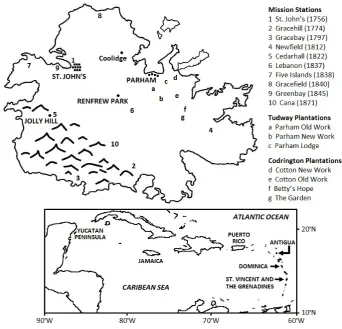
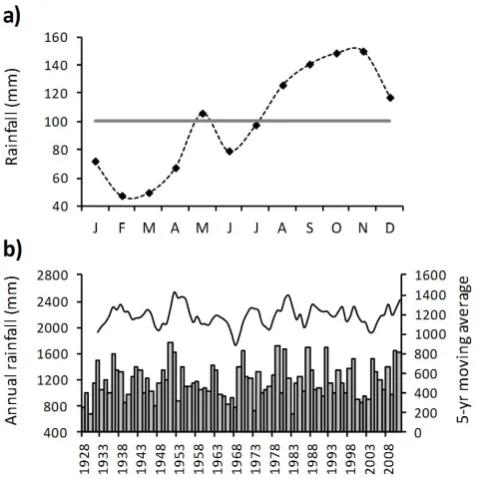
Antigua is situated in the northern Lesser Antilles (Fig. 1). It is a small (∼280 km2), predominantly low-lying limestone island (40–120 m a.s.l.) with a mountainous volcanic zone in the southwest (peaks >300 m a.s.l.). Average temperatures fluctuate from 25 to 28◦C throughout the year. Mean annual precipitation is 1184 mm, 70–80 % of which typically falls in the wet season between May and November (Antigua and Barbuda Meteorological Service, henceforth ABMS, 2013). An initial precipitation peak is normally experienced in May, a relative minimum in June and a maximum in October-November (Fig. 2a). Spatial variations in precipitation oc-cur in accordance with the island’s topography; from 1992 to 2011, mean annual rainfall at Jolly Hill in the volcanic zone was 1393 mm, while at Coolidge in the north and Renfew Park in the central “lowlands” (Fig. 1) the equivalent figures were 1044 and 1134 respectively (ABMS, 2013).
The annual rainfall regime of the Caribbean is driven by seasonal migrations of the Inter-Tropical Convergence Zone (ITCZ) and North Atlantic High (NAH). During the boreal winter, the former occupies an approximately equatorial po-sition and the latter spreads from the Atlantic Ocean to the North American landmass. This results in strong easterlies and relatively low SSTs in the region, inducing subsidence and dry conditions. Precipitation arises from occasional in-cursions of mid–high-latitude cold fronts, though these rarely extend further southeast than Puerto Rico (Taylor and Al-faro, 2005). Between late spring and autumn the NAH shifts offshore and poleward, the ITCZ shifts to a latitude of 6– 10◦N, SSTs increase and the trade winds converge over the basin, encouraging convective rainfall (Hastenrath, 1976; Gi-anni et al., 2000). African easterly waves propagate into the Caribbean from June to early November, intermittently de-veloping into tropical cyclones, and contribute significantly to summer precipitation totals (Taylor and Alfaro, 2005).
[image:2.595.313.540.84.449.2]Antigua experiences considerable interannual precipita-tion fluctuaprecipita-tions (Fig. 2b). At a regional scale, the El Ni˜no-Southern Oscillation (ENSO) and North Atlantic Oscilla-tion (NAO) are considered important independent drivers of such variability (Gianni et al., 2001a). The former affects early and late stages of the wet season differently. Its warm (cold) phase is associated with drier-than-normal (wetter-than-normal) conditions in the Caribbean from July to Octo-ber of the year of onset and above (below)-average precipita-tion around April–June the following year (Ibid.). Caribbean rainfall is negatively correlated with the NAO, its positive phase suppressing precipitation until May–June, after which its effects subside gradually (Gianni et al., 2001b).
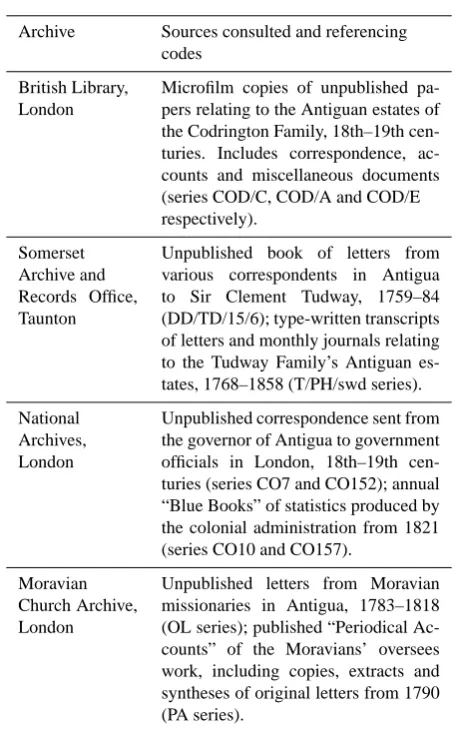
Table 1. Details of archival sources consulted and referencing codes used henceforth.
Archive Sources consulted and referencing
codes
British Library, London
Microfilm copies of unpublished pa-pers relating to the Antiguan estates of the Codrington Family, 18th–19th cen-turies. Includes correspondence, ac-counts and miscellaneous documents (series COD/C, COD/A and COD/E respectively).
Somerset Archive and Records Office, Taunton
Unpublished book of letters from various correspondents in Antigua to Sir Clement Tudway, 1759–84 (DD/TD/15/6); type-written transcripts of letters and monthly journals relating to the Tudway Family’s Antiguan es-tates, 1768–1858 (T/PH/swd series).
National Archives, London
Unpublished correspondence sent from the governor of Antigua to government officials in London, 18th–19th cen-turies (series CO7 and CO152); annual “Blue Books” of statistics produced by the colonial administration from 1821 (series CO10 and CO157).
Moravian Church Archive, London
Unpublished letters from Moravian missionaries in Antigua, 1783–1818 (OL series); published “Periodical Ac-counts” of the Moravians’ oversees work, including copies, extracts and syntheses of original letters from 1790 (PA series).
3 Data sources
This study employs a variety of archival sources held in the United Kingdom, in the form of plantation, missionary and government records (Table 1). These consist primarily of un-published, precisely dated documents written in Antigua by permanent residents of the island.
Fig. 1. Map displaying locations mentioned in the text. Dates of mission station establishment shown in brackets.
meteorological conditions received frequent commentary in their correspondence, often enabling the identification of monthly–seasonal variability.
Missionary correspondence pertains to the Society for the Furtherance of the Gospel, known also as the Moravians, whose evangelical work began at their mission station in St. John’s in 1756. Their operations expanded substantially during the subsequent century, with the establishment of an-other nine stations throughout Antigua (Fig. 1). Letters, mis-sion diaries and miscellaneous reports were sent regularly to Moravian headquarters in Britain and Germany. Such doc-umentation formed the basis of voluminous “Periodical Ac-counts”, which reported on the spiritual and physical welfare of the missionaries and their congregations globally.
Of particular value due to its abundance and temporal con-tinuity was the correspondence of the governors of Antigua, which kept the British Colonial Office abreast of affairs in the island. From 15 to 258 letters and enclosures were sent ev-ery year, covering topics ranging from the economy to natu-ral disasters. Enclosures comprised copies of legislative min-utes, statistical data and thematic reports prepared by gov-ernment officials. Complementary to this material were the colony’s “Blue Books”, which consisted of annual statisti-cal compendia including demographic, economic and,
occa-sionally, meteorological data. Overall, both government and missionary records were a rich source of information on me-teorological extremes, furnishing detailed accounts of ma-jor droughts and periods of excessive rainfall. They also af-forded an island-wide perspective, including both general and location-specific reports.
In addition to archival collections, the following con-temporary publications were consulted: Collins (1792), Lanaghan (1844), Nicholson (1866), Oliver (1894), SFG (1856), Sturge and Harvey (1838) and Young (1801). These include histories of Antigua and the Moravian missionaries, travel accounts and medical studies.
4 Methods of analysis
Fig. 2. (a) Mean monthly rainfall derived from national data, 1928– 2011. Solid grey line represents average of monthly mean values. (b) National annual rainfall totals, 1929–2011 (grey bars) and 5 yr moving average (black line). Data courtesy of ABMS.
as remarks about the timing of rainy season onset or pro-longed wetter or drier periods. Information of potential value for contextualising such findings was also recorded. This in-cluded indirect evidence of meteorological conditions (e.g. references to crop yields or water availability), details of non-meteorological factors implicated in harvest failures or food shortages and comments about the environment unre-lated to climate. Most accounts specified the dates of the phenomena to which they referred. Where dates were unspe-cific or omitted, comparison with other sources often enabled their timing to be constrained. Records for which it remained impossible to assign even approximate dates were excluded from the reconstruction. Particular care was taken when in-terpreting published sources, as it was occasionally unclear whether these were based on direct observations. Such ac-counts were treated as auxiliary to firsthand reports. Tran-scripts of the Tudway letters and relevant entries in the Mora-vians’ Periodical Accounts were compared with over 100 original documents used to compile those records. This re-vealed no significant discrepancies between sources.
The data collected was used to produce an island-wide and a central-eastern Antiguan precipitation record, which are discussed in the following sections.
4.1 Island-wide precipitation reconstruction
All direct references to meteorological phenomena (i.e. cat-egories 1 and 2 above) throughout Antigua were compiled chronologically. These consisted of passages discussing
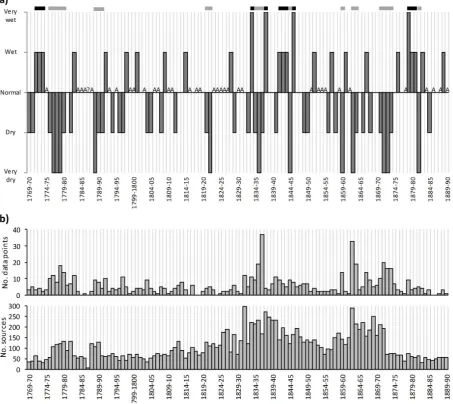
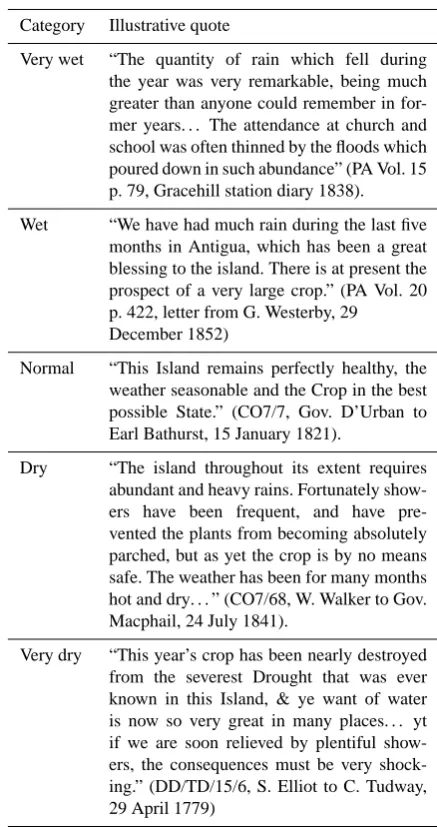
weather patterns or events experienced generally in the is-land or at multiple disparate locations in a given period. Iso-lated references to conditions at a single location were ex-cluded. The selected extracts were analysed in accordance with the Antiguan rain-year (December–November). Based on the predominant balance of climatic conditions reported, each rain-year from 1769–70 to 1889–90 was categorised as one of the following: very wet, wet, “normal” (i.e. season-able rains), dry or very dry. Such classifications have been used widely to reconstruct precipitation variability in south-ern Africa (e.g. Nash and Endfield, 2002; Kelso and Vogel, 2007; Nash and Grab, 2010). Examples of extracts typifying each category are shown in Table 2. To gauge the confidence of classification assignations, the results of this process were compared with the total number of sources and data points (i.e. references to rainfall or a lack thereof at a given time) available for each rain-year.
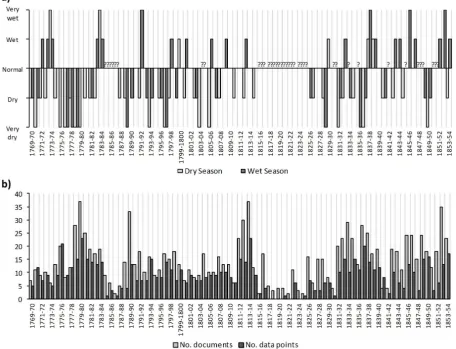
Thirty-four rain-years were not categorised because of a lack of conclusive weather references. For all of these but one, between 40 and 187 documents written by a variety of observers were consulted. Given the temporal regularity and abundance of this documentation, it is reasonable to conjec-ture that if major deviations from “normal” conditions had been experienced they would have been reported. These rain-years have thus been tentatively labelled as “assumed nor-mal” to indicate that this classification lacks explicit confir-mation. Only five documents were available for 1786–87, so this rain-year is unclassified.
[image:4.595.48.288.61.301.2]Fig. 3. (a) Document-derived chronology of predominant rainfall conditions throughout Antigua, 1769–70 to 1889–90.Aand ? denote assumed “normal” and unclassified rain-years respectively. Major dry (wet) phases highlighted in grey (black) at top of chart. (b) Number of data points and documents available for each rain-year.
inevitable in unstandardised instrumental data (Chenoweth, 2003). It is, however, noteworthy that the annual precipita-tion cycle exhibited by the monthly means of the St. John’s data (not shown) largely matches that derived from modern data (Fig. 2a).
4.2 Central-eastern Antiguan precipitation reconstruction
Plantation papers related chiefly to estates situated within a relatively small area in central-eastern Antigua (Fig. 1). These sources reported regularly on meteorological condi-tions, often enabling local inter-seasonal variability to be identified. To this end, all direct references to weather phe-nomena were collated and analysed according to the dry
[image:5.595.72.526.69.473.2]Table 2. Examples of statements characteristic of the five classifi-cations assigned to each rain-year.
Category Illustrative quote
Very wet “The quantity of rain which fell during
the year was very remarkable, being much greater than anyone could remember in for-mer years. . . The attendance at church and school was often thinned by the floods which poured down in such abundance” (PA Vol. 15 p. 79, Gracehill station diary 1838).
Wet “We have had much rain during the last five
months in Antigua, which has been a great blessing to the island. There is at present the prospect of a very large crop.” (PA Vol. 20 p. 422, letter from G. Westerby, 29
December 1852)
Normal “This Island remains perfectly healthy, the
weather seasonable and the Crop in the best possible State.” (CO7/7, Gov. D’Urban to Earl Bathurst, 15 January 1821).
Dry “The island throughout its extent requires
abundant and heavy rains. Fortunately show-ers have been frequent, and have pre-vented the plants from becoming absolutely parched, but as yet the crop is by no means safe. The weather has been for many months hot and dry. . . ” (CO7/68, W. Walker to Gov. Macphail, 24 July 1841).
Very dry “This year’s crop has been nearly destroyed
from the severest Drought that was ever known in this Island, & ye want of water is now so very great in many places. . . yt if we are soon relieved by plentiful show-ers, the consequences must be very shock-ing.” (DD/TD/15/6, S. Elliot to C. Tudway, 29 April 1779)
4.3 Methodological limitations
Limitations to the use of historical archives for climate re-construction and the aforementioned fivefold classification system have been discussed extensively elsewhere (e.g. Pfis-ter et al., 1999; Brazdil et al., 2005; Endfield, 2007; Nash and Grab, 2010) and will receive only brief mention here. First there is the matter of data reliability. All documentary sources have been produced by individuals with unique po-sitionalities influencing their attitudes, biases and environ-mental awareness. Information is included or excluded from documents reflecting such factors – which determine percep-tions of “normal” climatic condipercep-tions and the scale of spe-cific events – as well as the intended readership. Secondly, categorisation of rain-years and seasons into discrete classes is inevitably a subjective and generalised representation of
climate variability. Often, classifications had to be assigned to reflect drier conditions in certain months counterbalancing wet weather in others (see Sects. 5.1 and 5.2 for examples). When determining yearly classifications, greater weighting was attached to conditions in the wet season, which typically accounts for over 70 % of rainfall. Only rain-years/seasons in which meteorological extremes were reported by multiple observers were classed “very wet” or “very dry”. Finally, cer-tain spatial limitations should be considered. Most observers resided either in St. John’s or at a limited number of plan-tations and mission splan-tations. Even with missionaries writing from nine locations across the island by the mid-1800s, news of weather conditions in isolated or sparsely populated ar-eas was chiefly spread by word of mouth. A degree of in-accuracy may be expected in such instances. With respect to the central-eastern Antiguan chronology, small-scale vari-ations in rainfall distribution may introduce some error. On 23 November 1836, Thomas Foote, manager of the Tudways’ Old Work estate, wrote the following:
Within the last ten days some heavy rains have fallen to the West and South of us but so partial that the South side of the New Work had more than any other part of it, and not one drop on this [estate] or the Lodge. . . (T/PH/swd/2, T. Foote to R. Tudway, 23 November 1836)
While this passage identifies local differences in rainfall, others reporting conditions at a particular plantation may not.
5 Results
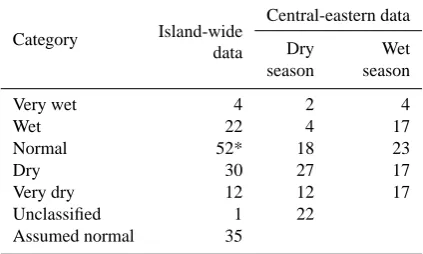
In total, 13 258 items of documentation were analysed, pro-ducing an almost continuous record of climate data for An-tigua spanning 1770–1890. Chronologies of average rain-fall conditions throughout the island and at the Tudways’ and Codringtons’ estates in central-eastern Antigua are shown in Figs. 3a and 5a respectively. The trends displayed should be interpreted with consideration of the availabil-ity of documentation and weather references (Figs. 3b and 5b).1 Table 3 displays classification frequencies for both 1Kelso and Vogel (2007) propose an alternative manner of
Very wet 4 2 4
Wet 22 4 17
Normal 52* 18 23
Dry 30 27 17
Very dry 12 12 17
Unclassified 1 22
Assumed normal 35
* Includes both documented and assumed classifications.
chronologies. Comparison of classifications with available rainfall measurements reveals fair correspondence between documentary-derived and instrumental data sets (Fig. 4).
Results indicate that nine episodes of major drought and six of consistently and/or particularly high rainfall levels were experienced throughout Antigua between 1769–70 and 1889–90 (Fig. 3a). Examples of evidence for the duration, severity and spatial variability of the most significant dry and wet phases will now be presented.
5.1 Major dry periods
Evidence suggests that the late 1770s witnessed the most protracted episode of drought in the study period. After a wet spell in the early–mid-1770s, plantation correspon-dence records severe precipitation scarcity throughout An-tigua from October 1775 until May 1776, followed by sea-sonable weather in late summer. Widespread drought was then recurrent from October 1776 to October 1780, during which accounts of extreme rainfall deficiency, harvest failure and subsistence crisis were abundant. For example, referring to the Antiguan populace, the governor of the colony wrote the following in May 1779:
Their present Crops are Distroyed [sic] by a long, very long severe Drought; nor have they now any prospect of a succeeding Crop: they have not had a thorough Season of Rain since October was a Twelve Month. . . Heavan [sic] has denied them not only Seasons but even refreshing Showers from whence they might raise Pulse and Vegeta-bles. . . (CO152/59, Gov Burt to Lord Germain, 3 May 1779).
Rains in October 1777 were seemingly the only major break in the dry phase. However, several short-lived showery classifications here were assigned on the basis of descriptions of the progression weather conditions or climate events over intervals of weeks to months, rather than annual/seasonal summaries.
& all the rest of the island. . . never made so bad a crop” (DD/TD/15/6, M. Walrond to C. Tudway, 29 July 1780). Af-ter reportedly mixed conditions in the rain-year 1780–81, precipitation scarcity returned from early 1782 to mid-1783, leading government officials to complain: “for more than seven years. . . has this unhappy Colony been visited with a Drought” (CO152/63, Legislative petition, 28 May 1783).
Contemporary observations of climatic conditions are rel-atively sparse in the late 1780s and early 1790s. Nonetheless, retrospective accounts record major precipitation scarcity from 1788 to 1791. An overview of past droughts appear-ing in an 1830s Moravian mission diary recollected that “in 1789 there was no rain for seven months” (PA, Vol. 14, p. 444, St. John’s diary, 21 January 1837), while a gov-ernment report on the same topic dated 1877 stated that “prolonged drought. . . almost entirely destroyed the grow-ing crop” in 1789 and 1790 (CO152/129, report of E. Baynes, 14 May 1877). Conditions in 1791 are documented chiefly in travel writings. For instance, the diary of visiting physician William Young notes that despite the occurrence of “partial rains” that year, the rainy season had “again failed” (Young, 1801: 282). Central-eastern Antiguan weather references are more abundant for 1790 and 1791, documenting intermittent wet spells from winter to early summer and deficient precip-itation during the rest of the wet season in both years.
The next major island-wide drought for which there is sub-stantive evidence occurred in the early 1820s. This may re-flect the relative shortage of climate references in the first three decades of the 1800s (Fig. 3b). Indeed, even the se-vere dry spell of 1820–22 is documented only in adminis-trative correspondence. A governor’s despatch dated 3 Oc-tober 1822, containing five enclosures on the matter, con-veyed news of “a most severe drought during the last and the present year, such as has not been known for more than thirty years” (CO7/7, Gov. D’Urban to Earl Bathurst, 3 Oc-tober 1822, Enclosure 4). One report prepared by the legisla-ture a month earlier noted the following:
From the scourge of excessive drought. . . our Pub-lic reservoirs and receptacles for wholesome Wa-ter, are in most instances empty, and in all much exhausted, our Sugar Crop is reduced to one fourth of its averaged amount, and our ground Provisions and other internal means of subsistence almost to-tally annihilated. (Ibid., Enclosure 3)
[image:7.595.61.273.94.221.2]Fig. 4. (a) Instrumental rainfall data for Antigua, 1874 to 1890, av-eraged from multiple measurements by Auchinleck (1956). Black diamonds display annual totals for calendar years; grey line dis-plays annual mean for calendar years 1874–1949. (b) Instrumne-tal rainfall data for St. John’s, 1870–71 to 1889–90, from Oliver (1894), CO157/2, CO157/3 and CO157/4. Black diamonds indi-cate totals for each rain-year; grey line represents annual mean. (c) Documentary-derived chronology of average rainfall conditions
throughout Antigua, rain-years 1870–71 to 1889–90.Adenotes
as-sumed “normal” classification.
recorded across Antigua during much of 1834–35, save Au-gust, which saw moderate rains. There is then evidence of extremely dry conditions from late 1835 through early sum-mer 1837, including multiple reports of up to “13 months without any rain” (PA, Vol. 14, p. 444, St. John’s diary, 21 January 1837). By spring 1837, government correspon-dence had become dominated by discussion of this “most severe, protracted and unprecedented drought” and its socio-economic implications (CO7/47, Gov. Colebrooke to Lord
Glenelg, 19 May 1837). Dry conditions appear, however, to have been alleviated in the south-western “highlands” by oc-casional precipitation in mid- and late 1836. Central-eastern Antigua also experienced major drought in 1836 and 1837, but favourable weather in August–December 1835.
Successive rain-years of severe drought are next docu-mented in the period of 1862–64. After abundant precipi-tation towards the end of 1862, the first weather observa-tion in 1863, dated 12 June, noted that soils in the outskirts of St. John’s had been “baked by long drought nearly as hard as bricks” and water scarcity was becoming widespread (COD/C52, G. Holborow to C. Codrington, 12 June 1863). Thereafter, references to extremely dry conditions persisting until autumn 1864 are abundant, and one year later Antigua’s governor recalled this as a time of “unprecedented Drought extending over twenty months” (CO7/126, O. Eldridge to Gov. Hill, 21 August 1865). No major breaks in the dry spell were identified; however, the Moravians observed transient rains late in the 1863 wet season.
The final multi-year drought period in this study spans 1870–71 to 1873–74. Missionary papers indicate below-average precipitation in the vicinity of Gracefield and New-field stations from early to mid-1871, abundant rains im-mediately after a hurricane in late August and the prema-ture cessation of the year’s wet season throughout Antigua. From then until the arrival of continuous heavy rains in Octo-ber 1874, recurrent drought is recorded extensively. This was apparently punctuated by short, localised showery spells in autumn 1872 and at the start of that and the following year. Nonetheless, early in 1875, Brother T. Zippel of Gracehill reflected the following:
The sufferings of our people from the long seasons of drought and poverty, which have followed one upon another since the hurricane of 1871, it would be useless to describe. . . The island is now on the point of reaping a harvest, the like of which has not been seen for four or five years. (PA, Vol. 29, p. 329, Gracehill annual report 1874)
Three years later, Antigua’s “colonial secretary” wrote in detail of the general economic ruin and water shortages con-sequent of the “succession of severe droughts” from 1871 to 1874 (CO152/129, Report of E. Baynes, 14 May 1877). 5.2 Major wet periods
[image:8.595.64.268.59.463.2]Fig. 5. (a) Document-derived chronology of predominant rainfall conditions experienced at Tudway and Codrington estates in central-eastern Antigua, years 1769–70 to 1853–54. ? denotes unclassified years. (b) Number of documents and data points available for each rain-year.
various sources registered continuous wet weather until au-tumn 1775. For instance, early that year the Tudways’ An-tiguan attorney commented that “great falls of rain. . . for sixteen months from ye middle of June 1773 to ye latter end of September 1774” had damaged sugar crops “universally” (DD/TD/15/6, S. Blizard to C. Tudway, 15 March 1775). Central-eastern plantation papers recorded a similar se-quence of conditions in the early–mid-1770s.
Between the 1780s and 1820s, six isolated “wet” rain-years were registered throughout Antigua, though this may reflect the paucity of conclusive weather references for that period (Fig. 3). Extremely wet conditions are next ex-hibited clearly during the rain-years 1833–34 and 1837– 38. Precipitation abundance was first reported in February 1834, when, according to the Gracehill mission diary, there was “so much storm and rain, that the oldest inhabitants never remembered the like at this season” (PA, Vol. 13, p. 233, Gracehill diary 1834). Missionary and plantation pa-pers recorded intermittent downpours during the subsequent
five months, while assembly-member William Byam com-mented that from August to December “heavy torrents of rain, washes, &c. [etc.] prevailed” (CO7/42, Report of N. Nu-gent, July 1835). Another government official asserted that 60.83 inches (∼1545 mm) of rain had fallen during 1834 (Ibid.). Although the reliability of this figure cannot be ver-ified, if comparable with nation-wide ABMS data, it would be among the eleven highest annual precipitation totals from 1928 to 2011. Interestingly, the Tudway plantations and their surroundings appear not to have received the heavy rains ex-perienced elsewhere, estate supervisors reporting predomi-nantly dry weather throughout 1833–34. By contrast, unusu-ally high precipitation levels were recorded universunusu-ally in 1837–38. One mission diary noted
[image:9.595.70.527.71.420.2]Fig. 6. (a) Annual rainfall totals calculated from daily measure-ments taken at Savanna-la-Mar, western Jamaica, calendar years 1770 to 1786 (after Chenoweth, 2003). Solid grey line represents mean of annual totals, 1761–86. (b) Documentary-derived chronol-ogy of average rainfall conditions throughout Antigua, rain-years
1769–70 to 1785–86.Adenotes assumed ‘normal’ classification.
was, however, often thinned by the floods which poured down in such abundance. (PA, Vol. 15, p. 79, Gracehill station diary 1838)
The period 1841–46 was largely wet but interrupted by drought in 1844–45. Various government papers report the arrival of summer rains in June 1842 after a five-month dry spell. The remainder of the wet season purportedly witnessed abundant precipitation, with flooding in late August. For in-stance, in his quarterly report, stipendiary magistrate Robert Horsford commented
the country had been refreshed by frequent show-ers through the month of July and the early part of August, towards the end of which. . . the island was visited by one of the heaviest falls of rain ever remembered – a perfect deluge – which in the course of a few hours overflooded [sic] the en-tire face of the country; in the flat lands to a depth of several feet. . . (CO7/74, Report of R. Horsford, 30 September 1842)
A similar pattern characterised 1842–43, with rainfall scarcity from February to May and regular rains there-after. Wet-season precipitation was, however, commonly de-scribed as plentiful, rather than excessive. A continuance of “unusually favourable” weather from then until early
1845 was recorded by Antigua’s “General Agricultural Soci-ety” (T\PH\swd/3, General Agricultural Society report, Au-gust 1845) – an observation supported by numerous govern-ment and plantation papers. The best-docugovern-mented rain-year of above-average precipitation was 1845–46, with 22 indi-vidual weather references. In early August, Morvian Allen Hamilton noted
this season has been and still is most propitious for future crops; we never experienced such con-stant rains as have fallen during the last three months. (PA, Vol. 18, p. 40, Letter from A. Hamil-ton, 11 August 1846)
Weeks later the whole island was said by one estate man-ager to be “deluged” (COD/C30, J. Winter to C. Codring-ton, 27 August 1846) and the following May, Governor Hig-ginson recollected the widespread occurrence of “heavy and continuous rains” throughout autumn (CO7/86, Gov. Higgin-son to Earl Grey, 26 May 1847).
There was sustained above-average rainfall from 1878 to 1881, with especially wet conditions in 1878–79. Various missionaries echoed the remarks of Antigua’s chief med-ical officer that 1879 was a year “of unusual severity as regards the quantity of rain which fell” (CO152/138, Re-port of W. Edwards and A. Edwards, 9 April 1880). Con-ditions that year appear to have been consistently wet. The annual statement for Gracehill mission, for example, noted that Antigua had received an “abundance of rain. . . pretty evenly throughout the year” without “a single dry month” (PA, Vol. 31, p. 365, Gracehill report 1879). As in 1878–79, periodical reports furnished most climate references in sub-sequent rain-years. Government returns for 1880 enumerated the infrastructural damage produced by “excessive” precipi-tation that year. Meanwhile, mission papers reported “fruitful seasons” throughout Antigua from July 1880 to mid-1881, with “heavy rains” at Cedarhall (PA, Vol. 32, p. 98, Annual Report July 1880–July 1881), and persistently wet weather in the remainder of the 1881 wet season.
6 Discussion and conclusions
[image:10.595.64.271.63.314.2]avoided extensive commentary. Furthermore, Antigua’s pre-dominantly limestone geology and lack of permanent surface water features reduces the potential for major floods with profound societal impacts. Conversely, drought had read-ily perceptible consequences for agro-economic productivity and water supplies.
Another important consideration is the potential for ob-servers to exaggerate the severity of, or give undue attention to, adverse weather during times of socio-economic break-down. Such potential inaccuracies are inherent in historical climate research. Here, they have been accounted for through cross-comparison of multiple observations and careful refer-ence to contextual information in the archives and historical scholarship. The dry episode of 1775–76 to 1781–82 merits particular attention, coinciding with the American War of In-dependence (1775–83) and consequent trade embargo. These are recognised to have triggered an unprecedented subsis-tence crisis throughout the British Lesser Antilles (Sheridan, 1976; Dyde, 2000). Exogenous stresses on food supplies may have resulted in the documentation of episodes of rainfall scarcity that would otherwise have received little or no men-tion. This could account for the relatively high number of data points in this period (Fig. 3b). Nonetheless, recurrent direct descriptions of the duration of rainfall scarcity, water shortages and their impacts on crops provide substantial evi-dence of severe drought spells at the time.
Examination of the island-wide and central-eastern cli-mate chronologies reveals largely good correspondence be-tween these independent data series. As would be expected, this is particularly so when comparing annual classifications in the former with wet-season classifications in the latter (Kendall Tau-b correlation coefficient of 0.72, significant at the 0.01 level). Nonetheless, classification counts (Table 3) suggest that the central-eastern Antiguan sources were par-ticularly biased towards recording drier-than-normal condi-tions. The relatively limited potential for wet weather to dis-rupt sugar production – discussed above – may explain this. Another factor is the location of the studied estates in a part of the island characterised by lower average precipitation. Correspondents occasionally described the weather with ref-erence to that experienced elsewhere in the island. It is pos-sible that their writings may often have expressed meteoro-logical conditions relative to what was perceived as normal in Antigua generally, without explicitly stating so.
Despite the methodological limitations highlighted, the documentary-derived reconstruction presented here corre-sponds well with two separate series of unstandardised in-strumental data spanning 16–21 yr (Fig. 4). Findings afford separate annually and seasonally resolved chronologies of
sifications were assigned every 2.88 rain-years on average in the island-wide reconstruction. This is not completely di-vergent from the modern climatology of the ABMS, which defines “slight” to “severe” drought as the lowest 30 % of precipitation totals on record (i.e. occurring every∼3.33 yr). It is noteworthy that 3–5 successive years of drought, such as those identified in the 1770s, 1830s and 1870s, are also present in modern instrumental data.
Acknowledgements. This research was funded by a three-year
doctoral studentship provided by the Faculty of Social Sciences, University of Nottingham. Thanks go to James Lewis and Nicholas Nugent for help accessing historical rainfall data and maps, as well as the staff of the various archives visited throughout 2011 and 2012. Constructive comments made by four reviewers on an earlier version of this paper are apreciated. The authors are especially grateful to the Austin family and Felicity Dunnett for providing accommodation while undertaking data collection.
Edited by: J. Guiot
References
ABMS [Antigua and Barbuda Meteorological Service]: Climate Data, available at: www.antiguamet.com (last access: 22 Febru-ary 2013), 2013.
Auchinleck, G. G.: The rainfall of Antigua and Barbuda. Compiled from Available records, Antigua Sugar Association, St. John’s, 1956.
Brazdil, R., Pfister, C., Wanner, H. von Storch, H., and Luterbacher, J: Historical climatology in Europe – the state of the art, Clim. Change, 70, 363–430, 2005.
Chenoweth, M.: The 18th century climate of Jamaica: derived from the journals of Thomas Thistlewood, 1750–1786, Ameri-can Philosophical Society, Philadelphia, 2003.
Chenoweth, M.: A reassessment of historical Atlantic Basin tropical cyclone activity, 1700–1855, Clim. Change, 76, 169–240, 2006. Collins, J.: The case of the sugar colonies, London, 1792.
Dyde, B.: A history of Antigua: the unsuspected isle, Macmillian Education, London, 2000.
Endfield, G. H.: Archival explorations of climate variability and so-cial vulnerability in colonial Mexico, Clim. Change, 83, 9–38, 2007.
Farrell, D., Trotman, A., and Cox, C.: Drought early warning and risk reduction: a case study of the Caribbean drought of 20-2010. UNISDR Global Assessment Report on Disaster Risk Reduction, Geneva, Switzerland, 2010.
Garcia-Herrera, R., Diaz, H. F., Garcia, R. R., Prieto, M. R., Bar-riopedro, D., Moyano, R., and Hern´andez, E.: A chronology of El Ni˜no events from primary documentary sources in northern Peru, J. Climate, 21, 1948–1962, 2008.
Gianni, A., Kushnir, Y., and Cane, M. A.: Interanual variability of Caribbean rainfall, ENSO, and the Atlantic Ocean, J. Climate, 13, 297–311, 2000.
Gianni, A., Cane, M. A., and Kushnir, Y.: Interdecadal changes in the ENSO teleconnetion to the Caribbean region and the North Atlantic Oscillation, J. Climate, 14, 2867–2879, 2001a. Gianni, A., Kushnir, Y., and Cane, M. A.: Seasonality in the impact
of ENSO and the North Atlantic High on Caribean rainfall, Phys. Chem. Earth, 26, 143–147, 2001b.
Hastenrath, S.: Variations in low-altitude circulation and extreme climatic events in the tropical Americas, J. Atmos. Sci., 33, 202– 215, 1976.
Kelso, C. and Vogel, C.: The climate of Namaqualand in the nine-teenth century, Clim. Change, 83, 357–380, 2007.
Kilbourne, K. H., Quinn, T. M., Webb, R., Guilderson, T., Nyberg, J., and Winter, A.: Paleoclimate proxy perspective on Caribbean climate since the year 1751: evidence of cooler temperatures and multidecadal variability, Paleoceanography, 23, PA3220, doi:10.1029/2008PA001598, 2008.
Lanaghan: Antigua and the Antiguans: a full accounts fo the colony and its inhabitants from the time of the Cribs to the present day, interspersed with anecdotes and legends. Also, An impartial view of slavery and the free labour systems; the statistics of the is-land, and biographical notices of the principal families, Volume I, Saunders and Otley, London, 1844.
Magrin, G., Gay-Garcia, C., Cruz-Choque, D., Gim´enez, J. C., Moreno, A. R., Nagy, G. J., Nobre, C., and Villamizar, A.: Latin America, in: Climate Change 2007: Impacts, Adaptation and Vulnerability. Contribution of Working Group II to the Fourth Assessment Report of the Intergovernmental Panel on Climate Change, edited by: Parry, M. L., Canziani, O. F., Palutikof, J. P., Van Der Linden, P. J., and Hansen, C. E., Cambridge University Press, Cambridge, 2007.
Mendoza, B., Garc´ıa-Acosta, V., Velasco, V. J´auregui, E., and D´ıaz-Sandoval, R.: Frequency and duration of historical droughts from the 16th to 19th centuries in the Mexican Maya lands, Yucatan Peninsula, Clim. Change, 83, 151–168, 2007.
Mock, C.: Paleodroughts and society, in: Encyclopedia of Quater-nary Science, edited by: Elias, S. A., Elsevier, Oxford, 2007. Nash, D. J. and Endfield, G. H.: A 19th century climate chronology
for the Kalahari region of central southern Africa derived from missionary correspondence, Int. J. Climatol., 22, 821–841, 2002. Nash, D. J. and Grab, W.: “A sky of brass and burning winds”: documentary evidence of rainfall variability in the Kingdom of Lesotho, Southern Africa, 1824–1900, Clim. Change, 101, 617– 653, 2010.
Nicholson, T.: An essay on yellow fever. Comprising the history of that disease, as it appeared in the island of Antigua in the years 1835, 1839, & 1842. With an appendix continuing the history to 1853, London, 1866.
Oliver, V. L.: The history of the island of Antigua, one of the Lee-ward Caribbees in the West Indies, from the first settlement in 1635 to the present time, Volume I, Mitchell and Hughes, Lon-don, 1894.
Ortlieb, L.: The documented historical record of El Ni˜no events in Peru: an update of the Quinn record (sixteenth through nine-teenth centuries), in: El Ni˜no and the southern oscillation, multi-scale variability and global and regional impacts, edited by: Diaz, H. F. and Markgraf, V., Cambridge University Press, Cambridge, 2000.
Pfister, C., Br´azdil, R. Glaser, R., Barriendos, M., Camuffo, D., Deutsch, M., Dobrovolny, P., Enzi, S., Guidoboni, E., Kotyza, O., Militzer, S., R´acz, L., and Rodrigo, F. S.: Documentary evi-dence on climate in sixteenth-century Europe, Clim. Change, 43, 55–110, 1999.
SFG [Society for the Furtherance of the Gospel]: Retrospect of the history of the mission of the Brethren’s Church in Antigua, for the past hundred years, William Tyler, London, 1856.
Sturge, J. and Harvey, T.: The West Indies in 1837. Being the journal of a visit to Antigua, Montserrat, Dominica, St. Lucia, Barbados, and Jamaica. Undertaken for the purpose of ascertaining the ac-tual condition of the negro population of those Islands, Hamilton, Adams, & Co., London, 1838.