doi:10.4236/jemaa.2009.14039 Published Online December 2009 (http://www.SciRP.org/journal/jemaa)
Monte Carlo Integration Technique for Method of
Moments Solution of EFIE in Scattering Problems
Mrinal MISHRA, Nisha GUPTA
Department of Electronics and Communication Engineering, Birla Institute of Technology, Mesra, India
Email: [email protected], [email protected]
Received May 8th, 2009; revised July 10th, 2009; accepted July 18th, 2009.
ABSTRACT
An integration technique based on use of Monte Carlo Integration is proposed for Method of Moments solution of Elec-tric Field Integral Equation. As an example numerical analysis is carried out for the solution of the integral equation for unknown current distribution on metallic plate structures. The entire domain polynomial basis functions are em-ployed in the MOM formulation which leads to only small number of matrix elements thus saving significant computer time and storage. It is observed that the proposed method not only provides solution of the unknown current distribution on the surface of the metallic plates but is also capable of dealing with the problem of singularity efficiently.
Keywords:Scattering, EFIE, Method of Moments, Monte Carlo Integration
1. Introduction
The Method of Moments (MoM) [1] is one of the widely used numerical techniques employed for the solution of Integral Equations. The MoM is based upon the trans-formation of an integral equation, into a matrix equation. However, the application of the spatial-domain MoM to the solution of integral equation is quite time consuming. The matrix-fill time would be significantly improved if these integrals can be evaluated efficiently. The MoM employs expansion of the unknown function inside the integral in terms of known basis functions with unknown coefficients to be determined. Point matching technique or Galerkin’s technique commonly employed in MoM results in a system of linear equations equal in number to that of unknown coefficients. This leads to a matrix equation for the coefficients. The matrix thus obtained is called the ‘moment’ matrix. The unknown coefficients can then be obtained by matrix inversion.
The MoM method involves two approaches, the sub domain [2,3] and the entire domain [4,5] approaches, essentially based on the two kinds of basis functions em-ployed for the expansion of the unknown function on the metal surface. The entire domain basis functions extend over the whole region occupied by the structure, whereas the sub domain basis functions are defined to exist over a section of the structure and have a zero value over the rest of its portion. The choice of the type of basis func-tion depends upon the size and shape of the metallic structure in the problem. The advantage with the sub
domain basis functions is that due to their flexibility to be defined over small polygonal domains of varying sizes. The whole structure under investigation can be modeled as consisting of large number of such polygonal sub domains, thus making possible the analysis of com-plicated shaped structures. The disadvantage with these basis functions is that they are limited to electrically small and moderately large structures, as the number of sub domains required to model large structures accu-rately becomes very large. This results in the moment matrix of a large size increasing the computation costs in terms of memory and CPU time.
which results in the reduction of computational cost and an increase in the accuracy of the result.
The other aspect of the MoM formulation is the prob-lem of the singularity of the function that is to be inte-grated to obtain the matrix elements, in both the ap-proaches of the MoM formulation. In the point matching MoM approach using sub-domain basis functions, only a few matrix elements, whereas using entire domain ap-proach, all the matrix elements are obtained by integra-tion of singular funcintegra-tions. Various analytical and nu-merical techniques have been adopted to deal with such integrals. The Monte Carlo Integration (MCI) technique [6,7] proposed in this paper is not only capable of solving the scattering problem but also deals efficiently with the problem of singularity.
To demonstrate the capability of the above mentioned technique, the problem is formulated in terms of an inte-gral equation to determine the current distribution on square metallic plate. The MCI technique has been pro-posed to tackle scattering problem from an infinitesi-mally thin square metallic plate structures in the MoM formulation of the problem. The entire domain basis functions are utilized in the MoM matrix solution and hence reduce the computational cost to the great extent. Besides, it is also capable of handling the singularity aspect of the Green’s function easily and more efficiently. The typical simulation demonstrates the application of the proposed technique and also validates the result against the Benchmark solution [8].
2. Mathematical Concept
Monte Carlo methods are useful for obtaining solutions to problems involving integration which are too compli-cated to be solved analytically or by other numerical methods. Standard numerical integration techniques do not work very well on high-dimensional domains, espe-cially when the integrand is not smooth. Although the quadrature rules of integration typically work very well for one-dimensional integrals, problems occur when ex-tending them to higher dimensions.
Monte Carlo methods have advantages over numerical methods in a space of many dimensions. Their efficien-cies relative to other numerical methods increase when the dimension of the problem increases e.g. Quadrature formula becomes very complex while MCI technique remains almost unchanged in more than one dimension. In addition to this, the convergence of the MCI is inde-pendent of dimensonality regardless of the smoothness of the integrand. Monte Carlo integration is simple since only two basic operations are required, namely sampling and point evaluation. It is also suited for large structures and highly complex problems for which definite integral formulation is not obvious and standard analytical tech-niques are ineffective. Sampling can be used even on domains that are not well-suited to numerical quadrature.
The idea of Monte Carlo integration is to evaluate the integral using random sampling as
( ) I f x dx
(1)where f is a function of vector x, is domain of
integra-tion. The Monte Carlo integration is popular for complex
f and/or . In its basic form, this is done by
independ-ently sampling N points x1, …,xN according to some
convenient density function p, and then computing the
estimate
1
( ) ( ) N
i N
i i
f x F
N p x
(2)where p(xi) is the probability density function or pdf.
Here the notation FN is used rather than I to emphasize
that the result is approximate, and that its properties
de-pend on how many sample points are chosen. If p(xi) is
the uniform probability density, then the integral is sim-ply
1
( ) N
i i
I f x
N
(3)The MCI methods are better suited than quadrature methods for integrands with singularities. It is particu-larly helpful for integrand that have large values on a relatively small part of the domain due to singularities. It can be applied to handle such integrands effectively, even in situations where there is no analytic
transforma-tion available to remove the singularity.The simpleway
to handle the singularity using MCI is to ignore a region around the singularity and let this region become smaller as N increases [9–13]. In this approach the total region is
split into , where the numerical integrationis
per-form, and a small region min
min
r
r
r r which is apparently left
out as long as it has a small or negligible contribution for large values of N. The event generators use therefore a
cutoff to avoid this region of singularity i.e., the
random points generated in MCI are restricted to fall within this excluded region. This does not require any extra effort to handle the singularity problem as the re-quired condition can be embedded directly in the MCI technique itself in a single statement of the MATLAB code employed for the purpose in simulation.
mi
r n
3.
Numerical Example
As an example, the electric field integral equation is solved by method of moments for the unknown surface current density on a square metallic plate. The plate is an
infinitesimally thin λ x λ square in free space, with limits
-1.0m to 1.0m along both the x and y axes. The scatterer
is excited normally by an incident plane wave with the
electric field having a magnitude 1.0 Vm-1 and
po-larized along a scatterer edge, in this case the y- axis. The
i
field as:
(5) where
] ) ( )[ /
1
( 2
0
0 A k A
j
s
E
| '|
' 0
( ) ( ) '
4 conduc | ' |
jk
tingsurface e
d
r rA r J r r
r r (6)
is
inte uation (EFIE)
for the unknown current density
e inte
current on the conducting surface can be expanded as:
(8) the vector potential.
Applying the boundary condition nEt 0 on the
scatterer, we get the electric field g l eqra
:
[image:3.595.92.223.87.198.2]) ' (r J
Figure 1. Geometry of the λ x λ square P. E. C. scatterer incident upon by a plane wave with Ei polarized along the y-
axis, λ = 2m Ei Es (1/j00)[(A)k2A] (7)
For method of moments (MoM) solution of th
-gral equation, taking some known basis function fn(r'),
the unknown geometry is shown in Figure 1.
From Maxwell’s equations we can obtain vector ex-pression for the total electric field
s (4) i
t E E
E
) ' ( )
' (
1
r r
J M n
n nf a
where Et is the incident field and Es is the scattered
(a) (b)
(c) (d)
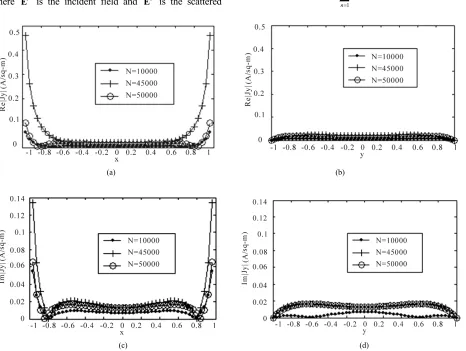
Figure 2. (a) Solution for the Jy-current component (real part) along the X axis of the scatterer obtained for different number
(imaginary part) along the Y axis of the scatterer obtained for different nu ber of random points generations
of random points generations; (b) Solution for the Jy-current component (real part) along the Y axis of the scatterer obtained
for different number of random points generations; (c) Solution for the Jy-current component (imaginary part) along the X
axis of the scatterer obtained for different number of random points generations; (d) Solution for the Jy-current component
[image:3.595.66.532.306.657.2]where an; n = 1, 2, . . ., M are unknown amplitudes of
is f
the bas unctions and are to be determined. This
expan-sion is plied over the same number of field points as the number of expansion terms, which transforms the integral equation into a set of simultaneous algebraic equation in the unknown coefficients, which can be writ-ten in the matrix form as:
ap
in mn a
Z En (9)
or
i n mnn Z E
a 1 (10)
The matrix elements of the matri
using numerical integration (such as MCI th
tire domain basis functions for the un
x equation are formed technique) of e singular function that results after differentiation of the Green’s function.
The problem under investigation is an entire domain MoM problem. The en
known current density are the modified polynomial functions, with edge correction and symmetry considera-tions as stated in the benchmark solution [8] and pre-sented as follows:
( 2 ) ( 2)
2
1 3
( , ) ( )
1
yx xx
n n i
j
x xij
i j
y
J x y a x x
y
(11)( 2) ( 2)
2
0 3
( , ) ( 1)
1
xy yy
n n i
j
y yij
i j
x
J x y a y
x
n = n = 8 and n = n = 7. The su
(12)
where xx yy xy yx bscript (2)
below the summation sign means that the indices i and j
are to be increased with a step size 2. Thus the total
number of expansion terms for x-current is 12 and for
y-current is 16, thus making the total number of unknown
coefficients = 28. This leads to the formation of the Z-matrix of order 28 X 28, far less than the number of coefficients required in sub domain analysis, which in case of such a large scatterer becomes extremely large for accurate analysis. Though, the Galerkin’s method in MoM is a suitable choice for the problem under investi-gation, the present formulation employs the point match-ing technique in MoM specifically to demonstrate the singularity aspect of integrand. The point matching tech-nique makes it essential that all the matrix elements that are evaluated, involve integration of singular integrands (singular kernels of the integral equation). Thus it is nec-essary to adopt means that can take care of the singular-ity inside the integral and give a good approximation of the actual result. The technique adopted here is the Monte Carlo Integration (MCI) technique that overcomes the singularity, making integration much simpler and justified in case of two dimensional and three dimension-
(a)
(b)
(c)
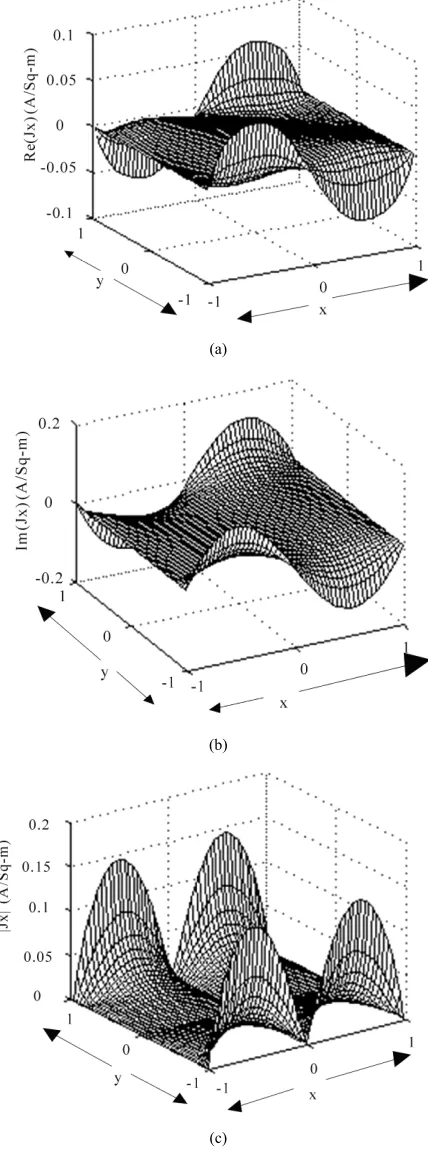
Figure 3. (a) Solution for the Jx current component (Real
part) over the scatterer; (b) Solution for the Jx current
component (Imaginary part) over the Scatterer; (c) Solution for the Jx current compone Magnitude) over the
[image:4.595.314.528.87.666.2]as to prevent the points fall inside a certain region
the M t two things. First, the
re
in polynomial basis h Monte Carlo Integration technique f the problem under investigation. In
h (CSIR), Pusa, New Delhi,
[1] R. F. Harrington, “Field computation by moment meth-ods,” New Yo
975.
ol.
rlo Methods, pp. 403–418, 2004.
entific and Industrial Researc al scattering problems. The method that has dealt with
the singularity here is named as the ‘local correction technique’. Since MCI is based on random generation of points inside the entire domain of integration, care must taken
India–110012.
REFERENCES
min
The Figures 2(a) and 2(b) show the real part of Jy as
seen along the x-axis while the Figures 2(c) and 2(d)
show the real and imaginary parts of Jy as seen along the
y-axis, for different numbers N of random points taken for CI. The figures make eviden
r r , the region of singularity. rk, Macmillan, 1968.
[2] C. A. Balanis, “Antenna theory: Analysis and design,” Harper & Row, New York, pp. 283–321. 1982.
[3] C. M. Bulter and D. R. Wilton, “Analysis of various nu-merical techniques applied to thin-wire scatterers,” IEEE Transactions, Vol. AP–23, No. 4, pp. 524–540, 1
sults for all the values of N show a good agreement with the results obtained in the benchmark solution [8] using MoM for the solution. Second, the solution with N = 10000 points converge to that obtained for N = 45000 and N = 50000 points, stating that N = 10000 points are suffi-cient enough in the MCI for the problem under in vestiga-tion, thereby decreasing the computational burden to a great extent. Figures 3(a), 3(b) and 3(c) show the results for the 3-D current distribution for the real part, imaginary
part and magnitude of Jx. Total number of random points
for the MCI to evaluate the elements in the impedance matrix for MoM solution has been taken to be 10,000. It is found that the results show good agreement with those obtained in benchmark solution [8].
4. Conclusions
The Monte Carlo integration technique in the MoM solu-tion of the integral equasolu-tions has been proposed. The technique employs the entire-doma
[4] B. M. Notaros and B. D. Popovic, “General entire-domain method for analysis of dielectric scatterers,” IEE Pro-ceedings - Microwaves, Antennas and Propagation, V 143, No. 6, pp. 498–504, 1996.
[5] M. Djordjevic and B. M. Notaros, “Double higher order method of moments for surface integral equation model-ing of metallic and dielectric antennas and scatterers,” IEEE Transactions on Antennas and Propagation, Vol. 52, No. 8, pp. 2118–2129, 2004.
[6] W. H. Press, S. A. Teukolsky, W. T. Vetterling, and B. P. Flannery, “Numerical recipes, second edition,” Cam-bridge University Press, 1992.
[7] M. N. O. Sadiku, “Numerical techniques in electromag-netics,” CRC Press, New York.
act
[8] B. M. Kolundžija, “Accurate solution of square scatterer as benchmark for validation of electromagnetic modeling of plate structures,” IEEE Trans ions on Antennas and Propagation, Vol. 46, No. 7, pp. 1009–1014, 1998. [9] T. Pillards, “Quasi-Monte Carlo integration over a
sim-plex and the entire space,” Ph. D. Thesis, Katholieke Uni-versiteit Leuven, Belgium, ISBN 90–5682–741–3, 2
functions along wit
in MOM solution o 006.
[10] J. Hartinger, R. F. Kainhofer, and R. F. Tichy, “Quasi- Monte Carlo algorithms for unbounded, weighted inte-gration problems,” Journal of Complexity, Vol. 5, No. 20,
the Monte Carlo Integration technique, a local correction technique is employed to deal with the singularity aspect of the kernel very efficiently and easily. For the demon-stration of the present method, the current distribution is investigated on a two dimensional square plate scatterer. Where comparisons are available, it is found that this technique yields results which compare very closely to those of other methods. In addition to the rapid conver-gence of the Monte Carlo integral with respect to total number of random points, the small number of basis functions (< 10) is needed to provide accurate results. Further research is being carried out to extend the method to three dimensional structures.
5. Acknowledgements
This research work was supported by the Council of
Sci-pp. 654–668, 2004,
[11] A. B. Owen, “Quasi-Monte Carlo for integrands with point singularities at unknown locations,” Monte Carlo and Quasi-Monte Ca
[12] M. Mishra and N. Gupta, “Singularity treatment for inte-gral equations in electromagnetic scattering using Monte Carlo integration technique,” Microwave and Optical Technology Letters, Vol. 50, No. 6, pp. 1619–1623, June 2008.