ISSN Online: 2156-8561 ISSN Print: 2156-8553
DOI: 10.4236/as.2019.1011106 Nov. 20, 2019 1453 Agricultural Sciences
Weed Management in White Bean with Variable
Doses of S-Metolachlor and Halosulfuron
Applied Preemergence
Nader Soltani
*, Christy Shropshire, Peter H. Sikkema
University of Guelph Ridgetown Campus, Ridgetown, Canada
Abstract
Five experiments were conducted in Ontario, Canada from 2016 to 2018 to determine how doses of S-metolachlor and halosulfuron applied preemer-gence (PRE) should be adjusted to control specific weed species in white bean. S-metolachlor, halosulfuron, and S-metolachlor + halosulfuron caused minimal (1% to 4%) injury in white bean. Weed interference reduced white bean yield 54%. On average, weed interference with S-metolachlor and halo-sulfuron decreased yield 34% and 29%, respectively. In contrast, white bean seed yield was similar to the weed-free control with the S-metolachlor + ha-losulfuron tankmixes. S-metolachlor applied alone controlled A. theophrasti,
A. retroflexus, A. artemisiifolia, C. album, E. crus-galli and S. viridis 0% to 3%, 78% to 93%, 0% to 9%, 5% to 15%, 97% to 99% and 96% to 98%, respec-tively. Halosulfuron applied alone controlled A. theophrasti, A. retroflexus, A. artemisiifolia, C. album, E. crus-galli and S. viridis 39% to 87%, 93% to 99%, 64% to 88%, 34% to 59%, 10% to 30% and 13% to 35%, respectively. S-meto- lachlor + halosulfuron tankmixes controlled A. theophrasti, A. retroflexus, A. artemisiifolia, C. album, E. crus-galli and S. viridis 47% to 94%, 98% to 100%, 78% to 94%, 37% to 78%, 94% to 98% and 91% to 96%, respectively. Weed density and biomass reductions with the herbicides evaluated followed the same pattern as visible weed control assessments. Results from this study in-dicate that doses of S-metolachlor and halosulfuron, when applied as a tank-mix, should be adjusted based on a weed species composition in each indi-vidual white bean field.
Keywords
Biomass, Density, Dry Bean, Maturity, Seed Yield, Tolerance, Weed Control
How to cite this paper: Soltani, N., Shrop-shire, C. and Sikkema, P.H. (2019) Weed Management in White Bean with Variable Doses of S-Metolachlor and Halosulfuron Applied Preemergence. Agricultural Sciences, 10, 1453-1464.
https://doi.org/10.4236/as.2019.1011106
Received: October 26, 2019 Accepted: November 17, 2019 Published: November 20, 2019
Copyright © 2019 by author(s) and Scientific Research Publishing Inc. This work is licensed under the Creative Commons Attribution International License (CC BY 4.0).
http://creativecommons.org/licenses/by/4.0/
DOI: 10.4236/as.2019.1011106 1454 Agricultural Sciences
1. Introduction
Dry bean (Phaseolus vulgaris L.) is popular legume crop grown in Ontario. Ap-proximately 80% - 90% of dry bean harvested in Ontario is exported out of the province [1]. White bean has been produced in the province since the early 1900’s and over the years has become the most popular dry bean market class grown [1]. In 2018, approximately 63,000 tonnes of white beans were produced from 22,000 ha in Ontario with a value of nearly $49 million [2]. Controlling weeds is one of the most important concerns for white bean production in On-tario.
Typical problem weeds for white bean producers in Ontario include Abutilon theophrasti Medic. (velvetleaf), Amaranthus retroflexus L. (redroot pigweed),
Ambrosia artemisiifolia L. (common ragweed), Chenopodium album L. (com-mon lambsquarters), Sinapis arvensis L. (wild mustard), Polygonum persicaria
L. (ladysthumb), Eastern black nightshade (Solanum ptycanthum Dun.), Xan-thium strumarium L. (cocklebur), Digitaria sanguinalis (L.) Scop. (large crab-grass), Setaria viridis (L.) Beauv. (green foxtail), and Echinochloa crus-galli (L.) P. Beauv. (barnyardgrass) [3]. These problematic weeds generally germinate early in the season and are fast growing thereby outcompeting the slower grow-ing white bean plants for irradiance, moisture and nutrients resultgrow-ing in sub-stantial yield losses [4]. White bean seed yield losses have been reported to be 68% to 81% in white bean from weed interference [5]-[12]. There are currently few herbicide choices that producers can choose from to control these proble-matic weed species in white bean.
Halosulfuron is a recently registered sulfonyl-urea herbicide for broadleaved weed control in white bean in Ontario (OMAFRA 2018). Major weeds controlled with halosulfuron includes A. theophrasti, C. album, S. arvensis, P. persicaria, A. retroflexus and X. strumarium, including biotypes that are resistant to Group 5 (triazine) herbicides [13] [14]. There is little activity with halosulfuron against grass weed species at doses registered in white bean (OMAFRA 2018). There-fore, halosulfuron needs to be used along with a graminicide to provide broad- spectrum control of problematic weeds in white bean [3].
S-metolachlor (the active of isomer of metolachlor) is a chloroacetanilide her-bicide that is registered in white bean to control of key weeds in Ontario includ-ing Echinochloa spp., Setaria spp., Panicum spp., Digitaria spp., Solanum spp. and Amaranthus spp. [15]. S-metolachlor tank mixed with halosulfuron can control troublesome grass and broadleaved weeds (including Group 5 resistant biotypes) in white bean.
The S-metolachlor label has a dose range of 1050 to 1600 g∙ai∙ha−1 and the
ha-losulfuron label has a dose range of 25 to 50 g∙ai∙ha−1. Earlier research has
pri-marily focused on halosulfuron at 35 g∙ai∙ha−1 for weed control in white bean [6] [9][10][16]. Limited information exists on the effect of S-metolachlor plus low-er doses of halosulfuron particularly at the lowest labelled dose of 25 g∙ai∙ha−1 for
ap-DOI: 10.4236/as.2019.1011106 1455 Agricultural Sciences
plication dose of halosulfuron alone or in tankmix with S-metolachlor for broad and comprehensive weed control in white bean. This information will allow producers to reduce their input costs and minimize crop losses from weed inter-ference in white bean.
The purpose of this research was to evaluate how doses of S-metolachlor and halosulfuron should be adjusted to control specific problematic weeds in white bean production.
2. Materials and Methods
Field experiments (total of 5) were established at the University of Guelph Re-search Station near Exeter (43˚19'1.2108''N, 81˚30'3.8736''E) in 2016 and 2017 and at the University of Guelph Ridgetown Campus near Ridgetown (42˚26'41.46''N, 81˚52'44.472''W) during 2016 to 2018. The experimental design was a rando-mized complete block design (RCBD) with 4 replications. Treatments included a weedy control, weed-free control, S-metolachlor at 1050 and 1600 g∙ai∙ha−1,
halo-sulfuron at 25, 37.5 and 50 g∙ai∙ha−1, S-metolachlor at 1050 g∙ai∙ha−1 + halosulfuron
at 25, 37.5 or 50 g∙ai∙ha−1, and S-metolachlor at 1600 g∙ai∙ha−1 + halosulfuron at
25, 37.5 or 50 g∙ai∙ha−1. Plots within each experiment included four rows of white
bean (“T9905”) spaced 75 cm apart and were 8 m long at Ridgetown and 10 m long at Exeter. White bean was seeded 3.5 to 4.5 cm deep at a rate of approxi-mately 240,000 seeds ha−1 in late May to early June of each year.
Herbicides were sprayed preemergence (PRE) one to two days after seeding with a backpack sprayer which was pressurized with CO2 and was calibrated to
deliver 200 L∙ha−1 of water at 240 kPa.
Injury in white bean was assessed visually 2 and 4 weeks after white bean emergence (WAE) and weed control assessments was made 4 and 8 WAE based on a rating of 0 to 100 where 0 represented no injury or weed control and 100 represented total bean or weed necrosis. Weed density (counts) and weed shoot dry weight (biomass) were evaluated 8 WAE by harvesting weeds from two 0.25 m−2
quadrats (counted and dried at 60˚C in a paper bag for at least 72 hours) within each experimental plot. White bean in each experimental plot was harvested during September/October of each year.
DOI: 10.4236/as.2019.1011106 1456 Agricultural Sciences
Percent visible weed control of all remaining weed species at 2 and 4 WAE were analyzed using arcsine square root distribution and identity link. Weed density and weed shoot dry weight were analyzed using the lognormal distribution and identity link. The weedy control (assigned a value of 0 for injury and weed con-trol) and weed-free control (assigned a value of 0 for injury, weed density and biomass, or 100 for weed control) were excluded from the analysis due to zero variance. Comparisons were still possible between the other treatments and the value zero using the LSMEANS output and differences were identified. Arcsine square root and lognormal distributions were back-transformed for presentation of results.
3. Results and Discussion
3.1. White Bean Injury and Yield
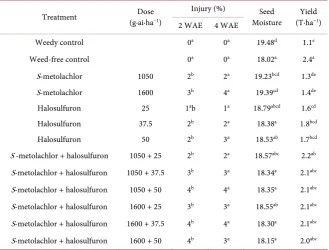
Visible white bean injury from the herbicides evaluated was minimal. S-meto- lachlor, halosulfuron, and S-metolachlor + halosulfuron, applied PRE, caused < 5% injury in white bean 2 and 4 WAE (Table 1). The level of injury is consistent with other research that have shown minimal, and transient, injury in white bean with S-metolachlor and halosulfuron [6][9][10][16].
[image:4.595.210.540.434.684.2]Weed interference delayed maturity (as indicated by seed moisture content at harvest) and reduced white bean seed yield 54%. Interference from weeds with
Table 1. Visible injury 2 and 4 WAE, percent moisture at maturity and yield of white bean treated with S-metolachlor and halosulfuron applied PRE at Exeter and Ridgetown (2016-2018)a,b.
Treatment (g∙ai∙haDose −1)
Injury (%) Seed
Moisture (T∙haYield −1) 2 WAE 4 WAE
Weedy control 0a 0a 19.48d 1.1e
Weed-free control 0a 0a 18.02a 2.4a
S-metolachlor 1050 2b 2a 19.23bcd 1.3de
S-metolachlor 1600 3b 4a 19.39cd 1.4de
Halosulfuron 25 1ab 1a 18.79abcd 1.6cd
Halosulfuron 37.5 2b 2a 18.38a 1.8bcd
Halosulfuron 50 2b 3a 18.53ab 1.7bcd
S -metolachlor + halosulfuron 1050 + 25 2b 2a 18.57abc 2.2ab S-metolachlor + halosulfuron 1050 + 37.5 3b 3a 18.34a 2.1abc S-metolachlor + halosulfuron 1050 + 50 4b 4a 18.35a 2.1abc S-metolachlor + halosulfuron 1600 + 25 3b 3a 18.55ab 2.1abc S-metolachlor + halosulfuron 1600 + 37.5 4b 4a 18.30a 2.1abc S-metolachlor + halosulfuron 1600 + 50 4b 3a 18.15a 2.0abc
aAbbreviations: PRE, preemergence; WAE, weeks after white bean emergence. bMeans followed by a
DOI: 10.4236/as.2019.1011106 1457 Agricultural Sciences
S-metolachlor and halosulfuron applied alone reduced white bean seed yield as much as 46% and 33%, respectively (Table 1). White bean seed yield with the
S-metolachlor + halosulfuron tankmixes at all doses evaluated was similar to the weed-free control. Results are consistent with other studies that have shown mi-nimal crop injury in white bean with S-metholachlor (1600 g∙ai∙ha−1), halosulfuron
(35 g∙ai∙ha−1), and S-metolachlor + halosulfuron (1050 + 35 g∙ai∙ha−1) [6][7][9][10].
3.2. Weed Control
Weeds selected for analysis needed to be present in at least 2 out of the 5 envi-ronments. Major weed species present on study sites included A. theophrasti, A. retroflexus, C. album, A. artemisiifolia, E. crus-galli and S. viridis.
3.2.1. Abutilon theophrasti
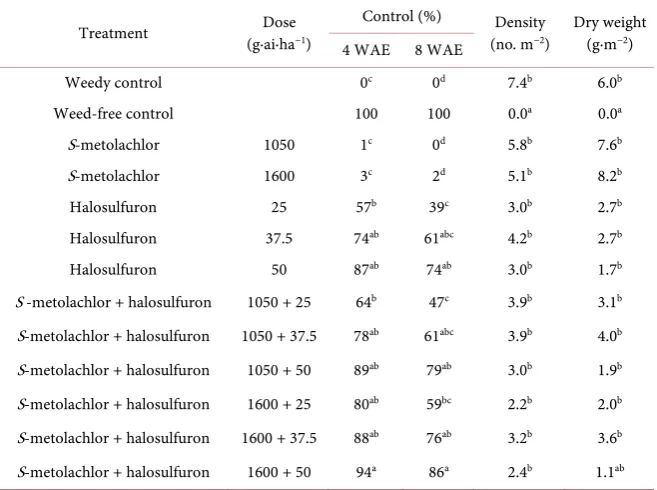
S-metolachlor at doses evaluated controlled A. theophrasti ≤ 3% (Table 2). Ha-losulfuron at the doses evaluated controlled A. theophrasti 39% to 87%.
S-metolachlor (1050 g∙ai∙ha−1) + halosulfuron at 25, 37.5 and 50 g∙ai∙ha−1
pro-vided as much as 64%, 78% and 89% control of A. theophrasti, respectively.
S-metolachlor (1600 g∙ai∙ha−1) + halosulfuron at 25, 37.5 and 50 g∙ai∙ha−1
[image:5.595.211.540.438.683.2]pro-vided as much as 80%, 88% and 94% control of A. theophrasti, respectively. All herbicide treatments resulted in A. theophrasti density and shoot dry weight that was comparable to the weedy control (Table 2).
Table 2. Percent visible control 4 and 8 WAE, density and dry weight of Abutilon theo-phrasti treated with S-metolachlor and halosulfuron applied PRE at Ridgetown (2016- 2018)a,b.
Treatment (g∙ai∙haDose −1)
Control (%) Density
(no. m−2) Dry weight (g∙m−2) 4 WAE 8 WAE
Weedy control 0c 0d 7.4b 6.0b
Weed-free control 100 100 0.0a 0.0a
S-metolachlor 1050 1c 0d 5.8b 7.6b
S-metolachlor 1600 3c 2d 5.1b 8.2b
Halosulfuron 25 57b 39c 3.0b 2.7b
Halosulfuron 37.5 74ab 61abc 4.2b 2.7b
Halosulfuron 50 87ab 74ab 3.0b 1.7b
S -metolachlor + halosulfuron 1050 + 25 64b 47c 3.9b 3.1b S-metolachlor + halosulfuron 1050 + 37.5 78ab 61abc 3.9b 4.0b S-metolachlor + halosulfuron 1050 + 50 89ab 79ab 3.0b 1.9b S-metolachlor + halosulfuron 1600 + 25 80ab 59bc 2.2b 2.0b S-metolachlor + halosulfuron 1600 + 37.5 88ab 76ab 3.2b 3.6b S-metolachlor + halosulfuron 1600 + 50 94a 86a 2.4b 1.1ab
aAbbreviations: PRE, preemergence; WAE, weeks after white bean emergence. bMeans followed by a
DOI: 10.4236/as.2019.1011106 1458 Agricultural Sciences
3.2.2. Amaranthus retroflexus
S-metolachlor and halosulfuron applied alone at doses evaluated controlled A. retroflexus 78% to 93% and 93% to 99%, respectively (Table 3). S-metolachlor (1050 or 1600 g∙ai∙ha−1) + halosulfuron at 25, 37.5 and 50 g∙ai∙ha−1 provided
ex-cellent (98% to 100%) control of A. retroflexus. Increasing the dose of S-metolachlor or halosulfuron did not significantly increase A. retroflexus control.
A. retroflexus density and dry weight reductions with herbicides evaluated were consistent with the visible control assessments (Table 3). S-metolachlor, halosulfuron, and S-metolachlor + halosulfuron reduced A. retroflexus density as much as 87%, 97% and 98% and A. retroflexus dry weight as much as 95%, 99% and 100%, respectively (Table 3).
Other studies have similarly shown 84% to 95% control of A. retroflexus with
S-metolachlor and 83% to 100% control of A. retroflexus with halosulfuron in white bean [7][9]. Brown and Masiunas [19] also reported 94% and 98% A. re-troflexus control with halosulfuron at 3 and 6 weeks after application (WAA), respectively. Other studies have also reported as much as 96% to 100% A. retrof-lexus control with S-metolachlor and halosufuron tankmix in white bean [6][7] [9] [18]. Li et al. [7] found 100% A. retroflexus control in white bean with
S-metolachlor + halosulfuron at 1050 + 35 g∙ai∙ha−1.
Table 3. Percent visible control 4 and 8 WAE, density and dry weight of Amaranthus retroflexus treated with S-metolachlor and halosulfuron applied PRE at Exeter (2016- 2017) and Ridgetown (2017).
Treatment (g∙ai∙haDose −1)
Control Density
(no. m−2) Dry weight (g∙m−2) 4 WAE 8 WAE
Weedy control 0c 0c 28.6c 36.0d
Weed-free control 100 100 0a 0a
S-metolachlor 1050 81.9b 78.4b 4.0b 2.3c
S-metolachlor 1600 92.9ab 92.7ab 3.7b 1.7bc
Halosulfuron 25 95.2ab 95.2ab 1.7ab 0.6abc
Halosulfuron 37.5 95.9ab 92.6ab 2.5ab 0.9abc
Halosulfuron 50 98.8ab 97.9a 0.9ab 0.4abc
S-metolachlor + halosulfuron 1050 + 25 98.9ab 97.9a 1.8ab 0.6abc
S-metolachlor + halosulfuron 1050 + 37.5 99.2a 99.3a 1.4ab 0.3abc S-metolachlor + halosulfuron 1050 + 50 98.9ab 98.7a 0.8ab 0.5abc S-metolachlor + halosulfuron 1600 + 25 99.2a 98.3a 1.1ab 0.4abc S-metolachlor + halosulfuron 1600 + 37.5 99.6a 99.6a 1.9ab 0.7abc
S-metolachlor + halosulfuron 1600 + 50 99.7a 99.8a 0.6ab 0.1abc
aAbbreviations: PRE, preemergence; WAE, weeks after white bean emergence. bMeans followed by a
[image:6.595.212.540.410.684.2]DOI: 10.4236/as.2019.1011106 1459 Agricultural Sciences
3.2.3. Ambrosia artemisiifolia
S-metolachlor alone at doses evaluated provided only 0% to 9% control of A. ar-temisiifolia (Table 4). However, halosulfuron alone at doses evaluated controlled
A. artemisiifolia 64% to 88%. S-metolachlor (1050 g∙ai∙ha−1) + halosulfuron at 25,
37.5 and 50 g∙ai∙ha−1 controlled A. artemisiifolia 78% to 91%. Similarly, S-meto-
lachlor (1600 g∙ai∙ha−1) + halosulfuron at 25, 37.5 and 50 g∙ai∙ha−1 provided 83%
to 94% A. artemisiifolia control.
S-metolachlor provided no reduction in density or dry weight of A. artemisii-folia at the doses evaluated (Table 4). However, halosulfuron and S-metolachlor + halosulfuron treatments reduced A. artemisiifolia density or dry weight as much as 95% (Table 4).
Other research has shown only 13% to 40% control of A. artemisiifolia with
S-metolachlor and 95% to 99% control of A. artemisiifolia with halosulfuron in white bean [7][9]. Li et al.[7] reported 95% to 98% A. artemisiifolia control in white bean with S-metolachlor + halosulfuron at 1050 + 35 g∙ai∙ha−1.
3.2.4. Chenopodium album
S-metolachlor applied alone at the doses evaluated provided poor (5% to 15%) control of C. album (Table 5). Halosulfuron alone at doses evaluated controlled
[image:7.595.211.540.429.684.2]C. album only 34% to 59%. S-metolachlor + halosulfuron at doses evaluated also provided less than adequate control (37% to 78%) of C. album. Increasing the
Table 4. Percent visible control 4 and 8 WAE, density and dry weight of Ambrosia ar-temisiifolia treated with S-metolachlor and halosulfuron applied PRE at Exeter (2017) and Ridgetown (2016-2018)a,b.
Treatment (g∙ai∙haDose −1)
Control (%) Density
(no. m−2) Dry weight (g∙m−2) 4 WAE 8 WAE
Weedy control 0c 0d 43.1c 50.2c
Weed-free control 100 100 0a 0a
S-metolachlor 1050 7b 0d 33.7c 63.1c
S-metolachlor 1600 9b 0d 27.8c 51.0c
Halosulfuron 25 78a 64c 5.9b 7.3b
Halosulfuron 37.5 81a 72bc 4.6b 6.5b
Halosulfuron 50 88a 81abc 4.5b 4.9b
S-metolachlor + halosulfuron 1050 + 25 86a 78abc 5.6b 6.0b S-metolachlor + halosulfuron 1050 + 37.5 91a 84ab 5.5b 8.0b S-metolachlor + halosulfuron 1050 + 50 91a 85ab 3.3b 5.4b S-metolachlor + halosulfuron 1600 + 25 89a 83abc 3.5b 6.1b S-metolachlor + halosulfuron 1600 + 37.5 93a 89a 2.8b 5.2b S-metolachlor + halosulfuron 1600 + 50 94a 88ab 2.2b 2.5b
aAbbreviations: PRE, preemergence; WAE, weeks after white bean emergence. bMeans followed by a
DOI: 10.4236/as.2019.1011106 1460 Agricultural Sciences Table 5. Percent visible control 4 and 8 WAE, density and dry weight of Chenopodium albumtreated with S-metolachlor and halosulfuron applied PRE at Exeter and Ridgetown (2016-2018)a,b.
Treatment (g∙ai∙haDose −1)
Control (%) Density
(no. m−2) Dry weight (g∙m−2) 4 WAE 8 WAE
Weedy control 0c 0d 30.9f 13.2c
Weed-free control 100 100 0a 0a
S-metolachlor 1050 5c 14cd 10.5e 10.7bc
S-metolachlor 1600 6c 15cd 8.2de 10.4bc
Halosulfuron 25 35b 34bc 3.2bc 3.7bc
Halosulfuron 37.5 49ab 45ab 3.3cd 2.7bc
Halosulfuron 50 59ab 48ab 2.0bc 3.5bc
S -metolachlor + halosulfuron 1050 + 25 47ab 37abc 2.7bc 4.1bc S-metolachlor + halosulfuron 1050 + 37.5 54ab 48ab 1.9bc 2.4bc S-metolachlor + halosulfuron 1050 + 50 64ab 61a 1.0bc 2.8bc S-metolachlor + halosulfuron 1600 + 25 66ab 46ab 2.1bc 5.3bc S-metolachlor + halosulfuron 1600 + 37.5 71a 62a 1.0b 1.8b S-metolachlor + halosulfuron 1600 + 50 78a 61a 1.2bc 2.0b
aAbbreviations: PRE, preemergence; WAE, weeks after white bean emergence. bMeans followed by a
differ-ent letter within a column are significantly differdiffer-ent according to a Tukey-Kramer multiple range test at P < 0.05.
dose of S-metolachlor or halosulfuron did not significantly increase the control of C. album.
S-metolachlor, halosulfuron, and S-metolachlor + halosulfuron reduced C. album density as much as 73%, 94% and 97%, respectively. However, shoot weight was not different than the weedy control with all herbicide treatments except for S-metolachlor (1600 g∙ai∙ha−1) + halosulfuron at 37.5 and 50 g∙ai∙ha−1
which reduced C. album dry weight 86% and 85%, respectively (Table 5). In other research, S-metolachlor applied alone provided 19% to 82% C. album
control in white bean [7][9]. Brown and Masiunas [19] reported 90% to 98% C. album control with halosulfuron at 3 to 6 WAA. Other studies have also re-ported 96% to 100% C. album control with halosulfuron in white bean [7][9]. Li
et al.[7] reported 99% to 100% C. album control with S-metolachlor + halosul-furon at 1050 + 35 g∙ai∙ha−1.
3.2.5. Echinochloa crus-galli
All treatments that included S-metolachlor provided excellent E. crus-galli con-trol (Table 6). S-metolachlor applied alone at the doses evaluated controlled E. crus-galli 97% to 99% (Table 6). In contrast, halosulfuron applied at 25, 37.5 and 50 g∙ai∙ha−1 controlled E. crus-galli only 10% to 30% in white bean (Table 6).
DOI: 10.4236/as.2019.1011106 1461 Agricultural Sciences Table 6. Percent visible control 4 and 8 WAE, density and dry weight of Echinochloa crus-galli treated with S-metolachlor and halosulfuron applied PRE at Exeter (2017) and Ridgetown (2018)a,b.
Treatment (g∙ai∙haDose −1)
Control (%) Density
(no. m−2) Dry weight (g∙m−2) 4 WAE 8 WAE
Weedy control 0c 0c 21.8d 26.3bc
Weed-free control 100 100 0 a 0a
S-metolachlor 1050 97a 98a 2.5b 1.1b
S-metolachlor 1600 99a 99a 2.2b 1.0b
Halosulfuron 25 26b 21b 28.2d 39.2c
Halosulfuron 37.5 28b 25b 15.1cd 28.0bc
Halosulfuron 50 30b 10b 27.5d 23.7bc
S-metolachlor + halosulfuron 1050 + 25 94a 97a 4.0bc 3.5b S-metolachlor + halosulfuron 1050 + 37.5 97a 98a 3.6bc 1.8b S-metolachlor + halosulfuron 1050 + 50 94a 96a 5.0bc 2.1b S-metolachlor + halosulfuron 1600 + 25 98a 98a 2.7b 1.0b S-metolachlor + halosulfuron 1600 + 37.5 95a 98a 2.7b 0.9b S-metolachlor + halosulfuron 1600 + 50 98a 98a 2.4b 10.4bc
aAbbreviations: PRE, preemergence; WAE, weeks after white bean emergence. bMeans followed by a
differ-ent letter within a column are significantly differdiffer-ent according to a Tukey-Kramer multiple range test at P < 0.05.
provided 97%, 98% and 96% control of E. crus-galli in white bean, respectively 8 WAE. Similarly, S-metolachlor (1600 g∙ai∙ha−1) + halosulfuron at 25, 37.5, and 50
g∙ai∙ha−1 controlled E. crus-galli as much as 98% in white bean.
S-metolachlor and S-metolachlor + halosulfuron reduced density of E. crus- galli as much as 90% and 89%, respectively. However, E. crus-galli density and shoot dry weight was not different than the weedy control with halosulfuron (Table 6).
3.2.6. Setaria viridis
All treatments that included S-metolachlor provided excellent S. viridis control (Table 7). S-metolachlor applied alone at the doses evaluated provided 96% to 98% S. viridis control (Table 7). Halosulfuron alone provided poor S. viridis con-trol. Halosulfuron (25, 37.5, and 50 g∙ai∙ha−1) provided a maximum S. viridis control
of 35% in white bean (Table 7). S-metolachlor (1050 or 1600 g∙ai∙ha−1) +
halosulfu-ron (25, 37.5, and 50 g∙ai∙ha−1) controlled S. viridis 91% to 96% in white bean.
[image:9.595.211.539.114.387.2]DOI: 10.4236/as.2019.1011106 1462 Agricultural Sciences Table 7. Percent visible control 4 and 8 WAE, density and dry weight of Setaria viridi-streated with S-metolachlor and halosulfuron applied PRE at Exeter and Ridgetown (2016-2018)a,b.
Treatment (g∙ai∙haDose −1)
Control (%) Density
(no. m−2) Dry weight (g∙m−2) 4 WAE 8 WAE
Weedy control 0c 0c 57.7c 58.1c
Weed-free control 100 100 0a 0a
S-metolachlor 1050 96a 96a 6.6b 3.8b
S-metolachlor 1600 98a 98a 6.4b 3.2b
Halosulfuron 25 21b 13b 47.9c 36.7c
Halosulfuron 37.5 25b 19b 45.7c 29.9c
Halosulfuron 50 35b 25b 40.2c 31.1c
S-metolachlor + halosulfuron 1050 + 25 92a 91a 12.4b 9.1b S-metolachlor + halosulfuron 1050 + 37.5 92a 94a 12.1b 8.4b S-metolachlor + halosulfuron 1050 + 50 92a 92a 9.6b 5.8b S-metolachlor + halosulfuron 1600 + 25 96a 95a 8.0b 5.9b S-metolachlor + halosulfuron 1600 + 37.5 96a 95a 8.5b 5.2b S-metolachlor + halosulfuron 1600 + 50 96a 96a 8.3b 3.9b
aAbbreviations: PRE, preemergence; WAE, weeks after white bean emergence. bMeans followed by a
differ-ent letter within a column are significantly differdiffer-ent according to a Tukey-Kramer multiple range test at P < 0.05.
Other studies have similarly shown 93% to 97% S. viridis control with S-me- tolachlor [6][20] and 47% to 59% S. viridis control with halosufuron in white bean [7][9]. Li et al.[7] found up to 94% S. viridis control with S-metolachlor + halosulfuron at 1050 + 35 g∙ai∙ha−1.
4. Conclusions
There is an adequate margin of crop safety in white bean for use of S-meto- lachlor, halosulfuron and S-metolachlor + halosulfuron applied PRE. S-metola- chlor alone provided poor control of A. artemisiifolia,C. album and A. theoph-rasti, fair control of A. retroflexus and excellent control of S. viridis and E. crus-galli. Halosulfuron alone provided poor control of C. album, A. theophras-ti, E. crus-galli and S. viridis, fair control of A. artemisiifolia and excellent con-trol of A. retroflexus. S-metolachlor + halosulfuron tankmixes provided poor control of C. album, fair control of A. theophrasti, good control of A. artemisii-folia and excellent control of A. retroflexus, E. crus-galli and S. viridis. There was a trend for better control of A. artemisiifolia,C. album and A. theophrasti with the higher doses of halosulfuron. White bean yield with S-metolachlor + halo-sulfuron tankmixes was similar to the weed-free control.
DOI: 10.4236/as.2019.1011106 1463 Agricultural Sciences
For fields with A. theophrasti, there was a trend for improved control with the higher doses of halosulfuron. For fields with A. artemisiifolia, there was a trend for improved control with the higher doses of halosulfuron when applied as a tankmix with the low dose of S-metolachlor, however, there was no need to in-crease the halosulfuron dose when applied as a tankmix with the high dose of
S-metolachlor. For fields with A. retroflexus species, E. crus-galli and S. viridis, a tankmix of S-metolachlor + halosulfuron at the low dose was sufficient to pro-vide excellent weed control. Using this information, white bean producers can maximize crop yield and reduce input costs while reducing unnecessary loading of herbicides into the environment by adjusting herbicide doses depending on weed species present in their land.
Acknowledgements
This study was funded in part by Ontario Bean Growers (OBG).
Conflicts of Interest
The authors declare that there is no conflict of interest regarding the publication of this paper.
References
[1] Ontario Bean Growers (2019) Ontario Beans.
http://ontariobeans.on.ca/types-of-beans
[2] Ontario Ministry of Agriculture, Food and Rural Affairs (2019) Area, Yield, Pro-duction and Farm Value of Specified Field Crops (Imperial and Metric Units).
http://www.omafra.gov.on.ca/english/stats/crops/index.html
[3] Ontario Ministry of Agriculture, Food and Rural Affairs (2018) Guide to Weed Control. Publication 75. OMAF, Toronto, 355 p.
[4] Woolley, B.L., Micheals, T.E., Hall, M.R. and Swanton, C.J. (1993) The Critical Pe-riod of Weed Control in White Bean (Phaseolus vulgaris). Weed Science, 41, 180-184.
https://doi.org/10.1017/S0043174500076037
[5] Chikoye, D., Weise, S.F. and Swanton, C.J. (1995) Influence of Common Ragweed (Ambrosia artemisiifolia) Time of Emergence and Density on White Bean ( Phaseo-lus vulgaris). Weed Science, 43, 375-380.
https://doi.org/10.1017/S0043174500081352
[6] Li, Z., Van Acker, R., Robinson, D.E., Soltani, N. and Sikkema, P.H. (2016) Halo-sulfuron Tank-Mixes Applied PRE in White Bean (Phaseolus vulgaris L.). Weed Technology, 30, 57-66.https://doi.org/10.1614/WT-D-15-00084.1
[7] Li, Z., Van Acker, R., Robinson, D.E., Soltani, N. and Sikkema, P.H. (2016) Halo-sulfuron Tank-Mixes Applied Preplant Incorporated for Weed Control in White Bean (Phaseolus vulgaris L.). Canadian Journal of Plant Science, 96, 81-88.
https://doi.org/10.1139/cjps-2015-0124
DOI: 10.4236/as.2019.1011106 1464 Agricultural Sciences White Bean with Various Halosulfuron Tankmixes. Advances in Agriculture, 2014, Article ID: 391634.https://doi.org/10.1155/2014/391634
[10] Soltani, N., Nurse, R.E., Shropshire, C. and Sikkema, P.H. (2014) Weed Control with Halosulfuron Applied Preplant Incorporated, Preemergence or Postemergence in White Bean. The Journal of Agricultural Science, 5, 875-881.
https://doi.org/10.4236/as.2014.510094
[11] Soltani, N., Dille, J.A., Gulden, R., Sprague, C., Zollinger, R., Morishita, D.W., Law-rence, N.C., Sbatella, G.M., Kniss, A.R., Jha, P. and Sikkema, P.H. (2018) Potential Yield Loss in Dry Bean Crops Due to Weeds in the United States and Canada. Weed Technology, 32, 342-346. https://doi.org/10.1017/wet.2017.116
[12] Wilson, R.G., Wicks, G.A and Fenster, C.R. (1980) Weed Control in Field Beans (Phaseolus vulgaris) in Western Nebraska. Weed Science, 28, 295-299.
https://doi.org/10.1017/S0043174500055326
[13] Shaner, D.L. (2014) Herbicide Handbook. 10th Edition, Weed Science Soc. Am., Champaign, 513 p.
[14] Silvey, B.D., Mitchem, W.E., Macrae, A.W. and Monks, D.W. (2006) Snap Bean (Phaseolus vulgaris) Tolerance to Halosulfuron PRE, POST, or PRE Followed by POST. Weed Technology,20, 873-876. https://doi.org/10.1614/WT-05-046.1 [15] O’Connell, P.J., Harms, C.T. and Harms, C.T. (1998) Metolachlor, S-Metolachlor
and Their Role within Sustainable Weed-Management. Crop Protection, 17, 207-212.
https://doi.org/10.1016/S0261-2194(98)80011-2
[16] Li, Z., Van Acker, R., Robinson, D.E., Soltani, N. and Sikkema, P.H. (2017) Manag-ing Weeds with Herbicides in White Bean in Canada: A Review. Canadian Journal of Plant Science, 97, 755-766.https://doi.org/10.1139/CJPS-2017-0030
[17] SAS Institute Inc. (2016) Base SAS® 9.4 Procedures Guide: Statistical Procedures. 5th Edition, SAS Institute Inc., Cary.
[18] Soltani, N., Nurse, R.E., Shropshire, C. and Sikkema, P.H. (2012) Weed Control, Environmental Impact and Profitability of Pre-Plant Incorporated Herbicides in White Bean. American Journal of Plant Sciences, 3, 846-853.
https://doi.org/10.4236/ajps.2012.37102
[19] Brown, D. and Masiunas, J. (2002) Evaluation of Herbicides for Pumpkin ( Cucur-bita spp.). Weed Technology, 16, 282-292.
https://doi.org/10.1614/0890-037X(2002)016[0282:EOHFPC]2.0.CO;2