Wireless Sensor Network,2010,2,419-440
doi:10.4236/wsn.2010.26054 Published Online June 2010 (http://www.SciRP.org/journal/wsn)
Classification and Review of Security Schemes
in Mobile Computing
Sathish Alampalayam Kumar
Department of Computer Science and Information Technology PSG Institute of Advanced Studies, Coimbatore, India E-mail: [email protected]
Received October 13,2009; revised November 20, 2009; accepted December 25,2009
Abstract
In this paper, we present the classification and review of security schemes in mobile computing system. We classify these schemes based on types the infrastructure used in the mobile computing system-Mobile Ad Hoc Networks (MANET) and Mobile Agent model. Mobile Ad Hoc Networks are pervasive, ubiquitous and without any centralized authority. These unique characteristics, combined with ever-increasing security threats, demand solutions in securing ad hoc networks prior to their deployment in commercial and military applications. This paper reviews the prevailing mobile ad hoc network security threats, the existing solution schemes, their limitations and open research issues. We also explain the Intrusion detection and response technique as an alternate method to protect the MANET based mobile computing systems and their ap-proaches. A literature review of important existing Intrusion Detection approaches and Intrusion Response Approaches for MANET is also presented. This paper also presents the limitations of existing Intrusion De-tection and Response Approaches for MANET and open research issues in providing MANET security. With respect to Mobile Agent based mobile computing system, we have presented the classification of various types of security attacks in Mobile Agent based model and presented the security solutions for those type of attacks proposed by the various schemes and the open research issues in providing security for Mobile Agent based mobile computing system. Such classification enhances the understanding of the proposed security schemes in the mobile computing system, assists in the development and enhancement of schemes in the fu-ture and helps in choosing an appropriate scheme while implementing a mobile computing system.
Keywords:Wireless Sensor Networks, Beta Trust Model, Trust Routing Protocol, Network Security, Trust Evaluation
1. Introduction
Although the wonderful invention of Internet offers ac-cess to information sources worldwide, we do not expect to benefit from that access until we arrive at some famil-iar point-whether home, office, or school. However, the increasing variety of wireless devices offering IP con-nectivity, such as PDA’s, handhelds, and digital cellular phones, is beginning to change our perceptions of the Internet.
Mobile computing and networking should not be con-fused with the portable computing and networking we have today. In mobile networking, computing activities are not disrupted when the user changes the computer’s point of attachment to the Internet. Instead, all the needed reconnections occur automatically and none interactively. Mobile Internet implies changing the point of attachment
as the host (mobile station) roams between cells.
Truly, mobile computing offers many advantages. Confident access to the Internet anytime, anywhere will help free us from the ties that bind us to our desktops. Having the Internet available to us as we move will give us the tools to build new computing environments wherever we go. This is especially convenient in a wire-less LAN office environment, where the boundaries between attachment points are not sharp and are often invisible.
420 S. A. KUMAR
more vulnerable for intrusion and eavesdropping. Au-thentication mechanisms are designed to protect a sys-tem from unauthorized access to its resources and data. However, at present, completely preventing breaches of security seems unrealistic, especially in mobile com-puting systems [1,2]. A Personal Area Network (PAN) level firewall as envisioned for the next generation wireless networks can protect only if the users are at home and not when the users are roaming [3]. Even if such a firewall is provided, the communication would get fragmented by these ‘check points’ on the network, as each firewall needs maintenance of activities like log control, software update etc., creating unnecessary over-head. Thus existing technologies like firewalls and Virtual Private Network (VPN) sandboxes cannot be directly applied to the wireless mobile world. Even if the fire-wall concept were achieved by creating a private extra-net (VPN) which extends the firewall protected domain to wherever the user moves, this would still lead to in-efficient routing. Security is a fundamental concern for mobile network based system. Harrison et al. [4] iden-tify security as a “severe concern” and regard it as the primary obstacle to adopting mobile systems.
2. Mobile Computing Systems Security
2.1. Mobile Computing Systems Security Classification
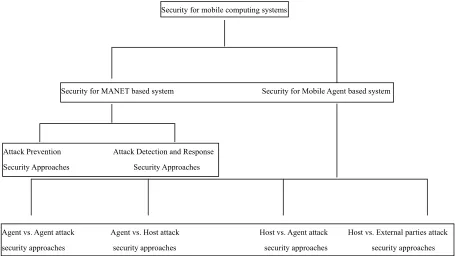
The security approaches for mobile computing systems can be classified as shown in the following Figure 1.
2.2. MANET and Security Attacks in MANET
2.2.1. MANET Background
A Mobile Ad hoc Network (MANET) is a collection of wireless mobile nodes forming a temporary network without any centralized authority. In a MANET, each wireless mobile node operates not only as an end-system, but also as a router to forward packets. The nodes are free to move about and organize themselves into a net-work. MANET does not require any fixed infrastructure such as base stations; therefore, it is an attractive net-working option for connecting mobile devices quickly and spontaneously. For instance, first responders at a disaster site or soldiers in a battlefield must provide their own communications. A MANET is a possible solution for this need to quickly establish communications in a mobile, transient and infrastructure-less environment. This is one of many applications where MANET’s can be used. Mobile ad-hoc networks are the future of wireless networks. Nodes in these networks will generate both user and application traffic and perform various network functions.
In the last decade, wired and wireless computer network revolution has changed the computing scenario. The pos-sibilities and opportunities due to this revolution are limit-less; unfortunately, so too are the risks and chances of at-tacks due to intrusion by malicious nodes [4]. Intrusion is defined as an attack or a deliberate unauthorized attempt
Security for mobile computing systems
Security for MANET based system Security for Mobile Agent based system
Attack Prevention Attack Detection and Response
Security Approaches Security Approaches
Agent vs. Agent attack Agent vs. Host attack Host vs. Agent attack Host vs. External parties attack
[image:2.595.70.527.443.699.2]security approaches security approaches security approaches security approaches
S. A. KUMAR 421
to access information, manipulate information, or render a system unreliable or unusable [5]. According to [6], threat can be defined as “the potential possibility of a deliberate unauthorized attempt to 1) access information, 2) manipulate information and 3) render a system unre-liable or unusable. By security we mean protecting nodes from damages due to either voluntary or accidental at-tacks [7]. This protection is provided by predicting an attack by monitoring a set of metrics measured from the ad hoc network, and then responding and modifying the security of the network based on the vulnerability level at a given time.
Security in mobile ad hoc network is essential even for basic network functions like routing which are carried out by the nodes themselves rather than specialized rou-ters. The intruder in the ad hoc network can come from anywhere, along any direction, and target any communi-cation channel in the network. Compare this with a wired network where the intruder gains physical access to the wired link or can pass through security holes at firewalls and routers. Since the infrastructure-free mo-bile ad hoc network does not have a clear line of de-fense, every node must be prepared for the adversary. The centralized or hierarchical network security solu-tion for the existing wired and infrastructure-based cel-lular wireless networks will not work properly for Mo-bile Ad Hoc Networks [8]. Securing the ad hoc net-works, like any other field of computers, is based on the principle of confidentiality and integrity. These princi-ples exist in every field, but the presence of malicious nodes, selfish nodes, covert channels and eavesdroppers in the mobile ad hoc network makes this an extremely important and challenging problem [9]. In the past sev-eral years, there has been a surge of network security research in the field of information assurance that has focused on protecting the network using techniques such as authentication and encryption. These techniques are applicable in the wired and infrastructure-based cellular network. In the case of infrastructure-free Mo-bile Ad Hoc Networks these techniques are not appli-cable [8]. In the infrastructure-free networks, the nodes themselves perform basic network functions like rout-ing and packet forwardrout-ing. Therefore, mobile ad hoc network security is a pressing issue, which needs im-mediate research attention [10-13]. Providing security services in the mobile computing environment is chal-lenging because it is more vulnerable for intrusion and eavesdropping. The challenge of mobile ad hoc network security has attracted several researchers with the aim of securing mobile ad hoc computer networks.
2.2.2. Security Attacks in MANET
A MANET can be subjected to active attacks and passive attacks. Active attacks refer to the direct attacks by a hostile entity during execution or transmission phase. Some of the major types of active attacks are routing
attacks and active DoS attacks. Passive attacks refer to the indirect attacks by an entity in the network during collaboration. Some of the major types of passive attacks include actions like selfishness, eavesdropping, traffic analysis and passive DoS attacks.
1) Active Attack in MANET: a) Routing Attacks:
Routing attack is a significant problem because nodes within the ad hoc network themselves performs routing functions and the security concepts are not incorporated in most of the routing protocols. Also, routing tables form the basis of network operations and any corruption to the routing table may lead to significant adverse con-sequences.
Designing a secure ad hoc network routing protocol is a challenge for the following reasons: Firstly, routing relies on the trustworthiness of all the nodes involved and it is difficult to distinguish selfish nodes from normal nodes. Secondly, rapid mobility of nodes that perform the role of routing and network topology makes the de-sign of a secure routing protocol more difficult. Active routing attacks differ in their behavior depending on the nature of the routing protocol. In the case of link-state routing protocol, a router sends information about its neighbors. Hence a malicious router can send incorrect updates about its neighbors, or remain silent if the link state of the neighbor has actually changed. However, in the case of distance-vector protocols, routers can send wrong and potentially dangerous updates regarding any nodes in the network, since the nodes do not have the full network topology. These attacks in case of both link- state and distance-vector protocols are very difficult to prevent if the routers exhibit Byzantine faults [14].
In the MANET shown in Figure 2, let us assume that packets are supposed to traverse from source node A to destination node C. However, the intruder updates the routing table so that the packets traverse from B to D instead of C, and hence the packets from A never reach C. This also causes congestion on domains served by nodes A, D and E, due to the bombardment of packets whose actual destination was C. Thus the attack can lead to network performance degradation.
Some of the important and common methods of rout-ing attacks are:
i) Router Protocol Poisoning: In this attack an intruder causes the disruption by poisoning the routing protocol. Securing these attacks is important because the routing protocol forms the basis of network operations, and any corruption of the protocol may lead to significant conse-quences. These attacks on the Mobile Ad Hoc Networks can lead to looping, congestion, sub optimal routing and partitioning [15]. Thus, they can ultimately affect the performance of an ad hoc network.
422 S. A. KUMAR
[image:4.595.103.500.60.184.2]B C
Figure 2. Routing loop attack. in turn would poison the routing tables. These attacks
would result in the artificial partitioning of the network, and the hosts residing in one partition would not be able to communicate with hosts residing in the other partition. iii) Routing Loop Attacks: In this attack, intruder or malicious nodes update the routing table to create a loop, so that packets can traverse in the network without reaching the destination, thereby conserving energy and bandwidth.
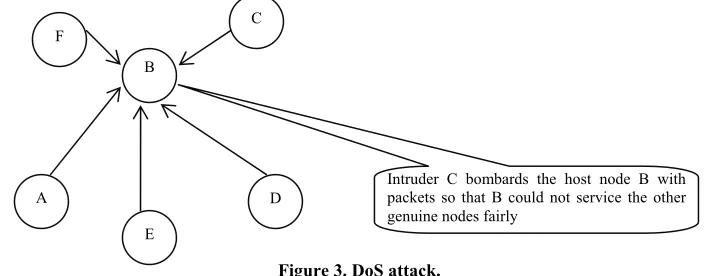
b) Active DoS Attacks:
These attacks can be defined as the direct denial of service attacks on a node by another hostile node through packet flooding, packet modification, deletion or forging of packets or routing table. Following are some of the common types of active DoS attacks by selfish nodes or adversaries: replay of expired routing information, bogus nodes create traffic by bombarding the neighboring nodes with the packets, radio jamming, flooding central-ized resource with the requests, ability to change routing protocol to operate as the user wants, Byzantine failure, sleep deprivation torture (Battery Exhaustion) and in-jecting incorrect routing information.
Active DoS attack is depicted in Figure 3, where node B is a host node and C is the intruder. The intruder node C creates a huge traffic resulting in the exhaustion of the node B’s resources. This results in the inability of node B to serve genuine nodes A, D, E and F fairly. Thus, DoS attacks on the mobile ad hoc networks can lead to net-work performance degradation.
2) Passive Attack in MANET a) Selfish Attacks:
Passive attacks could be caused by selfishness, eaves-
dropping and traffic analysis. In this section we explain selfishness attacks to give an idea of passive attacks. In the selfishness attacks, the selfish node abuses con-strained resources, such as battery power, for its own benefit [16]. They do not intend to directly damage other nodes in the network. Attackers may also get hold of a node and modify its behavior to make it malicious, so the node would perform selfish attacks in need of resources. These attacks have limited effectiveness compared to the routing-table “poisoning” and DoS attacks [17]. This is because, the attacks are limited to a part of the network rather than the whole network as in the case of routing protocol attacks.
Some of the common types of selfish node attacks in mobile ad hoc network are packet mistreatment and en-ergy consumption attacks. In this kind of attack, a node in mobile ad hoc network does not perform the expected network functions, like packet forwarding or routing, and later claims that the transaction or communication never took place [17]. It could be deliberate or accidental, due to false repudiation of a transaction or due to scarce re-sources in the mobile ad hoc networks.
As shown in Figure 4, the packets are supposed to traverse from source node A to destination node C. However, selfish node B discards the packets from A and hence the packets from A never reach C. This results in ‘black hole’ attacks. This in turn may result in deadlock issues which result in performance degradation. Some of the important and common methods of selfish attacks are: i) Packet mistreatment or interception: In this kind of attack, a selfish node does not perform the function of packet forwarding. As mentioned earlier, interruption
Figure 3. DoS attack.
A D
E
Intruder updates routing table so that the packets are routed from B to D instead of C and hence the packets from A never reach C.
A
B
D
E
C F
[image:4.595.118.479.582.720.2]S. A. KUMAR 423
A
B
C
[image:5.595.99.495.60.174.2]Selfish Node B discards the packet from A and forwards to itself instead of forwarding to C, and hence the packets from A never reach C.
Figure 4. Packet mistreatment attack.
of packets may reduce the overall throughput of the net-work. In a specialized form of packet discarding, selfish nodes do not forward the packets to host destination, but to itself. This result in black hole and DoS attacks.
ii) Energy consumption: In this kind of attacks, nodes try to save significant battery power by not performing networking functions such as routing. This is due to the fact that in ad hoc network most of the energy is con-sumed by routing of packets. For instance, experiments have shown that if the average hop from source to desti-nation is 5, approximately 80% of the available energy is spent in sending packets from source to destination by packet forwarding [17].
2.3. Mobile Agent Model and Security Threats in Mobile Agent Model
2.3.1. Mobile Agent Model Background
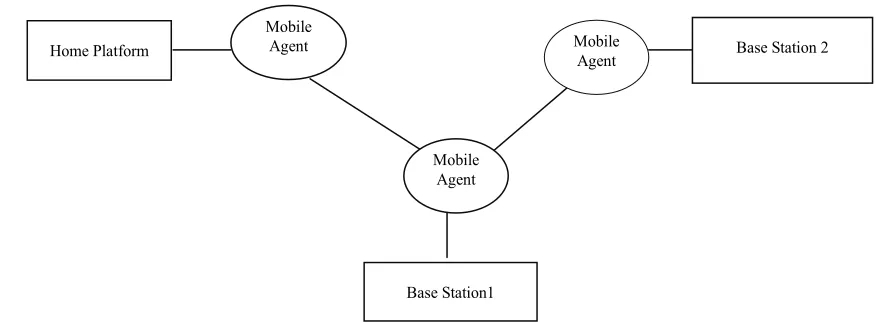
A distributed mobile agent system model for a wireless internet host environment involves the following parties, mobile agents and fixed base stations as shown in Figure 5. Some of the wireless models [18] applied for special applications like mobile military networks assumes mo-bile base stations. However, in this discussion we assume the base station is fixed.
Mobile Agent:
The Mobile Agent (MA) is a software component [19] like
A thread as in Telescript, that can migrate among
different nodes carrying its execution state (i.e., program counter, call stack etc.) Here the run-time image of the component is transferred as a whole, including its execu-tion state.
The task to rebuild the execution state is carried out by the run-time support of the Mobile Code System.
Or just a code fragment as in TACOMA [20] as-sociated with initialization data that can be shipped to a remote host. They don’t have the ability to migrate once they have started their execution. These systems claim to be able to move the state of a component along with its code. This assertion is justified by the availability of mechanisms that allow the programmer to pack some portion of the data space of an executing component be-fore the component’s code is sent to a remote destina-tion.
It is the programmer’s task to rebuild the execution state of a component after its migration, using the data transferred with the code.
Thus a mobile agent (with respect to design paradigm) contains.
Code component-Executing Unit (EU) (Sequential flows of computation), which encapsulate the know-how to perform a particular computation.
Resource component-(entities that can be shared among multiple EUs such as a file in a file system, an object shared by threads in a multi-threaded object-ori- ented language, or an operating system variable) that represents data or devices used during the computation.
Home Platform
Mobile
Agent Base Station 2
Base Station1 Mobile
Agent
Mobile Agent
[image:5.595.73.511.548.709.2]424 S. A. KUMAR
Computational components that are active execu-tors capable to carry out a computation.
Mobility allows an agent to move or hop among base station. The base station provides a computational envi-ronment in which an agent operates. The purpose of Mo-bile Agent in terms of Artificial Intelligence (AI) re-search paradigm is a software component that is able to achieve a goal by performing actions and reacting to events in a dynamic environment. The behavior of this component is determined by the knowledge of the rela-tionships among events, actions and goals. However, in terms of Distributed Systems research paradigm, the purpose of the mobile agent is to allow the migration of the whole computational component to a remote site, along the code it needs, some resources required to per-form the task along with its execution state of an EU to a different CE (Computation Environment or Host).
Mobile Agents are increasingly becoming popular with the ubiquitous and widespread deployment of wireless and internet technologies. With the help of mobile agents it is possible to create distributed appli-cations where the programs can autonomously traverse from one computer to another and get executed. They are more powerful than an ordinary applets [21] due to the AI component, they decide themselves where and when to traverse and execute. They are prominently applied in mobile computing systems. Connection mana- gement for mobile computing requires continuous re-configuration of the data links. If connectivity fails, the mobile computing system requires applications to han-dle extended off-line periods. “Mobile software agents are very useful in this context, since they could encap-sulate long-lasting transactions. They could carry a re-quest to server, cause its execution and bring back the result as soon as the connectivity is reestablished [21].” Due its ability to preprocess the results, it makes use of the slow communication link between the mobile de-vice and the network.
2.3.2. Security Threats in Mobile Agent Based Model: In the mobile agent-host model the security attacks or threats could be classified into four categories:
mobile agent attacked by another mobile agent mobile agent attacking by the host
host attacked by a mobile agent
host attacked by external unauthorized party like an agent or host
For the ease of understanding, any agent or host attack could be further classified into active or passive attacks. Before further classification, it is essential to define ac-tive and passive attacks.
Active attacks can be defined as the direct attacks on an entity by another hostile entity during its execution or transmission like code/message modification, deletion or forging.
Passive attacks can be defined as the indirect attacks on an entity by another hostile entity during its execution or transmission like eavesdropping and traffic analysis.
Mobile Agent Attacked by another Agent:
Different types of attacks by a MA against another MA can be classified as shown in the following taxonomy.
1) Active Attacks:
Denial of service: In these attacks agent could spam other agents causing resource constraints by repeatedly sending messages to another agent, may place undue burden on the message handling routines of the recipient. Agents can also intentionally distribute false or useless information to prevent other agents from completing their tasks correctly or in a timely manner.
Unauthorized Access: In these attacks agent would invoke other agent’s public methods by accessing or modifying agent’s code or data, which could change the behavior of agent from trusted to harmful one.
2) Passive Attacks:
Repudiation: Agent participating in a transaction or communication later claims that the transaction or com-munication never took place―could be deliberate or accidental, due to false repudiation of a transaction or due to imperfect business transactions within an organi-zation.
Masquerade: In this category an agent posing as host could deceive other agents and it harms both the agent that is being deceived and the agent whose identity has been assumed, especially in agent societies where repu-tation is valued and used as a means to establish trust.
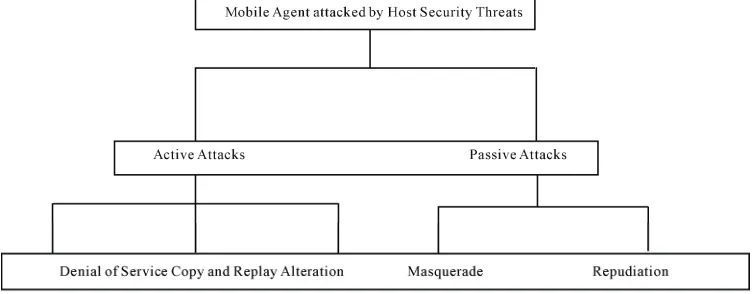
Mobile agent attacked by the host:
Different types of attacks by a host against MA can be classified as shown in the following taxonomy.
3) Active Attacks
Denial of Service: In these attacks host would ignore agent service request by not executing the agent or turn-ing away the request. This would introduce unaccept-able delays for critical tasks like handoff in the mobile computing world. Agents on other platforms waiting for the results from a non-responsive agent in the malicious host platform could cause deadlock or livelock prob-lems.
Alteration: Since agent visits various base stations or hosts during its life time, it could be altered by any of the hosts an agent passes through its lifetime. Thus a mobile agent is exposed to a new risk each time it is in transit and each time it is instantiated on a new platform.
Copy and Replay: In these attacks an agent or its message could be copied and replayed several times by the host.
4) Passive Attacks
S. A. KUMAR 425
Mobile Agent Host Model Security Threats
[image:7.595.113.497.66.181.2]Agent vs. Agent Agent vs. Host Host vs. Agent Host vs. External parties
[image:7.595.106.493.210.370.2]Figure 6. Taxonomy of mobile agent model security threats.
Figure 7. Taxonomy of mobile agent attacked by another agent attacks.
Figure 8. Taxonomy of mobile agent attacked by host security threats. Repudiation: Host participating in a transaction or
communication with an agent later claims that the trans-action or communication never took place-could be de-liberate or accidental, due to false repudiation of a trans-action or due to imperfect business transtrans-actions within an organization.
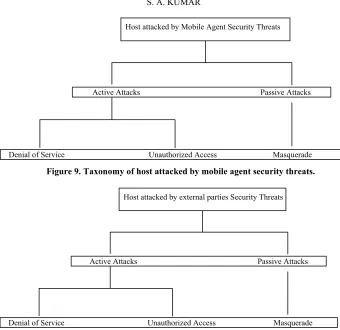
Host attacked by mobile agents
Different types of attacks by a MA against host can be classified as shown in the following taxonomy.
5) Active Attacks:
Denial of Service: In these attacks agent consume ex-cess amount of host resources so that the host can not service other agents properly.
Unauthorized access: In these attacks, agent without proper authorization could harm the host.
6) Passive Attacks
Masquerading: In these attacks agent may pose as an authorized agent to gain access to services and resources to which it is not entitled, to shift the blame for any ac-tions for which it does not want to be held accountable and to damage the trust the legitimate agent has estab-lished in an agent community and its associated reputa-tion.
Host attacked by other unauthorized external par- ties including host and agents:
[image:7.595.110.488.400.547.2]426 S. A. KUMAR
Host attacked by Mobile Agent Security Threats
Active Attacks Passive Attacks
[image:8.595.117.457.60.390.2]Denial of Service Unauthorized Access Masquerade
Figure 9. Taxonomy of host attacked by mobile agent security threats.
Host attacked by external parties Security Threats
Active Attacks Passive Attacks
Denial of Service Unauthorized Access Masquerade
Figure 10. Taxonomy of host attacked by external parties security threats. external MA or an external host against the host can be
classified as shown in the following taxonomy. 7) Active Attacks
Unauthorized Access: In these attacks, remote users, processes, and agents may request resources from the host, for which they are not authorized.
Denial of service: In these attacks, the agent services offered by the host or base station can be disrupted by common denial of service attacks.
8) Passive Attacks
Masquerade: An agent on a remote base station can masquerade as another agent and request services and resources for which it is not authorized. They may act in conjunction with its platform (base station) to deceive the host.
3. MANET Security Approaches
3.1. MANET Attack Prevention Approaches
In this section, we classify the MANET security work into two broad categories based on the type of attack: active attack or passive attack.
3.1.1. Review of MANET Attack Prevention Security Schemes for Active attacks
In ad hoc networks, a mobile node or host may depend
on other node(s) to route or forward a packet to its desti-nation. The security of these nodes could be compro-mised by an external attacker or due to the selfish nature of other nodes. This would create a severe threat of De-nial of Service (DoS) and routing attacks where mali-cious nodes combine and deny the services to legitimate nodes. Unlike nodes in a wired network, the nodes of MANET may have less processing power as well as bat-tery life and consequently would try to conserve re-sources. In this scenario, the usual authentication and encryption methods would not apply to a MANET the same way they would in a wired network [22]. However, both authentication and encryption are even more im-portant in a MANET [23,24]. Steiner et al. have devel-oped a Group key Diffie-Hellman (GDH) model that provides a flexible solution to group key management. Yi et al. [25] have developed the MOCA (MObile Certi-fication Authority) protocol that helps manage heteroge-neous mobile nodes as part of a MANET. MOCA uses Public Key Infrastructure (PKI) technology.
[image:8.595.117.460.64.223.2]S. A. KUMAR 427
service due to poor key management.
Routing is an important aspect of moving packets around in a network. It is a challenging problem because nodes within the ad hoc network themselves performs routing function and the security concepts were not in-corporated into the routing protocols when they were designed. It is important because the routing table forms the basis of the network operations and any corruption of routing table may lead to significant consequences. Routing attacks in mobile ad hoc network are more chal-lenging since routing relies on the trustworthiness of all the nodes involved and it is difficult to distinguish selfish nodes from normal nodes. Basically there are two meth-ods used for routing: AODV (Ad hoc On-demand Dis-tance Vector) routing and DSDV (Destination Sequenced Distance Vector) routing. These two methods can be classified as reactive and proactive respectively since AODV method discovers a route only when needed whereas the DSDV method maintains a dynamic routing table at all times.
A reactive routing method was proposed by Yang et al.
[27]. In this method, a unified network layer prevention method known as Self Organized Security (SOS) scheme that uses AODV routing is used. This scheme takes a self-organized approach by exploiting full localized de-sign, without assuming any apriori trust or secret asso-ciation between nodes. In this model, each node has a token in order to participate in the network operations, and its local neighbors collaboratively monitor it to de-tect any misbehavior in routing or packet forwarding services. Upon expiration of the token, each node renews its token via its multiple neighbors. The period of the validity of a node’s token is dependent on how long it has stayed and behaved well in the network. A well-be-having node accumulates its credit and renews its token less frequently as time evolves. In essence, this security solution exploits collaboration among local nodes to protect the network layer without completely trusting any individual node.
Another reactive scheme, called Techniques for Intru-sion-Resistant Ad Hoc Routing Algorithms (TIARA) was proposed by Ramanujam et al. to detect and elimi-nate DoS [28]. This model presents a new approach for building intrusion resistant ad hoc networks in the wake of DoS attacks using wireless router extensions. This approach relies on extending the capabilities of existing ad hoc routing algorithms to handle intruders without modifying the existing routing algorithms. This scheme proposes a new network layer mechanism for detecting and recovering from intruder induced malicious faults that work in concert with existing ad hoc routing algo-rithms and augment their capabilities.
Hu et al. [29] have developed a DSDV-based secure routing method called SEAD (Secure Efficient Ad hoc Distance vector). This method uses efficient one-way hash functions and does not use symmetric cryptographic
operations in the protocol in order to support the nodes of limited CPU processing capability and to guard against Denial-of-Service (DoS) attacks. The primary reason for this is due to the fact that the nodes in an ad hoc net-work are unable to verify asymmetric signatures quickly enough for routing protocols to decide on the routing path.
Routing attacks differ in their execution depending on the nature of the routing protocol. In the case of link state routing protocol such as AODV, a router sends informa-tion about its neighbors. Hence, a malicious router can send incorrect updates about its neighbors or remain si-lent if the link state of the neighbor has actually changed. However, in case of distance vector protocols such as DSDV, routers can send wrong and potentially danger-ous updates regarding any nodes in the network since the nodes do not have the full network topology. Awerbuch
428 S. A. KUMAR
detected in the primary route. This method also uses rep-lication and new cryptographic schemes, such as thresh-old cryptography, to build a highly secure and highly available key management service, which forms the core of the security framework.
In addition to the methods discussed above, there are some additional methods proposed in the literature to handle various forms of attacks. For example, the Secure Routing Protocol (SRP) by Papadimitratos et al. [31] guarantees correct route discovery, so that fabricated, compromised, or replayed route replies are rejected or never reach the route requester. SRP assumes a security association between the end-points of a path only and so intermediate nodes do not have to be trusted for the route discovery. This is achieved by requiring that the request along with a unique random query identifier reach the destination, where a route reply is constructed and a message authentication code is computed over the path and returned to the source. The authors prove the cor-rectness of the protocol analytically.
Another preventive solution for DoS attacks in ad hoc wireless networks is proposed by Luo et al. [32]. In this solution they distribute the functionality of authentica-tion servers, thus enabling each node in the network to collaboratively self-secure themselves. This is achieved by using the certificate-based approach. This scheme supports ubiquitous security for mobile nodes, scales to network size, and is robust against adversary break-ins. In this method centralized management is minimized and the nodes in the network collaboratively self-secure themselves. This scheme proposes a suite of fully dis-tributed and localized protocols that facilitate practical deployment. It also features communication efficiency to conserve the wireless channel bandwidth and independ-ency from both the underlying transport layer protocols and the network layer routing protocols.
The ARIADNE method developed in Europe is an-other important secure on-demand routing protocol. De-veloped by Hu et al. [33], ARIADNE (Alliance of Re-mote Instructional Authoring and Distributed Networks for Europe) prevents attackers from tampering with un-compromised routes consisting of unun-compromised nodes. It is based on Dynamic Source Routing (DSR) approach and relies on symmetric cryptography only. ARIADNE protocol is designed in three stages: The first stage pre-sents a mechanism that enables the target to verify the authenticity of the Route Request. Second stage presents a key management protocol that relies on synchronized clocks, digital signatures, and standard MAC (Message Authentication Code) for authenticating data in Route Requests and Route Reply. The final stage presents an efficient per-hop hashing technique to verify that no node is missing from the node list in the Request. Hu
et al. present simulations that show that the performance is close to DSR without optimizations.
Marti et al. [34] have taken another variation on the
DSR method. This method shows increased throughput in Mobile Ad Hoc Networks by complementing DSR with a watchdog for detection of denied packet forward-ing and a pathrater for trust management and routforward-ing policy rating that every path uses, thus enabling nodes to avoid malicious nodes in their routes as a detective and reactive protection measure. This reaction does not pun-ish malicious nodes that do not cooperate, but actually relieves them of the burden of forwarding for others while having their messages forwarded, and it allows nodes to use better paths and thus increase their th- roughput.
The traditional Secure Routing Protocol (SRP) is well suited for a wired network. In developing a similar pro-tocol for MANETs, Yi et al. [35] propose a new routing technique called Security-Aware ad hoc Routing (SAR) that incorporates security attributes as parameters into ad hoc route discovery. SAR enables the use of security as a negotiable metric to improve the relevance of the routes discovered by ad hoc routing protocols. Ad hoc routing protocols enable nodes in ad hoc networks communicate with their neighbors through Route REQuest (RREQ) packets and Route REPly (RREP) packets. In SAR, the security metrics are embedded into RREQ packets. In-termediate nodes receive these packets with particular security level and process these packets or forward the packets depending on the security level of the intermedi-ate node. If it cannot provide required security level, RREQ packets are dropped. Otherwise RREP packets are sent back to the source from destination or intermediate nodes. This approach, though resource intensive is a useful alternative for preventing attacks.
So far we have looked at research that addresses au-thentication, denial of service, selfish node and routing protocol attacks in a MANET. One of the main require-ments in a MANET is for each node to let other nodes know of their presence and readiness to participate in the MANET. In a wireless local area network, an Access Point (AP) is used to let the mobile nodes communicate with other nodes on the network. In a MANET, there is no Access Point and so each node must know the other nodes that participate in the MANET. One way to let the other nodes know of their presence, a mobile node sends out beacon signals. Binkley et al. [36] propose an au-thenticated routing protocol to address link security is-sues in this regard. This proposal also reduces the DoS threats like replay attacks caused by an Address Resolu-tion Protocol (ARP) or ad hoc routing protocol spoof, which would destroy a link-layer route to a host. This protocol transmits beacons similar to that of mobile IP agents. When a host node or agent receives the transmit-ted beacons, they authenticate them and if it is authentic, they add the MAC-to-IP address binding contained in the beacon into their table of authentic bindings.
S. A. KUMAR 429
for mobile hosts through threshold secret sharing mecha-nism where they distribute certificate authority functions. These methods are based on RSA cryptography and pro-vide distributed localized certificate services like certifi-cate issuing, renewal and revocation. These methods employ localized certification schemes to enable ubiqui-tous services. This model uses RSA system key pair de-noted by {Sk, Pk} where Sk is the system secret/private key and is used to sign certificates for all entities in the network. Pk is the system public key which verifies the certificate signed by Sk. In this scheme, Sk is shared among network entities but not visible or known by any component in the network, except at the boot strapping phase. Each entity Vi also maintains a secret share Pvi and a RSA personal public and private key pair {Ski, Pki} besides the system key pair. Thus, it uses the concept of threshold secret sharing and updating each entity’s secret share periodically to further enhance robustness against break-ins. This scheme scales to network size and is ro-bust against break-ins. In the threshold secret sharing mechanism each entity holds a secret share and multiple entities in a local neighborhood jointly provide complete services.
There are several open issues in the models that were reviewed. The important among them are explained as follows: The GDH method needs further study for the detection and resolution of inconsistent certificates, im-provement of certificate graph models and enhancing the use of existing PKI infrastructure. The MOCA method uses a unicast approach that only exploits information in the local routing cache. One useful extension would be to devise a way for a node to browse neighboring nodes’ routing tables. This would help in avoiding flooding. The CORE method considers only attacks from selfish nodes but not from active intruders. Hence one has to extend this method for intruder attacks as well. The solution for attack by selfish nodes presented in the nuglets method is focused just on packet forwarding attacks. Applica-tion-level issues like mutual provision of information services in an ad hoc network have to be addressed in order to better utilize the nuglet counter. The CONFI-DANT method assumes that nodes are authenticated and that no node can pretend to be another in order to get rid of a bad reputation. This assumption could lead to mis-placed trust in systems. The Guardian Angel method is not a comprehensive security scheme since it does not take into account the attacks like packet forwarding and denial of service or routing attacks, which are common-place today.
3.1.2. Review of MANET Attack Prevention Security Schemes for Passive Attacks
We noted earlier some of the problems due to selfish nodes not performing their role properly in a MANET. Actions of a selfish node could lead to congestion, lower throughput and denial of service. Buttyan et al. [38] have
shown by simulation that a selfish node does not partici-pate actively in packet forwarding in order to conserve electrical energy. This study shows that typically every node spends 80% of the energy in forwarding packets. This work also introduces a special counter called nuglet counter that is used to keep track of selfish behavior of nodes. In trying to solve the selfish node problem, Mi-chiardi et al. [39] have developed a model called CORE (Collaborative REputation). Under CORE’s approach, every node monitors the behavior of the neighboring nodes for a particular requested function and collects data about the execution of that function. If the observed result of the function matches with the expected result, then the observation takes a positive value. This mechanism al-lows a node to detect if any of its neighbors are selfish nodes and gradually isolate them.
As seen above, the problem of selfish behavior by nodes in a MANET is something significant that needs to be addressed. In a MANET, many nodes try to conserve battery life and consequently resort to selfish behavior by dropping packets rather than forwarding them as they are supposed to do in a network. Buchegger et al. [40] study the vulnerabilities exposed by selfish nodes in a MANET. Buchegger et al. [40] introduce a new protocol called CONFIDANT (Cooperation of Nodes-Fairness In Dis-tributed Ad hoc NETworks) to address this problem. Each node maintains reputation indexes about each of its neighbors based on their behavior and use these indexes to isolate misbehaving nodes. Avoine et al. [41] have developed a cryptography-based fair key exchange mod-el called Guardian Angmod-el. This modmod-el uses a probabilistic approach without involving a trusted third party in key exchange.
3.1.3. Limitations of Existing MANET Attack Prevention Schemes and Open Research Issues 1) Active Attack Security Approaches
430 S. A. KUMAR
MOCA protocol do not take into account the direction of Certification REQuests (CREQs). At a worst case, all the MOCAs picked by its unicast approach could reside on one side of the network from the requesting node. Then it is possible that all the CREQs are sent into one direction sharing the same next hop nodes, potentially causing unnecessary contention. This leads to a failure or at least delayed responses. One possible solution for such a sce-nario is to utilize the next hop field in the cached routing table entries. For example, by selecting a set of MOCAs with all the different next hops, one can expect to have a spatial load balancing effect in that each CREQ will go out in different directions [25].
The SEAD approach does not incorporate mechanisms to detect and expose nodes that advertise routes but do not forward packets [29]. In the Beacon scheme, scal-ability is an issue if there are large numbers of nodes compared to the available bandwidth. The proposed model assumes all nodes in a network share a symmetric key used only for beacon authentication. In addition to problems with scalability, every agent and mobile node at the site has to know the network authentication key. The symmetric keys might be replaced with public key cryptography. Public-key signature and verification of beacons and Mobile-IP registration messages is feasible, even though transmitting such a signature requires more link bandwidth. Every node can possess its own key and simply sign its beacons and registrations. The distribu-tion of certificates such that mobile nodes and agents can verify a beacon is again a higher-level problem [36]. SOS model provides fully localized design, easy support of dynamic node membership, limited intrusion tolerance capacity and decreasing overhead over time. While these characteristics are appealing, this scheme also has limita-tions as this is achieved at the increased computational overhead (associated with asymmetric cryptography pri-mitives) compared with other hash function based designs [27]. In the TRUST model when a new node enters the system, it assumes that the node already has an initial cer-tificate. This results in the problem of registering users. Also when two ad hoc networks merge, this model does not provide mechanisms for nodes originated from dif-ferent networks to certify and authenticate each other [32]. In SRP model, fair utilization of network resources is an issue. Possible ways to dismay nodes from broad-casting at the highest possible rate is still an issue [36]. Since the ARIADNE model does not possess the op-timizations of DSR, the resulting protocol is less efficient than the highly optimized version of DSR that runs in a trusted environment [33]. An important aspect of OSRP scheme is that the algorithm can be used to detect a fault. However, it is difficult to design such a scheme that is resistant to a large number of adversaries. The method suggested in this paper uses a fixed threshold scheme. This scheme does not explore other methods, such as adaptive threshold or probabilistic schemes which may
provide superior performance and extensibility. Also this scheme does not provide means of protecting routing against traditional denial of service attacks [30]. The Watchdog and Pathrater model assumes that there are no apriori trust relationships. Performance of model is bound to suffer when trusted node lists in ad hoc net-works are also taken into account. Also, in this model, all the simulations are based on Constant Bit Rate (CBR) data with no reliability requirements. The analysis should be extended to explain how the routing extensions per-form with TCP flows common to network applications [34].
2) Passive Attack Security Approaches
The scheme CORE considers only attacks from selfish nodes but not from active intruders. Hence the scheme needs to be extended and tested for intruder attacks as well. Also there is no definition of formal method to analytically prove robustness of CORE [39]. The solu-tion for attack by selfish nodes, presented in Nuglets model is focused just on packet forwarding attacks. This model also does not address application-level issues like mutual provision of information services in an ad hoc network [38]. The CONFIDANT protocol assumes that nodes are authenticated and that no node can pretend to be another in order to get rid of a bad reputation [40]. The Guardian Angel model is not a comprehensive secu-rity scheme and does not take into account the attacks like packet forwarding and denial of service or routing attacks [41].
3.2. MANET Intrusion Detection and Response Security Approaches
3.2.1. Review of MANET Intrusion Detection Security Approaches
S. A. KUMAR 431
limiting the resources usage for IDA purposes to only a few nodes. Such a framework can be applied in an envi-ronment where the security requirement is medium and efficiency requirement is high. Also, it may easily be expanded for multi-layered mobile networks.
IDS model for wireless Mobile Ad Hoc Networks proposed by Zhang and Lee implements local and col-laborative decision making with anomaly detection [43]. In this approach, individual IDA agents can work by themselves and also collaborate in decision making. Each IDA agent runs on a node and monitors local ac-tivities. If a node detects local intrusion with strong evi-dence, then the node concludes that intrusion has hap-pened and initiates an alarm response. However, if the evidence is not strong enough but needs investigation in a wider area in the network, then the IDA agent can start collaboration procedure which is a distributed consensus algorithm. This model provides a framework that fits the distributed nature of mobile networks as well. It also works with multiple types of audit data. If the IDA needs to work with new types of data, it can add in more data collection module in the IDA agent. It uses data mining as the local intrusion detection mechanism. The data mining is supposed to be superior in terms of both detec-tion rate and false alarm rate. Also, because this IDA does not use mobile agents for communication, it can be designed for high security need, if it can find an effective way to protect from Byzantine nodes.
Huang and Lee have proposed a cluster-based scheme in which a cluster head is elected by a group of nodes in a neighborhood (citizen nodes) and the head node moni-tor the citizen nodes [44]. Once the cluster head is elected, the other nodes need to transmit the features they obtain locally to the cluster head. This IDA uses anomaly detection implemented with data mining as its detection technique [44]. This model improves the efficiency of mobile networks by limiting the resources usage for IDA purposes to only a few nodes. The implementation proves it can also achieve satisfactory level of detection rate. Such a framework can be applied in environments where the security requirement is medium but efficiency re-quirement is high. Also, it may easily be expanded for multi-layered mobile networks [45].
Patrick and Camp have designed architecture for ad hoc networks, where each node runs a local IDA [46]. Each node detects intrusion locally and uses external data to confirm the detection. The nodes use mobile agents to communicate and collaborate. This model pro-vides a scalable architecture by using mobile agents. If the IDA needs more functionality, it can just incorporate more mobile agents with new tasks. It is supposed to reduce network traffic for intrusion detection purpose. However, since this architecture relies heavily on the use of mobile agents, it incurs computational complexity in creating and managing all the agents. This architecture needs an implementation to verify its performance.
Bo, Wu and Pooch have proposed an IDA model which uses collaboration mechanism with anomaly de-tection [47]. In this model, a network is divided into log-ical zones. Each zone has a gateway node and individual nodes. Individual nodes have an IDA agent to detect in-trusion activities individually. Once an individual node detects intrusion, it generates an alert message. Gateway node aggregates and correlates the alerts generated by the nodes in its zone. An algorithm is used to aggregate the alerts based on the similarities in the attributes of the alert [45]. Only gateway nodes utilize the alert to initiate an alarm [46]. This method does not use mobile agents but has gateway nodes, which work just like a cluster head. This architecture can be applied in environment where the requirement for IDA performance and security is high.
Huang et al. have proposed a detection algorithm scheme that uses the statistics of packets, namely, the relation between different features such as the correlation between the number of packets dropped and the per-centage of change in routing table [48]. This algorithm can be used as an intrusion detection engine in other IDA architectures. This model has low overhead, but was de-signed only for one routing protocol-OLSR and needs modification for other protocols.
Tseng et al. have proposed an IDS system where the normal behavior of critical objects in the network is con-structed with the normal specification first. Then the ac-tual behavior is compared to the normal specification [49]. It uses distributed network monitor to trace the re-quest-reply flow in the routing protocol. The network monitor runs a specification based detection algorithm to make decisions [50,51]. This model is novel with no conventional local detection mechanism, but has low efficiency since packet is checked at each hop.
Neighborhood Watch, an IDS protocol proposed by Sowjanya and Shah has two neighboring nodes of which one node is used to ensure that the packets are not modi-fied while traveling in the network [52]. This is done by comparing the information in each packet at each hop. It has two modes: passive mode-to protect a single host and active mode-to collaboratively protect the nodes in a cluster. In active mode, a cluster head starts a voting al-gorithm to determine whether intrusion really happens.
Puttini et al. have proposed an IDS architecture where information in the management information base (MIB) is used as input data [53]. It also uses mobile agent and a collaborative decision making mechanism. This model is distributed and efficient in use, with high scalability and can detect attack at multiple levels, but has security, computational cost and management problems related to mobile agents.
432 S. A. KUMAR
uses a CAT file to generate session vectors representing the activities of the users’ sessions. These session vectors are then analyzed against specific types of intrusive ac-tivities to calculate “anomaly scores”. If the scores cross some thresholds, warnings reports are generated. The algorithm analyzes a session vector in three steps:
1) it calculates a Bernoulli vector,
2) it calculates the weighted intrusion score, and 3) it calculates the suspicion quotient. The Bernoulli vector is generated from the session vectors as well as some threshold vectors. It is a simple binary vector in which the values in the vector are set to one if the corre-sponding arbitrary counts fall outside the threshold for a particular user group. The weighted intrusion score is generated for a particular session and for a particular intrusion type. It can be used to assign a suspicion value to the session. This suspicion value, or suspicion quotient, for a session is determined by what percentage of ran-dom sessions have a weighted intrusion score less than or equal to the weighted intrusion score of the current ses-sion. It describes how closely a session resembles the intrusion type as compared to all other sessions. The Haystack algorithm gets its name by being the algorithm implemented in the IDA called Haystack. Haystack is a host-based system, which attempts to detect several types of intrusions: attempted break-ins, masquerade attacks, penetration of the security system, leakage of informa-tion, denial of service, and malicious use. It was initially developed for use in the US military network. This algo-rithm is designed for use in a secured wired military network. If in a wireless ad hoc environment, it requires a designated node to act as a central administrator and all the other nodes to allow the central administrator to re-trieve audit trails from them. The central administrator can be pre-designated by the human initiator of the ad hoc network or can be assigned by programming. The audit trails requested can be submitted by the nodes themselves or by the mobile agents allowed to run on the nodes.
An IDS approach, Indra, proposed by Janakiraman
et al. is a distributed intrusion detection scheme based on sharing information between trusted peers in a network to guard the network as a whole against intrusion at-tempts [55]. It is a detection tool that takes a proactive and P2P approach to network security. The basic idea behind this model is cross monitoring or simply called “neighborhood watch,” and is very simple. In this me-thod, the hosts on the P2P network join together to form some sort of an immune system where each host distrib-utes information on attempted attacks among the inter-ested peers in the network. Such information is usually gathered by the intended victim of an attack and by noti-fying its adjacent hosts, an alarm can be sounded. This allows the system to react proactively or retroactively. When an alarm is sounded, subsequent attacks to other hosts are repelled straightaway as the adjacent hosts
would have forewarned other hosts.
Most of the surveyed models use packets and network traffic related information such as updates in routing table or request-reply flow in the network. Among the ones that use packets related information, IDS approach proposed in [50,51] uses the information inside the pack-ets header directly, such as network address or port number. Other models using packet or network traffic related information mainly use statistical data processes from packet information, such as the statistics of the number of packets received and sent or the statistics of change in routing table. IDS Model as described in [48] utilizes the statistics derived from packet or traffic re-lated statistics, for instance, the correlation between the number of packets dropped and the percentages of up-dates in routing table. Intrusion Detection approaches illustrated in [43] allow the IDA to work on different types of audit data or the possibility to adapt to different types of audit data. This property is valuable and should be an important consideration for the future design of IDA. Most of the architectures detect only the fact that an intrusion happens. Some models go further to obtain more information, such as the type of attack and the lo-cation of the intruder. For instance, Zone based IDA can detect both the type and location of the attack [46].
Some of the intrusion detection models utilize cluster head or gateway nodes [42]. The advantage of cluster head is that some of the resource consuming computation, such as intrusion detection, can be carried out only on some nodes of the network. Therefore, most other nodes can focus on the real work of network traffic. The cluster head usually collects information from cluster member to make the detection decision. In some methods, the origi-nal input data is further processed or formatted before it is sent to the cluster head. By doing this, the network traffic for transferring such data is reduced. The compu-tation on the cluster head can also be reduced because the incoming data from member nodes is already for-matted for the IDA use. The security communication between the cluster head and its member nodes should receive attention of research.
Most of the methods in our review, except the model proposed in [49], utilize anomaly detection. The anomaly detection is more suitable than misuse detection in Mo-bile Ad Hoc Networks. In MoMo-bile Ad Hoc Networks, the anomaly detection has a weakness: the profile of normal behavior needs to be updated periodically. This places a heavy burden on the limited network resources.
3.2.2. Review of MANET Intrusion Response Security Approaches
S. A. KUMAR 433
of the security models generate an alarm informing the administrator, who then decides the response. However, it is desirable that the response consists of an automated corrective action to protect the network from an identical future attack.
There are few IDA models that provide the integrated detection and response feature. Zhang et al. in their framework have explained that local response module triggers action local to the mobile node and the global response module coordinates actions among neighboring nodes, such as the IDS agents in the network electing a remedy work [43]. They have also explained that the type of response depends on the type of intrusion, the type of protocols, applications and the confidence in the evidence with examples. However, they have not pro-vided any implementation details regarding the intrusion response aspect of the model. Similarly, there is no do-cumentation on the simulation or experimental results on the response aspect of the model. However, there is a detailed explanation on the experimental results of the detection framework of the model. Thus, even though the idea of integrated detection and response model seems feasible, it appears that the implementation and simula-tion have not been conducted. Similarly, few related IDA models propose response actions/frameworks for respon- ding to the attacks once it is detected [57-65]. However the response system incorporating all those actions is not implemented.
There are a few intrusion prevention approaches de-scribed in the literature for mobile ad hoc network secu-rity as well. Puttini et al. have proposed a secure routing protocol that combines a certificate based authentication service with intrusion detection model to provide pre-ventive and corrective protections for Mobile Ad Hoc Networks [53]. Bhargava et al. have proposed a security model for AODV routing protocol to prevent attacks in mobile networks [66].
3.2.3. Limitations of existing MANET Intrusion Detection and Response Security Approaches and Open Research Issues
The misuse detection systems use patterns of known at-tacks to match and identify those intrusions [67]. Al-though it can accurately and efficiently detect instances of known attacks, it lacks the ability to adapt in detecting new type of attacks. The anomaly detection systems on other hand detect intrusions by finding deviations from the established user profiles. Anomaly detection should detect new types of intrusions but it could have higher false positive rate [68]. Traditionally, IDA are developed using expert knowledge of the system and attack meth-ods [48]. Due to the complexity of modern network sys-tem and sophistication of attackers, expert knowledge engineering is often very limited and unreliable [43]. Some IDA schemes are very sensitive to the data repre-sentation. For instance, these schemes may fail to
gener-alize an unseen data if the representation contains irrele-vant information. In some instance, it has been observed that training of IDA requires a noise-free data (the data that is labeled ‘normal’) [42]. It has been observed that the existing IDA performs poorly in detection as well as the false positive rates at higher mobility rates [46]. It has recently been observed that Denial of Service (DoS) attacks are targeted even against the IDA [18]. Thus, IDA themselves needs to be protected. An IDA should also be able to distinguish an attack from an internal sys-tem fault.
The identification of intruder and appropriate response techniques to protect Mobile Ad Hoc Networks still represents a challenging issue. The need to coordinate intrusion detection and response techniques and the need to respond and control the identified attacks effectively, require further research. It can be noted that though the response concepts are explained in the existing intrusion detection models, implementation details and results for the response framework are not provided to demonstrate and validate their response techniques. Also according to our literature review, we observe that none of the exist-ing models has proposed an intrusion control approach for mobile and senor networks, such that detection and response are done continuously to protect the mobile ad hoc networks.
To summarize, the related existing intrusion detection and intrusion response approaches suffer from one or more of the following limitations specifically with re-spect to mobile ad hoc networks:
Lower detection rate when mobility is used as a pa rameter.
Higher false positive rate when mobility is used as a parameter.
Appropriate response techniques to protect Mobile Ad Hoc Networks after threat detection.
4. Review of Mobile Agent Model Security
Approaches
In the following sections, we present the security ap-proaches for the different attack scenarios explained ear-lier in Section 2.
4.1. Security Approaches for Mobile Agent Attacked by Another Agent
with-434 S. A. KUMAR
out unauthorized parties being able to determine either the message content or the source and destinations of the messages. In addition, the sender of a message can re-main anonymous to the recipient. This is achieved through an intermediate computer called a ‘mix’ processes mes-sages so that header information is hidden from follow-ing communications. The main idea is new authentica-tion, digital mix, information leak and billing services. The architecture new security features for mobile net-works with existing infrastructure be provided through additional intelligent network services.
Profiling mobile users by Bayesian decision algorithm [71] proposes to provide detection and response solution for an agent attacked by agent privacy problems like masquerade and unauthorized access. This proposal fo-cuses on the application of anomaly detection techniques to mobile networks and generation of user profiles within GSM mobile networks.
Enhanced privacy and authentication for GSM by C. H. Lee et al. [72] proposes three improved methods to en-hance the security, to reduce the storage space, to elimi-nate the sensitive information stored in VLR, and con-sequently to improve the performance of the system. It includes an improved authentication protocol for the mobile station, a data confidentiality protocol, and a lo-cation privacy protocol. This proposal tends to improve but not to alter the existing architecture of the system, which is a very useful feature for the practical reasons. This scheme attempts to provide a solution for unauthor-ized access and masquerading by means of improved authentication protocol which eliminated the redundant sensitive information stored in Virtual Location Register (VLR), data confidentiality protocol (with/without ses-sion key table in Home Location Register (HLR/SC) and location privacy protocol with/without conference key shared by HLR’s.
4.2. Security Approaches for Mobile Agent Attacked by the Host
Mobile code cryptography [21] provides solution throu- gh encrypted functions and digital signing. This proposal uses cryptographic primitives and homomorphic encryp-tion schemes (public key) and funcencryp-tion composiencryp-tion sch- emes. This solution tries to prove that mobile code holds the key to uncouple the secure execution of programs from the trustworthiness of the underlying execution support. This solution tries to prove that one can obtain a system where a host can execute an encrypted function without having to decrypt it. The functions would be encrypted such that the resulting transformation can be implemented as a (mobile) program that will be executed on a remote host. The executing computer will see the program’s clear text instructions but will not be able to understand the function that the program implements. This scheme attempts to provide a solution for
masquer-ade and eavesdropping attacks by host on agent. This is achieved with the help of cryptography and encrypting agent functions that are executed by the host. This is re-alized via homomorphic functions and homomorphic encryption scheme.
Secure and open mobile agents (SOMA) [73] provide secrecy and integrity to the mobile agents by means of encryption and authenticated channels. Here agent is encrypted and digitally signed. This model has no over-head as in Trusted Third Party (TTP) solutions. The so-lution is an efficient, scalable and robust than multiple host (MH) protocols. However this proposal does not discusses about secrecy during the agent execution and secure delegation. This scheme attempts to provide a solution for eavesdropping, masquerade and alteration attacks on agent by host. This is achieved through a se-curity infrastructure and layered sese-curity policies that imposes authorizations and authentications. The security infrastructure consists of a policy server, a domain server for domain management, a role server for role manage-ment, a certification authority for issuing and the lifecy-cle management of certificates, an authentication server, an authorization server.
Another proposal, AJANATA [74] provides secure access to system resources and supports isolated protec-tion domains for agents by using supported thread groups and class loaders. This security architecture provides a solution for providing denial of service, alteration, eaves-dropping and masquerade attacks by host on agent. This is achieved by authentication protocol, by generic Agent- Server class, Ajanta security manager. Authentication protocol’s name services enforce its security policies. The architecture also provides protected name spaces for different users. This model uses proxy concept and pro-tects the information of agent. The proposed architecture is built upon Java’s security model and address problems related to protecting agent servers, agents and the name service information.
A solution through smartcards [9] by multifunctional trusted smart cards uses Java card for authentication and signing device, when user sends an agent and for trusted computing base attached to host environment. This sche- me attempts to protect agent from alteration, denial of service and masquerade attacks by host on agent. This is achieved by allowing agents to carry encrypted code parts and protecting an agent’s itinerary by means of security store. The decrypted form will be visible to smart- card only. This is achieved by using public key encryp-tion with certified public keys. This approach protects specific parts of mobile agent better than just using Java Card alone. This proposal which uses trusted computing base claims better protection for the agents than the mo-bile code cryptography, encrypted functions, code ob-fuscation and cryptographic trace etc.