Endogenous Price Flexibility and
Optimal Monetary Policy
Ozge Senay
∗and Alan Sutherland
†Abstract
Much of the literature on optimal monetary policy uses models in which the degree of nominal price flexibility is exogenous. There are, however, good reasons to suppose that the degree of price flexibility adjusts endogenously to changes in monetary conditions. This paper extends the standard New Keynesian model to incorporate an endogenous degree of price flexibility. The model shows that endo-genising the degree of priceflexibility tends to shift optimal monetary policy towards complete inflation stabilisation, even when shocks take the form of cost-push distur-bances. This contrasts with the standard result obtained in models with exogenous priceflexibility, which show that optimal monetary policy should allow some degree of inflation volatility in order to stabilise the welfare-relevant output gap.
JEL classifications: E31, E52
∗School of Economics and Finance, University of St Andrews. E-mail: [email protected]
†School of Economics and Finance, University of St Andrews, St Andrews, KY16 9AL and CEPR.
1
Introduction
Much of the recent literature on optimal monetary policy uses models in which the degree
of nominal price flexibility is imposed exogenously (see for example Woodford (2003)
and Benigno and Woodford (2005)). There are, however, good theoretical and empirical
reasons to suppose that the degree of price flexibility adjusts endogenously to changes
in economic conditions, including changes in monetary policy. The ability of monetary
policy to affect the real economy is closely linked to the degree of price flexibility, so
endogenous changes in price flexibility may have important implications for the welfare
effects of monetary policy.
This paper extends the standard New Keynesian DSGE model to incorporate an
en-dogenous degree of priceflexibility and uses this model to analyse optimal monetary policy
in the face of stochastic shocks. The model is based on an adaptation of the Calvo (1983)
price setting structure first proposed in Romer (1990). The key difference compared to
the standard Calvo model is that we allow producers to choose the average frequency of
price changes. An important advantage of our approach is that it is based on the general
workhorse model used in the monetary policy literature. Our model is easy to analyse and
offers potentially important results which can be compared directly to standard results
from the monetary policy literature. Alternative approaches to modelling endogenous
price flexibility, such as models of state-dependent pricing, may be more theoretically
appealing, but they represent a more radical and much less tractable departure from the
standard model used to analyse welfare maximising monetary policy.
Our model shows that monetary policy, by determining the volatility of macro
vari-ables, has an impact on the benefits of priceflexibility relative to the costs and thus affects
the optimal degree of price flexibility chosen by firms. For example, the greater is the
volatility of CPI inflation, the larger will be the benefits of price flexibility, sofirms will
in inflation will therefore tend to imply more priceflexibility in equilibrium.
Having established a framework which captures the connection between monetary
policy and price flexibility, we re-examine one of the main results from the literature
on welfare maximising monetary policy. This result (analysed in detail by, for instance,
Woodford (2003)) is that, in the face of cost-push shocks, it is optimal for monetary
policy to allow some volatility in CPI inflation in order to stabilise the output gap. How
might this result be changed when the degree of price flexibility is endogenised? Will
endogenising the degree of priceflexibility make it optimal for the monetary authority to
raise or lower the volatility of inflation?
Our model shows that endogenising the degree of priceflexibility tends to shift optimal
monetary policy towards a reduction in inflation volatility relative to the case of exogenous
price flexibility. Indeed, when the degree of price flexibility is endogenous, it appears
that optimal policy should almost completely stabilise inflation in the face of cost-push
shocks. This is in sharp contrast to the standard result emphasised in Woodford (2003)
and Benigno and Woodford (2005). The essential point is that, lower inflation volatility
tends to reduce the equilibrium degree of price flexibility and this both enhances the
power of monetary policy and reduces the resource cost of price adjustment.
Besides demonstrating these results, this paper makes a technical contribution by
demonstrating a relatively simple way to incorporate endogenous priceflexibility into an
otherwise standard model. Romer (1990), Devereux and Yetman (2002), Yetman (2003)
and Kimura and Kurozumi (2010) have previously proposed adaptations of the Calvo
model which are similar in nature to the one described below. However, unlike Romer
and Devereux and Yetman, we incorporate the modified approach into the standard
micro-founded New Keynesian model widely used by the literature on optimal monetary policy.
Note also that the main issue examined by Romer (1990) and Devereux and Yetman
(2002) is the impact of trend inflation on the equilibrium degree of price flexibility. They
they analyse welfare maximising monetary policy in the face of stochastic shocks.1
Kimura and Kurozumi (2010) do analyse endogenous price flexibility in a standard
New Keynesian model and, as in our paper, they do consider the implications of monetary
policy responses to stochastic shocks. However, Kimura and Kurozumi (2010) do not
explicitly derive the expected profit function from the micro-foundations of the model
and they adopt a solution approach which may not be robust in all cases. Our solution
approach on the other hand can more reliably deal with degenerate cases. Kimura and
Kurozumi (2010) also do not consider welfare maximising monetary policy in the presence
of endogenous priceflexibility, which is one of the main contributions of this paper.2
In two further related papers Devereux and Yetman (2003, 2010) analyse exchange
rate pass-through in an open economy model with endogenous price flexibility. These
papers are amongst the first to introduce this modification into a micro-founded general
equilibrium model. While the research question is different, in technical terms there are
parallels with our modelling approach. However, Devereux and Yetman either assume
that all shocks are i.i.d. or they make use of stochastic simulation techniques. In
con-trast to this, we show that, for quite general cases, it is possible to derive a closed-form
representation for producers’ expected profits. This greatly facilitates the derivation of
equilibrium in our model.
There are a number of other approaches to modelling endogenous price flexibility
which, compared to our approach, involve a greater departure from the general workhorse
1Empirically, it is arguable that trend inflation has a larger effect on price flexibly than does the
variability of inflation, so it is natural that the first focus of this literature has been on the analysis of
the link between trend inflation and price flexibility. However, while the empirical impact of inflation
variability on price flexibility may be smaller, it nevertheless has a potentially significant effect on the trade-offthat determines the optimal choice of monetary rule (as shown in this paper).
2In an early draft of their paper (Kimuraet al 2008) there is some discussion of the implications of
endogenous price flexibility for the optimal choice of the parameters of the Taylor rule. The authors
speculate that endogenous priceflexibility is likely to imply that a more aggressive anti-inflation stance
model used in the monetary policy literature. These include the models of Kiley (2000),
Calmfors and Johansson (2006), Devereux (2006), and Levin and Yun (2007). Calmfors
and Johansson (2006) and Devereux (2006) consider the interaction between endogenous
nominal flexibility and choice of exchange rate regime. In a related paper (Senay and
Sutherland, 2006) we also consider the impact of exchange rate regime choice on the
equilibrium degree of priceflexibility.3
The paper proceeds as follows. Section 2 describes the model. Section 3 discusses
our solution approach. Section 4 briefly discusses some features of equilibrium. Section 5
shows how welfare maximising monetary policy is affected by endogenising the degree of
price flexibility. Section 6 concludes the paper.
2
The Model
The model is a variation of the general equilibrium structure which is standard in the
literature on monetary policy. There is a single country which is populated by many
homogeneous households that supply labour tofirms and consume a basket of all goods.
There are many firms, each indexed on the unit interval and each a monopoly producer
of a single differentiated product. There is a unit mass of households and a unit mass of
firms.
Price setting follows the Calvo (1983) structure. In any given period, firm is allowed
to change the price of good with probability(1−()).
In period 0 the monetary authority makes its choice of monetary rule. Immediately
following this policy decision, allfirms are allowed to make a first choice of output price.
Simultaneously, all firms are also allowed to make a once-and-for-all choice of (). In
3The degree of price flexibility is, in a sense, also endogenous in models of state-dependent pricing.
See, for instance, Dotsey et al (1999), Dotsey and King (2005), Devereux and Siu (2007), Golosov and
Lucas (2007) and Ho and Yetman (2008). These papers typically focus on the implications of state
each subsequent period, beginning with period1, stochastic shocks are realised, individual
firms receive their Calvo-price-adjustment signal, thosefirms which are allowed to adjust
their prices do so, and finally trade takes place.
Firms face costs of price adjustment. These costs are increasing in the average
fre-quency of price changes. When firms make their decision on the choice of they must
balance the benefits of greater price flexibility against the costs of price adjustment.
The model economy is subject to stochastic shocks from two sources: productivity
and cost-push shocks.
2.1
Preferences
Households have preferences represented by
= " ∞ X = − µ
1−
1− −
¶# (1)
where0 1 0 1and is hours worked, is the expectations operator
(conditional on time information) and is a consumption index given by
= ∙Z 1
0
()
−1
¸ −1
(2)
where 1and()is consumption of good. The aggregate consumer price index is
= ∙Z 1
0
()1− ¸ 1
1−
(3)
The budget constraint of the representative household is
+ =−1+
+Π (4)
where is holdings of risk-free real bonds at the end of period , is the gross real
return on bonds, is the nominal wage and Π is the household’s share in the profits
of firms. It is assumed that all households own an equal share in all firms so households
are insured against stochastic variation in individual firm profits caused by Calvo price
2.2
Firms, Price Setting and Cost-push Shocks
Each individual firm produces a single differentiated product. The only input into
pro-duction is labour, which is hired in a homogeneous labour market wherefirms act as price
takers. The production function for product is given by () = () where () is
labour input. is a stochastic shock to productivity where log = log−1+,
0 1 and is symmetrically distributed over the interval [− ] with [] = 0
and [] =2 .4
Firm maximises the discounted present value of expected profits, i.e. firm
max-imises
Π() =
( ∞ X = − − − [()() −
Λ()
− (()) ] ) (5)
where(())represents the costs of price adjustment, which we assume take the form of
additional labour input. The function () is clearly crucial in the determination of the
optimal degree of price flexibility. The details of this function will be discussed in the
next section. Λ is a stochastic shock to labour costs (which may arise for instance from
a distortionary employment tax), where logΛ=ΛlogΛ−1+Λ, 0 Λ 1 and Λ is
symmetrically distributed over the interval[− ] with [Λ] = 0 and [Λ] =2Λ.
In equilibrium, allfirms choose the same value of()denoted. In any given period,
proportion(1−) of firms are allowed to reset their prices. All producers who set their
price at timechoose the same price, denoted. The first-order condition for the choice
of prices implies
=
(−1)
(P∞
=() −
Λ−1−−1
P∞
=() −
− −1
)
(6)
where is aggregate demand for final goods (which in equilibrium equals ).
Later it proves useful to consider the price that an individual firm would choose if
4Extending the model to allow for diminishing returns to labour is straightforward and has no
prices could be reset every period. This price is denoted
and is given by
=
(−1)Λ
−1
(7)
2.3
Costs of Price Adjustment
Price flexibility is made endogenous in this model by allowing all firms to make a
once-and-for-all choice of the Calvo-price-adjustment probability in period zero. When making
decisions about price flexibility each firm acts as a Nash player. Given that all firms
are infinitesimally small, the choice of individual () is made while assuming that the
aggregate choice of is fixed. The equilibrium is assumed to be the Nash equilibrium
value (i.e. where the individual choice of () equals the aggregate).
Firms make their choice of in order to maximise the discounted present value of
expected profits. From the point of view of the individual firm, the optimal is the one
which equates the marginal benefits of price flexibility with the marginal costs of price
adjustment. The benefits of price flexibility arise because a low value of implies that
the individual price can more closely respond to shocks. The costs of price adjustment
may take the form of menu costs, information costs and other decision making costs.
These costs of price adjustment are captured by the function(()) in equation (5). It
is further assumed that price adjustment costs are proportional to the expected number
of price changes per period, i.e. proportional to1−(). Thus(())is of the following
form
(()) =(1−()) (8)
where 0. Note that the cost of priceflexibility is a function of the average rate of price
adjustment, and is not linked to actual price changes.5 We assume that price adjustment
costs are second order in the sense that they are proportional to the variance of the
5Kimura and Kurozumi (2010) on the other hand assume that a lump-sum cost arises on each occasion
prices are adjusted. Our formulation in identical to Kimura and Kurozumi’s assumption in terms of the
innovations to exogenous shocks. Thus, the labour effort expended on price adjustment is
irrelevant in determining equilibrium employment in both the non-stochastic steady state
of the model and in thefirst-order approximation.
The assumption that () is linear is adopted for simplicity. An alternative (which
could easily be accommodated by our solution procedure) would be to assume that ()
is convex, so that price adjustment is subject to increasing marginal costs as the average
frequency of price changes rises. We comment further on this below.
The assumption that there is a once-and-for-all decision aboutis required for
tractabil-ity. A more general model would allowfirms to choose in each period (or alternatively
in those periods in which they have the opportunity to change price). This would allow
the equilibrium to respond dynamically to the evolution of state variables. However it
would also imply that the choice of will vary acrossfirms (because in any given period
output prices differ across firms so the incentive for priceflexibility differs across firms).
The solution of the model is this case would be very complex because it would need to
account for the evolution of the distribution of s across the population of firms. By
restricting the choice of to period zero we avoid this added level of complexity. Given
that our main objective is to investigate how the choice of responds to the choice of
monetary rule, and given that the choice of the monetary rule is itself assumed to be a
once-and-for-all decision, it is unlikely that much is lost by restricting the choice of in
this way. Nevertheless, extending the model to allow for time variation in is likely to
be an interesting avenue of future research.
A more general model could also allow price adjustment costs to be convex in the
size of price changes (as in Rotemberg (1982)). This would effectively turn the model
into a hybrid of the Calvo (1983) and Rotemberg (1982) models. In technical terms this
would again create problems of tractability because each individual firm’s price would
effectively become a state variable of the model. For these reasons we confine attention
Calvo and Rotemberg models have a number of different implications for monetary policy
(see Ascari and Rossi (2012)) the interaction between the endogenous determination of
the frequency of price changes and the macro dynamics implied by the Rotemberg cost
assumption are likely to be an interesting topic of future research.
2.4
Monetary Policy
Monetary policy is modelled in the form of a targeting rule. The monetary authority is
assumed to choose the monetary instrument (which is the nominal interest rate) in order
to ensure that the following targeting relationship holds
log
−1
+log
∗
= 0 (9)
where∗
is monetary authority’s target output level. We assume that∗ is chosen to be
the welfare maximising output level (which is specified in more detail below). Thus the
monetary authority follows a inflation targeting policy where measures the degree to
which inflation is allowed to vary in response to changes in the welfare-relevant output gap.
The analysis below focuses on the welfare implications of the choice of A rule of this
form is of particular interest because it is known to be optimal (within the class of
“non-inertial rules”) in a model where the degree of priceflexibility is exogenously specified (see
for instance the discussion of non-inertial policy rules in Benigno and Woodford (2005)).
Note that it is not necessary to specify explicitly the form of the interest rate rule which
delivers the targeted outcome defined by (9).
3
Model Solution
It is not possible to derive an exact solution to the model described above. The model
is therefore approximated around a non-stochastic equilibrium. In what follows a bar
indicates the value of a variable at the non-stochastic steady state and a hat indicates the
Our objective is to solve for the Nash equilibrium value of In order to do this it is
necessary to consider the optimal choice of()at the level of the individualfirm. Before
going into detail, however, we outline our general solution approach.
First note that, for a given value of aggregate it is possible to solve for the
behav-iour of the aggregate economy. The behavbehav-iour of the aggregate economy is, by definition,
unaffected by the choices of an individual firm (because eachfirm is assumed to be infi
n-itesimally small). It is therefore possible to analyse the choices of firm while taking the
behaviour of the aggregate economy as given. This allows us to solve for the expected
profits of firm for given values of and () It is then possible to identify the profit
maximising value of () for any given value of In other words, it is possible to plot
the “best response function” of firm to aggregate Using the best response function
it is straightforward to identify Nash equilibria in the choice of A Nash equilibrium is
simply one where the profit maximising choice of ()is equal to aggregate
Below we outline each stage of this solution process. We start with the aggregate
economy. We then derive an explicit solution for firm ’s expected profits as a function
of and() We use a grid search technique to analyse the expected profit function and
to plot the best response function. This allows us to identify all possible Nash equilibria
for each parameter combination.
3.1
The Aggregate Economy
For a given value of aggregatethe aggregate economy behaves exactly like the standard
New Keynesian model analysed by Benigno and Woodford (2005) (and many others).
As is standard, it is possible the derive the New Keynesian Phillips curve, which, using
first-order approximations of (3), (6) and (7), can be written in the form6
=( ˆ−ˆ) +[+1] + ¡
2¢ (10)
where= ˆ−ˆ−1 = (1−)(1−) =+−1 andˆ is the natural rate
of output, which is given byˆ = (−Λˆ+ˆ)
The New Keynesian Phillips curve provides one of the relationships which ties down
equilibrium in the macro economy. The second key relationship is provided by the policy
rule (9), which can be written in the form
+( ˆ−ˆ∗) = 0 + ¡
2¢ (11)
where ˆ∗ is defined to be the welfare maximising output level, which, following Benigno
and Woodford (2005), we assume is given byˆ∗
=ΛΛˆ+ˆ where
Λ = − Φ
[+ (1−)Φ] = 1
(12)
and where Φ= 1−(−1)
Using (7), (10) and (11) it is simple to show that the solution for ˆ
−ˆ and can
be written in the form
ˆ
−ˆ =ΛΛˆ+ˆ+ ¡
2¢ (13)
and
=ΛΛˆ+ˆ+ ¡
2¢ (14)
where Λ, Λ and are defined in the Appendix.
3.2
Expected Pro
fi
ts of the Representative Firm
In order to derive the equilibrium value of it is necessary to consider the impact of
the choice of on the expected profits of a representative individual firm. The expected
profits of firm at time zero (i.e. at the time() is chosen) are given by
Π() =
( ∞ X = − − − [()() −
Λ()
The Appendix shows that a second-order approximation of (15) takes the form
˜
Π0()−Π¯
¯
=
(−1)
2 0
∞
X
=1
−1h−(ˆ()−ˆ)2+ 2(ˆ −ˆ)(ˆ()−ˆ)i
−− 11¯
−(1−()) ++
¡
3¢ (16)
where represents terms independent of firm.
We will evaluate and use (16) to analyse the optimal choice of () for firm . It is
first useful to consider the general form of (16) in order to understand the underlying
links between () andfirm ’s profits. The choice of () most obviously affects profits
via the costs of price adjustment. However,()also affects profits via its impact on the
evolution offirm’s price, ˆ(). Equation (16) shows that there are two routes by which
the evolution of ˆ() affects profits. The first route arises via the term 0[(ˆ()−ˆ)2]
This term captures the variance of ˆ() relative to the general price level. A higher
variance of(ˆ()−ˆ)implies lower expected profits. Note that the variance of(ˆ()−ˆ)
depends on the difference between the flexibility of ˆ() and theflexibility of ˆ This is
captured by the difference between ()and aggregate This term is therefore likely to
create a tendency for the individualfirm to prefer a value of()close to aggregateThe
second route by which the evolution of ˆ() affects expected profits arises via the term
0[(ˆ
−ˆ)(ˆ()−ˆ)] This term is the covariance between the actual price charged by
firm and the optimal price if firm had complete freedom to choose a new price every
period. Not surprisingly, an increase in the covariance has a positive effect on expected
profits. Also not surprisingly, this covariance is negatively related to (), i.e. the more
rigid isˆ()the less correlated it can be withˆ7
The effect of () on expected profits is a combination of these three effects, i.e. it is
7Note that Romer (1990), Devereux and Yetman (2002) and Kimura and Kurozumi (2010) start
from a postulated profit function of the form [ˆ()−ˆ]
2
. This can be expanded to yield
£ˆ2
()−2ˆˆ() + ˆ2
¤
If it is noted that ˆ2
is independent of the actions of producer this can
be written as £ˆ2
()−2ˆˆ()¤+ which has the same form as the first term in (16). Note also
uncon-a combinuncon-ation of the effect on the costs of price adjustment, the variance of (ˆ()−ˆ)
and the covariance betweenˆ()andˆAn increase in()will reduce the costs of price
adjustment and will thus increase expected profits, but it will also tend to reduce the
covariance betweenˆ()and ˆ
which tends to reduce expected profits. The effect of an
increase in()on the variance of(ˆ()−ˆ)will depend on whether()is greater than
or less than aggregate The optimal () will obviously depend on the net outcome of
the interaction of all these three factors.
In order to analyse equation (16) in more detail it is necessary to derive equations which
describe the expected evolution offirm’s price, i.e. ˆ(). In particular it is necessary to
derive second-order accurate solutions for0[(ˆ
−ˆ)(ˆ()−ˆ)] and0[(ˆ()−ˆ)2]
Sinceˆ() depends onˆ()(i.e. the optimal price chosen whenfirm is allowed to reset
the price of good ) it is first necessary to solve for thefirst-order accurate behaviour of
ˆ
() The Appendix shows that ˆ()−ˆ can be written in the following form
ˆ
()−ˆ=ΛΛˆ+ˆ+ ¡
2¢ (17)
and further shows how this expression can be used to solve for 0[(ˆ −ˆ)(ˆ()−ˆ)]
and0[(ˆ()−ˆ)2] The definitions of
Λ and are given in the Appendix.
Using equations (13), (14), (17) and the expressions for 0[(ˆ
−ˆ)(ˆ()−ˆ)] and
0[(ˆ()−ˆ)2] derived in the Appendix we can derive a closed-form solution for the
expected profits of firm For the sake of simplicity we focus on the case where the only
source of shocks is the cost-push disturbance,ΛExtending the expression to incorporate
other shocks is straightforward. The resulting expression is
˜
Π0()−Π¯
¯
= −
(−1)∆2
Λ
2(1−)(1−2Λ)(1−Λ())(1−())
−− 11¯
−(1−()) ++
¡
3¢ (18)
ditional expectations) yields an expression based on expected profits for a given output price discounted
at rate. A similar form of expression can be obtained (after much rearrangement) from (16) by taking
where
∆ = (1−Λ())(1−())2Λ+ (1 +Λ())()2Λ
−2Λ()(1−())ΛΛ−2(1−())[(1−())ΛΛ−()ΛΛ] (19)
In principle it would be possible to analyse the optimal choice of () by examining
the derivatives of (18). The resulting expressions are however very complex. Furthermore,
because the choice of()must lie in the[01]range (since it is a probability) the optimal
choice of () may be a corner solution rather than an interior solution. It is therefore
easier to analyse (18) by means of a numerical grid search technique. This is the most
reliable way to identify the global maximising value of () within the [01] range for
each in the [01] range. We use this grid search technique to plot the best response
function for each parameter combination. In turn, this allows us to identify all possible
Nash equilibria for each parameter combination.8
4
The Equilibrium Degree of Price Flexibility
This section presents numerical results which illustrate the general nature and properties
of equilibrium in the model described above. We analyse the model using the benchmark
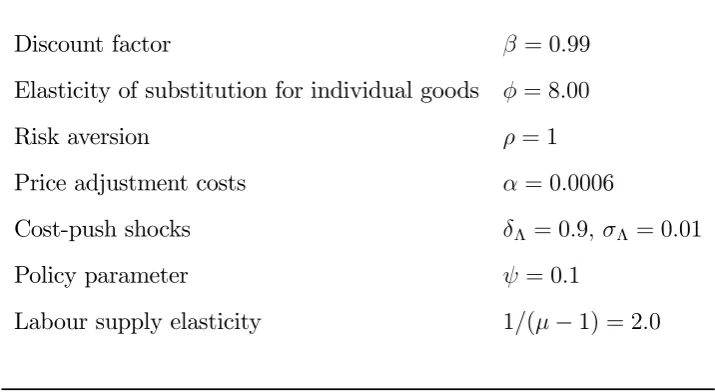
set of parameter values in Table 1. Most of the values chosen are quite standard and
require no explanation. The only parameter which requires some discussion is i.e. the
coefficient determining the costs of price adjustment. The function (()) in principle
captures a wide range of costs associated with price adjustment. Not all these costs are
directly measurable, so there is no simple empirical basis on which to select a value for
As a starting point, for the purposes of illustration, the value of is set at 00006 in the
8Devereux and Yetman (2003) derive a closed-form solution for their model which plays a similar role
to (18). However, their expression is only valid for the case ofi.i.d. shocks. But note that our model
Discount factor = 099
Elasticity of substitution for individual goods = 800
Risk aversion = 1
Price adjustment costs = 00006
Cost-push shocks Λ = 09 Λ = 001
Policy parameter = 01
[image:16.595.118.476.101.297.2]Labour supply elasticity 1(−1) = 20
Table 1: Parameter Values
benchmark case. In equilibrium (given the benchmark values for other parameters) this
implies prices are adjusted at an average rate of once every four quarters (i.e. = 075) so
aggregate price adjustment costs are0015% of GDP in equilibrium. This total aggregate
cost is not implausibly high, given the potentially wide range of costs incorporated in
(()) but it is acknowledged that a more satisfactory basis needs to be found for
calibrating In order to test the sensitivity of the main results we consider a wide range
of alternative values for .
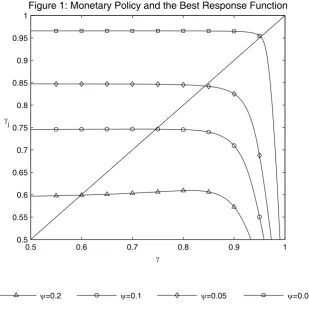
Figure 1 illustrates some of the main features of equilibrium in the benchmark case and
a number of simple variations around that benchmark case. Figure 1 plots the optimal
value of () against values of aggregate In other words it shows the “best response
function” of firm against aggregate. The benchmark case is illustrated with the plot
marked with circles. This plot intersects the 450 just once. This point of intersection
represents a single Nash equilibrium where() = ≈075
The position of the best response function, and its shape, are contingent on the values
of other parameters of the model. A change in the value of any parameter implies a
shows four other examples of best response functions - each based on a different value of
the parameter of the monetary policy rule. The higher is the more monetary policy
is aimed at stabilising the output gap, while a lower value of implies that monetary
policy is aimed at stabilising inflation. The general pattern that emerges from the cases
illustrated in Figure 1 is that an decrease in shifts the best response function upwards,
and thus leads to an increase in the equilibrium value of while an increase in shifts
the best response function downwards and thus leads to a reduction in the equilibrium
value of In other words, the more policy focuses on stabilisation of inflation, the lower
is equilibrium price flexibility.
The intuition behind this result is relatively straightforward. If the monetary authority
is stabilising aggregate inflation it is by definition stabilising the desired price, ˆ If the
desired price is very stable then the incentive to incur the costs of price flexibility are
much reduced, hence firms choose a high value of . At the other extreme, a high value
of (i.e. a monetary rule which allows fluctuations in inflation in order to achieve some
stabilisation of the output gap) will necessarily cause fluctuations in the desired price,
ˆ
This raises the incentive for firms to incur the costs of price flexibility and therefore
choose a lower value of
The results illustrated in Figure 1 correspond to the results presented by Kimura and
Kurozumi (2010). They model monetary policy in terms of a Taylor rule, rather than as
a targeting rule of the form used in this paper, but the same relationship between the
anti-inflation stance of monetary policy and the equilibrium value of emerges. As the
feedback coefficient on inflation in the Taylor rule is increased the equilibrium value of
increases, so output prices become lessflexible.
The cases illustrated in Figure 1 are quite regular in the sense that for each value
of there is a single intersection between the best response function and the 450 line,
so there is a unique Nash equilibrium. Furthermore that equilibrium is strictly within
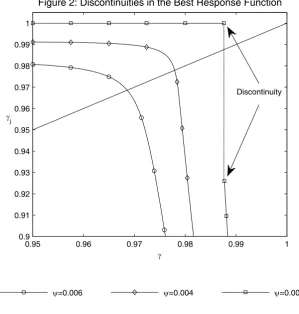
parameter becomes very small (i.e. as policy approaches strict inflation stabilisation).
Figure 2 illustrates an example of this case. Thisfigure focuses on values of very close
to zero and it shows that, for instance when= 0002there is a discontinuity in the best
response function which implies that there is no intersection with the 450 line. There is
thus no simple Nash equilibrium for this (or smaller) values of9
It will become apparent below that the non-existence of a simple Nash equilibrium
for low values of is relevant in the analysis of the welfare maximising choice of so
it is worth considering this result in more detail. Consider the best response function
for = 0002 shown in Figure 2. The best response function is horizontal at unity
for values of less than approximately 0987. There is then a discrete downward jump
at ' 0987 after which the best response function becomes downward sloping. The
discontinuity arises because the profit function is not single-peaked. Thus, for values of
in the neighbourhood of the discontinuity, the profit function has two local maxima, one
at() = 1 and one at a lower value of()For values of to the left of the discontinuity
profits are higher at () = 1 But for values of to the right of the discontinuity profits
are higher at the internal turning point in the profit function. At the discontinuity the
two maxima yield the same value of profits.
The fact that the profit function has two local maxima suggests that, even though
there is no simple Nash equilibrium with a unique equilibrium value of there may be
a more complex Nash equilibrium where the set of firms divides into two groups, each
group setting a different value of (corresponding to the two maxima). It is considerably
more complex to derive solutions for such equilibria so we do not investigate them further
in this paper. Below, when we consider the welfare maximising choice of we therefore
confine attention to the range of values of for which simple Nash equilibria exist (i.e.
where there is single equilibrium value).
A number of other potentially important special cases are illustrated in Figure 3, which
shows the effect of varyingthe parameter that determines the cost of price adjustment.
This figure shows that as increases, the equilibrium value of tends to increase. The
explanation for this is obvious. As price adjustment becomes more costlyfirms optimally
choose to make output prices less flexible.10 Note however that for very high values of
the best response function intersects the 450 line twice. There are thus two Nash
equilibria. And for the highest values of the best response function does not intersect
with the450 line within the zero-one interval. In this latter case the Nash equilibrium is
a corner solution at = 1i.e. completelyfixed prices. In other words, when the costs of
price adjustment are sufficiently high, firms optimally choose to avoid price adjustment
entirely.
Figures 2 and 3 illustrate a number of cases where the Nash equilibrium of this simple
model either does not exist, is based on a corner solution or is not unique. These cases
illustrate the benefits of working with the explicit functional form for the profit function
given by (18). By applying a numerical grid search technique to this functional form
it is possible reliably to identify the profit maximising value of () even when there
are multiple turning points in the function or when the maximum occurs at a corner.
By contrast, methods which rely on evaluating the first derivative of the profit function,
such as used by Kimura and Kurozumi (2010), potentially yield spurious results for some
parameter configurations.
10Notice from (18) that the profit function consists of two main terms: one that measures the expected
profits foregone because of price inflexibility and one that measures the expected costs of price changes.
Increasing obviously increases the weight on the second term relative to the first. Notice that, other
things being equal, this is equivalent to reducing 2 (the variance of the innovations in the cost-push
5
Welfare and Optimal Policy
We now consider the welfare implications of endogenous price flexibility. In particular
we consider the implications for the welfare maximising choice of the policy parameter,
For the purposes of this exercise aggregate welfare in period 0 (i.e. at the time the
monetary policy parameter, is set) is defined as
Ω=0
∞
X
=1
−1
½
1−
1− −
¾ (20)
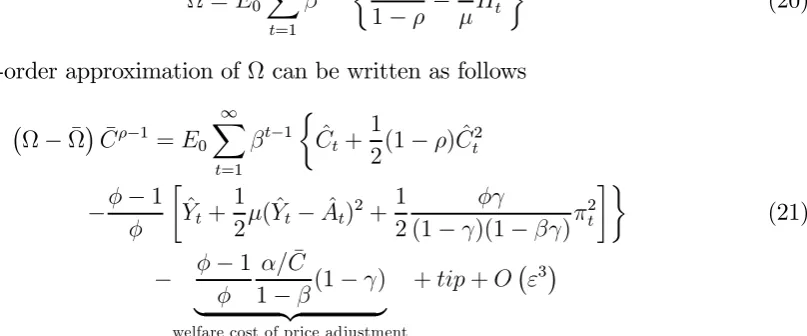
A second-order approximation ofΩ can be written as follows
¡
Ω−Ω¯¢¯−1 =0
∞
X
=1
−1
½ ˆ
+ 1
2(1−) ˆ 2
−− 1 ∙
ˆ
+ 1
2( ˆ−ˆ) 2+1
2
(1−)(1−)
2
¸¾
(21)
− − 11¯
−(1−)
| {z }
welfare cost of price adjustment
++¡3¢
Equation (21) shows that the welfare expression in this model takes the same form as in
the conventional model (with exogenous ) but with an added term that represents the
welfare costs of price adjustment.
[image:20.595.119.523.232.400.2]5.1
The Benchmark Case
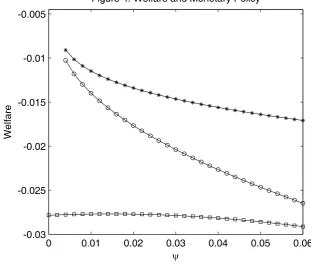
Figure 4 plots welfare against a range of values for while keeping other parameters at
their benchmark values. In this figure the plot marked with circles shows the behaviour
of welfare for the case of endogenous priceflexibility. As a point of comparison, thefigure
also shows welfare for the case where priceflexibility is exogenouslyfixed at a given level.
(This latter plot is marked with squares.) In this example we set = 075The exogenous
case corresponds to the standard model widely analysed in the literature on optimal
monetary policy (see e.g. Benigno and Woodford (2005)) and it is therefore a natural
The welfare plot for the exogenous case shows that the welfare maximising value of
is approximately0013. This implies that it is optimal for monetary policy to allow some
volatility in inflation in order to achieve some stabilisation of the welfare-relevant output
gap. This corresponds to the result emphasised by Benigno and Woodford (2005). In
essence, cost-push shocks are distortionary and imply that the flexible price equilibrium
is sub-optimal. In a sticky price environment it is therefore not optimal for monetary
policy to reproduce theflexible price equilibrium. Sticky prices give monetary policy some
degree of leverage which can be used to stabilise output around the welfare maximising
level. This requires some volatility in inflation.
Now consider the plot of welfare in the case were priceflexibility is endogenous (i.e. the
plot marked with circles). It is immediately clear from this plot that, when priceflexibility
is endogenous, welfare appears to increase monotonically as decreases towards zero. In
other words, when price flexibility is endogenous, it appears to be optimal to engage
in aggressive inflation stabilisation. This is in contrast to the case of exogenous price
flexibility, where it is optimal to allow some variability in inflation.
As noted above (in relation to the discussion of Figure 2) in Figure 4 we confine
attention to the range of values of for which a simple Nash equilibrium exists, i.e.
where there is a single equilibrium value ofThis implies that we do not consider values
of below 0.0035. It is apparent from Figure 4 that this lower limit on the value of
corresponds to the welfare maximising choice of (within the range that we consider).
Because does not equal zero at this point, we describe this as aggressive inflation
stabilisation rather than strict inflation targeting.
The contrast between the exogenous and endogenous flexibility cases illustrated in
Figure 4 arises for two reasons. Firstly, as is reduced, the rise in the equilibrium value
of reduces the resource cost of priceflexibility (i.e. less frequent price changes implies
lower costs). Secondly, the rise in the equilibrium value of implies that monetary policy
on the presence of nominal rigidities and these become more significant as increases).
Therefore, as increases, monetary policy becomes more effective in dealing with the
distortions caused by cost-push shocks. This is reflected in a higher level of welfare as
decreases and increases.
It is simple to measure the relative contributions of these two welfare effects by plotting
the welfare measure excluding the welfare costs of price adjustment (i.e. excluding the
term indicated in (21)) and comparing it to the full welfare measure (which includes the
costs of price adjustment). This comparison is also shown in Figure 4. The plot marked
with asterisks in Figure 4 is the value of welfare excluding the costs of price adjustment.
This can be compared to the plot marked with the circles, which shows welfare including
the costs of price adjustment. It appears that the decline in the welfare costs of price
adjustment (i.e. the vertical distance between the two plots) contributes about half of
the rise in total welfare asis reduced. The other half of the rise in welfare (i.e. the rise
in welfare illustrated in the upper plot in Figure 4) comes from the effect of more rigid
prices on the ability of monetary policy to deal with cost push shocks .
The result illustrated in Figures 4 represents a significant departure compared to the
literature based on exogenous price flexibility. That literature has emphasised that
com-plete inflation stabilisation is not optimal in the face of cost-push shocks. The comparison
between the exogenous and endogenous price flexibility cases shown in Figure 4 implies
that this basic result may be overturned when priceflexibility is endogenised.
Of course, Figure 4 is based on just one set of parameter values. Nevertheless,
exper-iments (not reported) testing the sensitivity of this basic qualitative result indicate that
it is robust across a wide range of values for key parameters, such as and The
basic comparison between the exogenous and endogenous price flexibility cases remains
the same across these parameter variations. Namely, it is optimal to allow some degree
of inflation variability in the exogenous price flexibility case but it is welfare enhancing
5.2
Discussion and Generalisations
As already noted, our analysis of the welfare effects of in the endogenous case is
restricted to values of for which a simple Nash equilibrium exists. This places a lower
limit on the value It is apparent from the example illustrated in Figure 4 that welfare
reaches its maximum at exactly this lower limit. Our analysis therefore leaves open the
question of what happens to welfare for values of below this lower limit. This question
can only be answered by considering more complex Nash equilibria than those analysed
here. Such equilibria are likely to imply a division of the set offirms into different groups,
each with a different value of A preliminary investigation of an example of such an
equilibrium has been carried out for the benchmark case, which suggests that welfare
continues to increase as is reduced below the value considered in Figure 4. But a full
analysis of this type of equilibrium is well beyond the scope of this paper.
There are a number of other generalisations of our analysis which are more
straight-forward. For instance, as noted above, a more general approach to the modelling of price
adjustment costs would be to allow convexity in(), so that price adjustment is subject
to increasing marginal costs as the average frequency of price changes rises. Note that
this alternative assumption would tend to strengthen the incentive forfirms to set a high
value of . This suggests that our main result (i.e. that the optimal choice of is very
close to zero and that the resulting equilibrium choice of byfirms is very close to unity)
is robust to convexity in the price adjustment costs function ().
The cost function could further be generalised to allow for the effects of aggregate
variables on the cost of price adjustment. For instance, the cost of price adjustment could
be assumed to fall as aggregate prices become moreflexible. An effect such as this could
easily be incorporated into our analysis.
It would also be straightforward to generalise our analysis to encompass more sources of
shocks. The results described above focus entirely on the implications of cost-push shocks.
flexibility, show that government spending shocks are very similar to cost-push shocks in
terms of their implications for optimal monetary policy. This similarity carries over into
our model. Extending our analysis to consider productivity shocks (i.e. shocks toin our
model) would also add little to the results we have emphasised above. Woodford (2003)
and Benigno and Woodford (2005), using models of exogenous priceflexibility, show that
optimal monetary policy should completely stabilise inflation in the face of productivity
shocks. In that case, our model of endogenous priceflexibility simply predicts that prices
will be completely rigid. This has no impact on the nature of optimal monetary policy in
the face of productivity shocks.
A potentially important further extension of the model would be to introduce a cost
of inflation indexation. It is well-known that the standard Calvo model generates inertia
in the price level but leaves the rate of inflation completelyflexible. Likewise, our model
makes the degree of price-level inertia endogenous while retaining the assumption that
the inflation rate is completely flexible. It has become standard in many applications
of the Calvo model to include an partial degree of inflation indexation which creates an
exogenous degree of inertia in the inflation rate. Just as the model used in this paper
endogenises the degree of price-level inertia, it would be possible to endogenise the degree
of inflation inertia by allowingfirms to choose the rate of indexation subject to some cost
of indexation. This would be another interesting line of future research.
6
Conclusion
This paper takes a standard sticky-price general equilibrium model and incorporates a
simple mechanism which endogenises the degree of nominal priceflexibility. The analysis
shows that the equilibrium degree of price flexibility is sensitive to changes in monetary
policy. For instance, the more the more weight monetary policy places on inflation
flexibility tends to shift optimal monetary policy towards complete inflation stabilisation,
even when shocks take the form of cost-push disturbances. This contrasts with the
stan-dard result obtained in models with exogenous price flexibility, which show that optimal
monetary policy should allow some degree of inflation volatility in order to stabilise the
welfare-relevant output gap.
The model we develop and analyse in this paper takes a somewhat stylised shortcut to
the representation of endogenous priceflexibility. A more theoretically appealing approach
would be to develop a structural model of state-dependent price setting. While such
models are being developed and analysed in the recent literature, they are still some
way from being tractable enough to allow a detailed analysis of optimal monetary policy.
In lieu of further progress with the development of state-dependent pricing models, the
results we present in this paper offer a potentially useful benchmark for judging the impact
of endogenous priceflexibility on the welfare effects of monetary policy.
Acknowledgements
We are grateful to two anonymous referees for many useful comments on an earlier draft
References
Ascari, G. and L. Rossi (2012) “Trend Inflation and Firms’ Price Setting: Rotemberg
versus Calvo”Economic Journal, 122, 1115-1141.
Benigno, P. and M. Woodford (2005) “Inflation Stabilization and Welfare: The Case of a
Distorted Steady State”Journal of the European Economic Association,3, 1185-1236.
Calmfors, L. and A. Johansson (2006) “Nominal Wage Flexibility, Wage Indexation, and
Monetary Union” Economic Journal,116, 283-308.
Calvo, G. A. (1983) “Staggered Prices in a Utility-Maximising Framework” Journal of
Monetary Economics, 12, 383-398.
Devereux, M. B. (2006) “Exchange Rate Policy and Endogenous Price Flexibility”,
Jour-nal of the European Economic Association, 4, 735—769.
Devereux, M. B. and H. E. Siu (2007) “State Dependent Pricing and Business Cycle
Asymmetries”International Economic Review, 48, 281-310.
Devereux, M. B. and J. Yetman (2002) “Menu Costs and the Long Run Output-Inflation
Trade-off” Economic Letters, 76, 95-100.
Devereux, M. B. and J. Yetman (2003)“Price-Setting and Exchange Rate Pass-Through:
Theory and Evidence” in Price Adjustment and Monetary Policy: Proceedings of a
Conference Held by the Bank of Canada, Bank of Canada Publications, Ottawa,
347-371.
Devereux, M. B. and J. Yetman (2010)“Price Adjustment and Exchange Rate
Pass-through” Journal of International Money and Finance, 29, 181-200.
Dotsey, M. and R. G. King (2005) “Implications of State-Dependent Pricing for Dynamic
Dotsey, M., R. G. King and A. L. Wolman (1999) “State Dependent Pricing and the
Gen-eral Equilibrium Dynamics of Money and Output” Quarterly Journal of Economics,
114, 655-690.
Golosov, M. and R. E. Lucas (2007) “Menu Costs and Phillips Curves” Journal of
Political Economy, 115, 171-199.
Ho, A. W. Y. and J. Yetman (2008) “The Long-Run Output-Inflation Trade-off with
Menu Costs”North American Journal of Economics and Finance, 19, 261-273.
Kimura, T. and T. Kurozumi (2010) “Endogenous Nominal Rigidities and Monetary
Policy” Journal of Monetary Economics, 57, 1038-1048.
Kimura, T., T. Kurozumi and N. Hara (2008) “Endogenous Nominal Rigidities and
Monetary Policy” Bank of Japan, Tokyo, unpublished manuscript.
Kiley, M. T. (2000) “Endogenous Price Stickiness and Business Cycle Persistence”
Jour-nal of Money, Credit and Banking, 32, 28-53.
Levin, A. and T. Yun (2007) “Reconsidering the Natural Rate Hypothesis in a New
Keynesian Framework”Journal of Monetary Economics, 54, 1344-1365.
Romer, D. (1990) “Staggered Price Setting with Endogenous Frequency of Adjustment”
Economics Letters, 32, 205-210.
Rotemberg, J. J. (1982) “Monopolistic Price Adjustment and Aggregate Output”Review
of Economic Studies, 49, 517-531.
Senay, O. and A. Sutherland (2006) “Can Endogenous Changes on Price Flexibility Alter
the Relative Welfare Performance of Exchange Rate Regimes?” inNBER International
Seminar on Macroeconomics 2004 R. H. Clarida, J. F. Frankel, F. Giavazzi and K.
Woodford, M. (2003) Interest and Prices: Foundations of a Theory of Monetary Policy
Princeton University Press, Princeton, NJ.
Yetman, J. (2003) “Fixed Prices versus Predetermined Prices and the Equilibrium
Appendix
Optimal Prices and Aggregate Inflation
Expressions (13) and (14) are derived using (3), (7) and (11). The coefficients Λ, Λ
and are given by the following
Λ=ΓΛ(1−Λ) =Γ(1−) Λ =ΓΛ
=Γ
(22)
where
ΓΛ =
[1 +Λ] +(1−Λ)
Γ=−
[1 +]
+(1−) (23)
Approximation of Firm ’s Expected Profit Function
A second-order approximation of (15) is derived as follows. First substitute for()and
rearrange to yield
Π() = 1
− ∞ X = − " 1 µ () ¶1−
−2 µ
()
¶−
−−(1−())
#
(24)
where
1 =− and2 =−Λ
−1 (25)
This form of the profit function isolates terms which depend on () A second order
approximation implies
˜
Π0()−Π¯ = −
(−1)
2 ¯ 0
∞
X
=1
−1h(ˆ()−ˆ)2 −2(ˆ2−ˆ1)(ˆ()−ˆ) i
−− 11
−(1−()) ++
¡
3¢ (26)
whererepresents terms independent offirm. This may be written in the form of (16)
by noting that
ˆ
2−ˆ1 = ˆΛ+ ˆ−ˆ−ˆ+ ¡
The Expected Dynamics of Firm ’s Price
The first-order condition for price setting forfirm implies
ˆ
()−ˆ= (1−())(ˆ−ˆ) +()[ˆ+1()−ˆ+1] +()[+1] + ¡
2¢ (28)
When combined with (13) and (14) it is simple to show thatˆ()−ˆ can be written in
the form
ˆ
()−ˆ=ΛΛˆ+ˆ+ ¡
2¢ (29)
where Λ and are given by
Λ = ΓΛ
(1−Λ)(1−())+Λ()
(1−Λ())
(30)
= Γ
(1−)(1−())+()
(1−())
(31)
To complete the solution for 0[(ˆ −ˆ)(ˆ()−ˆ)] and 0[(ˆ()−ˆ)2] it is
use-ful to decompose the expectations operator 0 into 0 expectations across aggregate
disturbances, and
0 expectations across the Calvo pricing signal for firm , where
0[] =
0 [0[]] (Note that 0[] is conditional on particular realised values of the
aggregate disturbances,Λˆandˆ.) Since aggregate disturbances and aggregate variables
are independent from the Calvo pricing signal forfirm, we may write
0[(ˆ−ˆ)(ˆ()−ˆ)] = 0 [(ˆ
−ˆ)
0 [ˆ()−ˆ]] (32)
It is thus necessary to obtain a first-order accurate solution for
0 [ˆ()−ˆ]
The Calvo pricing process implies that 0[ˆ()−ˆ] evolves according to
0[ˆ()−ˆ] =()0[ˆ−1()−ˆ−1] + (1−())(ˆ()−ˆ)−()+ ¡
2¢ (33)
This can be solved and combined with (13) and (17) to yield a second-order accurate
expression for0[(ˆ
−ˆ)(ˆ()−ˆ)]
An equation for the evolution of 0[(ˆ()−ˆ)2]can be derived in a similar way. The
Calvo pricing process implies that
0[(ˆ()−ˆ)2] =()0[(ˆ−1()−ˆ)2] + (1−())0[(ˆ()−ˆ)2] +
¡
Using the relationships
0[(ˆ−1()−ˆ)2] =0[(ˆ−1()−ˆ−1)2] +0[2]−20[(ˆ−1()−ˆ−1)] (35)
0[(ˆ−1()−ˆ−1)] =0[0(ˆ−1()−ˆ−1)] (36)
equation (34) can be written as
0[(ˆ()−ˆ)2] = ()0[(ˆ−1()−ˆ−1)2] + (1−())0[(ˆ()−ˆ)2]
+()0[2]−2()0[0(ˆ−1()−ˆ−1)] +
¡
3¢ (37)
which can be solved in combination with (13) and (17) to yield a second-order accurate
0.5 0.6 0.7 0.8 0.9 1 0.5
0.55 0.6 0.65 0.7 0.75 0.8 0.85 0.9 0.95
1Figure 1: Monetary Policy and the Best Response Function
j
[image:32.595.139.449.245.556.2]0.95 0.96 0.97 0.98 0.99 1 0.9
[image:33.595.137.437.248.563.2]0.91 0.92 0.93 0.94 0.95 0.96 0.97 0.98 0.99 1
Figure 2: Discontinuities in the Best Response Function
j
=0.006 =0.004 =0.002
0.5 0.6 0.7 0.8 0.9 1 0.5
[image:34.595.130.467.247.543.2]0.55 0.6 0.65 0.7 0.75 0.8 0.85 0.9 0.95 1
Figure 3: Price Adjustment Costs and the Best Response Function
j
0 0.01 0.02 0.03 0.04 0.05 0.06 -0.03
[image:35.595.121.433.251.524.2]-0.025 -0.02 -0.015 -0.01 -0.005
Figure 4: Welfare and Monetary Policy
Welfare