Individual differences in preferences for cues to intelligence in the face
1
2
MOORE, F. R.a, LAW SMITH, M. J.b & PERRETT, D. I.c
3
4
a School of Psychology, University of Dundee, UK
5
6
bDepartment of Psychology, University of Limerick, Ireland.
7
8
cSchool of Psychology, University of St Andrews, UK.
9
10
11
12
13
14
15
16
17
18
19
20
21
22
23
24
25
26
27
28
aAuthor for correspondence: School of Psychology, Scrymgeour Building, Park Place, University of
29
Dundee, Dundee, DD1 1HG, UK. [email protected]. +44 1382 386 754
Abstract
31
We tested for individual differences in women’s preferences for cues to intelligence in male faces in
32
accordance with hormonal status (i.e. menstrual cycle phase and use of hormonal contraceptives),
33
relationship status and context, and self-rated intelligence. There were no effects of hormonal or
34
relationship status (Studies 1 and 2) on preferences. There was, however, a positive relationship
35
between self-rated intelligence and preferences for cues to intelligence in the face in the context of a
36
long-term relationship, suggesting context-specific assortment (Study 3). In Study 4, self-rated partner
37
intelligence correlated with preferences for facial cues to intelligence. We discuss these results in the
38
context of intelligence as a fitness indicator and suggest that future research must control for
39
assortative mating for cognitive traits in order to better understand intelligence in mate choice.
40
41
42
43
44
45
46
47
48
49
50
51
52
53
54
55
56
57
Keywords: fitness-indicator; intelligence; face; attractiveness; individual-differences
58
Introduction
Intelligence is an important consideration in human mate choice decisions (e.g. Buss,
60
1989; Lee & Zeitch, 2011; Li et al., 2001; Moore et al., 2011; Prokosch et al., 2009; Zebrowitz et al.,
61
2002). Miller (2000a,b) argues that the high heritability of general intelligence (g) (Plomin & Spinath,
62
2004) implicates evolution through sexual (rather than natural) selection, and points to close
63
associations between scores on g-loaded tests and various proxies of fitness such as health and
64
developmental stability (e.g. Arden et al., 2008, 2009; Banks et al., 2010; Furlow et al., 1997;
65
Gottfredson & Deary, 2004; Miller & Penke, 2007; Prokosch et al. 2005). That intelligence is the
66
product of variation across the genome (e.g. Plomin and Kovas, 2005), and is inversely related to
67
mutation load (e.g. Yeo et al. 2011), lends strong support to a role of intelligence in signaling fitness to
68
potential partners (Miller, 2003). Such ‘fitness indicator’ traits signal mutation load and maintain
69
additive genetic variance in sexually selected traits via condition-dependent expression (Houle, 2000;
70
Houle & Kondrashov, 2002; Rowe & Houle, 1996; Tomkins et al., 2004). Mate preferences that result
71
in avoidance of mates with a high mutation load confers a selective advantage in terms of securing
72
superior genetic material for offspring. Since there doesn’t appear to be a sex difference in preferences
73
for intelligent partners, it is possible that sexual selection has shaped human intelligence via mutual
74
mate choice (Hooper and Miller, 2008).
75
76
Recently, researchers have attempted to identify context dependency in women’s
77
preferences for intelligence in a partner. Women’s mate choice decisions are complex, involving
78
context- and condition-dependent tradeoffs between, for example, cues to the willingness and ability to
79
commit to a relationship versus cues to indirect heritable benefits (e.g. Debruine et al., 2010a). In
80
particular, women express preferences for a committed partner in the context of long-term
81
relationships, but switch to preferences for cues to alternative heritable qualities in the context of
short-82
term relationships (Little et al., 2002; Little et al., 2007) or during times of high fertility (Little et al.,
83
2002; Penton Voak et al., 1999; Penton Voak & Perrett, 2000; but see Peters et al., 2009). Identifying
84
when preferences for intelligence are strongest, then, can inform as to the qualities it may bestow.
85
86
While there is evidence that women’s preferences for cues to men’s creativity - a trait related to
87
intelligence - increase during the fertile phase of the menstrual cycle (Haselton & Miller, 2006) and
88
that male creative output is positively related to mating success (Nettle & Clegg, 2006), previous
studies have failed to find effects of menstrual cycle phase on preferences for cues to general
90
intelligence (e.g. Gangestad et al., 2007; 2010). Recently, for example, Prokosch and colleagues (2009)
91
analysed women’s preferences for men’s verbal intelligence and subjective ratings of the men’s
92
intelligence and creativity based on video footage in long- and short-term relationship contexts.
93
Subjective creativity and intelligence, and verbal intelligence scores each explained independent -
94
albeit small - proportions of the variance in men’s appeal for both long- and short-term relationships.
95
These effects were not moderated by menstrual cycle phase, and results suggest that intelligence is
96
equally valued in women’s mate choice decisions regardless of hormonal status and relationship
97
context.
98
99
Here we conducted a series of studies designed to test for individual differences in preferences
100
for cues to intelligence in the face on the basis of wider measures of hormonal status (i.e. menstrual
101
cycle phase and use of hormonal contraceptives) in a more representative sample of women than the
102
University students used in previous studies. Furthermore, since sexual selection for intelligence in
103
humans is likely to have evolved via mutual mate choice, resulting in positive assortment (or ‘fitness
104
matching’; Miller, 2000; Hooper and Miller, 2008) we also controlled for the strong tendency for
105
individuals to mate assortatively on the basis of intelligence (Watson et al., 2004). We used a set of
106
facial stimuli parametrically controlled and manipulated to differ in cues to intelligence but that were
107
matched for cues to sexual dimorphism, health and age. In Study 1 we tested the effects of menstrual
108
cycle phase and relationship status on preferences for the facial stimuli in a sample of undergraduate
109
female students. In Study 2 we tested for these effects, as well as effects of hormonal contraceptive use,
110
in a sample of women from a broader age, education and socioeconomic profile. In Study 3 we tested
111
the effects of relationship context on preferences for cues to intelligence in the face while controlling
112
for positive assortative mating on the basis of intelligence. In Study 4 we assessed the validity of our
113
measure of preference for cues to intelligence by comparing it with women’s partner intelligence.
114
115
Study 1
116
117
The aim of Study 1 was to test the effects of menstrual cycle phase and relationship status on
118
preferences for cues to intelligence in the face, using facial stimuli parametrically manipulated to differ
in cues to perceived intelligence whilst controlling for sexual dimorphism, health and age.
120
121
Methods
122
123
Participants
124
125
Participants were a sub-sample (n = 34) of those described in Law Smith et al (2006) who
126
completed a series of face preference tests. All were Caucasian female students recruited from the
127
University of St Andrews (UK) who reported a heterosexual orientation, and were not pregnant or
128
using hormonal contraceptives (age: 19.67 (1.35)). Ten participants were single during the period of
129
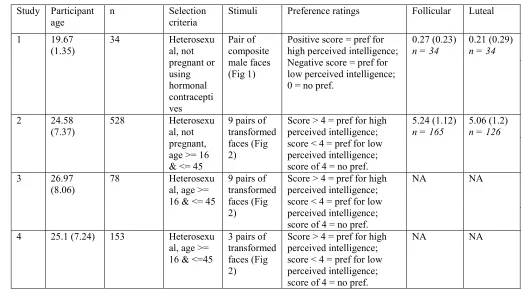
testing. See table 1.
130
131
Table 1 about here.
132
133
Materials
134
135
a. Stimuli creation
136
137
Stimuli were a pair of male facial composites that differed in perceived intelligence but were
138
matched for attractiveness, age and sexual dimorphism described in Moore et al. (2011). Briefly, 166
139
male faces were rated by 19 participants (male: n = 8) for intelligence, health, attractiveness and sexual
140
dimorphism (i.e. “How intelligent/healthy/attractive/masculine is this face?”, with intelligence defined
141
as “knowledgeable, analytic and rational, adaptable, independent in opinion and solves problems”).
142
Residuals extracted from a multiple linear regression model (dependent variable: intelligence ratings;
143
predictor variables: age, and ratings of attractiveness and sexual dimorphism) were used to identify the
144
5 faces that received higher ratings of intelligence than predicted by the model, and the 5 faces that
145
received intelligence ratings lower than predicted by the model. These faces were blended together and
146
symmetrized using Psychomorph software (Tiddeman et al., 2001) to provide a pair of faces that were
147
matched for components of attractiveness (i.e. sexual dimorphism, health and age) but that differed in
148
perceived intelligence (although it is important to note that the high perceived intelligence composite
was rated as more attractive than the low perceived intelligence composite, despite these controls). See
150
Fig 1. Perceived intelligence of the face has been shown to be associated with various measures of
151
actual intelligence (see Zebrowitz et al. (2002) for a review of meta-analyses).
152
153
[Figure 1 about here]
154
155
b. Menstrual cycle phase & relationship status
156
157
Menstrual cycle phase was estimated from self-report data (number of days in a typical cycle
158
and number of days since onset of last period of menses) using the countback method in which
159
ovulation was estimated to occur 14 days after the onset of the most recent period of menses. All
160
women reported regular menstrual cycles. The follicular phase (i.e. the period during which women’s
161
hormonal profile is consistent with high fertility) was estimated to occur during the week prior to
162
ovulation, with the luteal (i.e. non-fertile) phase between ovulation (e.g. starting on day 15) and the
163
onset of the next period of menses.
164
To assess effects of relationship context, we asked participants to report whether they were
165
currently in a committed relationship (e.g. Penton Voak et al., 1999).
166
167
c. Face preference tests
168
169
Participants rated the composite faces, presented individually, for attractiveness on 1 – 7
170
scales (“How attractive is this face?”; 1 = not at all attractive, 7 = extremely attractive). Faces were
171
presented in random order, distributed among the stimuli of an unrelated study.
172
173
Procedure
174
175
Participants attended between 4 and 6 weekly testing sessions, to ensure they rated the faces
176
during late follicular and luteal cycle phases. At each session participants reported their menstrual
177
cycle status and rated the facial stimuli for attractiveness.
178
Preference for the high perceived intelligence composite over the low perceived intelligence
180
composite was calculated by subtracting ratings of the latter from those of the former (high-low). A
181
positive score represented a preference for the high perceived intelligence face, and a negative score a
182
preference for the low perceived intelligence face. A score of 0 equated to no preference in either
183
direction.
184
185
Results
186
187
In ANOVA, with menstrual cycle phase as a within-subjects factor (2 levels: late follicular
188
and luteal) and relationship status as a between subjects factor (2 levels: single and in a relationship),
189
there were no significant effects of cycle phase or relationship status and no interaction between the
190
two (all p > 0.5). Women preferred the high intelligence face in both phases of their cycle (late
191
follicular: mean = 0.27; luteal: mean = 0.21)), and regardless of their relationship status (single: mean =
192
0.23; in a relationship: mean = 0.24). For full descriptive statistics, see Table 1.
193
194
Discussion
195
196
The women in Study 1 preferred facial cues to intelligence across relationship and fertility
197
contexts. Cyclic shifts in women’s preferences for cues to creativity in a potential short-term partner
198
(Haselton & Miller, 2006), then, may be independent of preferences for intelligence (see Prokosch et
199
al., 2009). Our findings using careful controlled facial stimuli are consistent with those showing that
200
intelligence is treated as an “essential” rather than a “luxury” in mate choice decisions (Li et al., 2002),
201
and that verbal- and perceived-intelligence predict desirability regardless of relationship context or
202
menstrual cycle phase (Prokosch et al., 2009). Taken together, results suggest that, unlike traits such as
203
masculinity, intelligence is not traded-off with other desirable characteristics in mate choice decisions.
204
The work to date, however, has been largely limited to samples of undergraduate students who are
205
unlikely to provide a representative intelligence profile, which may obscure any such tradeoffs. In
206
Study 2, then, we tested relationship-context and menstrual cycle phase effects on preferences for facial
207
cues to intelligence in a broader, larger, sample.
208
Study 2
210
211
To address the limitations of previous work, we tested for effects of relationship status and
212
menstrual cycle phase in a larger sample with a broad age, education and socioeconomic profile. As
213
use of hormonal contraception has been shown to influence face preferences (e.g. Jones et al., 2005),
214
we also tested effects on preferences for perceived intelligence.
215
216
Methods
217
218
Participants
219
220
Five hundred and twenty eight heterosexual female participants who were not pregnant and
221
were aged 16 - 45 (mean: 24.58 (7.37)) completed an online questionnaire and face preference test
222
hosted on a face research website (www.perceptionlab.com). Thirty percent reported use of hormonal
223
contraceptives, and 43% were in a relationship. Eighty seven percent were European residents. Eighty
224
six percent reported being Caucasian, 2% being Afro-Caribbean, 1% being Asian, and the remainder
225
reporting their ethnicity as “other”. Twenty one percent reported having postgraduate level of
226
education, 62% having attended college or University, and the remainder having graduated from high
227
school. See Table 1.
228
229
Materials
230
231
a. Facial Stimuli
232
233
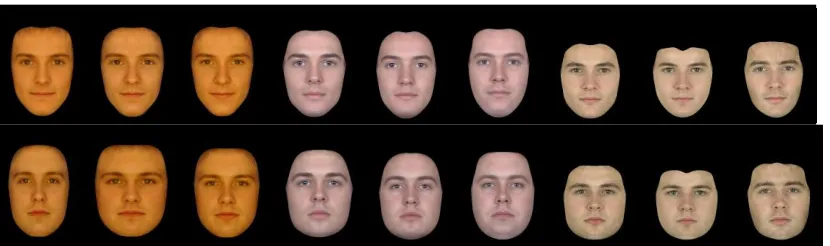
The composite perceived intelligence faces described in Study 1 were used as the end points
234
of a continuum along which 9 base faces (created as the average of 5 – 6 male faces selected at random
235
from 3 different image sets) were transformed (25% towards the high perceived intelligence transform,
236
and 25% towards the low perceived intelligence transform). This was achieved using Psychomorph
237
software, which adds 25% of the shape, colour and texture difference between the base face and the
238
composite high or low perceived intelligence face, to the base face (Tiddeman et al., 2001). This
resulted in 9 pairs of faces, with the same identity within each pair transformed to look more or less
240
intelligent. These were rated by a sample of 244 male and 210 female students via on online survey
241
hosted at perceptionlab.com (mean age: 30.87 (11.59)) for perceived intelligence (“How intelligent
242
does this face look?”; 1 = not at all intelligent, 7 = extremely intelligence). The high intelligence
243
transforms were perceived as significantly more intelligent than the low intelligence transforms (high
244
intelligence: 3.61 (0.75); low intelligence: 2.61 (0.91); t(453) = 25.78, p < 0.001). See Figure 2.
245
246
[Figure 2 about here.]
247
248
b. Questionnaires
249
250
Participants answered identical questions regarding their menstrual cycle as in Study 1, and
251
also reported whether they are currently using – or stopped using in the preceding 3 months – hormonal
252
contraception. They indicated their age, sexual orientation, country of residence, ethnicity, relationship
253
status and maximum level of education.
254
255
Procedure
256
257
Participants completed the questionnaire followed by the face preference tests. Face pairs
258
were displayed and rated on 1 to 7 likert scales (“Which face do you prefer?”; 1 = strongly prefer left, 2
259
= prefer left, 3 = slightly prefer left, 4 = no preference, 5 = slightly prefer right, 6 = prefer right, 7 =
260
strongly prefer right). The side on which the high- and low-perceived intelligence composites were
261
displayed and the order of pairs were fully randomized. Menstrual cycle phase was calculated as
262
described for Study 1, with the exception that days falling between menstrual cycle day 0 and ovulation
263
were treated as the fertile period (i.e. the entire follicular phase).
264
265
Mean preferences for perceived intelligence were computed (i.e. a score > 4 represents a
266
preference for high perceived intelligence, a score < 4 represents a preference for low perceived
267
intelligence, and a score of 4 represents no preference in either direction).
268
Effects of menstrual cycle phase, use of hormonal contraceptives and relationship status were
270
assessed using ANOVA (Model 1: between subjects factors were cycle phase (follicular or luteal), and
271
relationship status (single or in a relationship); Model 2: between subjects factors were use of hormonal
272
contraceptives (yes or no), and relationship status (single or in a relationship)). Participants who
273
reported use of hormonal contraceptives were excluded from Model 1.
274
275
Results
276
277
The results of Models 1 and 2 revealed no significant effects of cycle phase, use of hormonal
278
contraceptives, or relationship status, and no significant interactions (all p > 0.2).
279
280
Discussion
281
282
Consistent with Study 1, and with Prokosch et al. (2009), we did not find effects of menstrual
283
cycle phase or relationship context on preferences for facial cues to intelligence, despite our attempts to
284
reach a more representative sample of women than has been achieved by previous research. While this
285
suggests that failure to detect such effects is not simply an artifact of testing University students, our
286
sample was still limited to women with access to the internet, with sufficient interest in psychology to
287
participate, and to a relatively highly educated profile. Future work which accesses a truly
288
representative sample both in terms of the participants who contribute to the facial stimuli, and those
289
who rate them, may yield different results. To date, however, there is a consistent lack of support for
290
context-dependent intelligence preferences.
291
292
A limitation of previous research, including Studies 1 and 2, is failure to control for the strong
293
tendency for individuals to mate assortatively on the basis of traits including intelligence (Jensen,
294
1998; Watson et al., 2004). Any effect of relationship context or cycle phase may be secondary to
295
positive assortment effects. In Study 3, then, we asked participants to rate their own intelligence and
296
controlled for this in analyses. A further limitation of Studies 1 and 2 was our reliance on participant’s
297
relationship status as a method of assessing effects of relationship context on preferences. In Study 3
298
we sought to test preferences for our perceived intelligence stimuli under long-term and short-term
contexts.
300
301
Study 3
302
303
Here we tested preferences for cues to intelligence under long- and short-term relationship
304
contexts and controlled for self-rated intelligence.
305
306
Methods
307
308
Participants
309
310
Seventy eight heterosexual female participants aged 16 to 45 (age: 26.97 (8.06)) were
311
recruited to an online experiment hosted on a face research website (www.perceptionlab.com). Eighty
312
four percent were in a relationship at the time of testing. Data regarding country of origin and ethnicity
313
was not collected.
314
315
Materials
316
317
a. Facial stimuli
318
319
Stimuli were those described in Study 2.
320
321
b. Questionnaire
322
323
Participants reported their age, sexual orientation and relationship status and rated themselves
324
for intelligence (“How intelligent do you consider yourself to be?”; 1 = not at all intelligent, 7 =
325
extremely intelligent).
326
327
Procedure
328
Participants completed the short questionnaire followed by the face preference test. Face pairs
330
were displayed in random order in a forced choice paradigm, in which participants had to choose which
331
face they found more attractive from each of the 9 pairs and to express the strength of their preference
332
from a scale presented below the faces (“Which face do you prefer?”; 1 = strongly prefer left, 2 =
333
prefer left, 3 = slightly prefer left, 4 = no preference, 5 = slightly prefer right, 6 = prefer right, 7 =
334
strongly prefer right). Faces were rated for desirability for both a short-term and a long-term
335
relationship (“Which face would you prefer for a short/long-term relationship?). Order of presentation
336
of pairs, relationship context and the side on which each face was displayed were fully randomized.
337
Responses were coded as for Study 2, and mean preferences across all 9 pairs for each relationship
338
context were computed.
339
340
Results
341
342
In ANOVA with 1 within-subjects factor (relationship context: short-term and long-term) and
343
self-rated intelligence (mean: 5.73 (1)) as a covariate, there were no main effects of relationship
344
context (F(1, 76) = 3.58, p = 0.062) or self-rated intelligence (F(1,76) = 5.19, p = 0.063) and no interaction
345
between relationship context and self-rated intelligence (F(1,76)= 3.29, p = 0.074). As, however, results
346
approached significance, bivariate correlations were explored and demonstrated significant
347
relationships between self-rated intelligence and preferences for cues to intelligence in the face for
348
long-term (rs(78) = 0.29, p = 0.01), but not short-term relationships (rs(78) = 0.18, p = 0.116).
349
350
Discussion
351
352
Results demonstrate an effect of relationship context on preferences for cues to intelligence in
353
the face when self-rated intelligence is controlled for, with women expressing stronger preferences for
354
cues to intelligence in the context of a short-term relationship. Post-hoc analyses revealed assortment to
355
be present only in the context of long-term relationships. This suggests that women take their own
356
intelligence into account when judging desirability of males for long-term relationships, perhaps
357
reflecting considerations such as compatibility, but that these considerations may not be made in the
358
context of short-term relationships. Failure to control for positive assortment in the context of
term relationships may explain why previous studies have not detected an effect of relationship context
360
on preferences for intelligence (but see Regan and Joshi, 2003). It should also be noted that women
361
tend to underestimate their own intelligence (Furnham et al. 2002) and while self-ratings may correlate
362
with other-rated intelligence they are not always an accurate reflection of actual intelligence (Borkenau
363
and Liebler, 1993). Actual intelligence scores, then, would be a useful addition although we argue that
364
self-perceived intelligence is likely to be at least as important to the mating decisions of individuals as
365
actual intelligence scores.
366
367
Study 4
368
369
The aim of Study 4 was to test the validity of preferences for facial cues to intelligence by
370
comparison with self-reported partner characteristics.
371
372
Methods
373
374
Participants
375
376
One hundred and fifty-three female participants (age: 25.1 (7.24)) were recruited to an online
377
experiment via the Abertay University psychological research site. All participants were heterosexual
378
and aged 16 or over. Thirty four percent of participants reported using hormonal contraceptives, and
379
57% reported being in a relationship. Eighty-one percent were European residents, 96% were
380
Caucasian and 73% had a University education. See Table 1.
381
382
Materials
383
384
a. Facial stimuli
385
386
Facial stimuli were a subset of the 9 face pairs described in Study 3 (n = 3 pairs) transformed
387
to differ in cues to intelligence. A subset (the first 3 face pairs displayed in Figure 2), rather than the
388
full set of 9 face pairs, was used in order to reduce the duration of the test.
390
b. Questionnaires
391
392
Participants reported their age and sexual orientation, and rated intelligence of current or most
393
recent partner (“How intelligent is your current or most recent partner?”; 1 – 7; 1 = not at all intelligent,
394
7 = extremely intelligent).
395
396
Procedure
397
398
Participants completed the questionnaire followed by the face preference tests (with faces
399
displayed individually and in random order) on remote computers.
400
401
Average preferences for cues to high over low intelligence were computed by first calculating
402
the mean preference for the 3 high-perceived intelligence faces (high IQ pref) and for the 3
low-403
perceived intelligence faces (low IQ pref). Preference for cues to high over low perceived intelligence
404
was then calculated by subtracting low IQ pref from high IQ pref (high IQ pref – low IQ pref), such
405
that a positive score represented a preference for cues to high intelligence, and a negative score
406
preferences for cues to lower intelligence.
407
408
Results
409
410
In a bivariate linear regression model (Adj R2 = 0.03, F(1, 148) = 5.13, p = 0.025), partner
411
intelligence was a significant predictor of preference for facial cues to intelligence (β = 0.18, p =
412
0.025).
413
414
General Discussion
415
416
There were no effects of menstrual cycle phase on preferences for facial cues to intelligence in
417
3 samples of women, spanning undergraduate students and women from a broader range of
418
backgrounds. Neither were there effects of the use of hormonal contraceptives, suggesting that
women’s preferences for intelligence are not hormonally mediated. Women considering faces in the
420
context of a short-term relationship, however, expressed stronger preferences for cues to intelligence
421
than in the context of a long-term relationship. Importantly, this was only the case when self-rated
422
intelligence was controlled for in analyses, suggesting that assortative mating on the basis of
423
intelligence may account for the failure of previous studies to detect these effects. Post hoc tests
424
revealed positive assortment only in a long-term relationship context, suggesting that an effect of
425
relationship context on preferences may stem from the mediation of preferences in the long-term
426
context, rather than greater value placed on intelligence in a short-term context. In addition, we found
427
that preferences for perceived intelligence in the face were positively associated with self-rated partner
428
intelligence.
429
430
Women’s preferences for cues to intelligence have now been shown to be independent of
431
hormonal status across 5 studies (Studies 1 – 3; Gangestad et al., 2007; Prokosh et al., 2009). Our
432
results contribute to a growing body of results consistent with intelligence as a fitness indicator rather
433
than a trait that is traded off against other valuable aspects of fitness (Arden et al., 2008, 2009; Banks et
434
al., 2010; Furlow et al., 1997; Gottfredson & Deary, 2004; Miller & Penke, 2007; Prokosch et al.
435
2005). In other words, there may be multiple benefits associated with an intelligent partner that render
436
it an essential consideration in mate choice decisions. One potential explanation is that fitness for the
437
highly educated, high socioeconomic status women in our samples and those of the other studies
438
reported here, is more closely linked to intelligence than to health. We may find different results under
439
more diverse social and environmental conditions, suggesting great value to cross cultural work to
440
answer these questions. Alternatively, intelligence may be associated with direct fitness benefits such
441
as status and resource provision, meaning that it provides cues to traits essential to mate choice
442
decisions regardless of context (but see Lee et al. 2012).
443
444
We acknowledge that our results are limited to preferences for cues to intelligence in the face,
445
and further to one set of facial stimuli, so are prone to issues of pseudo-replication. Furthermore, our
446
stimuli were created on the basis of perceived – rather than actual – intelligence, perhaps limiting the
447
ecological validity of our findings. While we advocate replication of methods using stimuli based on
448
actual intelligence scores and which address multiple modalities, we suggest that perceived intelligence
– particularly when controlling for an attractiveness halo effect as we sought to achieve with our
450
stimuli – is both a good proxy to actual intelligence (Zebrowitz et al., 2002) and valid in terms of
451
assessing preferences. Future work, however, should attempt to identify the specific qualities that are
452
signaled in our facial stimuli and which contribute to perceived intelligence (e.g. social dominance,
453
mental altertness, self esteem).
454
455
In conclusion, our results demonstrate that women prefer facial cues to intelligence regardless
456
of their hormonal status or the relationship context. Effects of relationship context on preferences when
457
own intelligence or attractiveness are controlled for appears to be due to positive assortment for
458
intelligence in the long-term relationship context. We propose that our results are consistent with
459
intelligence as a fitness indicator, but that cross cultural research is required to identify whether all
460
traits associated with intelligence are consistently preferred across environments with different social
461
and physical demands.
462
463
References
464
465
Arden, R., Gottfredson, L. S. & Miller, G. (2008). Does a fitness factor contribute to the association
466
between intelligence and health outcomes? Evidence from medical abnormality counts among
467
3, 654 US veterans. Intelligence, 37, 581-591.
468
469
Arden, R., Gottfredson, L. S., Miller, G & Pierce, A. (2009). Intelligence and semen quality are
470
positively correlated. Intelligence, 37, 277-282.
471
472
Banks, G., Batchelor, J. H. & McDaniel, M. A. (2010). Smarter people are (a bit) more symmetrical: a
473
meta-analysis of the relationship between intelligence and fluctuating asymmetry. Intelligence,
474
38, 393-401.
475
476
Borkenau, P & Liebler, A. (1993). Convergence of stranger ratings of personality and intelligence with
477
self-ratings, partner-ratings and measured intelligence. Journal of Personality and Social
478
Psychology, 65, 546-553.
480
Buss, D. M. (1989). Sex differences in human mating preferences: evolutionary hypotheses tested in
481
37 cultures. Behavioral and Brain Sciences, 12, 1 – 49.
482
483
Debruine, L. M., Jones, B. C., Crawford, J. R., Welling, L. L. M. & Little, A. C. (2010a). The health of
484
a nation predicts their mate preferences: cross cultural variation in women’s preferences for
485
masculinized male faces. Proceedings of the Royal Society of London Series B, 277, 2405-2410.
486
487
Furnham, A., Hosoe, T. & Tang, T. L. P. (2002). Male hubris and female humility? A cross-cultural
488
study of ratings of self, parental, and sibling multiple intelligence in America, Britain and Japan.
489
Intelligence, 30, 101-115.
490
491
Furlow, F. B., Armijo-Prewitt, T., Gangestad, S. W. & Thornhill, R. (1997). Fluctuating asymmetry
492
and psychometric intelligence. Proceedings of the Royal Society of London Series B, 264,
823-493
829.
494
495
Gangestad, S. W., Garver-Apgar, C. E., Simpson, J. A. & Cousins, A. J. (2007). Changes in women’s
496
mate preferences across the ovulatory cycle. Journal of Personality & Social Psychology, 92,
497
151-163.
498
499
Gangestad, S. W., Thornhill, R. & Garver-Apgar, C. E. (2010). Men’s facial masculinity predicts
500
changes in their female partners’ sexual interests across the ovulatory cycle, whereas men’s
501
intelligence does not. Evolution & Human Behavior, 31, 412-424.
502
503
Gottfredson, L. S. & Deary, I. J. (2004). Intelligence predicts health and longevity, but why? Current
504
Directions in Psychological Science, 13, 1 – 4.
505
506
Haselton, M. & Miller, G. F. (2006). Women’s fertility across the cycle increases the short-term
507
attractiveness of creative intelligence. Human Nature, 17, 50 – 73.
508
Hooper, P. & Miller, G. F. (2008). Mutual mate choice can drive ornament evolution even under
510
perfect monogamy. Adaptive Behavior, 16, 53-70.
511
512
Houle, D. (2000). Is there a g factor for fitness? The Nature of Intelligence, Vol 233. Chichester:
513
John Wiley and Sons.
514
515
Houle, D. & Kondrashov, A. S. (2002). Coevolution of costly mate choice and condition-dependent of
516
display of good genes. Proceedings of the Royal Society of London Series B, 269, 97-104.
517
518
Jensen, A.R. (1998) The g factor: the science of mental ability. Westport, CT, Praeger.
519
520
Jones, B. C, Perrett, D. I., Little, A. C., Boothroyd, L., Cornwell, R. E., Feinberg, D. R., Tiddeman, B.
521
P., Whiten, S., Pitman, R. M., Hillier, S. G., Burt, D. M., Stirrat, M. R., Law Smith, M. J. &
522
Moore, F. R. (2005). Menstrual cycle, pregnancy and oral contraceptive use alter attraction to
523
apparent health in faces. Proceedings of the Royal Society of London Series B, 272, 347-354.
524
525
Law Smith, M. J., Perrett, D. I., Jones, B. C., Cornwell RE, Moore FR, Feinberg DR, Boothroyd LG,
526
Durrani S, Stirrat MR, Whiten S, Pitman RM. & Hillier, S. G. (2006) Facial appearance is a cue
527
to oestrogen levels in women. Proceedings of the Royal Society B, 273, 135-140.
528
529
Lee, A. J., Dubbs, S. L., Kelly, A. J., von Hippel, W., Brooks, R. C., & Zietsch, B. P. (2012). Human
530
facial attributes, but not perceived intelligence, are used as cues to health and resource
531
provision potential. Behavioral Ecology, doi:10.1093/beheco/ars199.
532
533
Lee, A. J. & Zietsch, B. P. (2011). Experimental evidence that women’s mate preferences are directly
534
influenced by cues of pathogen prevalence and resource scarcity. Biology Letters, 7, 892-895.
535
536
Li, N. P., Bailey, J. M., Kenrick, D. T. & Linsenmeier, J. A. W. (2002). The necessities and luxuries of
537
mate preferences: testing the tradeoffs. Journal of Personality & Social Psychology, 82,
947-538
955.
540
Little, A.C., Jones, B. C., Penton-Voak, I.S., Burt, D.M. and Perrett, D.I . (2002). Partnership status
541
and the temporal context of relationships influence human female preferences for sexual
542
dimorphism in male face shape. Proceedings of the Royal Society of London Series B, 269,
543
1095-1100.
544
545
Little, A. C., Cohen, D. L., Jones, B. C. & Belsky, J. (2007). Human preferences for facial masculinity
546
change with relationship type and environmental harshness. Behavioural Ecology &
547
Sociobiology, 61, 967-973.
548
549
Miller, G. F. (2000a). The Mating Mind. New York: Doubleday.
550
551
Miller, G. F. (2000b). Sexual selection for indicators of intelligence. The Nature of Intelligence, Vol
552
233. Chichester: John Wiley and Sons.
553
554
Miller, G. F. (2003). Fear of fitness indicators: How to deal with our ideological anxieties about the
555
role of sexual selection in the origins of human culture. In Being human: Proceedings of a
556
conference sponsored by the Royal Society of New Zealand (Miscellaneous series 63) (pp.
65-557
79). Wellington, NZ: Royal Society of New Zealand.
558
559
Miller, G. F. & Penke, L. (2007). The evolution of human intelligence and the coefficient of additive
560
genetic variance in human brain size. Intelligence, 35, 97-114.
561
562
Moore, F. R., Filipou, D. & Perrett, D. I. (2011). Intelligence and attractiveness in the face: beyond the
563
attractiveness halo effect. Journal of Evolutionary Psychology, 9, 205-217.
564
565
Nettle, D. & Clegg, H. (2006). Schizotypy, creativity and mating success in humans. Proceedings of
566
the Royal Society of London Series B, 273, 611-615.
Penton-Voak, I. S., Perrett, D. I., Castles, D. L., Kobayashi, T., Burt, D. M., Murray, L. K., &
569
Minamisawa, R. (1999). Female preference for male faces changes cyclically. Nature, 399,
741-570
742.
571
572
Penton Voak, I. S. & Perrett, D. I. (2000). Female preference for male faces changes cyclically: further
573
evidence. Evolution & Human Behavior, 21, 39-48.
574
575
Peters, M., Simmons, L. W. & Rhodes, G. (2009). Preferences across the menstrual cycle for
576
masculinity and symmetry in photographs of male bodies and faces. PLoS One, 4, e4138.
577
578
Plomin, R. & Kovas, Y. (2005). Generalist genes and learning disabilities. Psychological Bulletin, 131,
579
592–617.
580
581
Plomin, R., & Spinath, F. M. (2004). Intelligence: genetics, genes, and genomics. Journal of
582
Personality and Social Psychology, 86, 112-129.
583
584
Prokosch, M., Yeo, R. & Miller, G. (2005). Intelligence tests with higher g loadings show higher
585
correlations with body symmetry: evidence for a general fitness factor mediated by
586
developmental stability. Intelligence, 33, 203 – 213.
587
588
Prokosch, M. D., Coss, R. G., Scheib, J. E. & Blozis, S. A. (2009). Intelligence and mate choice:
589
intelligence men are always appealing. Evolution & Human Behavior, 30, 11-20.
590
591
Regan, P. C., & Joshi, A. (2003). Ideal partner preferences among adolescents. Social Behavior and
592
Personality, 31, 13-20.
593
594
Rowe, L. & Houle, D. (1996). The lek paradox and the capture of genetic variance by condition
595
dependent traits. Proceedings of the Royal Society of London Series B, 263, 1415-1421.
Tiddeman, B. T., Burt, D. M. & Perrett, D. I. (2001). Prototyping and transforming facial textures for
598
perception research. Computer Graphics and Applications, 21, 42 – 50.
599
600
Tomkins, J. L., Radwan, J., Kotiaho, J. S. & Tregenza, T. (2004). Genic capture and resolving the lek
601
paradox. Trends in Ecology & Evolution, 19, 323-328.
602
603
Watson, D., Klohnen, E.C., Casillas, A., Simms, E. N., Haig, J., & Berry, D. S. (2004). Match makers
604
and deal breakers: Analyses of assortative mating in newlywed couples. Journal of Personality,
605
72, 1029-1068.
606
607
Yeo, R. A., Gangestad, S. W., Liu, J., Calhou, V. D. & Hutchison, K. E. (2011). Rare copy number
608
deletions predict individual variation in intelligence. PLoS One: 10.1371/journal.pone.0016339
609
610
Zebrowitz, L.A., Hall, J. A., Murphy, N. A. & Rhodes, G. (2002). Looking smart and looking good:
611
facial cues to intelligence and their origins. Personality and Social Psychology Bulletin, 28, 238
612
– 249.
613
614
615
616
617
618
619
620
621
622
623
624
629
630
631
632
633
[image:22.595.99.362.61.208.2]634
Figure 1. C
omposite low (left) and high (right) perceived intelligence facial stimuli.
635
Faces constructed from groups of five faces that differed in perceived intelligence,
636
but were matched for attractiveness, age and sexual dimorphism (Moore et al. 2011).
637
638
639
640
Figure 2. Face pairs transformed to look high (upper level) and low (lower level) in perceived
641
intelligence.
642
643
644
645
646
647
648
[image:22.595.108.523.363.486.2]Study Participant
age n Selection criteria Stimuli Preference ratings Follicular Luteal Relationship context Hormonal contraceptives No hormonal contraceptives 1 19.67
(1.35) 34 Heterosexual, not pregnant or using hormonal contracepti ves Pair of composite male faces (Fig 1)
Positive score = pref for high perceived intelligence; Negative score = pref for low perceived intelligence; 0 = no pref.
0.27 (0.23)
n = 34 0.21 (0.29) n = 34 Single In a relationship NA NA 0.23 (0.16)
n = 10 0.24 (0.24) n = 24
2 24.58 (7.37)
528 Heterosexu al, not pregnant, age >= 16 & <= 45
9 pairs of transformed faces (Fig 2)
Score > 4 = pref for high perceived intelligence; score < 4 = pref for low perceived intelligence; score of 4 = no pref.
5.24 (1.12) n = 165
5.06 (1.2) n = 126
Single In a relationship
5.24 (1.22) n = 114
5.16 (1.16) n = 291 5.21 (1.22)
n = 230 5.14 (1.11) n = 175
3 26.97
(8.06) 78 Heterosexual, age >= 16 & <= 45
9 pairs of transformed faces (Fig 2)
Score > 4 = pref for high perceived intelligence; score < 4 = pref for low perceived intelligence; score of 4 = no pref.
NA NA Short term
relationshi p
Long term
relationship NA NA
5.41 (0.99) 5.37 (0.89)
4 25.1 (7.24) 153 Heterosexu al, age >= 16 & <=45
3 pairs of transformed faces (Fig 2)
Score > 4 = pref for high perceived intelligence; score < 4 = pref for low perceived intelligence; score of 4 = no pref.
NA NA NA NA NA NA
[image:23.595.74.595.68.372.2]