Acta Cryst.(2001). E57, i87±i89 DOI: 10.1107/S1600536801015094 Bas B. van Akenet al. YbMnO3
i87
inorganic papers
Acta Crystallographica Section E Structure Reports Online
ISSN 1600-5368
Hexagonal YbMnO3
revisited
Bas B. Van Aken,* Auke Meetsma and Thomas T. M. Palstra
Solid State Chemistry Laboratory, Materials Science Centre, University of Groningen, Nijenborgh 4, NL-9747 AG Groningen, The Netherlands.
Correspondence e-mail: [email protected]
Key indicators
Single-crystal X-ray study T= 293 K
Mean(Mn±O) = 0.004 AÊ Rfactor = 0.030 wRfactor = 0.072
Data-to-parameter ratio = 26.1
For details of how these key indicators were automatically derived from the article, see http://journals.iucr.org/e.
#2001 International Union of Crystallography Printed in Great Britain ± all rights reserved
The crystal structure of hexagonal ytterbium manganese oxide, YbMnO3, has been re®ned at room temperature. It is
isomorphous with YMnO3. The Mn ions lie near the centre of
a trigonal bipyramid. Although the Yb ions lie on threefold axes, the apical oxygen ions are at dissimilar distances, leading to ferroelectric behaviour. The sample studied was composed of almost an equal volume of inversion twins.
Comment
As part of a programme to investigate the origin of the ferroelectric behaviour in the hexagonal LnMnO3family, we
have determined accurate structural parameters for several members of this series (Van Akenet al., 2001a,b,c). Here we report the structure of YbMnO3. Single-crystal growth of
YbMnO3 has frequently been described (Yakel et al., 1963;
Bertaut et al., 1963), but the structure was ®rst reported by Isobeet al.(1991). Our re®nement shows small but signi®cant differences from the work of Isobeet al.(1991), as discussed below.
The hexagonal LnMnO3family has been described in great
detail previously (Van Aken et al., 2001a,b,c). The lattice parametercof 11.5575 (5) AÊ reported by Isobeet al.(1991) is exceptionally large when compared with other LnMnO3
compounds. However, the value we measured of 11.3561 (7) AÊ is likely more reliable, as it lies within the range observed for other isostructural compounds,i.e.11.36±11.42 AÊ (Yakelet al., 1963; Van Akenet al., 2001a,b,c).
The metal±oxygen bond lengths are given in Table 1. In contrast to the report of Isobe et al. (1991), the equatorial MnÐO distances are the same within the measured s.u.'s. More importantly, the apical MnÐO distances in our report are also the same within the experimental precision. They differ by only 0.001 (7) AÊ, whereas Isobe reports a difference of 0.058 (10) AÊ. As a result, the Mn is approximately in the centre of its oxygen environment. Likewise, the differences between the apical bond distances of Yb1 and Yb2, 1.140 (18) and 0.876 (10) AÊ, respectively, are signi®cantly larger than those reported by Isobeet al.(1991),viz. 1.071 and 0.707 AÊ.
Isobe et al. (1991) measured re¯ections for only one asymmetrichkl set and therefore included no Bijvoet pairs, with the result that they could obtain no information about the non-centrosymmetry of their sample. Our experiments included over 90% of the Friedel pairs, allowing us to calculate the Flack (1983) parameter. The re®nement indicated that our sample contained roughly equal volumes of inversion twins as was also found for YMnO3 (Van Aken et al., 2001a). Our
results show the signi®cance of a full data set, for twinned non-centrosymmetric samples.
inorganic papers
i88
Bas B. van Akenet al. YbMnO3 Acta Cryst.(2001). E57, i87±i89Experimental
Single crystals of YbMnO3were obtained using a ¯ux method by mixing appropriate amounts of Yb2O3and MnO2with Bi2O3in a 1:12 ratio (Yakelet al., 1963). The powders were thoroughly mixed and heated for 48 h at 1523 K in a Pt crucible. The crystals were separated from the ¯ux by increasing the temperature to 1723 K and evapor-ating the Bi2O3¯ux (Bertautet al., 1963).
Crystal data
YbMnO3
Mr= 275.88
Hexagonal,P63cm
a= 6.0584 (6) AÊ
c= 11.3561 (7) AÊ
V= 360.97 (6) AÊ3
Z= 6
Dx= 7.617 Mg mÿ3
MoKradiation Cell parameters from 22
re¯ections
= 15.0±27.9
= 43.58 mmÿ1
T= 293 K Platelet, black 0.150.100.01 mm
Data collection
Enraf±Nonius CAD-4F
diffractometer
!/2scans
Absorption correction: Gaussian (Spek, 1983)
Tmin= 0.059,Tmax= 0.577
3264 measured re¯ections 835 independent re¯ections 636 re¯ections withF> 4(F)
Rint= 0.037
max= 39.9
h=ÿ10!0
k= 0!10
l=ÿ20!20 3 standard re¯ections
frequency: 180 min intensity decay: none
Re®nement
Re®nement onF2
R[F2> 2(F2)] = 0.030
wR(F2) = 0.072
S= 1.08 835 re¯ections 32 parameters
w= 1/[2(F
o2) + (0.0494P)2]
whereP= (Fo2+ 2Fc2)/3
(/)max< 0.001
max= 2.5 (10) e AÊÿ3
min=ÿ7.3 (10) e AÊÿ3
Extinction correction:SHELXL97 Extinction coef®cient: 0.0121 (7)
Table 1
Selected geometric parameters (AÊ,).
Yb1ÐO1 2.231 (7)
Yb1ÐO2i 2.294 (8)
Yb1ÐO3i 2.269 (18)
Yb1ÐO3 3.409 (18)
Yb2ÐO1 2.257 (5)
Yb2ÐO4 2.401 (10)
Yb2ÐO4ii 3.277 (10)
Yb2ÐO2iii 2.270 (8)
MnÐO1 1.867 (7)
MnÐO2 1.868 (7)
MnÐO3 2.039 (4)
MnÐO4 2.034 (4)
O1ÐMnÐO2 179.5 (4)
O1ÐMnÐO3 92.3 (6)
O1ÐMnÐO4 86.1 (3)
O3ÐMnÐO4 120.54 (8)
O4ÐMnÐO4iv 118.62 (19)
MnÐO3ÐMnv 118.1 (3)
MnÐO4ÐMnvi 118.6 (2)
Symmetry codes: (i) xÿy;x;1
2z; (ii) ÿy;ÿx;12z; (iii) xÿy;xÿ1;12z; (iv) 1y;x;z; (v)ÿy;xÿy;z; (vi)ÿy;xÿyÿ1;z.
The space group is determined to beP63cm, taking into consid-eration the unit-cell parameters, statistical analyses of intensity distributions and, where appropriate, systematic extinctions (h-hl:l6
2n; 00l:l62n). Attempts to ®t the data in the space groupP63/mcm were unsuccessful with wR2 = 0.45 and R = 0.18. Anisotropic displacement parameters and SHELXL97 (Sheldrick, 1997) indi-cated that the Yb ions should be shifted away from the mirror plane perpendicular to thecaxis. The structure was solved by using initial coordinates which are taken from a previous reported hexagonal manganite, YMnO3 (Van Akenet al., 2001a). The positional and anisotropic displacement parameters were re®ned. The ®nal
differ-ence Fourier map showed a peak of 2.5 (10) e AÊÿ3 near the Yb1 position and a hole of 7.3 (10) e AÊÿ3also near the Yb1 position. No other signi®cant peaks having chemical meaning above the general background 1.0 e AÊÿ3were observed in the ®nal difference Fourier map. The Flack parameter (Flack, 1983) of an initial re®nement
Figure 1
indicated that the crystal was twinned. The model without a twin yielded a Flack parameter ofx= 0.34 (3) andx = 0.57 (3) for the inverse structure. TheRvalues arewR2= 0.0789 andR= 0.0305, and wR2= 0.086 andR= 0.0318, respectively. Therefore an inversion twin was added to the structure model, similar to the one reported for YMnO3(Van Akenet al., 2001a). The ®nal re®nement gave a twin fraction near 50%. We expect a 50/50% distribution because this yields no net electrical polarization (Rao & Gopalakrishnan, 1997). Fixing the twin fraction at 50% had no signi®cant in¯uence on any other parameter.
Data collection:CAD-4-UNIX Software(Enraf±Nonius, 1994); cell re®nement: SET4 (de Boer & Duisenberg, 1984); data reduction: HELENA (Spek, 1997); program(s) used to re®ne structure: SHELXL97 (Sheldrick, 1997); molecular graphics: ORTEP-3 (Farrugia, 2000); software used to prepare material for publication: PLATON(Spek, 2001).
This work is supported by the Netherlands Foundation for the Fundamental Research on Matter (FOM).
References
Bertaut, E. F., Forrat, E. F. & Fang, P. (1963).C.R.Acad. Sci.256, 1958±1961. Boer, J. L. de & Duisenberg, A. J. M. (1984).Acta Cryst.A40, C410. Enraf±Nonius (1994).CAD-4-UNIX Software. Version 5.1. Utrecht modi®ed
version of October 1994. Enraf±Nonius, Delft, the Netherlands. Farrugia, L. J. (2000).ORTEP-3. University of Glasgow, Scotland. Flack, H. D. (1983).Acta Cryst.A39, 876±881.
Isobe, M., Kimizuka, N., Nakamura, M. & Mohri, T. (1991).Acta Cryst.C47, 423±424.
Rao, C. N. R. & Gopalakrishnan, J. (1997). New Directions in Solid State Chemistry, 2nd ed., p. 385. Cambridge University Press.
Sheldrick, G. M. (1997).SHELXL97. University of GoÈttingen, Germany. Spek, A. L. (1983). Proceedings of the 8th European Crystallography Meeting,
Belgium.
Spek, A. L. (1997).HELENA.Utrecht University, the Netherlands. Spek, A. L. (2001).PLATON.Utrecht University, the Netherlands. Van Aken, B. B., Meetsma, A. & Palstra, T. T. M. (2001a).Acta Cryst.C57,
230±232.
Van Aken, B. B., Meetsma, A. & Palstra, T. T. M. (2001b).Acta Cryst.E57, i38± i40.
Van Aken, B. B., Meetsma, A. & Palstra, T. T. M. (2001c). cond-mat/0106298; available at http://xxx.lanl.gov.
Yakel, H. L., Koehler, W. C., Bertaut, E. F. & Forrat, E. F. (1963).Acta Cryst.
16, 957±962.
Acta Cryst.(2001). E57, i87±i89 Bas B. van Akenet al. YbMnO3
i89
supporting information
sup-1
Acta Cryst. (2001). E57, i87–i89
supporting information
Acta Cryst. (2001). E57, i87–i89 [doi:10.1107/S1600536801015094]
Hexagonal YbMnO
3revisited
Bas B. Van Aken, Auke Meetsma and Thomas T. M. Palstra
S1. Comment
As part of a program to investigate the origin of the ferroelectric behaviour in the hexagonal LnMnO3 family, we have
determined accurate structural parameters for several members of this series (van Aken et al., 2001a,b,c). Here we report
the structure of YbMnO3. Single-crystal growth of YbMnO3 has frequently been described (Yakel et al., 1963; Bertaut et
al., 1963), but the structure was first reported by Isobe et al. (1991). Our refinement shows small but significant differences from the work of Isobe et al. (1991), as discussed below.
The hexagonal LnMnO3 family has been described in great detail previously (van Aken et al., 2001a,b,c). The lattice
parameter c of 11.5575 (5) Å reported by Isobe et al. (1991) is exceptionally long when compared with other LnMnO3
compounds. However, the value we measured of 11.3561 (7) Å is likely more reliable, as it lies within the range observed
for other isostructural compounds, i.e. 11.36–11.42 Å (Yakel et al., 1963; van Aken et al., 2001a,b,c).
The metal–oxygen bond lengths are given in Table 1. In contrast to the report of Isobe et al. (1991), the equatorial Mn—
O distances are the same within the measured s.u.'s. More important, the apical Mn—O distances in our report are also
the same within the accuracy. They differ by only 0.001 (7) Å, whereas Isobe reports a difference of 0.058 (10) Å. As a
result, the Mn is approximately in the centre of its oxygen environment. Likewise, the differences between the apical
bond distances of Yb1 and Yb2, 1.140 (18) and 0.876 (10) Å, respectively, are significantly larger than those reported by
Isobe et al. (1991), viz. 1.071 and 0.707 Å.
Isobe et al. (1991) only measured reflections of one asymmetric hkl set and therefore included no Bijvoet pairs,
meaning that they could obtain no information about the non-centrosymmetry of their sample. Our experiments included
over 90% of the Friedel pairs, allowing us to calculate the Flack (1983) parameter. The refinement indicated that our
sample contained roughly equal volumes of inversion twins as was also found for YMnO3 (van Aken et al., 2001a). Our
results show the significance of a full data set, for twinned non-centrosymmetric samples.
S2. Experimental
Single crystals of YbMnO3 were obtained using a flux method by weighing appropriate amounts of Yb2O3 and MnO2 with
Bi2O3 in a 1:12 ratio (Yakel et al., 1963). The powders were thoroughly mixed and heated for 48 h at 1523 K in a Pt
crucible. The crystals were separated from the flux by increasing the temperature to 1723 K and evaporating the Bi2O3
flux (Bertaut et al., 1963).
S3. Refinement
The space group is determined to be P63cm, taking into consideration the unit-cell parameters, statistical analyses of
intensity distributions and, where appropriate, systematic extinctions (h-hl: l ≠ 2n; 00 l: l ≠ 2n). Attempts to fit the data in
the space group P63/mcm were unsuccessful with wR2 = 0.45 and R = 0.18. Anisotropic displacement parameters and
supporting information
sup-2
Acta Cryst. (2001). E57, i87–i89
the c axis. The structure was solved by using initial coordinates which are taken from a previous reported hexagonal
manganite, YMnO3 (van Aken et al., 2001a). The positional and anisotropic displacement parameters were refined. The
final difference Fourier map showed a peak of 2.5 (10) e Å-3 near the Yb1 position and a hole of 7.3 (10) e Å-3 also near
the Yb1 position. No other significant peaks having chemical meaning above the general background 1.0 e Å-3 were
observed in the final difference Fourier map. The Flack parameter (Flack, 1983) of an initial refinement indicated that the
crystal was twinned. The model without a twin yielded a Flack parameter of x = 0.34 (3) and x = 0.57 (3) for the inverse
structure. The R values are wR2 = 0.0789 and R = 0.0305, and wR2 = 0.086 and R = 0.0318, respectively. Therefore an
inversion twin was added to the structure model, similar to the one reported for YMnO3 (van Aken et al., 2001a). The
final refinement gave a twin fraction near 50%. We expect a 50/50% istribution because this yields no net electrical
polarization (Rao & Gopalakrishnan, 1997). Fixing the twin fraction at 50% had no significant influence on any other
supporting information
sup-3
[image:6.610.207.399.74.510.2]Acta Cryst. (2001). E57, i87–i89
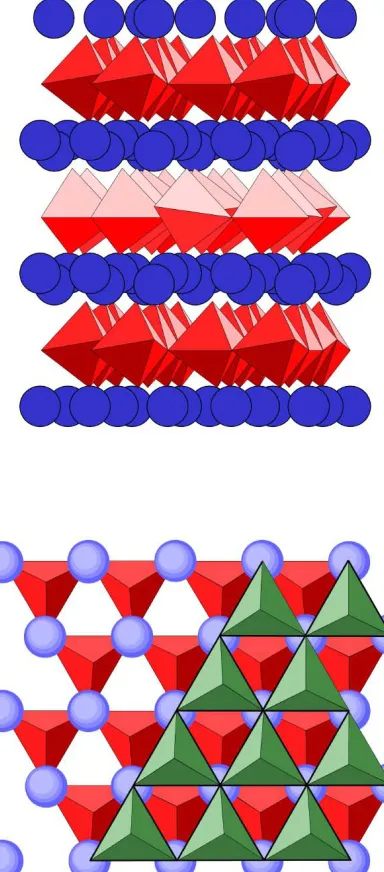
Figure 1
Schematic view of the crystallographic structure of YbMnO3. (a) A view along the basal plane. Er is represented by blue
spheres, and the MnO5 clusters are represented by red trigonal bipyramids. This panel highlights the two-dimensional
nature of the structure. (b) A view along the c axis of two layers to show the stacking of the bipyramids. The bipyramids
supporting information
sup-4
Acta Cryst. (2001). E57, i87–i89
Ytterbium Manganese Oxide
Crystal data
YbMnO3
Mr = 275.88
Hexagonal, P63cm
Hall symbol: P 6c -2 a = 6.0584 (6) Å c = 11.3561 (7) Å V = 360.97 (6) Å3
Z = 6 F(000) = 714
Unit cell parameters (Duisenberg, 1992) and orientation matrix were determined from a least-squares treatment of SET4 (de Boer &
Duisenberg, 1984) setting. Reduced cell calculations did not indicate any higher metric lattice symmetry and examination of the final atomic coordinates of the structure did not yield extra symmetry elements (Spek, 1988; Le Page 1987, 1988)
Dx = 7.617 Mg m−3
Mo Kα radiation, λ = 0.71073 Å Cell parameters from 22 reflections θ = 15.0–27.9°
µ = 43.58 mm−1
T = 293 K Platelet, black
0.15 × 0.10 × 0.01 mm
Data collection Enraf Nonius CAD-4F
diffractometer
Radiation source: fine focus sealed Philips Mo tube
Perpendicular mounted graphite monochromator
ω/2θ scans
Absorption correction: gaussian (Spek, 1983)
Tmin = 0.059, Tmax = 0.577
3264 measured reflections 835 independent reflections 636 reflections with F > 4σ(F) Rint = 0.037
θmax = 39.9°, θmin = 3.6°
h = −10→0 k = 0→10 l = −20→20
3 standard reflections every 180 min intensity decay: none
Refinement Refinement on F2
Least-squares matrix: full R[F2 > 2σ(F2)] = 0.030
wR(F2) = 0.072
S = 1.08 835 reflections 32 parameters 0 restraints 0 constraints
Primary atom site location: structure-invariant direct methods
Secondary atom site location: none w = 1/[σ2(F
o2) + (0.0494P)2]
where P = (Fo2 + 2Fc2)/3
(Δ/σ)max < 0.001
Δρmax = 2.5 (10) e Å−3
Δρmin = −7.3 (10) e Å−3
Extinction correction: SHELXL97, Fc*=kFc[1+0.001xFc2λ3/sin(2θ)]-1/4
Extinction coefficient: 0.0121 (7)
Special details
Geometry. Bond distances, angles etc. have been calculated using the rounded fractional coordinates. All e.s.d.'s are estimated from the variances of the (full) variance-covariance matrix. The cell e.s.d.'s are taken into account in the estimation of distances, angles and torsion angles
Refinement. Refinement of F2 against ALL reflections. The weighted R-factor wR and goodness of fit S are based on F2,
conventional R-factors R are based on F, with F set to zero for negative F2. The threshold expression of F2 > 2σ(F2) is
supporting information
sup-5
Acta Cryst. (2001). E57, i87–i89
Fractional atomic coordinates and isotropic or equivalent isotropic displacement parameters (Å2)
x y z Uiso*/Ueq
Yb1 0.00000 0.00000 0.27336 (5) 0.00427 (11)
Yb2 0.33333 −0.33333 0.23061 (3) 0.00472 (7)
Mn 0.3333 (5) 0.00000 −0.00194 (14) 0.0054 (2)
O1 0.3030 (12) 0.00000 0.1617 (6) 0.0039 (10)
O2 0.3610 (15) 0.00000 −0.1658 (6) 0.0074 (11)
O3 0.00000 0.00000 −0.0268 (16) 0.004 (2)
O4 0.33333 −0.33333 0.0192 (9) 0.0059 (17)
Atomic displacement parameters (Å2)
U11 U22 U33 U12 U13 U23
Yb1 0.0047 (2) 0.0047 (2) 0.0035 (2) 0.0023 (1) 0.0000 0.0000
Yb2 0.0035 (1) 0.0036 (1) 0.0071 (2) 0.0018 (1) 0.0000 0.0000
Mn 0.0069 (4) 0.0048 (4) 0.0039 (2) 0.0024 (6) 0.0002 (3) 0.0000
O1 0.0050 (14) 0.0017 (18) 0.0041 (19) 0.0009 (9) −0.0019 (15) 0.0000
O2 0.014 (2) 0.0001 (18) 0.0033 (17) 0.0000 (9) 0.0002 (19) 0.0000
O3 0.003 (2) 0.003 (2) 0.005 (6) 0.0016 (10) 0.0000 0.0000
O4 0.009 (3) 0.009 (3) 0.000 (3) 0.0047 (13) 0.0000 0.0000
Geometric parameters (Å, º)
Yb1—Yb2 3.5313 (4) Yb2—O1 2.257 (5)
Yb1—O1 2.231 (7) Yb2—O4 2.401 (10)
Yb1—Yb2i 3.5313 (4) Yb2—O4xi 3.277 (10)
Yb1—Yb2ii 3.5313 (4) Yb2—O2xii 2.270 (8)
Yb1—Mniii 3.254 (3) Yb2—O1xiii 2.257 (6)
Yb1—O2iii 2.294 (8) Yb2—O2xiv 2.270 (5)
Yb1—O3iii 2.269 (18) Yb2—O1xv 2.257 (8)
Yb1—O3 3.409 (18) Yb2—O2vii 2.270 (5)
Yb1—O1iv 2.231 (6) Yb2—Yb2viii 3.4978 (3)
Yb1—Mnv 3.254 (3) Yb2—Yb2xvi 3.4978 (3)
Yb1—O2v 2.294 (9) Yb2—Yb2x 3.4978 (3)
Yb1—O1vi 2.231 (7) Mn—O1 1.867 (7)
Yb1—Mnvii 3.254 (3) Mn—O2 1.868 (7)
Yb1—O2vii 2.294 (7) Mn—O3 2.039 (4)
Yb1—Yb2viii 3.5313 (4) Mn—O4 2.034 (4)
Yb1—Yb2ix 3.5313 (4) Mn—O4x 2.034 (4)
Yb1—Yb2x 3.5313 (4)
O1—Yb1—O2iii 77.2 (2) O1xiii—Yb2—O2vii 77.2 (2)
O1—Yb1—O3iii 124.64 (18) O1xv—Yb2—O2xiv 77.2 (3)
O1—Yb1—O1iv 90.89 (18) O2xiv—Yb2—O2vii 95.6 (3)
O1—Yb1—O2v 162.9 (3) O1xv—Yb2—O2vii 169.1 (2)
O1—Yb1—O1vi 90.9 (2) O1—Mn—O2 179.5 (4)
supporting information
sup-6
Acta Cryst. (2001). E57, i87–i89
O2iii—Yb1—O3iii 72.47 (18) O1—Mn—O4 86.1 (3)
O1iv—Yb1—O2iii 77.2 (3) O1—Mn—O4x 86.1 (3)
O2iii—Yb1—O2v 111.3 (2) O2—Mn—O3 87.2 (6)
O1vi—Yb1—O2iii 162.9 (2) O2—Mn—O4 94.2 (3)
O2iii—Yb1—O2vii 111.3 (3) O2—Mn—O4x 94.2 (3)
O1iv—Yb1—O3iii 124.64 (17) O3—Mn—O4 120.54 (8)
O2v—Yb1—O3iii 72.47 (18) O3—Mn—O4x 120.54 (18)
O1vi—Yb1—O3iii 124.64 (18) O4—Mn—O4x 118.62 (19)
O2vii—Yb1—O3iii 72.47 (17) Yb1—O1—Yb2 103.8 (2)
O1iv—Yb1—O2v 77.23 (17) Yb1—O1—Mn 130.3 (4)
O1iv—Yb1—O1vi 90.9 (2) Yb1—O1—Yb2x 103.8 (2)
O1iv—Yb1—O2vii 162.9 (2) Yb2—O1—Mn 107.0 (3)
O1vi—Yb1—O2v 77.2 (2) Yb2—O1—Yb2x 101.6 (3)
O2v—Yb1—O2vii 111.34 (16) Yb2x—O1—Mn 107.0 (3)
O1vi—Yb1—O2vii 77.2 (2) Yb1xvii—O2—Mn 102.4 (4)
O1—Yb2—O4 69.72 (17) Yb2xvii—O2—Mn 123.3 (2)
O1—Yb2—O2xii 169.1 (3) Yb2xviii—O2—Mn 123.3 (2)
O1—Yb2—O1xiii 108.65 (19) Yb1xvii—O2—Yb2xvii 101.4 (2)
O1—Yb2—O2xiv 77.2 (2) Yb1xvii—O2—Yb2xvii 101.4 (2)
O1—Yb2—O1xv 108.6 (2) Yb2xvii—O2—Yb2xviii 100.8 (3)
O1—Yb2—O2vii 77.2 (3) Yb1xvii—O3—Mn 98.0 (5)
O2xii—Yb2—O4 121.22 (19) Mn—O3—Mniv 118.1 (3)
O1xiii—Yb2—O4 69.72 (17) Mn—O3—Mnvi 118.1 (3)
O2xiv—Yb2—O4 121.22 (16) Yb1xvii—O3—Mniv 98.0 (5)
O1xv—Yb2—O4 69.72 (18) Yb1xvii—O3—Mnvi 98.0 (5)
O2vii—Yb2—O4 121.22 (16) Mniv—O3—Mnvi 118.1 (3)
O1xiii—Yb2—O2xii 77.2 (3) Yb2—O4—Mn 96.8 (3)
O2xii—Yb2—O2xiv 95.6 (3) Yb2—O4—Mnxiii 96.8 (3)
O1xv—Yb2—O2xii 77.2 (3) Yb2—O4—Mnxv 96.8 (3)
O2xii—Yb2—O2vii 95.6 (3) Mn—O4—Mnxiii 118.6 (2)
O1xiii—Yb2—O2xiv 169.1 (2) Mn—O4—Mnxv 118.63 (17)
O1xiii—Yb2—O1xv 108.6 (2) Mnxiii—O4—Mnxv 118.63 (19)
Symmetry codes: (i) x−1, y, z; (ii) x, y+1, z; (iii) x−y, x, z+1/2; (iv) −y, x−y, z; (v) −x, −y, z+1/2; (vi) −x+y, −x, z; (vii) y, −x+y, z+1/2; (viii) y, x−1, z; (ix) y,
x, z; (x) y+1, x, z; (xi) −y, −x, z+1/2; (xii) x−y, x−1, z+1/2; (xiii) −y, x−y−1, z; (xiv) −x+1, −y, z+1/2; (xv) −x+y+1, −x, z; (xvi) y+1, x−1, z; (xvii) x−y, x,