New Aesthetics, Techniques, and Technologies
Name
School University
Place Country Email@Email
Name
School University
Place Country Email@Email
Name
School University
Place Country Email@Email
ABSTRACT
Despite of its long history, opera as an art form is constantly evolving. Composers have never lost their fascination about it and keep exploring with innovative aesthetics, techniques, and modes of expression. New technologies, such as Virtual Reality (VR), Robotics and Artificial Intelligence (AI) are steadily having an impact upon the world of opera. The evolving use of performance-based software such as Ableton Live and Max/MSP has created new and exciting compositional techniques that intertwine theatrical and musical performance. This paper presents some initial work on the development of an opera using such technologies that is being composed by Kallionpää and Chamberlain. Furthermore, it presents two composition case studies by Kallionpää: “She” (2017) and puppet opera “Croak” (2018), as well as their documentation within the world's first 360° 3D VR recordings with full spatial audio in third-order Ambisonics and the application of an unmixing paradigm for focusing and isolating individual voices.
ACM Reference format:
Authors . Title. In Proceedings of Audio Mostly, London, United Kingdom, August 23-26, 2017 (AM´17), 8 pages. https://doi.org/10.1145/3123514.3123536.
CCS Concepts
• Human Centered Computing → Collaborative and social computing; Collaborative and social computing theory, concepts and paradigms; Social content sharing; Collaborative content creation.
KEYWORDS
Ethnography, Autoethnography, Semantics, Methods, Design, Maps, Audio, Participation, Ubiquitous Computing, Place,
Space, Memory, Curation, Museums, Music, Heritage, Opera, Contemporary Music, Immersive Experience, Virtual Reality, Ambisonics, 3D Audio, Audio Source Separation.
1 INTRODUCTION
Opera as an art form keeps fascinating composers, performers, and audiences all around the world. Because of its combination of both musical and theatrical elements, it provides an ideal new-media research platform that can allow researchers to develop new technologies and interactional techniques that at a high-level explore the interplay between audience, performance, composition and staging. In many respects opera lends itself to being explored though methods developed in Participatory Design, Human-Computer Interaction and Computer-Supported Cooperative Work. We offer a brief insight into some of the initial work and discussions that have started to emerge in regard of the development of an opera called ‘Spirits of the Land, Lake and Sea’, which aims to explore the use of Virtual Reality/Mixed Reality, non-linear performance and narratives, autonomous compositional techniques and multi-sited/distributed performance. This discussion will be reflected to Kallionpää´s previous opera composition productions “She” and “Croak”.
2 State of the Art in the Context of Contemporary
Opera
The genre of contemporary opera sets its special challenges to the composers, performers, and producers, as well as to the intendents of opera houses. How to obtain new audiences and at the same time keep the current ones interested? Opera as an art form has a strongly established tradition of many centuries. How to simultaneously pay respect to it and develop new aesthetics, dramaturgies, narratives, and musical languages suitable to the audiences of today? This discussion showcases a few examples of operas that engage innovative composition techniques, technologies, and storytelling.
2.1 Challenging the Storyline
As stated above, opera as a music genre has a very distinguishable character. Almost everyone has an opinion about it as an artform, one either does or does not like it. Whereas the traditional opera aesthetics appeal to certain ______________________________________
Permission to make digital or hard copies of all or part of this work for personal or classroom use is granted without fee provided that copies are not made or distributed for profit or commercial advantage and that copies bear this notice and the full citation on the first page. Copyrights for components of this work owned by others than ACM must be honored. Abstracting with credit is permitted. To copy otherwise, or republish, to post on servers or to redistribute to lists, requires prior specific permission and/or a fee. Request permissions from [email protected].
AM '17, August 23–26, 2017, London, United Kingdom © 2017 Association for Computing Machinery. ACM ISBN 978-1-4503-5373-1/17/08…$15.00
audiences, some others may be put off by it. Because of this, some gate keepers of the opera world (such as, for example, opera producers and leaders of the opera houses) are keen on renewing this tradition. Moreover, composers are usually interested in exploring and developing new musical language and technical solutions. Traditional compositional forms, such as symphony, sonata, and opera, have often been disliked by experimental composers of the past but, nonetheless, operas are still regularly being commissioned, composed, performed, and listened. This may be because of the successful implementation of interesting expressive ideas and technologies, which keeps the opera tradition alive and fresh and helps to raise interest in audiences that otherwise would not pay attention to it.
One of the most common methods of challenging the usual concept of an opera is to break or fragmentize the story line. ‘Spirits of the Land, Lake and Sea’, will do this by using algorithmic composition techniques, as well as by bringing in different musical material and narrative depending on where in the concert space the performer and listeners are located. The artistic motivation for this lies in the concept of human memory, as our memories do not consist of a direct continuum of events, but are a non-linear collection of various experiences, feelings, and impressions. Memories and forgetting are also themes of Sir Maxwell Davies´ opera “Miss Donnithorne´s Maggot”, in which the story is being told from the perspective of the main protagonist who has lost her mind because of a traumatic past event. It is up to the listeners to decide what is true and what is not, and what actually happened. Moreover, the presence of just one singer underlines the peculiar characteristics of the narrative. Nonlinear, fragmentary storytelling and ambitious use of technical solutions form a part of van der Aa´s opera Blank Out (2013), in which the dramatic contents are communicated with the help of 3D projection techniques in combination with live performance, pre-recorded musical material, and sound processing. On top of being a composer, van der Aa is also a film director, which can be seen in the visual language and formation of the dramatic arch of his works. Instead of restricting his aesthetics to the traditional characteristics of an opera, the composer provides the audience an immersive and powerful theatrical experience. Van der Aa uses different technologies as an essential part of structuring his works. Moreover, he has exploited 3D techniques in his film opera Sunken Garden (2011-2012). Furthermore, his previous music dramas The Book of Disquiet (2008), After Life (2005-2006), One (2002), Vuur (2001) and Writing to Vermeer (1999) contain likewise special mix of interaction between the live musicians, pre-recorded material, video, and soundtrack. Composer Miika Hyytiäinen has often been experimenting with the essence and compositional identity of the concept of opera. For example, his Omnivore (2012) is the world´s first mobile phone opera. Hyytiäinen got interested in the project because he wanted to “explore new forms of musical theatre” [10]. As described by him and the stage director Jaakko
Nousiainen, “the whole script, form, musical expression, and in general the way of making an opera have been totally re-discovered” (Ibid.). Instead of setting up the opera in a concert hall, the work is showed to the audience via their mobile phones and tablet computers. The authors did not intend the work to be experienced through high quality speakers but with the original build-in speakers of the smart phones. Part of the experience is that one should be able to listen to the opera for example when waiting for the bus outside (Ibid.). The 20 minutes long opera consists of seven episodes that each last between 30 seconds and three minutes. Hyytiäinen´s work strongly relies on the tradition of conceptual art. Furthermore, there is a fine line between the genres of opera and musical theatre, which is why it can sometimes be difficult (and perhaps also unnecessary) to distinguish them from each other.
3 COMPOSING AN OPERA: “SHE” (2017)
“She” was composed between 2016 and 2017 by Maria Kallionpää. The work was commissioned by Fabbrica Young Artists´ Development Program of Opera di Roma, where it was premiered in October 2017. The work is scored for four soloists, middle sized orchestra, magnetic resonator piano, and theremin. The composer herself performed the magnetic resonator piano parts. A VR recording of the piece was produced by Hans-Peter Gasselseder, who also recorded the audio with the prototype of the Zylia ambisonic microphone. This recording is the first of its kind made of an entire opera performance. We believe that, on top of the actual musical work, as such, the recording has artistic value on its own right. This discussion will shed some light on the process of opera writing.
3.1 Perspective of the Composer-Performer Maria
Kallionpää
When starting to compose her first opera “She” in 2016, the composer received a variety of comments arguing that writing an opera would very much differ from composing other types of musical works. In the course of the process it became evident that, although some truth may lie in that statement, producing an opera was in essence rather similar to writing any vocal compositions for soloists and an orchestra (however, not every composer has experience with working with singers, which is why they might associate such problems with operatic composing). Based on the composer´s experience on “She”, and later on with puppet theatre opera “Croak”, the most poignant character of opera writing is the libretto being in the main role, meaning that the text defines the pace and form of the music. Whereas a composer normally needs to define the form and proportions of their composition every time anew when starting to work on a musical piece, this step may be skipped in the context of an opera.
adaptable for this kind of a musical drama. Librettist Stefano Simone Pintor produced a script that, rather than being an exact representation of the original text, took its inspiration from it. The libretto was draft was modified a couple of times to make it more suitable for the musical drama. The modifications mainly applied to its length. Many writers tend to underestimate the difference between opera and spoken theatre: whereas in the latter genre the drama is carried out in the same pace as in everyday discussion, in vocal compositions much more time is required for communicating the text. Moreover, enough space needs to be given for the orchestra (or in the context of lieder music, the piano). The plot of an opera is never told by the words only, but by a combination of what is being said (or sung) and how the situations are being interpreted in the orchestral accompaniment (harmonies, melodies, effects, and timing of musical events).
The first step in composing the music was to produce a vocal score (for piano and soloists only) that was used for rehearsing the singers with an accompaniment of a repetiteur. The composer then orchestrated the piano texture to the entire ensemble. The main character of “She” is the Goddess-like Ayesha (or “She Who Must Be Obeyed”). To emphasize her supernatural character, the composer decided to use the combination of theremin and magnetic resonator piano. These instruments only appear whenever Ayesha´s presence is required.
Using extended instruments (in this case magnetic resonator piano) raise some practical challenges. For example, how to find suitable musicians to play them? The composer opted for playing the magnetic resonator piano by herself as, in order to be able to perform on it, certain special instrumental techniques would have to be learned. Such techniques included, for example, applying very light articulation on the keys in order to bring up the overtone series of particular tones, and modifying the dynamics of a sustained tone or chord, which was also done by altering the playing style. Sound producing qualities usually associated with string instruments were exploited, too. Such included, for example, applying pitch bend and sustaining a chord, which would normally not have been possible on a keyboard instrument. The time frame of the project would have not allowed for the training of an external pianist, which meant that, in addition to supervising the rehearsal period of the work, the composer was also playing at the everyday rehearsals and performed at the premiere. Moreover, technical support was received throughout the rehearsing process from the developer of the magnetic resonator piano, prof. Andrew McPherson.
Based on her experience on “She”, the composer believes that the use of extended instruments and electronic solutions should mainly be motivated by the desire of obtaining better expressive and artistic results. Instead of applying them for the reasons of technical curiosity only, one should use them to highlight the structure and dramatic arch of a musical work, and to widen the musicians´ aesthetic and technical
possibilities. They can help the composers to reach technical and expressive means that would not be accessible by human musicians (or singers) playing regular concert instruments.
4 COMPOSING “CROAK” (2017)
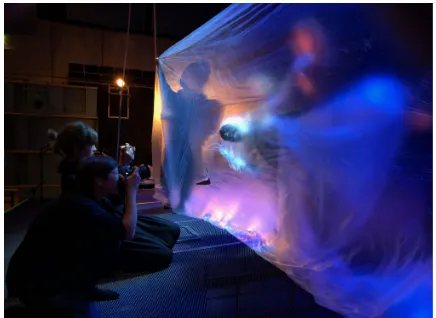
“Croak” is the first puppet theatre opera produced in the Nordic Countries, which was composed by Maria Kallionpää and Markku Klami together, to the libretto written by Mikhail Brashinsky. The composition process of “Croak” run very similarly to that of “She”. The composers initially put together “a catalogue” in which the main musical motifs of the opera´s key characters were drafted, after which a vocal score for the rehearsal purposes was produced. As with “She”, the music was then arranged for the full orchestra. Some minor changes were made after the initial rehearsals with the conductor and, as usual, also during the orchestrating phase of the work. The work involved human-sized puppets that were specifically manufactured for the needs of this project by Viktor Antonov in Sank Petersburg. Both the stage design and the looks of the puppets evolved alongside the music. Although the original setup was aesthetically rather traditional, Antonov and the stage director Anna Ivanova-Brashinskaya decided to change the visual character to better correspond to the music that they found to be stylistically more contemporary than expected. This resulted in Antonov designing puppets that were made of lighter materials than the original ones, and also the stage design became more minimalistic. Because many visual effects (such as, for example, Croak swimming under the water) were made by using a large and flexibly moving canvas of thin plastic, its rustling also put its mark on the sonic world of the work, as well as on the recording that was made of it.
The main difference between composing the two operas was the involvement of two composers, who had to find a way to keep the work unified and to try to avoid too stark contrasts of style. Partly because of this (and also depending on each composer´s interest in composing particular scenes of the opera), Klami and Kallionpää divided the work in larger sections, usually consisting of more than one consecutive scenes. This way the general character of the work did not become too fragmentary. Moreover, because every composer has their unique way of writing music, it would have been impossible to completely merge the composing styles of Klami and Kallionpää. However, this turned out not to be a problem, as the opera consisted of 16 individual scenes that anyway required music that would reflect the different happenings in each of them. This allowed the storyline to flow naturally despite of the changes in the musical style. One could even say that the diversity of the sonic material ended up becoming one of the strengths of the work´s dramatic structure.
uses for interpreting the text into music. The composer needs to make the words alive by conveying their inner meaning to the listeners. What are the motivations of the protagonists, and how do they think and feel? What are the unsaid reasons behind the seemingly trivial conversations and other interactions between the characters of the opera? Based on Kallionpää´s experiences on “She” and “Croak, she argues that the role of the orchestra in the storytelling of the opera is similar to that of the camerawork in the context of film. The orchestra (or the film camera) reveals to the audience what lies beneath the surface of the storyline. To do this, the orchestral texture requires a certain amount of time to evolve, meaning that the number of words used in the libretto should be limited, and their meanings crystallized (because of this, also the libretto of “Croak” had to be radically shortened). Franz Schubert´s lieder are an illustrative example of this. Although they usually last several minutes, the lyrics are rarely very long and wordy. In general, regulating the amount of words leaves space for the dialogue between the singers and the instrumental parts, which forms a vital part of a well- structured vocal music composition.
[image:4.612.65.283.397.556.2]Like in Croak, a multi-composer setup will also apply to the previously mentioned future opera collaboration ‘Spirits of the Land, Lake and Sea’, a concept of which will be presented later in this paper. However, because the new work will be nonlinear and form a more unified entity, alternative ways of dividing the work between the composers still needs to be established.
Figure 1: Croak ”swims” under the water. The effect is made with the help of a transparent and thin sheet of plastic
4.1 “It´s Cool, Just Hit Record!?” – Recording Opera
as an Immersive Experience
Aside from their artistic distinctions, the operas “She” and “Croak” featured some strong technical aspirations that set them apart from previous offerings within the genre. To the best of the authors’ knowledge, both productions represent the first full-length recordings of an opera in an immersive format that supports 360-degree video and audio for playback and control in virtual reality [VR; i.e. head movements as well as six degrees of freedom facilitated by volumetric
simulations]. Apart from these considerations for applications in VR, a further desideratum of the recording plan was to maintain high compatibility with legacy as much as next generation formats, with supported playback setups ranging from traditional channel-based systems [such as 5.1 surround sound] to full 360-degree object-based surround [either rendered binaurally or on an arbitrary number of loudspeaker pairs]. Whereas both operas share a common paradigm in their recording philosophy, that is to offer the spectator a perspective otherwise unattainable to an audience member of the live show, they also showcase differences in the application of immersive recording techniques due to circumstantial requirements set by the stage design/directing, musical material/orchestral layout as well as legal considerations.
When reflecting on an early review of the methodological insights gained while recording “She”, for the visual domain, on the one hand, the added sense of ‘being there’ was achieved by moving closer and thus offering more detail on the character interactions. For audio, on the other hand, the counter-approach seemed most effective by moving further away from the scene and subsequently adding a sense of space or situational context to the experience (see [5] for some theoretical considerations related to this finding).
In contrast, the production of “Croak” exhibited a rather different set of criteria to be respected by the recording. Whereas the staging of “She” necessitated a two-dimensional approach with added depth [for the sake of supporting the sense of involvement as much as ‘being there’], the production of “Croak” posed a challenge in the opposite direction. The production made little use of stage properties but rather had its characters move a lot and explore the depth of the stage to large extend. Moreover, the nature of the main characters being represented by life-size puppets controlled by puppeteers would have made spectators prone to confuse character relationships if the same two-dimensional recording setup had been used as in “She”. Thus, rather than positioning the recording gear close-up [visual]/far-off [audio], the recording rationale chosen opted for a wide and more distant view of the stage that embraced depth by means of a three-dimensional video [as compared to the two-three-dimensional approach applied in “She”] and a more surrounding audio experience. This allows spectators to differentiate the suggested layers of diegesis that are inherent in puppet theater where the representative characters [“puppets”] are accompanied by puppeteers, and in the special case of opera, by individual singers. Where “She” required depth in its depiction of the stage, “Croak” necessitated a sense of segmentation of the different hierarchical diegetic layers suggested by the positioning of individual actors/singers. With puppets commonly positioned in the mid-front, singers at the side edge of the stage, and puppeteers further behind the former two, a three-dimensional video in 360-degrees enables spectators to tell these [hierarchical] layers apart. Another complexity specific to “Croak” posed the stage lighting, which varied in color and, in combination with the shadows cast by the puppets, caused interesting reflections onto the sides and rear of the concert hall. These reflections were mainly visible from the audience’s perspective. In order to capture the depth of the stage as well as an alternative perspective of the hall from the audience’s view, the main camera rig [Insta360 Pro in 3D at 6k resolution] was placed approximately 6 meters at the edge between stage and orchestra pit. Furthermore, the primary rig was extended by a secondary 360-degree camera setup [2x Kodak SP360 4k] positioned between the first row of the audience seating area as well as above the conductor in the orchestra pit. For the final video, this configuration enables a change of perspectives during playback when zooming out on the footage recorded on the primary camera rig and blending over to the material that was shot on the secondary camera rig.
As for audio, the staging as well as setting of “Croak” implied moving closer with the Ambisonics microphone [Zylia ZM-1d prototype] towards the stage action. Therefore, the microphone was placed between the stage and the orchestra [rather than in front of the orchestra as in “She”] and also functioned as the center of a Decca tree setup that was supported by an additional 12 spot microphones.
well as its associated genre. Whereas an opera recording in a legacy format [i.e. two-dimensional 16:9 aspect ratio] leaves it to the film director to edit camera cuts and foci of the action, VR hands over such responsibility to the spectator/user. It is thus even more important to suggest the user with specific contextual functions respective to the visual and acoustic domain of the presentation to establish guiding markers of the diegesis between the meta-virtual [i.e. the depiction of the stage performance] and its [infra-] virtual realm informed by the nature of the physical environment [i.e. the concert hall]. If made aware of these roles on an implicit level during initial contact with the content [i.e. the overture of “Croak”], users are more likely to recognize the meaning structures as well as the extend of possible actions on different layers of abstraction [i.e. what’s to be depicted on stage versus what physical setting it is being staged in]. Giving users of VR an initial understanding of the relevance and modal representation of each of these realms builds an authentic representation of a truly immersive operatic experience that is more than a documentation of its original performance.
5 Singing, Control and Performance
In this section we discuss one area that we are currently focusing on and present an initial design intervention into the area. Our research has been about understanding the ways, as we have said earlier, that opera might be used as a platform to explore new and evolving technologies in a performance-based setting, because of the opportunities that opera affords. In this section we start to outline the design of a software-based system that forms part of a mixed-media opera experience and is designed to support singers in working with live graphics/visuals. Currently the tool has been developed as a design probe that we can start to explore the interactional issues that occur when people attempt to effect visuals in live performances and the issues that one can come across in live settings when one is dealing with a reactive audio environment. The development of such software systems is important in opera as operas evolve and head towards mixed media, VR and as we have seen puppet-based performances, it mean that singers are able to interact and react with elements of the performance.
In this section we outline the tool, it's development and then move on to talk about the implications for design and the future development of the system. The tool was designed using Max/MSP. The initial concept behind the software was the development of a tool that could be controlled by a singer in order to add visual effects to a range of graphical elements that were being used as part of a performance. The tool needed to be able to run video across multiple/single screens, be able to react to audio and add video effects to the videos (triggered by the singing) and it also needed to be allow the singer to control switch the system on and off. In order to do this, we developed an audio reactive patch using the VIZZIE library and then developed an interface and saved the application as a stand-alone program. The concept behind this
piece of software is that the singer would be able to control streamed or video-based media with their voice, and therefore create a more dynamic performance where the audience might be able to see the way in which the singer could have an impact upon and control parts of the stage set. We hoped that this would create a more impactful performance.
What we learnt from this was that, although this appeared to be a simple proposition to develop audio-reactive systems, that it is in fact not simple at all, and there are lessons to be learnt that can inform the designers of such systems. In this small paper we would like to briefly outline some of these issues that emerged from our initial prototype.
- The systems need to have direct input, that is to say that controlling and triggering based on environmental audio triggers is difficult and at best chaotic, so there needs to be a direct 'input' into the system, although using systems that can react to the audio in a given environment can create interesting experiences that one might not have previously thought about.
- Keep it simple, reactive systems are adapting to 'something' systems of this sort need to be intelligible regarding the system state. This is often accomplished via feedback - the system can be seen to be influencing the media in the performance.
- Controlling adaption, is a difficult problem to get rid of in such systems. Who or what controls the adaption, by how much, is it automated and how does one deal with 'live' situations. There must be a full understanding of (in our case) how much and what kind of effects we want the system to have on the visuals. Do we want for example pixilation, or a glitch effect? How much do we want this to happen? How can the singer control this? In our system we were using an approach where the louder the volume would equate to more of an effect, but we found that each effect was different. Therefore, some effects would have more of an impact on the graphics. This means that each effect needs to have the parameters defined in the software in order to not render the impact of the adaption useless. In order to control a system, people need training and to deal with timing issues.
- Multitasking, is it just too much? Bearing in mind that the singer has to perform, which includes singing and acting with other performers sometimes, we need to think about how, if the singer is going to control a system such as the one that we have outlined how to minimise this. This leads us to propose that we need to carry out an initial ethnographic study in order to further understand the work that goes into being an
opera singer.
audio-reactive system we have stated to unpack some design considerations that we think are worthy of further exploration.
5 Singing, Playing, and Adaption
When discussing musical performance, one cannot forget the essential role of physicality in it. Whereas for a composer the creative process mainly consists of dealing with the composition techniques, structure, and the instant sonic outcomes resulted from them, a performing musician mainly approaches a musical composition from the viewpoint of physicality and instrumental techniques [6]. Although classical musicians are generally accustomed and trained to perform the most challenging works of their instrumental repertoires, they have to adapt their instrumental skills to new technical requirements when playing contemporary music works involving unfamiliar extended techniques, instrumental combinations, or technologies [7]. As discussed above, using different controllers in electroacoustic performance sets its special challenges to the performers. In general, technology has an impact on the performing experience: sometimes the use of strictly controlled electronic background may even limit and constrain the performing artist [4][8] by directing their focus away from the sound quality and expression.
As discussed, performing on an opera stage is a multitasking situation in which the singer deals with the aspects of acting, choreography, and singing, all of which they usually have to know by heart. These tasks can sometimes seem overwhelming for the musicians, especially if they are not used to perform contemporary music. For example, this was one of the challenges of the rehearsal period of “She”, as the singers had previously mainly performed traditional opera repertoire. To make it easier for them to focus on their vocal parts, the stage director originally planned to simplify the choreography, which at the end proved not to be necessary. Unlike standard repertoire pieces, electronic or electroacoustic compositions involving live systems often cannot be learned by analyzing the score, as many functions of the interactive part may be impossible to notate. For example, like with Kallionpää´s interactive Disklavier work “Climb!”, the overall form is nonlinear, which makes the piece shape up anew in every performance, and which is something that a traditional music score cannot properly communicate. Moreover, the same applies to works that, similarly to “Climb!”, contain randomized effects of the electronic system. The easiest method to learn such a piece (and to find a way to adapt one´s techniques, timing, and musical gestures to it) is usually to play alongside the system as often as possible [7]. This way the performer gets used to the behavior of their electronic duet partner.
5.2 Future Directions
In this section we quickly discuss our vision for the opera, which is currently in its early phases, we briefly discuss three
constituent parts of the opera that will be of interest to the conference audience. ‘Spirits of the Land, Lake and Sea’ is envisaged as being a participatory experience. Communities in rural Finland and the UK will form the core inspiration for the narrative of the performance, which will be based on their experiences of living with the land, lakes and sea. In past projects we have used participatory approaches to great effect, as they engender the involvement of the community, which lead to a sense of ownership and a greater commitment to, and involvement in the project [1].
Virtual and Mixed Reality – We intend use VR and Mixed Reality in order to share different environments that will consist of different audio environments and differing VR experiences relating to the different sites where the opera is performed. Mixed Reality techniques will bring the virtual and physical together by the blending of audio, location and performance into a narrative structure.
Non-Linear Narratives & Performance – Developing non-linear compositional and performance techniques is a key area exploration. Tools such as Ableton live mean that non-linear performance and ‘triggering’ is possible, however the integration of computational performance and acoustic instruments is more complex – relating this to the narrative of the opera will be challenging, using modular compositional approaches may offer a solution.
Autonomous Composition & Streamed Content – We aim to use compositional techniques that will offer us the opportunity to engage with, understand and develop a theoretical framework for composing and performing with autonomous music. As part of the opera we aim to build on our existing research in this area [2] and develop the integration of streamed and sonified content [3] relating to the sites explored.
6 CONCLUSIONS
ACKNOWLEDGMENTS
ThisworkwassupportedbytheEngineeringandPhysical SciencesResearchCouncil[grantnumberEP/L019981/1] projectFusingSemanticandAudioTechnologiesfor IntelligentMusicProductionandConsumption
REFERENCES
[1] Atak,A.,&Kingma,S.(2011).Safetycultureinanaircraftmaintenance organisation:Aviewfromtheinside.Safetyscience,49(2),268-278.
[2] Bødker,M&Chamberlain,A.(2016).AffectTheoryandAutoethnography inOrdinaryInformationSystems,Proceedingsof 2016European ConferenceonInformationSystems,(ECIS2016), June12-15th,Istanbul, Turkey, AIS.
[3] Button,G.(2000).Theethnographictraditionanddesign.DesignStudies, vol.21,319-332.
[4] Chadabe,J. (1997). ElectricSound:ThePastandPromiseofElectronic Music.NJ:UpperSadleRiver:Prentice.
[5] Gasselseder,H-P. (2015). TheRoleofAgencyinLudoacousticImmersion: ExperiencingRecordedSoundandMusicinSituationalContext.In AM'15
ProceedingsoftheAudioMostly2015onInteractionWithSound[13] AssociationforComputingMachinery.
[6] Hämeenniemi,E.(2007).Tulevaisuudenmusiikinhistoria.BasamBooks. Helsinki,Finland.
[7] Kallionpää,M.(2014).BeyondthePiano:TheSuperInstrument. Widening theInstrumentalCapacitiesintheContextofthePianoMusicofthe21st Century.DPhildissertation,UniversityofOxford,Oxford
[8] Kimura,M. PerformancePracticeinComputerMusic.ComputerMusic Journal,19(1),64-75.
[9] Schütze,S.,&Irwin-Schütze,A. (2018).NewRealitiesinAudio.CRCPress: BocaRaton,FL.
[10]Vedenpää,V.(2011).