TEMPERATURE AND ITS EFFECTS ON SOME
MARITIME PLANTS IN BRITAIN
M. Anne Palin
A Thesis Submitted for the Degree of PhD
at the
University of St Andrews
1979
Full metadata for this item is available in
St Andrews Research Repository
at:
http://research-repository.st-andrews.ac.uk/
Please use this identifier to cite or link to this item:
http://hdl.handle.net/10023/14351
ABSTRACT
Temperature and its Effect on some Maritime Plants in Britain*
The physiological ecology of five coastal species has heen examined with respect to temperatire and its effect on survival and distribution. The aims of, the study have been to establish whether any direct correlation
exists between distribution and the responses of the plants to temperature at different stages in the life cycle. The species under consideration were the northern Lifflisticum scoticum and Mertensia maritima and the
southern Crithmum marltimum. Limoniujii binervosum and Glaucium flavum. Highest germination percentages for each species were found at temperatures close to those associated with the season favourable for
germination in the natural habitat. Northern■species bad higher temperature requirements than the southern, corresponding to spring/ summer and autumn or spring germination respectively.
Root respiration, measured as- oxygen uptake, was found to be twice as great in the northern Liffustlcuin and Mertensia as in the southern
Crithmum and Limonium over a range of experimental temperatures. This varied to some extent with time and temperature of pretreatment. The single experiment on the southern Glaucium showed rates similar to those of the northern species. , Arrhenius plots' of respiration data for the northern species showed a break in gradient at the upper end of the experimental temperature range which correlated well with apparently limiting July mean temperatures from the distribution maps. The southern Crithmum showed a break at lower temperature range close to the limiting January mean temperature. The response of Limonium to experimental
temperature depended on the pretreatment; upper range breaks were shown 'I u after low pretreatment temperatures, and lower range breaks after higher
pretreatment temperatures. The single experiment on Glaucium gave a
straight line Arrhenius plot. 1
Carbohydrate analyses of the same-pretreated plants yielded additional
ProQuest Number: 10167157
All rights reserved
INFORMATION TO ALL USERS
The quality of this reproduction is dependent upon the quality of the copy submitted.
In the unlikely event that the author did not send a com plete manuscript and there are missing pages, these will be noted. Also, if material had to be removed,
a note will indicate the deletion.
uest
ProQuest 10167157
Published by ProQuest LLO (2017). Copyright of the Dissertation is held by the Author.
All rights reserved.
This work is protected against unauthorized copying under Title 17, United States C ode Microform Edition © ProQuest LLO.
ProQuest LLO.
789 East Eisenhower Parkway P.Q. Box 1346
2.
to temperature. The southern Crithmum had the highest starch content at all temperatures while the northern higusticum and Mertensia had less.
Ratios of soluble sugar to starch were greatest in the northern species, possibly reflecting displacement of the equilibrium from starch to soluble sugar at lower temperatures.
Overall a connection has been demonstrated between the direct effects of temperature on the plants and the limitation of distribution by temperature, This is clearest for the two northern species, Ligusticum scoticum and
Mertensia maritima, less definite for the southern Crithmum maritimum. and only suggested for Limonium binervosum with its apparently less simple temperature responses. Glaucium flavum appears anomalous and requires
further study.
a
Temperature and its Effect on come Maritime Planti
in Britain,
A thesis presented for the degree of Ph«D< at the
University of St. Andrews-1979
by
'Z-Declaration
I hereby declare that this thesis has been composed by myself, and that it is a record of work done by myself. None of the work has been accepted in any previous application for a degree. Any other sources of information hâve been individ ually acknowledged.
Signed:
M.Anne palin
i
(i)
I, Margaret Anne Palin, was admitted as a research student of the University of St. Andrews in October 1975 in accordance with Ordinance General No* 12, and the resolution of the
University Court, 19&7, No. 1. The thesis was completed in March 1979.
Certificate
I hereby certify that Margaret Anne Palin has been engaged upon research from October 1975 onwards to prepare the accompanying thesis for the degree of Doctor of Philosophy, and lias completed the required number of terms.
Signed:
R.M.M* Crawford
St* Andrews March 1979
Acloiowledgement s
I would like to thank Professors J.A. Macdonald and D.H.N, Spence for maiding available facilities in the
Botany Department, St. Andrews, and Professor P.M.M.Crawford for all his help and advice as my research supervisor*
I am grateful to Mr. P. Mitchell of the St. Andrews Botanic Garden, for obtaining plants and seed, and to
>
Mr. C.Preston (of Cambridge University), Miss E.Bullard (of Orlmey), Dr. J.E.Palin and Dr. and Mrs.D.E,Palin for conservation-conscious collection of plants from the wild.
I wish to acknowledge, with thanlcs, permission from the Biological Records Centre, Monks Wood, to reproduce the distribution maps used in tliis thesis.
The last year of the work was funded by a University of St. Andrews Research Scholarship for which I am most grateful*
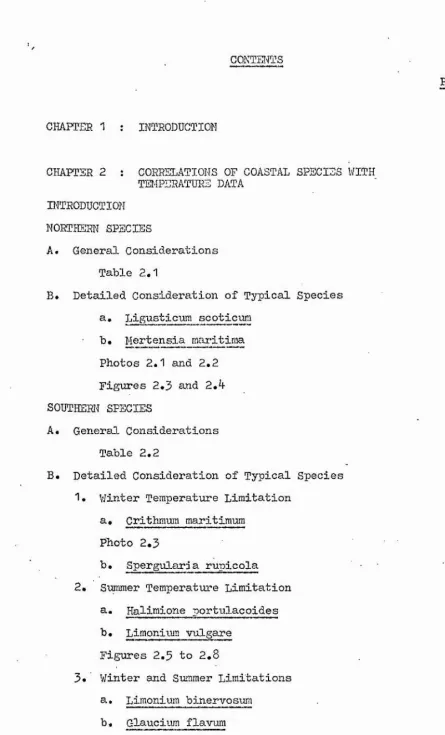
CONTENTS
Page
CHAPTER 1 INTRODUCTION
CHAPTER 2 : CORRELATIONS OF COASTAL SPECIES WITH TEMPERATURE DATA
INTRODUCTION NORTHERN SPECIES
[image:11.612.45.491.45.781.2]A. General Considerations Table 2.1
B* Detailed Consideration of Typical Species a. Ligusticum scoticum
b. Mertensia maritima Photos 2.1 and 2.2 Figures 2.3 and 2.4 SOUTHERN SPECIES
A. General Considerations Table 2.2
B. Detailed Consideration of Typical Species 1. Winter Temperature Limitation
a. Crithmum maritimum Photo 2.3
b. Spergulari a rupicola 2. Summer Temperature Limitation
a. Halimione portulacoides b. Limonium vulgare
Figures 2.3 to 2.8
3. Winter and Summer Limitations a, Limonium binervosum
b. Glauciun flavum c. Inula crithmoides
Figures 2*9 to 2*11 CONCLUSION
Figures 2*1 and 2*2 (fold out)
Page 37 40 41
'■is
CHAPTER 3 : THE EFFECT OF TEMPERATURE ON SEED GERMINATION OF COASTAL SPECIES INTRODUCTION
Table 3.1 MATERIALS AND METHODS
1• Constant Temperature 2* Alternating Temperatures
3. Temperature and Light Interaction RESULTS AND DISCUSSION
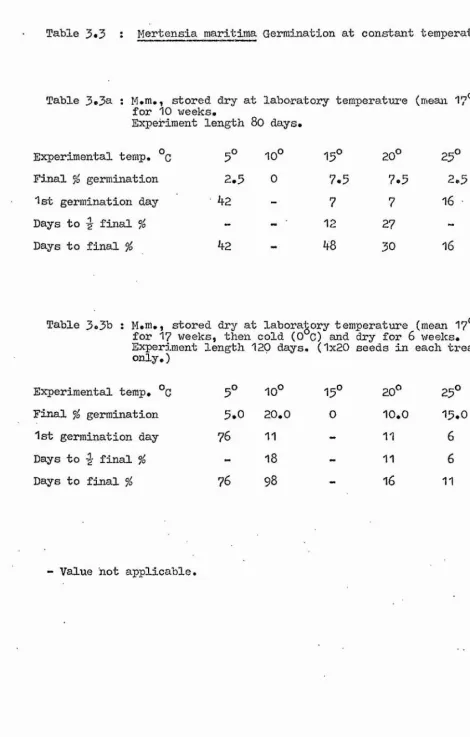
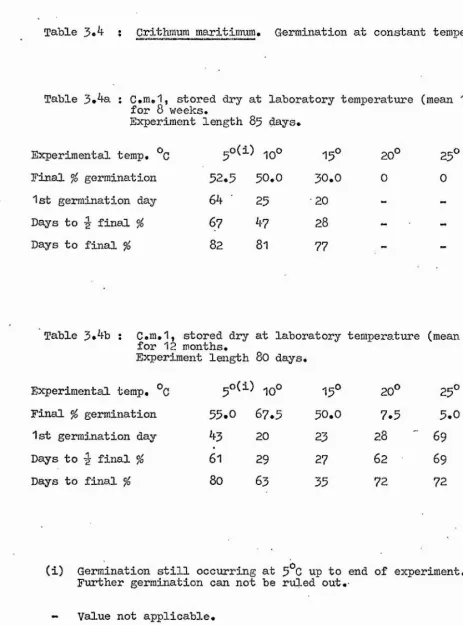
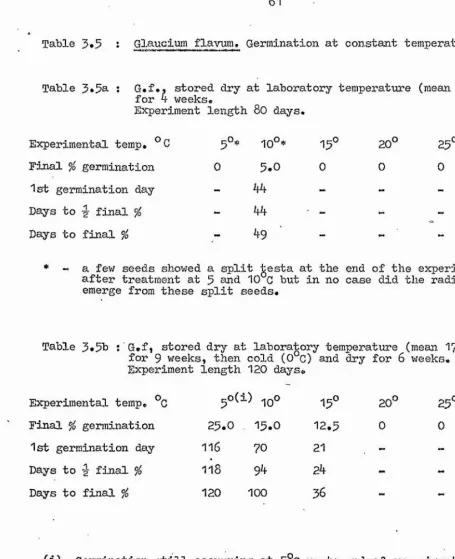
1. Constant Temperatures Tables 3.2
Figure 3.1 Table 3.3 Figure 3.2
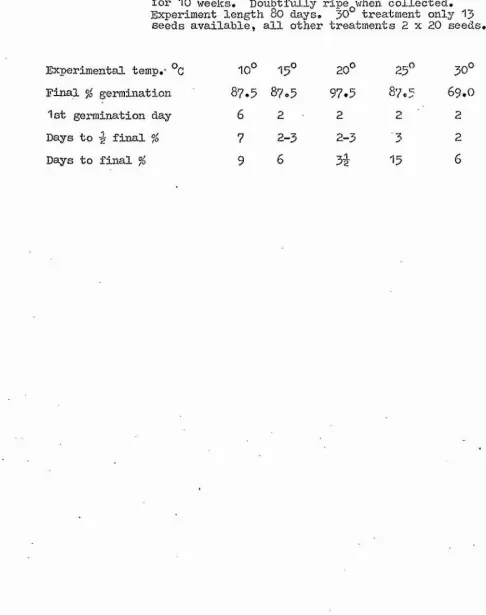
Tables 3.4 to 3.6 Figure 3.3
2* Alternating Temperatures
3. Temperature and Light Interaction Table 3.7
Figure 3.4 Table 3.8 CONCLUSIONS
43 43 46 4? 48 48 48 30 50 54 57 58 59
60
63 64
66
68
70 71 72
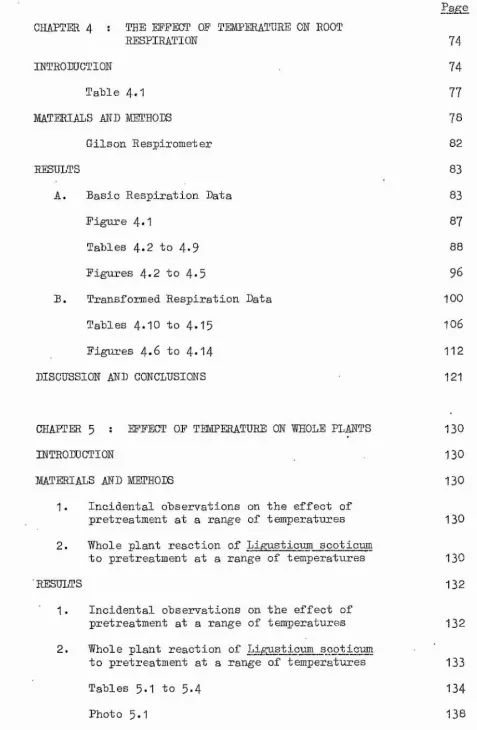
Cl-IAPTER 4 : THE EEFEGT OP TEMPERATURE ON ROOT RESPIRATION
INTRODUCTION
Table 4*1 MATERIALS AND METHODS
Gilson Respirometer RESULTS
A. Basic Respiration Data Pignre 4*1
Tables 4*2 to 4*9 Figures 4*2 to 4*5
B* Transformed Respiration Data Tables 4*10 to 4*15
Figures 4*^ to 4*14 DISCUSSION AND CONCLUSIONS
CHAPTER 5 : EFFECT OF TEMPERATURE ON WHOLE PLANTS INTRODUCTION
MATERIALS AND METHODS
1. Incidental observations on the effect of pretreatment at a range of temperatures 2. Whole plant reaction of Ligusticum scoticum
to pretreatment at a range of temperatures RESULTS
' 1.
2.
Incidental observations on the effect of pretreatment at a range of temperatures Whole plant reaction of Ligusticum scoticum
to pretreatment at a range of temperatures Tables 5*1 to 5*4
Photo 5*1
DISCUSSION AND CONCLUSIONS
fage 74 74 77 78 82 83 83 87 88 96 100 106 112 121 130 130 130 130 130 132 132 133 134 138 139 (vii)
[image:13.612.50.528.54.785.2]' " \ rj 'f y. '/
-CHAPTER 6 EFFECT OF TEMPERATURE ON CARBOHYDRATE CONTENT OF ROOTS
INTRODUCTION TÆBTH0D6
1. Starch estimation
2. Total soluble sugar estimation Anthrone Reagent
3. Characterisation and determination of sugars by gas liquid chromatography
RESULTS
1. Starch
Tables 6.1 to 6.3 2. Total soluble sug'ars
3. Starch and sugars considered together Tables 6.4 to 6,9
4» Sugar characterisation and determination Table 6.9
DISCUSSION AND CONCLUSIONS
CHAPTER 7 : SUMMARY AND CONCLUSIONS
APPENDIX 1
REFERENCES ADDENDA
141
141
143 143 144
144
145
146
146
147
149 149 152 156
157
158
160
171
172
176
1
CHAPTER 1 - INTRODUCTION
There have been many different approaches made to the study of distribution of plants in relation to temperature. For example, from observations on Scandinavian alpine and arctic species, Dahl (1951) pointed out correlations between their southern limits and isotherms for maximum summer temperatures. Similarly, Seddon (1971) pointed out a number of close correlations between summer and winter mean isotherms and plant distributions in Britain. These conclusions were drawn from observation of relevant distribution maps and corresponding overlays (ed. Perring and Walters, 1976). These studies demonstrate a connection between distribution and temperature, but the relationship is not
explained except as a probable function of length of growing season in day degrees.
The limitations of temperature on the distribution of a plant species may act at any stage in the life cycle of the plant. The constraint can be on seed germination, seedling establishment, or on the mature plant, and may occur in either summer or winter. If temperature acts directly on the plant, then the effects will possibly be noticeable in the short term, over say, two or three years. If temperature is affecting such processes as flowering and seed set, then the effect may only be noticeable over a longer period of, say, 10 to 15 years. The actual time over which the temperature constraint is apparent will depend on the longevity of the plant and on variations in climate from year to year. Several of the above factors are considered in more detail below.
Various studies on seed germination have shown the many ways in which seed of different species responds to temperature. Optimum germination requirements vary widely and depend on a .combination of the storage
temperature and the germination temperature, and whether these are constant or fluctuating. Light may also interact with temperature and the resulting total germination characteristics are unique for each species or ecotype. Examples of work of this kind on a wide variety of species are to be found
-9^
1 - Nomenclature throughout is from Claphara, Tutin and Warburg (19Ô2) 2
in papers by Thompson (1973i1974a,19?4b,19?4c), Probert and Thompson (1976) and Simon et al (1976) in addition to the many examples cited by Mayer and Poljakoff-Mayber (1975)*
Work on temperature sensitivity of seedlings has often been included with a study of mature plants. However, seedlings may be more sensitive to adverse temperature conditions than adult plants as stated by Okusanya (1976) for Crithmum maritimum L . a n d they may also be more sensitive to such non-temperature related pressures as grazing or trampling than adult plant,s.
The survival of any particular mature plant must depend ultimately on the maintenance of a positive carbohydrate balance, though this is in addition to its ability to survive such ecological pressures as shading, extreme oligotrophy or eutrophy, and competion from other species. The combination of these pressures with sub-optimal or limiting temperatures, whatever the temperature effect, will ultimately determine whether or not
the plant will survive in any one place and will thus contribute to the 4 determination of its overall distribution.
In Britain, Stewart and. Bannister (1974) have shown that three species of Vaccinium have different responses to temperature which can be linked with their distributions in Britain., These three, V.myrtillus L.,
V.vitis-idaea L. and V.uliginosum L. show progressively more northern '> distributions, in that order, and measured dark respiration rates are highest 4 in the most northerly species, V.uliginosum. This is in accordance with
the observations of many authors, reviewed by Billings and Mooney (I968), that arctic and alpine species tend to have higher intrinsic rates of
•respiration than temperate or lov/land species. Stewart and Bannister (1973) also studied the carbohydrate status throughout the year, particularly for * V.uliginosum, and found a characteristic yearly cycle of rising and falling
r-3
changes in temperature and light intensity, and in conjunction with data in the 1974 paper, the different parts played by photosynthesis and respiration in winter were calculated.
Work in the U.S.A. has shown variations in carbohydrate status in relation to growth and respiration rate for various alpine plants from different altitudes and latitudes (Mooney and Billings, I960,1961,1965; Mooney, I963). Temperature was suggested as the limiting factor here, though it v/as only treated as a function of altitude in some instances.
More recently Higgins and Sporaer (1976) have demonstrated that soil temperature is more important than air temperature in the effect it has on long term survival of plants. Here, the temperature of the roots was related directly to the respiration rate and survival potential of the plants.
Wager (1941) also studied respiration and carbon assimilation in
relation to temperature for a range of arctic species and again confirmed j that those of most northerly distribution tended to have high intrinsic
rates of respiration especially when compared with species of temperate distribution. These data were also compared with those from other authors for a variety of species including crop plants.
Most of the work so far discussed has been concerned with wild plants of arctic or alpine origin from various parts of the world. The arctic species are limited in their distribution almost exclusively by latitude and related temperature, and they thus have a reasonably continuous habitat where there is land. Though the relationship between altitude and
temperature is reasonably simple, the limitations to the study of distrib ution of alpine plants are greater than those for arctic ones because the disjunct habitat may prevent a species from occupying its full potential range.
has been restricted to plants with coastal habitats so that discontinuity of habitat will not seriously limit distribution; even though the coast
In order to avoid at least some of these problems, the present study 1
has variety such as cliff, shingle, dune and salt-marsh habitats* In addition both the altitudinal range, and annual and diurna.l temperature fluctuations of the coast are relatively limited when compared with inland sites.
Consequently it was decided to initiate the present investigation on temperature limitations on distribution of selected coastal species found in Britain. To facilitate the choice of suitable species for
study, and to enable comparisons to be made, a list of coastal species 4 with limited distributions in Britain was made from the 'Atlas of the
British Flora' (ed, Perring and Walters, 1976) together with their habitats, distribution limits in Britain and the rest of the world, and corresponding apparently limiting isotherms in Britain. This information is given and considered further in Chapter 2.
I Two of these apparently temperature limited coastal plants were chosen 4 4 initially for study; one northern, Ligusticimi scoticum L., Scots Lovage;
and one southern, Crithmum maritimum L., Rock Samphire. Both are members of the Urabelliferae and are found in similar habitats on rocky shores and cliffs. These tv/o species were treated the most thoroughly in the
experimental work. 3
Subsequently a further northern species, Mertensia maritima(L) S.F.Gray, Oyster plant, and a further southern species, Limonium binervosum (G.E.Sni) C.E. Salmon, Rock Sea-lavender, were added to the study for comparison but 4 these were not treated so thoroughly. Some limited experiments were also J carried out on Glaucium flavum Cranz, Yellow Horned-poppy, another southern plant. Material both as seed and mature plants was limiting to some ^ extent for all five species, but in particular there were shortages of seed for Mertensia^ and Limonium and of plants for Glaucium.
A brief ecological description of these five species is also given in Chapter 2 together with those for several other coastal species for
5
comparison. The distribution of each plant is compared with temperature data and any apparent correlations between the two are noted.
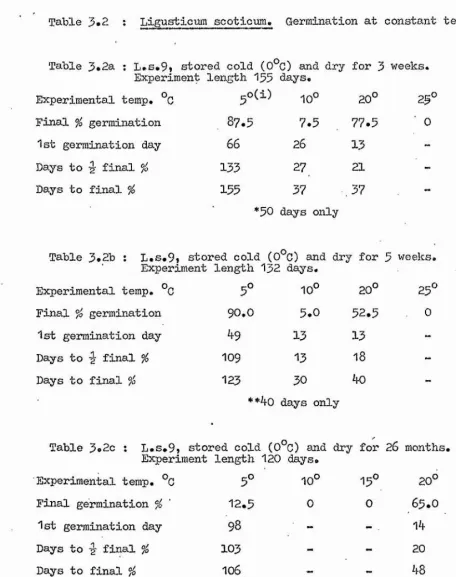
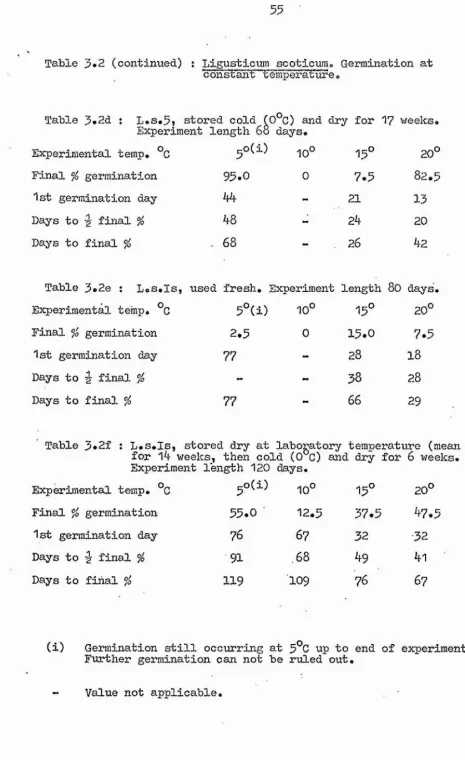
Some of the possible stages in the life cycle of the plants at which temperature may be restricting the distribution were then investigated. One such stage is seed germination, and Chapter 3 comprises an accoimt of the effect of a range of experimental temperature regimes on this. All species were tested under constant temperature conditions, and some
additional alternating day and night temperature experiments were carried out on Ligusticum and Crithmum.
The main part of the work is concerned with the longest stage in the life cycle of these species; as mature plants. The effect of temperature on the roots of such plants was investigated when the plants were in their winter condition. Chapter 4 deals with the way in which the respiration rate of the plants responded to a range of experimental temperatures after each of a variety of different temperature pretreatments. Root
respiration rates are particularly important to a plant in its winter condition since there are few or no leaves to replenish carbohydrate
reserves by photosynthesis, and even where leaves are present, light levels may not be adequate for a net gain of cai"bohydra.te. Thus loss of stored carbohydrate by winter respiration is very important to the plant and may become critical if the temperature rises, leading to a higher rate of respiration and faster loss of reserves.
6
CHAPTER 2
CORRELATION OF DISTRIBUTIONS OF COASTAL SPECIES WITH TEMPERATURE DATA
INTRODUCTION
The correlations between distribution and temperature for certain British species pointed out by Seddon (1971) and based largely on the distribution maps and isotherm overlays of. the 'Atlas of the British Flora' (ed. Perring and Walters, 1976) were mentioned in Chapter 1. In this chapter, data have been extracted from the 'Atlas' for exclusively coastal British species which show northern and southern distribution limits, and these have .been tabulated together with additional relevant information and world wide distribution where available; introduced, doubtfully native and very rare species have been omitted. This selection has resulted in a list of 43 species, of which, in Britain, 7 are northern (with a southern limit to their distribution) (Table 2.1) and 36 are southern (with a northern limit to their distribution), (Table 2.2).
Of the species listed in the Tables several were chosen for more detailed description as examples of the various categories of apparent temperature limitations on distribution, and all the five species studied in more detail in work of later chapters are included. The survey made in this chapter confirmed the validity of the prior selection of Ligusticum scoticum and Crithmum maritimum as good examples of northern and southern coastal species for investigation, and resulted in the later inclusion in the study of Mertensia maritima (northern), and Limonium binervosum and Glaucium flavum (both southern)•
The species included in the Tables were selected by consideration of the distribution maps, and each distribution was subsequently compared with the isotherm overlays from the 'Atlas' showing the mean January and July
temperatures and the mean February minimum temperature. The isotherms 4 used in the preparation of the overlays in the 'Atlas' were however prepared
j
■
7
from Meteorological Office data for the years 1901-1930 (Meteorological Office, 1932) whereas the distributions on the maps are divided into pre-and post-1930 records. The latter have most relevance to present day distributions so the temperature data of the 'Atlas' are not strictly
applicable to the mapped distributions. Temperature data are however if available from records of individual meteorological recording stations
for the years 1931-1960 (Meteorological Office, I963) and the records for 4
coastal stations have been used in the present study to malœ valid 4
comparisons with the earlier isotherms at the coast. The 1931-1960 average temperatures for the coastal stations have been added to the isotherm maps, in Fig. 2.1 for January mean temperature, and in Fig. 2.2 for July mean temperature. Both these Figures fold out at the end of this chapter (after page 40 ). These maps show that the change in mean January temperature from the 1901-1930 to 1931-1960 periods has been a
decrease of one or two degrees Fahrenheit^ round the entire British coast with least change in western Scotland. A similar comparison of the July mean temperatures shows that the south and west coasts of Britain have, in the main, similar temperatures over the two periods while those on the east coast, from the Thames estuary to eastern Scotland, are consistently one or two degrees Fahrenheit higher in the 1931-1960 period. That temperature changes of this magnitude could be relevant to the present study is shown, for example, by Firbas and Losert (1949) who found that a 1^0 temperature decrease resulted in a 100 to 200m reduction in the level
of the tree line, and by Lamb (I967) who pointed out that the limit for 4 growth of vines moved 280 miles south for a 1®C temperature drop.
In considering the influence of changes in seasonal temperature on distribution over a period of years it would be expected that changes which resulted in the loss of a species from an area would be more obvious than those which created a potentially extended range for a species since the colonisation of new areas by a plant is usually a much slower process than
the loss of plants. Some changes in distribution between'the periods I90I-I930 and I93I-I960 resulting from the coastal temperature changes discussed above are given in the detailed information on typical northern and southern species later in this chapter.
The following two sections, which cover northern and southern species respectively and include the relevant Tables and detailed descriptions referred to above, aim to correlate distribution and temperature for individual species in Britain. It has only been possible to attempt correlation between temperature and distribution for the European or world range of species in a few cases, partly throu^ sliortage of comparably detailed temperature data, and partly due to non-comparable methods for mapping of distribution used by different authors.
The sources used for compilation of the Tables are as follows: ed. Perring and Walters, 1976 - all species.
Clapham, Tutin & Warburg, 1962 - all species.
ed. Tutin, 1964, I968, 1972, 1976 - not monocotyledons. Fitter, 197& ~ not grasses, sedges etc.
Hulten, 1958 - various species. Huiten, 1961 - monocotyledons. Hulten, 1970 - dicotyledons. Hulten, 1971 - various species.
NORTHERN SPECIES
A. General Considerations
The 7 'northern* species listed in Table 2.1 are those which, from data given in the 'Atlas of the British Flora' (ed. Perring and Walters, 1976) appear to have a southern limit to their distribution in Britain.
Of the northern species considered in the Table all except
Elymus arenarius (see below) have the southern limit of their British distribution well defined by one of the July mean temperature isotherms. Ligusticum scoticum, for example, grows only where the July mean
temperature is 59°F (15*0^0)^ or less. Similarly, Mertensia maritima and Blysmus rufus are both limited by the 6o°F (15«5°C) July mean in Britain.
Elymus arenarius does not appear to be a strictly northern species in Britain, though it does decrease markedly in frequency in the south of England. It has been widely planted as a sand binder and was once
protected by law in both Scotland and England (Arber, 1934, p.339)* It is clearly a northern species when its whole European distribution is considered, only extending south as far as the Cherbourg peninsula of
northern France and continuing to 71^N in northern Scandinavia, (Bond, 1932) In France, the southern limit of this distribution correlates with a
January mean of 6^0 (42.8^F) and a July mean of 17^0 (62,6*^F) (temperature data from WalLen, 1970).
A more detailed description follows of Ligusticum scoticum and Mertensia maritima, both of which have distributions of the typically northern type in Britain. Both species are included in the studies of the present project described in later chapters.
<M
I
W<DI
•H OI
CQ ♦H SI
cS 'O' OII
<DIi
"g k ^m «*o Ü CO CO hsEH w *d ca 0
1
I
ra .ai
oo§
*cs
s
I to
11
p *H
.a go*p
a
W IQ0 •Pi to
• *d s
*C5 (7n
IS
0Ii
*p•||S
S .1d P 53 S
I
BI
•HI
10I
oP4 w 'd!l
A ■d '33 flil
O 0U Pn
ii
^ §'d MP 0 to
•P
Pi .* m 0 "H *doo nj 0 CO 0 o Ü d
fell
CO (-3 M H <44Ü pi Ü H Pa coÜ
1
S ^ S P ' ? 0 'd 0 g * ^ ra ‘d
< o ^
•d doo cO
Ü S 0
1 O’^ I S p a h)p o
•H ■
ll
§
I
§
oà •
CO <D
5c
k *• 0 <
%!:
0 K \ p S Pj p•H [tj 44 •<
P w ** 0 ri*d
too , P c3 ro p Ü p»dP H
I
PII
II
K\ SiK^ (j m {Xi OLTv O
I
COI
*dI
'd P to;l
vH O to '"3, 1I m 3 •H # 10
S'’%'.•P
•o
"d o. dg K\*H ^
P < ^ d U
A
<oi
p hj< Ü
I
1
ÜI
m0*8
aI
I
(Q 0 -g&
d J § §•
itil
•H f4 ’HoJS bo 0 rH
3
S?|
H d a w 0 - 0d d
0 d d O d d
n
i
• fx, 0 Ch 0 OJ a t!5 d _ 0
^5.S||?- «H d H
d • rl Â
I
%
■s
e< o f>5
f l ' â a
-HO ^ d A(0<- 0-0 0 0<- ^ U.O O O *H»H P H B OtO
I
VO
11
"3'3d 0 .'i
• d T § r- CT\ bO
o œ piH a S.-e S
-p S d ^ 0 bO to 0
5.9^ 0 h d
•p 0 p •H d H O H
P 0 < 0 d P
1 1 1 1 1
a «
# d P o d
T— OJ
12
B• Detailed Consideration of Typical Species
a. Ligusticum scoticum L» (Haloscias scoticus(L«)Fr>), Family Umbelliferae, Scottish Lovage*
;.'Î
.4
This plant, shown in photo 2.1, has bright green, biternate shiny leaves the petioles of which ai’e often tinged dark red. The flowers of the compound umbels are usually white but may be pink, and are found from July to September in Scotland. The single seeded fruits are ripe by October or November and the plant dies back to ground level for
overwintering. Growth recommences in late March or early April, as soon as there is a period of warm v/eather. The perennial rootstock is stout and long and the whole plant has a characteristic taste and smell when crushed. The leaves were formerly used as a vegetable or pot herb. In common with other perennial cliff plants Ligusticum is sensitive to grazing (Goldsmith, 1975)*
L*scoticum is usually a plant of cliffs and rocky shores in the north of Britain, though it is occasionally found on shingle and sandy beaches and in such man made habitats as harbour walls etc. It is exclusively maritime throughout its range with the exception of Green land where it is also found "in heath vegetation some distance from the sea", (Bocher et al, 1968).
In Britain L.scoticum is found northwards from Kirkudbright and Wigtownshire on the west coast and from Northumberland on the east
coast. It is also found in north and west Ireland, and throughout %
Britain the southern limit of the distribution (Fig 2.3) shows a close correlation with the 38° or 39°F (14,4°C or 15*0^0) isotherms of July temperature for I90I to 1930, (Fig* 2.2 after page 40 )•
The apparent slight retreat of the species northwards in Northumber land since 1930 shov/n in Fig 2.3 may be attributable to the increase in mean summer temperature on this part of the coast from 1901/1930 to
1931/1960 discussed on page 7 . I n Fife where the.species is near to the present southern limit in Britain, those plants which are found on northern and eastern facing parts of the shore appear to grow larger and to be generally more robust than those growing on shores with a
southerly aspect.
13
I Europe l.scoticum is found northwards from Denmark to the Arctic circle though there are only 2 recorded stations on the Baltic, (ed Tutin et al, 1968)0 Overall it has a cireunipolar distribution, being found in Iceland, Greenland, and North America, with a subspecies
Loscoticum ssp. hulteni in Alaska and Siberia, (Huiten, 1938, map 276). | Loscoticum is naturalised in New Zealand.
The distribution in Europe also shows reasonable correlation with the 15^0 July mean temperature isotherm as mapped by Fitter (197&) (based on Wallen, 1970) for north and west Europe. The sm3.ll scale of the map however makes accurate correlation difficult.
b. Mertensia maritima(L»)S.F* Gray; family Boraginaceae. Oyster Plant, Sea Lungi'fort, Northern Bhorewort.
This is a trailing plant (photo 2.2) with grey-green fleshy oval shaped leaves v/hich have a salty fishy taste not unlike that of oysters. The pink or blue flowers are found from May to August and the resulting
seeds are contained in black inflated nutlets. The black rootstock produces numerous new shoots each year which die back in late autumn to below ground level, and start to g70w again in March or April (Scott, 1963a). The plant is able to tolerate being buried since it readily produces new shoots from its numerous underground buds.
Though usually found growing on shingle above the drift line; M.mantima is also occasionally found in sandy habitats. The distribu
tion in Britain formerly extended from Anglesey and Norfolk northwards,
and this v/as closely correlated with the 60^f (13*3^0) July mean | isotherm for I90I to 1930. However, the present distribution is much
reduced and it now only extends as far south as Lancashire and Aberdeen
shire, as shown in Fig 2.4. This reduced distribution can be directly | attributed to the shift to higher summer temperatures from 1931 to I96O,
14
similar to that of Ligusticum scoticumo In Em*ope it is found on the
coasts of Denmark, Norway and NW Russia though it is absent from the . | Baltic, (ed Tutin, 1972), and extends to Spitsbergen, Iceland, Green
land and North America* In NE Asia M.maritime is replaced by
M.m.ssp asiatica though there is some doubt as to whether this should be a subspecies or a separate species (Huiten, 1938, map 273)« In
Alaska and Greenland M.maritime seems to be advancing northwards, very 1
slowly, as the polar ice cap retreats and,- as in Britain, it has become extinct in places in Europe and probably also in America and Asia, at the southern limits of its distribution (Scott, 1963a).
15
Photo 2.1; Ligusticum scoticum, a typical large plant at Portsoy, Banffshire, July 1976.
16
306/1
LIGUSTICUM SCO TICUM L.
Lovas* • 1930 onwards o Before 1930
ÎTG. 2.3î Distribution of ligusticum scoticum in Britain.
permission of the Botanical Society of the
British Isles, taken from their 'Atlas of the British Flora', and updated by the Biological Records Centre, Institute of Terrestrial Ecology, Monks Wood
17
MERTENSIA MARITIMA ’ f
(L.) Gray Oystar Plant «1930 onwards o Before 1930
FIG. 2.4: Distribution of Mertensia maritima, in Britain.
By permission of the Botanical Society of the British Isles, taken from their ’Atlas of the British Flora’, and updated by the Biological Records Centre, Institute of Terrestrial Ecology, Monks Wood Experimental Station, Huntingdon.
•1
[image:31.612.55.484.37.780.2]18
' '
;
1
SOUTHERN SPECIES
A* General Considerations
The 36 ’southerrf species listed in Table 2.2 are those which have a northern limit to their distribution in Britain as indicated by the maps of the ’Atlas of the British Flora* (ed* Perring and Walters, 1976).
There appear to be two clear groupings which can be made of the southern species on the basis of their British temperature limitations* The first category includes those species with a winter (January or February) temperature limitation, and the second, those with a summer temperature (July) limitation* Species with dual summer/winter temp erature limitations and those with no cléar temperature effect have been included in a third category*
The most extreme examples of plants which have a winter temperature limitation are those such as Lavatera arborea which will not tolerate frost (Okusanya, 1976). Others such as Crithmum maritimum,
Calystegia soldanella and Eryngium maritimum all show restriction by winter temperature though it is not certainly knoim whether frost is damaging to these plants to the extent of limiting their distribution, though Malloch (1970) did find that seedlings of Crithmum mailtimum were killed by frost which left older plants unaffected*
The second type of distribution seems to depend on summer temperatures, expressed here as July means, exceeding a certain critical level*
Beta vulgaris ssp maritima, Halimione portulacoides, Limonium vulgare and Agropyron pungens all belong to this group and have limiting July mean temperature isotherms between 57°F (13*9°C) and 59°F (15*0^C), though the mechanism acting to restrict the plants is not clear for any one* A parallel might be drawn here with the temperature limita tion on seed set in Cirsium acaulon in Derbyshire where it is at the northern limit of its range (Pigott, 1968)*
The third grouping includes those plants which can only be
19
Pucciellia rupestris have no well defined temperature limits, while
possible dual limitation by January and Ju3.y mean temperatures is exhibited by limonium binervosum (discussed below) and
Euphorbia portlandica. Here there is a similarity with the observa tions of Iverson (1944) on the dual temperature limitations on
Ilex aquifolium,,Hedera helix, and Viscum album, and the good correlation between fossil finds of these plants and the projected contemporary climate for the relevant regions.
Two species from each of the first two categories, and tliree of the third group are considered below in detail as examples. The southern species, Crithmum maritimum, Limonium binervosum and
IQ
!
!
I
toII
I
o rvi« (MI
IQ <DI
i
I
(Q <D■dI
I
I
I
I
<D8
o * "o'A';
%
* 5I
o'S
-^j- oS'
Sh h)ê
1
CQ Pcrf 0)P?p P
•H CQ
Pg •
M •ÀCQ CQ 0)
00 d p q*ri «•o
!
s
Is
I
I
I
'ZS o
I
*HS
• «II
.p M Si uII
pj Ü cog.lOv,Dg
h) <D
8
§ cr*-P 0_ (4 (D
O * K\ o
T) Pi K\nd Q)d o d> to
to d pR s * H
h ’^ ^ h ^ •
VO
20
(Q
s
J
'O nds
to 'XS
IS-
8
'^.g
P
^\S\ (Q TO pR^
&
oaa
I
•rsI
H oy CQI
I
8
!|
O *H •H -P1-5
>
ào‘^ 1
§ • p Û)
pti
o tQ *...- <2):5 o d to^*Z3 Hr\ 0)• % to T'o ' ë
o ON o d ïi'^'dgFh^jOSî
J
CQ «»
^ H
§|.
^ gs
«o“
•H to 'O p'dS
nj *0
&
ë
I
H (HOI
'O oo CQa
O * mF:
pi h)fl
l'iB
ÎK-•ri k d ^d ro
m " o
° S 1 I P C O (0 fO
[Q K\H O
Q P ^ S Ho < CQ
I y
I
.3 § ü VO§
(H"§O nj A §
. m
I-•H CQ
«H • ° -S
" ■ d o *
CQ H o j q
^
"S's! ®
••H • h^
u*» <u o
*.dvo
k (0
&%&
li|l
P -d *
» cO •
CQ d Ho CQ
CQ
I
i-"H q
5”
■ d s
21 "8
i
.5I
I
a
i
!
I
WI
gg
5
P
IQ 1q
'ë
II
o ^
'd
I
ü oj OJi
(Q 0)I
I
n
(QI
"B"
s
o p • oil
l^KO P , ‘ri Ch •'Xio rH ü)
« g
-'^1
|r|
(Hi ON d0 K\H S 55
{
I
g|
■O P CQ A CQ v~ ë CQ] G G d *Hü H G d A •H CQ d 1 tuV h T-OJy
.
I
^
o • <0uoI
«H Ho o 5: P (H G O ü(U
ü)’^ i ^Fr.,l§
-d - O
HHO»
I
8
1
i
I
!
i
s
ë o CQI
|l
•S CQ §
i-a s
IfN^
• o Tj P Û) *dII
ü N
oîJ «rî
. CQ (Q:
d Ho 'H I d sT P
PO d w
0) H
!: I
G •• 0) £QO P W P ON»r) •tû tA 'G î>
G G • % Hos pq
CQ
I
h O P
H oy CQ (Q •G
I
"G q *ON rQ lA Pi1
R
"rd
l'iT'l
is-i
O H H D AI
1
I
I.
Il
C Q MG H
î
i
i
IQVD Oë"g g
^ H
3
g'^ag'^i
.
isii
A h) C Q OI
g “o§R
o g G Ho P «» GcJo
f^o
dr~l f Û)
OO ü
l-i
A ^0 Prii|gg-|g
il
p -gK
h
§@
•H *
II
| c Q CQwI
i
IQ ♦HI
Pii
•So
M31
I
CQ CQ OOyg
O Ho p GO P -d" 3 ' ^ ®i
A t-o ê(Q G ë G CM
I
I
A acS • CQ
G G
CQ d t A •
bO
X dG A ü
CQ CQ <i-i
G o d CQP •riü
0 CQ P,
P d «H
_ o < (Q O
G a G
H Pd IQ G •Hl>
»• o s i
- G diP «H
H
S ë
<H
°
po
H p ÎA G G
H H [i4 «» r. o IQ
G «O P fco
.g|5 ®.g | % S dPi G-d" d G
k Pi Pi G
^ H Ho P=i W
I
gt
O PqI
i
I
■g dI
ë
* G
q SoO
• g
3 gHo A
tQ
&
G do P. . g H ITv d p HA dh
S !
I ool
lëSi
>4 d lACQ CQ ü Ho CQ22 * G
I
Ï
A O P «O ü o 'H P G d À d PHG «aî Pi H ta
d • G
^o. to
9
giRa.g
CQ A A
23
p *» tQ fA
G d
gpi_ o
g'"G G
P
G *> G CQ 'HO ë 5 M G
P G G G
îs; A
l,
MiaI x 3 | CQ **P|cop GO CQVO
4
Gh
!d •• oCOO p d
T-Ui
fcl
G OO 01
H G * Po
P(0 HCO G
^lAH
i!i
p LA POO CA CQ• r . 8 %) ü
|sl
wtAA•H P :s G <
1
ë
g Ai
I
« I•ri
II
a d
G
II
82
d CQ«Sll
* A oCQ^ ü ^ P •* ü G G ir\W< G
XCAo o A p
Pi CQ
- 0
COO ü
2 5 §
•H J4 O d ü p
I®
d d
G Sî CO O W G a EH CQ
-I
■?I
f
1
ü OJ OJi
ë
♦1hî
ta •gI
G O G 1q .gë
Pi «H ^ O 8 o M P W
ë
I
:
I
a
GI
G Gâ
AI
I
<\J Rri
i
?
GI
G G CQ A!
AI
CM V A G5
I
G1
lAS
V CA Pi G G r4 P&0 d .d :3 •H rd A(Q fco•H G A •H d (H dGPi S
üi
o G dbO G î>"nd o Pi d A A CQ d CQ
i
gi
â
^ GS GS A
i ^ X
Hi
2 e ®23 IQ G 'ë a
'!
1
AI
.
GO A O ® bpvO dR A
oÿ w
CQ G
A Â ad _ tS •*G
WOO
° r p k
PGO Î4
COfM A
d-M-
O • A A a
g
I
a
P
8 3CQ *^.r1 G «-G
i?
l'^’Sd «» G
o >
G
1
CQI
& G GIt
f
CQI
1
D] * >» -O CQ ON •IB
I j-S (S ®3S.a s ° 8d • ' p S
.g8r\ (ü 3'^â.gG •"•ri
Rll
P ONCQ d 0 ^
a G CQ A
!
I
O GCO CQ
GU\ d A . i
-83'^' a'""ëo
OO CQ
.gtR-ë
O •" % . 3
O P CQ G
1
*G d
g.s
t o ‘d d G A G tSJ A
CQ U
^ P
P-J
04 •*CQ d GSI
^gdpb |
1
GCO o o ^ < .OWM
o * d GK|!|
!1P
u * " p (Q O
%
S ON O îA dA GA a O
ië|
G G AI
M.S
G
S I
A < H a oW G
• d
COO ro
#1
CQ • PiH^3 gO G P
P *H f G
po G
3 ^ 0CQ p c iP
§ •* G OO ü
S
^ G â
'vi
P .
ë §
s s
1
rjë
II
O ^•• GG d v~ d CQ •H G P •H d Ü O G ü a CQ (\i # OJ G A A d EH
I
I
I
PiCQ CQ
il
i
AI
I
g ai
f
I
3
a
I
VOr- v~ OJ
\LA lA \CA
OJ VO VO
rA CA CA
O A
TO G♦
r» A CQ bo
M d G
0 * 3 d
O r dU d
CQ CQ
G G G
d G d
d CQ d «
•H G G
.CQ A r~i
«H A •» CiO
ë ë 1-3
A P d A
ü CQ CQ G
il
R •
g " i
d o
•H H
U
•H A
ë
I
CQ 2 31
I
s
T-lAi
ë
I
ë
CQ G ëa
C\JI
Zh
1
1
O (\J# OJI
w0 •ëi
1
•H .AI
'ü:
Ü 0)ll
«••cîII
f e
1^*
■o'’jq (Uâi
bî T5f K\ ^ (Dg K\C/].H
P O
Ü Ft) O <U rd &
Ü T) #
.„.;=}• g <y ra P ^ U O m
Î
Î
I
i
:
-fJ
•H
t-CQ s
O
s
♦H
Ü
(Ü
0
)
•H
A
(Q
to
•d
i
+5
g
O »%)
-P 4->‘H •'id (DO 'd «H H U"\ (D<
k >
g -P J 'pO o o
gSil
p fA ft) ■dî
nS o f-D ts; to
*3
I
If
!§
AI
toI
LAS
L*
o -P lAU
'PO u . gf^g* ■So'gS=0SH (o h):s AI
O COS|
:3
£
A-I
s I
y
li
4^i'-i
V CT\ P^rAHê
.3
A
s
ll
d •■ & 3
I
1
H <y •to ** •o d O LA‘ri
•H .
p
O ON ^ HfAH to h) S3
LQ
rl
'd'SP
I
I
M CÜ IQI
'Pfn
o1^1
(DOhlA *ritAI"
K
fA Î2; fp wI
i
'd0 , 0 A
<D S! ê «H O t ) CQ d •H (D
A • •P -P rd
( o ÿ +5
(Q +) nî
<D cS d f {
Qio <D Ü CQ
P 5 : fcoto (D
U
ob d oa •p• P * o OS d A S A
•H H 0)
H <D d o I
H A p A
ru d • S> •
-H rd A (Q 'p
Ü +> p d d
p ÿ fe ( £ ro
•aj w v~
25
I
I
I
5
I
I
!
5
.
d
I
OJ OJI
w 0)I
I
■è
I
(Q CD •dI
I
I
1
m <xsf3 y
I
I
'd Ü H o f o o ^o\ cq 0 «K\ rQ ^ • < EÔ WI
I
I
<d •3oKo •
0 »-D0 ** 1a a0 •« o
^
o K \H
O «-D :b:
IQ
I
1
I
I
I
1
f?o‘
O-a
A •do ^§"A
U K\H
«H >P
Î
i
Î
I
•rj H'So
l i
Is
V"CN
0 •
#
a
oy•n ^ OK'S # 4> 0
0 0\H or\. 1-3 «Î Hj 03
IQ
:
I
Î
s •H di|
l
5
CO' v£>T-CN
rH iSRg 03 ^IQ
I
1
I
I
i
CQ£ I
&
W W%
MDV CNI
OJ 0I
I
0
CÜ OJ|1
&
s ”
0 0 o^
•d 0§1
r*rH rO P4cc5 d
26
B» Detailed Considerations of Typical Species j 1* Winter Temperature Limitation
8.# Crithmum maritimum L.^ Family Umbelliferae> Rock Samphire* % The fleshy finger-like leaves of Critlimum are much divided and of
a bright green to grey-green colour* The plant produces its yellow green compound umbels from July to September and the somewhat corlcy single seeded fruits are ripe in late October or early November* Seed
set in Crithmum appears to be dependent on summer temperature conditions. Ï Okusanya (1976) found that viable seed was only obtained in North Wales
and Cumbria, near the limits of its range, after the particularly warm ?|
- i
summer of 1975, though further south (South Wales and SW Egland) viable S
seed was set in every year studied (1973 to 1973)* Many of the leaves of the plant die back for the winter leaving the long woody rootstock underground* The whole plant has a characteristic taste and smell and the leaves used to be made into a pickle with spices and vinegai’* Photo 2*3 shows the plant in November*
C»maritimum is found on cliffs and rocky shores in southern and western Britain, replacing Ligusticum scoticum in the south and over lapping with it in south and west Scotland* The distribution of
C# maritimum is shown in Fig* 2.5 and this can be compared with Fig 2*3 to show the complementary distribution of L* scoticum. Crithmum, however is absent from much of the east coast of Egland only reaching a few
isolated localities in Suffolk. It is found all round the Irish coast* This distribution in Britain coincides very closely with the 40^F (4.4°c) January mean isotherm and also with the mean February minimum isotherm of 35°F (1.7^C) but it is not clear which of these low temperatures is likely to have the most detrimental effect on the survival and distri bution of the plants* From the information given in Fig 2,5 it would appear that the distribution of c * maritimum has changed little betvæen the two periods, 1901/1930 and 1931/1960, but it should be noted that the greatest changes in winter temperatures between the two periods
(Fig. 2.1 and discussed on page 7 ) ere on the east coast, north of the limits for Crithmum.
'
27
photo 2*3: Crithmum maritimum on limestone cliffs,
'r
28
In Europe, Crithmum is found on the Atlantic coast from France southwards, and all around the Mediterranean sea, (ed. Tutin, I968)* b* Spergularia rupicola Lebel, family Caryophyllaceae, Cliff
Sand-spurrey.
This trailing perennial has a woody, stout rootstock and linear acute fleshy leaves. The flowers are pink and are found from June to September, and the small black seeds, contained in a capsule, become ripe by November. The plant seems to be easily propagated from seed since it *appeared♦ in the collected sample of Crithmum maritimum plants in the absence of any whole plant material.
In Britain, S. rupicola is found on walls, cliffs and rocks on the south and west coasts from Hampshire to the Outer Hebrides and around most of the Irish coast, as shovni in Fig. 2.6. The 40°F and 41^f (4,4°
and 5*0°C) January mean iemperature isotherms bound the limits of the distribution of the plant in Britain with a good degree of correlation, and summer temperature appears to play no part in this. Okusanya (1976) included this plant in hj.s study and suggested that frost intolerance v/as limiting its distribution.
In Europe, 8. rupicola is found from North France southwards to Spain and Portugal, (ed. Tutin, 1964).
2, Summer Temperature Limitation
a. Halimione portulacoides (L.) Aell., family Chenopodiaceae, Sea Purslane.
This small shrub has decumbent stems with ascending branches and mealy, variably shaped leaves. The.flowers malce up a dense compound inflorescence and are found from July to September. The fruit is ripe between September and November.
In Britain, H, portulacoides is found in the higher part of salt marshes from Northumberland and V/igotv/nshire southwards and around the
south and east coasts of Ireland. This distribution is shov/n in Fig 2,7
4
29
and the 58°F (14#4°C) July mean isotherm is found to he limiting with good correlation. Chapman (1950) suggested a limitation by 60°F (15*5°C) July temperature in Britain and by 60°F August temperature in Europe where the plant is found on all coasts south of Denmark and also on the Baltic sea. He also suggested that H. portulacoides is restricted to
areas where the average annual temperature is greater than 50°F (10.0°C). /
It is also found in North Africa, Asia Minor and South Africa, and has been introduced to North America,
bft Limonium vu].gare Mill*, family Plumbaginaceae, Sea Lavender.
The blue-purple flowers of this salt marsh plant are found from July to October on the large spreading inflorescence which arises on a single upright peduncle from the rosettes of elongate leaves. The plant is a perennial and has a deep tap root and branched woody stock.
The distribution of L. vulgare in Britain extends southwards from
Fife and Dumfries as shown in Fig. 2,8, and it has its limit between the i
59°F and 58°F (15.0°C and 14,4°C) July mean isotherms, Fig. 2.2 (page 42).
It is absent from Ireland, Boorman (196?) states that there is little evidence of damage by adverse winter weather in Britain but he points out that the plant has a narrow altitudinal range of Ira and suggests that this may limit the distribution, A further possibility is that L» vulgare has a minimum temperature for successful seed set in the summer, which may explain the lack of limitation by winter temperatures. The plant is sus ceptible to trampling and grazing and is intolerant of pollution and drought, however, L. vulgare was observed by Boorman (19&7) to be little affected by the severe winter of 1962/63,
30
%
• J
B 29S/1 C R ITH M U M M A R ITIM U M »
L
Rock Samphire 1930 onwards o Before 1930
:-iT
FIG. 2.3: Distribution of Crithmum maritimum in Britain.
permission of the Botanical Society of the British
31
i 3
B 143/3 SPERGULARIA
RUPICOLA L*b*l • 1930 onwards o Before 1930
FIG* 2.6; Distribution of Spergularia rupicola in
Britain. :
By permission of the Botanical Society of the British
Isles, taken from their *Atlas of the British Flora», and updated by the Biological Records Centre, Institute of Terrestrial Ecology, Monks Wood Experimental Station, Huntingdon.
f
32
I
B t 1S7/1 H A L IM IO N E P O R TU LA C . ♦
OIDES (L.) Aailen
Pur*l«n« » 1930 onwards o Before 1930
i
'i
FIG* 2*7: Distribution of Halimione portulacoides in Britain*
By permission of the Botanical Society of the British
B 365/t L IM O N IU M
VULGARE Mill. Sea Lavender • 1930 onwards o Before 1930
FIG. 2*8; Distribution of Limonium vulgare in
Britain. \
By permission of the Botanical Society of the British
Isles, taken from their 'Atlas of the British Flora', and updated by the Biological Records Centre, Institute of Terrestrial Ecology, Monks Wood Experimental Station, Huntingdon.