Wasakorn Laesanklang, Dario Landa-Silva and J. Arturo Castillo-Salazar
School of Computer Science, ASAP Research Group, The University of Nottingham, Nottingham, U.K.{psxwl3, dario.landasilva, psxjaca}@nottingham.ac.uk
Keywords: Workforce scheduling, Routing problem, Home care scheduling, Mixed integer programming, Problem
decomposition.
Abstract: We propose an approach based on mixed integer programming (MIP) with decomposition to solve a workforce
scheduling and routing problem, in which a set of workers should be assigned to tasks that are distributed across different geographical locations. This problem arises from a number of home care planning scenarios in the UK, faced by our industrial partner. We present a mixed integer programming model that incorporates important real-world features of the problem such as defined geographical regions and flexibility in the workers’ availability. Given the size of the real-world instances, we propose to decompose the problem based on geographical areas. We show that the quality of the overall solution is affected by the ordering in which the sub-problems are tackled. Hence, we investigate different ordering strategies to solve the sub-problems and show that such decomposition approach is a very promising technique to produce high-quality solutions in practical computational times using an exact optimization method.
1
INTRODUCTION
The workforce scheduling and routing problem (WSRP) is a difficult problem that arises in industries like home care, health care, patrol service, meter read-ing, etc. (Castillo-Salazar et al., 2014). One specific example of WSRP is home health care services where nurses or care workers should deliver care services at the patient’s home. Solving the problem involves producing a job schedule and a route for each worker while satisfying the business requirements and consid-ering workers qualifications and skills, task require-ments, travelling distances, etc. It is usually expected that the solution gives the lowest operational cost.
Developing automated solution methods to solve WSRP scenarios is a current research challenge as reflected by recent published research (Mankowska et al., 2014; Liu et al., 2014; Hart et al., 2014). Solv-ing an instance of WSRP often requires the expertise and knowledge of a human planner (Barrera et al., 2012). In this research, we are working with an in-dustrial partner who provides scheduling services for businesses and other organisations facing this type of problems. The data sets considered here come from real-world scenarios. A particular feature is that ‘work-ing areas’ or ‘regions’ are pre-defined and this affects the difficulty of the problem being tackled.
Tackling WSRP with exact optimization methods to produce solutions in practice is still a research chal-lenge. Since obtaining an optimal schedule is the ultimate goal, exact methods like mathematical pro-gramming are a suitable approach. However, proven optimality with exact methods has been shown mainly on problem instances of limited size (Borsani et al., 2006; Bredstrom and Ronnqvist, 2007). Problem in-stances faced in practice are larger and for solving them, heuristic methods are usually considered more efficient in terms of computation time (Akjiratikarl et al., 2007; Pillac et al., 2012). The motivation for our work is to develop a solution approach based on exact optimization to tackle real-world WSRP instances.
In this paper, we propose a decomposition ap-proach that uses mixed integer programming to tackle WSRP instances of practical size. The proposed method splits the problem into sub-problems according to defined geographical areas. Our computational ex-periments show that the approach allows to explore the trade-off between computation efficiency and solution quality. Moreover, the insights from our experiments suggest that success of decomposition varies accord-ing to the problem instance, which provides us with ideas for future research.
scheduling and routing are tackled within a decompo-sition approach, has an effect on the computational efficiency and achieved solution quality. Following this, some ordering strategies are proposed to achieve solutions of good quality, typically 16.36% of relative gap on average, in practical computation time.
Section 2 reviews related works in the literature and establishes the motivation for the research in this paper. Section 3 gives the problem definition and formulation for the WSRP considered here. Section 4 describes the proposed MIP with decomposition approach and the experimental study, including description of test data instances. The final section summarises the paper and outlines some of the proposed future work.
2
LITERATURE REVIEW
Solving integer programming formulations for larger problem instances still has its limitations in terms of computation time. Mathematical programming has been used in the literature to tackle some WSRP. Exam-ples include linear programming (Angelis, 1998), inte-ger programming (Kergosien et al., 2009) and mixed integer programming (Bredstrom and Ronnqvist, 2007; Dohn et al., 2009; Borsani et al., 2006; Rasmussen et al., 2012). Solving real-world size problems often resources to heuristic or hybrid algorithms (Bertels and Torsten, 2006; Akjiratikarl et al., 2007; Eveborn et al., 2009). There are some improved exact meth-ods, like branch and price (Bredstrom and Ronnqvist, 2007; Dohn et al., 2009; Rasmussen et al., 2012), that can deal with large instances. Branch and price re-quires problem reformulation which usually involves Dantzig-Wolfe decomposition to compute a tighter re-laxation bound (Vanderbeck, 2000; Feillet, 2010). The algorithm also requires two steps to repeatedly solve the problem in order to improve the solution.
Decomposition techniques are another good alter-native to apply exact optimization methods to large in-teger programming formulations. The basic idea here is to transform or split the problem into smaller sub-problems. This technique has been applied in various problem domains. For example, Benders’ decomposi-tion was used to produce soludecomposi-tions for large instances of the aircraft routing and crew scheduling problem (Cordeau et al., 2001; Mercier et al., 2005). Benders’ decomposition is suitable for problems with exclu-sive sub-problem sets or problems that shows some block structures linked by constraints (Benders, 1962). In another example (Perl and Daskin, 1985) split the warehouse location-routing problem into three smaller problems: the complete multi-depot vehicle-dispatch problem, the warehouse location-allocation problem
and the multi-depot routing-allocation problem. These three smaller problems were solved in phases and each of them was formulated with mathematical program-ming and solved by an exact solver. For detailed re-views of decomposition approaches see (Ralphs and Galati, 2010; Vanderbeck and Wolsey, 2010).
Decomposition techniques have also been applied within heuristic approaches using some form of clus-tering. For example, (Reimann et al., 2004) tackled a large vehicle routing problem by decomposing it into sub-problems. Each sub-problem was a cluster of customers assigned to a vehicle which then became a travelling salesman problem. The sub-problem size is controlled by splitting a large sub-problem to shrink the corresponding cluster. Similar ideas were applied in a hybrid heuristic for generating multi-carrier trans-portation plans (Landa-Silva et al., 2011).
The purpose of this paper is to propose a decompo-sition approach that uses mixed integer programming (MIP) to tackle workforce scheduling and routing prob-lem instances arising in real-world scenarios. For this, we also present an MIP formulation that incorporates features of the WSRP scenarios faced by our indus-trial partner. The proposed decomposition technique does not require some formulation structure like in Benders’ decomposition neither uses a heuristic solver. Our approach harness the power of exact optimization solvers while decomposing the problem instances in a way that is meaningful to practice.
3
PROBLEM DESCRIPTION AND
FORMULATION
The goal in WSRP is to assign each worker to under-take a set of tasks across a set of geographical loca-tions. A path is the series of tasks to be performed by a worker within the planning period. A good quality solution consists of a set of shortest paths represent-ing the task assignments for each worker at the lowest cost. The solution should also respect other conditions such as task pre-requisites, required travelling time be-tween locations, defined appointment times, workers’ skills, workers availability, restricted working regions, working time limits, etc.
Note that elements ofT are referred here as tasks but also each task has an associated location.
In practical scenarios like the ones considered here, the available workforce and its skills are often not sufficient to cover all the tasks that need performing. This can be addressed by introducing a dummy worker (through a binary decision variableyj) that takes any
excess work that cannot be assigned to the real work-force (Bredstrom and Ronnqvist, 2008; Rasmussen et al., 2012). Then, the assignment of tasks is repre-sented by (1).
∑
c∈Ci∈
∑
D∪Txci,j+yj=1 ,∀j∈T (1)
The sequence of tasks that a worker performs is represented as a path for visiting task locations, hence the number of workers arriving at one location must be equal to the number of workers leaving that task loca-tion so that either workers are assigned to the next task or go home. Then, the path constraint is represented by (2).
∑
i∈D∪T
xci,j=
∑
k∈D0∪Txcj,k ,∀j∈T,∀c∈C (2)
Workers must start and end their paths from their specific location (e.g. their home or a central office) as given by (3) and (4). SinceDandD0are sets of start and end locations respectively, these two constraints indicate the start and end locations for each worker. Also, workers leave their start location and enter their end location at most once (although the start and end locations can be different) as expressed by (5) and (6) respectively. Note that a worker does not leave his start location if he is not assigned to work. This is different from the common case in the literature where all workers leave their start location. In our problem instances, the specific start and end locations are provided for every worker.
∑
j∈D0∪T
xck,j≥
∑
j∈D0∪T xci,j
,∀c∈C,∀i∈T,∃k∈D (3)
∑
i∈D∪T
xci,k≥
∑
i∈D∪T
xci,j
,∀c∈C,∀j∈T,∃k∈D0 (4)
∑
j∈D0∪T
xci,j≤1 ,∀i∈D,∀c∈C (5)
∑
i∈D∪T
xci,j≤1 ,∀j∈D0,∀c∈C (6)
Let S be the set of skills ands∈S a particular skill. For workercthe qualification level on skills isqc
s and for task jthe requirement of skillsisrs,j.
Hence, workerccan be assigned to task jonly if the worker has the required qualifications level for skill s, that is,qcs≥rs,j. Then, in our model the multi-skill
qualification requirements are represented by (7).
xci,jrs,j≤qcs
,∀c∈C,∀i∈D∪T,∀j∈T,∀s∈S (7)
Also, travel time between task locations must be feasible. Decision variable aci takes a positive frac-tional value that gives the worker arrival time to the location of taski. Note that the maximum arrival time value is 1440 which is equivalent to the 24thhour of the day. Letaci,acjbe the arrival times of workercto the locations of taskiand task jrespectively. Letti,j
be the travelling time between the locations of tasksi and j. Letδibe the duration of taski. Then, if worker
cis assigned to perform task jafter completing taski, inequality (8) (Mis a large constant number) expresses the arrival on time requirement.
acj+M(1−xci,j)≥aci+xci,jti,j+δi
,∀c∈C,∀i∈D∪T,∀j∈D0∪T (8) An arrival time window is also defined for taskiand the worker should not arrive earlier thanwLi or later thanwUi , as expressed by (9).
wLi ≤aci ≤wiU ,∀i∈T,∀c∈C (9) An important feature of our WSRP scenarios is that working regulations and availability can be spe-cific for each worker. In the problems considered here, this refers to long breaks between shifts (short breaks within the working shift are not considered), days-off, working shift duration, maximum working hours, and specific worker preferences (e.g. late morning, afternoon only, whole day, overnight). We adopt a flexible availability constraint from an optimization of daily scheduling for home health care services (Traut-samwieser and Hirsch, 2011). Any task assignment at timeacjincluding the task durationδjshould lie in
between the shift starting timeαcLand the shift end-ing timeαUc. The availability parametersαcLandαcU
are real numbers defined for each workerc. A task assigned outside the shift is charged as additional ex-pense, hence binary decision variableωj=1 if this is
the case andωj=0 otherwise. Then, individual
avail-ability constraints are denoted by (10) and (11) while the working hours limit (hc) constraint is denoted by (12).
αcL−acj≤M(1−xci,j+ωj)
acj+δj−αUc ≤M(1−xci,j+ωj)
∀c∈C,∀i∈D∪T,∀j∈T (11)
∑
i∈D∪Tj
∑
∈Txci,jδj≤hc ,∀c∈C (12)
Another important feature of our WSRP scenar-ios is that workers have preferred geographical areas for working but the decision maker can still request workers to work outside those preferred regions. We formulate this in (13) where binary parameterγcj=1 if workercis willing and able to work at the location of task j,γcj=0 otherwise, and binary decision
vari-ableψj=1 if workercis forced to work outside their
defined regions.
∑
i∈D∪T
xci,j−ψj≤γcj ,∀c∈C,∀j∈T (13)
Most of the above constraint formulations exist in literature but not all. Common constraints (see also (Castillo-Salazar et al., 2014)) such as path constraint (2), skill and qualification (7) and time windows (9) form the basic structure of the scheduling and routing problem (Dantzig and Ramser, 1959; Bredstrom and Ronnqvist, 2008; Dohn et al., 2009; Castro-Gutierrez et al., 2011; Rasmussen et al., 2012). Tailor cut straints adopted from literature are the availability con-straints (10,11) while the concon-straints that required fur-ther adaptation to our problem features are the working region (13) (implemented as soft constraint) and start-end paths (3-6).
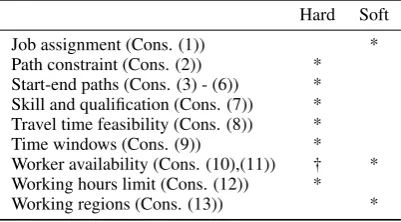
Table 1 summarises the constraints in our MIP model. Given our real-world data sets, some are im-plemented as soft constraints. For example, workers can be forced to work outside their predefined regions and availability. Also, tasks can be left unassigned (assigned to the dummy worker). These features are quite important to maintain the practical applicability of our model and solution approach.
The objective function (14) involves three costs: monetary cost, preferences penalty cost and soft con-straints penalty cost.
Min
∑
c∈Ci∈
∑
D∪Tj∈∑
D0∪Tdi,j+pcj
xci,j
+
∑
c∈Ci∈
∑
D∪Tj∈∑
D0∪Tρcjxci,j
+
∑
j∈TM1yj+M2(ωj+ψj) (14)
The first term in (14) is the monetary cost and in-cludes the travelling costdi,jof going from location of
[image:4.595.315.516.121.232.2]taskito the location of task j, and the paymentpcjfor
Table 1: Summary of problem requirements and type of constraints.
Hard Soft
Job assignment (Cons. (1)) *
Path constraint (Cons. (2)) *
Start-end paths (Cons. (3) - (6)) *
Skill and qualification (Cons. (7)) *
Travel time feasibility (Cons. (8)) *
Time windows (Cons. (9)) *
Worker availability (Cons. (10),(11)) † *
Working hours limit (Cons. (12)) *
Working regions (Cons. (13)) *
† Hard constraints (15) and (16) are described in Sec-tion 4.2 and only apply to the decomposiSec-tion model.
workercto perform task j. The second term in (14) is the preference penalty cost denoted byρcj≥0 and is a
summation of penalties for not meeting worker-client preferences, required skill preferences and working region preferences. This penalty value can go from 0 to 75 andρcj=0 when all preferences are met, while this penalty value grows higher as the preference level of assigning workercto task jdecreases. The third term in (14) is the soft constraints penalty cost due to the violation of the three soft constraints in the model. The job assignment constraint has the highest priority (M1=2000), so a violation of this constraint
type costs more than a violation of the the other two constraints. The worker availability and working re-gions constraints have the same priority (M2=500).
Note that the working regions constraint is involved in two costs. If the worker is assigned a task in a non-preferred region then this is a constraint penalty cost. If the worker is assigned to one of the preferred regions this is quantified as a preference penalty cost according to the degree in which the region is preferred by the worker (several working regions with different preference levels).
The above MIP model corresponds to the inte-grated scheduling and routing problem. Solving this model with an exact optimization method is not prac-tical considering our real-world problem instances. Hence, we apply a decomposition technique.
4
DECOMPOSITION APPROACH
AND STUDY
Later, the method is described and experimental results are presented.
4.1
Test Instances
For the present work, we prepared some test instances using real-world data corresponding to home care sce-narios in the UK, provided by our industrial partner. A problem instancePhas a set of locationsV. Recall from Section 3 thatV=D∪T∪D0. Also, some of the tasks{j1,j2, . . . ,jn}inT share the same
geographi-cal locationκ∈K, whereKis a set of geographical
locations. A group of locations are assembled as a geographical area or working regiona∈A. Note that a⊆KandAis a partition. Also, an individual worker cmay work on one or several geographical areas. As noted above, a key aspect of our scenarios is that sev-eral tasks might be required at one particular location. Each individual task may have different required skills, worker preferences and worker cost.
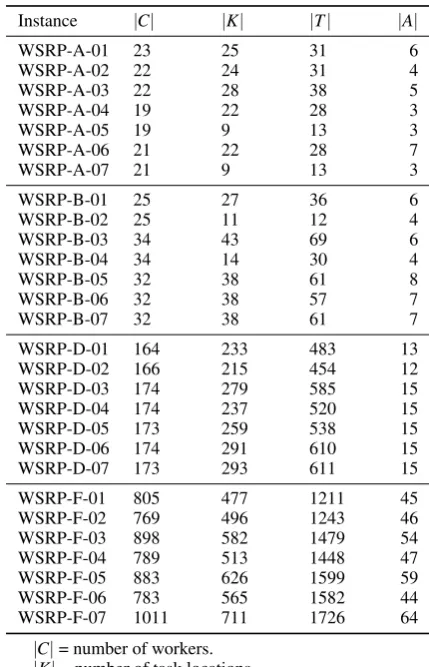
We took four real-world scenarios and prepared a data set from each. Although the instances in each data set come from the same scenario, each instance is formed from a different planning time giving a vari-ation in the available human resources and task re-quirements. In our data, the start and end locations of a worker are the same (d=d0). Table 2 shows the main features of the test instances: the number of avail-able workers|C|, the number of task locations|K|, the numbers of tasks|T|and the number of predefined geographical areas|A|. In terms of size, instances WSRP-A-(01-07) and WSRP-B-(01-07) are consid-ered small with around 19-34 workers and 13-69 tasks. The optimal solution for each of these instances can be found in less than 5 minutes. Instances WSRP-D-(01-07) and WSRP-F-(01-WSRP-D-(01-07) are considered large with more than 100 workers and 400 tasks. These large in-stances cannot yet be solved to optimality in practical computation time. In our experimental study, we use the small instances to validate the proposed decom-position approach as we can compare to the optimal solutions. Moreover, the experimental results show the suitability of the decomposition approach in tackling the large instances using an exact optimization solver.
4.2
Geographical Decomposition with
Conflict Avoidance
[image:5.595.306.521.108.442.2]In this paper, the workforce scheduling and routing problem is decomposed into working regions as this is a key feature of the scenarios provided by our indus-trial partner. Since we decompose the problem into sub-problems to deal with the larger size more effi-ciently, by solving the sub-problems one at a time in
Table 2: The test data sets.
Instance |C| |K| |T| |A|
WSRP-A-01 23 25 31 6
WSRP-A-02 22 24 31 4
WSRP-A-03 22 28 38 5
WSRP-A-04 19 22 28 3
WSRP-A-05 19 9 13 3
WSRP-A-06 21 22 28 7
WSRP-A-07 21 9 13 3
WSRP-B-01 25 27 36 6
WSRP-B-02 25 11 12 4
WSRP-B-03 34 43 69 6
WSRP-B-04 34 14 30 4
WSRP-B-05 32 38 61 8
WSRP-B-06 32 38 57 7
WSRP-B-07 32 38 61 7
WSRP-D-01 164 233 483 13
WSRP-D-02 166 215 454 12
WSRP-D-03 174 279 585 15
WSRP-D-04 174 237 520 15
WSRP-D-05 173 259 538 15
WSRP-D-06 174 291 610 15
WSRP-D-07 173 293 611 15
WSRP-F-01 805 477 1211 45
WSRP-F-02 769 496 1243 46
WSRP-F-03 898 582 1479 54
WSRP-F-04 789 513 1448 47
WSRP-F-05 883 626 1599 59
WSRP-F-06 783 565 1582 44
WSRP-F-07 1011 711 1726 64
|C|= number of workers.
|K|= number of task locations.
|T|= number of required tasks.
|A|= number of working regions.
a given sequence, we can no longer guarantee overall optimality.
Basically, the decomposition method generates a sub-problem for each working region and solves each sub-problem in sequence. Worker assignment con-flicts (i.e. a worker being assigned to different task locations at the same time) are avoided because each sub-problem is solved using only the reduced available workforce after solving the previous sub-problem.
Algorithm 1 presents the proposed geographi-cal decomposition with conflict avoidance approach (GDCA). A problem instancePis split into several sub-problemsPi(step 2). A sub-problemPicorresponds to
ex-pressed by equations (15) and (16) are enforced in this algorithm.
acj+δj−βcL≤M(2−xic,j−ζc)
∀c∈C,∀i∈D∪T,∀j∈T∪D0 (15)
βUc −acj≤M(1−xci,j+ζc)
∀c∈C,∀i∈D∪T,∀j∈T∪D0 (16)
Here,βcLdenotes the start of unavailable time and
βUc denotes the end of unavailable time for workerc.
Since the original model generates a continuous path for a worker, a path created under hard availability conditions is allocated either before or after the un-availability period. That is, a path which overlaps with the unavailability period defined byβcLandβUc is not al-lowed. The control variableζcis applied for selecting
only one side of the availability period. Whenζc=1
the time interval beforeβcLis selected and if theζc=0
the time interval afterβcUis selected.
In our data, we know that the start locationdand end locationd0for a worker are the same. Therefore, we designed a sub-problem solutions combination pro-cess based on this assumption. During theCombine sub-problem solutionsprocess (step 7), sub-problem solutions are combined together by connecting the worker’s paths from each sub-problem to get a long single path. After this process, a worker leaves his start location and arrives to his end location only once. Suppose thatΦ1={(xcd,t1,a
c
1),(xct1,d0,a
c d1)}is
a solution to sub-problemP1representing the
assign-ment of workercfrom start location d to work on taskt1 and returning to end location d0 and Φ2=
{(xdc,t
2,a
c
2),(xct2,d0,a
c
d2)}is a solution to sub-problem
P2 representing the assignment of the same worker
cfrom starting locationd to work on taskt2and
re-turning to ending locationd0. Assume without loss
Algorithm 1:Geographical decomposition with conflict avoidance (GDCA).
Data: Problem instanceP={C,A}
1 initialization: For workerc∈C, define earliest
availability vectorβL= (βcL)and latest availability
vectorβU= (βUc);
2 Split problemPby areas denoted as
Pi={C,a},a∈A,i=1...|A|;
3 forall thePi∈Pdo
4 SolvePiwith availabilityαLandαUby CPLEX
solver→Φi;
5 Update availability vectorβLandβU;
6 end
7 Combine sub-problem solutions;
of generality thatac1<acd
1 <a
c
2<acd2. The
combin-ing process redirects the arrivcombin-ing assignment to end locationd0to taskt2which gives a global solution as Φ={(xcd,t
1,a
c
1),(xtc1,t2,a
c
2),(xct2,d0,a
c
d2)}. It is possible
than in other scenarios of the WSRP, the start loca-tion and end localoca-tion for a worker are different, we leave this for future work as it is not a feature of the scenarios tackled at present.
4.3
Experiments and Results
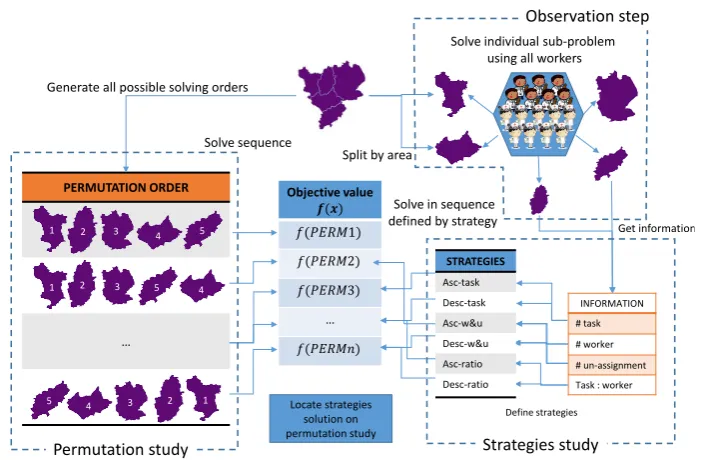
The flow of our experimental study is depicted in Fig-ure 1. The figFig-ure outlines the three parts of the ex-perimental design. First, on the left-hand side of the figure, the permutation studyrefers to solving the sub-problems in different order given by all the differ-ent permutations of the geographical areas. However, trying all permutations is practical only in small prob-lems. Therefore, finding an effective ordering pattern is the second part of experiment,observation stepin the figure. This second part solved each sub-problem using all available workforce, i.e. ignoring if some workers were assigned in previous sub-problems. The third part analysed the results from the observation step in order to define some strategies to tackle the sub-problems. Based on thisstrategies study, some solving strategies were envisaged. Listed in the figure are these ordering strategies: task, Desc-task, Asc-w&u, etc. More details about these ordering strategies are provided when decribing the Observation step below. Finally, the solutions produced with the differ-ent ordering strategies are compared to the solutions produced by the permutation study to evaluate the per-formance of these ordering strategies.
PERMUTATION ORDER
…
4 1
1
2 3 5
2 3 5 4
5 4 3 2 1
INFORMATION # task # worker # un-assignment Task : worker
Objective value 𝒇(𝒙)
𝑓(𝑃𝐸𝑅𝑀1)
𝑓(𝑃𝐸𝑅𝑀2)
𝑓(𝑃𝐸𝑅𝑀3)
…
𝑓(𝑃𝐸𝑅𝑀𝑛) Split by area
Solve individual sub-problem using all workers
Get information
Define strategies
Solve in sequence defined by strategy Solve sequence
Generate all possible solving orders
Locate strategies solution on permutation study
Observation step
Strategies study Permutation study
STRATEGIES
[image:7.595.121.475.90.320.2]Asc-task Desc-task Asc-w&u Desc-w&u Asc-ratio Desc-ratio
Figure 1: Outline of the experimental study in three parts: permutation study, observation step and strategies study.
1-2-3 1-3-2 2-1-3 2-3-1 3-1-2 3-2-1 4
6 8 10
Relati
v
e
g
ap
(%)
WSRP-A-04
1-2-3 1-3-2 2-1-3 2-3-1 3-1-2 3-2-1 30
40 50
WSRP-A-05
1-2-3 1-3-2 2-1-3 2-3-1 3-1-2 3-2-1 20
30 40
[image:7.595.75.524.346.440.2]WSRP-A-07
Figure 2: Relative gap obtained from solving the 3 instances (WSRP-A-04, WSRP-A-05 and WSRP-A-07) with|A|=3 using
the different permutation orders. Each graph shows results for one instance. The bars represent the relative gap between the solution obtained with the decomposition method and the overall optimal solution.
WSRP-A-07.
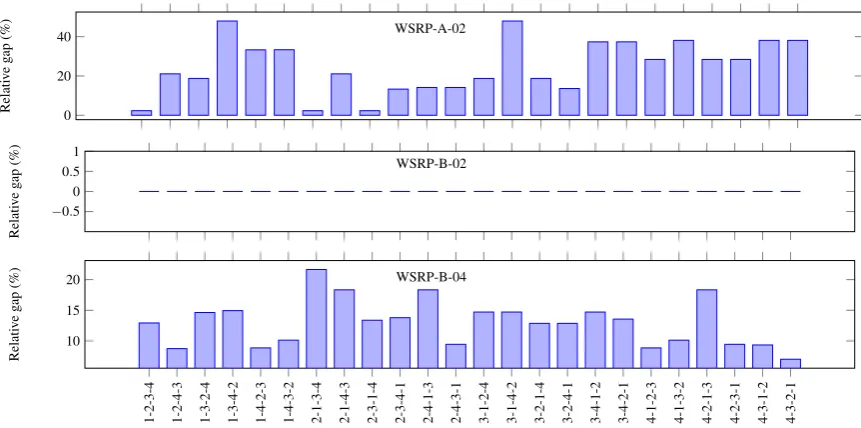
Figure 3 shows the relative gap obtained for the small instances that have 4 regions. Each sub-figure shows the result for one instance when solved using the permutation orders of the 4 regions. Each bar shows the relative gap between the solution by the de-composition method and the overall optimal solution. The figure reveals an interesting result from instance WSRP-B-02. The optimal solution value is obtained for every permutation. Closer inspection reveals that the decomposition method works very well on this instance because its geographical areas are well sep-arated from each other. Therefore, the sub-problem solutions are part of the complete overall solution and not many worker assignment conflicts arise when solv-ing the sub-problems. For the other instances, WSRP-A-02 and WSRP-B-04, the quality of the obtained solutions fluctuates in the same way as in Figure 2. Re-sults in Figure 3 indicate that some solutions obtained with the decomposition approach using some
permu-tations have a considerable gap in quality compared to the overall optimal solution. The figure also shows that some permutations clearly give better results than others. For example, permutation “1-2-3-4”, “2-1-3-4” and “2-3-1-4” for instance WSRP-A-02 and permuta-tion “4-3-2-1” for instance WSRP-B-04.
The conclusion from this permutation study is that the order in which the sub-problems are solved matters differently according to the problem instance. More importantly, the results confirm our assumption that some particular permutation could produce a very good result in the decomposition approach. Hence, the next part of the study is to find a good solving order.
unas-0 20 40
Relati
v
e
g
ap
(%) WSRP-A-02
−0.5 0 0.5 1
Relati
v
e
g
ap
(%) WSRP-B-02
1-2-3-4 1-2-4-3 1-3-2-4 1-3-4-2 1-4-2-3 1-4-3-2 2-1-3-4 2-1-4-3 2-3-1-4 2-3-4-1 2-4-1-3 2-4-3-1 3-1-2-4 3-1-4-2 3-2-1-4 3-2-4-1 3-4-1-2 3-4-2-1 4-1-2-3 4-1-3-2 4-2-1-3 4-2-3-1 4-3-1-2 4-3-2-1 10
15 20
Relati
v
e
g
ap
[image:8.595.76.507.94.308.2](%) WSRP-B-04
Figure 3: Relative gap obtained from solving the 3 instances (WSRP-A-02, WSRP-B-02 and WSRP-B-04) with|A|=4 using
the different permutation orders. Each graph shows results for one instance. The bars represent the relative gap between the solution obtained with the decomposition method and the overall optimal solution.
signed task) and the ratio of tasks to worker in the solu-tion (task/worker ratio). Then, we defined six ordering strategies as follows. Increasing number of tasks in the sub-problem (Asc-task); decreasing number of tasks in the sub-problem (Desc-task); increasing sum of minimum workers required and unassigned tasks (Asc-w&u); decreasing sum of minimum workers required and unassigned tasks (Desc-w&u); increasing ratio of tasks to worker (Asc-ratio) and decreasing ratio of tasks to worker (Desc-ratio).
Strategies Study. The GDCA approach is again executed using the 6 ordering strategies listed above to tackle the sub-problems in each problem instance. The results are presented in Figure 4 which shows the relative gap for the 14 small instances in the WSRP-A and WSRP-B groups. Note that each bar represents the relative gap obtained with each strategy.
From Figure 4, the decomposition technique with ordering strategies gives solutions with relative gaps below 50%. On average, the decomposition technique produces relative gap at 16.36%. Moreover, we can see that some of the ordering strategies are more likely to produce better solutions than others. The best per-forming ordering strategy is Asc-w&u that gives 9 best solutions considering all 14 small instances. The average gap for the ordering strategies Asc-task, Desc-task, Asc-w&u, Desc-w&u, Asc-ratio and Desc-ratio are 14.09%, 19.94%, 11.19%, 19.66%, 15.01% and 18.28% respectively. Table 3 shows a comparison of relative gap between the best permutation order (see Permutation study) and the best ordering strategy. It
Table 3: Relative gap (%) of best permutation VS. best strategy.
Instance Best permutation Best strategy
WSRP-A-04 3.9 6.4
WSRP-A-05 24.67 24.67
WSRP-A-07 14.43 15.03
WSRP-A-02 2.31 2.32
WSRP-B-02 0 0
WSRP-B-04 7.02 8.86
is clearly shown that solutions from the best ordering strategy are not much different from the best permu-tation solution (maximum of 2.5% different). In addi-tion, two out of six solutions (instance WSRP-A-05 and WSRP-B-02) of the best ordering strategy match the solution from the best permutation. This shows that the ordering strategies are able to work well in other problem instances.
[image:8.595.310.517.386.477.2]A-01 A-02 A-03 A-04 A-05 A-06 A-07 B-01 B-02 B-03 B-04 B-05 B-06 B-07 0
20 40
WSRP-Relati
v
e
g
ap
(%)
[image:9.595.84.506.93.229.2]Asc-task Desc-task Asc-w&u Desc-w&u Asc-ratio Desc-ratio
Figure 4: Relative gap obtained from solving the 14 small instances using the 6 ordering strategies. Each bar for an instance represents the relative gap between a solution by the decomposition method using an ordering strategy and the overall optimal solution.
32 34 37 47 49 53 54 60 61 64 89 93 93 103
0 100 200
Problem size (items)
Computation
time
(seconds)
Small instances
620 647 694 711 759 784 784 2012 2016 2237 2365 2377 2482 2737 0.5
1 1.5
·104
Problem size (items) Large instances
Asc-task Desc-task Asc-w&u Desc-w&u Asc-ratio Desc-ratio Optimal
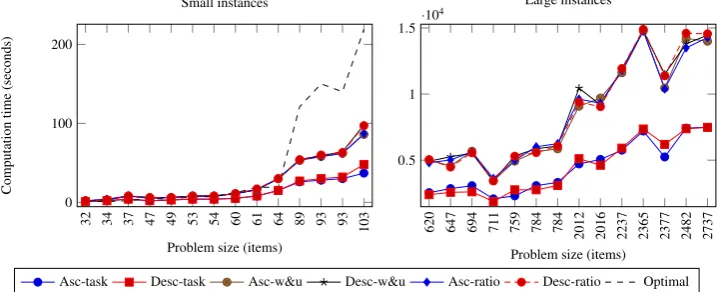
Figure 5: Computation time (seconds) used in solving small and large instances. Each sub-figure corresponds to a problem size category (small and large). The problem size (items) is the summation of #workers and #tasks. Each graph presents the computation time used by the decomposition method with the different ordering strategies (line with markers) and the time used for producing the overall optimal solution (dashed line) when possible.
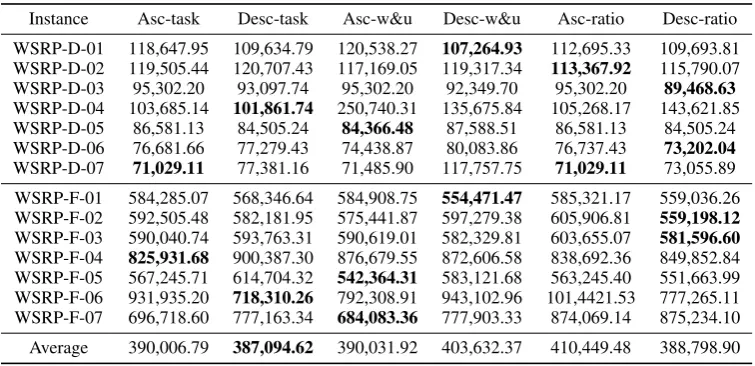
solutions respectively while the others give two best solutions. On average, the Desc-task strategy gives the lowest cost solution, around 5.7% less than the highest average cost strategy (Asc-ratio).
Figure 5 shows, according to the problem size, the computation times used by the decomposition ap-proach using the different ordering strategies and the time used to find the overall optimal solution. Each sub-figure presents the problem instances classified by their size (number of items is |T|+|C|). Each line represents the time used by the ordering strat-egy in solving the group of 14 problem instances. As noted before, the time to find the optimal solution represented by is available only for the small instances. For the smaller instances with less than 89 items, the computation time used by the decomposi-tion method is not much different from the time used to find the optimal solution. The computation time used to find the optimal solution grows significantly for instances with 89 items and above. For the large in-stances, it is shown that the computation time used by
the decomposition method goes above 4 hours (14,895 seconds). Also, for the large instances the computa-tion time used by the ordering strategies Asc-task and Desc-task is significantly less than for the other order-ing strategies. This is because these orderorder-ing strategies do not require an additional process to retrieve infor-mation about the problem. Hence, considering both solution quality and computation time, it can be con-cluded that Asc-task and Desc-task (best known on average) should be selected for large instances because they produce solutions which are not much different from the other strategies but requiring significantly less computational time (48.3% less on average).
5
CONCLUSION AND FUTURE
WORK
[image:9.595.119.478.279.425.2]Table 4: Objective value obtained from solving large instances using six ordering strategies.
Instance Asc-task Desc-task Asc-w&u Desc-w&u Asc-ratio Desc-ratio
WSRP-D-01 118,647.95 109,634.79 120,538.27 107,264.93 112,695.33 109,693.81
WSRP-D-02 119,505.44 120,707.43 117,169.05 119,317.34 113,367.92 115,790.07
WSRP-D-03 95,302.20 93,097.74 95,302.20 92,349.70 95,302.20 89,468.63
WSRP-D-04 103,685.14 101,861.74 250,740.31 135,675.84 105,268.17 143,621.85
WSRP-D-05 86,581.13 84,505.24 84,366.48 87,588.51 86,581.13 84,505.24
WSRP-D-06 76,681.66 77,279.43 74,438.87 80,083.86 76,737.43 73,202.04
WSRP-D-07 71,029.11 77,381.16 71,485.90 117,757.75 71,029.11 73,055.89
WSRP-F-01 584,285.07 568,346.64 584,908.75 554,471.47 585,321.17 559,036.26
WSRP-F-02 592,505.48 582,181.95 575,441.87 597,279.38 605,906.81 559,198.12
WSRP-F-03 590,040.74 593,763.31 590,619.01 582,329.81 603,655.07 581,596.60
WSRP-F-04 825,931.68 900,387.30 876,679.55 872,606.58 838,692.36 849,852.84
WSRP-F-05 567,245.71 614,704.32 542,364.31 583,121.68 563,245.40 551,663.99
WSRP-F-06 931,935.20 718,310.26 792,308.91 943,102.96 101,4421.53 777,265.11
WSRP-F-07 696,718.60 777,163.34 684,083.36 777,903.33 874,069.14 875,234.10
Average 390,006.79 387,094.62 390,031.92 403,632.37 410,449.48 388,798.90
Boldtext refers to the best solution.
problem is presented. The model is constructed by incorporating various constraint formulations from the literature while also adding working region constraints to the formulation. It is usually the case that models in the literature for this type of problem are presented but their solution is approached using alternative methods such as heuristics because solving the model using mathematical exact solvers is computationally chal-lenging. A geographical decomposition with conflict avoidance approach is proposed here to tackle work-force scheduling and routing problems while still har-nessing the power of exact solvers. The proposed decomposition method allows to tackle real-world size problems for which finding the overall optimal solu-tion requires too much computasolu-tion time. However, the solution quality fluctuates when changing the order to tackle the sub-problems defined by the geographi-cal regions. Exploring all permutation orders to find the one producing the best results is not practical for larger problems (e.g. more than 6 geographical ar-eas). In this work, six ordering strategies are proposed for obtaining high-quality solutions within acceptable computation time. Our future research will explore ways to replace the originally defined geographical areas with automated clustering to define well sepa-rated geographical areas even in cases where the areas defined by the problem data are not well separated.
ACKNOWLEDGEMENTS
Special thanks to the Development and Promotion for Science and Technology talents project (DPST, Thai-land) who providing partial financial support. Also, we are grateful for access to the University of Nottingham
High Performance Computing Facility.
REFERENCES
Akjiratikarl, C., Yenradee, P., and Drake, P. R. (2007). PSO-based algorithm for home care worker scheduling in the UK.Computers & Industrial Engineering, 53(4):559– 583, doi:10.1016/j.cie.2007.06.002.
Angelis, V. D. (1998). Planning home assistance for AIDS
patients in the City of Rome , Italy.Interfaces, 28:75–
83.
Barrera, D., Nubia, V., and Ciro-Alberto, A. (2012). A network-based approach to the multi-activity combined timetabling and crew scheduling problem: Workforce scheduling for public health policy implementation.
Computers & Industrial Engineering, 63(4):802–812, doi:10.1016/j.cie.2012.05.002.
Benders, J. (1962). Partitioning procedures for solving
mixed-variables programming problems.Numerische
Mathematik, 4(1):238–252, doi:10.1007/BF01386316. Bertels, S. and Torsten, F. (2006). A hybrid setup for a hybrid
scenario: Combining heuristics for the home health
care problem. Computers & Operations Research,
33(10):2866–2890.
Borsani, V., Andrea, M., Giacomo, B., and Francesco, S. (2006). A home care scheduling model for human
re-sources. 2006 International Conference on Service
Systems and Service Management, pages 449–454, doi:10.1109/ICSSSM.2006.320504.
Bredstrom, D. and Ronnqvist, M. (2007). A branch and price algorithm for the combined vehicle routing and scheduling problem with synchronization constraints.
NHH Dept. of Finance & Management Science Discus-sion Paper No. 2007/7, (February).
and synchronization constraints. European Journal of Operational Research, 191(1):19 – 31.
Castillo-Salazar, J., Landa-Silva, D., and Qu, R. (2014). Workforce scheduling and routing problems: literature
survey and computational study.Annals of Operations
Research, doi:10.1007/s10479-014-1687-2.
Castro-Gutierrez, J., Landa-Silva, D., and Moreno,
P. J. (2011). Nature of real-world multi-objective
vehicle routing with evolutionary algorithms.
Sys-tems, Man, and Cybernetics (SMC), 2011 IEEE International Conference on, pages 257–264, doi:10.1109/ICSMC.2011.6083675.
Cordeau, J.-F., Stojkovic, G., Soumis, F., and Desrosiers,
J. (2001). Benders decomposition for
simul-taneous aircraft routing and crew
schedul-ing. Transportation Science, 35(4):375–388, doi:10.1287/trsc.35.4.375.10432.
Dantzig, G. B. and Ramser, J. H. (1959). The truck
dis-patching problem. Management Science (pre-1986),
6(1).
Dohn, A., Esben, K., and Jens, C. (2009). The
man-power allocation problem with time windows and job-teaming constraints: A branch-and-price approach.
Computers & Operations Research, 36(4):1145–1157, doi:10.1016/j.cor.2007.12.011.
Eveborn, P., Ronnqvist, M., Einarsdottir, H., Eklund, M., Liden, K., and Almroth, M. (2009). Operations re-search improves quality and efficiency in home care.
Interfaces, 39(1):18–34, doi:10.1287/inte.1080.0411. Feillet, D. (2010). A tutorial on column generation and
branch-and-price for vehicle routing problems. 4OR,
8(4):407–424.
Hart, E., Sim, K., and Urquhart, N. (2014). A real-world
em-ployee scheduling and routing application. In
Proceed-ings of the 2014 Conference Companion on Genetic and Evolutionary Computation Companion, GECCO Comp ’14, pages 1239–1242, New York, NY, USA. ACM.
Kergosien, Y., Lente, C., and Billaut, J.-C. (2009). Home health care problem, an extended multiple travelling
salesman problem. InProceedings of the 4th
multidis-ciplinary international scheduling conference: Theory and applications (MISTA 2009), Dublin, Ireland, pages 85–92.
Landa-Silva, D., Wang, Y., Donovan, P., Kendall, G., and Way, S. (2011). Hybrid heuristic for multi-carrier
trans-portation plans. InThe 9th Metaheuristics
Interna-tional Conference (MIC 2011), pages 221–229.
Liu, R., Xie, X., and Garaix, T. (2014).
Hy-bridization of tabu search with feasible and
infeasible local searches for periodic home
health care logistics. Omega, 47(0):17 – 32,
doi:http://dx.doi.org/10.1016/j.omega.2014.03.003. Mankowska, D., Meisel, F., and Bierwirth, C. (2014). The
home health care routing and scheduling problem with
interdependent services. Health Care Management
Science, 17(1):15–30, doi:10.1007/s10729-013-9243-1.
Mercier, A., Cordeau, J.-F., and Soumis, F. (2005). A com-putational study of Benders decomposition for the
in-tegrated aircraft routing and crew scheduling problem.
Computers & Operations Research, 32(6):1451 – 1476, doi:http://dx.doi.org/10.1016/j.cor.2003.11.013.
Perl, J. and Daskin, M. S. (1985). A warehouse
location-routing problem. Transportation
Re-search Part B: Methodological, 19(5):381 – 396, doi:http://dx.doi.org/10.1016/0191-2615(85)90052-9. Pillac, V., Gueret, C., and Medaglia, A. (2012). On the dynamic technician routing and scheduling problem. In Proceedings of the 5th International Workshop on Freight Transportation and Logistics (ODYSSEUS 2012), page id: 194, Mikonos, Greece.
Ralphs, T. K. and Galati, M. V. (2010). Decomposition
methods for integer programming. Wiley
Encyclope-dia of Operations Research and Management Science, doi:10.1002/9780470400531.eorms0233.
Rasmussen, M. S., Justesen, T., Dohn, A., and
Larsen, J. (2012). The home care crew
schedul-ing problem: Preference-based visit clustering
and temporal dependencies. European
Jour-nal of Operational Research, 219(3):598–610, doi:http://dx.doi.org/10.1016/j.ejor.2011.10.048. Reimann, M., Doerner, K., and Hartl, R. F. (2004). D-Ants:
Savings based ants divide and conquer the vehicle
routing problem. Computers & Operations Research,
31(4):563 – 591, doi:http://dx.doi.org/10.1016/S0305-0548(03)00014-5.
Trautsamwieser, A. and Hirsch, P. (2011). Optimization of
daily scheduling for home health care services.Journal
of Applied Operational Research, 3:124–136. Vanderbeck, F. (2000). On Dantzig-Wolfe decomposition in
integer programming and ways to perform branching
in a branch-and-price algorithm. Operations Research,
48(1):111.
Vanderbeck, F. and Wolsey, L. (2010). Reformulation and decomposition of integer programs. In Junger, M. et al.,
editors,50 Years of Integer Programming 1958-2008,