CONDITIONS
Ángel Alberto Núñez Magro
A Thesis Submitted for the Degree of PhD at the
University of St Andrews
2007
Full metadata for this item is available in Research@StAndrews:FullText
at:
http://research-repository.st-andrews.ac.uk/
homogeneous conditions
A thesis presented by
Ángel Alberto Núñez Magro
to the
University of St Andrews
in application for
THE DEGREE OF DOCTOR OF PHILOSOPHY
I, Angel Alberto Nuñez Magro, hereby certify that this thesis, which is approximately 49000 words in length, has been written by me, that it is a record of work carried out by me and that it has not been submitted in any previous application for a higher degree.
Date Signature of Candidate
I was admitted as a research student in October 2004 and as a candidate for the degree of Doctor of Philosophy in July 2005; the higher study for which this is a record was carried out in the University of St Andrews between 2004 and 2007.
Date Signature of Candidate
I hereby certify that the candidate has fulfilled the conditions of the resolution and regulations appropriate for the degree of Doctor of Philosophy in the University of St Andrews and that the candidate is qualified to submit this thesis in application for that degree.
Date Signature of Supervisor
available for use in accordance with the regulation of the University Library for the time being in force, subject to and copyright in the work not being affected thereby, and a copy of the work may be made to any bona fide library or research worker, that my thesis will be electronically accessible for personal or research use, and that the library has the right to migrate my thesis into new electronic forms as required to ensure continued access to the thesis. I have obtained any third-party copyright permissions that may be required in order to allow such access and migration
this nation will rise up and live
out the true meaning of its creed:
'We hold these truths to be self-evident,
that all men are created equal.'"
Martin Luther King,
28 August 1963,
at the Lincoln Memorial,
Washington D.C
.
"Sé que nunca más recuperaré
a mi hijo pero dame, al menos,
el consuelo de la verdad"
personas que hay en este mundo
Firstly, I would like to thank Professor David Cole-Hamilton for his continual support and patience, for cheering me up in the bad moments, for making me feel comfortable so far from my home, and of course for his wonderful smile which he has in both the good and the bad moments. Thanks also to Dr. Graham Eastham for being like a second supervisor, for his enthusiasm and his fantastic ideas to address problems, and to Lucite International for the financial support that made this project possible.
I would like to give special mention to Dr Robert Tooze and Dr Simon Crabtree for their helpful discussions, Dr Alex Slawin for the resolution of my X-Ray (and for making me smile all the time) and Laura Marshall for the correction of my terrible English.
Thanks also to the Professor David Cole-Hamilton group for the incredible atmosphere in our laboratory, especially Dr. Anja Fish, Ine Boogaerts and Nicolas Vautravers for suffering my bad character and Spanish humor in the laboratory, and Benjamin Lee Parnham for cheering me up in the bad moments (without your support I would not be here now), Cristina Jiménez (por enseñarme a empezar en este mundo) and Peter Pogorzelec for his help (the rest of the group, please excuse me for not giving details of your help).
I am thankful to the members of the Spanish mafia (as Professor Cole-Hamilton calls us) Gregorio Guisado, Dr. David Bastidas, Dr. Maria del Carmen Carrión and Dr. José A. Fuentes (por haber sido mi familia en St Andrews, por soportarme y ayudarme en todo lo humanamente posible), Rafael Madueño (por esos fantásticos momentos juntos, incluidos los que hemos pasado en ese cubil donde trabajas), Alejandro Ovalle (por su fantástico y políticamente incorrecto humor), Belén Díaz (lo que diga la rubia), Cristina Lucas (por esas interminables charlas), Fernando Portela (por su humor y personalidad) and Diana Rúa (por ser una de las mejores cosas que me llevo de St Andrews).
time I spent there, Colin Millar for his incredible smile, and of course Melanja H. Smith for NMR (and for being so talkative). Thanks also to the secretarial staff, Louise Bain, Callie M Gates, Elizabeth (Liz) Harris, Iona Hutchison and Suzanne Knowles for their support.
Deserving special thanks Maria del Pilar Magro Roldan and Domingo Núñez Valladares (por ser los mejores padres que puedan uno tener) and my brother, Mario Núñez Magro and sister, Azucena, Beatriz and Maria del Pilar Núñez Magro (por vuestro apoyo todo este tiempo). Also many thanks to Javier Nuñez García (por animarme a estudiar mi doctorado aquí y por todo lo que siguió). And of course Ayako Nagano for being close to me all this time (愛してる). And mis niñas, Beatriz de Lara, Eva Jiménez, Cayetana Murillo, Eva Vicente and Sara Díaz (por todo, parece mentira que haya pasado tanto tiempo desde que empezamos químicas y siempre habéis estado ahí para mi).
BDTBPMB has been proven to be an essential ligand in carbonylation chemistry. Its twotert-butyl groups and wide bite angle give it the ideal characteristics for this kind of chemistry, and leads to high activity and selectivity with use of its complexes. During this work the group of reactions where this ligand has been proven to be active has been extended with two new protocols for hydroxycarbonylation and aminocarbonylation. In the hydroxycarbonylation process, a large variety of unsaturated compounds were studied. Dioxane was found to be the ideal solvent, due to its properties in terms of coordinability, and miscibility with water. Using this solvent as the medium, a BDTBPMB complex of palladium was found to be highly active and selective under mild conditions.
Initial attempts to address the aminocarbonylation of alkenes catalysed by the Pd/BDTBPMB system did not give high activity. This problem was overcome by the addition of an arylalcohol. Under those conditions, high selectivity and conversion was
obtained in a wide variety of amides. However, attempts to address the
aminocarbonylation of alkenes with ammonia gas to generate primary amides did not result in any conversion. The generation of these primary amides was obtained with transamidation ofN-phenylnonamides which can be prepared by aminocarbonylation.
catalysed by copper require high temperatures. However, palladium complexes of highly electron donating ligands such as BDTBPMB or P(tBu)3 were found to be highly active
ACAC acetylacetonate
ACH Acetone cyanohydrin
ACOEt Ethyl acetate
AIBN 2,2'-Azobis(2-methylpropionitrile)
BCPE 1,2-P,P’-bis(9-phosphabicyclo[3,3,1]nonyl)ethane
BDPPMB 1,2-bis(diphenylphosphinomethyl)benzene
BDPPMP 2,6-bis(diphenylphosphinomethyl)pyridine
BDTBPMB 1,2-bis(ditertbutylphosphinomethyl)benzene
BDTBPMN bis(ditertbutylphosphinomethylnaphtalene
BDTBPMP 2,6-bis((di-tert-butylphosphino)methyl)pyridine
BDTBPP 1,3 bis(ditertbutylphosphino)propane
BINAP 2,2'-Bis(diphenylphosphino)-1,1'-binaphthalene
BNPPA (S)-(+)-binaphyl-2,2-diyl Hydrogen Phosphate
BQ Benzoquinone
DBA dibenzilydenacetone
DIOP (−
)-2,3-O-Isopropylidene-2,3-dihydroxy-1,4-bis(diphenylphosphino)butane
DCPB dicyclohexylphosphinobutane
DME 1,2-dimethoxyethane
DMSO Dimethylsulfoxide
DPPB Diphenylphosphinobutane
DPPE Diphenylphosphinoethane
DPPF Diphenylphosphinoferrocene
DPPM Diphenylphosphinomethane
DPPP Diphenylphosphinopropane
KBDTBPMBS Potassium 3,4-bis(di-tert-butylphosphinomethyl)benzenesulfonate
MEP Methyl propanoate
MMA Methyl metracrylate
MSA Methanesulfonic acid
NMP N-methyl-2-pyrolidinone
PMMA Poly(methyl metracrylate)
TDTBPMB 1,3,5-tris((di-tert-butylphosphino)methyl)benzene
TFO Trifluoroacetate
THF tetrahydrofuran
TMEDA N,N,N’,N’-tetramethylethylenediamine
TOF Turnover frequency (mol product/(mol catalyst·h)
TON Turnover number (mol product/(mol catalyst)
TPPDS Triphenylphosphine bissulfonated sodium
TPPMS Triphenylphosphine monosulfonated sodium
TPPTS Triphenylphosphine trisulfonated sodium
TRIPHOS 1,1,1-Tris(diphenylphosphinomethyl)ethane
1. Introduction………... 1
1.1. Chemistry in the World………..……. 1
1.2. Catalysts…...……… 2
1.2.1. Homogenous and Heterogeneous Catalysts………. 8
1.2.2. Homogeneous Catalysts………... 9
1.2.2.1. Use of Phosphines in Homogeneous Catalysis……….. 11
1.2.2.1.1. Electronic Effects………..…...……….. 12
1.2.2.1.2. Steric Effects……….. 13
1.2.2.2. Phosphines and Homogeneous Catalysis in the Real World……. 16
1.2.2.2.1. Thermal Decomposition………. 16
1.2.2.2.2. Chemical Decomposition………... 17
1.2.2.2.2.1.Oxidation……….. 18
1.2.2.2.2.2.Alkylation of Phosphines……….. 18
1.2.2.2.2.3.Ligand Scrambling……… 19
1.3. 1,2-bis(ditertbutylphosphinomethyl)benzene as a Ligand……….20
1.3.1. 1,2-bis(ditertbutylphosphinomethyl)benzene in Catalysis... 23
1.3.1.1. Generation of Methylmetracrylate: From the Old Process (ACH) to the New Alpha Process……….. 23
1.3.1.2. Methoxycarbonylation of Alkenes……… 25
1.3.1.3. Hydroxycarbonylation of 1,3-Butadiene………... 34
1.3.1.4. Methoxycarbonylation of Chloroarenes……… 36
1.3.2. Immobilisation of the BDTBPMB/Pd System………. 37
2.1.1. Reactivity of Different Substrates and Nucleophiles………44
2.1.2. Mechanism of carbonylation……… 45
2.1.3. Deactivation of the Catalyst………. 47
2.1.4. Hydroxycarbonylation of Alkenes………... 49
2.1.5. Aminocarbonylation of Alkenes……….. 53
2.2. Result and Discussion………... 59
2.2.1. Hydroxycarbonylation of Alkenes Catalysed by the Pd/BDTBPMB System………. 59
2.2.1.1. Effect of Temperature on the Hydroxycarbonylation of Octene… 60 2.2.1.2. Effect of pressure on the Hydroxycarbonylation of Octene……... 63
2.2.1.3. Study of the Concentration of Water on the Hydroxycarbonylation of Octene……… 64
2.2.1.4. Hydroxycarbonylation of Octene in Other Solvents………... 66
2.2.1.5. Other Palladium Precatalysts on the Hydroxycarbonylation of Octene………. 68
2.2.1.6. Hydroxycarbonylation of Octene under Other Conditions………. 69
2.2.1.7. Deuteriation Study of Hydroxycarbonylation………. 71
2.2.1.8. Hydroxycarbonylation of Other Octene Isomers……… 72
2.2.1.9. Hydroxycarbonylation of Other Alkenes……… 73
2.2.1.10. Hydroxycarbonylation of Unsaturated Carbonyl Compounds…... 75
2.2.1.11. [BDTBPMBH2][BF4]2: an Air-stable Alternative to the Use of BDTBPMB……….. 77
2.2.2. Aminocarbonylation of Alkenes……….. 80
2.2.2.1. Aminocarbonylation of Alkenes using Alkylamines……….. 81
2.2.2.1.1. Preliminary Results……… 81
2.2.2.1.2. Effect of Temperature on the Aminocarbonylation of Octene………. 83
2.2.2.1.5. The Effect of Pressure on the Aminocarbonylation of
Octene………. 88 2.2.2.1.6. Use of Other Halide Salts on the Aminocarbonylation of
Octene………. 90 2.2.2.1.7. Use of Tetraammonium Salts on the Aminocarbonylation
of Octene………. 92 2.2.2.1.8. Aminocarbonylation of Octene in Other Solvents…………. 93 2.2.2.1.9. Aminocarbonylation of Octene in Methanol………. 95 2.2.2.1.10. Use of [BDTBPMBH2][BF4]2in the Aminocarbonylation of
Octene………. 97 2.2.2.1.11. Aminocarbonylation of octene under a syngas atmosphere.. 98 2.2.2.1.12. Aminocarbonylation of Octene with Other Amines……….. 100 2.2.2.1.13. Aminocarbonylation of Isomers of Octene………101 2.2.2.2. Aminocarbonylation of Alkenes Using Arylamines………...103 2.2.2.2.1. Preliminary Results………103 2.2.2.2.2. Study on the Variation of Naphtol Concentration in
Aminocarbonylation………... 105 2.2.2.2.3. Study on the Effect on Variation of Aniline Concentration
on Aminocarbonylation……….. 106 2.2.2.2.4. Effect of Pressure in Aminocarbonylation of Octene……… 109 2.2.2.2.5. Test of Other Halide Salts in Aminocarbonylation Using
Aniline……… 111 2.2.2.2.6. Aminocarbonylation in Other Solvents………. 113 2.2.2.2.7. Aminocarbonylation in Methanol……….. 115 2.2.2.2.8. Use of [BDTBPMBH2][BF4]2in the aminocarbonylation
Methoxyanilines………. 122
2.2.2.2.10.3. Aminocarbonylation of Octene Using Cyanoanilines.. 123
2.2.2.2.10.4. Aminocarbonylation of Octene Using Fluoroanilines.. 125
2.2.2.2.10.5. Aminocarbonylation of Octene Using Chloroanilines..127
2.2.2.2.11. Aminocarbonylation of Octene Isomers……… 128
2.2.2.3. HPNMR Study of Aminocarbonylation………..130
2.2.2.4. Aminocarbonylation Using Ammonia Gas……….132
2.2.3. Methoxycarbonylation and Hydroxycarbonylation of Octene Using Arylalcohols as Promoters………...134
2.2.4. Transamidation and Ester/amide Exchange……….136
2.2.4.1. Transmidation Reactions Catalysed by Tetrakis(diamino)titanium (IV)………...137
2.2.4.2. Transmidation Reaction Catalysed by Titanium Isopropoxide…. 139 2.2.4.3. Transmidation Reaction Catalysed by Scandium (III) Triflate….. 141
2.2.4.4. Transmidation of OtherN-Arylnonamides……… 142
2.2.4.5. Ester/amide Exchange……… 144
2.3. Conclusions………...146
2.4. References……….. 148
3. Hydrogenation of Amides……….
1533.1. Introduction………...153
3.1.1. Heterogenous Catalytic Systems………..153
3.1.2. Homogenous Catalytic Systems……….. 156
3.2. Results and Discussion………..168
3.2.1. Hydrogenation ofN-Phenylnonamide………... 168
3.2.1.3. Study of the Effects of Pressure in the Hydrogenation of
N-Phenylnonamide………..175
3.2.1.4. Study of the Effect of Temperature in the Hydrogenation of N-Phenylnonamide………..176
3.2.1.5. Hydrogenation ofN-Phenylnonamide Catalysed by Ruthenium…..177
3.2.1.6. Hydrogenation ofN-Phenylnonamide in Other Solvents…………. 179
3.2.1.7. Study of the Effect of the Aniline in Hydrogenation of N-Phenylnonamide………..180
3.2.1.8. Hydrogenation ofN-Phenylnonamide catalysed by Ru(acac)3/TDTBPMB system……….182
3.2.2. Hydrogenation of Butanamide………. 183
3.2.3. Hydrogenation of Nonanoic Acid in Presence of Ammonia…………... 188
3.2.4. Hydrogenation of Diamides in Presence of Ammonia……… 191
3.2.5. Hydrogenation of Other Substrates………..193
3.3. Conclusions………... 194
3.4. References……….195
4. Decarboxylation and Desulfonation………
1984.1. Introduction………...198
4.1.1. Decarboxylation………... 198
4.1.2. Desulfonation………...206
4.2. Results and Discussion……….208
4.2.1. Decarboxylation……….. 208
4.2.1.1. Preliminary Results……… 208
4.2.1.5. Effect of Halides in the Decarboxylation ofp-Hydroxybenzoic
Acid……….. 212
4.2.1.6. Study of the Effect of Base in the Medium of the Decarboxylation reaction……… 214
4.2.1.7. Decarboxylation in Other Solvents……….216
4.2.1.8. The Use of Other Palladium Precursors in Decarboxylation……..217
4.2.1.9. The Use of Other Metal Catalysts in Decarboxylation…………... 219
4.2.1.10. Decarboxylation ofp-Hydroxybenzoic Acid Using Palladium Complexes of other phosphines……….. 221
4.2.1.11. The Use of D2O in Decarboxylation Reactions.…….……….. 223
4.2.2. Desulfonation………...225
4.3. Conclusions………...227
4.4. References……….228
5. Conclusions and Further Work………...
2305.1. References……….235
6. Experimental……….
2366.1. Analytical Techniques………..237
6.2. Preparation of Solutions for Catalytic Tests……….238
6.2.1. Hydroxycarbonylation of Alkenes………...238
6.2.2. Aminocarbonylation of Alkenes in the Presence of a Promoter………..238
6.2.3. Aminocarbonylation of Alkenes in the Presence of Ammonia………... 238
6.2.4. Methoxycarbonylation of Alkenes in the Presence of a Promoter…….. 239
6.2.5. Transamidation ofN-phenylnonamides………... 239
6.3. Techniques………240
6.3.1. HPNMR………... 240
6.3.2. Procedure for the Charging of the Autoclave with Ammonia Gas…….. 242
6.4. Synthesis………...243
6.4.1. Phosphines………... 243
6.4.1.1. [BDTBPMBH2][BF4]2……… 243
6.4.1.2.1,3,5-tris((di-tert-butylphosphino)methyl)benzene (TDTBPMB)…. 244 6.4.2. Synthesis of Aryl Sustituted Nonamides………. 244
6.4.2.1. N-phenylnonamide………..245
6.4.2.2. N-(o-trifluoromethylphenyl)nonamide………... 245
6.4.2.3. N-(m-trifluoromethylphenyl)nonamide………...246
6.4.2.4. N-(p-trifluoromethylphenyl)nonamide………... 246
6.4.2.5. N-(o-methylphenyl)nonamide……….247
6.4.2.6. N-(m-methylphenyl)nonamide……… 247
6.4.2.7. N-(p-methylphenyl)nonamide……….248
6.4.2.8. N-(o-methoxyphenyl)nonamide……….. 248
6.4.2.9. N-(m-methoxyphenyl)nonamide………. 249
6.4.2.10.N-(p-methoxyphenyl)nonamide……….. 249
6.4.2.11.N-(p-methoxyphenyl)nonamide……….. 250
6.4.2.12.N-phenylacrylamide……… 250
6.4.2.13.N,N’-diphenyloxalamide……….250
6.4.3. Other compounds………. 251
6.4.3.1. 2,6-(bromomethyl)pyridine……….251
6.4.3.2. Bis(acetonitrile)dichloropaladium (II)……… 251
6.4.3.3. Mesitylene-α,α’,α’’-triyl tripotassium [K3(C9H9)]………..251
7.3.Structure of [BDTBPMBH2][BF4]2……… 257
7.4.Structure of [Pd(BDTBPMB)Cl2]………...260
Table 1.1.TheEFactor of different chemical sectors……… 5
Table 1.2. Comparison of homogenous and heterogeneous systems……….. 8
Table 1.3.CO Frequencies of Ni(CO)3L………. 13
Table 1.4.Methoxycarbonation of ethylene with BDTBPMB analogues……….. 28
Table 1.5. Hydroxycarbonylation of butadiene………... 36
Table 1.6.Carbonylation of vinyl acetate, with catalyst recycling………. 38
Table 2.1. Methoxycarbonylation of propene catalysed by Pd(OAc)2/PPh3/HA (Adapted from Reference 14)……….. 46
Table 2.2.Alkoxycarbonylation of 1-octene in the presence of hydrogen (CO/H2= 5:1)……….. 48
Table 2.3.Aminocarbonylation of phenylacetylene (Adapted from reference 39)…... 57
Table 2.4.Aminocarbonylation of heptyne in ionic liquids. Recycling of catalyst (Adapted from reference 40)……….. 58
Table 2.5. Effect of temperature on the hydroxycarbonylation of octene………... 61
Table 2.6.Selection of bond lengths and angles in [Pd(BDTBPMB)Cl2] (C-H hydrogen atoms omitted for clarity)………... 62
Table 2.7.Effect of pressure on the hydroxycarbonylation of octene……… 63
Table 2.8.Study of the concentration of water on the hydroxycarbonylation of octene. 65 Table 2.9.Hydroxycarbonylation of octene in other solvents……… 67
Table 2.10.Other palladium precatalysts on the hydroxycarbonylation of octene……. 68
Table 2.11.Hydroxycarbonylation of octene under other conditions………. 70
Table 2.12. Deuterium abundance in the final product, nonanoic acid………... 71
Table 2.13.Hydroxycarbonylation of other octene isomers………... 73
Table 2.14. Hydroxycarbonylation of other alkenes……….. 74
Table 2.15.Hydroxycarbonylation of unsaturated carbonyl compounds………... 76
in aminocarbonylation………. 85
Table 2.20.Study on the effects of the variation of amine concentration
in aminocarbonylation……… 87
Table 2.21.Effect of pressure on the aminocarbonylation of octene……….. 89
Table 2.22.Use of other halide salts on the aminocarbonylation of octene…………... 90
Table 2.23.Use of tetraammonium salts on the aminocarbonylation of octene………. 92
Table 2.24.Aminocarbonylation of octene in other solvents………. 94
Table 2.25.Aminocarbonylation of octene in methanol………. 96
Table 2.26.Use of [BDTBPMBH2][BF4]2in the aminocarbonylation of octene……... 98
Table 2.27.Aminocarbonylation of octene under a syngas atmosphere………. 99
Table 2.28.Aminocarbonylation of octene with other amines……….. 100
Table 2.29.Aminocarbonylation of isomers of octene………...102
Table 2.30.Preliminary results in the aminocarbonylation of alkenes using
arylamines………... 104
Table 2.31.Blank assays in the aminocarbonylation of octene……….. 105
Table 2.32.Study about the variation of naphthol concentration on
aminocarbonylation………..106
Table 2.33.Study on the variation of aniline concentration on aminocarbonylation…. 107
Table 2.34.Calculation of minimization of the square residue………. 107
Table 2.35.Obtained parameters……….108
Table 2.36.Effect of pressure on the aminocarbonylation of octene………..110
Table 2.37.Test of other halide salts in aminocarbonylation………. 111
Table 2.38.Examination of ammonium salts in aminocarbonylation……….112
Table 2.39.Aminocarbonylation in other solvents……… 114
Table 2.40.Aminocarbonylation in methanol……….115
Table 2.41.Methylation of aniline and naphthalene under aminocarbonylation
conditions……… 117
Table 2.42.Use of [BDTBPMBH2][BF4]2in the aminocarbonylation of octene……... 118
Table 2.46.Aminocarbonylation of octene using cyanoanilines……… 124
Table 2.47.Aminocarbonylation of octene using other Fluoroanilines………..126
Table 2.48.Aminocarbonylation of octene using other chloroanilines……….. 127
Table 2.49.Aminocarbonylation of octene isomers………... 129
Table 2.50.31P{1H} NMR data for [Pd(BDTBPMB)H(solv)] in different solvents at 293 K (Adapted from reference 58h)………. 131
Table 2.51.Aminocarbonylation of octene using ammonia gas………. 132
Table 2.52.Methoxycarbonylation and hydroxycarbonylation of octene using
arylalcohols as promoters……… 135
Table 2.53.Transmidation reactions catalysed by tetrakis(diamino)titanium (IV)…… 138
Table 2.54.Transmidation reaction catalysed by titanium isopropoxide…………..… 140
Table 2.55.Transmidation reaction catalysed by Scandium (III) triflate……….. 141
Table 2.56.Transmidation of otherN-arylnonamides……… 143
Table 2.57.Ester-amide exchange………. 145
Table 3.1.Reduction of propionamide catalysed by the Pd/Re system (Adapted
from reference 13)………156
Table 3.2.Hydrogenation of dimethyl oxalate (adapted from reference 25)………….. 161
Table 3.3.Hydrogenation of propionic acid catalysed by the Ru/Triphosphine
system (adapted from 33)……….163
Table 3.4.Hydrogenation of esters catalysed by ruthenium complexes of pincer
ligands (adapted from reference 37)……… 166
Table 3.5.Hydrogenation ofN-phenylnonamide………170
Table 3.6.Study of the effects of water in the hydrogenation ofN-phenylnonamide… 171
Table 3.7.Selection of bond lengths and angles in [Ru(Triphos)H2CO](Hydrogen
atoms omitted for clarity)………173
Table 3.8.Study of the effect of ruthenium and Triphos concentrations in
Table 3.11.Hydrogenation ofN-phenylnonamide catalysed by ruthenium…………... 178
Table 3.12.Hydrogenation ofN-phenylnonamide in other solvents……….. 179
Table 3.13.Study of the effect of aniline in the hydrogenation ofN-phenylnonamide..181
Table 3.14.Hydrogenation of butanamide………..184
Table 3.15.Hydrogenation of primary amides in the presence of aqueous ammonia… 186
Table 3.16. Hydrogenation of butanamide in the presence of liquid ammonia……… 187
Table 3.17. Hydrogenation of nonanoic acid in the presence of aqueous ammonia…...188
Table 3.18.Hydrogenation of nonanoic acid in the presence of liquid ammonia……...190
Table 3.19.Hydrogenation of diamides in the presence of aqueous ammonia………...191
Table 3.20.Hydrogenation of diamides in the presence of liquid ammonia………….. 192
Table 4.1. Decarboxylation of benzoic acids (Adapted from reference 13)…………... 202
Table 4.2.Preliminary results………. 208
Table 4.3.Effect of temperature in the decarboxylation ofp-hydroxybenzoic acid….. 211
Table 4.4.Study of the effect of the BDTBPMB/Pd ratio in the decarboxylation of p-hydroxybenzoic acid……….212
Table 4.5.Effect of halides in the decarboxylation ofp-hydroxybenzoic acid……….. 213
Table 4.6.Study of the effect of base in the medium of the decarboxylation reaction.. 215
Table 4.7.Decarboxylation in other solvents………. 217
Table 4.8.The use of other palladium precursors in decarboxylation……… 218
Table 4.9.The use of other metal catalysts in decarboxylation……… 220
Table 4.10.Decarboxylation ofp-hydroxybenzoic acid using palladium complexes of other Diphosphines……….. 221
Table 4.11.Decarboxylation ofp-hydroxybenzoic acid using palladium complexes of monophosphines……….. 223
Table 4.12.The use of D2O in the decarboxylation reaction………. 224
Fig 1.1.Decrease of activation energy by a catalyst……….. 2
Fig 1.2.Example of 100% atom economic process………... 5
Fig 1.3.Fluctuation of palladium price in the last four decades……… 6
Fig 1.4.Mechanism of catalyst reactivation in the hydrogenation of acids…………... 7
Fig 1.5.Oxo process developed by Roelen……….. 10
Fig 1.6.Hydroxycarbonylation and alcoxycarbonylation………... 10
Fig 1.7.Homogeneous processes………. 11
Fig 1.8.Equation for the measurement of electronic effects in phosphines……… 13
Fig 1.9.Cone angle (a) and White’s definition of solid angle (b)…...……… 14
Fig 1.10.A comparation of solid angle and cone angle…………...………... 14
Fig 1.11.Variation of orbitals depending on geometry of platinium complex……... 15
Fig 1.12.Methoxycarbonylation of ethane………... 17
Fig 1.13.Plot of activity versus PPh3/Rh in hydroformylation………... 17
Fig 1.14.Oxidation of phosphines………... 18
Fig 1.15.Generation of alkylphosphonium salts by different methods………... 19
Fig 1.16.Scrambling of triphenylphosphine monosulfonated sodium salt……….. 20
Fig 1.17.1,2-bis(ditertbutylphosphinomethyl)benzene………... 20
Fig 1.18.Preparation of BDTBPMB via attack of ditertbutylphosphine……….... 21
Fig 1.19.Formation of 5 membered ring phosphonium salt in the synthesis of
BDTBPMB……….. 21
Fig 1.20.Formation of BDTBPMB via a boron protected secondary phosphine…….. 22
Fig 1.21.Formation of BDTBPMB via a potassium salt………. 22
Fig 1.22.Generation of cyanohydrin……….. 23
Fig 1.23.Generation of methyl methacrylate from cyanohydrin……… 24
Fig 1.24.Generation of MMA by the alpha process………..…. 24
Fig 1.30.Formation of-deuratred methyl propanoate (1) or- deuteratred methyl
propanoate (2) in the carbomethoxy mechanism……….. 30
Fig 1.31.Formation of deuterated methyl propanoate in the hydride mechanism……. 31
Fig 1.32.Generation of palladium hydride3……….. 32
Fig 1.33.Parent ions from methyl nonanoate formation in deuterated methanol (GC trace insert)……… 33
Fig 1.34.Methoxycarbonylation of unsaturated ester………. 34
Fig 1.35.Tandem metathesis/methoxycarbonylation process………. 34
Fig 1.36.Use of adipic acid………... 35
Fig 1.37.Formation of adipic acid………... 35
Fig 1.38.Methoxycarbonylation of chlorobenzene………... 36
Fig 1.39.Immobilisation of a diphosphine system………... 37
Fig 1.40.Immobilisation of Pd/BDTBPMB in a modified sulfonic Wang resin……….. 38
Fig 2.1.Hydroxycarbonylation of acetylene catalysed by [Ni(CO)4]……….43
Fig 2.2.Formation of-allylpalladium species from allene………... 44
Fig 2.3.Simplified proposed mechanism for hydroxycarbonylation……..………. 45
Fig 2.4.Origin of the selectivity in hydroxycarbonylation………..……… 46
Fig 2.5.Hydroxycarbonylation of alkenes………... 49
Fig 2.6.Hydroxycarbonylation of alkenes as described by Kinfton………50
Fig 2.7.Hydroxycarbonylation of polybutadiene……… 50
Fig 2.8.Oxidative carbonylation………50
Fig 2.9.Synthesis of non-steroidal anti-inflammatory drugs by hydroxycarbonylation. 51
Fig 2.10.Asymmetric synthesis of ibuprofen………... 52
Fig 2.11.Hydroxycarbonylation of alkenes by Pd(OAc)2-dppb-HCO2H-CO…………. 52
Fig 2.12. Plausible mechanism of hydroxycarbonylation using formic acid…………. 53
Fig 2.13.Generation of amides………..54
Fig 2.14.Synthesis of pentenamide from 1,3-butadiene via aminocarbonylation……... 55
Fig 2.17.Aminocarbonylation of ortho-vinylaniline (Adapted from reference 36)…… 56
Fig 2.18.Aminocarbonylation of alkynes (Adapted for reference 38)……… 57
Fig 2.19.Oxidative aminocarbonylation of alkynes (Adapted from reference 42)…….. 58
Fig 2.20.Generation of lactams via tandem Heck/Aminocarbonylation
(Adapted from reference 43)……… 59
Fig 2.21.1,2-bis(ditertbutylphosphinomethylbenzene)………... 60
Fig 2.22.Formation of a palladacycle by C-H activation of aromatic ring of
BDTBPMB………... 69
Fig 2.23.Hydroxycarbonylation of 2-methyl-pent-2-ene………. 73
Fig 2.24.Generation of adipic acid via two hydroxycarbonylation steps……….. 75
Fig 2.25.Pausible mechanism for the generation of N-phenylsuccinimide from
N-phenylacrylamide……… 77
Fig 2.26.Generation of [BDTBPMBH2][BF4]2……….. 78
Fig 2.27.X-Ray structure of [BDTBPMBH2][BF4]2(C-H hydrogen atoms omitted
for clarity)………... 78
Fig 2.28.P-H hydrogen atoms interact with the [BF4]-anions in
the [BDTBPMBH2][BF4]2net……….. 79
Fig 2.29.Hydroxycarbonylation of alkene under catatysis
of PdCl2/[BDTBPMBH2][BF4]2………80
Fig 2.30.Formation of naphthalen-2-yl nonanoate via alcoxycarbonyaltion…………. 82
Fig 2.31.Possible role of 2-naphthol in the amidocarbonylation of 1-octene…………. 83
Fig 2.32.Destruction of the active species for a highly basic amine……….. 88
Fig 2.33.Trends in the halide effect………... 91
Fig 2.34.Aminocarbonylation of octene in methanol……….. 95
Fig 2.35. Methylation of aniline and naphthol under aminocarbonylation conditions...116
Fig 2.36.HP-31P NMR of aminocarbonylation of alkenes under 20 bar of CO……….. 130
Fig 3.1.Hydrogenation of carbonyl groups……… 153
Fig 3.2.Hydrogenation of ethyl acetate catalysed by copper………. 154
Fig 3.3.Hydrogenation of decanoic acid catalysed by Rh/Re system………. 154
Fig 3.4.Selective reduction of benzoic acid catalysed by the Cr/Zr system………155
Fig 3.5.Hydrogenation of N,N-disubstituted amides……….. 155
Fig 3.6.Hydrogenation of succinic anhydride catalysed by homogeneous ruthenium... 156
Fig 3.7.Hydrogenation of-lactone catalysed by homogeneous ruthenium…………...157
Fig 3.8.Hydrogenation of 3,3-dimethyldihydro-2H-pyran-2,6(3H)-dione catalysed
by [RuCl2(TTP)]……….. 158
Fig 3.9.Flow diagram of the process to reduce succinic anhydride to-lactone……...159
Fig 3.10.Selective hydrogenation of imines………159
Fig 3.11.Hydrogenation of acetic acid………... 160
Fig 3.12.Hydrogenation of dimethyl oxalate as described by Elsevier……….. 160
Fig 3.13.Hydrogenation of benzyl benzoate in 2,2,2-trifluoroethanol (Adapted
from reference 28)………162
Fig 3.14.Hydrogenation of maleic acid catalysed by the Ru/Triphos system………….162
Fig 3.15.Role of water in the regeneration of the ruthenium catalyst………164
Fig 3.16.Acitive hydra-ruthenium complex in hydrogenation of carbon dioxide……...164
Fig 3.17.Hydrogenation of methyl-phenylacetate catalysed by Ru/P(nOctyl)3………...165
Fig 3.18.Hydrogenation of dimethyloxalate catalysed by Ru/TrisulfBu……….. 166
Fig 3.19.Selective hydrogenation of acids catalysed by palladium……… 167
Fig 3.20.Hydrogenation of di-acid in presence of an amine……….. 168
Fig 3.21.Hydrogenation of N-phenylnonamide catalysed by the Ru/Triphos system….169
Fig 3.22.The origin of alcohol in the hydrogenation of N-phenylnonamide………….. 169
Fig 3.23.Catalytic solution after the hydrogenation reaction……… 172
Fig 3.24.1,3,5-tris((di-tert-butylphosphino)methyl)benzene (TDTBPMB)……….182
Fig 3.25.Proposed route for the generation of TDTBPMB……… 183
Fig 3.26.Proposed mechanism for the hydrogenation of amides………... 185
Fig 3.30.Hydrogenation of 1-acetylazepan-2-one……….. 194
Fig 4.1.Ethylation of benzoates catalysed by [RuH2(CO)(PPh3)3] (Adapted
from reference 1a)………..198
Fig 4.2.Generation of ethyl-4-hydroxybenzoate from 4H-pyran-4-one………..198
Fig 4.3.Decarboxylation of an aromatic substrate in acidic medium……… 199
Fig 4.4.Decarboxylation of aβ-oxocarboxylic acid……….. 199
Fig 4.5.Decarboxylation of an aromatic carboxylic acid catalysed by Hg(OAc)2……. 200
Fig 4.6.Decarboxylation of an aromatic carboxylic acid catalysed by the
Cu/quinoline system………. 200
Fig 4.7.Proposed mechanism for decarboxylation of aromatic carboxylic acid
catalysed by Cu/Quinoline system (Adapted from reference 9a)……….201
Fig 4.8.Generation of a biphenyl by decarboxylation/cross coupling reaction………. 202
Fig 4.9.Preparation of meta-depside decarboxythamnolic acid involving
a decarboxylation step………..203
Fig 4.10.Decarboxylation of an aromatic carboxylic acid catalysed by
palladium complexes………203
Fig 4.11.Proposed mechanism for decarboxylation of aromatic carboxylic acid
catalysed by Pd……… 204
Fig 4.12.Tandem decarboxylation/Heck and decarboxylation/Suzuki………... 205
Fig 4.13.Decarboxylation under Barton’s conditions……… 205
Fig 4.14.Proposed mechanism for Barton’s decarboxylation……… 206
Fig 4.15.Sulfonation of aromatic rings………...206
Fig 4.16. Desulfonation of an aromatic ring………...207
Fig 4.17.Generation of aromatic halide by extrusion of SO2catalysed by
[RhCl(PPh3)]………207
Fig 4.18.Plausible mechanism of the decarboxylation of aromatic carboxylic
Fig 4.21.Hypothetical deuteration of the aromatic ring during the
decarboxylation reaction in the presence of D2O………224
Fig 4.22.Deuteration of the aromatic ring catalysed by palladium………... 225
Fig 5.1.Generation of acids and amides via carbonylation catalysed by
the Pd/BDTBPMB system………... 230
Fig 5.2.Synthesis of inmobilisation of BDTBPMB in resin by a sulphone link……….. 231
Fig 5.3.Synthesis of inmobilisation of BDTBPMB in silica………232
Fig 5.4.Hydrogenation of amides under homogeneous catalysis using a
Ru/Triphos complex………. 232
Fig 5.5.Hydrogenation of amides generated in situ by the reaction of esters
with ammonia………...233
Fig 5.6.Decarboxylation of benzoic acids catalysed by the Pd/BDTBPMB system…... 233
Fig 5.7.Coupling reaction involving a catalysed decarboxylation……….234
Fig 6.1.Brass and aluminium NMR tube protective case, 10 mm high pressure NMR cell and spinner………...241
Eq 1.Chosen parametric equation for the study on the effects of aniline and
naphthol………... 107
Table of Graphics
1.- Introduction.
1.1.- Chemistry in the World
Chemistry is defined as the science of transformation. Usually simple feedstocks can be transformed into manufactured products by chemical processes. These products such as plastics, medicines, clothes, etc, are consumed daily by us all. Chemistry drives our cars and makes our lives easier and more comfortable.
We have been investigating and producing manufactured products since the origin of humanity. However, we could see a turning point with Antoine-Laurent de Lavoisier (26th of August, 1743 –8th of May, 1794) named “the father of modern chemistry”. He, with the discovery of oxygen and hydrogen, and the law of conservation of mass, started this new science and set basis for the new concept of science. Since Lavoisier, excellent chemists, such as Perkin, Dalton, and Berzelius, discovered the fundamental principles of this science. In these two centuries chemistry has been studied deeply, and has become the driving force of our economy and something common to our everyday lives.
This knowledge elevated chemistry to the top of business markets. Nowadays, chemical markets generate approximately £1500 billon per year. The European Union is the leading chemical-producing area in the world with the production of 31% of the world’s chemicals (the USA and Japan produce 22% and 20% respectively), and an average growth of 3 % per year.1
1.2.- Catalysts
The word “catalyst”is complex in its origin. It comes from two greek words:kata (below) and lyein (facilitate, help). The first time that this concept was used, was by Berzilius in 1835 when he was working in fermentation processes and noticed the positive effect of some substances in the process. However, the more specific definition of what a catalyst is was determined many years later in 1895, by Ostwald. He is quoted as saying “a catalyst is a substance that changes the rate of a chemical reaction without itself appearing
in the product.”3 This concept does not exclude the case where the added substrate may
interfere in the process. Therefore, nowadays this definition has been redefined as “A catalyst is a substance which increases the rate at which a chemical reaction approaches
equilibrium without itself permanently involved.”3
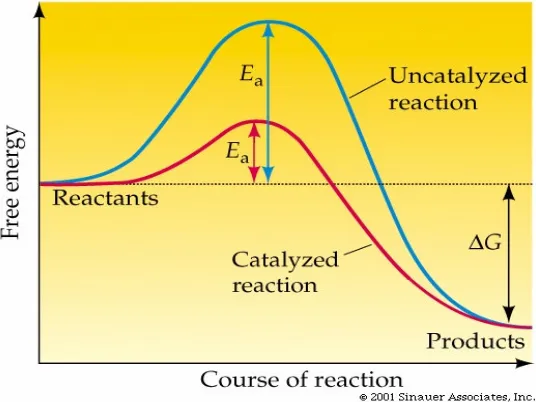
[image:34.595.192.460.492.693.2]In essence a catalyst is a material which makes the process more viable. The concept of viability implies that the reaction can be carried out under milder conditions, with a lower amount of waste and/or better selectivity. Although the role of these material in making the process more viable has not been fully determined, the generally accepted proposal is the reduction of the activation energy of the rate determining step in the formation of the product (Fig 1.1). The decrease in energy in this step makes the reaction easier and leads to the formation of the desired product.
These beneficial effects of catalysts results in their widespread use in the chemical industry. Chris Adams, writing for The North American Catalyst Society, stated that “35% of global GDP depends on catalysts although this excludes the emergent genetic business.
Confining the analysis to the chemicals industry, with global sales of perhaps $1.5 · 1012
the proportion of processes using catalyst costs are much less than 1 % of the sales revenue
from the products which they help create. Small wonder that the catalyst market is
increasing at 5 % per annum”.5
The decision to choose a catalyst is one of the most important stages in the preparation of a process. In essence the aspects which contribute to making a good catalyst, are as follows:
Required conditions
Selectivity
Atom economy and generation of waste
Cost
Time stability and recyclability
Air stability
Operate under continuous flow conditions
The essential conditions required by a process must be taken into consideration. The temperature, pressure and time of a reaction are variable which may influence the cost of the process, and therefore the cost of the product and any profits arising. A lower temperature results in a less expensive heating process and a lower pressure process requires equipment which is less material intensive, and therefore, requires a less expensive installation. For these three reasons, it is desirable for a process to be carried out under as mild conditions as possible – preferably ambient pressure and temperature – to increase the profit obtained.
Chemoselectivity: The generation of one of the possible product types, such as
alcohols or aldehydes.
Regioselectivity: The generation of one regioisomer such as the formation of
branched or linear aldehyde in the oxo process (Fig 1.2).
Stereoselectivity. The generation of one of the stereomers: diastereomers or enantiomers.
Very often the selectivity is dependent on the conditions of the process. Harsh conditions in a reaction may lead to a decrease in selectivity while mild conditions, although giving better selectivity, tend to yield low conversion. Therefore a compromise between conversion and selectivity must be made.
The generation of by-products and waste is undesirable, but may be inherent in the reaction, such as the formation of calcium chloride in the Solvay process.6By-products may also arise from a loss in selectivity, such as the generation of a branched product in the carbonylation process. The production of by-products must be minimized in the industrial applications of these processes.
Two factors have been established to quantify the generation of these by-products and waste – the atom economy factor and theEfactor.
Atom economy is a concept described by Trost.7 Atom economy is defined as “The formula weights of the desired products divided by the stoichiometric weight of the all reactants”. Therefore the incorporation of all the reactants into the final molecule should be maximised in the process.
R + CO + NuH
R
O
Nu H
O
OEt
O
OEt O
EtO "M"
M: Pd, Co, Rh
Pd
O O
Carbonylation
Dimerisation
Pauson-Khand R
Nu O +
Linear Branched
Co
Fig 1.2.Examples of 100% atom economic processes
The second parameter for the quantification, theEFactor, was introduced by Sheldon11 and defined as the mass (kg) ratio of waste to desired product.
Table 1.1.TheEFactor of different chemical sectors.5
Industrial segment Product tonnage (kg) Efactor
Oil refining 106-108 Approx. 1
Bulk Chemicals 104-106 <1-5
Fine Chemicals 102-104 5-50+
Pharmaceuticals 10-103 25-100+
Another factor which must be taken into account is the cost of the catalyst. A catalyst is often formed from precious metals or expensive enzymes. Therefore the cost of the catalyst can result in the rejection of a process. This cost should not exceed one per cent of the value of the final product. Along with cost, the availability of the catalyst has to be considered. Due to supply and demand, when a cheap catalyst is overexploited, its price will increase, therefore converting an acceptable process into an unacceptable one.
[image:38.595.149.506.300.567.2]One example is the recent price of palladium. The new processes developed based around this metal have resulted in its price increasing (Fig 1.3)12. Therefore a process based on palladium which was viable in the 1960’s may not be valid nowadays.
Fig 1.3.Fluctuation of palladium price in the last four decades12
expensive catalyst with high regeneration possibilities may be considered an excellent choice of reagent for a process.
An interesting example of catalyst regeneration was discovered by Crabtree in the hydrogenation of carboxylic acids to give alcohols using a 1,1,1-tris(diphenylphosphino-methyl)ethane (Triphos)/ruthenium catalyst under hydrogen atmosphere13 (see Section 3.1.2). In this system, the release of CO from the forming alcohol poisons the catalyst (1) by generating the carbonyl species (2). However, at high temperature and in the presence of water, this CO is converted to CO2 by the water shift process, regenerating the catalyst
(Fig 1.4). This reactivation may take placein situby addition of water to the reaction.
PPh2 Ph2P Ph2P
Ru H H
R OH O
R OH
PPh2 Ph2P Ph2P RuH
H
R H PPh2
Ph2P Ph2P
Ru H
CO H 1
1
2 H2O
[image:39.595.202.448.310.561.2]CO2+ H2
Fig 1.4.Mechanism of catalyst reactivation in the hydrogenation of carboxylic acids.
must therefore be able to be recovered at the separation stage without loss of activity, and be pumped back into the reaction within a short time.
1.2.1.- Homogeneous and Heterogeneous Catalysts.
In general, a catalyst can be distinguished as either homogeneous or heterogeneous. A catalyst can be considered homogeneous when it can be dissolved in the medium in which the reaction will be carried out. Heterogeneous catalysts however, are insoluble in the reaction medium.
This difference makes the behaviour of the catalyst change substantially (Table 1.2). While the process of diffusion between solid and liquid (or gas) phases is a determining factor in heterogeneous catalysis, in homogeneous this factor is not present. Heterogeneous processes therefore generally require harsher conditions and a higher concentration of catalyst compared to homogeneous ones.
Table 1.2. Comparison of homogeneous and heterogeneous systems (adapted from references 5, 14 and 15).
Homogeneous Heterogeneous
Diffusion problems Not present Present
Concentration Small High
Reaction condition Mild Severe
Catalyst structure Known Unknown
Stoichiometry Known Unknown
Catalyst separation Difficult Easy
Stability May be poor High
Application Limited Wide
coordination sphere around the metal in the catalyst and how this catalyst progresses.16, 17 These useful techniques normally do not have a homologue in the solid state. Therefore, while the homogeneous catalytic cycles and stoichiometry can be understood fully in most cases, details of the heterogeneous catalysts are less well know.
The bottle-neck of homogeneous catalysis is the stability of the catalyst and subsequent separation. While heterogeneous catalysts can endure unusually high temperatures for the duration of a reaction, the upper temperature limit of homogeneous catalysts is approximately 250ºC.18 Likewise, the catalyst under homogeneous conditions does not present the same stability as under heterogeneous conditions. This results in the catalyst requiring to be recycled frequently and more often than heterogeneous catalysts. This subsequently results in a significant loss of interest for industrial applications.
These two effects limit the range of applications of homogeneous catalysts. Only processes under mild conditions (usually below 100ºC) and in which volatile products easily separated from the medium are produced can be applied under homogeneous conditions, unless special properties of the catalyst and products allow special separation methods to be used.
1.2.2.- Homogeneous Catalysts.
demanded oxygenated products. This has become the most important reaction catalysed by homogeneous catalysis,8 with the production of six million of tonnes of alcohols and aldehydes per year.3,18
+ CO + H2
[Co2(CO)8]
90ºC-150ºC 100-400 bar
H O
Fig 1.5.Oxo process developed by Roelen19
Hydroformylation was the first homogeneous process developed which involved the addition of a molecule of carbon monoxide. Carbonylation reactions have been developed such as hydroxycarbonylation and alcoxycarbonylation, as described by Reppe.15 In this carbonylation, the acid and the ester can be produced from alkenes under a carbon monoxide atmosphere in the presence of either water or an alcohol (Fig 1.6).
R + CO
R OH
O
R OR´
O R´OH
Alcoxycarbonylation
H2O
Hydroxycarbonylation
Fig 1.6.Hydroxycarbonylation and alcoxycarbonylation
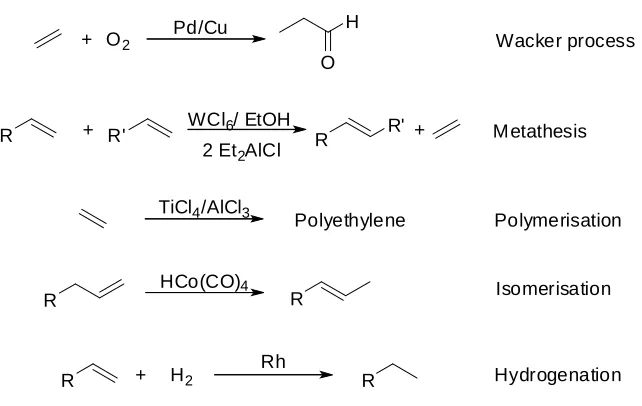
+
+ O2 H
O Pd/Cu
Wacker process
R R' WCl6/ EtOH R R' + Metathesis 2 Et2AlCl
Polyethylene Polymerisation TiCl4/AlCl3
R HCo(CO)4 R Isomerisation
R
Rh
[image:43.595.167.488.102.305.2]R Hydrogenation + H2
Fig 1.7.Homogeneous processes
These systems have been improved since the 1960’s with the replacement of iron, nickel, cobalt and tungsten with phosphine complexes of rhodium, palladium and ruthenium. One of these systems was developed by the Wilkinson group. This system is formed by a rhodium complex of triaryl phosphine and is extremely efficient in the hydroformylation of alkenes.21The use of certain diphosphines lead to better selectivities.22
New processes based on these new phosphine catalysts have been developed in the last thirty years, such as the carbonylation of methanol to generate acetic acid from methanol described by Pringle or Van Leeuwen,23 or the coupling reactions of Heck24, Stille25 and Suzuki.25,26 These processes convert homogeneous catalysts, with better selectivity under milder conditions, into significantly important systems for the production of plastics, fine chemicals, pharmaceuticals, etc.
1.2.2.1.- Use of Phosphines in Homogeneous Catalysis.
or electron donating groups or atert-butyl group instead of a methyl group can drastically change the coordination ability of phosphines and, therefore, the effectiveness of the catalyst.
The first example of the use of phosphines was described by Reppe. A complex of nickel with triphenylphosphine [NiBr2(PPh3)2] was found to be more efficient than NiBr2in
the reaction of an alkyne, an alcohol and carbon monoxide (alcoxycarbonylation).27 This, with other important contributions, provided an excellent base for this new chemistry.
These contributions include the hydrogenation of alkenes catalyzed by a
triphenylphosphine-platinium tin complex,28 the Shell process of hydroformylation based on a trialkylphosphine cobalt catalyst,29 and the advances in the use of the rhodium complex [RhCl(PPh3)3] in hydroformylation30 and hydrogenation31 as reported by
Wilkinson.
Since these origins, some reasoning about the influence of electronic and steric effects of this kind of ligand has been determined. Prior to the 1970’s, only the electronic effects of these ligands were taken into consideration. In that decade, studies confirmed that the combination of both effects gives the characteristics of the phosphine ligand. Therefore in view of improving the activity of catalysts formed by phosphines, a rational design of the phosphine ligand must be done. Tools for this rational design are a measurement of both the electronic and the steric effects.
1.2.2.1.1.- Electronic Effects.
The electron donating properties of the ligand depend on its electronic effect. This electronic effect was defined by Tolman. By effect he meant “changes in molecular
properties as a result of changing part of a molecule” and byelectroniche meant “a result
of transmission along chemical bonds, for example, changing from P(p-C6H4OMe)3to
P(p-C6H4Cl)3.”32
influence). Tolman prepared a series of phosphinetricarbonylnickel [Ni(CO)3L]
compounds by reaction at room temperature of [Ni(CO)4] with the corresponding
phosphine.32 Measurement of the IR frequency of the carbonyl group of different phosphines (Table 1.3) and referencing this to PtBu3 allowed Tolman to create a formula
for the quantification of the electronic effect of phosphines. This was done simply by the sum ofparameter of each substituents (Fig 1.8).
Table 1.3.CO Frequencies of [Ni(CO)3L] (Adapted from reference 33).
L
P(p-Tol)3 2066.7
P(o-Tol)3 2066.6
PMe3 2064.1
PEt3 2061.7
P(iPr)3 2059.2
P(tBu)3 2056.1
3 2 1X X
PX
3
3
1 . 2056
i i
Fig 1.8.Equation for the measurement of electronic effects in phosphines
1.2.2.1.2.- Steric Effects.
P
M 2.28 A
(a) (b)
P
M 2.28 A
(a) (b)
P
M
2.28 A
(a)
P
M
(b)
Fig 1.9.Cone angle (a) and White’s definition of solid angle (b)
The Tolman cone angle is an excellent approximation. However, the substituent in the ligand rarely presents a perfect cone, and therefore there is a difference between the real steric effect (measured by X-ray) and the steric effect predicted by Tolman. A modification of this cone angle was described recently by White and co-workers.34 This measurement consists of the projected area of the hypothetical shadow (solid angle,) of the substituents on the phosphine (Fig 1.9 (b)) giving a more realistic result (Fig 1.10).
P R
R R
Cone angle Solid angle
Fig 1.10.A comparison of solid angle and cone angle (adapted from 34a)
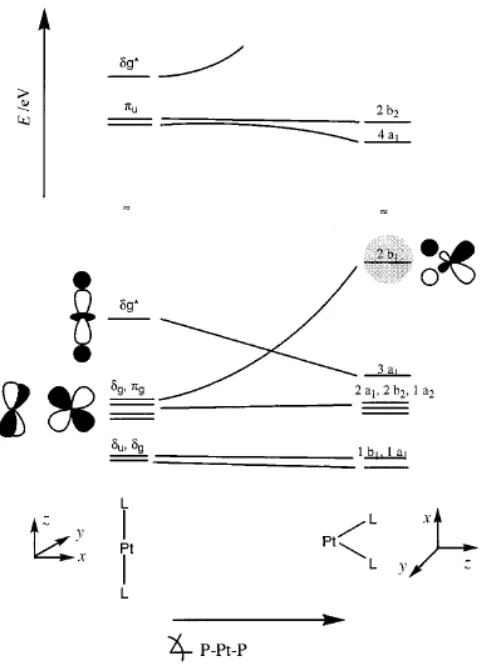
Therefore the electronic properties may be affected by the new geometry.37b,37cFor instance, the energies of the orbitals in platinum change slightly if the conformation is linear or square planar (Fig 1.11).38Therefore, although the natural conformation for platinum (0) is linear, it may be modified by coordination with a phosphine which forces the platinum to adopt another conformation, therefore changing both its electronic and steric properties.
Fig 1.11.Variation of orbitals depending on geometry of platinum complex38
complex, such as palladium or platinium, is basically a serious error. Several variables must be considered in this choice and often the choice of the best ligand for a process can not be predicteda priori,and only an experimental study of the possible ligand can confirm the hypothesis.
1.2.2.2.- Phosphines and Homogeneous Catalysis in the Real World.
Homogeneous catalysts, especially those which are formed by a phosphine and a metal, are an important advance in chemistry. However, no catalyst has an infinite lifetime. Decomposition processes which may take place in the medium under reaction conditions, lead to the inactivity of the catalyst. The study of these processes and the conclusions made make the system more understandable and therefore easier to improve. However, these studies are far from being a trivial task, because the decomposition of a catalyst may be influenced by the medium, reactants and their impurities, and the conditions of the reaction.
Generally, these processes of inactivation can be divided into two groups:
Thermal decomposition
Chemical decomposition
o Oxidation
o Alkylation
o Ligand scrambling
1.2.2.2.1.- Thermal Decomposition.
Homogeneous catalysts are appreciably more sensitive to thermal decomposition than heterogeneous catalysts (see Section 1.2.1). Therefore the thermal limit of this kind of process has to be taken into consideration. This limit is highly dependent on the ligand and
the medium. For example, the generation of methyl propanoate from the
of 1,2-bis(ditertbutylphosphinomethyl)benzene (BDTBPMB) instead of triphenylphosphine decreased the required temperature to 80ºC.2The sum of this fact with the fully protonation of the ligand in acid condition avoid the decomposition the of catalyst by alkylation.42
+ CO + MeOH
OMe O Pd/Ligand
Fig 1.12.Methoxycarbonylation of ethene
1.2.2.2.2.- Chemical Decomposition.
Chemical decomposition may be considered as all of the processes which may affect the catalytic activity. Usually a homogeneous catalyst is more sensitive to these processes of deactivation than a heterogeneous catalyst. The system may be affected by impurities in the reactants, intermediates or by the product itself. The quantity of phosphine also affects the activity of the catalyst. Normally the equilibrium of complex formation requires an excess of phosphine to increase the concentration of complex in the medium. However, a high excess of this may lead to the decrease in activity. A classical example of this effect is reported by Oliver and Booth in hydroformylation,5,43where a plot of activity versus PPh3/Rh shows a maximum and a drastic decrease of activity when the
PPh3/Rh is higher than this point in a typical “volcano plot” (Fig 1.13).
[image:49.595.262.390.529.651.2]P:Rh
1.2.2.2.2.1.- Oxidation.
Phosphines, as phosphorus (III) compounds, are usually air-sensitive and may be oxidised to phosphine oxides under an oxygen atmosphere or in the presence of peroxide (Fig 1.14). This reaction is highly dependent on the subtituents on phosphine. Therefore, while the highly donating phosphines are quickly oxidised under oxidising conditions, arylphosphines are relatively stable in the solid state.
Considering that phosphines oxides are inert, the exclusion of oxygen or other oxidants from the reaction must be a priority in homogeneous catalysis.
P 3
P 3
O O2or ROOH
Fig 1.14.Oxidation of phosphines
1.2.2.2.2.2.- Alkylation of Phosphines.
Phosphines are highly electron donating ligands, and are therefore plausible nucleophiles to consider in the process. Very often the phosphines are alkylated in the presence of a possible electrophile, generating undesirable phosphonium salts. The generation of these phosphonium salts may be severe in some processes such as the methoxycarbonylation of alkenes catalysed by the PPh3/Pd system (Fig 1.6). In this system,
R
MeOH + PR3 MePR3+OH
-+
R3P
M
R3P
CO H
R3P
M
R3P R
+
R
R3P
+ +
+ M(0)
HO
M/PR3
CO/H2 H
O
PR3
H2O
H
O
-R3P+
a)
b)
c)
Fig 1.15.Generation of alkylphosphonium salts by different methods
Alkylphosphonium salts may also be formed by reductive elimination of an alkylmetal species41 (Fig 1.15b). These alkylmetal species are quite common in the carbonylation process and are generated initially by insertion of a metalhydride into a double bond. This route is not only undesirable in terms of the ligands, but the reductive elimination leads the production of a metal (0) species, which are usually not active in these kind of processes.
In the case where the product is an ,-unsaturated compound, such as the generation of acrylic acid by hydroxycarbonylation of acetylene, or the hydroformylation of vinyl alcohol giving acrolein, a Michael addition of the phosphine to the double bond can take place giving the corresponding zwitterion44(Fig 1.15c).
1.2.2.2.2.3.- Ligand Scrambling.
P
2
P
3 SO3Na NaO3S
+ P
2 SO3Na
P 3 +
Fig 1.16.Scrambling of triphenylphosphine monosulfonated sodium salt1
The scrambling of the substituents modifies the reactivity and properties of the ligand. For example, in the particular case shown in Figure 1.16, the generation of a highly sulfonated ligand, such as triphenylphosphine bissulfonated sodium (TPPDS) or triphenylphosphine trisulfonated sodium (TPPTS), drastically changes the solubility of these compounds in polar solvents such as water, in turn affecting the catalytic process.
1.3.- 1,2-bis(ditertbutylphosphinomethyl)benzene as a Ligand.
Diphosphines are reported to give considerably better efficiency than
monophosphines in several processes such as carbonylation.
1,2-Bis(ditertbutylphosphinomethyl)benzene (BDTBPMB) (Fig 1.17) contains a large bridge which in turn gives a large natural bite angle (103.9ºC).42 The presence of a phenyl group gives some rigidity which is essential in the activity of this ligand. This steric effect, in addition to its high electron donating properties given by two tertbutyl groups in each phosphine, make 1,2-bis(ditertbutylphosphinomethyl)benzene an essential ligand in a large number of systems especially in carbonylation processes.
P P
The first synthesis of this ligand was reported by Shaw in (1974) by direct attack of the ditertbutylphosphine on 1,2-di(bromomethyl)benzene (Fig 1.18).46 This synthesis requires a deprotonation of the formed phosphonium hydride by base. Although recently this synthesis has been improved with the addition of an acid47 in the first step, this preparation gives only moderate yields (30%). No by-product has been reported.
P P Br
Br
H P
P P
H H
[image:53.595.130.522.493.648.2]Base
Fig 1.18.Preparation of BDTBPMB via attack of ditertbutylphosphine
The generation of LiPtBu2 by deprotonation of ditertbutylphoshine with butyl
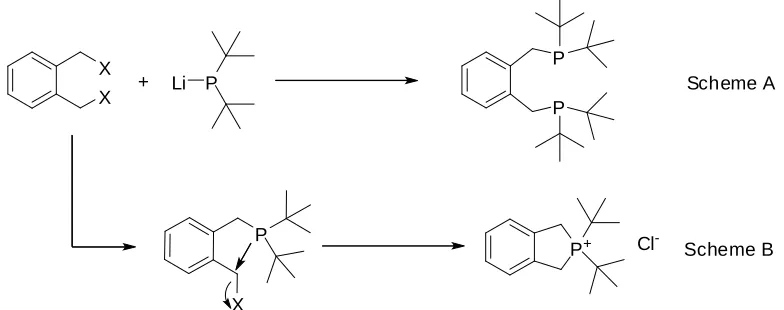
lithium makes the phosphorus more nucleophilic, and therefore easier to react with the dihalide compound (Fig 1.19 Scheme A). This route yielded high conversion, although a cyclic phosphonium salt is formed as by-product (40%).48This phosphonium salt is formed by the intramolecular reaction of the monosubstituted phosphine intermediate with the halide in the benzilic position (Fig 1.19 Scheme B). Attempts to cleave this ring have been unsuccessful.
X
X + Li P
P P
P
X
P+ Cl
-Scheme A
Scheme B
The modification of this route using LiPtBu2(BH3)49 instead of LiPtBu2 blocks the
synthesis of the phosphonium salt. This route forms the corresponding BH3 protected
BDTBPMB (Fig 1.20). Easy deprotection developed by Lucite50 involves treatment with methanesulfonic acid, giving the phosphonium hydride, which is then deprotonated by an ethanolic sodium hydroxide solution giving the corresponding BDTBPMB.
X
X Li PtBu2 +
PtBu2 PtBu2 BH3
BH3
BH3
PtBu2 PtBu2 BH3
BH3
+ PtBu2 +PtBu
2 H
H
PtBu2 PtBu2 2 MeSO3
-MeSO3H NaOH/EtOH
Fig 1.20.Formation of BDTBPMB via a boron protected secondary phosphine
Another interesting approach to obtain BDTBPMB involves via deprotonation of orthoxylene with butyl lithium/potassiumtertbutoxide in the presence of an amine, usually TMEDA generating the corresponding potassium salt. This potassium salt gives a highly nucleophilic species, which is able to attack the chloroditertbutylphosphine (Fig 1.21), to obtain the desirable phosphine in yields ranging from 31-69% depending on the conditions used.51 A variant of this system is the use of the Grignard reagent of 1,2-di(chloromethyl)benzene instead of the potassium salt, to give a yield of 55%.52
PtBu2 PtBu2 CH2
-CH2 -BuLi/KtOBu
TMEDA
ClPtBu2 K+
K+
1.3.1- 1,2-bis(ditertbutylphosphinomethyl)benzene in Catalysis.
1.3.1.1.- Generation of Methylmetracrylate: From the Old Process (ACH) to the
New Alpha Process.
Poly(methyl methacrylate) (PMMA) also known as plexiglax (Rohm and Haas), Lucite (DuPont) or Perspex (ICI) is a highly transparent thermoplastic polymer. Its uses are normally in the substitution of glass in common objects such as tables, glasses, and windows. The sales of this common polymer, discovered by Rohm, came to only $13,000 in its first year. Its importance was raised during the Second World War in the manufacturing of new aircraft – in 1943 alone, 83,000 tonnes of PMMA were produced.2 Nowadays, 2.4 x 10⁶ tonnes are produced annually, of which Lucite International owns 25% of the worldwide production.53
The traditional process for the manufacture of methyl methacrylate (MMA), the monomer for PMMA, involves a three-step process: firstly the generation of a cyanohydrin (Fig 1.22), followed by the dehydration of the alcohol/hydration of cyano group, and finally exchange of ammonia and methanol (Fig 1.23).
O
HCN
+ OH- HO CN
Fig 1.22.Generation of cyanohydrin
NH3+ O CN
HO
+ H2SO4 HSO4
-NH3+ O
HSO4- MeOH
OMe O
+ NH4HSO4
Fig 1.23.Generation of methyl methacrylate from cyanohydrin
Although this process is economically competitive, it presents some negative factors. The main negative factor is the use of hydrogen cyanide. This combined with the production of 1.2 tonnes of ammonium bisulphate per tonne of methyl methacrylate results in the ACH process being unacceptable.
Some alternative processes have been developed in the last few years,54 of which one of the most important is the alpha process developed recently by Lucite which consists of two steps.53 The first stage consists of the methoxycarbonylation of ethene under a carbon monoxide atmosphere by homogeneous BDTBPMB/palladium catalyst to generate methyl propanoate (MeP). MeP reacts with formaldehyde in the gas phase at 320oC and at 2 bar pressure giving MMA with 97 % selectivity (Fig 1.24). The concentration of water, which is generatedin situ, must be kept to a minimum in order to decrease the production of methacrylic acid. In this process virtually no waste is generated. Therefore, this fact along with the high efficiency of the new catalyst (See Section 1.3.1.2) makes the process more environmentally friendly. Also, a 20 % cost saving has been estimated for this new process.53
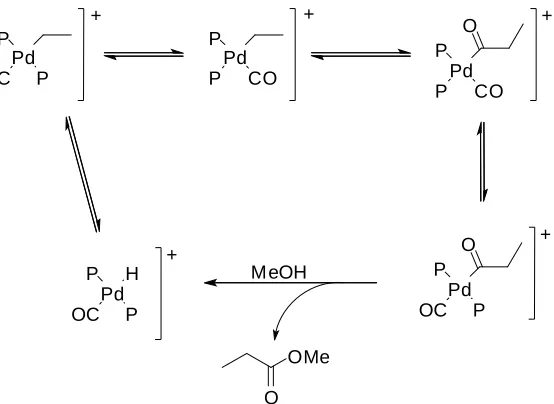
OMe O + CO
OMe O
OMe
O O
+ H
H
MeOH
Pd/Ligand
H2O