LETTER • OPEN ACCESS
Variation in beliefs about ‘fracking’ between the
UK and US
To cite this article: Darrick Evensen et al 2017 Environ. Res. Lett. 12 124004
View the article online for updates and enhancements.
Related content
Just fracking: a distributive environmental justice analysis of unconventional gas development in Pennsylvania, USA Emily Clough and Derek Bell
-The greenhouse impact of unconventional gas for electricity generation
Nathan Hultman, Dylan Rebois, Michael Scholten et al.
-The neglected social dimensions to a vehicle-to-grid (V2G) transition: a critical and systematic review
Benjamin K Sovacool, Lance Noel, Jonn Axsen et al.
Environ. Res. Lett.12(2017) 124004 https://doi.org/10.1088/1748-9326/aa8f7e
LETTER
Variation in beliefs about ‘fracking’ between the UK and
US
Darrick Evensen1,6 , Richard Stedman2, Sarah O’Hara3, Mathew Humphrey4and Jessica
Andersson-Hudson5
1 School of Psychology, Cardiff University, Tower Building, 70 Park Place, Cardiff, CF10 3AT, United Kingdom 2 Department of Natural Resources, Cornell University, 104 Fernow Hall, Ithaca, NY 14853, United States of America 3 School of Geography, University of Nottingham, Trent Building, University Park, Nottingham, NG7 2RD, United Kingdom 4 School of Politics and International Relations, University of Nottingham, University Park, Nottingham, NG7 2RD, United Kingdom 5 School of Social Sciences, Nottingham Trent University, Goldsmith Street, Nottingham, NG1 5JT, United Kingdom
6 Author to whom any correspondence should be addressed.
OPEN ACCESS
RECEIVED
23 November 2016
REVISED
26 September 2017
ACCEPTED FOR PUBLICATION
27 September 2017
PUBLISHED
24 November 2017
Original content from this work may be used under the terms of the
Creative Commons Attribution 3.0 licence. Any further distribution of this work must maintain attribution to the author(s) and the title of the work, journal citation and DOI.
E-mail:[email protected]
Keywords:shale gas, hydraulic fracturing, cross-national comparison, United States, United Kingdom, energy development
Supplementary material for this article is availableonline
Abstract
In decision-making on the politically-contentious issue of unconventional gas development, the UK
Government and European Commission are attempting to learn from the US experience. Although
economic, environmental, and health impacts and regulatory contexts have been compared
cross-nationally, public perceptions and their antecedents have not. We conducted similar online
panel surveys of national samples of UK and US residents simultaneously in September 2014 to
compare public perceptions and beliefs affecting such perceptions. The US sample was more likely to
associate positive impacts with development (i.e. production of clean energy, cheap energy, and
advancing national energy security). The UK sample was more likely to associate negative impacts
(i.e. water contamination, higher carbon emissions, and earthquakes). Multivariate analyses reveal
divergence cross-nationally in the relationship between beliefs about impacts and support/
opposition—especially for beliefs about energy security. People who associated shale gas development
with increased energy security in the UK were over three times more likely to support development
than people in the US with this same belief. We conclude with implications for policy and
communication, discussing communication approaches that could be successful cross-nationally and
policy foci to which the UK might need to afford more attention in its continually evolving regulatory
environment.
1. Introduction
The general public’s framing of unconventional gas development (UGD), portrayed in mass media, social media, and documentary film, has influenced politi-cal regulation of development and the industry’s social licence to operate (Lloyd et al 2013, Andrews and McCarthy 2014, Cottonet al2014, Luke et al2014, Simonelli2014, Vasiet al2015, Williams et al2017, Bomberg2015, Mazur2016). The ability of develop-ment to proceed in the UK and elsewhere will depend just as much on public perceptions and acceptability
of this form of energy extraction as it does on scien-tific and technical knowledge (Rayner2010, Webler and Tuler 2010, The Royal Society 2012, Kasper-son and Ram2013, Stephenson2016, UKERC2016). Nevertheless, while research has focused on the extent to which economic, environmental, and health impacts and local contexts associated with extensive develop-ment in the US are potentially transferable to the UK (House of Lords 2014, Public Health England 2014), and Europe broadly (EASAC2014, Pearsonet al 2012), similar attention has not been afforded to public perceptions (Thomaset al2017).
We compare public perceptions of UGD (often called‘fracking’)7 in the United Kingdom (UK) and
United States (US) via simultaneously-implemented surveys of representative national samples in both nations. Each nation has witnessed intense mass media coverage (Evensenet al2014a, Jaspal and Nerlich2014, Jaspalet al2014, Williamset al2017, Ashmooreet al 2016, Bomberg2015, Mazur2016), policy attention, and debate on this issue (Smallet al 2014, Sovacool 2014, Wiseman2014, Konschnik and Dayalu 2016). Both nations have considerable unconventional gas reserves in which firms have expressed active inter-est in exploitation. Many differences exist between the UK and US, however, in: (1) private vs. national ownership of mineral rights, (2) processes for leas-ing mineral rights, (3) national vs. state/regional/local governance, (4) the level at which most political dis-course occurs, and (5) length and depth of experience with physical development (see Stedmanet al(2016) for an overview of such differences). Furthermore, the social and cultural contexts vary considerably across nations (Partridgeet al2017). The differences in policy and regulation between the US and Europe on UGD (Boersma and Johnson2012, Wang and Hefley2016, Whittonet al 2017) and the differential influence of communication on policy across these regions (Metze and Dodge 2016, Bomberg2017, Dodge and Metze 2017) have been a topic of notable academic interest. Far less research has compared public perspectives on UGD.
Public perceptions on this issue have been stud-ied extensively in the US (e.g. Anderson and Theodori 2009, Braiseret al2011, Perry2012, Jacquet and Sted-man 2013, Kriesky et al2013, Ladd2013, Theodori 2013, Jacquet and Stedman2014, Theodoriet al2014, Clarkeet al 2015, Crowe et al 2015, Evensen 2015, Evensen et al2017, Israelet al 2015, Morrone et al 2015, Schafft and Biddle2015, Sangaramoorthyet al 2016, Kroepsch 2016, see Thomas et al 2017 for a review) and UK individually (e.g. Cottonet al 2014, Cotton 2015, Whitmarsh et al 2015, Williams et al 2017, Bomberg2015, Andersson-Hudsonet al2016,
O’Hara et al 2016, see Lis et al 2015 for a review),
but to our knowledge there has been no cross-national quantitative comparison of factors influencing per-ceptions. One study has compared perceptions across in-depth qualitative workshops in select cities within the UK and California (Partridgeet al2017). Other research compared perceptions across in-depth indi-vidual interviews: (1) in the US and Canada (Evensen and Stedman2017a) and (2) nations in Eastern Europe
7We use the term‘unconventional gas development’throughout this article to refer to the set of processes and associated effects that attend this form of energy extraction/development. While no term is perfect, social-psychological research into how this word is used provides nuanced discussions of why to avoid use of‘fracking’ (Wolske and Hoffman2013, Evensenet al2014b, Evensen2016). We employ this term to mean the processes most commonly linked to‘shale gas’and‘fracking’in public and mass media discourse.
(Goldthau and LaBelle2016, Goldthau and Sovacool 2016). Furthermore, we previously reported on differ-ent data from the same comparative surveys examined herein to explore the relationship between awareness of UGD and support for development cross-nationally (Stedmanet al2016). In this article, we substantially further understanding of cross-national differences by examining UK versus US differences in associations between beliefs about impacts caused by UGD and sup-port for UGD. This new analysis allows us to consider why cross-national variations exist; we then use this information to recommend how political communica-tion and policy approaches in each nacommunica-tion could mirror or depart from those in the other nation.
1.1. Research questions
The differences between the UK and US and the interest in identifying lessons from the US experience with UGD that could apply in the UK, led us to the following research questions that guided our data collection and analysis:
1. What differences, if any, exist between the UK and US on beliefs about impacts associated with UGD?
2. Are cross-national differences in support and oppo-sition unique to UGD or are they also reflected in support for and opposition to other energy sources?
3. What factors (e.g. beliefs and/or demographic char-acteristics) exert the greatest influence on support for and opposition to UGD in each nation? Do these factors, or the strength of their relationship with support and opposition, differ cross-nationally?
2. Methods
We used an existing, repeated cross-sectional online survey of the UK general public to conduct a UK/US comparison of public perceptions. We implemented nearly identical surveys with the UK sample (7–9 September 2014,n= 3823, administered by YouGov) and US sample (16–19 September 2014, n= 1625, administered by Qualtrics). Both surveys approximated their respective national populations with respect to sex, regional distribution (by state in the US and by the 12 national census regions in the UK), and age (of individuals 18 years and older)8. Because both
sur-vey firms draw respondents from online panels, quotas were applied to responses to ensure that the resulting responses match the national averages demographi-cally. In addition to the aforementioned metrics on
Environ. Res. Lett.12(2017) 124004
* independent samples t-test between nations significant at p < 0.01; ** significant at p < 0.001. T-test excludes ‘don’t know’ responses from the analysis.
0 10 20 30 40 50 60
Cheap energy** Clean energy** Energy security** Higher greenhouse
gas (carbon) emissions
Contamination of drinking water*
Earthquakes**
[image:4.595.123.551.59.271.2]Yes (UK) Yes (US) No (UK) No (US) Don't know (UK) Don't know (US)
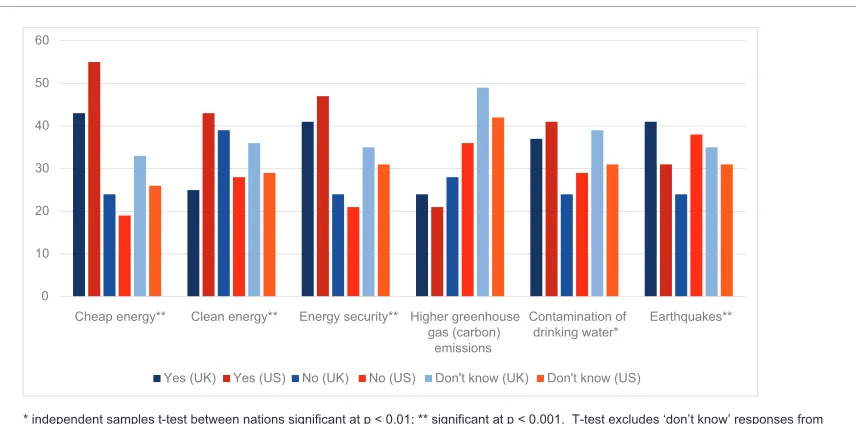
Figure 1.Do you associate the following with shale gas?
which the samples were representative, the YouGov sample also used quotas for social class (a UK marketing research metric) and type of newspaper readership.
While the two surveys employed mostly the same questions, wording did vary in a few instances (see supplementary methods available at stacks.iop.org/ ERL/12/124004/mmedia). An additional limitation is the slightly different recruitment strategies of the online firms that conducted the research in the respective nations, although both did employ existing online panels and used quota sampling approaches. Fur-thermore, the samples were nationally representative based on population distribution across the nations, meaning that areas with low population have very lit-tle representation in the surveys (e.g. states such as the Dakotas, Wyoming, and Montana; regions such as Scotland, Wales, and North East England; and all rural areas). This means that areas with UGD (or potential for UGD) contributed few respondents. The goal, however, was not a cross-state comparison within the US or a cross-region comparison in the UK; instead we sought to identify macro-level differ-ences between the US and UK. The survey should be viewed as reflecting national views on this topic, not the views of communities exposed to development or with potential for development (see Clarke et al (2016) and Evensen and Stedman (2016) for a dis-cussion of differences in perception based on scale of analysis).
The original wording appears in our supplemental material for each question we report on in the results section. These were not the only questions in the sur-vey (for the full sursur-vey text also see the supplemental information). We began the survey with a question asking respondents to identify which gas, from a list, is associated with hydraulic fracturing or‘fracking’. If they answered correctly (‘shale gas’), they continued on to the rest of the survey; if they answered incorrectly,
they received a brief statement about shale gas and then continued.
3. Results
3.1. UK/US differences in support and opposition
In our previous analysis of this data set (Stedmanet al 2016), we report on basic descriptive statistics—herein we focus on multivariate relationships. The prior analy-sis revealed that 60% of the US sample replied shale gas extraction‘should’be allowed, whereas 25% answered ‘should not’, and 16% responded‘don’t know’. In the UK sample, 44% responded‘should’, 27% answered ‘should not’, and 29% responded‘don’t know’. Uncer-tainty was almost twice as prevalent in the UK as in the US, despite twice as many people in the UK answering the awareness question correctly as in the US (72% versus 36%—which gas, from a list, is asso-ciated with hydraulic fracturing?). In addition to the national level analysis on support and opposition, we compared across areas within each nation (see supple-mental information for these data).
Below we address each of our research questions in turn, and in doing so shed light on possible rationales for cross-national differences in support and opposi-tion.
3.2. UK/US differences in beliefs about impacts
We asked respondents whether or not they associ-ated six distinct impacts with shale gas (figure1; see also table S1 in supplementary information for the full data). When excluding‘don’t know’answers, a higher percentage of UK respondents, compared with US respondents, associated the three negative impacts with shale gas (i.e. earthquakes, water contamination, and higher emissions); a higher percentage of US respon-dents associated the three positive impacts with shale gas (i.e. cheap energy, clean energy, energy security).
* independent samples t-test between nations significant at p < 0.01; ** significant at p < 0.001; t-test compares the UK response option ‘should be part of the UK’s energy mix’ to the US response options ‘support’ and ‘strongly support’ (pooled together); UK response option ‘should NOT be part of the UK’s energy mix’ is compared to ‘oppose’ and ‘strongly oppose’ (pooled)
NB: ‘don’t know’ and ‘neither support nor oppose’ responses are not included for significance tests to allow for comparability across samples 0
10 20 30 40 50 60 70 80 90
Hydro-electric
Solar* Wind** Conventional natural gas**
Bioenergy / biomass**
Shale gas** Coal* Nuclear**
[image:5.595.119.553.61.252.2]Support (UK) Support (US) Oppose (UK) Oppose (US)
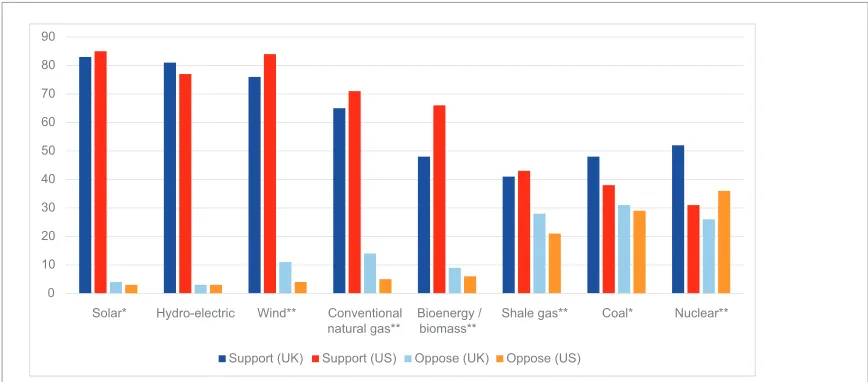
Figure 2.Support for domestic use of various energy sources.
The largest differences between nations were for clean energy (43% in the US vs. 25% in the UK asso-ciated it with shale gas) and cheap energy (55% in the US vs. 43% in the UK). The percentage of‘don’t know’responses was high in both nations (over 25% for all six associations) and particularly for association with higher vs. lower greenhouse gas emissions (over 40% in each nation). This mirrors scientific uncertainty and disagreement over whether UGD will increase or decrease net carbon emissions (Alvarez et al 2012, Newell and Raimi2014).
3.3. Support for other energy sources
Our second research question queried the broader con-text around the cross-national differences observed in relation to UGD—are these reflected in support for and opposition to other energy sources? We asked whether respondents supported or opposed domestic production and use of each of eight renewable energy, fossil fuel, and nuclear energy sources. For the com-parisons below, we include respondents who answered the question affirmatively or negatively (i.e. exclud-ing ‘don’t know’ and ‘neither support nor oppose’ responses to allow for comparison of the differently-worded questions across the two samples; all responses are reflected in table S2 in the supplementary informa-tion, however). Statistically significant differences, via independent samples t-tests, existed between nations for seven of the eight energy sources (figure2). Sup-port was higher in the US for five sources. Nevertheless, high support for all forms of renewable energy listed (i.e. solar, hydro-electric, wind, and bioenergy)andfor conventional natural gas existed in both nations. More than 92% of US respondents with positive or negative views on the energy source in question supported use of each of these five energy sources, while at least 83% in the UK supported use of each source.
Of respondents who supported or opposed devel-opment (not answering‘don’t know’[UK survey] or ‘neither support nor oppose’ [US survey]), support for shale gas as a future national energy source was higher in the US (68%) than in the UK (58%). In each case, the percentage of respondents supporting shale gas for domestic use was substantially lower than the percentage supporting conventional natural gas (93% in US; 83% in UK). Support for the other fossil fuel, coal, was higher than support for shale gas in the UK; the opposite was true in the US sample (again, excluding ‘don’t know’and ‘neither’ responses). Compared to other energy sources, sup-port for nuclear power was by far the lowest in the US (45%). Although support was not high in the UK (66%), the gap between nations was largest for this energy source.
3.4. Factors affecting support for UGD; cross-national differences
Environ. Res. Lett.12(2017) 124004
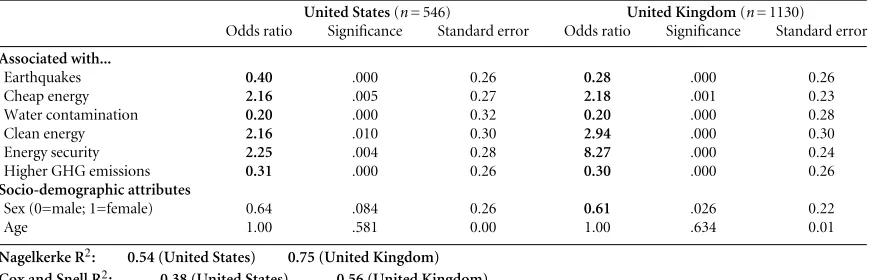
Table 1.Binary logistic regression, support/opposition and associations with shale gas.
United States(n= 546) United Kingdom(n= 1130) Odds ratio Significance Standard error Odds ratio Significance Standard error
Associated with...
Earthquakes 0.40 .000 0.26 0.28 .000 0.26
Cheap energy 2.16 .005 0.27 2.18 .001 0.23
Water contamination 0.20 .000 0.32 0.20 .000 0.28
Clean energy 2.16 .010 0.30 2.94 .000 0.30
Energy security 2.25 .004 0.28 8.27 .000 0.24
Higher GHG emissions 0.31 .000 0.26 0.30 .000 0.26
Socio-demographic attributes
Sex (0=male; 1=female) 0.64 .084 0.26 0.61 .026 0.22
Age 1.00 .581 0.00 1.00 .634 0.01
Nagelkerke R2: 0.54 (United States) 0.75 (United Kingdom)
Cox and Snell R2: 0.38 (United States) 0.56 (United Kingdom)
NB: The dependent variable is coded as 1 = extracting natural gas from shale in [UK or US] should be allowed, 0 = should NOT be allowed; boldodds ratios denote significant parameter estimates (p<0.05).
the UK R2(i.e. percent variation in the dependent vari-able explained by the set of independent varivari-ables) was substantially higher (0.75 for UK; 0.54 for US). Much research on public perceptions of UGD in the US has asserted that beliefs about impacts are key cor-relates of support/opposition (Jacquet and Stedman 2013, Theodori2013, Evensen and Stedman2017b); our data suggest that this is true to an even greater extent in the UK.
All odds ratios for the associations were in the intuitive directions—beliefs that risks exist were asso-ciated with opposition; beliefs that benefits exist were associated with support. Beliefs that water contamina-tion, higher greenhouse gas emissions, and earthquakes will occur link with more opposition. In contrast, if one associates development with cheap energy, clean energy, or energy security, one is more likely to support development. The degree to which beliefs about cheap energy, water contamination, and higher greenhouse gas emissions are associated with support for UGD is remarkably similar across the nations (as measured by the odds ratios).
A substantial cross-national difference emerges in the extent to which association with energy security cor-relates with support; UK respondents who associated UGD with energy security were 8.3 times more likely to support development than UK respondents who did not make this association (the odds ratio in the US was only 2.3). A logistic regression for the UK sam-ple with support/opposition as the dependent variable and association with energy security as the sole inde-pendent variable generated a Nagelkerke pseudo-R2of 0.52, meaning that this association alone could explain over half of the variation in support for and opposition to development.
4. Discussion and communication
implications
Shale gas received the least support in the UK of any of the eight energy sources considered in our survey. Even coal, widely recognised as more polluting, more
detrimental for climate change, and more liable to cause human health problems (Duggan-Haas et al 2013), received greater support. This could owe, in part, to the UK having much more historical experience with coal extraction than with onshore gas development—coal is a known entity (Gunzburgeret al2017). Neverthe-less, support for shale gas contributing to the future energy mix in both nations outstripped opposition, and more respondents in both nations supported domestic production and use than opposed it.
In both nations, the opposition that exists to UGD seems to have little to do with thegas aspect, as support for conventional natural gas use paral-lels levels for renewable energy sources. This has considerable implications for communication and policy on this issue, especially in light of the UK government’s announcement in November 2015— and renewed commitment under Prime Minister Theresa May’s current Government—of bringing more gas-fired electricity generating plants online to replace coal-fired plants—all of which are slated to be retired by 2025. Focusing on differences (or lack thereof) between unconventional and conventional develop-ment in mass media and political discourse could strongly shape policy conversations and public per-ceptions. The UK Government, industry, and other entities supporting UGD would likely see this as an opportunity to highlight similarities between UGD and conventional development (e.g. that which has occurred in the North Sea for decades), while oppo-nents such as community ‘frack free’ organisations and environmental non-governmental organisations would seek to emphasise the differences. Our rec-ommendation is that any party interested in fostering informed decision-making clearly explicate, in accessi-ble language, the similarities and differences between conventional and unconventional development in terms of both the techniques employed and the potential impacts on environment, economy, and social life.
The cross-national differences in beliefs about impacts highlight that the ‘cheap and clean’ depic-tion of UGD conveyed in the US has clearly not been
accepted to the same extent in the UK. Discourse and mass media coverage on UGD in the US is decentralised and regional, varying from state to state (Ashmooreet al 2016), whereas national media coverage is the primary means of information sharing in the UK (Bomberg 2015, Cotton 2015, Williams et al 2017). Coverage that challenges the‘cheap and clean’message would thus be more diffuse in the US and any exposure to this message likely would not be evident in a national sample survey that has little representation of individ-uals living in the rural areas where development occurs or is likely to occur (i.e. where regional mass media coverage on this topic is based). Conversely, the nat-ural gas industry has engaged in extensive television advertising in the US, employing the rhetoric of‘cheap and clean’. Indeed, previous research has found an association between obtaining information predomi-nantly from television and increased support for UGD (Boudetet al2014).
The results herein help explain our previously-reported finding that support is substantially elevated in the US sample compared to the UK sample
(Sted-manet al2016). The effect sizes of the binary logistic
regressions showed that a large percentage of the vari-ance in support and opposition can be explained by beliefs about a relatively small number of impacts potentially associated with UGD (six beliefs explain 54% of variance in the US and 75% in the UK). When excluding‘don’t know’responses, the UK sam-ple perceived, on average, all three negative impacts to be more likely than the US sample did. Con-versely, the US sample perceived all three positive impacts as more likely than the UK sample did. If we assume that beliefs about impacts precede evaluations of support and opposition, the cross-national differ-ences in beliefs about these six impacts can explain the majority of the difference in support and opposition cross-nationally.
The substantial percentage of ‘don’t know’ responses to the support/opposition question and to the six ‘beliefs about impacts’ questions reveals that there might be a large undecided population whose views on this topic can be shaped further. Recent research has shown that additional informa-tion about impacts of UGD can influentially shape overall attitudes and beliefs (Whitmarsh et al 2015). Beliefs about UGD’s effects on water contamination, energy security, and carbon emissions are all strongly associated with likelihood of support for UGD; fur-thermore, over 30% of respondents in each nation answered‘don’t know’as to whether these effects were associated with UGD or not. Due to the important connection between beliefs about these issues and sup-port/opposition, and the amount of indecision about UGD especially in the UK, communication about these effects could potentially influence public percep-tions to a heightened extent in the UK compared to the US.
5. Policy relevance
In this section, we focus predominantly on policy in the UK, because the UK Government is currently seeking to move forward with shale gas extraction (in Eng-land) and is trying to learn from US experience for the formation of policy. Her Majesty’s Treasury (2016) is reviewing evidence from a consultation on how to approach setting up a shale wealth fund to compen-sate people in England living near shale developments. Information is being drawn from the US experience. We are not aware of any examples of US states or US regulatory authorities looking to the UK experience to inform their policy and regulation. This does not mean that policy developments in the US are not impor-tant or interesting; we simply feel that UK policy has much more to learn from a comparison of UK and US perceptions than US policy has to gain from such a comparison. The fact that regulation is much less decentralised in the UK also means that policy direc-tions can be discussed more clearly and concisely in that nation (i.e. only the four national governments— England, Scotland, Wales, and Northern Ireland—have jurisdiction over regulation).
In Her Majesty’s Treasury’s (2016) recent con-sultation on a proposed shale wealth fund, the UK Government revealed it wants to make benefits of shale gas development to local communities more tangi-ble. While this is certainly one approach to increasing support for shale gas development (the Government’s clear goal), the importance of national-level implica-tions of development (e.g. energy security and carbon emissions) cannot be neglected. Likewise, our find-ing that the public attribute as much importance to beliefs about water contamination in the UK as do the public in the US (where this is often reported as the cen-tral issue affecting support/opposition), reveals that UK Government discourse and regulation must not dwell solely on benefits, but also on proper management and regulation of risks.
Environ. Res. Lett.12(2017) 124004
In terms of communication from interest groups opposed to the Government’s current support for development, these entities (e.g. Friends of the Earth and ‘Frack Free’ organisations within communities throughout the UK) have already focused on water contamination, earthquakes, and their questioning of the premise that shale gas development benefits carbon emissions—due to incentivising investment in further infrastructure that will prolong dependence on fossil fuels. Our finding on the importance of beliefs about energy security intimates that these groups also could benefit from an explicit focus on the energy security implications of UGD. For example, if UGD is to be opposed, what other energy sources can be realistically relied upon to enhance the energy security that clearly matters to the British public?
In terms of the effect of associating UGD with higher carbon emissions on support/opposition, Whit-marshet al(2015) have independently shown through an embedded experiment in a survey of UK residents that providing people with additional information about the connection between UGD and carbon emis-sions can change attitudes, particularly for individuals without firmly held views on whether such a relation-ship exists. Considering that 42% of survey respondents in the US and 49% of respondents in the UK reported that they‘don’t know’whether UGD is associated with higher carbon emissions or not, this could be a fruit-ful area for further communication in either nation. While much research has established the connection between views on climate change and political lean-ing (i.e. liberals are more likely to attribute climate change to anthropogenic sources and to be concerned about it compared to conservatives), no research yet has examined whether political views affect the extent to which an association is made between climate change and UGD. One might hypothesise that liberals would associate higher emissions with UGD, while conserva-tives would associate lower emissions with UGD; this remains an important area for further inquiry. Nev-ertheless, the fact that nearly half of all respondents in both surveys were undecided on this association indicates that, unlike views on climate change itself, views on this association between emissions and UGD might be susceptible to influence through provision of additional information.
The largest difference between nations, in terms of factors affecting support and opposition, is the mag-nitude of influence that beliefs about energy security exerts upon support for UGD. Whether one associates development with water contamination was the leading correlate of (lack of) support for UGD in the US; energy security was the strongest correlate of support for UGD in the UK. Conversations about energy security do exist in the US (often framed as‘energy independence’), but are likely more salient in the UK. This difference in salience is because the US expects to be a net nat-ural gas exporter by 2017 (US EIA 2016), while in 2014, imports represented over 60% of total natural
gas supply in the UK (UK Government2015). Energy security is also a prominent topic in the UK due to: (1) concerns over the UK’s declining domestic oil and gas reserves in the North Sea, (2) the Government’s proposed closure of all coal-fired power plants by 2025 (ostensibly necessitating more power generation from natural gas), and (3) concerns about importing gas originally sourced from Russia (a politically unstable trade partner, as evidenced by Gazprom’s dealings with Ukraine; Russia supplies Europe with about 30% of its natural gas). In contrast, the US sources 97% of its imported natural gas from Canada (US EIA2015). This importance of contextual factors in shaping widely var-ied views on energy security cross-national has been highlighted previously (Sovacool and Vivoda 2012, Knox-Hayes et al 2013, Sovacool 2016), as has the high level of concern about energy security in the UK specifically (Demskiet al2014).
Energy security is mentioned frequently in UK mass media and policy discourse (UKERC2016) and Prime Minister Theresa May and former Prime Minis-ter David Cameron have championed energy security as a rationale for pursuing UGD. Thirty-five percent of the UK respondents‘don’t know’whether they would asso-ciate energy security with UGD or not; their ultimate determination on that question could substantially influence whether or not they support the UK engaging in substantial commercial scale UGD. The implications of this fact for communication are clear for individuals on all‘sides’of this issue. Arguments about the ways in which, and extent to which, domestic unconventional gas can forward energy security (or not) could prove pivotal for decreasing equivocation and indecision on attitudes towards UGD in the UK. The magnitude of the difference in association between energy security and support for development between the US and UK certainly justifies more inquiry on this relationship. In such future inquiry, numerous operationalisations of the multi-faceted concept of‘energy security’
(Sova-coolet al2012) would increase understanding of what
exactly motivates the connection between the variables.
6. Conclusions
The findings presented herein highlight the sim-ilarities and differences in perceptions of energy development that can emerge across differing cultural, governance, and geopolitical contexts. Despite contex-tual differences, several commonalities were manifest cross-nationally. Communications designed to target wide-ranging audiences on this topic could focus on those commonalities. Even within the US, there is considerable variation in regulation, mineral rights ownership, and discourse across states, making this recommendation equally applicable intra-nationally within the US. The cross-national differences reported herein afford government, non-governmental organi-sations, and industry the opportunity to target messages
about specific impacts and characteristics of UGD to nationally- or regionally-specific audiences.
Finally, the notable differences between perceptions of UGD in UK versus the US, as well as the sim-ilarities, reveal the need for better understanding of public perceptions in multiple nations debating UGD. Such perceptions directly affect the industry’s social licence to operate (Lloydet al2013, Lukeet al2014, Gunzburgeret al2017, Bradshaw and Waite2017). A dearth of social scientific information exists about UGD cross-nationally, even in many industrialised nations in Europe (Liset al2015) and in Canada (Thomaset al 2017). Most understanding is limited to findings from the US, with some attention to the UK, and less to Canada, the Netherlands, Australia, and sparse studies in other western nations (e.g. Poland, France (Gun-zburgeret al2017, Lis and Stankiewicz2017, Lis and Stasik2017)).
The knowledge gap is even more noticeable in developing nations (e.g. Argentina, Mexico, China, South Africa) considering or moving forward with UGD, where no empirical findings on public percep-tions of unconventional gas development whatsoever have entered the peer-reviewed research literature. Our findings of cross-national commonalities sug-gest that some context-specific data from the US might apply to these foreign situations (e.g. in relation to beliefs about water contamination and/or carbon emissions), but other US findings will be of little use for understanding perspectives in those nations. One could easily predict substantial cultural differ-ences between, for example, developing nations and the US—which could shape public perceptions. This discussion highlights the dangers of generalising across national contexts, and makes the case for increased understanding in nations where we know little to nothing. This is perhaps the single greatest current research need in relation to public perceptions of UGD.
Acknowledgments
Funding for this research was provided by: (1) federal formula funds from the US Department of Agricul-ture, administered through Cornell University, (2) the Science and Technology Research Priority Group at the University of Nottingham, and (3) the Euro-pean Union’s Horizon 2020 Research and Innovation Programme under grant agreement number 640715 and under the Marie Sklodowska-Curie grant agree-ment number 663830. Views expressed here are those of the authors alone, and not those of any funding entity.
ORCID iDs
Darrick Evensen https://orcid.org/0000-0001-8892-0052
References
Alvarez R, Pacala S, Winebrake J, Chameides W and Hamburg S 2012 Greater focus needed on methane leakage from natural gas infrastructureProc. Natl Acad. Sci. USA1096435–40 Anderson B and Theodori G 2009 Local leaders’perceptions of
energy development in the Barnett ShaleSouth. Rural Sociol. 24113–29
Andersson-Hudson J, Knight W, Humphrey M and O’Hara S 2016 Exploring support for shale gas extraction in the United KingdomEnergy Policy98582–9
Andrews E and McCarthy J 2014 Scale, shale, and the state: political ecologies and legal geographies of shale gas development in PennsylvaniaJ. Environ. Stud. Sci.47–16
Ashmoore O, Evensen D, Clarke C, Krakower J and Simon J 2016 Regional newspaper coverage of shale gas development across Ohio, New York, and Pennsylvania: similarities, differences, and lessonsEnergy Res. Soc. Sci.11119–32
Bradshaw M and Waite C 2017 Learning from Lancashire: exploring the contours of the shale gas conflict in England Glob. Environ. Change4728–36
Brasier K, Filteau M, McLaughlin D, Jacquet J, Stedman R, Kelsey T and Goetz S 2011 Residents’perceptions of community and environmental impacts from development of natural gas in the Marcellus Shale: a comparison of Pennsylvania and New York casesJ. Rural Soc. Sci.2632–61
Boersma T and Johnson C 2012 The shale gas revolution: US and EU policy and research agendasRev. Policy Res.29570–6 Bomberg E 2017 Shale we drill? Discourse dynamics in UK fracking
debatesJ. Environ. Policy Plan.1972–88
Bomberg E 2017 Fracking and framing in transatlantic perspective: a comparison of shale politics in the US and European Union J. Transatlantic Stud.15101–20
Boudet H, Clarke C, Bugden D, Maibach E, Roser-Renouf C and Leiserowitz A 2014 Fracking controversy and communication: using national survey data to understand public perceptions of hydraulic fracturingEnergy Policy6557–67
Clarke C, Hart P, Schuldt J, Evensen D, Boudet H, Jacquet J and Stedman R 2015 Public opinion on energy development: the interplay of issue framing, top-of-mind associations, and political ideologyEnergy Policy81131–40
Clarke C, Bugden D, Hart P, Stedman R, Jacquet J, Evensen D and Boudet H 2016 How geographic distance and political ideology interact to influence public perception of
unconventional oil/natural gas developmentEnergy Policy97
301–9
Cotton M 2015 Stakeholder perspectives on shale gas fracking: a Q-method study of environmental discoursesEnviron. Plan.A 471–19
Cotton M, Rattle I and Van Alstine J 2014 Shale gas policy in the United Kingdom: an argumentative discourse analysisEnergy Policy73427–38
Crowe J, Ceresola R and Silva T 2015 The influence of value orientations, personal beliefs, and knowledge about resource extraction on local leaders positions on shale development Rural Sociol.80397–430
Demski C, Poortinga W and Pidgeon N 2014 Exploring public perceptions of energy security risks in the UKEnergy Policy66
369–78
Dodge J and Metze T 2017 Hydraulic fracturing as an interpretive policy problem: lessons on energy controversies in Europe and the USAJ. Environ. Policy Plan.191–13
Duggan-Haas D, Ross R and Allmon W 2013The Science Beneath the Surface: A Very Short Guide to the Marcellus Shale(Ithaca, NY: Paleontological Research Institution)
European Academies’Science Advisory Council (EASAC) 2014 Shale gas extraction: Issues of particular relevance to the European Union ( www.easac.eu/home/reports-and-statements/detail-view/article/shale-gas-ex.html) (Accessed: 22 November 2016)
Environ. Res. Lett.12(2017) 124004
Evensen D, Jacquet J, Clarke C and Stedman R 2014b What’s the fracking problem? One word can’t say it allExtr. Ind. Soc.1 130–6
Evensen D 2015 Policy decisions on shale gas development (fracking): the insufficiency of science and the necessity of moral thoughtEnviron. Value.24511–34
Evensen D 2016 Word choice matters: Comment on Stoutenboroughet al2016, is fracking a new dirty word? Energy Res. Soc. Sci.2089
Evensen D and Stedman R 2016 Scale matters: Variation in perceptions of shale gas development across national, state, and local levelsEnergy Res. Soc. Sci.2014–21
Evensen D and Stedman R 2017a Fracking: promoter and destroyer of the good lifeJ. Rural Stud.accepted (https://doi.org/ 10.1016/j.jrurstud.2017.02.020)
Evensen D and Stedman R 2017b Beliefs about impacts matter little for views on shale gas developmentEnergy Policy10910–21 Evensen D, Stedman R and Brown-Steiner B 2017 Resilient but not
sustainable? Public perceptions of shale gas development via hydraulic fracturingEcol. Soc.228
Fry M, Briggle A and Kincaid J 2015 Fracking and environmental (in)justice in a Texas cityEcol. Econ.11797–107
Goldthau A and LaBelle M 2016 The power of policy regimes: explaining shale gas policy divergence in Bulgaria and Poland Rev. Policy Res.33603–22
Goldthau A and Sovacool B 2016 Energy technology, politics, and interpretative frames: shale gas fracking in Eastern Europe Glob. Environ. Polit.1650–69
Gunzburger Y, Agnoletti M, Deshaies M, Ferey S and Raggi P 2017 Social perception of unconventional gas extraction on the outskirts of a former coal-mining area in Northeast France Extr. Ind. Soc.453–62
H M Treasury 2016Shale Wealth Fund: Consultation(London: UK Government)
House of Lords, Economic Affairs Committee 2014 The Economic Impact on UK Energy Policy of Shale Gas and OilHL paper 172
Israel A, Wong-Parodi G, Webler T and Stern P 2015 Eliciting public concerns about an emerging energy technology: the case on unconventional shale gas development in the United StatesEnergy Res. Soc. Sci.8139–50
Jacquet J and Stedman R 2013 Perceived impacts from wind farm and natural gas development in Northern PennsylvaniaRural Sociol.78450–72
Jacquet J and Stedman R 2014 The risk of social-psychological disruption as an impact of energy development and environmental changeJ. Environ. Plann. Manage.57
1285–304
Jaspal R and Nerlich B 2014 Fracking in the UK press: threat dynamics in an unfolding debatePublic Underst. Sci.23
348–63
Jaspal R, Turner A and Nerlich B 2014 Fracking on Youtube: exploring risks, benefits and human valuesEnviron. Value.23
501–27
Kasperson R and Ram B 2013 The public acceptance of new energy technologiesDædalus14290–6
Knox-Hayes J, Brown M, Sovacool B and Wang Y 2013 Understanding attitudes toward energy security: results of a cross-national surveyGlob. Environ. Change23609–22 Kriesky J, Goldstein B, Zell K and Beach S 2013 Differing
opinions about natural gas drilling in two adjacent counties with different levels of drilling activityEnergy Policy58
228–36
Konschnik K and Dayalu A 2016 Hydraulic fracturing chemicals reporting: analysis of available data and recommendations for policymakersEnergy Policy88501–14
Kroepsch A 2016 New rig on the block: spatial policy discourse and the new suburban geography of energy production on colorado’s front rangeEnviron. Commun.10337–51 Ladd A 2013 Stakeholder perceptions of socioenvironmental
impacts from unconventional natural gas development and hydraulic fracturing in the haynesville shaleJ. Rural Soc. Sci. 2856–89
Lis A, Braendle C, Fleischer T, Thomas M, Evensen D and Mastop J 2015 Existing European Data on Public Perceptions of Shale Gas (www.m4shalegas.eu/reportsp4.html) (Accessed: 22 November 2016)
Lis A and Stankiewicz P 2017 Framing shale gas for policy-making in PolandJ. Environ. Policy Plan.1953–71
Lis A and Stasik A 2017 Hybrid forums, knowledge deficits and the multiple uncertainties of resource extraction: negotiating the local governance of shale gas in PolandEnergy Res. Soc. Sci.28
29–36
Llewellyn Get al2015 Evaluating a groundwater supply contamination incident attributed to Marcellus Shale gas developmentProc. Natl Acad. Sci. USA1126325–30 Lloyd D, Luke H and Boyd W 2013 Community perspectives of
natural resource extraction: coal-seam gas mining and social identity in Eastern AustraliaCoolabah10144–64
Luke H, Lloyd D, Boyd W and Exter K 2014 Unconventional gas development: why a regional community said noGeogr. Res. 52263–79
Mazur A 2016 How did the fracking controversy emerge in the period 2010–2012Public Underst. Sci.25207–22 Metze T and Dodge J 2016 Dynamic discourse coalitions on
hydro-fracking in Europe and the United StatesEnviron. Commun.10365–79
Morrone M, Chadwick A and Kruse N 2015 A community divided: hydraulic fracturing in rural AppalachiaJ. Appalachian Stud. 21207–28
Nagelkerke N 1991 A note on a general definition of the coefficient of determinationBiometrika78691–2
Newell R and Raimi D 2014 Implications of shale gas development for climate changeEnviron. Sci. Technol.488360–8 O’Hara S, Humphrey M, Andersson-Hudson J and Knight W 2016
Public perception of shale gas extraction in the UK: two years on from the Balcombe protestsReport(Nottingham: University of Nottingham) (www.scribd.com/doc/ 131787519/publicperceptions-of-shale-gas-in-the-UK-September-2015-pdf#scribd) (Accessed: 22 November 2016)
Olmstead S, Muehlenbachs L, Shih J-S, Chu -Z and Krupnick A 2013 Shale gas development impacts on surface water quality in PennsylvaniaProc. Natl Acad. Sci. USA1104962–7 Partridge T, Thomas M, Harthorn B H, Pidgeon N, Hasell A,
Stevenson L and Enders C 2017 Seeing futures now: emergent US and UK views on shale development, climate change and energy systemsGlob. Environ. Change421–12
Paydar N, Schenk O, Bowers A, Carley S, Rupp J and Graham J 2016 The effect of community reinvestment funds on local acceptance of unconventional gas developmentEcon. Energy Environ. Policy5131–56
Pearson I, Zeniewski P, Gracceva F, Zastera P, McGlade C, Sorrell S, Speirs J and Thonhauser G 2012Unconventional Gas: Potential Energy Market Impacts in the European Union (Luxembourg: Joint Research Centre of the European Commission)
Perry S 2012 Development, land use, and collective trauma: The Marcellus Shale gas boom in rural PennsylvaniaCult. Agric. Food Environ.3481–92
Public Health England 2014 Review of the potential public health impacts of exposures to chemical and radioactive pollutants as a result of the shale gas extraction processReport
PHE-CRCE-009
Rahm B and Riha S 2012 Toward strategic management of shale gas development: regional, collective impacts on water resources Environ. Sci. Policy1712–23
Rayner S 2010 Trust and the transformation of energy systems Energy Policy382617–23
Sangaramoorthy T, Jamison A, Boyle M, Payne-Sturges D, Sapkota A, Milton D and Wilson S 2016 Place-based perceptions of the impacts of fracking along the Marcellus ShaleSoc. Sci. Med.15127–37
Schafft K and Biddle C 2015 Opportunity, ambivalence, and youth perspectives on community change in Pennsylvania’s Marcellus Shale regionHum. Organ.7474–85
Simonelli J 2014 Home rule and natural gas development: civil frackingrightsJ. Polit. Ecol.21258–78
Small Met al2014 Risks and risk governance in unconventional shale gas developmentEnviron. Sci. Technol.488289–97 Stedman R, Evensen D, O’Hara S and Humphrey M 2016
Comparing the relationship between knowledge and support for hydraulic fracturing between residents of the United States and the United KingdomEnergy Res. Soc. Sci.20
142–8
Stedman R, Jacquet J, Filteau M, Willits F, Brasier K and McLaughlin D 2012 Marcellus Shale gas development and new boomtown research: views of New York and Pennsylvania residentsEnviron. Pract.14382–93
Stephenson M 2016 Shale gas in North America and EuropeEnergy Sci. Eng.44–13
Sovacool B 2014 Cornucopia or curse? Reviewing the costs and benefits of shale gas hydraulic fracturing (fracking)Renew. Sustain. Energy Rev.37249–64
Sovacool B 2016 Differing cultures of energy security: an international comparison of public perceptionsRenew. Sustain. Energy Rev.55811–22
Sovacool B, Valentine S, Bambawale M, Brown M, de F´atima Cardoso T, Nurbek S and Alhajji A 2012 Exploring propositions about perceptions of energy security: an international surveyEnviron. Sci. Policy1644–64
Sovacool B K and Vivoda V 2012 A comparison of Chinese, Indian, and Japanese perceptions of energy securityAsian Survey52
949–69
Stokstad E 2014 Will fracking put too much fizz in your water? Science3441468–71
The Royal Society 2012Shale Gas Extraction in the UK: A Review of Hydraulic Fracturing(London: The Royal Society and The Royal Academy of Engineering)
Theodori G 2013 Perception of the natural gas industry and engagement in individual civic actionsJ. Rural Soc. Sci.28 122–34
Theodori G, Luloff A, Willits F and Burnett D 2014 Hydraulic fracturing and the management, disposal, and reuse of frac flowback waters: views from the public in the Marcellus Shale Energy Res. Soc. Sci.266–74
Thomas M, Pidgeon N, Evensen D, Partridge T, Hasell A, Enders C and Bradshaw M 2017 Public perceptions of hydraulic fracturing for shale gas and oil in the United States and CanadaWiley Interdiscip. Rev. Clim. Change8e450 UK Energy Research Centre (UKERC) 2016 Review of UK Energy
Policy ( www.ukerc.ac.uk/asset/5759B0E9-85AF-4F2A-88303316685EAD37/) (Accessed: 22 November 2016)
UK Government, National Statistics 2015 Natural gasDigest of United Kingdom Energy Statistics (DUKES)ch 4
( www.gov.uk/government/statistics/natural-gas-chapter-4-digest-of-unitedkingdom-energy-statistics-dukes) (Accessed: 22 November 2016)
US Energy Information Administration (US EIA) 2016Annual Energy Outlook 2016: With Projections to 2040(Washington, DC: US Department of Energy)
US Energy Information Administration (US EIA) 2015US Natural Gas Imports and Exports 2015(Washington, DC: US Department of Energy)
Vasi I, Walker E, Johnson J and Tan H 2015 No fracking way! Documentary film, discursive opportunity, and local opposition against hydraulic fracturing in the United States, 2010–2013Am. Sociol. Rev.80934–59
Vengosh A, Jackson R, Warner N, Darrah T and Kondash A 2014 A critical review of the risks to water resources from
unconventional shale gas development and hydraulic fracturing in the United StatesEnviron. Sci. Technol.48
8334–48
Vidic R, Brantley S, Vandenbossche J, Yoxtheimer D and Abad J 2013 Impact of shale gas development on regional water qualityScience3401235009
Wang Y and Hefley W 2016The Global Impact of Unconventional Shale Gas Development: Economics, Policy, and
Interdependence(Berlin: Springer)
Webler T and Tuler S 2010 Getting the engineering right is not always enough: researching the human dimensions of the new energy technologiesEnergy Policy382690–1
Whitmarsh L, Nash N, Upham P, Lloyd A, Verdon J and Kendall J-M 2015 UK public perceptions of shale gas hydraulic fracturing: the role of audience, message and contextual factors on risk perceptions and policy supportAppl. Energy 160419–30
Whitton J, Brasier K, Charnley-Parry I and Cotton M 2017 Shale gas governance in the United Kingdom and the United States: opportunities for public participation and the implications for social justiceEnergy Res. Soc. Sci.2611–22
Williams L, Macnaghten P, Davies R and Curtis S 2017 Framing fracking: exploring public perceptions of hydraulic fracturing in the United KingdomPublic Underst. Sci.2689–104 Wiseman H 2014 The capacity of states to govern shale gas development risksEnviron. Sci. Technol.488376–87 Wolske K and Hoffman A 2013 Public perceptions of high-volume