1876-6102 © 2016 Published by Elsevier Ltd. This is an open access article under the CC BY-NC-ND license (http://creativecommons.org/licenses/by-nc-nd/4.0/).
Peer-review under responsibility of the organizing committee of CUE 2015 doi: 10.1016/j.egypro.2016.06.062
Energy Procedia 88 ( 2016 ) 847 – 853
ScienceDirect
CUE2015-Applied Energy Symposium and Summit 2015: Low carbon cities and urban
energy systems
Study of HEV power management control strategy
Based on driving pattern recognition
Zhen WEI
1*, Z.XU
1, Dunant HALIM
21Department of Electrical and Electronics Engineering 2
Department of Mechanical, Materials and Manufacturing Engineering The University of Nottingham Ningbo China
Abstract
In this work, an optimized HEV power management fuzzy control strategy is proposed with the aim to further improve the fuel efficiency of the rule-based control strategy and overcome the drawbacks of the conventional control strategies. The driving pattern recognition method is used to classify the driving condition into one of the driving patterns to select proper control algorithm. The dynamic programming solution is used to design the fuzzy control strategies for each driving pattern. The simulation results indicate that by adopting the proposed strategy the fuel efficiency of HEV is improved, especially under complex driving conditions.
© 2015 The Authors. Published by Elsevier Ltd. Selection and/or peer-review under responsibility of CUE
Keywords: HEV; driving cycle; energy management; fuzzy logic control
1. Introduction
Hybrid electric vehicles (HEVs) are widely considered as one of the most viable solutions to the world’s need for cleaner and more fuel-efficient vehicles. The performance of HEV is closely related to the adopted energy management control strategy. The control strategy should distribute the drive power between the engine and the motor reasonably to realize efficient energy saving and balance of battery SOC.
The rule-based control strategy is widely adopted in the modern HEVs due to the advantages of strong robustness, high operation efficiency and being easy to implement [1]-[2]. However, the threshold values of the rule-based control strategy are fixed, and the control strategy is not optimized for different driving conditions [3]. In order to solve the problems of the rule-based strategy, a number of studies have been undertaken to design the optimized HEV control strategy [4]-[5]. Some researchers focused on global
E-mail address:[email protected]
© 2016 Published by Elsevier Ltd. This is an open access article under the CC BY-NC-ND license (http://creativecommons.org/licenses/by-nc-nd/4.0/).
classify the current driving condition into one of the driving patterns to select proper control algorithm. The fuzzy logic control strategy of each driving pattern is the refined by the dynamic programming technique. Finally, simulation results are presented to investigate the performance of the proposed control strategy.
2. Urban driving pattern recognition
A driving cycle is a series of data points representing the speed of a vehicle versus time; it is widely used to determine the fuel consumption, pollution emissions and development of new automotive technologies. In this work, a number of urban driving cycles are utilized, according to the driving characteristics (average speed, maximum speed, maximum acceleration, average acceleration, etc.) driving cycles is classified into four driving patterns:
1. Stop-and-go: The mean speed of the vehicle is low (lower than 20 km/h) but the dynamic is very high. There are a lot of start/stop, acceleration and deceleration phases.
2. Urban: The mean speed is medium (around 30 km/h) and the dynamic of the vehicle is average. 3. Suburban: The mean speed is high (around 60 km/h) and the dynamic of the vehicle is low due
to the low number of start/stops.
4. Highway: The mean speed is high (up to 100 km/h) and the number of start/stop phases is zero. The dynamic is low because the vehicle is constantly running at high speed.
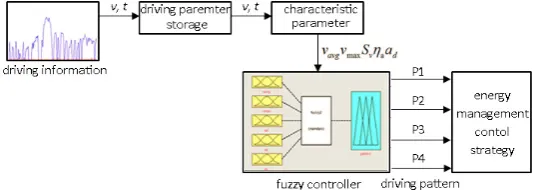
[image:2.544.138.408.503.598.2]The process flow of urban driving pattern recognition is illustrated in Figure 1. Vehicle speed data of 100 seconds prior is stored and characteristic parameters of real time driving condition are extracted. The driving pattern is determined by the fuzzy controller based on the characteristic parameters. Figure 2 shows the test result of driving pattern recognition method by using a mixed driving cycle (MANHATTAN*1+UDDS*1+US06H*1+ NYCC*1), it can be seen that the driving pattern recognition system adopted in this paper is able to reflects the current driving condition correctly with only a reasonable delay.
Fig. 2. Test of driving pattern recognition method
3. DP-based fuzzy logic control
Due to the requirement of a priori-knowledge of scheduled driving cycles, the dynamic programming method cannot be implemented for practical application. Nevertheless, the theoretical optimal solutions can be utilized for the design of other control strategies. This work introduces a systematic design procedure of HEV power management fuzzy logic control strategy based on the dynamic programming results.
One attractive characteristics of the fuzzy logic control strategy is that it does not require accurate models for its implementation, making it effective for controlling of non-linear systems such as HEVs whose accurate models may not be available. Furthermore, HEVs also have high requirements for the high control response and stability, which can be fulfilled by the fuzzy control strategy due to its strong robustness and low computational cost. However, the design of the fuzzy logic controller is based on the objective human experience and knowledge. Real-time test is the most reliable way to obtain this experience and knowledge but requires a long time and involves high cost. Another effective way is by using simulation technologies to tune the control parameters iteratively until achieving optimal parameters for the specified operation environment. This work may be time consuming. It is easier to use off-line optimization technologies than iteratively running rules/fuzzy logic-based simulation to obtain the optimal control parameters. Dynamic programming is one of these techniques.
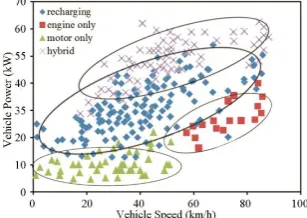
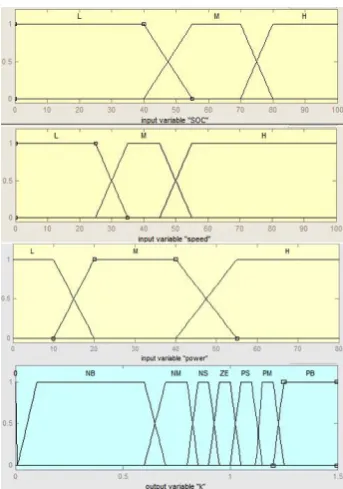
In this paper DP technique is adopted to obtain the theoretical optimal solutions to further refine the proposed fuzzy control strategy [10]-[11]. For driving pattern 3, Figure 3 shows some vehicle operating points of a parallel HEV based on DP method, which can be used to design the fuzzy controller of the proposed control strategy. In order to make the fuzzy control strategy practical in real application the input variables should be easy to obtain. Vehicle speed, vehicle power and battery SOC are three parameters. The diagram of fuzzy logic control is shown in Figure 4.
[image:3.544.206.360.511.620.2]efficiency range of 0.3 to 0.8.
For torque coupling parallel HEVs, when the motor and the engine are coupled to the torque coupler
e m
c
e m
T T T
i i
(1)
Zc Ze ei Zm mi (2)
where ɷc denotes the output rotational speed of the torque coupler, ɷe is the engine rotational speed, ɷm
represents the motor speed, Tc is the output rotational torque of the torque coupler, Te and Tm denotes the
engine torque and motor torque, ie is the gear ratio of the engine and im is the motor gear ratio in the
torque coupler mechanism.
It is noted that when the vehicle load and speed profile are determined, the engine torque and motor torque can be controlled by each other. Because of the goal of the proposed power management control strategy is to minimize the fuel consumption, in consideration of the huge efficiency gap between inner combustion engine and electric motor, it is better to control the engine torque close to the optimal torque at the corresponding speed.
The goal of the fuzzy controller is to find the reasonable engine torque under the corresponding vehicle condition. While the target value of the engine torque is hard to be calculated by the fuzzy controller, hence the torque split ratio k is introduced, which represents the ratio of engine torque Tm to optimal
engine torque Topt at the corresponding engine speed, k=Tm/Topt .
[image:4.544.176.369.64.135.2]Fig. 5. Membership functions design of driving pattern 3
4. Simulation results
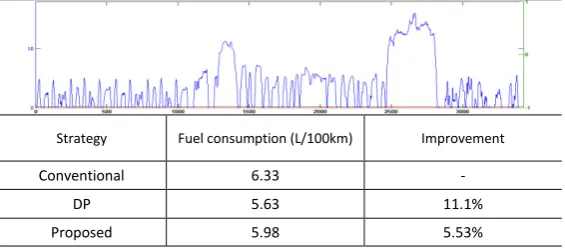
[image:5.544.194.366.60.305.2]The simulation results of two different driving cycles are shown in Table 1 to 2. Urban Dynamometer Driving Schedule (UDDS) driving cycle is a typical urban driving cycle with average speed of 31.51km/h and has frequent braking and acceleration. In the simulation of UDDS driving cycle, the optimal DP algorithm has an improvement of 8.57% in fuel consumption compared with the conventional rule-based strategy, while under the proposed strategy the number is 3.85%, and other simulations also indicate that the proposed strategy can achieve improvement of average 3-4% in fuel consumption in different urban driving cycles. Nevertheless, the proposed control strategy still has a difference of 4.72% with DP method. There are multiple reasons for this gap. Firstly, the fuzzy control strategy can only ensure the engine torque varying within a reasonable range, but not at the optimal operation point. Secondly, the motor efficiency is ignored, as it is much higher than the engine. In order to further improve the efficiency more membership functions can be added in the design of fuzzy logic controller
Table 1. Simulation results of UDDS driving cycle
Strategy Fuel consumption (L/100km) Improvement
Conventional 5.72 -
DP 5.23 8.57%
Strategy Fuel consumption (L/100km) Improvement
Conventional 6.33 -
DP 5.63 11.1%
Proposed 5.98 5.53%
5. Conclusion
In this paper a new HEV energy management control strategy is proposed. The control strategy of each driving pattern is refined by the simulation results of dynamic programming. The driving pattern recognition algorithm which uses historical vehicle data to determine the current driving pattern is introduced. The performance of the proposed control strategy was evaluated by using different driving cycles. It is found that the multi-mode control strategy achieves significant fuel efficiency improvement in all driving cycle tests, especially when the driving condition changes frequently. The comparison study also shows that for the proposed strategy, there is still room for improvement the fuel by revising the membership functions of the fuzzy controller.
In the future study, the driving pattern recognition technique and DP algorithm can be further improved by using real time driving data that obtained during real-time driving.
Acknowledgements
[image:6.544.137.420.139.263.2]Reference
[1]Rahman Z, Butler K L, Ehsani M. A comparison study between two parallel hybrid control concepts[C]. SAE Work 2000-01-0994,2000.
[2]Jalil N, Kheir N A, Salman M. A rule-based energy management strategy for a series-hybrid vehicle[C]. Proc of the American Control Conference, Albuquerque, New Mexico, USA, 1997: 689-693.
[3] Johnson V H, Wipke K B, Rausen D J. HEV control strategy for real-time optimization of fuel economy and emissions [C]. [4] Wagener A., Korner C. , Seger P. et al. Cost function based adaptive energy management in hybrid drivetrains[C]. Proceedings of the 18th
International Electric Vehicle Symposium, Berlin, Germany, 2001.
[5] C. C. Lin, H. Peng, and J. W. Grizzle, “A stochastic control strategy for hybrid electric vehicles,” presented at the Amer.
Control Conf., Boston, MA, Jun. 2004.
[6] L. Perez, Guillermo R. Bossio, Diego Moitre, Guillermo O.Garcia. Optimization of power management in an hybrid electric vehicle using dynamic programming [J]. Mathematics and Computers in Simulation, 73(2006), 244-254.
[7] Olle Sundstrom, D Ambuhl and Guzzella L. On Implementation of Dynamic Programming for Optimal Control Problems with Final State Constraints [J]. Oil& Science and Technology-Rev. IFP, 2010,65(1): 91-102.
[8] Olle Sundstrom,Lino Guzzella. A generic dynamic programming matlab function[J]. 18th
IEEE International Conference on control applications part of 2009 IEEE Multi-conference on Systems and Control Saint Petersburg, Russia,2009,July:1625-1630.
[9] C. C. Lin, H. Peng, J. W. Grizzle, and J.-M. Kang, “Power management strategy for a parallel hybrid electric truck,” IEEE Transactions on Control System Technology, 11 (6), November 2003.
[10] P. Betsekas, Dynamic Programming and Optimal Control, Athena Scientific, 1995. [11] D. E. KirK, Optimal Control Theory, An Introduction. New York, NY, USA: Dover, 2004.
Biography