Nicola McLelland
German as a Foreign Language in Britain
The history of German as a ‘useful’ language since 1600
11
Introduction
A quarter of a century ago, two essays examined the early history of German as a Foreign Language (GFL) in Britain.2 The present paper revisits the history of GFL at a time of perceived crisis in modern language education, to provide some historical answers to the question “Why learn German?” that may offer a useful context for debates about the status of German in schools and universities and in wider society today.3 Using as primary sources the materials available to
||
1 I gratefully acknowledge the support of the Arts and Humanities Research Council (Research Fellowship AH/I021930/1) in making this research possible. Many thanks to Anne Simon for her sympathetic reading of an earlier draft of this article. Some highlights of the work present-ed here were publishpresent-ed under the title ‘Why Learn German?’ in Deutsch Lernen und Lehren, in the journal for language teachers published by the Association for Language Learning (Spring 2014): http://journals.all-languages.org.uk/2014/05/why-learn-german-answers-since-1600/ NicolaMcLelland.
2 David Blamires, “British Knowledge of German before the High Dutch Minerva,” in German Life and Letters 43 (1990): 102–112. C. W. Proescholdt, “The Introduction of German Language Teaching into England,” in German Life and Letters 44 (1991): 93–102. For comprehensive bibliography of the field see Nicola McLelland, German Through English Eyes (Wiesbaden: Har-rassowitz, 2015). I note here only the following key references: Karl Peter Ortmanns, Deutsch in Großbritannien: Die Entwicklung von Deutsch als Fremdsprache von den Anfängen bis 1985 (Stuttgart: Franz Steiner, 1993); Helmut Glück, Deutsch als Fremdsprache in Europa vom Mittelalter bis zur Barockzeit (Berlin: de Gruyter, 2002), 332–337, and Helmut Glück, Die Fremdsprache Deutsch (Wiesbaden: Harrassowitz, 2013), 484–501. Three volumes reflecting on the ‘state of the discipline’ of German in the 1970s, 1980s and early 1990s are now useful histor-ical documents: German in the United Kingdom: Problems and Prospects (London: CILT, 1976); German in the United Kingdom: Issues and Opportunities (London: CILT, 1986); German Studies in the United Kingdom: A Survey of German in Schools and Universities (Cambridge: European Business Associates, 1993).
learners since 1600, most of which have previously received very little attention from this perspective, I examine the interplay and the tensions between the various motivations for learning German that have been asserted, and give some illustrations of how the various answers to “Why German?” were reflected in the contents of textbooks and examinations for learners.4 Discussions of the value of German can be found in other kinds of primary sources, too, especially in the later period, including the popular and scholarly press, school prospec-tuses, policy documents, published and unpublished syllabi and curricula, but this study concentrates largely on the case made for German to its learners in the materials that were available to them. For the later nineteenth and twentieth centuries, however, when modern languages became institutionalized and then established in mass education, I have also made selective reference to policy documents, and to the popular and scholarly press, as these too became fora in which the value of German was discussed. We shall see that the question of why to learn German is closely related to expectations about who should learn Ger-man, and that those expectations, too, have changed; but I shall argue that cultural rather than purely instrumental reasons have remained crucial.
2
First Beginnings: Scholarly Interest in German
The first documented learners of German as a Foreign language (GFL) in Europe were merchants learning for commercial reasons, as attested by fifteenth-cen-tury manuals used for teaching German to Venetian cloth merchants.5 However, there is no evidence that a similar need was felt by English traders – as long as
||
languages (http://www.speaktothefuture.org/), and more widely the ‘Think German’ networks (http:// www. daad.org.uk/en/12965/index.html), supported by the German Embassy.
4 I cannot consider here the history of German in universities, but see John L. Flood, “Ginger Beer and Sugared Cauliflower: Adolphus Bernays and Language Teaching in Nineteenth-Century London,” in German Studies at the Turn of the Nineteenth-Century, eds. Rüdiger Görner and Helen Kelly-Holmes (Munich: Iudicium, 1999), 101–115; Alexander Weber, “Karl Völker (1796–1884). Turner, Germanist und Pädagoge im englischen Exil,” in Euphorion 106 (2012): 387–415; and “Der Frühsozialist Thomas Hodgskin und die Anfänge der Germanistik in Großbritannien,” in Internationales Archiv für Sozialgeschichte der deutschen Literatur 31.1 (2006): 51–75; Eda Sagarra, “Die Britische Germanistik 1896 bis 1946,” in Zur Geschichte und Problematik der Nationalphilologien in Europa: 150 Jahre erste Germanistenversammluing in Frankfurt am Main (1846–1896), eds. Frank Fürbeth et al. (Tübingen: Niemeyer, 1999), 683–696.
Hansa merchants ran the trade with England (until their ejection from England in 1598), it was Germans who learnt English, rather than vice versa.6 Even in the seventeenth century, when Dutch-English manuals for merchants became nu-merous (the first printed in England was The Dutch Schoole Master of 1606, “wherein is shewed the true way to learne the Dutch tongue”),7 there were no German-English equivalents, and when the first manual for learning German finally appeared in England in 1680, it was aimed at a scholarly audience.8 The full title of Martin Aedler’s High Dutch Minerva (“High Dutch” by contrast with Low Dutch, i.e. Dutch/Low German) advertised it as “A Perfect Grammar never extant before whereby The English may both easily and exactly learne the Neat-est Dialect of the German Mother-Language used throughout all Europe”. By the “Neatest Dialect”, Aedler meant the prestigious Saxon pronunciation, of which he was a native speaker; he provided the first ever attempt to describe approxi-mately German pronunciation for English learners by using English spelling (a method still beloved of phrase-books today). Note, for example, the rendering of den with dane in the first line of the Creed, one of his sample texts; note too the rendering of German long a as <àu>, indicative of the Saxon accent:
ih glaube an Gott den vater allmaehtigen shoepfer des himmels und der erden
ig ghlòu-wey aun Gut dane vàuter, oll-maght-e-ghen, shoepf-er das him-mels und dare ar-den.9
Aedler was probably aware, through his university contacts, of the tiny minority of the literate elite who had had an interest in German theological matters since the sixteenth century,10 but according to its full title page, Aedler’s book was to be sold in a public house, Rabbets & Harrow in Blackfriars, near the wharves,
||
6 See Helmut Glück, Deutsch in Europa, 323f.
7The Dutch Schoole Master Wherein is Shewed the True Way to Learne the Dutch Tongue (Lon-don: G. Elde for S. Waterson, 1606). See Pieter Loonen, For to Learne to Buye and Sell: Learning English in the Low Dutch Area Between 1500 and 1800: A Critical Survey (Amsterdam: APA-Holland University Press, 1991).
8 Martin Aedler, The Hig [Sic] Dutch Minerva […] (London: Printed for the author, 1680; Facsimile reprint Menston, England: Scolar Press, 1972). See Fredericka van der Lubbe, Martin Aedler and the High Dutch Minerva: The First German Grammar for the English (Frankfurt: Peter Lang, 2007).
9 Aedler, The Hig [Sic] Dutch Minerva, 43.
presumably in the hope of attracting the interest of travellers and merchants. However, it sold poorly.11 It cannot have helped sales that Aedler had rejected as unnecessary the bilingual dialogues that were standard fare in language learn-ing manuals of the time, and instead listed idioms (in loose alphabetical order by English keyword), which he considered more important because languages’ idioms differed in unpredictable ways. Under ‘clap’, for example, we read er hat di Franzosen or die Venus-krankheit he has a clap or the French pocks;12 under ‘blow your nose’, snauze dih du garstiger sakk! Or puze di nase du unflat blow your nose you slut you.13 Aedler also used his grammar to contribute to discus-sions about the standardization of German taking place within Germany,14 drawing on the most important German grammar of his day, Schottelius’s Ausführliche Arbeit der Teutschen Hauptsprache (1633),15 and advocating his own preferred system of orthography. (Some of its idiosyncrasies can be seen in the quotation above.) Even at the earliest beginnings of promoting German in England, then, Aedler’s grammar exhibits a tension between the claim of prac-tical use and more scholarly interest.
||
11 The poor sales bankrupted Aedler, who was forced to marry the widow to whom he was in debt. A re-issue of the work under the more transparent title of Grammer [sic] was perhaps intended to make it more marketable. See Charles Carr, “Early German Grammars in England,” in Journal of English and Germanic Philology 36 (1937): 455–474, here: 456, and Van der Lubbe, Martin Aedler, 71.
12 Aedler, The Hig [Sic] Dutch Minerva, 181.
13 Aedler, The Hig [Sic] Dutch Minerva, 185.
14 He was a member of the German language society the Deutschgesinnte Genossenschaft, and though it seems he did not ever officially join the Fruchtbringende Gesellschaft, perhaps be-cause of his move to England, he got as far as having a draft motto, society name, and poem of recommendation (dated 1677).
3
Social Prestige: Language Learning for Leisure
in the Eighteenth Century
Before Aedler, already in the first half of the seventeenth century, we find vari-ous reports of plans to offer German at academies aimed at young noblemen.16 Whether or not German was in fact ever taught in any such academy, the pro-posal to offer German “indicates that German was of some interest to the cultur-al elite”.17 The second guide for English speakers to learn German, Heinrich Offelen’s Double Grammar for Germans to Learn English, and for English-men to Learn the German-tongue (1687), catered to this emerging interest among the leisured elite. Its format was, in contrast to Aedler’s work, typical of the lan-guage manuals that had been circulating in Europe for a century or so. In addi-tion to the usual bilingual dialogues about practical topics of interest to the traveller, Offelen also provided dialogues catering to the requirements of the Grand Tourist: a description of the German Empire (its legal and political foun-dations) and a description of Versailles. This work was clearly aimed at a lei-sured class; Offelen, in the preface, hoped it would be “wellreceived by the Nobility, Schollars and all Well-bred People”.18 Next to appear was König’s Roy-al Compleat Grammar (1715), dedicated to King George of the German House of Hannover, who had ascended the British throne in 1714 after the death of Queen Anne.19
||
16 See Ortmanns, Deutsch in Großbritannien, 20, following Foster Watson, The Beginnings of Teaching Modern Subjects in England (London: Pitman, 1909), xxxii–xxxiii. Guthke rightly emphasizes the lack of any evidence that German was actually taught at these academies: Karl Guthke, “Deutsche Literatur aus zweiter Hand: Engl. Lehr-und Lesebücher in der Goethezeit,” inJahrbuch des Freien Deutschen Hochstifts 2011, 163–237, here: 167. On the language educa-tion of the nobility at such academies see Andrea Bruschi, “Studying the Vernaculars, Study-ing in Vernaculars: Modern Languages in the Education of the Elites (France and Europe, 16th– 18th centuries),” in Ideal vospitaniia dvorianstva v Evrope, XVII-XIX vv. [The ideal of education among the European nobilities, XVIIth to XIXth c.], eds. Wladimir Berelowitch, Vladislav Rjéou-tski and Igor Fedyukin, Moscow, NLO (forthcoming, in 2016).
17 Van der Lubbe, Martin Aedler, 36.
18 Heinrich Offelen, A Double Grammar for Germans to Learn English and for English-Men to Learn the German Tongue (London: Old Spring Garden by Charing Cross, 1687).
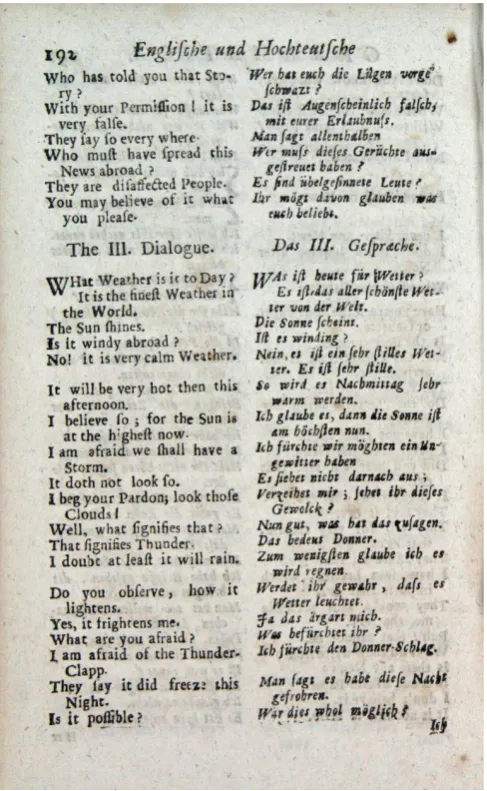
Fig. 1: König’s A Royal Compleat Grammar (1715), 192. By kind permission of Trinity College, Dublin.
||
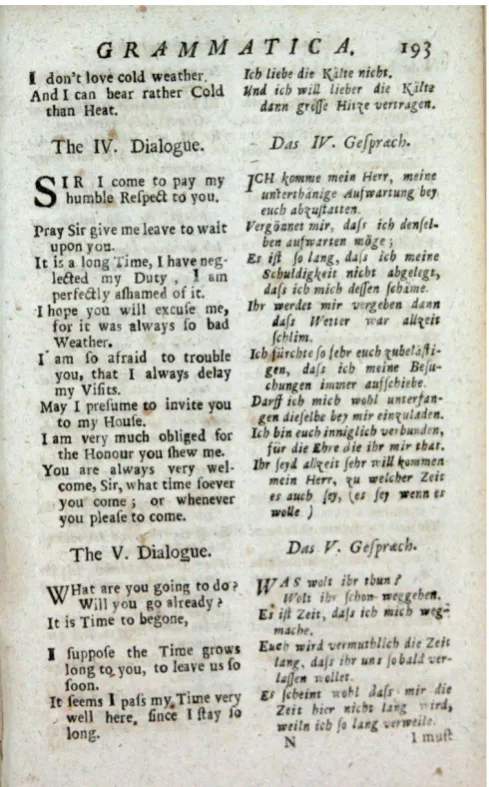
Fig. 2: König’s A Royal Compleat Grammar (1715), 193. By kind permission of Trinity College, Dublin.
ing and denying […] to ask advice”. The attention paid to such functions sug-gests that Anglo-German contact had become a matter of developing and sus-taining personal relationships according to social etiquette – not merely com-munication for survival while travelling, or for trade. Learners no longer expected merely to book rooms and order meals, or to negotiate prices (favour-ite topics in other language manuals), but to be able to hold their own in pol(favour-ite conversation. For example, two of König’s dialogues model how to keep a con-versation going about that most archetypical polite topic, the weather, and the art of paying a call (see figures 1 and 2), providing the foreign learner with just the kind of guidance that would also be available for native speakers to master the rules of these etiquette-governed communicative genres.20 German itself was not yet prestigious, but the learning of foreign languages for one’s educational tour had become a sign of prestige, of the membership of a cultural elite.
4
German as a Language of Literature
Anglo-German contacts intensified under Hanoverian rule, evidenced by the popularity not just of König’s bilingual manual (see note 19 above), but also of two further manuals, both specifically aimed at English learners of German and printed in Britain, and both running to more than one edition.21 The steep in-crease in the reception of German literature in England has been documented by Boehning’s study of periodicals of the time,22 and in 1774 Gebhard Wende-born (1742–1811), Minister at the German chapel on Ludgate Hill, was the first grammarian to present German to English learners explicitly as a language of literature and culture, in his Elements of German Grammar. Wendeborn ob-served in his preface that “[T]he Germans have lately made great improvements,
||
20 On the notion of the ‘communicative genre’ and its applicability to scenarios in language-learning dialogues, see Nicola McLelland, “Mining Foreign Language Teaching Manuals for the History of Pragmatics,” in Journal of Historical Pragmatics, to appear 2016.
21 Benedictus Beiler, A NEW German Grammar […] (London: J. Downing for the Author, 1731, 2nd ed. 1736), and John Bachmair, A Complete German Grammar […] (London: [n.p.], 1751; 2nd ed. London: for Andr. Linde, etc. 1771). See Fredericka van der Lubbe, “One Hundred Years of German Teaching,” in AUMLA December (2007), 143–152; Fredericka van der Lubbe, “Con-structing Germany: The German Nation in Anglo-German Grammars of the 18th Century,” in Anglo-German Linguistic Relations, eds. Falco Pfalzgraf and Felicity Rash (Frankfurt: Peter Lang, 2008), 63–72.
both in their language and their manner of writing”,23 so that even the French were now taking an interest in their literature, and the English would no doubt follow suit:
The French, who in general are thought to be rather partial to their own productions, have lately begun to study the German language, and to think favourably of German literature; against which they formerly entertained great prejudices. Among the English the German has been hitherto very little known; but there is reason to expect, that within a few years, even in this country, so famous for the improvement and patronage of the arts and scienc-es, the language and the literature of the Germans will no more be looked upon with indif-ference.24
A reviewer of Wendeborn’s grammar in the Critical Review in 1775 commented:
As German literature is at present of much greater consequence than is commonly appre-hended, we join with the author in wishing, that it were more attended to, and that this Grammar may be an inducement and a help to the study of it, for at present we know scarce anything of it, excepting through the medium of French translations.25
Of particular interest in this climate of hunger for German literature is Wen-deborn’s “Catalogue of some of the best German modern writers”, which he updated and expanded in a volume of Exercises published separately to accom-pany the third edition of the grammar, listing writers “Whose work, on account of the purity and elegance of the style, will improve the reader in the language, and at the same time afford him some agreeable entertainment”.26 Many of Wendeborn’s choices have an explicitly religious, devotional or moral subject, supporting Jefcoate’s observation that it was on religious matters, especially Protestantism and the Pietist movement, that German culture had the greatest influence in eighteenth-century England.27 Over half of the authors whom Wen-deborn listed were still alive at the time WenWen-deborn was writing: they included
||
23 Gebhard Friedrich August Wendeborn, The Elements of German Grammar (London: printed for C. Heydinger, 1774), 1.
24 Wendeborn, The Elements of German Grammar, viii.
25 The review is reprinted in Boehning, The Reception of Classical German Literature, vol. 1, 266.
26 Wendeborn, The Elements of German Grammar, [153]–[156], here: [153], and Wendeborn, Exercises to Dr. Wendeborn’s Introduction to German Grammar, Written by Himself […] (London: printed for the author, 1797), 196–200.
Goethe (aged 48 in 1797) and Schiller (aged 38), both new additions in the 1797 edition of his list (see table 1).
Table 1: Periodicals and authors recommended by Wendeborn (combining the names listed in both the 1774 and 1797 catalogues, excluding details of the works and editions recommend-ed)28
Recommendations
Periodicals Bibliothek (die Allgemeine Deutsche); Bibliothek (die), der schönen Wissenschaften und freyen Künste; Der Gesellige, Der Jüngling; Eine moralische Wochenschrift; Der Mensch; Der Arzt, Eine Medicinische Wochenschrift
Writers Thomas Abbt, Johann Heinrich Bartels, Johann Beckmann, Gottfried August Bürger, Joachim Campe, Johann Andreas Cramer, Johann Friedrich Freiherr von Cronegk, Johann Jakob Dusch, Friedrich Chris-toph Jonathan Fischer, Christian Garve, Christian Fürchtegott Gellert, Salomon Gesner, Johann Wilhelm Ludwig Gleim, Johann Wolfgang von Goethe, Friedrich von Hagedorn, Albrecht von Haller, Johann Timo-theus Hermes, Isaac Iselin, Johann Friedrich Wilhelm Jerusalem, Ewald Christian von Kleist, Friedrich Gottlieb Klopstock, Gotthold Ephraim Lessing, Georg Friedrich Meier, Christian Meiner, August Gottlieb Meißner, Moses Mendelssohn, Johann Peter Miller, Johann Lorenz Mosheim, Ernst Ludwig Posselt, Gottlieb Wilhelm Rabener, Karl Wilhelm Ramler, Hermann Samuel Reimarus, Johann Kaspar Riesbeck, Christian Gotthilf Salzmann, Friedrich von Schiller, Johann Joachim Spalding, Johann Georg Sulzer, Johann Peter Uz, Johann Heinrich Voß, Veit Weber, Christian Felix Weiße, Christoph Martin Wieland, Justus Friedrich Wilhelm Zachariae, Johann Georg Zimmer-mann, Georg Joachim Zollikofer
Another catalogue of recommended authors appeared in Reverend William Render’s Concise Practical Grammar of the German Tongue (1799). Render’s grammar was based on his experience of teaching both at Oxford and Cam-bridge, and of teaching “fine families” in London for over eight years.29 Like Wendeborn’s, Render’s grammar falls clearly into the group of those teaching
||
28 For full details and discussion see McLelland, German Through English Eyes, 58–65. See also Guthke, “Deutsche Literatur”.
German not for its practical utility, but for its intellectual interest, both literary and linguistic. In his dedication to his royal patron Prince Frederick (Duke of York and second son of George III), Render pointed out that
German is an original language, having no relationship to the Celtic; that it is one of the most ancient, the most copious, and the most energetic languages of the world; and that it has a particular claim to the attention of the literati in England, from its striking affinity to their own tongue.30
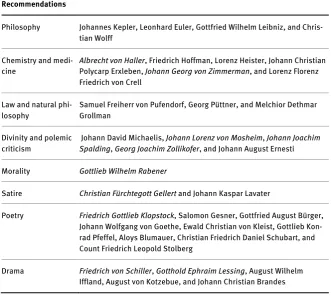
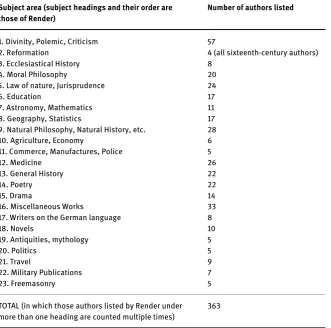
Five years later, in 1804, Render observed in his Complete Analysis of the Ger-man Language that “It is, I believe, generally allowed, that no country has pro-duced a greater variety of authors than Germany: and it is well-known that many of them have obtained a distinguished reputation in the various branches of literature.31 Render went on to list writers, across many fields of endeavour. Render’s “catalogue of the best German writers”32 contained over 130 names, repeating many of those given in the preface (see table 2 and the summary in table 3).
Render concluded by making a point that has often been made before and since – that reading in the original, giving “free and unconstrained access”, is superior to relying on second-hand-translations:
I think it will be obvious to every reader, that an acquaintance with the German language must be of great utility; in order to peruse the works of German writers in the original; to have, as it were, free and unconstrained access to the treasures of knowledge, which the industry of the German has successfully been accumulating for a considerable time.33
However, Guthke suggests that Render’s recommendation of Kotzebue’s (in Guthke’s words) “sentimentale und krasse” dramas and works of the young Schiller (in places similarly flawed, according to Guthke) suggest Render’s poor taste; the educated elite of England were, according to Guthke, already turning up their noses at such works.34
||
30 Render, A Concise Practical Grammar, v–vi.
31 William Render, A Complete Analysis of the German Language, or a Philological and Gram-matical View of its Construction, Analogies, and Various Properties (London: H.D. Symonds, 1804), vii.
32 Render, A Concise Practical Grammar, [227]–[229].
33 Render, A Complete Analysis, viii–ix.
Table 2: Some of Render’s recommendations, grouped by topic (figures in italics were also cited by Wendeborn)
Recommendations
Philosophy Johannes Kepler, Leonhard Euler, Gottfried Wilhelm Leibniz, and Chris-tian Wolff
Chemistry and
medi-cine Albrecht von HallerPolycarp Erxleben, , Friedrich Hoffman, Lorenz Heister, Johann Christian Johann Georg von Zimmerman, and Lorenz Florenz Friedrich von Crell
Law and natural
phi-losophy Samuel Freiherr von Pufendorf, Georg Püttner, and Melchior Dethmar Grollman
Divinity and polemic
criticism Johann David Michaelis, Spalding, Georg Joachim ZollikoferJohann Lorenz von Mosheim, and Johann August Ernesti , Johann Joachim
Morality Gottlieb Wilhelm Rabener
Satire Christian Fürchtegott Gellert and Johann Kaspar Lavater
Poetry Friedrich Gottlieb Klopstock, Salomon Gesner, Gottfried August Bürger, Johann Wolfgang von Goethe, Ewald Christian von Kleist, Gottlieb Kon-rad Pfeffel, Aloys Blumauer, Christian Friedrich Daniel Schubart, and Count Friedrich Leopold Stolberg
Table 3: Render’s recommendations by topic (Render 1804: 349–351)
Subject area (subject headings and their order are
those of Render) Number of authors listed
1. Divinity, Polemic, Criticism 57
2. Reformation 4 (all sixteenth-century authors)
3. Ecclesiastical History 8
4. Moral Philosophy 20
5. Law of nature, Jurisprudence 24
6. Education 17
7. Astronomy, Mathematics 11
8. Geography, Statistics 17
9. Natural Philosophy, Natural History, etc. 28
10. Agriculture, Economy 6
11. Commerce, Manufactures, Police 5
12. Medicine 26
13. General History 22
14. Poetry 22
15. Drama 14
16. Miscellaneous Works 33
17. Writers on the German language 8
18. Novels 10
19. Antiquities, mythology 5
20. Politics 5
21. Travel 9
22. Military Publications 7
23. Freemasonry 5
TOTAL (in which those authors listed by Render under
more than one heading are counted multiple times) 363
The first anthologies of German literature for English learners were produced by George Crabb (1778–1851), a teacher of Classical languages at Carlisle House School. His Easy and Entertaining Selection of German Prose and Poetry and the revised version, German Extracts from the Best Authors, already ran to eight editions.35 The first edition, written by Crabb at the age of twenty-two, included fables, stories, letters, readings about ‘nature’, and poetry, and seems to have
||
been largely taken from pre-existing anthologies. The revised edition, though largely still taken from others’ collections, shows, in Guthke’s view, signs of an improved literary consciousness and taste, but Guthke concludes that overall there are as many ‘lesser’ authors as there are great authors of the Goethezeit; Schiller is given most room, but no more than Kotzebue, who remains just as prominent was he was in Render’s book.36
Whether or not German learners were exposed to the ‘right’ literature by Guthke’s criteria, by 1824, Rowbotham was able to declare in his Practical Ger-man Grammar :
The Germans hold so high a rank in literature, science and the arts, and their authors of eminence are so numerous in every department of human knowledge, that the study of their language has now become, not merely desirable as a matter of taste, but, in some degree, necessary to every person who has the slightest pretensions to an acquaintance with European literature. 37
Note, however, that Rowbotham still asserted, “Its utility, in a mercantile point of view, cannot be doubted”38 – see section 6 below.
5
GFL as Mental Training
The tail end of the late eighteenth century saw the emergence of a new reason to value the learning of German as a foreign language. Mastering the grammatical complexities of the foreign language and wrestling with translation between the mother tongue and the foreign language were viewed as valuable exercises that developed the intellectual powers of learners, as part of a wider Neohumanist educational ideal, first codified by Wilhelm von Humboldt in 1809 for the edu-cation of the elite in Prussia’s Gymnasien, but influential throughout Europe.39 The first foreign language textbook that aimed to promote such mental gymnas-tics was a German one, Johann Valentin Meidinger’s Praktische französische Grammatik wodurch man diese Sprache auf eine ganz neue und sehr leichte Art in
||
36 Guthke, “Deutsche Literatur,” 200, 207.
37 John Rowbotham, A Practical German Grammar (London: printed for Baldwin, Cradock and Joy […], 1824), iv.
38 Rowbotham, A Practical German Grammar, iv.
39 On early nineteenth-century discussions of language study explicitly as geistige Gymnastik, see Sonya Kirk, Teaching and Learning Latin in 19th-century Germany and England (Diss.
kurzer Zeit gründlich erlernen kann (1783); it was soon widely imitated.40 Meidinger included exercises devoted to practising specific points of grammar – this was the meaning of praktisch or “practical” in the title of his and later works. Meidinger and his ilk were damned by late nineteenth-century language-teaching reformers as exponents of the hated “grammar-translation method” (see note 62 below), but were actually at the forefront of innovation in their own time: the idea of including practical exercises to aid learning was absolutely new. The first such “practical” grammar of German for English learners was John Uttiv’s Complete Practical German Grammar (1796). In many ways Uttiv’s text was very similar to earlier manuals, including dialogues, but Uttiv also added exercises. He “chiefly followed: and indeed often strictly copi’d’ the ‘tru-ly excellent’” method of Meidinger.41 As an illustration, Uttiv’s first exercises, devoted to what he called the “first declension”, begin “The father of the mas-ter. The proprietor of the garden. The brother of the gardener. The looking-glass of the sister. The chamber of the girl. The daughter of the mother. The sword of the governor’”.42
A year after Uttiv, Wendeborn also published a volume of exercises, to ac-company his own grammar. Apologizing in his preface that the style of his exer-cises was not as “neat and elegant”, nor as “connected and interesting” as in other types of writing, he explained that “[t]he author’s chief aim was to com-bine, in each line of an Exercise, as many words as could be well joined, to elu-cidate the particular rules for which they were intended”.43 In this, Wendeborn arguably succeeded, as he contrived to string together lots of words in single but highly artificial sentences. For example, an exercise on the definite article, to be translated into German, runs: “The cunning fox, that killed the hen of the poor woman, who sold the eggs to the wife of the butcher, has been seen near the cottage, which is not far from the meadow, where the cows and the sheep of the farmer are grazing”.44 Besides requiring eleven definite articles which be-tween them cover all three genders, singular and plural, and all four
grammati-||
40 Johann Valentin Meidinger, Praktische französische Grammatik, wodurch man diese Spra-che auf eine ganz neue und sehr leichte Art in kurzer Zeit gründlich erlernen kann, ([Frankfurt?]: 1783 self-published, 1783 first ed.; 1799).
41 John Uttiv, Complete Practical German Grammar (Göttingen: Vandenhoek & Ruprecht, 1796), A2. Reviewed in the Allgemeine Literarische Zeitung (September 1797: 632), Uttiv’s grammar was described as “fade” and “ganz nach der Meidingerschen Manier” – evidence that this ‘practical’ approach had its critics from the very outset.
42 Uttiv, Complete Practical German Grammar, 28.
43 Uttiv, Complete Practical German Grammar, “Exercises,” 1.
cal cases, this sentence plainly incorporates a good number of syntactical com-plexities that would be far beyond the reach of any beginning learner. Similarly, the first exercise for translation into English runs, “Ein Habicht, der eine Taube verfolgte, sah ihr mit einem scharfen Auge nach, und schoß, von einer großen Höhe, auf sie herab: allein, ein Jäger rettete sie, indem er, mit einer Flinte, dem Raubvogel eine Kugel in die Brust schoß”.45 The sentence does indeed illustrate the indefinite articles in three cases, but, even with all the vocabulary supplied in a list below the sentence, its syntax would have posed a considerable chal-lenge to the beginning learner (with two subordinate clauses and separable verbs, for example, not to the mention the differences in idiom). While the addi-tion of targeted exercises at all was an innovaaddi-tion, and the layout on the page was clear and generous, making them at least look manageable, thought had yet to be given to the grading of the exercises.
The emergence of this kind of exercise coincided with the incorporation of modern languages (in Britain: French and German) into school curricula at the turn of the nineteenth century. In the eighteenth century, while French had been widely taught in private schools catering to the emerging middle classes, German seems to have been taught in Britain only in the so-called Dissenting Academies of non-conformist Protestant groups.46 Many other pupils would have learnt German with a private tutor or governess, and the fact that Queen Victoria employed a German governess for her children meant that from the 1840s “an increasing number of well-to-do families in England wanted their children to be taught German by a native speaker”.47 The first of the emerging major Public Schools to offer German may have been the newly founded Uni-versity College School (founded as part of UniUni-versity College London, estab-lished in 1826). Its prospectus, issued in 1830, indicated that boys would “enter the German class” as soon as they were “sufficiently master of the French lan-guage”; the study of German was “introduced for the specific purpose of ena-bling the pupil to avail himself of the valuable assistance afforded by the la-bours of German Philologists towards the right study of Classical Literature” – a new scholarly, and very typically nineteenth-century, reason for mastering
||
45 Uttiv, Complete Practical German Grammar, “Exercises,” 7.
46 Ortmanns, Deutsch in Großbritannien, 21, following Watson, The Beginnings of Teaching Modern Subjects, 694. The number of these and similar schools increased after 1779, when non-conformists were legally allowed to be teachers.
German.48 Several other schools followed in the 1840s.49 At Rugby, under the headship of Thomas Arnold (head there 1828–1841), French and German were even compulsory for pupils not taking a science.50 When Oxford and Cambridge Universities introduced their public examinations for school pupils from 1858, German was included along with French as one of two modern languages in the list of available subjects.
6
German for Business Purposes?
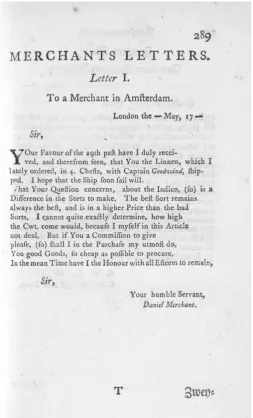
From the outset, German textbook authors were in the habit of mentioning – alongside other advantages – the usefulness of German for trade. Some text-books from the mid-eighteenth century featured written commercial German (only then catching up with the much longer tradition in other language pairs, e.g. Dutch-English manuals such as that of François Hillenius of 1664).51 An example from Bachmair’s Complete German Grammar (1771) is given in figures 3 and 4.
In the latter decades of the nineteenth century, the importance of German for trade was being asserted not just by individuals, but also in public debate. The perceived need for German for commercial purposes was not remotely reflected in the types of examinations for which pupils in Public Schools and grammar schools were prepared – for, though intended for pupils not going on to univer-sity, the papers were set by university academics. Nor did the code governing higher grade elementary schools allow for language learning in their curricu-lum, which, catering to the children of skilled workers, minor professionals, and tradesmen, might have been expected to meet the need for commercial clerks with language skills.52 Much like today, this state of affairs was regularly criticized in the press, chambers of commerce, and Parliament. For example, an item in the Educational Times noted a report by the London Chamber of
Com-||
48 H.J.K. Usher, C.D. Black-Hawkins, and G.J. Carrick, An Angel without Wings. The History of University College School 1830–1980 (London: University College School, 1981), 13.
49 See Proescholdt, “The Introduction of German Language Teaching,” 95, and Ortmanns, Deutsch in Großbritannien, 28.
50 See Ortmanns, Deutsch in Großbritannien, 27, and J.B. Hope Simpson, Rugby since Arnold: A History of Rugby School since 1842 (London: Macmillan, 1967), 7.
51 Francois Hillenius, Den Engelschen Ende Ne’erduitschen Onderrichter [...] (Rotterdam: Bast-iaan Wagens, 1664), 99–115.
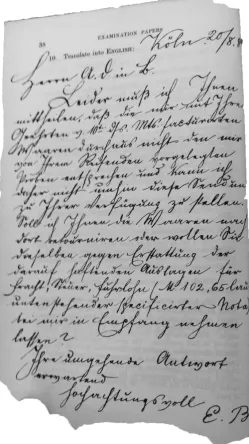
merce, which had found that “the number of foreign clerks employed by lead-ing firms steadily increases”.53 In this climate the Cambridge Syndicate of Local Examinations took the well-intentioned step of introducing a commercial exam-ination in 1888 with a compulsory foreign language element, at which German (or French or Spanish) could be offered as a subject, including compulsory translation of a business letter in German handwriting (see figure 5), and an optional conversation test.54
Textbooks of “Commercial German” were produced for this new constitu-ency of middle-class learners who might go on to clerical positions in commer-cial houses. However, as the foreword to one such manual noted, “Few boys have experience or imagination enough to enter intelligently into the higher commercial technique”, which was therefore “best left to the practical training of the office”. The author’s modest goal was that “all boys may gain working knowledge of German by means of a more useful vocabulary and a less compli-cated grammar than that usually presented”, with an effort made to include some core business vocabulary (e.g. Kaufleute, Geschäft, Kommis), and intro-ducing simple business letters in the later chapters.55
||
53Educational Times, 1 August 1887, 301; cf. also 1 December 1887, 466. Similarly, the first issue of the Journal of the Royal Society of Arts warned in 1879 that “Beyond all doubt we suffer in competition abroad from ignorance of foreign languages by our merchants, agents, clerks and mechanics” (cited by Hawkins in 30 Years of Language Teaching, ed. Eric Hawkins (Lon-don: CILT, 1996), 34). Compare the 2013 report Languages: The State of the Nation (note 3 above), 9, 14, 24.
54 Interestingly, Spanish was also available for this examination (as well as French), even though it was not yet available as a subject in the school Junior and Senior examinations run by the Cambridge board.
Fig. 3: John Bachmair’s Complete German Grammar, 3rd ed. 1771(London: printed for G. Keith
[et al.]), 288. By kind permission of University of Glasgow Library, Special Collections. 56
||
Fig. 4: John Bachmair’s Complete German Grammar, 3rd ed. 1771(London: printed for G. Keith.
The results of the Cambridge commercial examinations were disappointing. In the first year, only eight out of forty-nine candidates were awarded Commercial Certificates, and in German,
the most ordinary rules of German grammar seemed to be unknown to most of the candi-dates […] No candidate was able to write a German business-letter on a given subject […] In German Conversation [not compulsory] two of the seven candidates who presented themselves passed.57
In 1892 things were no better: “No candidate gave evidence of being able to write a correct and idiomatic German letter”.58 The numbers presenting for the Commercial Certificate remained low, as did the rate of success, and – after a final year in 1893 with only eight entrants, of whom five passed, the examina-tion was discontinued.59 The difficulty lay in the gulf between the expectation that pupils should learn commercially useful German and the reality that such a difficult and specialized variety simply could not be mastered in the time avail-able to school pupils. As Jethro Bithell wrote some decades later in an Encyclo-paedia of Education entry on teaching commercial German (1921), “Commercial German being a language in itself, those who teach it must make a detailed study of it.”60 An anonymous item in the Educational Times of 1919 repeated with approval the view expressed in a recent issue of the Liverpool Journal of Commerce that “Commerce calls for a study of German”, but the final sentence quoted from the original piece was crucial: “If British commerce is to penetrate into and seek to displace German commerce in Europe, or in any part of the globe, a perfect knowledge, technical and commercial, of German is a first es-sential to success”.61 Such “perfect knowledge” of a specialist variety was – and remains – a tall order at school level.
||
57 1888 Report of the Local Examinations and Lectures Syndicate to the Senate of Cambridge University, 5, 9, 10. Cambridge University Library, Cam.c.11.51.10.
58 1888 Report of the Local Examinations, 8.
59 Report of the Local Examinations and Lectures Syndicate to the Senate of Cambridge Uni-versity, 29 January 1895.
60 Jethro Bithell, “The Teaching of German (Commercial),” in The Encycopaedia and Diction-ary of Education, ed. F. Watson (London, 1921), 692f., here: 693. Bithell also pointed out the difficulty of reading German handwritten letters, even if the spread of typewriters was starting to reduce the difficulty. “The practice may begin with letters carefully written and pass on to scrawls and scribble”.
7
German as Part of “Modern Languages” in
School Curricula in the Early Twentieth Century
The second half of the nineteenth century saw increasing professionalization of teachers in general, and of modern language teachers in particular. In newly founded associations and journals teachers across Europe debated the best methods to teach and learn language, in what came to be known as the Reform Movement.62 Also at stake was the place of Modern Languages in the curricu-lum. Proponents argued that modern language study could supply everything that the more highly regarded Classics could (i.e. training in linguistic analysis and exposure to great literature, providing both mental rigour and moral edifi-cation), but with the added value of a living language. Karl Breul, Reader in German in Cambridge (and Schröder Professor of German there from 1910), declared: “Modern Languages are at last beginning to receive in this country the attention to which the subject is entitled not only by its practical usefulness but still more by its intrinsic value as an important element in a truly liberal educa-tion.”63 Unfortunately for German, this view of “Modern Languages” as a single discipline, one subject, implied that all its benefits could be gained by studying just one language – and that language was, generally, French, which was
hist-||
62 In Britain, the College of Preceptors was founded in 1846 and received its Royal Charter in 1849; the Modern Language Association was founded as the professional body of modern language teachers in 1892, with a journal, Modern Language Teaching. The Reform Movement is usually said to have begun with Wilhelm Viëtor, Der Sprachunterricht muss umkehren [Pamphlet] (Heilbronn: Verlag von Gebr. Henninger, 1882). On two teachers of German who were key advocates of the Reform Movement principles, albeit in different ways, see Nicola McLelland, “Walter Rippmann and Otto Siepmann as Reform Movement Textbook Authors: A Contribution to the History of Teaching and Learning German in the United Kingdom,” in Language & History 55 (2012): 125–145. The definitive documentation of the Reform Movement, with a very useful introduction, is A.P.R. Howatt and Richard Smith, Modern Language Teaching: The Reform Movement. (5 vols. London: Routledge, 2002). See also Mark Gilbert, “The Origins of the Reform Movement in Modern Language Teaching in England (Parts I, II, III),” three articles in vols. 4–6 of Research Review (Institute of Education, University of Durham)/ Durham and Newcastle Research Review), 4:1–9; 5: 9–18; 6:1–10 (1953, 1954, 1955).
orically and by a clear margin the first foreign language.64 Even the President of the Modern Language Association, A.C. Benson, told the Association in 1907, “I do not think that we can secure a firm position for German, but yet I think we can secure it for French”.65 Benson repeated arguments about the value of learn-ing a modern language that are familiar today, includlearn-ing an idea of intercultur-al awareness avant la lettre:66
It gives mental proportion, mental perspective; it shows that people of different nationali-ties approach subjects from different points of view; it gives largeness and breadth to the mental horizon; it corrects the insularity and self-satisfaction that is one of the worst qual-ities of a complacent and self-absorbed nationality; it introduces the mind to a whole range of novel ideas and emotions; it shows the different scale of qualities among the nations.67
And yet:
I venture to believe that this is possible with a single language only, for most people […] I claim, then, that a single modern language should be made the basis of our linguistic instruction; and, though I am inclined to think that we Englishmen are more in need of the kind of message which German literature can give us: its lofty emotion, its intellectual enthusiasm, its unaffected idealism, yet I believe that French is probably the more practical choice, because of its greater variety, its more tangible imaginativeness, and its exquisite precision and delicacy of literary form.68
||
64 On the relative status of French and German in schools during this period, see Nicola McLelland, “French and German in Competition in British Schools, 1850–1945,” in Documents pour l'histoire du français langue étrangère ou seconde 53 (2014) (Special issue, ed. Marcus Reinfried: French, English and German: Three Languages in Competition Between 1850 and 1945), 125–151). In 1897, about half as many hours in the curriculum were devoted to German as to French, according to Ortmanns, Deutsch in Großbritannien, 37; and in the many sets of fig-ures available to Ortmanns, the numbers of pupils taking German compared to those taking French in the late nineteenth century range between about a tenth (the number of pupils in Glasgow secondary schools taking German as a special subject compared to French in the 1880s) and about a quarter (the number of candidates taking German compared to French at Oxford local examination in the 1890s).
65 A.C. Benson, “The Place of Modern Languages in the Secondary Curriculum: Presidential Address to the Modern Language Association, Durham, January 4,” in Modern Language Teaching 3 (1907), 6–18, here: 16 and, below, 12; also cited by Ortmanns, Deutsch in Großbritannien, from a version printed in the Journal of Education 2 (1907).
66 See note 87 below.
67 Benson, “The Place of Modern Languages,” 13.
[image:25.439.49.278.210.472.2]
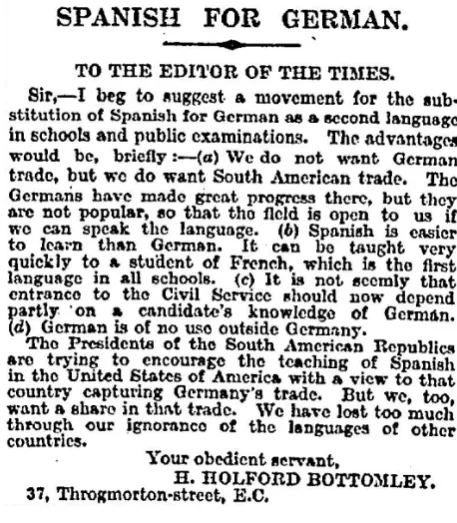
Not surprisingly, World War I also had a negative effect on the status of German as a school subject. Between 1912 and 1918, thirty-eight schools gave up German as subject, thirteen of them in the two years before the war.69 Symptomatic, perhaps, of anti-German feeling, is a letter published in The Times in 1915, ad-vocating making Spanish rather than German the second foreign language in Britain (see figure 6).The writer made the pragmatic point that Spanish was easier than German for pupils who have already learnt French; the economic argument for strengthening trade with South America; and the ideological one that it was not now ‘seemly’ for knowledge of German to stand at the gateway to the British Civil Service.
Fig. 6: Letter to the editor, The Times, 1915. 70
||
69 For further evidence of the decline, see McLelland, “French and German in Competition”.
The feeling that the future of German in schools was at risk is evident in the frequency of publications by teachers and academics with titles like “German?”, “The study of German after the war”, or “Should we teach German?”.71 Symptomatic of what was clearly happening across the country in the second decade of the twentieth century is the decision recorded in the minutes of the Masters’ Meeting at Rugby of November 22, 1918, that in Upper Middle 1, “German will be dropped, two of the periods being devoted to Latin and two to French”. While German did not completely disappear from Rugby, it lost ground to French; Latin remained secure because it was still a requirement for university admission.72 In 1928 at the Secondary School Certificate examination, when 54,273 students offered French, only 3,837 took German (Spanish, with 719 entrants, was small but growing). In Ireland, only 7.4% of examination candidates took German (down from the high-point of 18,4% in 1912); in 1927 there were only thirty-three candidates.73 The 1912 Circular on Modern Lan-guages (Board of Education Circular 797) noted with concern that German was “completely disappearing from the curriculum in schools where it formerly found a place”. Both the Circular and the 1918 Leathes Report on Modern Lan-guages made the case that at least some schools should make German the first foreign language, especially in regions where commercial and industry links to Germany were strong: “After the war, the importance of German must correspond with the importance of Germany. If Germany after the war is still enterprising, industrious, highly organized, formidable not less in trade than in arms, we cannot afford to neglect her or ignore her for a moment.”74
||
71 For full references to these and other cries for help, see McLelland, “French and German in Competition”.
72 Cambridge did not drop the requirement for one of Greek or Latin until 1960, requiring instead any two languages (dropped to one in 1967). The requirement for foreign languages began to be dropped entirely by universities from the late 1960s onwards.
73 There are interesting gender differences here. From 1933 to 1945, the number of boys taking German examinations sank and remained under thirty; but in 1936 there were 134 girls taking the examinations, all coming from five convent schools. Fischer, Das Deutschlandbild, finds that in Ireland German was a subject for girls from the outset.
8
Making the Case for German in the Twentieth
Century
The case for German in schools throughout the nineteenth century and early twentieth century had essentially been made on intellectual grounds. Whether the emphasis was on the rigours of grammar and translation or on the access to a treasure-house of literature, philology and science, and whether more or less explicitly as an alternative to the Classics – German, the second modern lan-guage after French, was part of any good liberal education. According to Bay-ley, the Leathes Report on “Modern Studies” laid the emphasis firmly on lan-guages as part of the “ideal of humane learning”, even if it did also note the value of languages for business and public service.75 This ideal was also perpet-uated in materials for pupils, such as Beresford Webb’s Second German Book, Lesson 34, “Warum ich die deutsche Sprache lernen sollte”. Here, two of the seven reasons listed were purely practical (4 and 7 below, travel and trade/pro-fession), but the remainder all made the case for the cultural importance and prestige of German on the world stage (1, 2 and 3), or asserted the value of lan-guage study in its own right (5 and 6):
1. Weil [in various parts of the world] gegen achtzig Millionen Menschen sind, deren Mut-tersprache Deutsch ist.
2. Weil Deutschland eine Literatur besitzt, welche derjenigen der andern civilisierten Völ-ker wenig oder gar nicht nachsteht.
3. Weil ich als Engländer keinem andern Volke den Vorrang abtreten will, und deshalb auch in meinen Sprachkenntnissen nicht zurückbleiben möchte.
4. Weil ich aller Wahrscheinlichkeit nach eines Tages in Deutschland, Österreich oder der Schweiz reisen, und mit den dortigen nicht-Englischsprechenden Bewohnern Um-gang haben möchte.
5. Weil die deutsche Sprache für einen Engländer von besonderem Interesse ist, da unsere und die Vorfahren der Deutschen dieselbe Sprache redeten, und eine Vergleichung dieser verwandten Sprachen ein höchst interessantes Studium bietet.
6. Weil überhaupt das Studium einer Sprache eine äußerst nützliche Geistesübung ist und das Erlenern anderer lebenden und toten [sic] Sprachen erleichtert.
||
7. Weil in jedem Beruf, sei es im Handel, in der Kunst und Wissenschaft, im Civil- und Mi-litär-Dienste oder in der Diplomatie, die Kenntnis der deutschen Sprache vom größ-ten Nutzen ist und zu meinem Erfolg in diesen Fächern bedeugröß-tend beitragen wird.76
Kron’s 1916 textbook for advanced learners of German also opens with a pro-grammatic passage “Warum lernen wir Deutsch?” Kron begins by emphasizing the achievements of German culture (Errungenschaften der deutschen Kultur), and even when he raises the practical usefulness of German to the traveller, it is not so much as an essential means of communication but because it allows the traveller to communicate with locals first-hand and so to enjoy a richer experi-ence; a second-hand experience of the culture, by means of a translation, can only ever be second-best (cf. Render’s view expressed in 1804, above). When Kron’s final sentence concedes that German might also be practically useful, it is to ensure that the unsuspecting traveller or trader is not cheated by “gewis-senslose Leute”.77
Later developments in the twentieth century – not least World War II – made it more difficult to make the case for German on the grounds of prestige, either of German culture, or as part of the discipline of Modern Languages. It is impossible here to show in detail the effects of Nazism, World War II, German division and (re)unification on how Germany and German were presented to British learners (something I have discussed elsewhere),78 but it is worth noting that the textbooks in the first two decades after World War II typically passed over the Nazi period in complete silence, and dwelled even more emphatically on the riches of older German culture, intended more or less explicitly to coun-teract images of German “militarism […] nourished by the press”, as the author of a 1958 School German Course put it.79 Meanwhile, however, other develop-ments began to reduce the focus on learning German to gain access to a great culture. The “languages for all” movement of the late 1950s and 1960s, associ-ated with moves towards comprehensivization (i.e. non-selective ‘comprehen-sive’ schools replacing the two-tier secondary modern/selective grammar school system), opened up the learning of German (and other foreign lan-guages) beyond private and grammar schools to large numbers of pupils across
||
76 H.S. Beresford Webb, A Second German Book, with Passages for Translation and Continuous Exercises (London: Longmans and Co., 1903), 46.
77 Richard Kron, Der Kleine Deutsche (1916, 15th ed. Freiburg: J. Bielefelds Verlag, 1923), 7f.
78 See McLelland, German Through English Eyes, 261–308. For fuller discussion of available sources and methodology, see 8–18.
the whole ability range. Optimism about the feasibility of teaching languages to large numbers had been fuelled post-war by news of Armed Forces language training programmes where average learners were apparently successful, and the Newsom Report on education for average and lesser ability pupils, Half Our Future (1963), argued strongly that pupils of all abilities should have the oppor-tunity to learn a foreign language.80 Eric Orton’s Auf deutsch, bitte! (1959) was specially written “for use in Comprehensive and Secondary Modern Schools” with the ambition “to establish German as an exciting and rewarding new sub-ject” for this new constituency of pupils. Orton followed “the recommendations on the teaching of modern languages to non-academic pupils as given by the Incorporated Association of Assistant Masters in their book The Teaching of Modern Languages”,81 including selecting vocabulary according to frequency of use, “only a minimum of carefully presented grammar”, plenty of repetition, and an overall slower pace than in “the usual Grammar School course”. Orton chose his material with the aim of “giving a lively and amusing picture of Ger-many and the Germans”.82 Figure 7 may serve as an illustration of what this looked like in practice. The story of an April Fool’s joke is taken from Chap-ter 16, relatively near the end of Orton’s book, in which the dative was only introduced in Chapter 19. Note the very simple syntax, with the complete avoid-ance of subordinate clauses, and the avoidavoid-ance of the dative and genitive cases (quite a feat over sixteen chapters).
||
80 See H.H. Stern, Fundamental concepts of language teaching (Oxford: Oxford University Press, 1983), 102–104 and references there; Phillips and Filmer-Sankey, Diversification in Mod-ern Language Teaching, 24. The concMod-ern to provide opportunities for less academic learners was not unique to modern languages. It bore fruit in the introduction of the CSE (Certificate of Secondary Education) examinations for less academically able pupils, which ran alongside the GCE O-level (General Certificate of Education Ordinary Level) from 1967 until 1988, when both were replaced by the GCSE. Between 0.5% and 1% of pupils taking these examinations took German, and pass rates were generally high: 90% and above, compared to around 60% for the GCE (according to Ortmanns, Deutsch in Großbritannien, 163–169; 179–182), although a CSE, unless passed with the highest Grade 1, was not a suitable foundation for continuing with the language. Grade 1 was equated with a low O-level pass, though the same standard was proba-bly not reached, according to Eric Hawkins, Modern Languages in the Curriculum. Revised Edition (Cambridge: Cambridge University Press, 1987), 15.
81 I.e. Incorporated Association of Assistant Masters in Secondary Schools, The Teaching of Modern Languages (London: University of London, 1956).
The late 1970s and early 1980s saw another adjustment to less academic pupils, as the Graded Objectives movement in Modern Languages broke the syllabus down into a “series of short-term goals, each building on the one before, so that the pupil advances in knowledge and skill”.83 As CILT’s Derek Hewitt an-nounced in 1986, “Gone are the days when German groups were selected in years 2 and 3 on the sole criterion of pupils being considered able to complete an often rigorous course […] over three to four years.”84 The philosophy of the Graded Objectives movement ultimately produced the Council of Europe’s Common European Framework of Reference for Languages, worked on from 1989 and finally published in 2001, which identified six reference levels, expressed in terms of what the learner can do, from A1 to C2, and which have been widely influential. These developments all aimed to bring foreign language learning, and, equally importantly, a sense of attainment in that learning, within reach of everyone. Where skills-based targets began to dictate the curriculum, however, there was less and less scope for the ‘prestige’ side of language learning, and in their eagerness to embrace the usefulness of languages in the context of greater European integration, language advocates increasingly laid the emphasis on the practical usefulness of German. For example, when Nigel Reeves – then Professor of German at Aston University and member of the National Congress on Languages in Education at the time – opened CILT’s 1986 German in the United Kingdom conference, he was presum-ably well aware that the Under-Secretary for Education Peter Brooke was in his audience and judged that it was the economic case for German that had the greatest chance of a sympathetic hearing. Reeves began by staking out the terri-tory of literary worth, citing Heine, but he swiftly moved to “the industrial and commercial necessity for an emphasis in British education on foreign languages and on German in particular”,85 and it was to this that he devoted the majority of his speech. Even the “moral” case for German as part of the “intellectual portfolio of an educated Briton as a European and as a citizen of the world”86 is exemplified by Reeves with an economist’s argument: the need to understand the country that produced Marx, and hence capitalism.
||
83 Brian Page, “Graded Objectives,” in Language Teaching 16 (1983) 292–308, here: 292.
84 Derek Hewitt, “Graded Objectives in Modern languages – a survey of German in GOML for 1985–86,” in German in the United Kingdom: Issues and Opportunities, 54f. CILT is the Centre for Information on Language Teaching, founded in 1966.
85 Nigel Reeves, “Why German?,” in German in the United Kingdom: Issues and Opportunities, 1–12, here: 4.
9
Conclusion
I have documented the emergence of several, often overlapping, reasons for the usefulness of learning German: limited scholarly interest (seventeenth century onwards); the social capital generated by learning languages for leisure, and the ability to participate in the international intercourse of a social elite, for example on the Grand Tour (late seventeenth century and eighteenth century); knowledge of a prestige language, opening the doors to a great culture and literature (from the 1770s onwards); the benefits of a modern language as a ‘discipline’ in formal education; commercial importance; and, finally, a return to the practical needs of the traveller typically catered to in seventeenth- and eighteenth-century manuals, from the early twentieth century onwards, as lan-guages became available to all school pupils, not just a social or academic elite.87 In current discourse aimed at trying to increase the uptake of German and modern languages these days, we hear (and perhaps ourselves say) most about the last two of these reasons – the business case and the needs of the tourist. But why have people really learnt German? Ortmanns concluded his 1993 study of GFL in Britain with the assertion that historic increases in the learning of German in particular (rather than of Modern Languages in general) are largely explained by economic factors,88 and that cultural or linguistic fac-tors played at best a secondary role. To my mind, the evidence presented above suggests the reverse. While claims about the utility of German were made from the outset, and certainly increased in intensity as economics and politics dictat-ed, there is little evidence that these arguments actually convinced learners to take up German. German rose to prominence in the late eighteenth century above all for cultural reasons – increased contact with Germany, in part thanks to Hanoverian rule, combined with an increased appreciation of its culture. Always second to French, German stayed in second place in schools until the last twenty years or so, when German has lost ground to Spanish. Spanish has
||
87 While I have not developed the point here, the increasing expectation that learners will use their language in encounters with native speakers is reflected in a focus in the 1990s on inter-cultural language education, preparing learners to be sympathetic and open-minded in their encounters with other cultures. Michael Byram and Claire Kramsch are (in different ways) key exponents of these approaches: see Michael Byram, From Foreign Language Education to Edu-cation for Intercultural Citizenship: Essays and Reflection (Clevedon: Multilingual Matters, 2008), and Germany: Its Representation in Textbooks for Teaching German in Great Britain, ed. Michael Byram (Frankfurt am Main: Diesterweg, 1993); and Claire Kramsch, Language and Culture (Oxford: Oxford University Press, 1998).
been learned in England for purposes of commerce since the sixteenth century (well before German!),89and no doubt the history of Spanish in the UK, once it is written, will show periodic restatements of the economic arguments already made in its favour, including already in the 1918 Leathes Report. However, Spanish overtook German in popularity only once cultural familiarity was achieved, as Spain and South America became mass popular travel destinations for the English. If there is a moral to the tale for Germanists and teachers of German, it is perhaps this: we must continue to make the case ‘upwards’ to policy-makers, that German is indeed a useful language, and, in this era, one of the most useful ones, deserving its prominent place in education. However, history gives succour to the view that it is not hard-headed commercial reason-ing that wins individual learners to languages in general and to German in par-ticular, but the promise of enriching cultural encounters, both in travel (in the seventeenth century as now, but today for a far wider market) and in travels of the mind.
||
![Fig. 3: John Bachmair’s Complete German Grammar, 3rd ed. 1771 (London: printed for G. Keith [et al.]), 288](https://thumb-us.123doks.com/thumbv2/123dok_us/8675957.377575/19.439.51.311.56.479/john-bachmair-complete-german-grammar-london-printed-keith.webp)