Oranna Speicher
1and Sascha Stollhans
2Abstract. It is well documented that providing assessment feedback through the medium of screencasts is favourably received by students and encourages deeper engagement with the feedback given by the language teacher (inter alia Abdous & Yoshimura, 2010; Brick & Holmes, 2008; Cann, 2007; Stannard, 2007). In this short paper we will report the results of a case study where students moved from passively receiving feedback to actively entering into a feedback dialogue with their language teachers: screencasts were used not only by the teachers to provide audio and visual feedback to students on their written work, but also by the students themselves to comment in depth on the feedback they had received. Participants in the case study were surveyed at the end of the semester, and we will report on the survey findings as well as discuss the limitations and implications of the case study. The paper will reflect on the potential role of technology in providing feedback, the effectiveness of elicitation feedback in the context of this case study and the students’ perception of the usefulness of creating their own screencasts in response to the feedback they have received.
Keywords: feedback, screencasts, computer-mediated communication, CMC, student engagement.
1. Introduction
In 2005 the Higher Education Funding Council for England (HEFCE) launched the now annual National Student Survey (NSS) to gauge the level of overall satisfaction amongst final year students regarding their degree courses in the UK. The survey questions cover various aspects of the students’ university experience,
1. University of Nottingham, United Kingdom; [email protected] 2. University of Nottingham, United Kingdom; [email protected]
from the organisation and management of their study programmes and the teaching they experienced, to feedback on their assessments and availability and quality of learning resources. Whilst student satisfaction with assessment and feedback has risen since the start of the survey, last year’s figures suggest that it is still the category where, relatively speaking, students express least satisfaction regarding their university experience.
In 2012 HEFCE itself produced guidelines for Higher Education Institutions aimed at increasing students’ engagement with the feedback they receive.
If students continue to see feedback as the area of their degree experience that they are least satisfied with, the question arises as to what staff can do in order to improve the way(s) in which feedback is presented to the students. The following study report details the results of a case study where students moved from passively receiving feedback to actively entering into a feedback dialogue with their language teachers.
2. Method
2.1. Participants
Our small scale study took place in the spring semester of the academic session 2014/2015 and involved two distinct groups of students from the School of Cultures, Languages and Area Studies at the University of Nottingham: one second-year group studying German as a degree subject consisting of 10 students (group 1), and one mixed-year group, consisting of 12 students, studying German as a subsidiary module alongside their main degree course through the institution-wide language programme (group 2). The language competence of the participants was approximately in line with level B2 (group 1) or B1 (group 2) of the European Framework of Reference for Languages. All students were undergraduate students at the time the study took place.
2.2. Data collection
In the first instance, both groups of students were given a formative written task: an essay (group 1) and a summary in German (group 2). Both teachers then provided the students with a screencast, using the freely available software screencast-o-matic3. In the case of group 1, the screencast showed the students’ piece of written
work and contained an audio recording of the teachers’ elicitation feedback, i.e. the audio feedback consisted of metalinguistic explanations and prompts to encourage the students to work out for themselves how to improve their work (e.g. Lyster & Ranta, 1997). This was done in the target language. In the case of group 2, the non-specialist group, the screencast was in English and it had also written elicitation comments as an additional feedback element.
It is at this point in the feedback process that the innovative element of our study is found: after reworking their essays, the students themselves produced a screencast video, using the same software, in order to explain how they had incorporated the elicitation feedback into their second essay/summary submission.
Finally, students were asked to fill in an online questionnaire created with surveymonkey4 in order to gauge their perception on the feedback they had
received, and how they evaluated its usefulness and the role technology played in both receiving and creating feedback.
3. Discussion
All students in both groups submitted the draft version of their written assignment and received a screencast with audio elicitation feedback. Out of a total number of 22 students, eight created a screencast themselves of their final version of the assignment. Roughly 40% of the total number of the participating students completed the questionnaire with the following results.
The majority of the students had watched the video several times, 50% had watched it three times or more. All participants had then used the feedback to rework their essays accordingly. Open comments like the following suggest that students used the feedback to analyse and work on their linguistic weaknesses, not only for this specific assignment but also beyond:
“I did use the feedback to identify my main areas of weakness and focus heavily on these aspects on revising for the exam, hopefully significantly improving my marks and the standard of my German”.
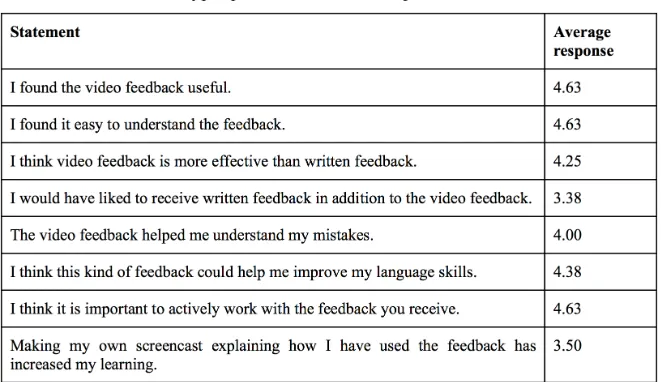
We asked students to evaluate the following general statements about the activity (Table 1), using a five-point Likert scale (1 = Strongly disagree, 2 = Disagree, 3 = Neither disagree or agree, 4 = Agree, 5 = Strongly agree).
Table 1. Likert-scale type questions of the final questionnaire
The results suggest that students perceived the exercise as very useful and beneficial to their learning experience, and that working actively with the feedback they had received helped them improve their language skills.
Several open comments suggest that students perceive screencast feedback to be more personal and that it encourages students to work more actively with the feedback. However, students were divided over the idea of creating a screencast themselves, the average score of 3.50 as well as open comments show that some students found it useful, whereas others were not convinced that it had benefitted their learning process.
Regarding the question of whether students would prefer the feedback to be in English or in the target language, 50% opted for the target language, 25% for English, and the remaining 25% did not express a preference.
4. Conclusions
[image:4.442.57.388.86.277.2]in student’s opinion about which language the feedback should be given in can be attributed to the students’ main study discipline – those studying German as a degree subject prefer the feedback to be in German, those studying German as a subsidiary prefer the language to be English. Our small scale study did not find that students are convinced about the learning benefits of creating a screencast and explaining their revised essays to their teacher.
References
Abdous, M. H., & Yoshimura, M. (2010). Learner outcomes and satisfaction: a comparison of live video-streamed instruction, satellite broadcast instruction, and face-to-face instruction. Computers & Education, 55(2), 733-741. doi:10.1016/j.compedu.2010.03.006
Brick, B., & Holmes, J. (2008). Using screen capture software for student feedback: towards a methodology. In IADIS International Conference on Cognition and Exploratory Learning in the Digital Age.
Cann, A. J. (2007). Podcasting is dead. Long live video! Bioscience Education, 10. doi:10.3108/ beej.10.c1
Lyster, R., & Ranta, L. (1997). Corrective feedback and learner uptake. Studies in second language acquisition, 19(1), 37-66. doi:10.1017/S0272263197001034
© 2015 by Research-publishing.net (collective work) © 2015 by Author (individual work)
Critical CALL – Proceedings of the 2015 EUROCALL Conference, Padova, Italy Edited by Francesca Helm, Linda Bradley, Marta Guarda, and Sylvie Thouësny
Rights: All articles in this collection are published under the Attribution-NonCommercial -NoDerivatives 4.0 International (CC BY-NC-ND 4.0) licence. Under this licence, the contents are freely available online (as PDF files) for anybody to read, download, copy, and redistribute provided that the author(s), editorial team, and publisher are properly cited. Commercial use and derivative works are, however, not permitted.
Disclaimer: Research-publishing.net does not take any responsibility for the content of the pages written by the authors of this book. The authors have recognised that the work described was not published before, or that it is not under consideration for publication elsewhere. While the information in this book are believed to be true and accurate on the date of its going to press, neither the editorial team, nor the publisher can accept any legal responsibility for any errors or omissions that may be made. The publisher makes no warranty, expressed or implied, with respect to the material contained herein. While Research-publishing.net is committed to publishing works of integrity, the words are the authors’ alone.
Trademark notice: product or corporate names may be trademarks or registered trademarks, and are used only for identification and explanation without intent to infringe.
Copyrighted material: every effort has been made by the editorial team to trace copyright holders and to obtain their permission for the use of copyrighted material in this book. In the event of errors or omissions, please notify the publisher of any corrections that will need to be incorporated in future editions of this book.
Typeset by Research-publishing.net
Fonts used are licensed under a SIL Open Font License
ISBN13: 978-1-908416-28-5 (Paperback - Print on demand, black and white)
Print on demand technology is a high-quality, innovative and ecological printing method; with which the book is never ‘out of stock’ or ‘out of print’.
ISBN13: 978-1-908416-29-2 (Ebook, PDF, colour) ISBN13: 978-1-908416-30-8 (Ebook, EPUB, colour)
Legal deposit, Ireland: The National Library of Ireland, The Library of Trinity College, The Library of the University of Limerick, The Library of Dublin City University, The Library of NUI Cork, The Library of NUI Maynooth, The Library of University College Dublin, The Library of NUI Galway.
Legal deposit, United Kingdom: The British Library. British Library Cataloguing-in-Publication Data.
A cataloguing record for this book is available from the British Library.