Déjà vu experiences in anxiety
Christine E. Wells
a*, Akira R. O’Connor
band Chris J.A. Moulin
caSchool of Social and Health Sciences, Leeds Trinity University, Leeds, UK; bSchool of
Psychology and Neuroscience, University of St Andrews, St Andrews, UK, Email:
[email protected]; Laboratoire de Psychologie et Neurocognition, LPNC CNRS
5105, Université Grenoble Alpes, France, Email: [email protected]
Déjà vu experiences in anxiety
Déjà vu occurs when a novel event is experienced with an erroneous sense of
familiarity. Memory researchers theorise that this arises due to an error in the
processes underlying the recognition memory system. Research has indicated that
there may be a link between high levels of anxiety and increased frequency and
intensity of déjà vu, however there has been comparatively little characterisation
of déjà vu as experienced by individuals with clinical anxiety. We used an online
questionnaire to collect data from individuals self-reporting a clinical diagnosis
of anxiety, as well as from age-matched controls. The Anxiety Group reported a
significantly higher frequency of déjà vu episodes over the previous month than
controls. They also reported experiencing déjà vu more frequently and with
higher intensity during periods of high anxiety. In addition, the Anxiety Group
reported finding déjà vu episodes significantly more distressing than the control
group. The findings indicate that there are differences in déjà vu experienced by
people reporting high levels of anxiety compared to healthy controls without an
anxiety diagnosis. We discuss structural and neural mechanisms thought to
underpin déjà vu in relation to these results.
Keywords: déjà vu; anxiety; memory; decoupled familiarity; theta
Introduction
Déjà vu is a phenomenon conservatively thought to be experienced by
approximately 60% of the general population (Brown, 2003). It is typically a transitory state during which a person encountering a novel experience, such as visiting a new place, is struck by an erroneous sense of familiarity (Illman, Butler, Souchay & Moulin, 2012). Crucially, the déjà vu experience is accompanied by insight into the false nature of this feeling of familiarity (e.g. Urquhart, Sivakumaran, Macfarlane & O’Connor, 2018).
had or had not experienced déjà vu. Group allocation was determined by their responses on the Inventory for déjà vu experiences assessment (IDEA; Sno et al, 1994), a
Whilst these studies implicate regions, they do not identify whether déjà vu is a result of the functional interactions between this set of regions. Shaw, Marecek & Brázdil, 2016) examined structural covariance, an indicator of the organisation of neural signalling between constituent brain structures, in healthy déjà vu experiencers. They reported that pairwise correlations in grey matter amongst regions within the medial temporal lobe (MTL) and between MTL, dorsal striatum and insula cortex were more positively correlated as self-reported frequency of déjà vu episodes increased. As such, the authors proposed that healthy déjà vu results from some form of aberrant signalling within MTL circuitry.
TLE patients who have undergone electrical stimulation of MTL regions and related structures using depth electrodes have also provided useful insights into the underlying circuitry of déjà vu. Stimulation of the rhinal cortex has been shown to induce déjà vu episodes (e.g. Bancaud, Brunet-Bourgin, Chavel & Halgren, 1994; Barbeau et al, 2005; Bartolomei et al, 2012). In addition, rhinal stimulation has
indicated that theta band activity, involved in memory processing, may be linked to déjà vu episodes, as stimulation-induced episodes have been observed to be accompanied by theta synchronisation across MTL structures (Barbeau et al; Bartolomei et al, 2012).
systematically mistimed neural signalling could result in erroneous recollection of novel stimuli. Briefly, they proposed that hippocampal CA1 neuron firing, decoupled from the usual point on the cycle indicating novelty, and mistimed to the point that it
systematically occurs at a phase of the theta cycle consistent with recollection, would result in behaviours seen in patients experiencing pathological déjà vu characterised by accompanying confabulation.
The putative relationship with the theta cycle provides a link between déjà vu and associated emotions. The theta cycle is implicated in memory-related processes (e.g. Mormann et al, 2008; Osipova et al, 2006; Sederberg, Kahana, Howard, Donner & Madsden, 2003) but also in emotional processing, specifically anxiety (Gray, 1982; Gray & McNaughton (2000). Rodent hippocampal theta is reliably reduced through the administration of a range of neurochemically dissimilar anxiolytic drugs (Gray & McNaughton, 2000; Wells et al, 2013). Crucially, this effect is not observed with other types of psychoactive drugs e.g. antipsychotics, leading to the suggestion that this a reliable index of a reduction in anxiety. There is also evidence in the animal literature to suggest increased anxiety is associated with alterations in theta (e.g. Fontani, Farabollini & Carli, 1984; Fontani & Vengi, 1990a & b; Gordon, Lacefield, Kentros & Hen, 2005; Meyza, Boguszewski, Olszewski, Kasicki & Zagrodza, 2009). Human data also supports the role of theta oscillations in anxiety (e.g. Cornwell, Arkin, Overstreet, Carver, & Grillon, 2012; Khemka, Barnes, Dolan & Bach, 2017).
symptoms and depersonalisation, and 30 individuals with TLE, aiming to compare the prevalence of a range of symptoms. Déjà vu was reported by 12/30 of the PADS and 7/30 of the TLE group. The authors also indicated that déjà vu episodes were of a longer duration in the PADS group (although this data was not presented in the article). These findings therefore indicate a possible link between symptoms associated with anxiety and a higher frequency of occurrence and longer duration of déjà vu episodes.
Interest in exploring the relationship between anxiety and déjà vu was recently revived through a case study reported by Wells et al. (2014). A young male, presenting with high levels of anxiety, reported experiencing chronic and debilitating déjà vu. Neurological assessment indicated no obvious underling neurological pathology, indicating that this was potentially psychogenic in nature, and that his high level of anxiety may both contribute to and result from his frequent déjà vu experiences. It is difficult to characterise the nature of the relationship between anxiety and déjà vu from this single case but, placed alongside the earlier findings of Harper and Roth (1962), it adds to the rationale behind conducting a more extensive assessment of the déjà vu experiences of clinically-anxious patients compared to healthy controls and to further define the nature of the relationship between anxiety and déjà vu.
highlighted as of particular interest (Illman et al, 2012; Moulin, 2014; Wells et al, 2014).
This paper presents the results of a questionnaire study assessing aspects of déjà vu, including frequency, intensity, and triggers of these episodes in two groups of participants: individuals who self-reported having a clinical diagnosis of anxiety (‘Anxiety Group’) and individuals who reported having no such diagnosis (‘Control Group’) and compared responses across these two groups. The study also included several standardised measures used to assess anxiety, stress, depression and
dissociation. Based on the nascent literature in the field, we speculatively suggest that clinically anxious participants will report their déjà vu experiences as being more frequent and longer in duration than non-anxious controls.
Method
Participants
All participants were recruited online from advertisements posted on a range of sites, including anxiety websites and forums, social media and websites recruiting voluntary psychology research participants. Participants were given the choice to complete the study online or request paper copies. The majority of participants (99.4%) completed the study online. Two participants requested paper copies, which were posted to them for completion.
Demographic characteristics
clinical anxiety were also asked to provide their anxiety diagnosis from several alternatives taken from the DSM-IV criteria. The most frequently reported diagnosis was Generalised Anxiety Disorder (GAD; 63.9% of participants). The anxiety group also reported diagnoses of Social Phobia (28.8%), Post-Traumatic Stress Disorder (PTSD; 19.6%), Obsessive Compulsive Disorder (OCD; 13.7%), Specific Phobia (4.6%), Acute Stress disorder (1.3%), Panic Disorder with Agoraphobia (9.8%), without Agoraphobia (12.4%), Agoraphobia without history of Panic Disorder (2.6%). Sixty-five (42.5%) of the Anxiety Group reported comorbid anxiety diagnoses. There were 199 participants in the healthy control group (41 males, 156 females, 2 did not report gender, mean age = 25.4, SD = 8.0 years).
The mean age of the Anxiety group (26.78 [SD = 9.11, range = 18-66] years) was comparable to the control group (25.49 [SD = 8.04, range =19-61] years; t350 = 1.42, p = 0.16, d = 0.15). There were 23 (15.0%) males and 130 (85.0%) females in the Anxiety group. The control group comprised 41 (20.6%) males, 156 (78.4%) females and 2 (1.0%) participants didn’t provide gender information.
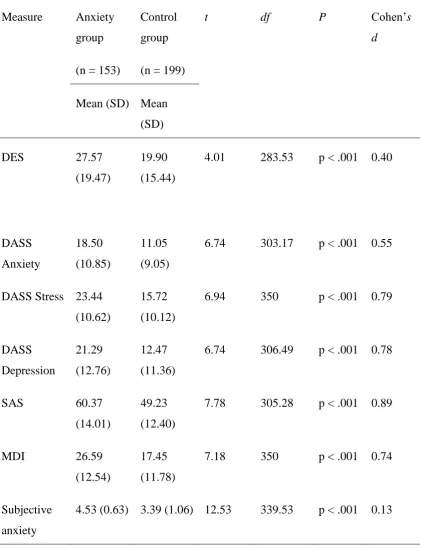
A series of t-tests on our standardised measures (see below) ascertained that our Anxiety Group were significantly more anxious than our control group (see Table 1). In sum, the Anxiety group scored significantly higher on all measures assessing anxiety, stress, depression and dissociation.
[Table 1 here]
Measures
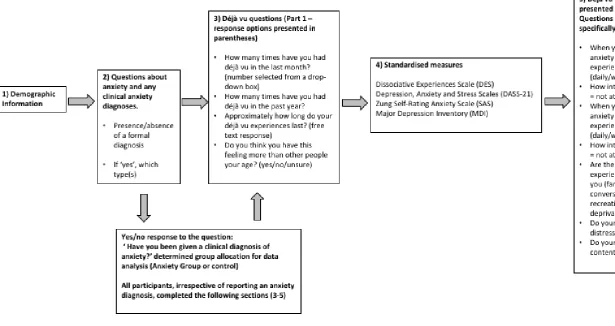
levels compared to other people?’ – this is referred to as ‘subjective anxiety’ throughout the rest of the paper); 3) An assessment of general knowledge about déjà vu and any such experiences participants have had to date; 4) Several standardised measures to assess levels of anxiety, depression, stress, and dissociative experiences; and 5) Questions asking more specifically about participants’ déjà vu in relation to anxiety. Figure 1 presents an overview of the structure of the questionnaire and déjà vu questions. The questionnaire battery was identical in terms of content and ordering of the questions in both the online and paper versions.
Déjà vu assessment
Before answering questions about déjà vu, participants were provided with a definition: ‘Déjà vu is the name we give to a strange sensation, where we feel like we have encountered something before, but we know that we have not. It might be meeting a person for the first time, going to a new place, or just having a conversation’. They were then asked two sets of questions about déjà vu. These were positioned either side of the standardised measures of anxiety, depression, stress and dissociative experiences. Part 1 asked participants about their previous experiences of déjà vu (e.g. frequency and duration of déjà vu experiences, Figure 1). Part 2 included questions which focused more specifically on déjà vu in the context of anxiety (e.g. frequency of déjà vu experiences, Figure 1). This section also included a number of open-ended questions about déjà vu, which asked participants to elaborate on issues including: whether they ever experienced any abnormal sensations during their déjà vu experiences; whether their déjà vu experiences contained any emotional content; whether they had ever noted a connection between their déjà vu experiences and anxiety or discussed this
limited number of responses were gathered for these open-ended questions and so the analysis presented here is primarily focused on the quantitative data gathered from the questionnaire.
Standardised measures of dissociation, anxiety, stress and depression
Dissociative Experiences Scale
The Dissociative Experiences Scale (DES; Bernstein & Putnam, 1993) is a 28 item self-report questionnaire assessing dissociation. An example item is ‘Some people have the experience of finding themselves in a place and having no idea how they got there. Select a number to show what percentage of the time this happens to you.’ Participants select a percentage value ranging from 0-100% in 10% intervals. Higher mean scores reflect higher levels of dissociation.
Depression, Anxiety and Stress Scales
The Depression, Anxiety and Stress Scales (DASS-21) measure the dimensions of depression, anxiety and stress (Lovibond & Lovibond, 1995). The 21-item version includes 7 statements for each of the three dimensions. Participants are asked to indicate how much each statement applied to them over the past week. An example item from the anxiety scale is ‘I worried about situations in which I might panic and make a fool of myself’. Participants are asked to rate each item from on a 4-point Likert scale from ‘Did not apply to me at all’ to ‘Applied to me very much, or most of the time’. The total score is multiplied by 2 to calculate the final score. Scores for each dimension can fall into one of 5 categories; normal, mild, moderate, severe and extremely severe
20+; Stress: normal 0-14; mild 15-18; moderate 19-25; severe 26-33; extremely severe 34+).
Zung Self-Rating Anxiety Scale (SAS)
The Zung Self-Rating Anxiety Scale (Zung, 1971), is a 20-item questionnaire assessing cognitive and somatic symptoms of anxiety. Participants are asked to indicate how much each statement applied to them over the past week. An example item from the scale is ‘I get upset easily or feel panicky’. Rating is on a 4-point Likert scale from ‘Never/rarely’ to ‘Always’. Scoring involves the reversal of five items, and total scores are then converted to anxiety index scores. Scores below 45 are considered within the normal range, 45-59 = minimal to moderate anxiety, 60-74 = marked to severe anxiety, > 75 most extreme anxiety.
Major Depression Inventory (MDI)
The Major Depression Inventory (MDI; Bech, Rasmussen, Olsen, Noerholm & Abilgaard, 2001) consists of 10 items which cover the ICD 10 and DSM-IV symptoms of Major Depression. Items 8 and 10 are divided into two sub-items, and the highest scoring of each of these is included in the total score. Participants are asked to indicate how they have been feeling over the past two weeks. An example item is ‘Have you felt in low spirits or sad?’ Rating is on a 6-point Likert scale from 0 (symptom is never present) to 5 (symptom constantly present). Scores of 20-24 reflect mild depression, 25-29 moderate depression, and 30+ are considered to reflect severe depression.
Procedure
requested paper copies, which were posted out to them with stamped addressed return envelopes. The questionnaire battery took approximately 30 minutes to complete. Ethical approval for the study was gained from the School of Psychology, University of Leeds University. All participants gave informed consent to participate in the study.
Statistical analysis
Differences in group scores on the measures of anxiety, stress, depression, dissociation and déjà vu frequency were analysed using independent samples t-tests. The relationship between déjà vu frequency questions, DES scores, and age were analysed using Pearson’s correlations. Questions about the triggers of déjà vu, duration of episodes, distress levels and emotionality were analysed using X2 tests.
Results
The main aim of this study was to ascertain whether people who reported a clinical diagnosis of anxiety had a higher level of déjà vu than a comparison Control Group. We thus first concentrate on comparisons between the groups on our déjà vu measures and questions, before examining individual differences in the experience of déjà vu, and factors related to déjà vu experience.
Frequency of déjà vu
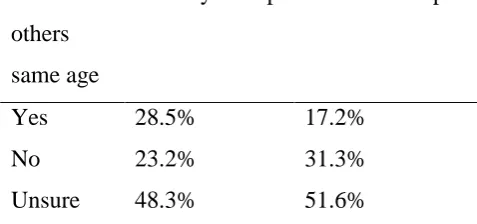
Participants were also asked as to whether they perceived their déjà vu experiences to be more frequent than others their age. Overall, 29% of the Anxiety Group, compared to 17% of the Control Group, felt that they experienced déjà vu more frequently than other people their age (Table 2).
[Table 2 here]
Duration of déjà vu
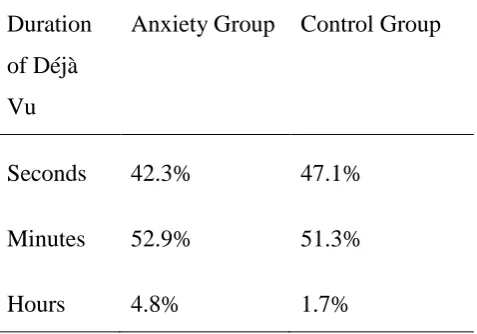
Participants were asked to provide a text description of the typical duration of their déjà vu experiences. These descriptions were coded into seconds, minutes and hours to allow for comparison between groups. The pattern of responses did not differ significantly between the two groups (X2 [1, N = 227] = 2.18, p = 0.34) (Table 3).
[Table 3 here]
Subjective reports of anxiety and déjà vu
Triggers of déjà vu
Participants were asked about the perceived circumstantial triggers for their déjà vu and were asked to select as many as they felt related to them. Possible responses were: locations and people (familiar and unfamiliar), conversations, recreational drugs, stress, tiredness and anxiety. Anxiety was the only trigger significantly more frequently reported by the Anxiety Group than the Control Group (Table 4).
Distress levels
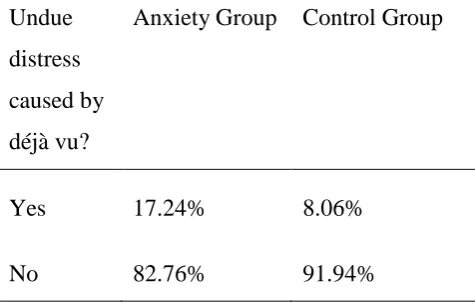
The Anxiety Group reported déjà vu as causing them undue distress compared to controls (X2 [1, N = 331] = 6.46, p = 0.01) suggesting that experiencing déjà vu affects this group in a different manner compared to healthy controls (Table 5).
[Table 5 here]
Déjà vu during periods of high anxiety or stress
Participants were asked about their déjà vu experiences during periods of both minimal and high anxiety/stress. The Anxiety Group reported their déjà vu experiences as significantly more frequent (M = 2.44, SD = 1.04) than controls (M = 2.09; SD = 0.87; t285.96 = -3.39, p = 0.001) during periods of high anxiety/stress. They also reported that these déjà vu experiences as significantly more intense (M = 3.00, SD = 1.19) than controls (M = 2.45, SD = 1.14; t340 = 4.28, p = 0.00002). There were no group
differences when asked identical questions regarding periods of minimal anxiety/stress.
Emotionality of déjà vu experiences
The Anxiety Group reported their déjà vu experiences as containing emotional content more frequently than controls [X2 (1, N = 332) = 8.76, p = 0.003]. They also rated this content as significantly more emotional (M = 2.54, SD = 1.44) than controls (M = 2.00, SD = 1.39; t233.63 = 3.38, p = 0.001). Participants also had the opportunity to provide some qualitative information regarding the nature of their déjà vu and the emotions they experienced. The Anxiety Group described a range of accompanying emotions, including anxiety, stress and confusion (e.g. ‘I become very frightened and as if I am stuck in the room in which I am experiencing it’) but also more positive
(e.g. ‘typically very nostalgic emotions, but paired with confusion or detached distress/panic due to the fact that I cannot remember the circumstances of first experiencing the emotion’). Control Group participants reported a similar range of positive and negative emotions, but in addition to this several participants in this group did not feel that any emotion was associated with their déjà experiences e.g. ‘usually (a) very neutral feeling’.
Correlational Analyses
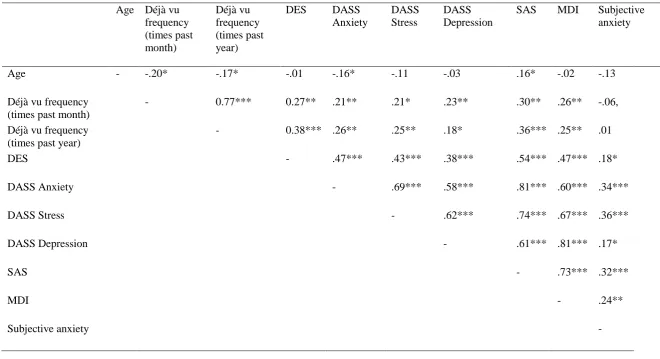
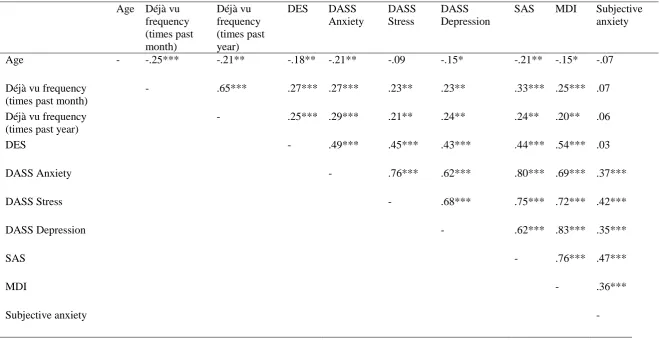
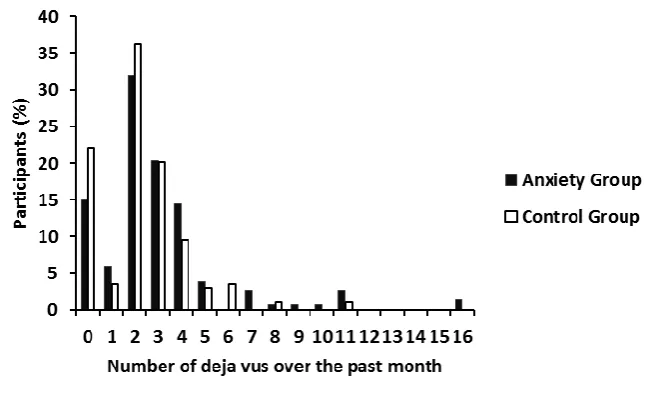
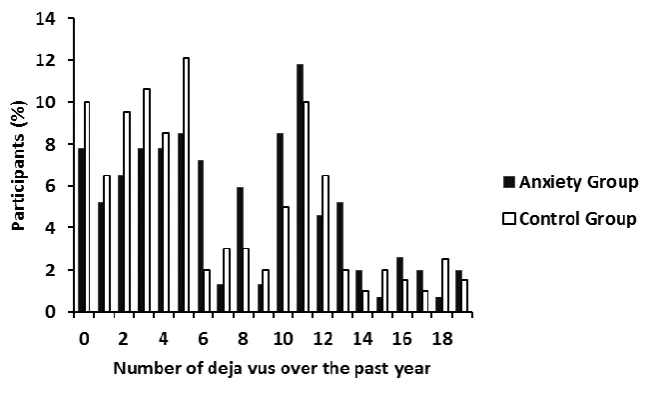
Thus far, our data points to our Anxiety Group having more frequent déjà vu (especially during periods of high anxiety), and déjà vu which is triggered by anxiety and is perceived as being more distressing. However, within each group there are differences in how frequently the groups report having déjà vu (Figures 2 and 3). To examine the characteristics of anxiety triggered déjà vu and anxiety and déjà vu more generally we carried out correlational analyses. We carried out a series of correlations separately in each group (Tables 6 and 7).
the past year, with the SAS giving the highest correlation coefficient (r=.36). Perhaps of most interest, within the Anxiety Group, it appears that those with highest levels of déjà vu are those with higher reports of dissociative experiences (rs of .27 and .38 for monthly and yearly frequency respectively). The DES itself correlates with most of the anxiety measures with high r values. Within the Control Group, a similar pattern is found, with strong correlations between many of the tasks. Again, SAS seems to be best correlated with reports of déjà vu frequency, and although not quite reaching a medium effect size, there is a correlation between the DES and the monthly and yearly ratings of déjà vu frequency (rs .27 and .25 respectively). In summary, we have been deliberately cautious in describing the patterns of correlations in our data, but it appears that déjà vu experiences are associated with higher scores on measures of anxiety and dissociative experiences.
[Table 6 here]
[Table 7 here]
Discussion
Anxiety Group reported finding these as significantly more distressing than controls. Perhaps unsurprisingly then, measures of anxiety correlated with the frequency of déjà vu experience.
It has long been established that déjà vu involves memory-related circuitry (e.g. see Hughlings-Jackson, 1881; Penfield & Perot, 1963; Halgren, Walter, Cherlow & Crandall, 1978) but research has also long-since implicated emotional circuitry in déjà vu (e.g. Gloor, Oliver & Quesney, 1982). Structural differences in memory and
emotion-related circuitry are apparent when comparing healthy individuals who experience déjà vu and individuals with TLE and déjà vu (Labate et al, 2015), and indeed research comparing the phenomenology of déjà vu in these two groups remains somewhat inconclusive as to the extent to which they are the same (Warren-Gash & Zeman, 2001; Moulin, 2014; Perucca et al, 2017). Perhaps then, the phenomenological differences we report between our controls and the Anxiety Group also reflect
underlying structural differences in memory and/or emotion-related circuitry. Whilst this is beyond the scope of this paper, it would be of interest to determine whether there are any structural markers which differentiate these two groups.
role in déjà vécu, a clinical manifestation of déjà vu. If theta is involved in the
generation of déjà vu perhaps the differences we observed between the Anxiety Group and controls reflect underlying anxiety-related differences in oscillatory activity.
We found that whilst there were differences in the frequency of déjà vu
episodes, and the perceived distress they caused, there was no difference in duration of déjà vu when comparing the two groups. However, one of the key limitations in déjà vu research is that it is largely retrospective in nature, which is problematic when aiming to collect accurate data about these subjective experiences. We attempted to address this issue by encouraging participants who completed the study discussed here to complete a brief follow-up immediately after their next déjà vu episode. This follow-up required participants to complete the Impact of Event Scale (Horowitz, Wilner & Alvarez, 1979), typically used to assess stress reactions for traumatic events. Low numbers of
We have added to the evidence base about clinical anxiety and déjà vu. It is commonly asserted there is a relationship between déjà vu and stress (e.g. Brown, 2003), and more recently research has indicated that there may be differences in the frequency and intensity of déjà vu experienced by people with clinical anxiety. We therefore believe that this paper adds important quantitative support, which has been previously lacking, to the existence of such relationships. This paper therefore contributes not only to the pre-existing body of déjà vu research, but also makes a clinically-relevant contribution. Towards the end of this study we asked participants whether they have ever discussed their déjà vu experiences when with a medical professional. In a few instances, participants reported that they had, and that they were told anxiety and déjà vu are associated (e.g. ‘yes, (I) was told it was common for people with anxiety’). In presenting novel findings which confirm the existence of such a relationship, our findings therefore strengthen the validity of such discussions between patients and clinicians.
In summary, we report the main findings from the first large-scale study
profiling déjà vu in anxiety. It would appear that déjà vu is more frequently experienced by people with clinical anxiety, and that déjà vu experiences cause significantly more distress than they do in healthy controls. Understanding these group differences may be of use to clinicians when considering the potential impact of déjà vu symptoms upon the psychological wellbeing of individuals with anxiety disorders.
Acknowledgements: The authors are grateful to Dave Horton for helping set up the online
questionnaire.
References:
Journal of Nervous and Mental Disorders, 196(5), 417-419. doi: 10.1097/NMD.0b013e31816ff36d
Adachi, T., Adachi, N., Takekawa, Y., Akanuma, N., Ito, M., Matsubara, R., Ikeda, H. et al. (2006). Déjà vu experiences in patients with schizophrenia. Comprehensive Psychiatry, 47(5), 389-393. doi:10.1016/j.comppsych.2005.12.003
Bancaud, J., Brunet-Bourgin, F., Chauvel, P. & Halgren, E. (1994). Anatomical origin of déjà vu and vivid ‘memories’ in human temporal lobe epilepsy. Brain, 117(1), 71-90. doi: 10.1093/brain/117.1.71
Barbeau, E., Wendling, F., Régis, J., Duncan, R., Poncet, M., Chauvel, P., & Bartolomei, F. (2005). Recollection of vivid memories after perirhinal region stimulations: synchronization in the theta range of spatially distributed brain areas. Neuropsychologia, 43(9), 1329-1337. doi:
10.1016/j.neuropsychologia.2004.11.025
Bartolomei, F., Barbeau, E. J., Nguyen, T., McGonigal, A., Régis, J., Chauvel, P., & Wendling, F. (2012). Rhinal–hippocampal interactions during déjà vu. Clinical Neurophysiology, 123(3), 489-495. doi: 10.1016/j.clinph.2011.08.012
Bech, P., Rasmussen, N-A., Olsen, L.R., Noerholm, V., & Abildgaard, W. (2001). The sensitivity and specificity of a Major Depression Inventory, using the Present State Examination as the index of diagnostic validity. Journal of Affective Disorders, 66, 159-164. doi:10.1016/S0165-0327(00)00309-8
Bernstein, E.M., & Putnam, F.W. (1993). An update on the Dissociative Experiences Scale. Dissociation: Progress in the Dissociative Disorders, 6, 16-27.
Brázdil, M., Mareček, R., Fojtíková, D., Mikl, M., Kuba, R., Krupa, P., & Rektor, I. (2009). Correlation study of optimized voxel‐based morphometry and 1H MRS in patients with mesial temporal lobe epilepsy and hippocampal sclerosis. Human brain mapping, 30(4), 1226-1235. doi: 10.1002/hbm.20589
Brázdil, M., Mareček, R., Urbanek, T., Kašparek, T., Mikl, M., Rektor, I., & Zeman, A. (2012). Unveiling the mystery of déjà vu: the structural anatomy of déjà
Brown, A. S. (2003). A review of the déjà vu experience. Psychological Bulletin,
129(3), 394-413. doi: 10.1037/0033-2909.129.3.394
Cornwell, B. R., Arkin, N., Overstreet, C., Carver, F. W., & Grillon, C. (2012). Distinct contributions of human hippocampal theta to spatial cognition and
anxiety. Hippocampus, 22(9), 1848-1859. doi: 10.1002/hipo.22019
Eichenbaum, H., Yonelinas, A. P., & Ranganath, C. (2007). The medial temporal lobe and recognition memory. Annu. Rev. Neurosci., 30, 123-152. doi:
10.1146/annurev.neuro.30.051606.094328
Fontani, G., Farbollini, F., & Carli, G. (1984). Hippocampal electrical activity and behavior in the presence of novel environmental stimuli in rabbits. Behavioural brain research, 13(3), 231-240. doi: 10.1016/0166-4328(84)90165-7
Fontani, G., & Vegni, V. (1990). Hippocampal electrical activity during social interactions in rabbits living in a seminatural environment. Physiology & behavior, 47(1), 175-183. doi: 10.1016/0031-9384(90)90058-C
Fontani, G., & Vegni, V. (1990). Hipppcampal Electrical Activity and Behaviour in Rabbits during Adaptation to a Novel Semi‐Natural Environment. European Journal of Neuroscience, 2(3), 203-210. doi: 10.1111/j.1460-9568.1990.tb00413.x
Gloor, P., Olivier, A., Quesney, L. F., Andermann, F., & Horowitz, S. (1982). The role of the limbic system in experiential phenomena of temporal lobe epilepsy. Annals of neurology, 12(2), 129-144.
Halgren, E., Walter, R.D., Cherlow, D.G. & Crandall, P.H. (1978). Mental phenomena evoked by electrical stimulation of the human hippocampal formation and
amygdala. Brain, 101(1), 83-115.
Harper, M., & Roth, M. (1962). Temporal lobe epilepsy and the phobic
anxiety-depersonalisation syndrome. Part 1. A Comparative Study. Comprehensive Psychiatry, 3, 129-151. doi: 10.1016/S0010-440X(62)80009-1
Horowitz, M., Wilner, N., Alvarez, W. (1979). Impact of event scale: a measure of subjective stress. Psychosomatic Medicine, 41, 209-18.
Hughlings-Jackson, J. (1881). On temporary paralysis after epileptiform and epileptic seizures; a continuation to the study of dissolution of the nervous system. Brain, 3(4), 433-451.
Illman, N.A., Butler, C.R., Souchay, C., & Moulin, C.J.A. (2012). Deja experiences in temporal lobe epilepsy. Epilepsy Research and Treatment, 2012, 1-15. doi:
10.1155/2012/539567
Khemka, S., Barnes, G., Dolan, R. J., & Bach, D. R. (2017). Dissecting the function of hippocampal oscillations in a human anxiety model. Journal of Neuroscience, 1834-16. doi: 10.1523/JNEUROSCI.1834-16.2017
Labate, A., Cerasa, A., Mumoli, L., Ferlazzo, E., Aguglia, U., Quattrone, A., & Gambardella, A. (2015). Neuro-anatomical differences among epileptic and non-epileptic déjà-vu. cortex, 64, 1-7. doi: 10.1016/j.cortex.2014.09.020
Lovibond, S.H., & Lovibond, P.F. (1995). Manual for the depression anxiety stress scales. Sydney: Psychology Foundation.
Mormann, F., Osterhage, H., Andrzejak, R. G., Weber, B., Fernández, G., Fell, J., ... & Lehnertz, K. (2008). Independent delta/theta rhythms in the human hippocampus and entorhinal cortex. Frontiers in human neuroscience, 2, 3. doi:
Moulin, C.J.A. (2014). The strange sensation of déjà vu: not so strange in temporal lobe epilepsy. Journal of Neurology, Neurosurgery & Psychiatry, 85, 132. doi:
10.1136/jnnp-2012-303876
Pail, M., Brázdil, M., Mareček, R., & Mikl, M. (2010). An optimized voxel‐based morphometric study of grey matter changes in patients with left‐sided and right‐sided mesial temporal lobe epilepsy and hippocampal sclerosis (MTLE/HS). Epilepsia, 51(4), 511-518. doi: 10.1111/j.1528-1167.2009.02324.x
Penfield, W., & Perot, P. (1963). The brain’s record of auditory and visual experience: a final summary and discussion. Brain, 86(4), 595-696.
O'Connor, A. R., Lever, C., & Moulin, C. J. (2010). Novel insights into false
recollection: a model of déjà vécu. Cognitive Neuropsychiatry, 15(1-3), 118-144. doi: 10.1080/13546800903113071
Osipova, D., Takashima, A., Oostenveld, R., Fernández, G., Maris, E., & Jensen, O. (2006). Theta and gamma oscillations predict encoding and retrieval of declarative memory. Journal of neuroscience, 26(28), 7523-7531. doi: 10.1523/JNEUROSCI.1948-06.2006
Perucca, P., Crompton, D. E., Bellows, S. T., McIntosh, A. M., Kalincik, T., Newton, M. R., ... & Tan, K. M. (2017). Familial mesial temporal lobe epilepsy and the
borderland of déjà vu. Annals of neurology, 82(2), 166-176. doi: 10.1002/ana.24984 Roth, M. (1959). The phobic anxiety-depersonalization syndrome. Proceedings of the Royal Society of Medicine, 52, 587-595.
Silberman, E.K., Post, R.M., Nurnberger, J., Theodore, W., Boulenger, J-P. (1985). Sensory, cognitive and affective phenomena in affective illness: comparison with partial epilepsy. British Journal of Psychiatry, 146, 81-89. doi: 10.1192/bjp.146.1.81
Sno, H. N., Schalken, H. F., de Jonghe, F., & Koeter, M. W. (1994). The Inventory for Déjà vu Experiences Assessment: Development, utility, reliability, and validity. Journal of Nervous and Mental Disease, 182(1), 27-33. doi: 10.1097/00005053-199401000-00006
Squire, L. R., Wixted, J. T., & Clark, R. E. (2007). Recognition memory and the medial temporal lobe: a new perspective. Nature Reviews Neuroscience, 8(11), 872. doi: 10.1038/nrn2154
Urquhart, J. A., Sivakumaran, M. H., Macfarlane, J. A., & O’Connor, A. R. (2018). fMRI evidence supporting the role of memory conflict in the déjà vu
experience. Memory, 1-12. doi: 10.1080/09658211.2018.1524496
Warren-Gash, C., & Zeman, A. (2014). Is there anything distinctive about epileptic déjà vu? Journal of Neurology, Neurosurgery & Psychiatry, 85, 143-147. doi: 10.1136/jnnp-2012-303520
Warren-Gash, C., & Zeman, A. (2003). Déjà vu. Practical Neurology, 3, 106-9. doi: 10.1046/j.1474-7766.2003.11136.x
Wells, C.E., Moulin, C.J.A., Ethridge, P., Illman, N.A., Davies, E., Zeman, A. (2014). Persistent psychogenic déjà vu: a case report. Journal of Medical Case Reports, 8, 414-417. doi: 10.1186/1752-1947-8-414
Wells, C. E., Amos, D. P., Jeewajee, A., Douchamps, V., Rodgers, J., O'Keefe, J., ... & Lever, C. (2013). Novelty and anxiolytic drugs dissociate two components of
hippocampal theta in behaving rats. Journal of Neuroscience, 33(20), 8650-8667. DOI: doi: 10.1523/JNEUROSCI.5040-12.2013
Table 1. Anxiety and Control Group descriptives and comparisons on measures of depression, anxiety, stress and dissociative experiences
Measure Anxiety group (n = 153)
Control group (n = 199)
t df P Cohen’s
d
Mean (SD) Mean (SD)
DES 27.57
(19.47)
19.90 (15.44)
4.01 283.53 p < .001 0.40
DASS Anxiety 18.50 (10.85) 11.05 (9.05)
6.74 303.17 p < .001 0.55
DASS Stress 23.44 (10.62)
15.72 (10.12)
6.94 350 p < .001 0.79
DASS Depression 21.29 (12.76) 12.47 (11.36)
6.74 306.49 p < .001 0.78
SAS 60.37
(14.01)
49.23 (12.40)
7.78 305.28 p < .001 0.89
MDI 26.59
(12.54)
17.45 (11.78)
7.18 350 p < .001 0.74
Subjective anxiety
4.53 (0.63) 3.39 (1.06) 12.53 339.53 p < .001 0.13
Note: DES is Dissociative Experiences Scale, DASS is Depression Anxiety Stress Scales, SAS is Zung Self-Rating Anxiety Scale, MDI is Major Depression Inventory. T = t value for independent t-test, df = degrees of freedom, p = significance value,
Table 2. Participants’ beliefs about the frequency of their déjà vu experiences
More than others same age
Anxiety Group Control Group
Yes 28.5% 17.2%
No 23.2% 31.3%
Table 3. Duration of déjà vu episodes in the Anxiety and Control Groups
Duration of Déjà Vu
Anxiety Group Control Group
Seconds 42.3% 47.1%
Minutes 52.9% 51.3%
Table 4. Percentage of participants reporting each type of trigger preceding their déjà vu Trigger % experienced trigger
Anxiety Group
Control Group
X2 df P
Conversation 55.60 55.80 0.05 1 0.82
Familiar location 48.40 49.70 0.07 1 0.80
Unfamiliar location 26.80 20.10 2.19 1 0.14
Familiar people 42.50 43.20 0.02 1 0.89
Unfamiliar people 18.30 18.60 0.01 1 0.94
Anxiety 24.80 10.60 12.65 1 0.0004
Stress 20.90 14.10 2.87 1 0.09
Recreational drugs 3.90 5.00 0.24 1 0.62
Tiredness/sleep deprivation
24.20 26.60 0.27 1 0.60
No particular triggers
27.50 25.6 0.15 1 0.70
Table 5. Presence of déjà vu-related distress reported by the Anxiety and Control Groups
Undue distress caused by déjà vu?
Anxiety Group Control Group
Yes 17.24% 8.06%
Table 6. Pearson’s correlations for the Anxiety Group: déjà vu frequency, age, measures of anxiety, stress, depression and dissociation Age Déjà vu
frequency (times past month)
Déjà vu frequency (times past year)
DES DASS
Anxiety
DASS Stress
DASS Depression
SAS MDI Subjective anxiety
Age - -.20* -.17* -.01 -.16* -.11 -.03 .16* -.02 -.13
Déjà vu frequency (times past month)
- 0.77*** 0.27** .21** .21* .23** .30** .26** -.06,
Déjà vu frequency (times past year)
- 0.38*** .26** .25** .18* .36*** .25** .01
DES - .47*** .43*** .38*** .54*** .47*** .18*
DASS Anxiety - .69*** .58*** .81*** .60*** .34***
DASS Stress - .62*** .74*** .67*** .36***
DASS Depression - .61*** .81*** .17*
SAS - .73*** .32***
MDI - .24**
Subjective anxiety -
Table 7. Pearson’s correlations for the Control Group: déjà vu frequency, age, measures of anxiety, stress, depression and dissociation Age Déjà vu
frequency (times past month)
Déjà vu frequency (times past year)
DES DASS Anxiety
DASS Stress
DASS Depression
SAS MDI Subjective anxiety
Age - -.25*** -.21** -.18** -.21** -.09 -.15* -.21** -.15* -.07
Déjà vu frequency (times past month)
- .65*** .27*** .27*** .23** .23** .33*** .25*** .07
Déjà vu frequency (times past year)
- .25*** .29*** .21** .24** .24** .20** .06
DES - .49*** .45*** .43*** .44*** .54*** .03
DASS Anxiety - .76*** .62*** .80*** .69*** .37***
DASS Stress - .68*** .75*** .72*** .42***
DASS Depression - .62*** .83*** .35***
SAS - .76*** .47***
MDI - .36***
Subjective anxiety -