Digital
Technical
Journal
I
SPIKE OPTIMIZE R FOR ALPHA EXECUTAB LES
ANALYSIS O F MEMORY ACCESS PATIERNS
OPENVMS ALPHA VLM
POWERSTORM 4 DT G RAPHICS ADAPTE R
FAST APPLICATION-LEVEL NETWORKING
Editorial
Jane C. Bbkc, Managing Editor Helen L. Panerson, Editor Kathleen M. Srer�on, Editor Circulation
Catherine M. Phillips, Manager Kristine JVI. Lowe, Administrator
Production
Christa W. Jcssico, Production Editor Elizabeth iv!cGrail, Typographer Peter R. Woodburv, Illustrator
Advisory Board
Thomas F. Gannon, Cbair01<1l1 (Acting) Scott E Cu tier
Donald z. Harbert William A. Laing Richard F. Lary Alan G. Ncmah Robert M. Supnik
Cover Design
The power of graphics workstations is mca smed by the speed at which the machine can cre;ue ;md manipulate 3-D objects . The l'owerStorrn 4D60T graphics adapter design, a topic featured in this issue, com b.incs Alpha 64-bit microprocessor technol ogy and modi tied rendering technology to attain high levels ofpcrtormance both on leading real-world CAD/CAM applicatjons such as Pro/ENGINEER, and on widely
accepted industry benchmarks such as OpenG L Viewperf. Om cover design is made up ofrepr·esentativc images fi·orn the Viewperfbenchrnark program and standard vicwscts.
The cover was designed by Lucinda O'Neill of the DIGITAL Industrial and Graphic Design Group. The editors thank author Benjamin Lipchak tor supplying rhc images used on the cover.
The nigital Technicaljourrwlis a refereed journal published quarterly by Digit3l
Equipment Corporation, 50 Nagog l'uk, AK02-3/B3, Acton, MA 01720-9843.
H<1rd-copv subscriptions can be ordered bv sending a check in U.S. funds (made payable to Digital Equipment Corporation) ro the publishcd-bv address. Gcocral subscription rates arc 540.00 (non-U.S. S60) for four issues
and $75.00 (non-U.S. $115) tor eight issues. University and college professors :1od Ph.D. students in the electrical engineering a11d com puter science fields receive compliment:�ry sub scriptions upon request. DIGITAL customers rnav qualli)' tor gilt subscriptions and are encour �lged ro contact their sales reprcscnratin.:s. Electronic subscriptions are available at no charge by accessing URL
http://www.d.igital.com/subscription. This service will send an clecrronic mail notification when a new issue is available
on rhe Internet.
Single copies and back issues can be ordered by sending rhe requested issue's volume and number and a check for $16.00 (non-U.S. $18) each ro the published-by address. Recent issues are also available on rhe Jnrerncr at http://www.digital.com/drj.
DIGITAL employees may order subscrip
rjons rhrough Readers Choice at U Rl. http://web•·c.das.dec.com.
Inquiries, address changes, and compli mentary subscription orders can be sent. to rhe Di.�ilal Tecbnica!Journa/ H rhe
published- by address or rbc electronic maiJ address, [email protected]. Inquiries can also be made by calling rhcJournal oFtice at 978-264-7556.
Comments on rhe conrcnr of an)' paprr and requests to conracr aurhors are welcomed
and may be scm to rhc managing ectiwr at tbc published-by or electronic mail address. Copvright© 1998 Digital Equipment Corporation. Copying wirhour kc is per mitted provided that such copies arc made for use in educ.ational institutions bv laculrv members and arc nor distributed fo
;·
com-. mcrci.li c1dvanrc1ge. Abstracting with credit of Digital Equipment Corpor<�tion's author ship is permitted.The information in rllcJournal is subjccr to change without notice and should not be construed as a commitment by Digital
Equipment Corporation or by the compan ies herein represented. Digital Equipment Corporation assumes no responsibility tor any errors rhar mav appear in tbeJuurna/.
ISSN 0898-90 I X
Docurnemat.ion Number EC-P9257-18 Book production was done by Quanric Communications, Inc.
The tollowing are trademarks of Digital F.quipmenr Corporation: AlphaServcr, DEC, DECner, DEC,rarion, DIGITAL, rhc DIGITAL logo, DIGITAL UNIX, Open VMS, PowcrStorm, and VA)(. ARC/INFO is a registered tradermrk
of Environmental Systems Research lnstirurc, Jnc.
AuroCf\D and t\urodesk are registered trademarks of Autodcsk, Inc. DirecL\, !v!inosoh, Visual C++, and
Windows NT arc registered trademarks of Microsoft Corporation.
EDS cHJd Unig
r
aphics arc registered trademarks of Electronic Dara Systems Corporation.Hewlcrr-Packard is a registered trademark ofl-lewlctt-Packard Companv.
IBM is a registe
r
ed trademark of· I nrernational Business Nhchines Corporation.Intel is a registered tradema
r
k ofinrel Corporation.,'v!icroSration is a registered rradernark of Bcnrlcv Svstc:ms, lncorpor,1ted.
MIPS, R4400, and RIOOOO arc trademarks of MIPS Technologies, Inc., a wholly owned subsidiary of Silicon Graphics, Inc. OpenGL and Silicon Graphics Me registered trademarks and lndigo2 and IMPACT are trademarks of Silicon Graphics Inc.
Oracle7 is a trademark of Oracle Corporarjon. OrCAD is a registered rrc1demark ofOrCAD, Inco
rp
orated.Pro/ENGINEER is a registered trademark of Parametric Technology Corporation. SolidWorks is a registered rrademe1rk of SolidWorks Corporation.
SPEC is ,1 registered rradernark ofSrandard Pcrtonnance Evaluation Co
•p
oration. Sun is a registered trademark of Sun J\t!icrosystcms, Inc.Svbasc is a registered trademark and SQ L
Server is a trademark ofSvbase, Incorporated.
UNIX is a registered trademark in rhc United Srares and orhcr countries, licensed exclusively through X/Open Companv Lrd.
X Window Svstern is a trademark ofrhe
Contents
Opti mizing Al pha Executables on Windows NT with Spike
Analyzing Memory Access Patterns of Programs on Al pha-based Architectures
Open VMS Al pha 64-bit Very Large Memory Design
PowerStorm 4DT: A H igh-performance Graphics Software Architecture
DART: Fast Appl ication-level Networking via Data-copy Avoidance
Patents
RobertS. Cohn, Da1·id W. Goodwin, and P. GeoH!·cv Lowncv
Susanne M. Balle and Simon C. Stech', Jr.
Karen L. Noel and Nirin Y. Karkbanis
Benjamin
N . Lipchak, Thomas Frisinger,Karen L.
B
ircsak,Keith L
C:omdord, and Michael I . RosenblumRobert J. Walsh
Digital Technical J ounul
3
21
33
49
61
76
2
Editor's
Introduction
In 1992, DIGITAL announced the rastest 64-bit RISC microprocessor, r.he Alpha, with a clock rate of 200 MHz. Today's Alpha processor rem:�ins the leader in performance; the newest gen eration operates at 600 MHz, and the next generation will operate at greater than 1,000 MHz- gigahertz speed. With the industry's most powerful processor in hand, DIGITAL's engi neers are working to applv Alpha in different areas of computing a.nd eftect optimal solutions to computing prob lems. Samples of that work arc pre sented in this issue and include programming performance tools, the Open VMS operating system ror very large memory (VLM) applications, graphics adapters tor workstations, and the DART network acbpter ror high-end systems.
Spike is a profile-directed perror mance tool for optimizing Alpha exe cutablcs running on the Windows NT operating system. Designed specifi cally to improve the pcrrormance of large, call-intensive programs, such as commercial databases, CAD pro grams, compilers, and productivity tools, Spike has been shown to speed program execution by as much as 33 percent. Robert Cohn, Dave Goodwin, and Geoff Lowney describe Spike's two components. The Optimizer modifies code layout to improve instruction cache behavior and pcr rorms hot-cold optimization to reduce the number of instructions executed on tl-equcnt parhs through the program. The Optimization Environment collects, manages, ;1nd applies profile information transparently for the programmer.
Dif!,ital Technical Journal
An experimental Atom-based per formance tool presented by Susanne Balle and Simon Steely provides pro grammers with an understanding of
the access pattern behavior of their technical applications. The tool gen erates histograms tor each memory reference in a program, thus aUowing the programmer to spot bottlenecks. The authors step through an instruc tive case studv in the usc of the tool with Fortran programs, showing how different compiler switches affect tl1e execution of a program algorithm.
The Open VMS Alpha operating system version 7.1 extends its support
for VLM applications. The design work discussed by Karen Noel and Nitin Karkhanis focused on increasing tlcxibilitv ror VLM applications and on adding svstem man:�gcment capa bilities. Areas reviewed are the shared memory objects designed to improve application scaling on the system, shared page tables to reduce applica tion start-up/shut-down times, and the physical memory reservation sys tem to allow cft-icient application use of system components, namely the translation buffer.
DIGITAL's PowerStorm series of graphics adapters rc.>r mid-range workstations provides exceptional performance on tl1e DIGITAL UNIX and the Windows NT operating sys tems. Benj Lipchak, Tom Frisinger, Karen Bircsak, Keith Comeford, and Mike Rosenblum have written an inrormative rutorial about the PowerStorm adapter design that was shaped in large parr Lw the existing competitive environment. Their dis cussion covers selected benchmarks
Vol . 9 No.4 1997
and real-world performance experi ences, the advantages and disadvan tages in choosing a direct-rendering or an indirect-rendering scheme, and the ways in which the engineering team exploited the Alpha micro processor's exceptional Aoating point speed.
DART is a 622-megabit-per-second
network adapter that connects gigabit class networks to gigabit-class 1/0
buses. It is designed to increase net work throughput and decrease system overhead. Bob Walsh explains tlut tl1e DART project, started in the
late 1980s, anticipated the need to address fi.mdamental memory band width bottleneck issues fi-om a system level perspective. The main approach taken in the DART adapter is data copy avoidance, without requiring changes to svstcrn call semantics.
The upcoming.fournalwill be a special issue that katures papers on programming languages and tools. Topics include C and Fortran paral lclizing compilers, the C++ template facility, alias analysis algorithms, debuggcrs, and pcrtormancc tools for software running on the 'vVindows NT, ll:-\IX, and Open VMS operating systems.
Optimizing Alpha
Executables on
Windows NT with Spike
Many Windows NT -based applications are large, call-intensive programs, with loops that span multiple procedures and procedu res that have complex control flow and contai n numer ous basic blocks. Spike is a profile-directed opti mization system for Alpha executables that is designed to improve the performance of these applications. The Spike Optimizer performs code layout to improve instr uction cache behavior and hot-cold optimization to reduce the number of instructions executed on the freq uent paths through the program. The Spike Optimization Environment provides a complete system for performing profile feedback by handling the tasks of collecting, managing, and applying profile information. Spike speeds up program execution by as much as 33 percent and is being used to optimize applications developed by DIGITAL and other software vendors.
I
Robert
S.Cohn
David W. Goodwin
P.
Geoffrey Lowney
Spike is a performance tool developed by
DIGITAL
to optimize AJpha executables on the WindowsNT
oper ating system. This optimization system has two main components: the Spike Optimizer and the Spike Optimization Environment. The Spike Optimizer'--' reads in an executable, optimizes the code, and writes out the optimized version. The Optimizer uses profile feedback ti·om previous runs of an application to guide its optimizations. Profile teedback is not commonly used in practice because it is difficult to coUect, manage, and apply profile informatjon. The Spike Optimization Environment' provides a user-transparent profile feed back system that solves most of these problems, allowing a user to easily optimize large applications composed of m<my executables and dynamic link libraries(DLLs).
Optimizing an executable image after it has been compiled and linked has several advantages. The Spike Optimizer can see rhe entire image and perform inter procedural optimizations, particularly with regard to code layout. The Optimizer can use profile feedback easily, because the executable that is profiled is the same executable that is optimized; no awkward map ping of profile data back to the source language takes place. Also, Spike can be used when the sources to an application are not available, which is beneficial when
DIGITAL
is working with independent software ven dors (ISVs) to rune applications.Applications can be loosely classified into two cate gories: loop-intensive programs and call-intensive programs. Conventional compiler technology is well suited to loop-intensive programs. The important loops in a program in this category are within a single procedure, which is typically the unit of compilation. The control flow is predictable, and the compiler can use simple heuristics to determine the frequently exe cuted parts of the procedure.
Spike is designed for large, call-intensive programs; it uses interprocedural optimization and profile teed back. In call-intensive programs, the important loops span multiple procedures, and the loop bodies contain procedure calls. Consequently, optimizations on the loops must be interprocedural. The control flow is
4
complex, and prohle ked back is required to accuratelv predict the ti·equcntlv executed parts of a program. Call overhead is large tor these programs. Optimiza tions to reduce call overhead are most e
f
kctive with interprocedural intormation or profile feedback.The Spike Optimizer implements rwo major optimiza tjons to improve the pertormance of tl1e call-intensi\'e programs just described. The first is code layout:'" Spike rearranges the code to improve localitv and
reduce the number of' instruction cache misses. The sec ond is hot-cold optimi;.arion (HCO):' Spike optimizes the rrequent paths through a procedure at the expense of the inrrequenrly executed paths. HCO is particularly effective in optimizing procedures with complex con trol flow and high procedure call overhead.
The Spike Optimization Em·ironment prO\·idcs a system for managing profile feedback optimization.'
The user interface is simple-it requires only two user interactions:
( l)
the request to start ked back collection on an application and (2) the request to end col
lection and to usc the feedback data to optimize tl1e applicatjon. Spike maintains a database ofprorile int(x
mation. VVhen a user selects an application, Spike
makes an entry in its database for the application and
tor each of its component images. For each image, Spike keeps an instrumented \'ersion, an optimized \"ersion, and profile intrxmation. VVhen the original
application is run, a transparency agent substitutes the instrumented or optimized version of the application, as appropriate.
Tbis paper discusses the Spike performance tool and
its use in optimizing Windows
NT-
based applications running on AJpha processors. In the Following section,we describe the characteristics ofVVi ndows l'\l ·based
applications. :-Je\t, we discuss the optimizations
tiS<.:d
in the Spike Optimizer ::md e\·aluate their
dkctil'cness.
We then present the Spike Optimization Environment for managing protile teedback optimization. A summary of our results concludes the paper.
Characteristics of Windows NT -based Applications
To evaluate Spike, we selected applications rhat are tvpically used on Alpha computers running the Windows
NT
operating system. These applic:tt
ions include commercial databases, computer-aided design ( .AD) programs, compilers, and personal productiv ity tools. For comparison, we also included the bench mark programs from rhe SPECint95 suite." T:tble I identifies the applications and benchmarks, and the workloads used to e\ercise them. All programs <1re optimized l'ersions ofDIGITALAlpha bin,
lrics and are compiled with the same highly optimizing back end that is used on theUNIX
and Open VMS systems.'' The charts and graphs in this paper contain dara ti·om a\'ol. 9 1'\o 4 !997
core set of applications. Note that we do nor have a full set o fmc1surements tor some applications.
In obtaining most of the profile-direcred optimiza tion results presented in this paper, we used the same
input for both training and timing so that we could
know the limits of our app,·o:�ch. Others
in
the field ha\'C shown that a reasonablv chosen training input will vield reliable speedups tor other input sets.'" Our e\perience contirms this result. for the code lavoutresults presented in Figure ll, we used the official SPF . timing harness to measure the Sl'ECinr bench marks. This harness uses a SPEC training input for
profile collection and a different rekrence
i
nput tor riming runs."Figure l is a graph rhat shows,
f(Jr each
applicati
on and benchmark, rhe size of the single executable or DLL responsible tor the majmity of the execution time. The f)gure contains datafcx
most of the applications and all the benchmarks listed in Table l. Some Windows NT-based applications are very large. For example, PTC has 30 t
i
mes more instructions than GCC, the largest SPECint95 benchmark. Large Windo\\'s N -based
applications have thousands ofpmcedures and millions of basic blocks. With such programs, Spike achieves signihcant speedups by rear ranging rhe code to reduce instruction cache misses.
Code rearrangement should also reduce the working set of the program and the number of vi rrual memory page faults, although we have not measured this reduction.
Ta ble 1
Windows NT -based Applications for Alpha Processors and SPECint95 Benchmarks
Program Full Name
SQLSERVR Microsoft SQL Server 6.5
SYBASE Sybase SQL Server 11.5.1
EXCHANGE Microsoft Exchange 4.0
EXCEL Microsoft Excel 5 .0
WINWORD Microsoft Word 6.0
TEXIM Welcom Software Technology
Texim Project 2.0e
MAX EDA Orcad MaxEDA 6.0
ACAD Autodesk AutoCAD Release 13
cv Computervision Pmodeler v6
PTC Parametric Technology
Corporation Pro/ENGINEER Release 18.0
SOLIDWORKS SolidWorks Corporation SolidWorks 97
USTATION Bentley Systems MicroStation 95
EDS Electronic Data Systems
Unigraphics 11.1
MPEG DIGITAL Light & Sound Pack C1, C2 Microsoft Visual C++ 5.0
OPT, EM486 DIGITAL FX!32 Version 1.2
ESRI Environmental Systems
Research Institute ARC/INFO 7.1.1
VORTEX SPECint95
GO SPECint95
M88KSIM SPECint95
Ll SPECint95
COMPRESS SPECint95
IJPEG SPECint95
GCC SPECint95
PERL SPECint95
move instructions from the entry basic block to less ti·equently executed blocks.
Figure 3 presents the loop behavior cbta tor many of the Windows NT-based applications listed in Table l.
Note that the applications bll into three groups. The most c11l-intcnsive applications arc SQLSERVR,
ACAD,
and EXCEL, which spend approximate!\·70
percent of their run time in procedures ll'ith an a\·er �lge trip count less than2. C2, WINWORD,
andUSTATION Jre mo
derately cJII intensive; they spendType Workload
Database Transaction processing
Database Transaction processing
Mail system Mail processing
Spreadsheet BAPCo SYSmark for
Windows NT Version 1.0
Word processing BAPCo SYSmark for
Windows NT Version 1.0 Project management BAPCo SYSmark for
Windows NT Version 1.0
Electronic CAD BAPCo SYSmark for
Windows NT Version 1.0 Mechanical CAD San Diego Users Group
benchmark
Mechanical CAD Mechanical model
Mechanical CAD Bench97
Mechanical CAD Intake runner model
Mechanical CAD Rendering
Mechanical CAD Brake shoe model
MPEG viewer MPEG playback
Compiler 5,000 lines of C code
C1: front end C2: back end
Emulation software BYTEmark benchmark
OPT: x86-to-Aipha translator
EM486: x86 emulator
Geographical Regional model Information Systems
Database SPEC reference
Game SPEC reference
Simulator SPEC reference
LISP interpreter SPEC reference Compression SPEC reference
JPEG compression/ SPEC reference
decompression
C compiler SPEC reference
Interpreter SPEC reference
approximately
40
percent of their run time in loopsvvith an average trip count less than 2.
MAXEDA �md
TEXJM are loop intensive; they spend approximately10
pe
rcent of their run time in loops with an ::werage trip count less than2. TEXIM
is dominated by a single loop with an average tri
p count of465.vVe
further characterized the nonlooping proce dures by control How. If a proced ure consists ofonlv Jfew basic blocks, techniques such as inlining are effec tive. To estimate the control tlow complexity of
6
1 0,000
(j) 1 ,000 r-o zz ::::J<{ oUl o::::J
_jo
��
oz f- = 1 0(j) (j) w rr: Q_ 2 0 (.)
_____ ....
_j ::;;;: w CCJ (j) Q_ 0<: co :::? co 2
0 _j X 0 2
CCJ w rr: w f- 0 CCJ w x
Q_ rr:
f-0 >
....
---<{ N rr: rr: z _j 0 0 > (j) 0
0 0 > 0 w rr: <{ 0 0
f-w w (j) a: f= (.) 0 (.) w Q_
X w <{ X s <{
<{ (j) w
2 _j f-(j) z
0 ::::J
�
(j)
A PPLICATION OR BENCHMA R K
KEY:
Figure 1
I NSTRUCTIONS BA SIC BLOCKS
Size of vVindows NT -b,lscd Applications :md Benchmarks
Figure 2
4 8 1 6
AVERAGE TRIP COU NT
Loop Behavior ofSQI5ERVR
(j) z 0
1 00
f- 80
��
rr:w tii
�
60 zw u:J� 2:0 40��
:::J:::J2
&:l
20 :::JXow
SQLSERVR, we classitled each of its procedures by the number of basic blocks, assigned a weight to each pro cedure based on the number of instructions executed in the procedure, and graphed a cun1ulative distribu tion of the instructions executed. vVe restricted this analvsis to procedures that have loops with '111 average trip count less than
4.
(These procedures account tor 69 percent of the execution time of SQLSERVR.) The line labeledALL
in Figure4
represents the results of our analysis. Note that 90 percent of the run time of the non looping procedures is spellt in procedures with more than 16 basic blocks. The line labeled FILTERED in Figure 4 represents the results when we ignored basic blocks that are rarclv executed. Note that 65 percent of the run time of the non loopingpro-2 4 8 1 6 32 64 1 28 256 5 1 2 1 K 2K 4K 8K 1 6K 32K 64K 1 28K 256K 5 1 2K
Figure 3
KEY:
-+- SQLSERVR ..,._ ACAD ---EXCEL
C2
-I}-WI NWORD
--iJ- USTATION � MAXE D A -o-TEXIM
AVERAGE TRIP COUNT
Loop Behavior ofWindmvs NT -based Applications
' I
'
, , --I
0 16 32 48 64 80 96 1 1 2 1 28
KEY: ALL F I LTERED
Figure 4
SIZE IN BASIC BLOCKS
Complcxitv of Procedures in SQLSERVR for Procedures with an Average Trip Count Less Than 4, Which Account
ri:>1· 69 Percent of rhe Execution Time
cedures is spent in procedures with more than 16 basic blocks. In SQLSERVR, procedures are large; many basic blocks arc executed, and many :trc not. Spi ke uses code layout and HCO to optimize the frequently executed paths through large procedures.
Figure 5 presents the control flow data for many of the Windows NT -based applications listed in Table
l.
Again we measured only nonJooping procedures and ignored basic blocks that are rarely executed. Note that Jll the JpplicJtions have large procedures. More than half the run time of the non looping procedures is spent in procedures that execute at least 16 basic blocks.(f)
z 1 00
�
80Of=' ::::lz a:w
�if
60zw
we:.
�0
405�
::::J::::J::;; �
20 ::::JX owTo estimate procedure call overhead, we counted the n umber of instructions executed i n the prolog and epilog of each procedure. This estimate is conserva tive; it ignores the cost of the procedure linkage and argument setup and measures only the number of instructions used to create or remove a frame from the stack and to save or restore preserved registers. I n SQLSERVR, 15 percent o f all instructions are i n pro logs and epilogs. HCO removes approximately one half of this overhead .
The
chart in Figure 6 shows the procedure call overhead for most of the Windows NT -based applications listed in Table
l.
The overhead ranges fi-om 23 percent to 2 percent. The applicJtions are ordered according to the amount of run time in procedures with an average trip count less than 8 in Figure 3. The call overhead is roughly correlated with the amount of run time in low trip count procedures. Figure 6 includes data for some of the SPECint95 benchmarks, which are ordered by the amount of run time in procedures with an average trip count less than 2. The ;1mount of call overhead tor the
se benchmarks ranges from 24 percent to 0 percent and is more strongly correlated with the amount of run time in low trip count proced ures.Optimizations
The Spike Optimizer is organized li ke a compi ler. It parses an execu table into an intermediate representa tion, optimizes the representation, and writes out an optimized executable. The intermediate representa tion is a list of Alpha machine instructions, annotated
0 16 32 48 64 80 96 1 1 2 1 28
Fig u re 5
S I ZE IN BASIC BLOCKS (FILTERED)
KEY:
-+- SQLSERVR (69%) -¢-WINWORD (49%)
---ACAD (82%) -o-USTATION (44%)
--EXCEL (71% ) -6-MAX E D A (1 3%) C2 (44%)
Nole that the number that appears after the application name indica1es I he percentage of the lolal execution time spent in procedures with an average trip counlless than 4.
Compkxity of Procedures in 'vVindows NT-bascd Applications tor Procedures with <Hl Averc1ge Trip Count Less Than 4
8
0
�
25 ::l&l
�
20 X f- W O ([) f-- 1 5Z LL 0 0 f= f-- 1 0 o z ::J W
g:
frl
5([) W � � 0
I
a: 0 > <{ a: (.) w <{
(f)
_j 0 ([)
.-
,--n
_j N 0w (.) a:
(.) 0
X
5:
w
z
�
.-n .-n
I
n
nz <{ � :::J X � 0 (? ([)
0 0 w (? w ([)
f= w X f-- ([) 0.. w
X w a: � :::2 a:
<{ <{ f-- 0 ro 0..
f-- ro
([) 2 > 2 :2:
::l 0
(.) APPLICATION OR BENCHMARK
Figure 6
Proced u re Call (),·crhccld ( Time Spent in Prolog and Epi log )
with a sma l l amount of add itional i n formation. O n top of the i ntermediate representation, the optimizer builds compiler-lik.c structures, including basic blocks, procedures, a How graph, a loop graph, and a call grap h . 1 1 Images arc large, and the algorithms and rep resentations used in the optimizer m ust be time and space efficient.
The Spike Optimizer performs
a
n interproccd ur;11 dataHo11· analysis to sum marize register usage 11·ithin the i mage.11 This enables optimizations to usc and real locate registers . The i nterprocedural dat�lf1ow is bst, requiring less than 2 0 seconds on the largest applications we teste d . Memory dataHow is much more d i fficult to an�1lvze because of the l i mited i n for mation available in an executable, so the opti mizer analvzcs onlv references to tl1e stack. . .Optimi zations rewrite the inte rmediate repn:senta tion. The import::�nt optimizations are code Lwout and
HCO. The
Spike Opti mizer also pcrforrns additional optimizations to reduce the 0\'erhcad of shared libraries .Code Layout
We dcri1·ed our code layout algorithm fi·om prior work on p rori.lc-guid cd code positioning by Pettis and Hansen." The goal of the algorithm is to reduce instruction cache miss. Our algorithm consists of' th ree steps. The first step reorgani zes basic blocks so rh�H the most frequent paths in a procedure :�re sequential, which permits more efficient usc of cache lines :mel the exploitation of instruction prefetch . The second step places procedures in memorv to avoid i nstruction e1che contlicts . The third step spli ts procedures i nto hot and cold sections to imprm·c the pcrtornnncc of procedure p lacement.
The following example i l lustrates bas1c block reor ganization . Consider the flow graph in Figure
7,
,,·here each node is a basic block that contains t()ur i nstruc tions. The arms of the cond itional branches arc 1<1bclcdDigitcll Technical )uu rn;ll Vol . lJ :--:o. 4 l lJlJ7
with thei r relatii'C p robabilities. Assume thJt the target is an Alplu 2 1 1 64 processor.1·' E�K h i nstruction is
4 bytes, and the instruction cache is organized into 32-byte lines; each cache l i ne l10lds two of the tour i nstruction basic bl ocks. A si m p le breadth-first code lavou t orders the code AR
CD
EF G H ,
and the com mon pathA BD FGH
req u ires tou r cache l ines. Two cacheJ
ines( CD
andEF)
each cont:� i n a basic blockthat is infi-cq ucntl\' used bur ll'bich m ust be resident in the cache for the ti-cq uently used block to be C\ccuted . If we order the code so that the common path is adja cent
(AB DF GH
CE), the infi-equenrlv used blocks arcin the same l ine ( CE ) , and thev do not need to be i n the cache to execute the ti·equentlv used blocks.
Straight- l i ne code is :llso better able to exploit instruction pre retch . On an instruction c1che miss, the Alpha 2 1 1 64 processor p refetchcs the next four cache
lines i nto a rctill bu ffer. After an i nstruction cache miss,
the processor fi-cqucntlv is able to e\ecute a straight line code path without stalling if the code is i n the sccon d - i ci'CI e1chc. A branch that is t aken typically requires a n <ld d i tional
cache
miss i f the target of the branch is nor al readv in the instruction Clchc.'vVc reorganize the basic blocks using J simple, greed1· a l gorithm, similar to the tLKe-picking
algo-Fig ure 7
Basic Block Rcorg�HliZ<ltion
�
O FB
G Hrithm used in trace scheduling. " Our goal is to find :1
new ordering of the basic blocks so that the tall through path is usually taken . vVe son the list of flow graph edges by execution count and process them i n order, beginning with the highest v:�lues. For each edge we make the destination basic block immediately fol low the source block, unless the source has already been :�ssigncd a successor or the destination has already been assigned a predecessor.
We pl:�ce procedures to avoid confl icts in the instruction cache. An Alpha
2 1 1 64
has a primary instruction cache of8
kilobytes(
KB) that holds2 5 6
lines of32
bvtes each. Two instructions contlict in the cache if thev arc more than32
bytes ap:�rt Jnd map to the s;lrnc c1cbc l i ne, specificallv, ifaddress 0/32
mod256 =
addressl /32
mod2 5 6 .
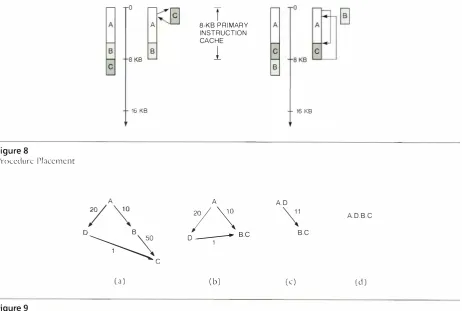
Our stratcgv is to place procedures so that frequentlv called proced ures arc ncar the cal ler. Consider the simple example in Figure8.
Assume procedure A calls procedureC
in a loop . A and C map to the same cache lines, so on c:�ch call to C, C replaces A in the cache, and on each retu rn ti-om C, A replacesC.
I f we reorganize the code such that C follows A, both A and C can fit in the cache at once, :111d there Jrc no conflict misses when A callsC.
We usc another greedy algorithm to pbcc proce dures. The example presented in Figure 9 illustrates the steps . vVc build a call graph and assign a weight to
each edge based on the number of calls. I f there is more than one edge with the same source and destina tion, we compute the sum of the execution counts and delete all but one edge. Figure 9a shows the cal l graph. To place the procedu res in the graph , we select the most heavilv weighted edge
(B
to C ) , record that the two nodes should be placed :1djacently, collapse the t\-vo nodes into one( B .C),
:1nd merge their edges ( :1s shown in Figure 9b ). We ag:1in select the most heavily weighted edge and continue ( Figure 9c) u ntil the graph is reduced to a single node A.D. B . C ( Figure 9d ). The final node contains an ordering of all the pro ccd u res. Speci:1l care is taken to ensure that we rarelv require a branch to span more than the maximum branch displacement.The effectiveness of procedure placement is limited by large procedures. In the PERL benchmark from
SPEC,
which is one of the smallest p rograms we stu d ied, one freq uently executed procedure is larger than3 2 KB ,
tou r times the size of the instruction cache on the Alpha2 1 1 64
processor. In SQLSERVR., more than hal f the run time is spent i n procedures with more than16
basic blocks. To address this problem, we split procedures into hot and cold sections and treat each section as an independent proced ur e when placing procedures. To split a procedure, we examine each basic block and usc a threshold on the execution countA
,LJ
[image:11.589.55.518.412.723.2]0 w
-�
8-KB P R I MARY INSTRUCTION CA CHEFigure 8
Procedure Pbcc mcnt
Figure 9
B
8 KB
16 KB
A
7 �
D�
( a )
c
Steps in rhc Procedure Placement Algor-ithm
1
A
� �
0 -- B.C
1
( b)
16 KB
A . D
�1
B.C
( c )
Digital TcchnicJI fournJI
A . D.B.C
( d )
1 0
to decide if a basic block i s col d . We usc a single threshold
f(x
the entire progr.1111. The threshold is chosen so that the total execution time for all the bJsic blocks below the threshold constitutes no more than 1 percent of the execution time of the progr�1111 . Proced ures with both hot and cold basic blocks Jrc split; otherwise, they are lett intact.Figure
1 0
i l l ustrates the importance of procedure splitting. The figure charts the speedup on SQLS E RYR,running on an Alpha 2 1 064 workstation,1; for the components of our code layout algorithm. The bar graph i ndicates that chaining basic blocks or pl acing proced ures results in a speed up of less than 4 percent, but placing procedu res after splitti ng yields a
IS
per cent speedup. Using al l our optimizations ( c h ;�ini ng, spl itting, and placing) together produces a 1 6 percent speed up.Figure I I presents the speedups fTom code la�'out tor the Windows NT -based appl ications and the SPECim benchmarks running on an Alpha 2 1 1 64 workstation . Speedups range ft·om 45 percent to
0
percent; mostNote that this data is for
the SQLSERVR
application running on an Alpha 2 1 064 microprocessor.Figure 1 0
Speed up for Code Llyou r lw Optimization
50
45
i=' 40
z 35 w 0 a: 30 w � 25 Q. ::> 20 0 w 1 5 w Q.
1 0 (f)
5
0
a: 0 -' (\J 0 z � > <( w 0 a: 0 a: 0 0 0
�
Xw <( X 5 w
(f) w
1--' z (f)
0
�
::>(f)
w w > 0 (.') (f) u 1-z <( Q. <( 0) I >-u (f) X w
(f) (f)
>:: 0 a: w 0 5 0 :::; 0 (f)
appl ications show a noticeable i mprovement. The leftmost seven Windows NT -based applications
(SQLS E RV R through TEX I M ) are ordered by the amount of time spe nt in proced ures with an average trip count less than 8 i n Figure 3. Note that all but the
most loop-intensive appl ication s how a significant
speedup from code layout. Three programs show min
imal speed up: TEXIM is dominated by a single loop
that fits
in
the instruction cache, and IJ PEG andCOM PRESS are dominJtcd by two or three sma l l loops. These programs d o not have a n appreciable amount of instruction cache miss; changi ng the code layout cannot imprO\'e their performance.
Hot-Cold Optimization
Hot-cold opti mization i s J generali zation of the proced ure-splitting technique used in our code l avout a.lgoritll m .c vVe opti mize the hot part of the proced ure ( ignori ng the cold parr) bv elim inating all instructions that :�re required on.ly by the cold part. To i m p l ement this optimization, we create ::1 hot procedure by copy ing the frequently executed basic blocks of a proce d ur e . All c:t!ls to the original procedure are redirected to the hot proced ure. Flow p�nhs in the hot procedure tllat target basic blocks th:�t were not copied :�rc red i rected to t h e appropriate basic block in t h e original (cold ) proced ure; that
is,
the tlows jump i nto the mid dle of the original proced ure. We then optimi7.e the hot proced ure, possi bly J t the e xpense of the rl ows that pass through the cold path .HCO is best u n derstood by working through an exte nded cx:�mple. Consider the procedure f o o (shown i n Figure 1 2 ), which is J simplified version of a proced ure ti·om the \iVindows NT kerne.l.
(.')
0 1- ([) w Q. co <t
Q. 0 2
2 w
:::; X � u -' 0 (.') (f) w 0 a: (.') w (f)
1- (f) (.') w Q. w a: >:: Q. :::? a:
0 co co Q.
> 2 2
0 0
APPLICATION OR BENCHMARK
Figure 1 1
Speedup ti-om Code LJ\'ou r
1 f oe : l d a s p , 1 6 ( s p ) a d j u s t s t a c k
2 s t q s O , O < sp ) s a v e s O 3 s t q r a , 8 ( s p ) s a v e r a
4 add l a 0 , 1 , s0 sO = aO +
5 add l aO , a 1 , a O a O = a O + a 1
6 b n e s0, L2 b r a n c h i f sO ! =
7 L 1 : b s r f 1 c a l l f 1
8 a d d l s O , a O , t 1 t 1 = a O + sO
9 s t l t 1 , 4 0 ( g p ) s t o r e t 1
1 0 L2 : l d q sO , O ( s p ) r e s t o re s O 1 1 l d q r a , 8 ( s p ) r e s t o r e r a 1 2 l d a s p , - 1 6 ( sp ) a d j u s t s t a c k
1 3 r e t ( r a ) r e t u r n
Figure 1 2
Simpliticd Version of a Procedure from rhc Windows �T
Kernel
0
Assume that the
branch
in line 6 of f o o is al most always tak
en and that lines 7 through 9 arc almost never executed. When we copyrlK
hot part of the pro cedu re, we exclude li nes 7 through 9 of f o o. Theresulting proced ure f o o 2 is shown in Figu re 1 3 .
1 2 3 4 5 6 7 8 9 1 0
f oo 2 : l da s p , 1 6 ( sp ) s t q s0, 0 ( s p ) s t q r a , 8 ( s p ) add l a 0 , 1 , s0 add l a O , a 1 , a O b e q s O , L 1
l dq sO, O < s p ) L dq r a , 8 ( s p ) l d a s p , - 1 6 ( s p ) r e t ( ra )
Figure 1 3
Hor Procedure
Note the reversal of the sense of the
br:meh
hom b n e in f o o to b e q in f o o 2 and the change of the branch's target from L 2 to L 1 . All calls to f o o are redirecte
d to the hot procedure f o o 2. If the branch in line 6 of f o o 2 is taken , then comrol transt-Crs to l ine 7 of f o o , which is in the middle of the ori
ginal proce dure . Once passed to the original proced ure, control nel'er passes back to the hot procedure. This kature of HCO enables opti mization; when optimizing the hot procedure, we can relax some of the constraints im
pose
d by the cold procedure.So
hr, we have set up the hot procedure t(>r opti mizJtion, but we have not made the proce
dure
�myfaster. Now we show how to optimize the procedu re. The hot procedure n o longer contains :1 call , so we em delete the save and restore of the return add ress i n l
i
nes3
and 8 o f f o o 2 i n Figure1 3 .
I fthe branch trans fers control to L 1 in
the cold procedure f o o , we mustarrange 6:x
r a to be saved on the stack. In genera
l, whenever we enter the original proc
edu
reti·om
the hot procedure, we must fix up the state to match the expected state . 'vVe cal l the fix-up operations compen sation code. To insert compensation code,\\'e
cre�ue J stu b and red irect thebranch
in line 6 of f o o 2to
branch to the stub. The stub saves r a on the stack and branches to L 1 .
Next, note that the instruction in line 5 of f o o 2
writes a 0 , bur the value of a 0 is never read in the hot
procedure. a 0 is not truly dead, however, because it is
sti l l read if the branch in l ine 6 of· f o o 2 is taken . Therefore, we delete line 5 ti·om the hot proced ure
and place a copy of the i nstruction on the stu b. HCO
tries to eliminate the uses of preserved registers in a
procedure. Preserved registers can be more expensive than scratch registers because they must be saved and restored if they are used . Preserved registers are typi
cally used when the lifetime of a value crosses a call. In the hot proced ure, no l i tCtime crosses a call and the use of a preserved register is unnecessary. We rename
all uses of s 0 in the hot procedure to use a free scratch
register
t
2 . We insert a copy on the stub from t 2 tos
0 . 'vVe can now eliminate the save and restore instruc ti
ons in Jines 2a
nd 7 of Figure1 3
and place the saveon the stub.
We have eliminated all references to tl1e stack in the hot proced ure. The stack adjusts on l ines l and 9
in F
i
gure1 3
can be deleted trom the hot procedu re,and the initial stack adjust c:m be placed in the stub.
The final code, including
the stub s t u b 1 ,
is listed in
Figu re 1 4 . The number of instructions executed in the ti·eq uent path has been reduced from10
to 3 . If the stu b is ta ken, then the fu ll 10
instructions and an extra copv and branch are executed.1 f oo 2 : a d d l a O , 1 , t 2 2 beq t 2 , s t u b 1 3 r e t ( r a ) 4 s t u b 1 : L d a s p , 1 6 ( s p ) 5 s t q s O , O < s p )
6 s t q ra , 8 ( s p )
7 add l a 0 , a 1 , a 0 8 mov t 2 , s 0
9 b r L 1
Figure 14
Optimized Hor Proo:d u rc
Final lv, we \
\
'Ould l i ke to i n J i n e the hot procedure. Copies of instruct
ions1
and2
can be placed inline. For the inlined branch, we must create a new stub th:n materializes the return address into r abefore
transtcrring control to s t u b 1 .
Except
t(.>r
p:1rrjal inlining, we have implemented all theHCO optimizations in
Spike. These
optimizations are• Partial
dead
code elimination 1c'-the removal ofdead cod e in the hot proced ure
•
Stack
pointer adjust elimin:nion-the removal of the stack adjusts in the hot procedu re• Presen·ed register e l i m i nation-the removal of the save and restore of preserved registers in the hot procedure
1 2
• Peephole optim ization-the removal i n the hot
procedure or' self-assignments and cond itional
[image:14.591.87.536.374.714.2]branches with an always-false condition
Figure 1 5 shows coverage statistics tor the H C O_
optimizations. CoverJge represents the percentage or
execution time spent in each categorv. To compute
coverage, we assigned each procedure to a cnegorv
a n d then for each category calcu lated the total n u m ber of instructions execu ted l)\' i ts procedures. The cate
gory OPTIMI ZED indic1tes the set of proced ures
optimi
z
edLw
HC:O. The portion of the executiontime spent in these proced ures is typically
60
percentbut often higher. The category
INFR.EQ UEr1T
is theset of p rocedu res whose execution times arc so sma l l
( less than
0
. l percent of the total time ) th�1t \\'e did northink it \\'JS worth,,·hilc to optimize the proced ures.
Icrnorincr proced ures 0 0 with small execution ti mes �11 10\\'S
.
.
us to optimize less than 5 percent of the in stru ctions 1 1 1
J program, a significant reduction in optimizer nmc.
The
category NO
SPLIT represents the proced u resthJt we cou ld not spl i t into bot and cold parts because
all basic blocks had simi lar execution counrs. The cate
aorv SP M O D I F J E D contains procedures in ,,·hich the
0 •
.
.
stack pointer is modiri cd after the initi,tl stack adjust l l1
1 00
90
80
i='
z 70 w u
rr: w 60
e::.
w ::;;; 50
1-z Q 40
1-::J u w 30
X w
20
1 0
rr: 0
-'
N> <{ w u
rr: u u
w <{ X (f)
-'
w a(f)
the prolog. We decided not to optimize these proce
d u res, but it is possible to do so with extra analysts.
Note that the execution time spent in this category of
procedures is small except for i n C2, where the cate gory contains two p rocedures and the coverage IS 7
percent. hn�1l ly, the category NO ADVANTAGE rep
resents the procedu res that were split but that the
optimizer ,,.,,s not able to i mpro,·e .
Figure
1 6
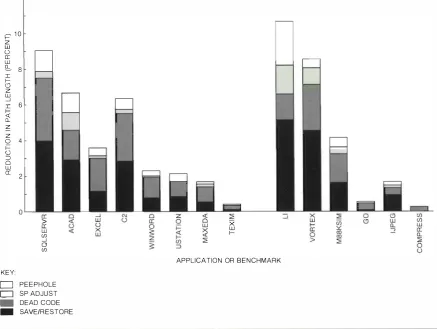
shows the O\·era l l reduction in pathleng;h �1s a result of HCO, broken dmm by optimiu tion. Most of the reduction i n path lcngt h comes
equally h-om the removal of unnecessary sa_ve and
restore instructions Jnd from the removal of partial
dead code . Stack pointer adjust elimination and peep
hole opti mi zation result in sm.1ller additional gai ns
.
Alarge peephole category is usu:�lly the result of a save
and restore of�1 prcsen·ed register that is made unnec essarl· lw H CO; the restore is co m-er ted to a self
assig
;
lm�
nt Lw copy prop:1g;ation, which is thenremoved by peep hole optimization.
HCO
is most effective on call-intensive programssuch as SQLS E RVR, ACAD, and
C2,
where weelimin::�te calls when creating the hot procedures. for
WINWO R D ,
the speedup is sma ll because coverag.e is k_>,,.
. \I'C could not ri nd a \\'<lV to split the procedures.'
.
APPLICATION OR BENCHMARK
KEY:
CJ
NO ADVANTAGE
c::::::J
SP MODIFIED
D
NO SPUT
INFREQUENT
-
OPTIMIZED
Figure 1 5
HCO Covcr<lg,c lw F\L·cut ion Time
1 2
!=' 1 0 z
w 0
a:
w
� 8 I f-(.') z
w _j I 6 f-<i o._ z
z
0 4 f=
u ::J 0 w a: 2
a: > a:
w (f) _j 0 (f)
X w
f-APPLICATION OR BENCHMARK
KEY
0
PEEPHOLED SP ADJUST
-
DEAD CODE [image:15.590.64.502.66.395.2]- SAVE/R ESTORE
Figure 1 6
Red uction in P:trh Lmgrh As a Resu lr of HC:O
For EXC EL, HCO was able to spl it the procedures, but there is often a call in the hot path. Inlining may help in optimizing E X C EL, but frequentl y the call is to a shared library.
HCO is less effective on loop-intensive programs such as USTATION, fvlAXEDA, and T
E
XIM. HCO provides a framework for opti mizing loops, andChang, Mahlke, and Hwu have shown that eliminat ing the i n frequent paths in loops enables additional optimizations, such as loop invariant removal.17 However, our current i mplementation of Spi ke includes :�lmost no information about the aliasing of memory operations; it can only optimize operations to local stack locations, such as spills of registers.
A leaf procedure is a proced u re that does not contain a procedure call . Figure 17 compares the amount of time spent i n leaf procedures before a nd after H CO is applied. B y eli mi nating i nfrequent code, HCO is able to eliminate all calls i n proced ures that represent 10 percent to 20 percent of the execu tion time in C2, ACAD, SQLSERVR, and MAXEDA. For the other Windows NT-based applications, the increase in time spent in leaf procedures is very sma l l . Most Windows N T -based applications spend much less than half the time i n leaf procedures. To improve
the performance of these applications, an optimizer n eeds to improve the performance of code with calls in the frequent pat h .
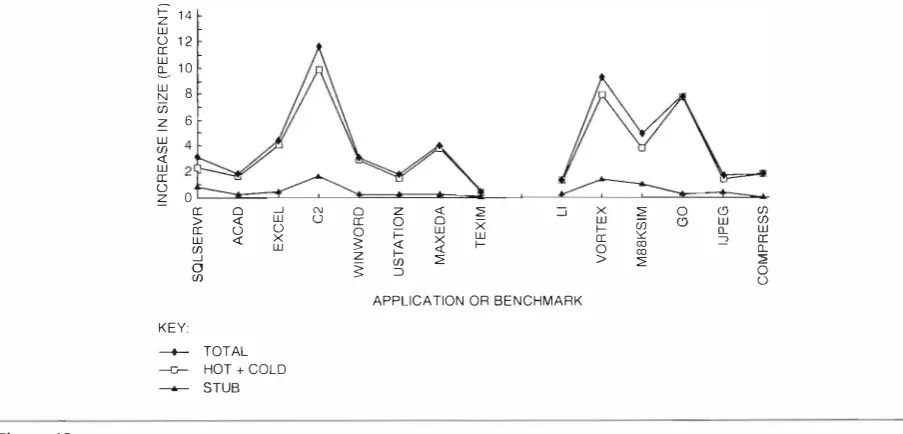
Code size a n d its efkct on cache behavior i s a major concern for us. In IJrge applications, locality for i nstructions is present but not high . If an optimization decreases path length but also decreases locality as a side eftect, the net result can be a loss i n performance. Figure
1 8
shows the total i ncrease in code size as a result of opti mization . H OT + COLD is the part of the increase that comes from replacing a single procedur e with the original procedure plus a copy of the hot part. STUB is the increase attri buted to stub procedu res. Overall, the i ncrease in size is small. The maximum increase is 1 1 .6 percent for C 2 . SQLSERVR has the best speedup and is only 3 . 1 percent larger. Looking at the i ncrease in total code size is misleading, however. HCO is not applied to procedures that are executed infrequently, which typically accou nt for more than95
percent of the i nstructions in a program, so tripling the size of optimized proced ures would resu lt i n only a modest increase in code size. Note that tripli ng the size of the active part of an application usuall�r disas trously decreases perf(xmance.1 4
1 00
90
80
i=' 70 z w
60 0 a:
50 w e:_ 4 0
w � 30 f- 20
1 0 0
a: 0 _j (\) 0 z <1: � ::::; X ::;; 0 (.9 <J)
> <1: w 0 a: 0 0 w
U5 (.9 w <J)
a: 0 0 0
f= w X w f- >::: Q_ w
w <1: X
� <1: X f- a: 0) ::::? a:
<J) w f- <1: 0 0) Q_
_j z
<J) ::;; > ::;; 2
0
�
:J 0(f) 0
APPLICATION OR BENCHMARK
KEY
[image:16.591.120.503.58.270.2] [image:16.591.78.530.502.719.2]-- ORIGI NAL -o- AFTER HCO
Figure 1 7
Time Spent i n Leaf Procc d u t·es before and after HCO
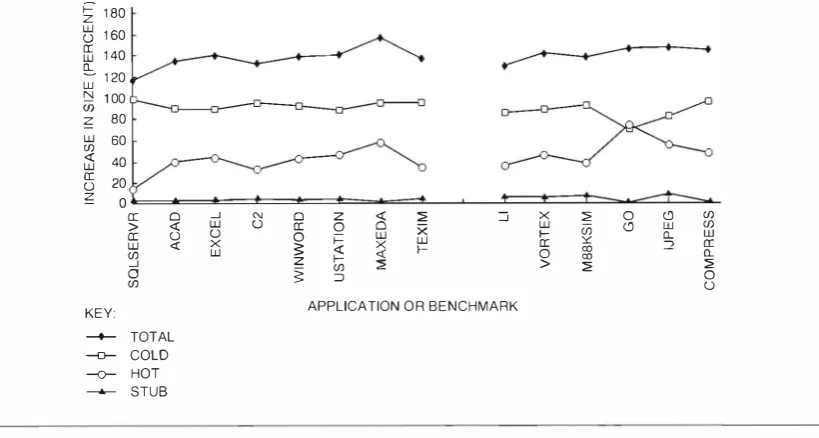
For this reason, we also measu red the i ncrease i n code size based o n the procedures that were optimized . Figure
1 9
compares the total sizes of the hot proce d u res with the total sizes of the original proced ures from which they were deri,·ed. For each procedure, by copying just the ti·equent l y executed part of the proce dure, we excluded about50
percent of the original. Next, we eliminated code that was ti-equently executed but only reachable through an inffequently nccuted path and therefore u n reachable in the hot procedure. This code usually represents only1
percent of the total size of a proced u re. finally, we optimized the hot pro cedure, reducing the remaining code size bv aboutlO percent, which is
5
percent of the size of theorigi-�
1 4 w 0 1 2 a:tf
1 0�
8 <J) z 6 UJ 4<J)
<( w 2
a: (.) � 0
a: 0
> <1:
a: 0
w <1:
<J)
_j 0 <J)
_j (\) 0 z <1: w 0 a: Q 0
0 0 w
X
f-w � <1:
�
f-z ="
�
<J) :J�
X w
f-nal procedure. The fi f-nal sizes of the hot procedures as pcrcentJ.ges of the sizes of the originJ.I procedures are shown in the .line labeled HOT. l'v!aking the most freq ucntlv executed part of a program
50
percent to80
percent smaller yields a big improvement in instruction cache behavior; however, it would be mis leading to <lttri bute tbis improvement to HCO, since our code layout optimization achieves the same result. When HCO is enabled, the cache layout optimizations arc run after HCO. The baseline we compare against also has cache optimizations enabled, so improve ments attributed to HCO are improvements beyond those th::Jt the other optimizations can make. HCO does make the ti·eq uently executed parts1 0 percent
::::; X =" 0 (.9 <J)
w U5 C) w (j)
I- Q_ w
a: '<: ::::? a:
0 0) 0) Q_
> =" =" 0 0 APPLICATION OR BENCHMARK
KEY
-- TOTAL
---G- HOT + COLD STUB
Figure 1 8
Overa l l Increase in Code Size after HCO
�
1 80�
1 60ffi
1 40a..
;;:;
1 20� 1 00
(f) � 80
w 60 (f)
<( 40 w a:
20
u
� 0 a: > a:
w
(f)
_j 0 (f)
0 _j <( w
u u
<( X
LlJ
N 0
u a: 0 s z
�
z <( :::;: :::J X � 0 (.') (f)
0 0 x w (.') w (f)
f= w 1- (f) a.. w
�
w a: � :::2 a:<( 1- 0 co a..
1- co
:::;: > :::;: :::;:
(f)
:::J 0
u
KEY: APPLICATION O R BENCHMARK
-+- TOTAL --o- COLO
--o- HOT
__.._ STUB
Figure 1 9
Size
of
OptimizedProcedures after
H COsmal ler, but we did not see significantly better i nstruc tion cache behavior when we ran programs with a cache simulator.
If we were to perform partial inlining, only the hot procedure would be copied . Since the hot procedure is less than half the size of the original procedure, partial in lining wou ld greatly reduce the growth in code size due to i nlining.
The line labeled COLD in Figure
19 shows how the
size of the cold procedure is affected by HCO. When we redirect all calls to the hot procedure, some code in the original procedure becomes unreachable. The amount of unreachable code is usual ly Jess than10
percent, which is much smaller than the50
percent of the code we copied to create the hot procedure . The infrequent paths in a p rocedure often rejoin the fre quent paths, which makes it necessary to have copies of both types of paths in the original procedure.The line labeled STUB shows the code size of the stubs, which is very smal l . A stub contains the com pensation code we introduce on a transition from a hot routine to a cold routine. We
also
implemented a variation of HCO that avoided stubs by reexecuting a procedure from the beginning instead of using a stub to reenter a routine in the middle. It is usually not pos sible to reexecute the procedure from the beginning because arguments have been overwritten. Given the small cost of stubs, we did not pursue this method.The line labeled TOTAL shows that HCO makes the total code (HOT + COLD + STU B )
20
percent to60
percent bigger. A procedure is partitioned so that there is less than a1
percent chance that the stllb and [image:17.590.82.492.58.277.2]cold part are executed, so their size should not have a significant effect on cache behavior as long as the pro file is representative.
Figure
20
shows how splitting affects the d istri bu tion of time spent among different procedure sizes for two programs where H C O is eftective( C2
and SQLSERVR) and two programs where it is not (�'\EDA and vVIl\TWORD ) . For the graphs shown in parts a through d of Figure20,
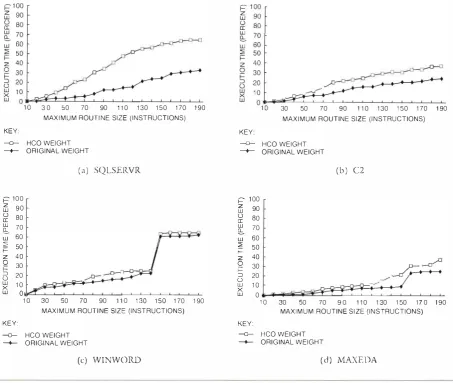
we classified each procedure by its size in instructions before and after HCO and plotted two cumulative clistributions of exe cution time. The farther apart the two lines, the betterHCO was at shifting the distribution from large proce dures to smaller procedures. Note that most of the programs spend a large percentage of the time in large procedures, which suggests that optimizers need to handle complex control flow wel l , even if profile infor mation is used to eliminate infrequent paths.
Managing Profile Feedback Optimization
Profile feedback is rarely used in practice because of the difficulty of collecting, managing, and applying profile information. The Spike Optimization Environ ment' provides a system for managing profile feedback that simplifies this process.
The first step in profile-directed optimization is to i nstrument each image in an application so that when the application is run, profile information is collected. I nstrumentation is most commonly done by using a compiler to i nsert counters into a program during compilation's or by
using
a post-link tool to insert counters into an image. '9·20 Statistical or sampling based profiling is an alternative to counter- based tech niques.2u2 Some compiler-based and post-link systems require that the program be compiled special ly, so that the resulting images are only usefi.!l for generating profiles. Many large appl ications have lengthy and1 6
3 0 50 70 90 I I 0 1 30 1 50 1 70 1 90 30 50 70 90 1 1 0 1 30 1 50 1 70 1 90
MAXIMUM ROUTINE SIZE (INSTRUCTIONS)
MAXIMUM ROUTINE SIZE (INSTRUCTIONS)
KEY
KEY
-o-
HCO WEIGHT
-o-HCO WEIGHT
--+--
ORIGINAL WEIGHT
--+--ORIGINAL WEIGHT
( a ) SQLSERVR ( b ) C2
i=' 1 0 0 i=' 1 00
z
90 z 90
w w
u 80 u 80
a: a:
w
70 w 70
� �
w 60 w 60
2
50 2
50
i= f=
z 40 z 40
0
30 0
30
f= f=
::::l 20 ::::l 20
u u
w 1 0 w 1 0
X X
w 0 w 0
1 0 30 50 70 90 1 1 0 1 30 1 50 1 70 1 90 1 0 30 50 70 9 0
1 1
0 1 30 1 50 1 7 0 1 90MAXIMUM ROUTINE SIZE (INSTRUCTIONS)
MAXIMUM ROUTINE SIZE (INSTRUCTIONS)
KEY:
KEY
-o-
HCO WEIGHT
-o-HCO WEIGHT
--+--
ORIGINAL WEIGHT
--+--ORIGINAL WEIGHT
[image:18.591.84.538.57.440.2](c)
WI NWORD( d ) 1\llAXEDA
Figure 20
Cumulati1·c Dis1 riburion of Execution Time l)\' Procedure Size before and a fter HC:O
complex build procedures. For these applicatio ns, requiring a special reb u i ld of the application to col l ect profi les is an obstacl e to the use of profilc-din.:ctcd optimization .
Spike d i rectly instruments the final production images so that a special compilation is not required. Spike does require that the images be l i n ked to include relocation i n rcm11ation ; howe1'er, incl uding this extra i n formation does nor i ncrease the n u m ber ot- 'instruc tions in the image and does not prn·ent t he compiler fi·om performing fu l l optim iLations when generating the i mage.
Most applications consist of a main executable :llld many
DLLs.
Instru menting all tl1e i m ages in an app l i cation ca n be d i fficult, especiallv when the user doing the profi le-directed optim ization does not kno\\· all the DLLs i n the application. Spike relie1·es the user ofthis task bv finding all tile DLLs that the app l icltion uses, even i f rhev are loaded dynamically with a c:dl to
Load Library.
\'ol. 9 �"- 4 1997
After
instrumentation, the next step i n profi le di rected opti m i Lation is to execute the i nstrumented appl ication and to collect profile i n f(mnation. Most profile-di rected optimization systems req u i re the user to first exp l i citly create instrumented copi es of each image in an app licati o n . Then the user m ust assemble tbe instrumented images into a new version of the application and run it to collect protile inr(>rmati o n . As the pro fi l e i n f-ormation is generated, the user is responsi ble for l ocating all the profile information generated for each image and m erging that i n forma tion i nto a single set of profiles. Our experience with users has shown that requ i ring the user to manage the instru mented copies of the i mages and the profile information is a frequent source of problems. For example, the user mav fai l to instru ment each i mage or mav attempt to i nstru ment an i mage that has alreadybeen instrumented . The user mav be unable to locate
from these tedious and error-prone tasks by managing both the instrumented copy of each image and the profile information generated for the image.
After profile information is col lected, the final step is to use the profile information to optimize each image.
As
with instrumentation, the typical profile-directed optimization system requires the user to optimize each image explicitly and to assemble the optimized appli cation. Spike uses the profile information collected for each image to optimize all the images in an application and assembles the optimized application for the user.Spike Optimization Environment
The Spike Optimization Environment (SOE) provides a simple means to instrument and optimize large applica tions that consist of many images. The SOE can be accessed through a graphical interface or through a command-line interface that provides identical func tionality. The command-line interface allows the SOE to be used as part of a batch build system such as make.23 In addition to providing a simple-to-use interface, the SOE keeps the instrumented and optimized ver sions of each image and the profile information associ ated witl1 each image in a database. When an application is instrumented or optimized, the original versions of the images in the application are not modi fied; instead, the SOE puts an instrumented or opti mized version of each image into the database. When the user invokes the original version of an application, the SOE uses a transparency agent to execute the instrumented or optimized version.
The SOE allows the user to instrument and optimize an entire application using the fol lowing procedure:
1 . Register: The user selects the application or applica tions that are to be instrumented and optimized. The user needs to specifY only the application's main image. Spike then finds aU the implicitly linked images ( DLLs loaded when the main image is loaded) and registers that tl1ey are part of the application.
2 . I nstrument: The user requests that an application be instrumented . For each image in the application, the SOE invokes the Spike Optimizer to instrument that image. The SOE places the instrumented ver sion of each image in the database. The original images are not modified .
3 .
Collect profile information: The user runs tl1e origi nal application in the normal way, e.g., from a com mand prompt, from Windows Explorer, or indirectly through another program. Our transparency agent (explained later in this section) invokes tl1e instru mented version of the application in place of the original version. Any i mages dynamically loaded by the application are instrumented on the fly. Each time the application terminates, profile information for each image is written to the database and merged \vith any existing profile information.4.
Optimize : The user requests that an application be opti mized. For each image in the application, the SOE i nvokes the Spike Optimizer to optimize the image using the collected profile information and places the optimized version of each image in the database.5.
Run the optimized version: The user runs the orig inal application, and our transparency agent substi tutes the optimized version, al lowing the user to evaluate the effectiveness of the optimization.6.
Export: The SOE exports the optimized i mages from the database, placing them i n a directory spec ified by the user. The optimized images can tl1en be packaged \vith other application components.The Spike Manager is the principal user interface for the SOE. The Spike Manager displays the contents of the database, showing the applications registered with Spike, the images contained i n each application, and the profile information collected for each i mage. The Spike Manager enables the user to control many aspects of the instrumentation and optimization process, including specifYing which images are to be instrumented and optimized and which version of the application is to be executed when the original applica tion is invoked.
Transparent Application Substitution