Joint Inference for Heterogeneous Dependency Parsing
Guangyou Zhou and Jun Zhao
National Laboratory of Pattern Recognition Institute of Automation, Chinese Academy of Sciences
95 Zhongguancun East Road, Beijing 100190, China
{gyzhou,jzhao}@nlpr.ia.ac.cn
Abstract
This paper is concerned with the problem of heterogeneous dependency parsing. In this paper, we present a novel joint infer-ence scheme, which is able to leverage the consensus information between het-erogeneous treebanks in the parsing phase. Different from stacked learning meth-ods (Nivre and McDonald, 2008; Martins et al., 2008), which process the depen-dency parsing in a pipelined way (e.g., a second level uses the first level outputs), in our method, multiple dependency parsing models are coordinated to exchange con-sensus information. We conduct experi-ments on Chinese Dependency Treebank (CDT) and Penn Chinese Treebank (CTB), experimental results show that joint infer-ence can bring significant improvements to all state-of-the-art dependency parsers.
1 Introduction
Dependency parsing is the task of building depen-dency links between words in a sentence, which has recently gained a wide interest in the natu-ral language processing community and has been used for many problems ranging from machine translation (Ding and Palmer, 2004) to question answering (Zhou et al., 2011a). Over the past few years, supervised learning methods have obtained state-of-the-art performance for dependency pars-ing (Yamada and Matsumoto, 2003; McDonald et al., 2005; McDonald and Pereira, 2006; Hall et al., 2006; Zhou et al., 2011b; Zhou et al., 2011c). These methods usually rely heavily on the manually annotated treebanks for training the dependency models. However, annotating
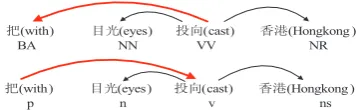
syntac-ᡞ(with) Ⳃܝ(eyes) ᡩ(cast) 佭␃(Hongkong ) BA NN VV NR
[image:1.595.326.507.247.302.2]ᡞ(with ) Ⳃܝ(eyes ) ᡩ(cast) 佭␃(Hongkong ) p n v ns Figure 1: Different grammar formalisms of syn-tactic structures between CTB (upper) and CDT (below). CTB is converted into dependency gram-mar based on the head rules of (Zhang and Clark, 2008).
tic structure, either phrase-based or dependency-based, is both time consuming and labor intensive. Making full use of the existing manually annotated treebanks would yield substantial savings in data-annotation costs.
In this paper, we present a joint inference scheme for heterogenous dependency parsing. This scheme is able to leverage consensus in-formation between heterogenous treebanks dur-ing the inference phase instead of usdur-ing individual output in a pipelined way, such as stacked learning methods (Nivre and McDonald, 2008; Martins et al., 2008). The basic idea is very simple: although heterogenous treebanks have different grammar formalisms, they share some consensus informa-tion in dependency structures for the same sen-tence. For example in Figure 1, the dependency structures actually share some partial agreements for the same sentence, the two words “eyes” and “Hongkong” depend on “cast” in both Chinese Dependency Treebank (CDT) (Liu et al., 2006) and Penn Chinese Treebank (CTB) (Xue et al., 2005). Therefore, we would like to train the de-pendency parsers on individual heterogenous tree-bank and jointly parse the same sentences with consensus information exchanged between them.
The remainder of this paper is divided as
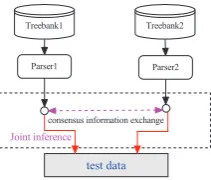
Treebank1 Treebank2
Parser1 Parser2
consensus information exchange
Joint inference
[image:2.595.142.248.61.151.2]test data
Figure 2: General joint inference scheme of het-erogeneous dependency parsing.
lows. Section 2 gives a formal description of the joint inference for heterogeneous dependency parsing. In section 3, we present the experimental results. Finally, we conclude with ideas for future research.
2 Our Approach
The general joint inference scheme of heteroge-neous dependency parsing is shown in Figure 2. Here, heterogeneous treebanks refer to two Chi-nese treebanks: CTB and CDT, therefore we have only two parsers, but the framework is generic enough to integrate more parsers. For easy expla-nation of the joint inference scheme, we regard a parser without consensus information as a base-line parser, a parser incorporates consensus infor-mation called ajoint parser. Joint inference pro-vides a framework that accommodates and coordi-nates multiple dependency parsing models. Sim-ilar to Li et al. (2009) and Zhu et al. (2010), the joint inference for heterogeneous dependency parsing consists of four components: (1) Joint In-ference Model; (2) Parser Coordination; (3) Joint Inference Features; (4) Parameter Estimation.
2.1 Joint Inference Model
For a given sentencex, a joint dependency parsing model finds the best dependency parsing tree y∗
among the set of possible candidate parses Y(x)
based on a scoring functionFs: y∗= arg max
y∈Y(x)
Fs(x, y) (1)
Following (Li et al., 2009), we will usedk to
de-note thekth joint parser, and also use the notation
Hk(x) for a list of parse candidates of sentence x determined bydk. The sth joint parser can be
written as:
Fs(x, y) =Ps(x, y) + ∑
k,k̸=s
Ψk(y,Hk(x)) (2)
where Ps(x, y) is the score function of the sth
baseline model, and eachΨk(y,Hk(x))is a partial
consensus score function with respect todkand is
defined overyandHk(x):
Ψk(y,Hk(x)) = ∑
l
λk,lfk,l(y,Hk(x)) (3)
where each fk,l(y,Hk(x)) is a feature function
based on a consensus measure between y and
Hk(x), and λk,l is the corresponding weight
pa-rameter. Feature indexlranges over all consensus-based features in equation (3).
2.2 Parser Coordination
Note that in equation (2), though the baseline score function Ps(x, y) can be computed individually,
the case ofΨk(y,Hk(x))is more complicated. It
is not feasible to enumerate all parse candidates for dependency parsing. In this paper, we use a bootstrapping method to solve this problem. The basic idea is that we can use baseline models’n -best output as seeds, and iteratively refine joint models’ n-best output with joint inference. The
joint inference process is shown in Algorithm 1.
Algorithm 1Joint inference for multiple parsers
Step1: For each joint parser dk, perform inference with a baseline model, and memorize all dependency parsing candidates generated during inference inHk(x);
Step2: For each candidate inHk(x), we extract subtrees
and store them inH′
k(x). First, we extract bigram-subtrees
that contain two words. If two words have a dependency relation, we add these two words as a subtree intoH′
k(x).
Similarly, we can extract trigram-subtrees. Note that the dependency direction is kept. Besides, we also store the “ROOT” word of each candidate inH′
k(x);
Step3: Use joint parsers to re-parse the sentencexwith
the baseline features and joint inference features (see sub-section 2.3). For joint parserdk, consensus-based features
of any dependency parsing candidate are computed based on current setting ofH′
s(x)for allsbutk. New
depen-dency parsing candidates generated bydkin re-parsing are
cached inH′′ k(x);
Step4:Update allHk(x)withH′′k(x);
Step5:Iterate from Step2 to Step4 until a preset iteration limit is reached.
In Algorithm 1, dependency parsing candidates of different parsers can be mutually improved. For example, given two parsersd1andd2 with candi-datesH1andH2, improvements onH1 enabled2 to improve H2, and H1 benefits from improved H2, and so on.
Thus Step3 can be viewed as full-scale candidates reranking because the reranking scope is beyond the limitedn-best output currently cached inHk.
2.3 Joint Inference Features
In this section we introduce the consensus-based feature functions fk,l(y,Hk(x)) introduced in
equation (3). The formulation can be written as:
fk,l(y,Hk(x)) = ∑
y′∈Hk(x)
P(y′|dk)Il(y, y′) (4)
whereyis a dependency parse ofxby using parser ds (s ̸= k), y′ is a dependency parse in Hk(x)
andP(y′|dk)is the posterior probability of
depen-dency parsey′ parsed by parserdkgiven sentence x. Il(y, y′) is a consensus measure defined on y
andy′ using different feature functions.
Dependency parsing model P(y′|dk) can be
predicted by using the global linear models (GLMs) (e.g., McDonald et al. (2005); McDonald and Pereira (2006)). The consensus-based score functionsIl(y, y′)include the following parts:
(1) head-modifier dependencies. Each head-modifier dependency (denoted as “edge”) is a
tu-ple t =< h, m, h → m >, so Iedge(y, y′) = ∑
t∈yδ(t, y′).
(2) sibling dependencies: Each sibling de-pendency (denoted as “sib”) is a tuple t =< i, h, m, h ← i → m >, so Isib(y, y′) = ∑
t∈yδ(t, y′).
(3) grandparent dependencies: Each grand-parent dependency (denoted as “gp”) is a tuple t =< h, i, m, h → i → m >, so Igp(y, y′) = ∑
<h,i,m,h→i→m>∈yδ(t, y′).
(4) root feature: This feature (denoted as “root”) indicates whether the multiple
depen-dency parsing trees share the same “ROOT”, so
Iroot(y, y′) =∑<ROOT >∈yδ(< ROOT >, y′). δ(·,·) is a indicator function–δ(t, y′) is 1 if
t ∈ y′ and 0 otherwise, feature index l ∈ {edge, sib, gp, root} in equation (4). Note that < h, m, h → m > and< m, h, m → h >are two different edges.
In our joint model, we extend the baseline fea-tures of (McDonald et al., 2005; McDonald and Pereira, 2006; Carreras, 2007) by conjoining with the consensus-based features, so that we can learn in which kind of contexts the different parsers agree/disagree. For the third-order features (e.g., grand-siblings and tri-siblings) described in (Koo et al., 2010), we will discuss it in future work.
2.4 Parameter Estimation
The parameters are tuned to maximize the depen-dency parsing performance on the development set, using an algorithm similar to the average per-ceptron algorithm due to its strong performance and fast training (Koo et al., 2008). Due to lim-ited space, we do not present the details. For more information, please refer to (Koo et al., 2008).
3 Experiments
In this section, we describe the experiments to evaluate our proposed approach by using CTB4 (Xue et al., 2005) and CDT (Liu et al., 2006). For the former, we adopt a set of head-selection rules (Zhang and Clark, 2008) to convert the phrase structure syntax of treebank into a de-pendency tree representation. The standard data split of CTB4 from Wang et al. (2007) is used. For the latter, we randomly select 2,000 sentences for test set, another 2,000 sentences for development set, and others for training set.
We use two baseline parsers, one trained on CTB4, and another trained on CDT in the ex-periments. We choose the n-best size of 16 and the best iteration time of four on the development set since these settings empirically give the best performance. CTB4 and CDT use two different POS tag sets and transforming from one tag set to another is difficult (Niu et al., 2009). To over-come this problem, we use Stanford POS Tagger1 to train a universal POS tagger on the People’s Daily corpus,2 a large-scale Chinese corpus (ap-proximately 300 thousand sentences and 7 mil-lion words) annotated with word segmentation and POS tags. Then the POS tagger produces a uni-versal layer of POS tags for both the CTB4 and CDT. Note that the word segmentation standards of these corpora (CTB4, CDT and People’s Daily) slightly differs; however, we do not consider this problem and leave it for future research.
The performance of the parsers is evaluated us-ing the followus-ing metrics: UAS, DA, and CM, which are defined by (Hall et al., 2006). All the metrics except CM are calculated as mean scores per word, and punctuation tokens are consistently excluded.
We conduct experiments incrementally to eval-uate the joint features used in our first-order and second-order parsers. The first-order parser
– Features UAS CTB4 CM UAS CDT CM
dep1
baseline 86.6 42.5 75.4 16.6
+edge 88.01 (↑1.41) 44.28 (↑1.78) 77.10 (↑1.70) 17.82 (↑1.22) +root 87.22 (↑0.62) 43.03 (↑0.53) 75.83 (↑0.43) 16.81 (↑0.21) + both 88.19 (↑1.59) 44.54 (↑2.04) 77.16 (↑1.76) 17.90 (↑1.30)
CTB4 + CDT 87.32 43.08 75.91 16.89
dep2
baseline 88.38 48.81 77.52 19.70
+edge 89.17 (↑0.79) 49.73 (↑0.92) 78.44 (↑0.92) 20.85 (↑1.15) +sib 88.94 (↑0.56) 49.26 (↑0.45) 78.02 (↑0.50) 20.13 (↑0.43) +gp 88.90 (↑0.52) 49.11 (↑0.30) 77.97 (↑0.45) 20.06 (↑0.36) +root 88.61 (↑0.23) 48.88 (↑0.07) 77.65 (↑0.13) 19.88 (↑0.18) + all 89.62 (↑1.24) 50.15 (↑1.34) 79.01 (↑1.49) 21.11 (↑1.41)
[image:4.595.131.470.61.206.2]CTB4 + CDT 88.91 49.13 78.03 20.12
Table 1: Dependency parsing results on the test set with different joint inference features. Abbreviations: dep1/dep2 = first-order parser and second-order parser; baseline = dep1 without considering any joint inference features; +* = the baseline features conjoined with the joint inference features derived from the heterogeneous treebanks; CTB4 + CDT = we simply concatenate the two corpora and train a dependency parser, and then test on CTB4 and CDT using this single model. Improvements of joint models over baseline models are shown in parentheses.
Type Systems ≤40 Full
D MaltParserdep2 90.8687.1 88.3885.8 Wang et al. (2007) 86.6 -C Martins et al. (2008)MSTM alt† † 90.5590.63 88.8288.84
Surdeanu et al. (2010)† 89.40 86.63 H Zhao et al. (2009)Ours 91.4888.9 89.6286.1 S Chen et al. (2009)Yu et al. (2008) 92.34- 87.2689.91 Chen et al. (2012) - 91.59
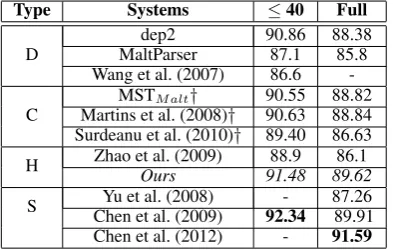
Table 2: Comparison of different approach on CTB4 test set using UAS metric. MaltParser = Hall et al. (2006); MSTM alt=Nivre and
McDon-ald (2008). Type D = discriminative dependency parsers without using any external resources; C = combined parsers (stacked and ensemble parsers); H = discriminative dependency parsers using ex-ternal resources derived from heterogeneous tree-banks, S = discriminative dependency parsers us-ing external unlabeled data.†The results on CTB4 were not directly reported in these papers, we im-plemented the experiments in this paper.
(dep1) only incorporates head-modifier depen-dency part (McDonald et al., 2005). The second-order parser (dep2)uses the head-modifier and sibling dependency parts (McDonald and Pereira, 2006), as well as the grandparent dependency part (Carreras, 2007; Koo et al., 2008). Table 1 shows the experimental results.
As shown in Table 1, we note that adding more joint inference features incrementally, the depen-dency parsing performance is improved
consis-tently, for both treebanks (CTB4 or CDT). As a final note, all comparisons between joint models and baseline models in Table 1 are statistically sig-nificant.3 Furthermore, we also present a base-line method called “CTB4 + CDT” for compari-son. This method first tags both CTB4 and CDT with the universal POS tagger trained on the Peo-ple’s Daily corpus, then simply concatenates the two corpora and trains a dependency parser, and finally tests on CTB4 and CDT using this single model. The comparisons in Table 1 tell us that very limited information is obtained without con-sensus features by simply taking a union of the dependencies and their contexts from the two tree-banks.
To put our results in perspective, we also com-pare our second-order joint parser with other best-performing systems. “≤40” refers to the sentence with the length up to 40 and “Full” refers to all the sentences in test set. The results are shown in Table 2, our approach significantly outperforms many systems evaluated on this data set. Chen et al. (2009) and Chen et al. (2012) reported a very high accuracy using subtree-based features and dependency language model based features derived from large-scale data. Our systems did not use such knowledge. Moreover, their technique is orthogonal to ours, and we suspect that combin-ing their subtree-based features into our systems might get an even better performance. We do not present the comparison of our proposed approach
3We use the sign test at the sentence level. All the
[image:4.595.84.281.307.432.2]Type Systems UAS DA
D Huang and Sagae (2010)Duan et al. (2007) 83.8885.20 84.3685.52 Zhang and Nivre (2011) 86.0 -C Bohnet and Kuhn (2012)Zhang and Clark (2008) 87.5- 86.21 -H Li et al. (2012)Ours 86.4485.88 86.52 -S Chen et al. (2009) - 86.70
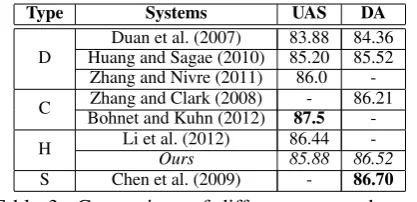
Table 3: Comparison of different approaches on CTB5 test set. Abbreviations D, C, H and S are as in Table 2.
Treebanks #Sen # Better # NoChange # Worse
CTB4 355 74 255 26
[image:5.595.76.285.61.162.2]CDT 2,000 341 1,562 97
Table 4: Statistics on joint inference output on CTB4 and CDT development set.
with the state-of-the-art methods on CDT because there is little work conducted on this treebank.
Some researchers conducted experiments on CTB5 with a different data split: files 1-815 and files 1,001-1,136 for training, files 886-931 and 1,148-1,151 for development, files 816-885 and files 1,137-1,147 for testing. The development and testing sets were also performed using gold-standard assigned POS tags. We report the experi-mental results on CTB5 test set in Table 4. Our re-sults are better than most systems on this data split, except Zhang and Nivre (2011), Li et al. (2012) and Chen et al. (2009).
3.1 Additional Results
To obtain further information about how depen-dency parsers benefit from the joint inference, we conduct an initial experiment on CTB4 and CDT. From Table 4, we find that out of 355 sentences on the development set of CTB4, 74 sentences ben-efit from the joint inference, while 26 sentences suffer from it. For CDT, we also find that out of 2,000 sentences on the development set, 341 sen-tences benefit from the joint inference, while 97 sentences suffer from it. Although the overall de-pendency parsing results is improved, joint infer-ence worsens dependency parsing result for some sentences. In order to obtain further information about the error sources, it is necessary to investi-gate why joint inference gives negative results, we will leave it for future work.
4 Conclusion and Future Work
We proposed a novel framework of joint infer-ence, in which multiple dependency parsing
mod-els were coordinated to search for better depen-dency parses by leveraging the consensus infor-mation between heterogeneous treebanks. Exper-imental results showed that joint inference signif-icantly outperformed the state-of-the-art baseline models.
There are some ways in which this research could be continued. First, recall that the joint in-ference scheme involves an iterative algorithm by using bootstrapping. Intuitively, there is a lack of formal guarantee. A natural avenue for further re-search would be the use of more powerful algo-rithms that provide certificates of optimality; e.g., dual decomposition that aims to develop decod-ing algorithms with formal guarantees (Rush et al., 2010). Second, we would like to combine our heterogeneous treebank annotations into a unified representation in order to make dependency pars-ing results comparable across different annotation guidelines (e.g., Tsarfaty et al. (2011)).
Acknowledgments
This work was supported by the National Natural Science Foundation of China (No. 61070106, No. 61272332 and No. 61202329), the National High Technology Development 863 Program of China (No. 2012AA011102), the National Basic Re-search Program of China (No. 2012CB316300), We thank the anonymous reviewers and the prior reviewers of ACL-2012 and AAAI-2013 for their insightful comments. We also thank Dr. Li Cai for providing and preprocessing the data set used in this paper.
References
B. Bohnet and J. Kuhn. 2012. The best of both worlds-a grworlds-aph-bworlds-ased completion model for trworlds-ansition- transition-based parsers. InProceedings of EACL.
X. Carreras. 2007. Experiments with a Higher-order Projective Dependency Parser. In Proceedings of
EMNLP-CoNLL, pages 957-961.
W. Chen, D. Kawahara, K. Uchimoto, and Torisawa. 2009. Improving Dependency Parsing with Subtrees from Auto-Parsed Data. InProceedings of EMNLP, pages 570-579.
W. Chen, M. Zhang, and H. Li. 2012. Utilizing depen-dency language models for graph-based dependepen-dency parsing models. InProceedings of ACL.
the Workshop on Recent Advances in Dependency
Grammar, pages 90-97.
X. Duan, J. Zhao, and B. Xu. 2007. Probabilistic Mod-els for Action-based Chinese Dependency Parsing.
InProceedings of ECML/PKDD.
J. M. Eisner. 2000. Bilexical Grammars and Their Cubic-Time Parsing Algorithm. Advanced in Prob-abilistic and Other Parsing Technologies, pages 29-62.
J. Hall, J. Nivre, and J. Nilsson. 2006. Discriminative Classifier for Deterministic Dependency Parsing. In
Proceedings of ACL, pages 316-323.
L. Huang and K. Sagae. 2010. Dynamic Programming for Linear-Time Incremental Parsing. In
Proceed-ings of ACL, pages 1077-1086.
T. Koo, X. Carreras, and M. Collins. 2008. Simple Semi-Supervised Dependency Parsing. In
Proceed-ings of ACL.
T. Koo, A. M. Rush, M. Collins, T. Jaakkola, and D. Sontag. 2010. Dual Decomposition for Parsing with Non-Projective Head Automata. InProceedings of
EMNLP.
M. Li, N. Duan, D. Zhang, C.-H. Li, and M. Zhou. 2009. Collaborative Decoding: Partial Hypothesis Re-ranking Using Translation Consensus Between Decoders. InProceedings of ACL, pages 585-592.
Z. Li, T. Liu, and W. Che. 2012. Exploiting multiple treebanks for parsing with Quasi-synchronous gram-mars. InProceedings of ACL.
T. Liu, J. Ma, and S. Li. 2006. Building a Dependency Treebank for Improving Chinese Parser. Journal of
Chinese Languages and Computing, 16(4):207-224.
A. F. T. Martins, D. Das, N. A. Smith, and E. P. Xing. 2008. Stacking Dependency Parsers. In
Proceed-ings of EMNLP, pages 157-166.
R. McDonald and F. Pereira. 2006. Online Learning of Approximate Dependency Parsing Algorithms. In
Proceedings of EACL, pages 81-88.
R. McDonald, K. Crammer, and F. Pereira. 2005. On-line Large-margin Training of Dependency Parsers.
InProceedings of ACL, pages 91-98.
Z. Niu, H. Wang, and H. Wu. 2009. Exploiting Het-erogeneous Treebanks for Parsing. InProceedings
of ACL, pages 46-54.
J. Nivre and R. McDonld. 2008. Integrating Graph-based and Transition-Graph-based Dependency Parsing. In
Proceedings of ACL, pages 950-958.
A. M. Rush, D. Sontag, M. Collins, and T. Jaakkola. 2010. On Dual Decomposition and Linear Program-ming Relation for Natural Language Processing. In
Proceedings of EMNLP.
M. Surdeanu and C. D. Manning. 2010. Ensemble Models for Dependency Parsing: Cheap and Good?
InProceedings of NAACL.
R. Tsarfaty, J. Nivre, and E. Andersson. 2011. Eval-uating Dependency Parsing: Robust and Heuristics-Free Cross-Annotation Evaluation. InProceedings
of EMNLP.
J.-N Wang, J-.S. Chang, and K.-Y. Su. 1994. An Au-tomatic Treebank Conversion Algorithm for Corpus Sharing. InProceedings of ACL, pages 248-254. Q. I. Wang, D. Lin, and D. Schuurmans. 2007.
Sim-ple Training of Dependency Parsers via Structured Boosting. In Proceedings of IJCAI, pages 1756-1762.
N. Xue, F. Xia, F.-D. Chiou, and M. Palmer. 2005. The Penn Chinese Treebank: Phrase Structure An-notation of a Large Corpus. Natural Language
En-gineering, 10(4):1-30.
Yamada and Matsumoto. 2003. Statistical Sependency Analysis with Support Vector Machines. In
Pro-ceedings of IWPT, pages 195-206.
D. H. Younger. 1967. Recognition and Parsing of Context-Free Languages in Time n3. Information
and Control, 12(4):361-379, 1967.
K. Yu, D. Kawahara, and S. Kurohashi. 2008. Chi-nese Dependency Parsing with Large Scale Auto-matically Constructed Case Structures. In
Proceed-ings of COLING, pages 1049-1056.
Y. Zhang and S. Clark. 2008. A Tale of Two Parsers: Investigating and Combining Graph-based and Transition-based Dependency Parsing Using Beam-Search. In Proceedings of EMNLP, pages 562-571.
Y. Zhang and J. Nivre. 2011. Transition-based De-pendency Parsing with Rich Non-local Features. In
Proceedings of ACL, pages 188-193.
H. Zhao, Y. Song, C. Kit, and G. Zhou. 2009. Cross Language Dependency Parsing Using a Bilingual Lexicon. InProceedings of ACL, pages 55-63. G. Zhou, L. Cai, J. Zhao, and K. Liu. 2011.
Phrase-Based Translation Model for Question Retrieval in Community Question Answer Archives. In
Pro-ceedings of ACL, pages 653-662.
G. Zhou, J. Zhao, K. Liu, and L. Cai. 2011. Exploit-ing Web-Derived Selectional Preference to Improve Statistical Dependency Parsing. InProceedings of ACL, pages 1556-1565.
G. Zhou, L. Cai, K. Liu, and J. Zhao. 2011. Improving Dependency Parsing with Fined-Grained Features.
InProceedings of IJCNLP, pages 228-236.
M. Zhu, J. Zhu, and T. Xiao. 2010. Heterogeneous Parsing via Collaborative Decoding. InProceedings