Proceedings of the Second International Conference on Dependency Linguistics (DepLing 2013), pages 23–32,
Towards Joint Morphological Analysis and Dependency Parsing of
Turkish
Özlem Çetino˘glu
and
Jonas Kuhn
IMS, University of Stuttgart
Germany
{ozlem,jonas}@ims.uni-stuttgart.de
Abstract
Turkish is an agglutinative language with rich morphology-syntax interactions. As an extension of this property, the Turk-ish Treebank is designed to represent sub-lexical dependencies, which brings extra challenges to parsing raw text. In this work, we use a joint POS tagging and pars-ing approach to parse Turkish raw text, and we show it outperforms a pipeline ap-proach. Then we experiment with incor-porating morphological feature prediction into the joint system. Our results show statistically significant improvements with the joint systems and achieve the state-of-the-art accuracy for Turkish dependency parsing.
1 Introduction
Turkish is a morphologically rich language (MRL) that has been known to pose interesting research questions to linguists and computational linguists, including architectural issues at the morphology-syntax interface. Today, good quality tools for morphological analysis are available for analysing Turkish raw text input at the word level, and in work on the Turkish Dependency Treebank (Oflazer et al., 2003), a representation scheme has been developed that captures the peculiarities at the morphology-syntax interface in a dependency format that is formally compatible with the stan-dard CoNLL dependency format.
So, it might seem as if all Turkish-specific chal-lenges have been resolved, and only language-independent data-driven methods are required from now on (after all, the Turkish Dependency Treebank was included in the CoNLL 2006 and 2007 Shared Tasks (Buchholz and Marsi, 2006; Nivre et al., 2007), and several researchers work-ing on language-independent methods have re-ported scores on the available data).
However, Turkish still causes a considerable chitectural challenge for the standard pipeline ar-chitecture used in data-driven dependency pars-ing: the dependency treebank scheme for Turk-ish is based on segments that are not identical to the words from the raw text input, but are often sublexical units that form parts of morphological derivations.
While it is straightforward to train data-driven parsers on the gold standard segmentation from the treebank (which is what happened in the shared tasks), any realistic application starting out with raw text has to involve morphological dis-ambiguation in the preprocessing which means it is not guaranteed that treebank-compatible seg-ment boundaries will be produced. For instance, when training a dependency parser on predicted POS and morphology features, the treebank is of course used to provide the gold standard depen-dency arcs, but with an automatic (and hence im-perfect) morphological disambiguator, there will be cases where the gold standard assumes two seg-ments for a word, but morphological prediction assumes only one. So any standard learning al-gorithm will break down because the node sets for the dependency graphs are incompatible.
For many languages, realistic parsing scenarios assume gold tokens and use predicted POS (and morphological features). For Turkish, keeping the gold segmentation and assigning predicted POS and morphology would converge to using an or-acle because gold segmentation would sometimes disambiguate morphology. Instead, realistic sce-narios include segmentation, and a statistical mor-phological disambiguator picks the most probable analysis among all possibilities a morphological analyser produces. It is the morphological anal-ysis that determines the lemma, POS, morpholog-ical features, and segmentation of a word is based on the number of its word-internal derivations.
four morphological analyses with different lemma and POS combinations, meaning ‘at me’, ‘on the mole’, ‘to the dam’, and ‘servant’ respectively.1
Hence, unlike many other languages, the segmen-tation, POS tagging, and morphological analysis are tightly connected for Turkish.
Eryi˘git et al. (2008) is the first work that ad-dresses the segmentation problem in parsing pre-dicted text. They set up a pipeline architecture of a morphological analyser and disambiguator but leave out handling the multiword expressions.2 A
recent work from Eryi˘git (2012) solely focuses on the impact of the morphological analysis and dis-ambiguation of the Turkish treebank. Again, it follows the standard pipeline but this time with a treebank version that represents multiwords as de-tached segments, which allows avoiding to use a multiword extractor.
The major drawback of a pipeline system is to propagate the disambiguator’s mistakes to the parsing step. Moreover, the disambiguator cannot take advantage of syntactic information that could help disambiguate certain morphological analyses. In (1), the first wordkahvelerimeans ‘the cof-fees (Acc)’, ‘his/her cofcof-fees’, ‘their (one) coffee’, ‘their coffees’ from (1a) to (1d). When the first two words come together, they make a sentence meaning ‘His/her/their coffees are at my place’.
kahveleriis still ambiguous but its dependency re-lation is clear;bende, with morphological analysis (1e), behaves as a copular predicate with no overt marker and kahveleriis dependent onbendeas a subject.
When the third word içelim ‘let’s drink’ fol-lows the former two, the meaning of the sentence changes to ‘Let’s drink the coffees at my place’, which also changes the morphological analysis of
kahvelerito (1a). It now behaves as the object of the main predicateiçelim. A pipeline system can-not benefit from such a disambiguation advantage. An alternative approach to pipeline architec-tures is making joint decisions on morphological disambiguation and parsing. It has been shown that such an architecture improves constituency parsing accuracy both for Arabic (Green and Man-1A3pl: 3rd personal plural agreement, A3sg: 3rd
per-sonal singular agreement, Pnon: no possessives, P3sg: 3rd personal singular possessive, P3pl: 3rd personal plural pos-sessive, Nom: Nominative, Acc: Accusative, Loc: Locative, Dat: Dative, Zero: No overt derivation, Pos: Positive, Opt: Optative mood
2because of the lack of a multiword extractor. Hence the
experiments are not in a fully predicted setting.
ning, 2010) and for Hebrew (Goldberg and Tsar-faty, 2008). On the dependency parsing front, Lee et al. (2011) introduces a joint morphological dis-ambiguation and dependency parsing architecture which proves to outperform their pipeline archi-tecture for Latin, Ancient Greek, Czech, and Hun-garian. However it is limited to unlabelled de-pendency parsing and initial scores are below the state-of-the-art. On the other hand, parsers that can jointly POS tag become more common in the last years (Bohnet and Nivre, 2012; Hatori et al., 2011; Li et al., 2011). Bohnet and Nivre (2012) propose a joint POS tagger and labelled depen-dency parser that outperforms the pipeline results and also improves the state-of-the-art accuracy for German, Czech, English, and Chinese.
Joint POS tagger and dependency parsers are not originally designed for predicting morphologi-cal features, but they provide a flexible field (POS) where the parser is not dependent on the morpho-logical disambiguator decisions. So the use of this field can actually be extended to accommodating morphological features instead of or in addition to POS tags, which gives parsers an opportunity to override fixed disambiguator mistakes. Hence, those parsers approximate to a joint morphological disambiguation and dependency parsing architec-ture, which provides us with a testbed until gen-uinely full-fledged joint parsers are developed.
In this paper we use Bohnet and Nivre’s (2012) system to apply their approach to Turkish and later to explore ways to include morphological feature prediction into parsing. Experimental results show that even a partial flexibility in predicting the mor-phological features helps improve the parsing ac-curacy statistically significantly.
The paper is structured as follows: Section 2 gives an overview on how morphological features are used in parsing MRLs. Section 3 explains the morphological analysis representation and its re-lation with segmentation. Section 4 describes the use of morphological features in joint parsing ex-periments. The setup for experiments are given in Section 5 and results are discussed in Section 6. We conclude with Section 7.
2 Use of Morphological Features
(1)
Kahveleri bende içelim
a.kahve+Noun+A3pl+Pnon+Acc e.ben+PersP+A1sg+Pnon+Loc iç+Verb+Pos+Opt+A1pl
b.kahve+Noun+A3pl+P3sg+Nom f.ben+Noun+A3sg+Pnon+Loc
c.kahve+Noun+A3sg+P3pl+Nom g.bent+Noun+A3sg+Pnon+Dat
d.kahve+Noun+A3pl+P3pl+Nom h.bende+Noun+A3sg+Pnon+Nom
helps, in others its impact is little. For some settings predicted information causes a drop, for some settings a partial set of morphological fea-tures improves parsing accuracy.
Ambati et al. (2010) explore ways of integrat-ing local morphosyntactic features into Hindi de-pendency parsing. They experiment with differ-ent sets of features both on a graph-based and a transition-based dependency parser. Both with gold and predicted settings using morphological features root, case, and suffix outperform using POS as the only feature.
Bengoetxea and Gojenola (2010) utilise the CoNLL-X format and MaltParser’s feature con-figuration file to take advantage of morphological features in parsing Basque with gold data. Their experiments show that case and subordination type increase parsing accuracy.
Marton et al. (2010) explore which morphologi-cal features could be useful in dependency parsing of Arabic. They observe the effect of features by adding them one at a time separately and compar-ing the outcomes. Experiments show that when gold morphology is provided, case markers help the most, whereas when the morphology is auto-matically predicted the outcome is the opposite: using case harms the results the most. When fea-tures are combined in a greedy heuristic, using definiteness, person, number, and gender informa-tion improves accuracy.
To overcome the exhaustive feature space prob-lem of Arabic, Dehdari et al. (2011) use heuristic search algorithms for the optimal feature combi-nation. Similar to Marton et al. (2010) they run experiments by including one feature at a time to their no-feature baseline, and also conduct a sec-ond set of experiments where they remove one fea-ture at a time from the whole feafea-ture set. They also conclude that leaving out the predicted case im-proved the parsing most among the possible can-didates to remove, this time for constituency pars-ing. In the single feature experiments, genitive cl-itics help the most. The optimal combination they achieve consists of the features determiner, proper noun, genitive clitics, and negation.
Another Semitic language that is studied within the MRLs is Hebrew. Initial results on Hebrew de-pendency parsing (Goldberg and Elhadad, 2009) show predicted morphological features help in a transition-based parser with a tailored feature con-figuration file, although scores drop in a graph-based parser. The same authors later prove both gold and predicted agreement features improve accuracy for an easy-first, non-directional depen-dency parser (Goldberg and Elhadad, 2010). Tsar-faty and Sima’an (2010) report agreement features are useful also for constituency parsing when they extend the Relational Realisational (Tsarfaty and Sima’an, 2008) models with this information.
Seeker and Kuhn (2011) focus on the internal structures and grammatical functions of German noun phrases. Their experiments show grammat-ical functions are predicted with higher accuracy when a graph-based dependency parser is pro-vided with both gold and predicted case markers.
They further explore the effects of using case in dependency parsing, this time for Czech and Hun-garian as well as for German (Seeker and Kuhn, 2013). On a graph-based parser German does not benefit much from using predicted morphol-ogy but Czech and Hungarian clearly profit. They also use case as a constraint on integer linear pro-gramming (ILP) parsing models to filter out un-grammatical case-function mappings. For all three languages, the constrained models outperform the unconstrained models and graph-based parser in predicting core grammatical functions.
The research discussed in this section show case and agreement are among the most investigated features, and most of the time they are among the most beneficial ones. These are the features we also look into. But first, we describe the interac-tion between the morphology and syntax in Turk-ish in Section 3.
3 The Morphology-Syntax Interface in
Turkish
syntactic in other languages are represented with derivational morphology in Turkish (Sulger et al., 2013). For instanceçektiis a one-word sentence in Turkish meaning ‘It was a cheque’. The wordçek
‘cheque’ is derived into a verb (with no overt suf-fix) and then the past tense suffix-tiis attached. (2) is the morphological representation of this word whereˆDBdenotes the derivational boundary:
(2) çek+Noun+A3sg+Pnon+NomˆDB+Verb+Zero +Past+A3sg
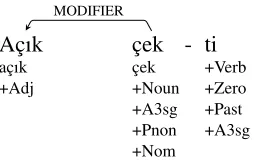
Each sequence of inflectional features divided by a derivational boundary is called aninflectional group (IG hereafter). The word in (2) has two IGs. A further example clarifies why inflectional groups are chosen as the unit of the treebank. Fig-ure 1 gives the dependency representation of the sentenceaçık çekti ‘It was a blank cheque’. The adjectiveaçık‘blank’ modifies the nounçekonly, not the derived verbçekti. A word based represen-tation would disregard this distinction.
Açık
çek - ti
açık çek +Verb
+Adj +Noun +Zero +A3sg +Past +Pnon +A3sg +Nom
[image:4.612.131.258.329.411.2]MODIFIER
Figure 1: The dependency representation foraçık çekti
The Turkish Treebank follows this IG nota-tion. A word is segmented into segments from its derivational boundaries. If it is derived n times, it is represented as n+1 segments. The first segment has the lemma, and the last segment has the whole word as the surface form. The surface forms of non-final segments are underscores. (3) gives the treebank representation of the sentence in Figure 1 in the CoNLL format. The derived verbçektiis represented as two segments.
The possible segmentation problem arises when words have ambiguous morphological analyses with different number of IGs. For instance, the word çekti has a second interpretation with the meaning ‘s/he pulled’ which is the past tense of the verbçek‘to pull’ in 3rd person singular. The morphological representation of this sense is given in (4).
(4) çek+Verb+Pos+Past+A3sg
Note that in this analysis, there are no deriva-tional boundaries, hence it only has a single IG. When the gold standard is the first interpretation of the wordçekti and a morphological prediction suggests the second interpretation, the number of segments do not match any more.
4 Morphological Feature Prediction
Like many other free-word-order languages, Turk-ish has overt case markers. It is the case marker that determines the function of a word in a sen-tence rather than the POS of that word. For in-stance, an accusative nominal is an object no mat-ter if it is a noun, proper noun, or pronoun.
However, the case-function mapping is not completely unambiguous. Nominative case is as-sociated with subjects and indefinite direct ob-jects. Subjects of sentential complements are gen-itive. Dative, ablative, genitive, and instrumental can be non-canonical objects (Çetino˘glu and Butt, 2008), although their primary function is adjunct. In copular sentences, the nominal predicate, with or without an overt copular suffix, can bear any case marker except accusative.
Another morphological feature that parsing al-gorithms can benefit from is agreement. In Turk-ish, subjects and verbs must agree in number and person. There is an exception to this rule: a third person plural subject might agree with a verb in third person singular as well as a verb in third per-son plural.
To explore the question whether we can benefit from case and agreement features in parsing Turk-ish, we employ two different representation meth-ods. First, we append case markers to nominal POS tags3to see if a more informative POS field
could facilitate parsing (Pos+Case). Then, with the intuition that case markers alone could deter-mine the function, we categorise nominals accord-ing toCASEinstead of their POS (Case).
In the implementation, in order to represent case markers as categories we move them to the POS field. POS tags are moved to the morphological features field. For instance, In the CoNLL for-mat4, çeki ‘cheque.Acc’ has normally the
repre-sentation in (5a). AppendingCASEto POS results in (5b). WhenCASEreplaces POS, the representa-tion is as in (5c).
3These are namely nouns, proper nouns, pronouns,
nomi-nal participals, and infinitives.
4The columns are Form, Lemma, POS, Morphological
(3)
ID Form Lemma POS Morph. Feat. Head Dep. Rel.
1 açık açık Adj _ 2 MODIFIER
2 _ çek Noun A3sg|Pnon|Nom 3 DERIV 3 çekti _ Verb Zero|Past|A3sg 0 ROOT
(5) a.çeki çek Noun A3sg|Pnon|Acc
b.çeki çek Noun|Acc A3sg|Pnon
c.çeki çek Acc A3sg|Pnon|Noun
This representation has two benefits. We can still use the POS tags as features for the parser, and after parsing, it is possible to restore the POS tags by switching them back. This allows us to evaluate our system against the standard gold data.
When combined with a joint parsing system, both approaches extend the use of the parser and practically carry it to a level between POS tag-ging and morphological analysis. We applied the CASE-POS replacement technique to agreement markers (Agr) hoping that the parser can learn and predict the relation between subjects and verbs better. We also collected the finite verbs under the VFin umbrella instead of Verb to distin-guish verbs with an agreement marker from non-finite ones (VFin). We discuss the effects of those changes in Section 6.2.
5 Experimental Setup
5.1 Data SetWe use the METU-Sabancı Turkish Treebank (Oflazer et al., 2003) for training and ITU vali-dation set (Eryi˘git, 2007) for testing. The train-ing and test sets consist of 5635 and 300 sen-tences respectively. There are no separate devel-opment sets. The original version of the treebank contains multiword expressions5where words that
construct the multiword are attached together with an underscore. The POS and morphological fea-tures of a MWE are that of the last word of the MWE. Eryi˘git et al. (2011) have created a de-tached version of the original treebank. In the detached version, multiword expressions are split-ted into words, and POS and morphological fea-tures are assigned to the new words. They are de-pendent on the final word of the multiword with the relation MWE. (6a) and (6b) give the origi-nal and detached versions ofsöz vermi¸stim‘I have promised’, respectively. Note that if a MWE con-5E.g., named entities, collocations, date-time expressions,
noun-verb compounds as in (6).
sists derived words they will also be represented with multiple IGs. In our experiments we use the detached version of the treebank.
5.2 Tools
In order to parse data with predicted segmenta-tion, POS and morphological features, the raw data is first passed through a morphological anal-yser (Oflazer, 1994) and then through a morpho-logical disambiguator (Sak et al., 2008). Heuris-tic rules are used for some unknown types6 and
the rest of unknowns are considered to be nom-inative proper nouns. We adopt Bohnet’s (2010) state-of-the-art graph-based parser as ourPipeline
parser7and Bohnet and Nivre’s (2012)
transition-based parser as our Joint parser that can jointly handle POS tagging and dependency parsing.
5.3 Evaluation
The standard evaluation metrics labelled and unla-belled attachement scores (LAS and UAS) (Buch-holz and Marsi, 2006) are not applicable to com-pare a predicted file to a gold file if the segment sizes are different. We handle this problem by using an evaluation tool based on IGs (Eryi˘git et al., 2008). The unlabelled attachement score UASIG gives the ratio of IGs that are attached to the correct head, and the labelled attachement score LASIGgives the ratio of IGs attached to the correct head with the correct label. In cases where the morphology (segmentation, POS, and morpho-logical features) of the head word is different from the gold one, an attachement is correct only if the dependent is attached to the correct wordandthe head IG has the gold main POS. Note that when gold segmentation and POS are used LASIGand UASIGare identical to the standard LAS an UAS respectively. We omit punctuation in evaluation.
6E.g. if a word ends with an apostrophe followed by the
surface form of a case marker, the string before the apostro-phe is the root of a proper noun and the case is determined from the surface form.
7We also ran baseline experiments with Bohnet’s
(6)
ID Form Lemma POS Morph. Feat. Head Dep. Rel. a. 4 söz_vermi¸stim söz_ver Verb Pos|Narr|Past|A1sg 5 SENTENCE
b. 4 söz söz Noun A3sg|Pnon|Nom 5 MWE 5 vermi¸stim ver Verb Pos|Narr|Past|A1sg 6 SENTENCE
6 Experiments and Analyses
We conduct 10-fold cross validation experiments on the training data and report the average scores for pipeline and joint parsers. Gold settings use gold segmentation, POS, and morphological fea-tures, whereas in predicted settings, all this in-formation is predicted (either by the morphologi-cal analyser+disambiguator or by the joint parser). For systems we observe improvements on 10-fold cross validation experiments, we also give the test set results.8
6.1 Pipeline Experiments
In the first set of experiments, we examine the ef-fect of using morphological features in parsing. Table 1 gives the average 10-fold cross validation scores on the training data. As discussed in Sec-tion 2, there are controversial results of using mor-phological features in parsing MRLs: although gold features help, predicted features might harm the accuracy. For Turkish, Eryi˘git et al. (2008) have already shown that adding gold morphologi-cal features to Malt parser trained on the original treebank improves accuracy. Our findings are in line with theirs.
The first row of Table 1 gives the graph-based parser results when both the training and parsing data have morphological information. The pre-dicted LASIG is 4.5% lower than the gold one. When the graph-based parser is trained on gold data with morphological features, but the features are not provided during parsing, there are 12.4% and 10.7% LASIGdrops in the gold and predicted settings respectively. A drop in such a scenario is of course expected, but the impact of no mor-phology in parsing is huge as compared to many other MRLs (e.g., Seeker and Kuhn (2013) report 6.3%, 2.4%, and only 0.4% absolute drops in LAS for Hungarian, Czech, and German respectively). When the morphological information is not used in training at all, the parser can cope with the lack of morphological information better during
pars-8For replicability, experimental settings are available at
http://www.ims.uni-stuttgart.de/~ozlem/ cetinogluDepling13.html
Gold Predicted System LASIG UASIG LASIG UASIG
GB +T,+P 66.29 77.51 61.79 73.89 GB +T,-P 53.88 71.49 51.02 69.71 GB -T,-P 60.62 75.36 56.31 71.42
Table 1: The effect of using morphological fea-tures on the graph-based parser. Morphologi-cal features are used in neither training nor pars-ing (-T,-P), used in trainpars-ing but not provided in parsing (+T,-P), used both in training and pars-ing (+T,+P). Results given are the average 10-fold cross-validation scores on the training data.
ing. Still, the gold and predicted LASIG scores are absolute 5-6% lower than a setting that uses morphology both in training and parsing.
6.2 Joint Parsing Experiments
Table 2 gives the training set 10-fold cross valida-tion average scores for systems we experimented in this paper, as well as for previous work. It is observed that movingCASEto the POS field helps with a 0.3% absolute increase in the gold pipeline settings. Joint parsing results with gold features, are 1-1.5% absolute lower than the pipeline scores. This is expected; the gold setting for joint parsing is not exactly gold, as by definition the parser pre-dicts POS tags during parsing instead of gold ones although the segmentation and morphological fea-tures are gold. As a result, they cannot beat purely gold settings.
If we have a closer look at the joint systems, we witness that onlyJointCaseoutperformsJoint.
JointP os+Case increases the tagset to be learned and predicted from 35 to 107 which is probably too fine-grained for the parser. Agreement mark-ers, which are not directly related to grammati-cal functions like CASE, have a negative impact in the gold settings when used instead of Verb. Still, when agreement markers are used only to introduce an extra category, namely VFin, the scores come closer to the baseline of joint parsing with gold information, and even improves over the baseline LASIGin the predicted setting.
im-Gold Predicted System LASIG UASIG LASIG UASIG
Pipeline 66.29 77.51 61.79 73.89 PipelineCase 66.60 77.60 62.07 74.00
Joint 64.61 75.83 62.21 73.86 JointCase 64.92 76.27 62.58 74.35
JointP os+Case 63.99 75.45 62.02 73.76
JointAgr 63.65 74.95 61.32 73.17
JointV F in 64.44 75.68 62.34 72.59
[image:7.612.90.317.50.151.2]Ery11-Ery12 65.90 76.00 58.3/61.1 70.70
Table 2:Training set 10-fold cross validation av-erage scores. Gold scores Ery11 are taken from Eryi˘git et al. (2011) and predicted scores Ery12 are taken from Eryi˘git (2012). Ery12 (Eryi˘git, 2012) gives an interval LASIGcorresponding 0% and 100% accuracy for MWE relations
Gold Predicted System LASIG UASIG LASIG UASIG
Pipeline 68.92 78.85 64.59 76.32 PipelineCase 68.86 78.98 65.00 76.35
Joint 66.14 76.86 63.77 75.06 JointCase 67.25 78.50 65.19 77.05
Ery11-Ery12 - - 64.2/66.2 75.53
Table 3: Testset scores. Ery11 (Eryi˘git et al., 2011) does not provide gold scores for testset. Ery12 (Eryi˘git, 2012) gives an interval LASIG corresponding 0% and 100% accuracy for MWE relations.
proves the labelled accuracy by 0.3% absolute for the training set. Letting the parser predict POS in the joint system adds 0.14 points more. The best score is achieved withJointCasewhich has a 0.3% absolute increase as compared toJoint. The difference between pipeline systems and joint sys-tems are statistically significant both for LASIG and UASIG, in the gold setting. When pre-dicted data is used, PipelineCase,Joint,JointCase LASIGscores are statistically significantly better thanPipeline(p<0.05, pairedt-test).
The testset scores are given in Table 3. They follow the training set trend, except for the Joint
system to our surprise. This is perhaps due to the different characteristics of test and training data. When we look at the breakdown of dependencies from 10-fold cross validation results in Section 6.3, we discuss a recall drop in some labels when they are parsed with theJointparser. We do not look at the dependency distribution of the test data but if it is different from the training data then a possibly similar drop in the same labels might im-pact the overall score more. In parsing the test
data with gold features, pipeline systems statisti-cally significantly outperform joint systems. In the predicted setting, onlyJointvs.JointCaseUASIG difference is statistically significant.
Both in Tables 2 and 3, predicted LASIGscores from Eryi˘git (2012) are given as an interval. In her experiments, the parser is trained on the original treebank (that is, no MWE relations are present in the training data) and tested on the detached ver-sion. She reports lower and upper bounds corsponding 0% and 100% accuracy for MWE re-lations. To compare our results to those of Ery-i˘git’s, we also calculate the upper bounds with 100% MWE accuracy in our best performing sys-tem. When we accept all MWE labels correct9
we achieve64.49%LASIGon the average score of 10-fold cross validation on the training set and
66.46% LASIG on the testset for the JointCase system. For both the predicted and gold systems our parsers outperform previous work.
For comparability with other existing results, we also trained thePipeline parser on the origi-nal version of the treebank which is used in the CoNLL 2007 Shared Task. Nivre et al. (2007) re-port71.6% LAS on the testset (excluding punc-tuation) for the best system (Titov and Hender-son, 2007). Eryi˘git (2012) increases the LAS to
71.98%and thePipelineparser outperform both systems with72.53%LAS .
6.3 Error Analysis
For a detailed error analysis we take into account the Pipeline, PipelineCase, Joint, and JointCase 10-fold cross validation results on the training set. In the predicted setting, scores from these four parsers are in ascending order (Table 2, predicted LASIG column, first four rows). When we look at the dependency breakdown of pipeline and joint systems, we observe subjects and objects follow this trend, together with question particles, nega-tive particles, and modifiers.
The dependencies that benefit from joint pars-ing the most are determiners. This is due to the fact that some frequently occuring determiners are ambiguous. For instance, O has the determiner (‘that’) and personal pronoun (‘he/she/it’) read-ings, and similarlybu‘this’ is both a determiner and a demonstrative pronoun. Joint parsing lets the parser assign the correct POS to those words where the morphological disambiguator fails.
[image:7.612.90.306.254.326.2]Dependency Precision Recall ABLATIVE.ADJUNCT 41.9 50.3
APPOSITION 48.3 15.0
CLASSIFIER 59.1 68.1
COORDINATION 53.0 48.4
DATIVE.ADJUNCT 40.5 45.8
DETERMINER 73.5 81.3
INSTRUMENTAL.ADJUNCT 24.6 21.0
INTENSIFIER 70.7 70.7
LOCATIVE.ADJUNCT 40.4 46.0
MODIFIER 60.3 58.3
MWE 63.5 58.1
NEGATIVE.PARTICLE 67.0 45.6
OBJECT 59.9 58.2
POSSESSOR 70.9 74.5
QUESTION.PARTICLE 71.5 62.8
SENTENCE 86.6 88.0
S.MODIFIER 49.4 46.1
SUBJECT 48.9 51.0
[image:8.612.98.295.47.240.2]VOCATIVE 29.6 19.5
Table 4: The dependency breakdown of the 10-fold cross validation scores forJointCasewith pre-dicted morphological information. Precision and recall are given in percent. Dependencies with less than 100 occurrences are omitted.
ting the parser predictCASEinstead of POS causes some drop, but both precision and recall are still higher than both pipeline systems.
Another dependency withJointas the most ac-curate system is coordination. CASE helps in
PipelineCase as compared toPipeline, but causes an accuracy decrease when going from Joint to
JointCase. The COORDINATION label attaches conjunctions to their conjunct to the right. The most frequent conjunctions comma and ve ‘and’ can be predicted with very high accuracy. When theJointparser is used, there are slight improve-ments on attacheimprove-ments to head conjuncts with var-ious POS tags and a systematic improvement on attaching conjunctions to head copulars and con-ditionals.
The precision of possessors does not change much with different systems, but the recall drops inJoint. That drop is recovered whenJointCaseis applied. Intensifiers (e.g., particlesde‘also, too’,
bile ‘even’) also have a similar trend. Precision, on the other hand increases withJoint.
A large subset of dependencies that suffers from the same drop is adjuncts. Dative, ablative, loca-tive, and instrumental adjuncts commonly have drops in the Joint recall as compared to pipeline systems. Their precision, however, increases. When we look into the parser output, we see that the Joint system has systematically mistaken by
assigning Adj to the Verb root of participles. Then all arguments attached to this incorrectly POS-tagged root are penalised by the evaluation script although most of the time attachements are correct.
The incorrect POS assignment problem disap-pears when the joint parser is trained on theCASE feature of nominals instead of their POS. This ex-plains why the precision of adjuncts improves a bit more and their recall has a jump. The only exception is the precision drop in instrumental adjuncts. The reason could be nouns in instru-mental case that behave as adverbs, such as hı-zla(speed+Ins, ‘quickly’). The parser cannot learn to distinguish an instrumental adjunct from an adverbial modifier when+Insis used as POS inJointCase.
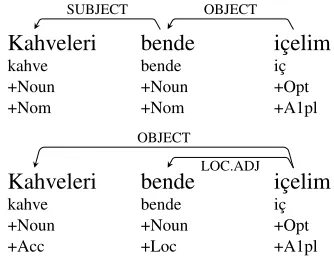
The advantage ofJointCaseoverPipelineis ex-emplified with a comparison in Figure 2. The
Pipelineand JointCase parse trees, together with POS tags and case markers are given in (a) and (b) respectively. ThePipelineparser relies on the morphological disambiguator output which incor-rectly assigns the analyses (1b) to kahveleriand (1h) tobende. As a result, the parser assigns the incorrect labels to both dependencies.
On the other hand, theJointCaseparser replaces the caseNomwith its predictionAccinkahveleri
and Nom replaces Loc in bende. These correc-tions result in predicting dependencies identical to gold ones. Note that the lemma ofbende is still incorrect, but it does not affect the attachements.
Kahveleri
bende
içelim
kahve bende iç
+Noun +Noun +Opt
+Nom +Nom +A1pl
SUBJECT OBJECT
Kahveleri
bende
içelim
kahve bende iç
+Noun +Noun +Opt
+Acc +Loc +A1pl
OBJECT
LOC.ADJ
Figure 2: The (a)Pipelineand (b)JointCaseparse trees for the example sentence (1)Kahveleri bende içelim ‘Let’s drink coffee at my place.’
[image:8.612.335.502.477.606.2]Turkish treebank representation, the root of a tree is the sentence-final punctuation. The main pred-icate of the sentence is attached to the sentence-final punctuation with the SENTENCE label. By far, this label is the easiest to predict with our sys-tems. It is followed by determiners, intersifiers, possessors, and question particles, which are all local dependencies. Then come classifiers, coor-dination, modifiers, multiword expressions within a range of 50-65% precision and recall.
Despite getting improvements with the
JointCase system, grammatical functions are still quite low in accuracy. Except for objects, all such labels are below 50% precision and recall. This is due to both the free-word-order nature of Turkish and the ambiguous case-function mapping mentioned in Section 4.
And finally, appositions, vocatives, and instu-mental adjuncts are at the bottom of the accuracy ranking with scores going down to 20-30%. Their frequencies are also low and they have different POS and morphological features within the same class, which complicates parsers’ learning.
7 Conclusion and Future Work
We have presented a set of experiments on pars-ing raw Turkish text. We argue the ideal method for parsing Turkish would be joint segmentation, POS tagging, morphological analysis, and depen-dency parsing. In this work we keep the segmen-tation fixed and first show using a joint POS tag-ging and parsing approach outperforms a pipeline approach in a realistic scenario. Then we come one step closer to the ideal case and attemp to in-corporate some morphological features into joint prediction. As a second outcome, we show cat-egorising nominals according to CASEinstead of their POS improves parsing at all settings ( gold vs. predicted, pipeline vs. joint). With the com-bination of joint parsing and CASE incorporation we not only show statistically significant improve-ments but also achieve the state-of-the-art parsing accuracy.
We believe these positive results prove there is room for improvement in predicting morphologi-cal features with a joint POS tagging and depen-dency parsing system. Even for the joint pars-ing experiments below the Joint baseline, more clever ways of integration into joint prediction might help achieve higher scores. Past research on MRLs present such cases. Bengoetxea and
Go-jenola (2010) show a simple integration of mor-phological features does not improve Basque pars-ing results on the first attemp, but takpars-ing advan-tage of the data representation and parser configu-ration changes the impact. Similarly, Tsarfaty and Sima’an (2010) has negative results initially for the impact of using agreement markers on Hebrew parsing. After they modify the way they use the morphological information, it actually helps.
In future work, we intend to explore ways to make more use of the joint parser and to apply the same or similar techniques to other MRLs such as German, Czech, and Hungarian.
We also want to add TedEval (Tsarfaty et al., 2012), which also supports mismatching system-gold segmentation, to our evaluation tools to ver-ify our scores and to use a language-independent metric in a multilingual setting.
Acknowledgments
We thank Bernd Bohnet for his help on using the joint parser and Gül¸sen Eryi˘git for providing us with the IG evaluation script. This work is funded by the Collaborative Research Centre (SFB 732) at the University of Stuttgart.
References
Bharat Ram Ambati, Samar Husain, Sambhav Jain, Dipti Misra Sharma, and Rajeev Sangal. 2010. Two methods to incorporate ‘local morphosyntactic’ fea-tures in Hindi dependency parsing. In Proc. of the SPMRL Workshop of NAACL-HLT, pages 22–30, Los Angeles, CA, USA.
Kepa Bengoetxea and Koldo Gojenola. 2010. Appli-cation of different techniques to dependency pars-ing of Basque. InProc. of the SPMRL Workshop of NAACL-HLT, pages 31–39, Los Angeles, CA, USA. Bernd Bohnet and Joakim Nivre. 2012. A transition-based system for joint part-of-speech tagging and la-beled non-projective dependency parsing. InProc. of the EMNLP-CoNLL, pages 1455–1465, Jeju, Ko-rea.
Bernd Bohnet. 2010. Top accuracy and fast depen-dency parsing is not a contradiction. In Proc. of COLING, pages 89–97, Beijing, China.
Sabine Buchholz and Erwin Marsi. 2006. CoNLL-X shared task on multilingual dependency parsing. In
Proc. of CoNLL-X, pages 149–164, Stroudsburg, PA, USA.
Jon Dehdari, Lamia Tounsi, and Josef van Gen-abith. 2011. Morphological features for parsing morphologically-rich languages: A case of Arabic. InProc. of the SPMRL Workshop of IWPT, pages 12–21, Dublin, Ireland.
Gül¸sen Eryi˘git. 2007. ITU validation set for METU-Sabancı Turkish treebank.
Gül¸sen Eryi˘git. 2012. The impact of automatic morphological analysis & disambiguation on depen-dency parsing of Turkish. InProc. of LREC, Istan-bul, Turkey.
Gül¸sen Eryi˘git, Joakim Nivre, and Kemal Oflazer. 2008. Dependency parsing of Turkish. Computa-tional Linguistics, 34(3):357–389.
Gül¸sen Eryi˘git, Tugay Ilbay, and Ozan Arkan Can. 2011. Multiword expressions in statistical depen-dency parsing. InProc. of the SPMRL Workshop of IWPT, pages 45–55, Dublin, Ireland.
Yoav Goldberg and Michael Elhadad. 2009. He-brew dependency parsing: Initial results. InProc. of IWPT, pages 129–133, Paris, France.
Yoav Goldberg and Michael Elhadad. 2010. Easy-first dependency parsing of modern Hebrew. InProc. of the SPMRL Workshop of NAACL-HLT, pages 103– 107, Los Angeles, CA, USA.
Yoav Goldberg and Reut Tsarfaty. 2008. A single gen-erative model for joint morphological segmentation and syntactic parsing. InProc. of ACL-HLT, pages 371–379, Columbus, Ohio.
Spence Green and Christopher D. Manning. 2010. Better Arabic parsing: baselines, evaluations, and analysis. In Proc. of COLING, pages 394–402, Stroudsburg, PA, USA.
Jun Hatori, Takuya Matsuzaki, Yusuke Miyao, and Jun’ichi Tsujii. 2011. Incremental joint POS tag-ging and dependency parsing in Chinese. InProc. of IJCNLP, pages 1216–1224, Chiang Mai, Thailand.
John Lee, Jason Naradowsky, and David A. Smith. 2011. A discriminative model for joint morpho-logical disambiguation and dependency parsing. In
Proc. of ACL-HLT, Portland, Oregon, USA.
Zhenghua Li, Min Zhang, Wanxiang Che, Ting Liu, Wenliang Chen, and Haizhou Li. 2011. Joint mod-els for Chinese POS tagging and dependency pars-ing. InProc. of EMNLP, pages 1180–1191, Edin-burgh, Scotland, UK.
Yuval Marton, Nizar Habash, and Owen Rambow. 2010. Improving Arabic dependency parsing with lexical and inflectional morphological features. In
Proc. of the SPMRL Workshop of NAACL-HLT, pages 13–21, Los Angeles, CA, USA.
Joakim Nivre, Johan Hall, Sandra Kübler, Ryan Mac Donald, Jens Nilsson, Sebastian Riedel, and Deniz Yuret. 2007. The conll 2007 shared task on depen-dency parsing. InProc. of the CoNLL Shared Task Session of EMNLP-CoNLL.
Kemal Oflazer, Bilge Say, Dilek Zeynep Hakkani-Tür, and Gökhan Tür. 2003. Building a Turkish tree-bank. In Anne Abeille, editor,Building and Exploit-ing Syntactically-annotated Corpora. Kluwer Aca-demic Publishers, Dordrecht.
Kemal Oflazer. 1994. Two-level description of Turk-ish morphology. Literary and Linguistic Comput-ing, 9(2):137–148.
Ha¸sim Sak, Tunga Güngör, and Murat Saraçlar. 2008. Turkish language resources: Morphological parser, morphological disambiguator and web corpus. In
Proc. of GoTAL 2008, pages 417–427.
Wolfgang Seeker and Jonas Kuhn. 2011. On the role of explicit morphological feature representation in syntactic dependency parsing for German. InProc. of IWPT, pages 58–62, Dublin, Ireland.
Wolfgang Seeker and Jonas Kuhn. 2013. Morphologi-cal and syntactic case in statistiMorphologi-cal dependency pars-ing.Computational Linguistics, 39:23–55.
Sebastian Sulger, Miriam Butt, Tracy Holloway King, Paul Meurer, Tibor Laczkó, György Rákosi, Cheikh Bamba Dione, Helge Dyvik, Victoria Rosén, Koenraad De Smedt, Agnieszka Patejuk, Özlem Çetino˘glu, I Wayan Arka, and Meladel Mistica. 2013. Pargrambank: The pargram parallel treebank. InProc. of ACL, Sofia, Bulgaria.
Ivan Titov and James Henderson. 2007. Fast and ro-bust multilingual dependency parsing with a gener-ative latent variable model. InProc. of the CoNLL Shared Task Session of EMNLP-CoNLL 2007, pages 947–951.
Reut Tsarfaty and Khalil Sima’an. 2008. Relational-realizational parsing. In Proc. of COLING, pages 889–896, Manchester, UK.
Reut Tsarfaty and Khalil Sima’an. 2010. Modeling morphosyntactic agreement in constituency-based parsing of modern Hebrew. InProc. of the SPMRL Workshop of NAACL-HLT, pages 40–48, Los Ange-les, CA, USA.
Reut Tsarfaty, Djamé Seddah, Yoav Goldberg, Sandra Kuebler, Yannick Versley, Marie Candito, Jennifer Foster, Ines Rehbein, and Lamia Tounsi. 2010. Sta-tistical parsing of morphologically rich languages (SPMRL) what, how and whither. In Proc. of the SPMRL Workshop of NAACL-HLT, pages 1–12, Los Angeles, CA, USA.