Minimum Bayes Risk based Answer Re-ranking for Question Answering
Nan Duan
Natural Language Computing Microsoft Research Asia [email protected]
Abstract
This paper presents two minimum Bayes risk (MBR) based Answer Re-ranking (MBRAR) approaches for the question answering (QA) task. The first approach re-ranks single QA system’s outputs by using a traditional MBR model, by mea-suring correlations between answer can-didates; while the second approach re-ranks the combined outputs of multiple QA systems with heterogenous answer ex-traction components by using a mixture model-based MBR model. Evaluation-s are performed on factoid queEvaluation-stionEvaluation-s Evaluation- se-lected from two different domains: Jeop-ardy! and Web, and significant improve-ments are achieved on all data sets. 1 Introduction
Minimum Bayes Risk (MBR) techniques have been successfully applied to a wide range of nat-ural language processing tasks, such as statisti-cal machine translation (Kumar and Byrne, 2004), automatic speech recognition (Goel and Byrne, 2000), parsing (Titov and Henderson, 2006), etc. This work makes further exploration along this line of research, by applying MBR technique to question answering (QA).
The function of a typical factoid question an-swering system is to automatically give answers to questions in most case asking about entities, which usually consists of three key components: ques-tion understanding, passage retrieval, and answer extraction. In this paper, we propose two MBR-based Answer Re-ranking (MBRAR) approaches, aiming to re-rank answer candidates from either single and multiple QA systems. The first one re-ranks answer outputs from single QA system based on a traditional MBR model by measuring the correlations between each answer candidates
and all the other candidates; while the second one re-ranks the combined answer outputs from multi-ple QA systems based on a mixture model-based MBR model. The key contribution of this work is that, our MBRAR approaches assume little about QA systems and can be easily applied to QA sys-tems with arbitrary sub-components.
The remainder of this paper is organized as fol-lows: Section 2 gives a brief review of the QA task and describe two types of QA systems with differ-ent pros and cons. Section 3 presdiffer-ents two MBRAR approaches that can re-rank the answer candidates from single and multiple QA systems respectively. The relationship between our approach and pre-vious work is discussed in Section 4. Section 5 evaluates our methods on large scale questions s-elected from two domains (Jeopardy! and Web) and shows promising results. Section 6 concludes this paper.
2 Question Answering
2.1 Overview
Formally, given an input questionQ, a typical
fac-toid QA system generates answers on the basis of the following three procedures:
(1)Question Understanding, which determines the answer type and identifies necessory informa-tion contained in Q, such as question focus and
lexical answer type (LAT). Such information will be encoded and used by the following procedures. (2)Passage Retrieval, which formulates queries based on Q, and retrieves passages from offline
corpus or online search engines (e.g. Google and Bing).
(3) Answer Extraction, which first extracts an-swer candidates from retrieved passages, and then ranks them based on specific ranking models.
2.2 Two Types of QA Systems
We present two different QA sysytems, which are distinguished from three aspects: answer typing, answer generation, and answer ranking.
The 1st QA system is denoted as
Type-DependentQA engine (TD-QA). In answer typing phase, TD-QA assigns the most possible answer typeTˆto a given questionQbased on:
ˆ
T =argmax T
P(T|Q)
P(T|Q) is a probabilistic answer-typing
mod-el that is similar to Pinchak and Lin (2006)’s work. In answer generation phase, TD-QA uses a CRF-based Named Entity Recognizer to detect all named entities contained in retrieved passages with the typeTˆ, and treat them as the answer
can-didate spaceH(Q): H(Q) =∪
k Ak
In answer ranking phase, the decision rule de-scribed below is used to rank answer candidate s-paceH(Q):
ˆ
A = argmax
A∈H(Q)
P(A|T , Qˆ )
= argmax
A∈H(Q)
∑
i
λi·hi(A,T , Qˆ )
where {hi(·)} is a set of ranking features that
measure the correctness of answer candidates, and
{λi}are their corresponding feature weights. The 2ed QA system is denoted as
Type-IndependentQA engine (TI-QA). In answer typ-ing phase, TI-QA assigns top N, instead of the
best, answer types TN(Q) for each question Q.
The probability of each type candidate is main-tained as well. In answer generation phase, TI-QA extracts all answer candidates from retrieved passages based on answer types inTN(Q), by the
same NER used in TD-QA. In answer ranking phase, TI-QA considers the probabilities of differ-ent answer types as well:
ˆ
A = argmax
A∈H(Q)
P(A|Q)
= argmax
A∈H(Q)
∑
T∈TN(Q)
P(A|T, Q)·P(T|Q)
On one hand, TD-QA can achieve relative high ranking precision, as using a unique answer type greatly reduces the size of the candidate list for
ranking. However, as the answer-typing model is far from perfect, if prediction errors happen, TD-QA can no longer give correct answers at all.
On the other hand, TI-QA can provide higher answer coverage, as it can extract answer candi-dates with multiple answer types. However, more answer candidates with different types bring more difficulties to the answer ranking model to rank the correct answer to the top 1 position. So the rank-ing precision of TI-QA is not as good as TD-QA. 3 MBR-based Answering Re-ranking 3.1 MBRAR for Single QA System
MBR decoding (Bickel and Doksum, 1977) aims to select the hypothesis that minimizes the expect-ed loss in classification. In MBRAR, we replace the loss function with the gain function that mea-sure the correlation between answer candidates. Thus, the objective of the MBRAR approach for single QA system is to find the answer candidate that is most supported by other candidates under QA system’s distribution, which can be formally written as:
ˆ
A=argmax
A∈H(Q)
∑
Ak∈H(Q)
G(A,Ak)·P(Ak|H(Q))
P(Ak|H(Q)) denotes the hypothesis
distribu-tionestimated on the search spaceH(Q)based on
the following log-linear formulation:
P(Ak|H(Q)) = ∑ exp(β·P(Ak|Q))
A′∈Hexp(β·P(A′|Q))
P(Ak|Q)is the posterior probability of the answer candidateAkbased on QA system’s ranking mod-el,β is a scaling factor which controls the
distri-butionP(·)sharp (whenβ >1) or smooth (when
β <1).
G(A,Ak) is the gain function that denotes the
degree of howAksupports A. This function can be further expanded as a weighted combination of a set of correlation features as:∑jλj·hj(A,Ak).
The following correlation features are used in
G(·):
• answer-level n-gram correlation feature:
hanswer(A,Ak) = ∑ ω∈A
#ω(Ak)
where ω denotes an n-gram in A, #ω(Ak)
• passage-level n-gram correlation feature:
hpassage(A,Ak) =
∑
ω∈PA
#ω(PAk)
where PA denotes passages from which A are extracted. This feature measures the de-gree ofAksupports Afrom the context per-spective.
• answer-type agreement feature:
htype(A,Ak) =δ(TA, TAi)
δ(TA, TAk)denotes an indicator function that
equals to 1 when the answer types ofAand
Akare the same, and 0 otherwise.
• answer-length feature that is used to penalize long answer candidates.
• averaged passage-length feature that is used
to penalize passages with a long averaged length.
3.2 MBRAR for Multiple QA Systems Aiming to apply MBRAR to the outputs fromN
QA systems, we modify MBR components as fol-lows.
First, the hypothesis space HC(Q) is built by merging answer candidates of multiple QA sys-tems:
HC(Q) =
∪
i
Hi(Q)
Second, the hypothesis distribution is defined as a probability distribution over the combined search space of N component QA systems and
computed as a weighted sum of component model distributions:
P(A|HC(Q)) =
N
∑
i=1
αi·P(A|Hi(Q))
where α1, ..., αN are coefficients with following
constraints holds1: 0≤α
i ≤1and∑Ni=1αi = 1, P(A|Hi(Q))is the posterior probability ofA esti-mated on theithQA system’s search spaceHi(Q).
Third, the features used in the gain functionG(·)
can be grouped into two categories, including:
• system-independent features, which includes all features described in Section 3.1 for single system based MBRAR method;
1For simplicity, the coefficients are equally set: α i =
1/N.
• system-dependent features, which measure the correctness of answer candidates based on information provided by multiple QA sys-tems:
– system indicator feature hsys(A, QAi),
which equals to 1 whenA is generated by theithsystemQAi, and 0 otherwise;
– system ranking featurehrank(A, QAi),
which equals to the reciprocal of the rank position ofApredicted byQAi. If QAi fails to generate A, then it equals
to 0;
– ensemble feature hcons(A), which
e-quals to 1 whenAcan be generated by all individual QA system, and 0 other-wise.
Thus, the MBRAR for multiple QA systems can be finally formulated as follows:
ˆ
A=argmax
A∈HC(Q)
∑
Ai∈HC(Q)
G(A,Ai)·P(Ai|HC(Q))
where the training process of the weights in the gain function is carried out with Ranking SVM2 based on the method described in Verberne et al. (2009).
4 Related Work
MBR decoding have been successfully applied to many NLP tasks, e.g. machine translation, pars-ing, speech recognition and etc. As far as we know, this is the first work that applies MBR prin-ciple to QA.
(2012) proposed to use different score combina-tions to merge answers from different QA system-s. Although all methods mentioned above leverage information provided by multiple QA systems, our work is the first time to explore the usage of MBR principle for the QA task.
5 Experiments 5.1 Data and Metric
Questions from two different domains are used as our evaluation data sets: the first data set in-cludes 10,051 factoid question-answer pairs se-lected from the Jeopardy! quiz show3; while the second data set includes 360 celebrity-asking web questions4selected from a commercial search en-gine, the answers for each question is labeled by human annotators.
The evaluation metricSucceed@nis defined as
the number of questions whose correct answers are successfully ranked to the top nanswer
can-didates.
5.2 MBRAR for Single QA System
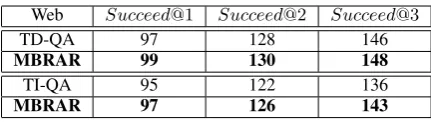
We first evaluate the effectiveness of our MBRAR for single QA system. Given the N-best answer outputs from each single QA system, together with their ranking scores assigned by the corresponding ranking components, we further perform MBRAR to re-rank them and show resulting numbers on t-wo evaluation data sets in Table 1 and 2 respec-tively.
Both Table 1 and Table 2 show that, by lever-aging our MBRAR method on individual QA sys-tems, the rankings of correct answers are consis-tently improved on both Jeopardy! and web ques-tions.
Joepardy! Succeed@1 Succeed@2 Succeed@3
TD-QA 2,289 2,693 2,885
MBRAR 2,372 2,784 2,982
TI-QA 2,527 3,397 3,821
MBRAR 2,628 3,500 3,931
Table 1: Impacts of MBRAR for single QA system on Jeopardy! questions.
We also notice TI-QA performs significantly better than TD-QA on Jeopardy! questions, but worse on web questions. This is due to fac-t fac-thafac-t when fac-the answer fac-type is fixed (PERSON for
3http://www.jeopardy.com/
4The answers of such questions are person names.
Web Succeed@1 Succeed@2 Succeed@3
TD-QA 97 128 146
MBRAR 99 130 148
TI-QA 95 122 136
[image:4.595.308.524.60.121.2]MBRAR 97 126 143
Table 2: Impacts of MBRAR for single QA system on web questions.
celebrity-asking questions), TI-QA will generate candidates with wrong answer types, which will definitely deteriorate the ranking accuracy. 5.3 MBRAR for Multiple QA Systems
We then evaluate the effectiveness of our MBRAR for multiple QA systems. The mixture model-based MBRAR method described in Section 3.2 is used to rank the combined answer outputs from TD-QA and TI-QA, with ranking results shown in Table 3 and 4.
From Table 3 and Table 4 we can see that, com-paring to the ranking performances of single QA systems TD-QA and TI-QA, MBRAR using two QA systems’ outputs shows significant improve-ments on both Jeopardy! and web questions. Fur-thermore, comparing to MBRAR on single QA system, MBRAR on multiple QA systems can pro-vide extra gains on both questions sets as well.
Jeopardy! Succeed@1 Succeed@2 Succeed@3
TD-QA 2,289 2,693 2,885
TI-QA 2,527 3,397 3,821
[image:4.595.310.523.553.601.2]MBRAR 2,891 3,668 4,033
Table 3: Impacts of MBRAR for multiple QA sys-tems on Jeopardy! questions.
Web Succeed@1 Succeed@2 Succeed@3
TD-QA 97 128 146
TI-QA 95 122 136
[image:4.595.72.291.572.634.2]MBRAR 108 137 152
Table 4: Impacts of MBRAR for multiple QA sys-tems on web questions.
6 Conclusions and Future Work
Experiments on questions from two different do-mains show that, our proposed method can sig-nificantly improve the ranking performances. In future, we will add more QA systems into our M-BRAR framework, and design more features for the MBR gain function.
References
P. J. Bickel and K. A. Doksum. 1977. Mathematical
Statistics: Basic Ideas and Selected Topics. Holden-Day Inc.
Jennifer Chu-Carroll, Krzysztof Czuba, John Prager,
and Abraham Ittycheriah. 2003. In Question
An-swering, Two Heads Are Better Than One. In pro-ceeding of HLT-NAACL.
Vaibhava Goel and William Byrne. 2000. Minimum
bayes-risk automatic speech recognition, Computer Speech and Language.
Arnaud Grappy, Brigitte Grau, and Sophie
Ros-set. 2012. Methods Combination and ML-based
Re-ranking of Multiple Hypothesis for Question-Answering Systems, In proceeding of EACL.
Thorsten Joachims. 2006. Training Linear SVMs in
Linear Time, In proceeding of KDD.
Shankar Kumar and William Byrne. 2004.
Mini-mum Bayes-Risk Decoding for Statisti-cal Machine Translation. In proceeding of HLT-NAACL.
Christopher Pinchak and Dekang Lin. 2006. A
Prob-abilistic Answer Type Model. In proceeding of EA-CL.
Ivan Titov and James Henderson. 2006. Bayes Risk
Minimization in Natural Language Parsing. Techni-cal report.
Alberto Tellez-Valero, Manuel Montes-y-Gomez, Luis
Villasenor-Pineda, and Anselmo Penas. 2008.
Im-proving Question Answering by Combining Multiple Systems via Answer Validation. In proceeding of CI-CLing.
Suzan Verberne, Clst Ru Nijmegen, Hans Van Hal-teren, Clst Ru Nijmegen, Daphne Theijssen, Ru Ni-jmegen, Stephan Raaijmakers, Lou Boves, and Clst
Ru Nijmegen. 2009. Learning to rank qa data.
e-valuating machine learning techniques for ranking answers to why-questions. In proceeding of SIGIR workshop.
Sibel Yaman, Dilek Hakkani-Tur, Gokhan Tur, Ralph Grishman, Mary Harper, Kathleen R.
McKe-own, Adam Meyers, Kartavya Sharma. 2009.