Machine Translation Detection from Monolingual Web-Text
Yuki Arase
Microsoft Research Asia No. 5 Danling St., Haidian Dist.
Beijing, P.R. China
Ming Zhou
Microsoft Research Asia No. 5 Danling St., Haidian Dist.
Beijing, P.R. China
Abstract
We propose a method for automatically detecting low-quality Web-text translated by statistical machine translation (SMT) systems. We focus on the phrase salad
phenomenon that is observed in existing SMT results and propose a set of computa-tionally inexpensive features to effectively detect such machine-translated sentences from a large-scale Web-mined text. Un-like previous approaches that require bilin-gual data, our method uses only monolin-gualtext as input; therefore it is applicable for refining data produced by a variety of Web-mining activities. Evaluation results show that the proposed method achieves an accuracy of 95.8% for sentences and 80.6%for text in noisy Web pages.
1 Introduction
The Web provides an extremely large volume of textual content on diverse topics and areas. Such data is beneficial for constructing a large scale monolingual (Microsoft Web N-gram Ser-vices, 2010; Google N-gram Corpus, 2006) and bilingual (Nie et al., 1999; Shi et al., 2006; Ishisaka et al., 2009; Jiang et al., 2009) corpus that can be used for training statistical models for NLP tools, as well as for building a large-scale knowledge-base (Suchanek et al., 2007; Zhu et al., 2009; Fader et al., 2011; Nakashole et al., 2012). With recent advances in statistical machine trans-lation (SMT) systems and their wide adoption in Web services through APIs (Microsoft Translator, 2009; Google Translate, 2006), a large amount of text in Web pages is translated by SMT sys-tems. According to Rarrick et al. (2011), their Web crawler finds that more than15%of English-Japanese parallel documents are machine transla-tion. Machine-translated sentences are useful if
they are of sufficient quality and indistinguish-able from human-generated sentences; however, the quality of these machine-translated sentences is generally much lower than sentences generated by native speakers and professional translators. Therefore, a method to detect and filter such SMT results is desired to best make use of Web-mined data.
To solve this problem, we propose a method for automatically detecting Web-text translated by SMT systems1. We especially target
machine-translated text produced through the Web APIs that is rapidly increasing. We focus on thephrase salad phenomenon (Lopez, 2008), which char-acterizes translations by existing SMT systems,
i.e., each phrase in a sentence is semantically and syntactically correct but becomes incorrect when combined with other phrases in the sentence. Based on this trait, we propose features for eval-uating the likelihood of machine-translated sen-tences and use a classifier to determine whether the sentence is generated by the SMT systems.
The primary contributions of the proposed method are threefold. First, unlike previous stud-ies that use parallel text and bilingual features, such as (Rarrick et al., 2011), our method only requires monolingual text as input. Therefore, our method can be used in monolingual Web data mining where bilingual information is unavailable. Second, the proposed features are designed to be computationally light so that the method is suit-able for handling a large-scale Web-mined data. Our method determines if an input sentence con-tains phrase salads using a simple yet effective fea-tures, i.e., language models (LMs) and automati-cally obtained non-contiguous phrases that are fre-quently used by people but difficult for SMT sys-tems to generate. Third, our method computes fea-tures using both human-generated text and SMT 1In this paper, the termmachine-translatedis used for
in-dicating translation by SMT systems.
results to capture a phrase salad by contrasting these features, which significantly improves detec-tion accuracy.
We evaluate our method using Japanese and En-glish datasets, including a human evaluation to as-sess its performance. The results show that our method achieves an accuracy of 95.8% for sen-tences and80.6%for noisy Web-text.
2 Related Work
Previous methods for detecting machine-translated text are mostly designed for bilingual corpus construction. Antonova and Misyurev (2011) design a phrase-based decoder for detecting machine-translated documents in Russian-English Web data. By evaluating the BLEU score (Papineni et al., 2002) of trans-lated documents (by their decoder) against the target-side documents, machine translation (MT) results are detected. Rarrick et al. (2011) extract a variety of features, such as the number of tokens and character types, from sentences in both the source and target languages to capture words that are mis-translated by MT systems. With these features, the likelihood of a bilingual sentence pair being machine-translated can be determined.
Confidence estimation of MT results is also a related area. These studies aim to precisely replicate human judgment in terms of the qual-ity of machine-translated sentences based on fea-tures extracted using a syntactic parser (Corston-Oliver et al., 2001; Gamon et al., 2005; Avramidis et al., 2011) or essay scoring system (Parton et al., 2011), assuming that their input is al-ways machine-translated. In contrast, our method aims at making a binary judgment to distin-guish machine-translated sentences from a mix-ture of machine-translated and human-generated sentences. In addition, although methods for confidence estimation can assume sentences of a known source language and reference translations as inputs, these are unavailable in our problem set-ting.
Another related area is automatic grammatical error detection for English as a second language (ESL) learners (Leacock et al., 2010). We use common features that are also used in this area. They target specific error types commonly made by ESL learners, such as errors in prepositions and subject-verb agreement. In contrast, our method does not specify error types and aims to
de-tect machine-translated sentences focusing on the phrase salad phenomenon produced by SMT sys-tems. In addition, errors generated by ESL learn-ers and SMT systems are different. ESL learnlearn-ers make spelling and grammar mistakes at the word level but their sentence are generally structured while SMT results are unstructured due to phrase salads. Works ontranslationesedetection (Baroni and Bernardini, 2005; Kurokawa et al., 2009; Ilisei et al., 2010) aim to automatically identify human-translated text by professionals using text gener-ated by native speakers. These are relgener-ated, but our work focuses on machine-translated text.
The closest to our approach is the method pro-posed by Moore and Lewis (2010). It automat-ically selects data for creating a domain-specific LM. Specifically, the method constructs LMs us-ing corpora of target and non-target domains and computes a cross-entropy score of an input sen-tence for estimating the likelihood that the input sentence belongs to the target or non-target do-mains. While the context is different, our work uses a similar idea of data selection for the pur-pose of detecting low-quality sentences translated by SMT systems.
3 Proposed Method
When APIs of SMT services are used for machine-translating an Web page, they typically insert specific tags into the HTML source. Utilizing such tags makes MT detection trivial. How-ever, the actual situation is more complicated in real Web data. When people manually copy and paste machine-translated sentences, such tags are lost. In addition, human-generated and machine-translated sentences are often mixed together even in a single paragraph. To observe the distribu-tion of machine-translated sentences in such diffi-cult cases, we examine3Ksentences collected by our in-house Web crawler. Among them, exclud-ing the pages with the tags of MT APIs,6.7%of them are found to be clearly machine translation. Our goal is to automatically identify these sen-tences that cannot be simply detected by the tags, except when the sentences are of sufficient qual-ity to be indistinguishable from human-generated sentences.
3.1 Phrase Salad Phenomenon
| Of surprise | was up | foreigners flocked | overseas | as well, | they publicized not only | Japan, | saw an article from the news. | Natural English: The news was broadcasted not only in Japan but also overseas, and it surprised foreigners who read the article.
Unnatural phrase sequence
Natural phrase | |
Missing combinational word
Figure 1:The phrase salad phenomenon in a sentence translated by an SMT system; each (segmented) phrase is correct and fluent, but dotted arcs show unnatural sequences of phrases and the boxed phrase shows an incomplete non-contiguous phrase.
SMT system. Each phrase, a sequence of con-secutive words, is fluent and grammatically cor-rect; however, the fluency and grammar correct-ness are both poor in inter-phrases. In addition, a phrase salad becomes obvious by observing dis-tant phrases. For example, the boxed phrase in Fig. 1 is a part of the non-contiguous phrase “not only?but also2;” however, it lacks the latter part of the phrase (“but also”) that is also necessary for composing a meaning. Such non-contiguous phrases are difficult for most SMT systems to gen-erate, since these phrases require insertion of sub-phrases in distant parts of the sentence.
Based on the observation of these characteris-tics, we define features to capture a phrase salad by examining local and distant phrases. These features evaluate (1) fluency (Sec. 3.2), (2) gram-maticality (Sec. 3.3), and (3) completeness of non-contiguous phrases in a sentence (Sec. 3.4). Furthermore, humans can distinguish machine-translated text because they have prior knowledge of how a human-generated sentence would look like, which has been accumulated by observing a lot of examples through their life. This knowl-edge makes phrase-salads, e.g., missing objects and influent sequence of words, obvious for hu-mans since they rarely appear on human-generated sentences. Based on this assumption, we ex-tract these features using both human-generated and machine-translated text. Features extracted from human-generated text represent the similar-ity to human-generated text. Likewise, features extracted from machine-translated text depict the similarity to machine-translated text. By contrast-ing these feature weights, we can effectively cap-ture phrase salads in the sentence.
3.2 Fluency Feature
In a machine-translated sentence, fluency becomes poor among phrases where a phrase salad occurs. We capture this influency using two independent LM scores; fw,H andfw,M T. The former LM is
2We use the symbol ?to represent a gap in which any
word or phrase can be placed.
trained with human-generated sentences and the latter one is trained with machine-translated sen-tences. We input a sentence into both of the LMs and use the scores as the fluency features.
3.3 Grammaticality Feature
In a sentence with phrase salads, its grammatical-ity is poor because tense and voice become in-consistent among phrases. We capture this using LMs trained with part-of-speech (POS) sequences of human-generated and machine-translated sen-tences, and the features offpos,H andfpos,M T are
respectively computed. In a similar manner with a word-based LM, such grammatical inconsistency among phrases is detectable when computing a POS LM score, since the score becomes worse when an N-gram covers inter-phrases where a phrase salad occurs. This approach achieves com-putational efficiency since it only requires a POS tagger.
Since a phrase salad may occur among distant phrases of a sentence, it is also effective to evalu-ate combinations of phrases that cannot be cov-ered by the span of N-gram. For this purpose, we make use of function words that sparsely ap-pear in a sentence where their combinations are syntactically constrained. For example, the same preposition rarely appears many times in a human-generated sentence, while it does in a machine-translated sentence due to the phrase salad. Simi-lar to the POS LM, we first analyze sentences gen-erated by human or SMT by a POS tagger, extract sequences of function words, and finally train LMs with the sequences. We use these LMs to obtain scores that are used as featuresff w,Handff w,M T.
3.4 Gappy-Phrase Feature
Sequences
World population not only grows , but grows old . A press release not only informs but also teases .
Hazelnuts are not only for food , but also fuel . The coalition must not only listen but also act . Table 1:Example of a sequence database
also.” When a sentence contains the phrase “not only,” the phrase “but also” is likely to appear in human-generated setences. Such a gappy-phrase is difficult for SMT systems to correctly generate and causes a phrase salad. Therefore, we define a feature to evaluate how likely a sentence contains gappy-phrases in a complete form without missing sub-phrases. This feature is effective to comple-ment LMs that capture characteristics inN-grams. Sequential Pattern Mining It is costly to man-ually collect a lot of such gappy-phrases. There-fore, we regard the task as sequential pattern min-ing and apply PrefixSpan proposed by Pei et al. (2001), which is a widely used sequential pattern mining method3.
Given a set of sequences and a user-specified
min support∈Nthreshold, the sequential pattern mining finds all frequent subsequences whose oc-currence frequency is no less than min support. For example, given a sequence database like Ta-ble 1, the sequential pattern mining finds all fre-quent subsequences, e.g., “not only,” “not only? but also,” “not?but?,” andetc.
To capture a phrase salad by contrasting appear-ance of gappy-phrases in human-generated and machine-translated text, we independently extract gappy-phrases from each of them using PrefixS-pan. We then compute features fg,H and fg,M T
using the obtained phrases.
Observation of Extracted Gappy-Phrases Based on a preliminary experiment, we set the parameter min support of PrefixSpan to 100 for computational efficiency. We extract gappy-phrases (of 2-tuple) from our develop-ment dataset described in Sec. 4.1 that includes 254K human-generated and 134K machine-translated sentences in Japanese, and 210K human-generated and 159K machine-translated sentences in English.
Regarding the Japanese dataset, we obtain about104Kand64Kgappy-phrases from human-3Due to the severe space limitation, readers are referred to
that paper.
generated and machine-translated sentences, re-spectively. According to our observation of the extracted phrases, 21K phrases commonly ap-pear in human-generated and machine-translated sentences. Many of these common phrases are incomplete forms of gappy-phrases that lack se-mantic meaning to humans, such as “not only ? the” and “not only ? and.” On the other hand, complete forms of gappy-phrases that preserve se-mantic meaning exclusively appear in phrases ex-tracted from human-generated sentences. We also obtain about74K and42K phrases from human-generated and machine-translated sentences in the English dataset (21K of them are common).
Phrase Selection As a result of sequential pattern mining, we can gather a huge num-ber of gappy-phrases from human-generated and machine-translated text, but as we described above, many of them are common. In addition, it is computationally expensive to use all of them. Therefore, our method selects useful phrases for detecting machine-translated sentences.
Although there are several approaches for fea-ture selection, e.g., (Sebastiani, 2002), we use a method that is suitable for handling a large num-ber of feature candidates. Specifically, we evaluate gappy-phrases based on the information gain that measures the amount of information in bits ob-tained for class prediction when knowing the pres-ence or abspres-ence of a phrase and the corresponding class distribution. This corresponds to measuring an expected reduction in entropy,i.e., uncertainty associated with a random factor. The information gainG∈Rfor a gappy-phrasegis defined as
G(g) =. H(C)−P(Xg1)H(C|Xg1)
−P(Xg0)H(C|Xg0),
whereH(C)represents the entropy of the classifi-cation,Cis a stochastic variable taking a class,Xg
is a stochastic variable representing the presence (X1
g) or absence (Xg0) of the phraseg,P(Xg)
rep-resents the probability of presence or absence of the phraseg, andH(C|Xg)is the conditional
in the early?period after?after the known as?to and also?and Human more?than MT and?but the
not only?but also no?not with?as well as not?not
Table 2:Example of gappy-phrases extracted from human-generated and machine-translated text; phrases preserving se-mantic meaning are extracted only from human-generated text.
The gappy-phrases depend on each other, and the more phrases extracted from human-generated (machine-translated) text are found in a sentence, the more likely the sentence is human-generated (machine-translated). Therefore, we compute the feature as
fc(s) =
X
i∈k
wiδ(i, s),
wherewiis a weight of thei-th phrase, andδ(i, s)
is a Kronecker’s delta function that takes1if the sentencesincludes thei-th phrase and takes0 oth-erwise. We may set the weightwiaccording to the
importance of the phrase, such as the information gain. In this work, we setwito1for simplicity.
[image:5.595.339.487.63.127.2]3.5 Classification
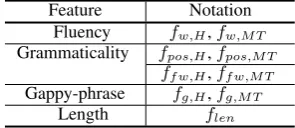
Table 3 summarizes the features employed in our method. In addition to the discussed tures, we use the length of a sentence as a fea-ture flen to avoid the bias of LM-based
fea-tures that favor shorter sentences. The proposed method takes a monolingual sentence from Web data as input and computes a feature vector of f = (fw,H, . . . , flen)∈R9. Each feature is
fi-nally normalized to have a zero-mean and unit variance distribution. In the feature space, a support vector machine (SVM) classifier (Vap-nik, 1995) is used to determine the likelihoods of machine-translated and human-generated sen-tences.
4 Experiments
We evaluate our method using both Japanese and English datasets from various aspects and investi-gate its characteristics. In this section, we describe our experiment settings.
4.1 Data Preparation
For the purpose of evaluation, we use human-generated and machine-translated sentences for
Feature Notation Fluency fw,H,fw,M T
Grammaticality fpos,H,fpos,M T
ff w,H,ff w,M T
Gappy-phrase fg,H,fg,M T
Length flen
Table 3:List of proposed features and their notations
constructing LMs, extracting gappy-phrases, and training a classifier. These sentences should be ensured to be human-generated or translated, and the human-generated and machine-translated sentences express the same content for fairness of evaluation to avoid effects due to vo-cabulary difference.
As a dataset that meets these requirements, we use parallel text in public websites (this is for fair evaluation and our method can be trained using
nonparalleltext on an actual deployment). Eight popular sites having Japanese and English paral-lel pages are crawled, whose text is manually veri-fied to be human-generated. The main textual con-tent of these 131K parallel pages are extracted, and the sentences are aligned using (Ma, 2006). As illustrated in Fig. 2, the text in one language is fed to the Bing translator, Google Translate, and an in-house SMT system4implemented based
on (Chiang, 2005) by ourselves for obtaining sen-tences translated by SMT systems. Due to a severe limitation on the number of requests to the APIs, we randomly subsample sentences before sending them to these SMT systems. We use text in the other language as human-generated sentences5.
In this manner, we prepare 508K human-generated and268Kmachine-translated sentences as a Japanese dataset, and420Khuman-generated and318Kmachine-translated sentences as an En-glish dataset. We split each of them into two even datasets and use one for development and the other for evaluation.
4.2 Experiment Setting
For the fluency and grammaticality features, we train 4-gram LMs using the development dataset with the SRI toolkit (Stolcke, 2002). To obtain the POS information, we use Mecab (Kudo et al., 2004) for Japanese and a POS tagger developed by Toutanova et al. (2003) for English. We evaluate 4A preliminary evaluation of the in-house SMT system
shows that it has comparable quality with Bing translator.
5These are a mixture of sentences generated by native
[image:5.595.73.291.63.116.2]Parallel sentences
MT systems Machine translated
sentences
Human-generated sentences
Human-generated sentences Human-generated sentences
…
English
Japanese
Japanese
Japanese
…
…
[image:6.595.329.504.61.136.2]…
Figure 2: Experimental data preparation; text in one lan-guage is fed to SMT systems and the other is used as human-generated sentences.
the effect of the sizes of N-grams and develop-ment dataset in the experidevelop-ments.
Using the proposed features, we train an SVM classifier for detecting machine-translated sen-tences. We use an implementation of LIB-SVM (Chang and Lin, 2011) with a radial basis function kernel due to the relatively small number of features in the proposed method. We set appro-priate parameters by grid search in a preliminary experiment.
We evaluate the performance of MT detection based on accuracy6 that is a broadly used
evalua-tion metric for classificaevalua-tion problems:
accuracy= nT P +nT N
n ,
where nT P and nT N are the numbers of
true-positives and true-negatives, respectively, and n is the total number of exemplars. The accuracy scores that we report in Sec. 5 are all based on10 -fold cross validation.
4.3 Comparison Method
We compare our method with the method of (Moore and Lewis, 2010) (Cross-Entropy). Al-though the Cross-Entropy method is designed for the task of domain adaptation of an LM, our prob-lem is a variant of their original probprob-lem and thus their method is directly relevant. In our context, the method computes the cross-entropy scores IM T(s) and IH(s) of an input sentence
sagainst LMs trained on machine-translated and human-generated sentences. Cross-entropy and perplexity are monotonically related, as perplex-ity of s according to an LM M is simply ob-6Although we also examine precision and recall of
clas-sification results, they are similar to accuracy reported in this paper.
Method Accuracy
Cross-Entropy 90.7 Lexical Feature 87.8 Proposed feature Word LMs 94.1 POS LMs 91.3
FW LMs 82.7
[image:6.595.76.288.65.178.2]GPs 85.7
Table 4:Accuracy (%) of individual features and compari-son methods
tained by bIM(s) where I
M(s) is cross-entropy
score and b is a base with regard to which the cross-entropy is measured. The method scores the sentence according to the cross-entropy differ-ence, i.e., IM T(s)−IH(s), and decides that the
sentence is machine-translated when the score is lower than a predefined threshold. The classifica-tion is performed by10-fold cross validation. We find the best performing threshold on a training set and evaluate the accuracy with a test set using the determined threshold.
Additionally, we compare our method to a method that uses a feature indicating presence or absence of unigrams, which we call Lexical Fea-ture. This feature is commonly used for transla-tionese detection and shows the best performance as a single feature in (Baroni and Bernardini, 2005). It is also used by Rarrick et al. (2011) and shows the best performance by itself in detecting machine-translated sentences in English-Japanese translation in the setting of bilingual input. We implement the feature and use it against a mono-lingual input to fit our problem setting.
5 Results and Discussions
In this section, we analyze and discuss the experi-ment results in detail.
5.1 Accuracy on Japanese Dataset
We evaluate the sentence-level and document-level accuracy of our method using the Japanese dataset. Specifically, we evaluate effects of indi-vidual features and their combinations, compare with human annotations, and assess performance variations across different sentence lengths and various settings on LM training.
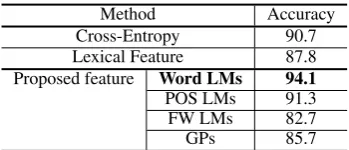
Effect of Individual Feature Table 4 shows the accuracy scores of individual features and com-parison methods. We refer to features for flu-ency (fw,H, fw,M T) asWord LMs,
Method Accuracy
Word LMs + GPs 94.7
Word LMs + POS LMs 95.1 Word LMs + POS LMs + GPs 95.4 Word LMs + POS LMs + FW LMs 95.5
[image:7.595.89.273.62.129.2]All 95.8
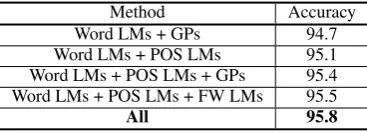
Table 5: Accuracy (%) of feature combinations; there are significant differences (p.01) against the accuracy score
of Word LMs.
and function word LMs (ff w,H, ff w,M T) as FW
LMs, respectively, and for completeness of gappy-phrases (fg,H, fg,M T) as GPs. The Word LMs
show the best accuracy that outperforms Cross-Entropy by 3.4% and Lexical Feature by 6.3%. This high accuracy is achieved by contrasting flu-ency in human-generated and machine-translated text to capture the phrase salad phenomenon. The accuracy of Word LM trained only on human-generated sentences is limited to 65.5%. On the other hand, the accuracy of Word LM trained on machine-translated sentences shows a better per-formance (84.4%). By combining these into a single feature vectorf = (fw,H, fw,M T, flen), the
accuracy is largely improved.
It is interesting that Lexical Feature achieves a high accuracy of 87.8% despite its simplicity. Since Lexical Feature is a bag-of-words model, it can consider distant words in a sentence. This is effective for capturing a phrase salad that oc-curs among distant phrases, which N-gram can-not cover. As for Cross-Entropy, a simple sub-traction of cross-entropy scores cannot well con-trast the fluency in human-generated and machine-translated text and results in poorer accuracy than Word LMs.
The accuracy of POS LMs (91.3%) is slightly lower than that of Word LMs due to the limited vocabulary, i.e., the number of POSs. The accu-racy of FW LMs and GPs are even lower. This is convincing since these features cannot have rea-sonable values when a sentence does not include a function word and gappy-phrase. However, these features are complementary to Word LMs as we will see in the next paragraph.
Effect of Feature Combination Table 5 shows the accuracy when combining features. Sign tests show that the accuracy scores of these feature combinations are significantly different (p.01) against the accuracy of Word LMs. The results show that the features complement each other. The
Error Ratio Accuracy
(%) Word
LMs All
[image:7.595.312.520.63.147.2]Has wrong content words 37.8 93.1 95.0 Misses content words 12.2 91.8 96.5 Has wrong function words 19.7 92.7 97.1 Misses function words 13.0 93.3 95.6 Has wrong inflections 10.8 97.3 98.7 Table 6:Distribution (%) of machine translation errors and accuracy (%) of proposed method on the different errors
combination of all features reaches an accuracy of95.8%, which improves the accuracy of Word LMs by1.7%. This result supports that FW LMs and GPs are effective to capture a phrase salad oc-curring in distant phrases and complement the ev-idence inN-grams that is captured by LMs. This effect becomes more obvious in the human evalu-ation.
We also evaluate the accuracy of the proposed method at a document level. Due to the high accu-racy at the sentence-level, we use a voting method to judge a document, i.e., deciding if the docu-ment is machine-translated when γ% of its sen-tences are judged as machine-translated. We use all features and find that our method achieves99% precision and recall withγ = 50.
Human Evaluation To further investigate the characteristics of our method, we conduct a human evaluation. We sample Japanese sentences and ask three native speakers to 1) judge whether a sen-tence is human-generated or machine-translated and 2) list errors that the sentence contains. Re-garding the task 1), we allow the annotators to as-sign “hard to determine” for difficult cases. We al-locate about230sentences for each annotator (in total 700sentences) without overlapping annota-tion sets.
The accuracy of annotations is found to be 88.2%, which shows that our method is even su-perior to native speakers. Agreement between the annotators and our method (with all features) is 85.1%. As we interview the annotators, we find that human annotations are strongly affected by the annotators’ domain knowledge. For example, technical sentences are more often misclassified by the annotators.
0 2 4 6 8 10
70 75 80 85 90 95 100
6 10 14 18 22 26 30 34 38 42 46 50 54 58 62 66 70 74 78
Rati
o(%
)
A
ccu
racy
(%
)
Num. of words in a sentence Proposed Method Cross-Entropy Lexical Feature Human
[image:8.595.317.515.61.155.2]Length distribution
Figure 3: Accuracy (%) across different sentence lengths (the primary axis) and distribution (%) of sentence lengths in the evaluation dataset (the secondly axis)
these sentences (a sentence may contain multiple errors). It indicates that the accuracy of Word LMs is improved by feature combination; from1.4%on sentences of “Has wrong inflections” to4.7%on sentences of “Misses content words”.
Effect of Sentence Length The accuracy of the proposed method is significantly affected by sen-tence length (the number of words in a sensen-tence). Fig. 3 shows the accuracy of the proposed method (with all features) and comparison methods w.r.t. sentence lengths (with the primary axis), as well as the distribution of sentence lengths in the eval-uation dataset (with the secondly axis). We ag-gregate the classification results on each cross-validation (test results). It also shows the accu-racy of human annotations w.r.t. sentence lengths, which we obtain for the700sentences in the hu-man evaluation. The accuracy drops on all meth-ods when sentences are short; the accuracy of our method is 91.6% when a sentence contains less than or equal to10words. The proposed method shows the similar trend with the human tions, and even the accuracy of human annota-tions significantly drops on such short sentences. This result indicates that SMT results on short sentences tend to be of sufficient quality and in-distinguishable from human-generated sentences. Since such high-quality machine-translations do not harm the quality of Web-mined data, we do not need to detect them.
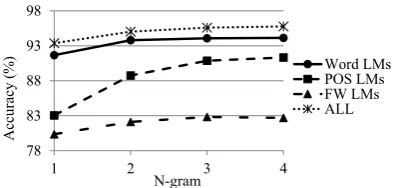
Effect of Setting on LM Training We evalu-ate the performance variation w.r.t. the sizes of N-grams and development dataset. Fig. 4 shows the accuracy of the LM based features and feature combination when changing sizes of N-grams. The performance of Word LMs is stabilized after
78 83 88 93 98
1 2 3 4
A
ccu
racy
(%
)
N-gram
[image:8.595.75.292.62.189.2]Word LMs POS LMs FW LMs ALL
Figure 4: Effect of the sizes ofN-grams on MT detection
accuracy (%)
3-gram while that of POS LMs is still improved at4-gram. This is because POS LMs need more evidence to compensate for their limited vocabu-lary. FW LMs become stable at 3-gram because the possible number of function words in a sen-tence should be small.
When we change the size of the development dataset with10%increments, the accuracy curve is stabilized when the size is40%of all set. Consid-ering the fact that the overall development dataset is small, it shows that our method is deployable with a small dataset.
5.2 Accuracy on English Dataset
To investigate the applicability of our method to other languages, we apply the same method to the English dataset. Because English is a config-urational language, function words are less flex-ible than case markers in Japanese. Therefore, SMT systems may better handle English function words, which potentially decreases the effect of FW LMs in our method. In addition, because En-glish is a morphologically poor language, the ef-fect of POS LMs may be reduced.
Nevertheless, in our experiment, all features are shown to be effective even with the English dataset. The combination of all features achieves the best performance, with an accuracy of93.1%, which outperforms Cross-Entropy by 1.9%, and Lexical Feature by8.5%. Even though improve-ments by POS LMs and FW LMs are smaller than Japanese case, their effects are still positive. We also find that GPs stably contribute to the accu-racy. These results show the applicability of our method to other languages.
5.3 Accuracy on Raw Web Pages
more complex; there are often instances of sen-tence fragments, such as captions and navigational link text. To evaluate the accuracy of our method on real Web pages, we conduct experiments using the dataset generated by Rarrick et al. (2011) that contains randomly crawled Web pages annotated by two annotators to judge if a page is human-generated or machine-translated. We use Japanese sentences extracted from 69 pages (43 human-generated and26machine-translated pages) where the annotators’ judgments agree;3,312sentences consisting of1,399machine-translated and1,913 human-generated sentences. To replicate the sit-uation in real Web pages, we conduct a minimal preprocessing,i.e., simply removing HTML tags, and then feed all the remaining text to our method.
An SVM classifier is trained with features ob-tained by the LMs and gappy-phrases computed from the data described in Sec. 4.1. Our method shows 80.6% accuracy at a sentence level and 82.4%accuracy at a document level using the vot-ing method. One factor for this performance dif-ference is again sentence lengths, as SMT results of short phrases in Web pages can be of high-quality. Another factor is the noise in Web pages. We find that experimental pages contain lots of non-sentences, such as fragments of scripts and product codes. The results show that we need a preprocessing to remove typical noise in Web text before SMT detection to handle noisy Web pages.
5.4 Quality of Cleaned Data
Finally, we briefly demonstrate the effect of machine-translation filtering in an end-to-end sce-nario, taking LM construction as an example. We construct LMs reusing the Japanese evalua-tion dataset described in Sec. 4.1 where machine-translated sentences are removed by the pro-posed method (LM-Propro-posed), Lexical Feature (LM-LF), and Cross-Entropy (LM-CE), as well as an LM with all sentences, i.e., with machine-translated sentences (LM-All). As a result of 5 -fold cross-validation, LM-Proposed has 17.8%, 17.1%, and16.3% lower perplexities on average compared to LM-All, LM-LF, and LM-CE, re-spectively. These results show that our method is useful for improving the quality of Web-mined data.
6 Conclusion
We propose a method for detecting machine-translated sentences from monolingual Web-text focusing on the phrase salad phenomenon pro-duced by existing SMT systems. The experimen-tal results show that our method achieves an accu-racy of95.8%for sentences and80.6%for noisy Web text.
We plan to extend our method to detect machine-translated sentences produced by differ-ent MT systems, e.g., a rule-based system, and develop a unified framework for cleaning various types of noise in Web-mined data. In addition, we will investigate the effect of source and target lan-guages on translation in terms of MT detection. As Lopez (2008) describes, a phrase-salad is a com-mon phenomenon that characterizes current SMT results. Therefore, we expect that our method is basically effective on different language pairs. We will conduct experiments to evaluate performance difference using various language pairs.
Acknowledgments
We sincerely appreciate Spencer Rarrick and Will Lewis for active discussion and sharing the exper-imental data with us. We thank Junichi Tsujii for his valuable feedback to improve our work.
References
Alexandra Antonova and Alexey Misyurev. 2011. Building a web-based parallel corpus and filtering out machine translated text. InProceedings of the Workshop on Building and Using Comparable Cor-pora, pages 136–144.
Eleftherios Avramidis, Maja Popovic, David Vilar Tor-res, and Aljoscha Burchardt. 2011. Evaluate with confidence estimation: Machine ranking of trans-lation outputs using grammatical features. In Pro-ceedings of the Workshop on Statistical Machine Translation (WMT 2011), pages 65–70.
Mohit Bansal, Chris Quirk, and Robert C. Moore. 2011. Gappy phrasal alignment by agreement. In
Proceedings of the Annual Meeting of the Associ-ation for ComputAssoci-ational Linguistics: Human Lan-guage Technologies (ACL-HLT 2011), pages 1308– 1317.
Chih-Chung Chang and Chih-Jen Lin. 2011. LIB-SVM : a library for support vector machines. ACM Transactions on Intelligent Systems and Technology, 2(3):27:1–27:27.
David Chiang. 2005. A hierarchical phrase-based model for statistical machine translation. In Pro-ceedings of the Annual Meeting of the Association for Computational Linguistics (ACL 2005), pages 263–270.
Simon Corston-Oliver, Michael Gamon, and Chris Brockett. 2001. A machine learning approach to the automatic evaluation of machine translation. In Pro-ceedings of the Annual Meeting of the Association for Computational Linguistics (ACL 2001), pages 148–155.
Anthony Fader, Stephen Soderland, and Oren Etzioni. 2011. Identifying relations for open information extraction. In Proceedings of the Conference on Empirical Methods in Natural Language Processing (EMNLP 2011), pages 1535–1545.
Michael Gamon, Anthony Aue, and Martine Smets. 2005. Sentence-level MT evaluation without refer-ence translations: Beyond language modeling. In
Proceedings of European Association for Machine Translation (EAMT 2005).
Google N-gram Corpus. 2006. http://www.ldc. upenn.edu/Catalog/CatalogEntry.
jsp?catalogId=LDC2006T13.
Google Translate. 2006. http://code.google.
com/apis/language/.
Iustina Ilisei, Diana Inkpen, Gloria Corpas Pastor, and Ruslan Mitkov. 2010. Identification of transla-tionese: A machine learning approach. In Proceed-ings of the International Conference on Intelligent Text Processing and Computational Linguistics (CI-CLing 2010), pages 503–511.
Tatsuya Ishisaka, Masao Utiyama, Eiichiro Sumita, and Kazuhide Yamamoto. 2009. Development of a Japanese-English software manual parallel corpus. In Proceedings of the Machine Translation Summit (MT Summit XII).
Long Jiang, Shiquan Yang, Ming Zhou, Xiaohua Liu, and Qingsheng Zhu. 2009. Mining bilingual data from the web with adaptively learnt patterns. In
Proceedings of the Joint Conference of the Annual Meeting of the Association for Computational Lin-guistics and the International Joint Conference on Natural Language Processing of the Asian Federa-tion of Natural Language Processing (ACL-IJCNLP 2009), pages 870–878.
Taku Kudo, Kaoru Yamamoto, and Yuji Matsumoto. 2004. Applying conditional random fields to Japanese morphological analysis. In Proceedings of the Conference on Empirical Methods in Natural Language Processing (EMNLP 2004), pages 230– 237.
David Kurokawa, Cyril Goutte, and Pierre Isabelle. 2009. Automatic detection of translated text and its impact on machine translation. In Proceedings of the Machine Translation Summit (MT-Summit XII).
Claudia Leacock, Martin Chodorow, Michael Gamon, and Joel Tetreault. 2010. Automated Grammatical Error Detection for Language Learners. Morgan and Claypool Publishers.
Adam Lopez. 2008. Statistical machine translation.
ACM Computing Surveys, 40(3):1–49.
Xiaoyi Ma. 2006. Champollion: a robust parallel text sentence aligner. InProceedings of the International Conference on Language Resources and Evaluation (LREC 2006), pages 489–492.
Microsoft Translator. 2009. http://www.
microsofttranslator.com/dev/.
Microsoft Web N-gram Services. 2010. http://
research.microsoft.com/web-ngram.
Robert Moore and William Lewis. 2010. Intelligent selection of language model training data. In Pro-ceedings of the Annual Meeting of the Association for Computational Linguistics (ACL 2010), pages 220–224.
Ndapandula Nakashole, Gerhard Weikum, and Fabian M. Suchanek. 2012. PATTY: A taxonomy of relational patterns with semantic types. In
Proceedings of the Joint Conference on Empir-ical Methods in Natural Language Processing and Computational Natural Language Learning (EMNLP-CoNLL 2012), pages 1135–1145.
Jian-Yun Nie, Michel Simard, Pierre Isabelle, and Richard Durand. 1999. Cross-language information retrieval based on parallel texts and automatic min-ing of parallel texts from the web. InProceedings of the Annual International ACM SIGIR Conference (SIGIR 1999), pages 74–81.
Kishore Papineni, Salim Roukos, Todd Ward, and Wei jing Zhu. 2002. BLEU: a method for automatic evaluation of machine translation. In Proceedings of the Annual Meeting of the Association for Com-putational Linguistics (ACL 2002), pages 311–318.
Kristen Parton, Joel Tetreault, Nitin Madnani, and Mar-tin Chodorow. 2011. E-raMar-ting machine translation. In Proceedings of the Workshop on Statistical Ma-chine Translation (WMT 2011), pages 108–115.
Spencer Rarrick, Chris Quirk, and Will Lewis. 2011. MT detection in web-scraped parallel corpora. In
Proceedings of the Machine Translation Summit (MT Summit XIII).
Fabrizio Sebastiani. 2002. Machine learning in au-tomated text categorization. ACM Computing Sur-veys, 34(1):1–47.
Lei Shi, Cheng Niu, Ming Zhou, and Jianfeng Gao. 2006. A DOM tree alignment model for mining par-allel data from the web. InProceedings of the Inter-national Conference on Computational Linguistics and the Annual Meeting of the Association for Com-putational Linguistics (COLING-ACL 2006), pages 489–496.
Andreas Stolcke. 2002. SRILM-an extensible lan-guage modeling toolkit. InProceedings of the Inter-national Conference on Spoken Language Process-ing (ICSLP 2002), pages 901–904.
Fabian M. Suchanek, Gjergji Kasneci, and Gerhard Weikum. 2007. Yago: a core of semantic knowl-edge. In Proceedings of International Conference on World Wide Web (WWW 2007), pages 697–706.
Kristina Toutanova, Dan Klein, Christopher Manning, and Yoram Singer. 2003. Feature-rich part-of-speech tagging with a cyclic dependency network. InProceedings of the Conference of the North Amer-ican Chapter of the Association for Computational Linguistics on Human Language Technology (HLT-NAACL 2003), pages 252–259.
Vladimir N. Vapnik. 1995. The nature of statistical learning theory.Springer.