Proceedings of the 51st Annual Meeting of the Association for Computational Linguistics, pages 1630–1639, Sofia, Bulgaria, August 4-9 2013. c2013 Association for Computational Linguistics
A Bayesian Model for Joint Unsupervised Induction
of Sentiment, Aspect and Discourse Representations
Angeliki Lazaridou
University of Trento
Ivan Titov
Saarland University
Caroline Sporleder
Trier University
Abstract
We propose a joint model for unsuper-vised induction of sentiment, aspect and discourse information and show that by in-corporating a notion of latent discourse re-lations in the model, we improve the pre-diction accuracy for aspect and sentiment polarity on the sub-sentential level. We deviate from the traditional view of dis-course, as we induce types of discourse re-lations and associated discourse cues rel-evant to the considered opinion analysis task; consequently, the induced discourse relations play the role of opinion and as-pect shifters. The quantitative analysis that we conducted indicated that the integra-tion of a discourse model increased the prediction accuracy results with respect to the discourse-agnostic approach and the qualitative analysis suggests that the in-duced representations encode a meaning-ful discourse structure.
1 Introduction
With the rapid growth of the Web, it is becoming increasingly difficult to discern useful from irrel-evant information, particularly in user-generated content, such as product reviews. To make it easier for the reader to separate the wheat from the chaff, it is necessary to structure the available informa-tion. In the review domain, this is done in aspect-based sentiment analysis which aims at identify-ing text fragments in whichopinionsare expressed about ratable aspects of products, such as ‘room quality’ or ‘service quality’. Such fine-grained analysis can serve as the first step inaspect-based sentiment summarization (Hu and Liu, 2004), a task with many practical applications.
Aspect-based summarization is an active re-search area for which various techniques have been developed, both statistical (Mei et al., 2007; Titov and McDonald, 2008b) and not (Hu and Liu, 2004), and relying on different types of supervi-sion sources, such as sentiment-annotated texts or polarity lexica (Turney and Littman, 2002). Most methods rely on local information (bag-of-words, short ngrams or elementary syntactic fragments) and do not attempt to account for more complex interactions. However, these local lexical repre-sentations by themselves are often not sufficient to infer a sentiment or aspect for a fragment of text. For instance, in the following example taken from a TripAdvisor1review:
Example 1. The room was nicebutlet’s not talk about the view.
it is difficult to deduce on the basis of local lexical features alone that the opinion about the view is negative. The clauselet’s not talk about the view
could by itself be neutral or even positive given the right context (e.g.,I’ve never seen such a fancy ho-tel room, my living room doesn’t look that cool... and let’s not talk about the view). However, the contrast relation signaled by the connective but
makes it clear that the second clause has a nega-tive polarity. The same observations can be made about transitions between aspects: changes in as-pect are often clearly marked by discourse connec-tives. Importantly, some of these cues are not dis-course connectives in the strict linguistic sense and are specific to the review domain (e.g., the phrase
I would also in a review indicates that the topic is likely to be changed). In order to accurately predict sentiment and topic,2a model needs to
ac-1http://www.tripadvisor.com/
2In what follows, we use the termsaspectandtopic,
count for these discourse phenomena and cannot rely solely on local lexical information.
These issues have not gone unnoticed to the search community. Consequently, there has re-cently been an increased interest in models that leverage content and discourse structure in senti-ment analysis tasks. However, discourse-level in-formation is typically incorporated in a pipeline architecture, either in the form of sentiment po-larity shifters (Polanyi and Zaenen, 2006; Naka-gawa et al., 2010) that operate on the lexical level or by using discourse relations (Taboada et al., 2008; Zhou et al., 2011) that comply with dis-course theories like Rhetorical Structure Theory (RST) (Mann and Thompson, 1988). Such ap-proaches have a number of disadvantages. First, they require additional resources, such as lists of polarity shifters or discourse connectives which signal specific relations. These resources are avail-able only for a handful of languages. Second, re-lying on a generic discourse analysis step that is carried out before sentiment analysis may intro-duce additional noise and lead to error propaga-tion. Furthermore, these techniques will not nec-essarily be able to induce discourse relations in-formative for the sentiment analysis domain (Voll and Taboada, 2007).
An alternative approach is to define a task-specific scheme of discourse relations (Somasun-daran et al., 2009). This previous work showed that task-specific discourse relations are helpful in predicting sentiment, however, in doing so they re-lied on gold-standard discourse annotation at test time rather than predicting it automatically or in-ducing it jointly with sentiment polarity.
We take a different approach and induce dis-course and sentiment information jointly in an un-supervised (or weakly un-supervised) manner. This has the advantage of not having to pre-specify a mapping from discourse cues to discourse rela-tions; our model induces this automatically, which makes it portable to new domains and languages. Joint induction of discourse and sentiment struc-ture also has the added benefit that the model is able to learn exactly those aspects of discourse structure that are relevant for sentiment analysis.
We start with a relatively standard joint model of sentiment and topic, which can be regarded as a cross-breed between the JST model (Lin and He, 2009) and the ASUM model (Jo and Oh, 2011),
changeably as well assentiment levelsandopinion polarity.
both state-of-the-art techniques. This model is weakly supervised, as it relies solely on document-level (i.e. not aspect-specific) opinion polarity la-bels to induce topics and sentiment on the sub-sentential level. In order to test our hypothesis that discourse information is beneficial, we add a discourse modeling component. Note that in modeling discourse we do not exploit any kind of supervision. We demonstrate that the resulting model outperforms the baseline on a product re-view dataset (see Section 5).
To the best of our knowledge, unsupervised joint induction of discourse structure, sentiment and topic information has not been considered before, particularly not in the context of the aspect-based sentiment analysis task. Importantly, our method for discourse modeling is a general method which can be integrated in virtually any LDA-style model of aspect and sentiment.
2 Modeling Discourse Structure
Discourse cues typically do not directly indicate sentiment polarity (or aspect). However, they can indicate how polarity (or aspect) changes as the text unfolds. As we have seen in the examples above, changes in polarity can happen on a sub-sentential level, i.e., between adjacent clauses or, from a discourse-theoretic point of view, between adjacent elementary discourse units (EDUs). To model these changes we need a strong linguistic signal, for example, in the form of discourse con-nectives or other discourse cues. We hypothesize that these are more likely to occur at the beginning of an EDU than in the middle or at the end. This is certainly true for most of the traditional discourse relation cues (particularly connectives).
Changes in polarity or aspect are often cor-related with specific discourse relations, such as ‘contrast’. However, not all relations are rele-vant and there is no one-to-one correspondence between relations and sentiment changes.3 Fur-thermore, if a discourse relation signals a change, it is typically ambiguous whether this change oc-curs with the polarity (example 1) or the aspect (the room was nice but the breakfast was even bet-ter) or both (the room was nice but the breakfast was awful). Therefore, we do not explicitly model
3The ‘explanation’ relation, for example, can occur with
a polarity change (We were upgraded to a really nice room because the hotel made a terrible blunder with our booking) but does not have to (The room was really nice because the hotel was newly renovated).
Name Description
[image:3.595.90.257.86.131.2]AltSame differentpolarity,sameaspect SameAlt samepolarity,differentaspect AltAlt differentpolarity and aspect
Table 1: Discourse relations
generic discourse relations; instead, inspired by the work of Somasundaran et al. (2008), we define three very general relations which encode how po-larity and aspect change (Table 1). Note that we do not have a discourse relationSameSamesince we do not expect to have strong linguistic evidence which states that an EDU contains the same senti-ment information as the previous one.4 However, we assume that the sentiment and topic flow is fairly smooth in general. In other words, for two adjacent EDUs not connected by any of the above three relations, the prior probability of staying at the same topic and sentiment level is higher than picking a new topic and sentiment level (i.e. we use “sticky states” (Fox et al., 2008)).
3 Model
In this section we describe our Bayesian model, first the discourse-agnostic model and then an ex-tension needed to encode discourse information. The formal generative story is presented in Fig-ure 1: the red fragments correspond to the dis-course modeling component. In order to obtain the generative story for the discourse-agnostic model, they simply need to be ignored.
3.1 Discourse-agnostic model
In our approach we make an assumption that all the words in an EDU correspond to the same topic and sentiment level. We also assume that an over-all sentiment of the document is defined, this is the only supervision we use in inducing the model. Unlike some of the previous work (e.g., (Titov and McDonald, 2008a)), we do not constrain aspect-specific sentiment to be the same across the docu-ment. We describe our discourse-agnostic model by first describing the set of corpus-level and document-level parameters, and then explain how the content of each document is generated.
Drawing model parameters On the corpus level, for every topic z ∈ {1, . . . , K} and ev-ery sentiment polarity level y ∈ {−1,0,+1},
we start by drawing a unigram language model
4The typical connective in this situation would be and
which is highly ambiguous and can signal several traditional discourse relations.
from a Dirichlet prior. For example, the language model of the aspectservice may indicate that the wordfriendlyis used to express a positive opinion, whereas the wordrudeexpresses a negative one.
Similarly, for every topic z and every
over-all sentiment polarity yˆ, we draw a distribution
ψy,zˆ over opinion polarity in this topic z.
Intu-itively, one would expect the sentiment of an as-pect to more often agree with the overall sentiment
ˆ
y than not. This intuition is encoded in an
asym-metric Dirichlet prior Dir(γyˆ) for ψy,zˆ : γyˆ =
(γy,ˆ1, . . . , γy,Mˆ ),γy,yˆ = β+τ δy,yˆ, whereδy,ˆy is
the Kronecker symbol, β and τ are nonnegative
scalar parameters. Using these “heavy-diagonal” priors is crucial, as this is the way to ensure that the overall sentiment level is tied to the aspect-specific sentiment level. Otherwise, sentiment lev-els will be specific to individual aspects (e.g., the ”+1” sentiment for one topic may correspond to a ”-1” sentiment for another one). Without this property we would not be able to encode soft con-straints imposed by the discourse relations.
Drawing documents On the document level, as in the standard LDA model, we choose the distri-bution over topics for the document from a sym-metric Dirichlet prior parametrized byα, which is used to control sparsity of topic assignments. Fur-thermore, we draw the global sentimentyˆdfrom a
uniform distribution.
The generation of a document is done on the EDU-by-EDU basis. In this work, we assume that EDU segmentation is provided by the prepro-cessing step. First, we generate the aspect zd,s
for EDU s according to the distribution of
top-ics θd. Then, we choose a sentiment level yd,s
for the considered EDU from the categorical dis-tribution ψyd,zd,sˆ , conditioned on the aspect zd,s,
as well as on the global sentiment of the document
ˆ
yd. Finally, we generate the bag of words for the
EDU by drawing the words from the aspect- and sentiment-specific language model.
This model can be seen as a variant of a state-of-the-art model for jointly inducing sentiment and aspect at the sentence level (Jo and Oh, 2011), or, more precisely, as its combination with the JST model (Lin and He, 2009), adapted to the specifics of our setting. Both these models have been shown to perform well on sentiment and topic prediction tasks, outperforming earlier models, such as the TSM model (Mei et al., 2007). Consequently, it can be considered as a strong baseline.
3.2 Discourse-informed model
In order to integrate discourse information into the discourse-agnostic model, we need to define a set of extra parameters and random variables.
Drawing model parameters First, at the corpus level, we draw a distributionϕ˜over four discourse
relations: three relations as defined in Table 1 and an additional dummy relation 4 to indicate that there is no relation between two adjacent EDUs (N oRelation). This distribution is drawn from an
asymmetric Dirichlet prior parametrized by a vec-tor of hyperparameters ν. These parameters
en-code the intuition that most pairs of EDUs do not exhibit a discourse relation relevant for the task (i.e. favor N oRelation), that isν4 has a distinct
and larger value than other parametersν¯4.
Every discourse relation c (including
N oRelation which is treated here as Same-Same) is associated with two groups of transition distributions, one governing transitions of sen-timent (ψ˜c) and another one controlling topic
transitions (θ˜c). The parameter ψ˜c,ys, defines a
distribution over sentiment polarity for the EDU
s+ 1given the sentiment for thesth EDUysand
the discourse relationc. This distribution encodes
our beliefs about sentiment transitions between EDUssands+ 1related throughc. For example,
the distribution ψ˜SameAlt,+1 would assign higher
probability mass to the positive sentiment polarity (+1) than to the other 2 sentiment levels (0,
-1). Similarly, the parameter θ˜c,zs, defines a
distribution over K aspects.
These two families of transition distributions are each defined in the following way. For the dis-tribution θ˜, for relations that favor changing the
aspect (SameAltandAltAlt), the probability of the preferred (K-1) transitions is proportional to ωθ
and for the remaining transitions it is proportional to 1. On the other hand, for the relations that fa-vor keeping the same aspect (NoRelationand Alt-Same), the probability of the preferred transition is proportional to ω0θ, whereas the probability of the
(K-1) remaining transitions is again proportional to1. For the sentiment transitions, the distribution
˜
ψc,ys is defined in the analogous way (but depends
onωψ andωψ0). These scalars are hand-coded and
define soft constraints that discourse relations im-pose on the local flow of sentiment and aspects.
The parameterφ˜cis a language model over
dis-course cues w˜, which are not restricted to
uni-grams but can generate phrases of arbitrary (and
variable) size. For this reason, we draw them from a Dirichlet process (DP) (i.e. one for each discourse relation, except forN oRelation). The base measureG0provides the probability of an
n-word sequence calculated with the bigram prob-ability model estimated from the corpus.5 This model component bears strong similarities to the Bayesian model of word segmentation (Goldwa-ter et al., 2009), though we use the DP process to generate only the prefix of the EDU, whereas the rest of the EDU is generated from the bag-of-words model.
Drawing documents As pointed out above, the content generation is broken into two steps, where first we draw the discourse cue w˜d,s fromφ˜cand
then we generate the remaining words.
The second difference at the data generation step (Figure 1) is in the way the aspect and sen-timent labels are drawn. As the discourse rela-tion between the EDUs has already been chosen, we have some expectations about the values of the sentiment and aspect of the following EDU, which are encoded by the distributions ψ˜ andθ˜. These
are only soft constraints that have to be taken into consideration along with the information provided by the aspect-sentiment model. This coupling of information naturally translates into the product-of-experts (PoE) (Hinton, 1999) approach, where two sources of information jointly contribute to the final result. The PoE model seems to be more appropriate here than a mixture model, as we do not want the discourse transition to overpower the sentiment-topic model. In the PoE model, in or-der for an outcome to be chosen, it needs to have a non-negligible probability under both models.
4 Inference
Since exact inference of our model is intractable, we use collapsed Gibbs sampling. The variables that need to be inferred are the topic assignments
z, the sentiment assignmentsy, the discourse
re-lations c and the discourse cuew˜ (or, more
pre-cisely, its length) and are all sampled jointly (for each EDU) since we expect them to be highly de-pendent. All other variables (i.e. unknown dis-tributions) could be marginalized out to obtain a collapsed Gibbs sampler (Griffiths and Steyvers, 2004).
5This measure is improper but it serves the purpose of
favoring long cues, the behavior arguably desirable for our application.
Global parameters: ˜
ϕ∼Dir(ν) [distrib of disc rel]
for each discourse relationc= 1, ..,4: ˜
φc∼DP(η, Go)[distrib of disc rel specific disc cues] ˜
θc,k- fixed [distrib of rel specific aspect transitions] ˜
φc,y- fixed [distrib of rel specific sent transitions] for each aspectk= 1,2...K:
for each sentimenty=−1,0,+1:
φk,y∼Dir(λk) [unigram language models] for each global sentimentyˆ=−1,0,+1:
ψy,kˆ ∼Dir(γ) [sent distrib given overall sentiment] Data Generation:
for each documentd: ˆ
yd∼U nif(−1,0,+1) [global sentiment] θd∼Dir(α) [distr over aspects] for every EDUs:
cd,s∼ϕ˜ [draw disc relation]
ifcd,s6=NoRelation ˜
wd,s ∼φ˜cd,s [draw disc cue]
zd,s∼ θd∗θ˜cd,s, zd,s−1 [draw aspect]
yd,s∼ ψyd,zd,sˆ ∗ψ˜cd,s,yd,s−1[draw sentiment level]
for each word after disc cue:
[image:5.595.65.283.86.366.2]wd,s∼ φzd,s,yd,s [draw words]
Figure 1: The generative story for the joint model. The components responsible for modeling dis-course information are emphasized in red: when dropped, one is left with the discourse-agnostic model.
Unfortunately, the use of the PoE model pre-vents us from marginalizing the parameters ex-actly. Instead, as in Naseem et al. (2009), we re-sort to an approximation. We assume thatzd,sand yd,sare drawn twice; once from the document
spe-cific distribution and once from the discourse tran-sition distributions. Under this simplification, we can easily derive the conditional probabilities for the collapsed Gibbs sampling.
5 Experiments
To the best of our knowledge, this is the first work that aims at evaluating directly the joint informa-tion of the sentiment and aspect assignment at the sub-sentential level of full reviews; most existing studies either focus on indirect evaluation of the produced models (e.g., classifying the overall sen-timent of sentences (Titov and McDonald, 2008a; Brody and Elhadad, 2010) or even reviews (Naka-gawa et al., 2010; Jo and Oh, 2011)) or evaluated solely at the sentential or even document level. Consequently, in order to evaluate our methods, we created a new dataset which will be publicly released.
Aspects Frequency
service 246
value 55
location 121
rooms 316
sleep quality 56 cleanliness 59 amenities 180
food 81
recommendation 121
rest 306
[image:5.595.345.472.87.213.2]Total 1541
Table 2: Distribution of aspects in the data.
Dataset and Annotation The dataset we created consists of 13559 hotel reviews from TripAdvi-sor.com.6 Since our modeling is performed on the EDU level, all sentences where segmented using the SLSEG software package.7 As a result, our dataset consists of 322,935 EDUs.
For creating the gold standard, 9 annotators an-notated a random subset of our dataset (65 re-views, 1541 EDUs). The annotators were pre-sented with the whole review partitioned in EDUs and were asked to annotate every EDU with the aspect and sentiment (i.e. +1, 0 or −1) it
ex-presses. Table 2 presents the distribution of as-pects in the dataset. The distribution of the sen-timents is uniform. The label restcaptures cases where EDUs do not refer to any aspect or to a very rare aspect. The inter-annotator agreement (IAA), as measured in terms of Cohen’s kappa score, was 66% for the aspect labeling, 70% for the sentiment annotation and 61% for the joint task of sentiment and aspect annotation. Though these scores may not seem very high, they are similar to the ones re-ported in related sentiment annotation efforts (see e.g., Ganu et al. (2009)).
Experimental setup In order to quantitatively evaluate the model predictions, we run two sets of experiments. In the first, we treat the task as an un-supervised classification problem and evaluate the output of the models directly against the gold stan-dard annotation. This is a very challenging set-up, as the model has no prior information about the aspects defined (Table 2). In the second set of experiments, we show that aspects and sentiments induced by our model can be used to construct in-formative features for supervised classification. In
6Downloadable from http://clic.cimec.
unitn.it/˜angeliki.lazaridou/datasets/ ACL2013Sentiment.tar.gz
7www.sfu.ca/˜mtaboada/research/SLSeg.
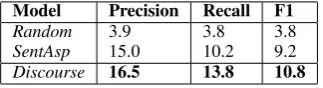
Model Precision Recall F1
Random 3.9 3.8 3.8
[image:6.595.299.524.86.186.2]SentAsp 15.0 10.2 9.2 Discourse 16.5 13.8 10.8
Table 3: Results in terms of macro-averaged pre-cision, recall and F1.
Model Unmarked Marked
SentAsp 9.2 5.4
Discourse 9.3 11.5
Table 4: Separate evaluation (F1) of the “marked” and the “unmarked” EDUs.
all the cases, we compare the discourse-agnostic and the discourse-informed models.
In order to induce the model, we let the sampler run for 2000 iterations. We use the last sample to define the labeling. The number of topics K was
set to 10 in order to match the number of aspects defined in our annotation scheme (see Table 2). The hyperpriors were chosen in a qualitative ex-periment over a subset of our dataset by manually inspecting the produced languages models. The resulting values are: α = 10−3, β = 5∗10−4, τ = 5∗10−4, η = 10−3,ν4 = 103,ν¯4 = 10−4,
ωθ= 85andω0θ=ωψ =ωψ0 = 5.
5.1 Direct clustering evaluation
Our labels encoding aspect and sentiment level can be regarded as clusters. Consequently we can ap-ply techniques developed in the context of cluster-ing evaluation. We use a version of the standard metrics considered for the word sense induction task (Agirre and Soroa, 2007) where a clustering is converted to a classification problem. This is achieved by splitting the gold standard into two subsets; the training portion is used to choose one-to-one correspondence from the gold classes to the induced clusters and then the chosen mapping is applied to the testing portion. We perform 10-fold cross validation and report precision, recall and F1 score. Our dataset is very skewed and the majority class (rest) is arguably the least important, so we use macro-averaging over labels and then average those across folds to arrive to the reported num-bers. We compare the discourse-informed model (Discourse) against two baselines; the discourse-agnostic SentAsp model and Random which as-signs a random label to an EDU while respecting the distribution of labels in the training set.
Table 3 presents the first analysis conducted on the full set of EDUs. We observe that by incor-porating latent discourse relation we improve
per-Content Aspect Polarity
1 butcertainly offitsgreatness value neg 2 andwhile smalltheyare nice rooms pos 3 butitis not free for all guests amenities neg 4 andthe water was brown clean neg 5 andno tea making facilities rooms neg 6 wheni checked out service pos 7 andif you do not service neg
[image:6.595.93.255.87.131.2]8 whenwe got home clean neu
Table 5: Examples of EDUs where local informa-tion is not sufficiently informative.
formance over the discourse-agnostic model Sen-tAsp(statistically significant according to paired t-test with p<0.01). Note that fairly low scores in
this evaluation setting are expected for any unsu-pervised model of sentiment and topics, as models are unsupervised both in the aspect-specific senti-ment and in topic labels and the total number of labels is 28 (all aspects can be associated with the 3 sentiment levels except for restwhich can only be used with neutral (0) sentiment). Consequently, induced topics, though informative (as we confirm in Section 5.3), may not correspond to the topics defined in the gold standard. For example, one well-known property of LDA-style topic models is their tendency to induce topics which account for similar fraction of words in the dataset (Jagar-lamudi et al., 2012), thus, over-splitting ‘heavy’ topics (e.g. roomsin our case). The same, though to lesser degree, is true for sentiment levels where the border between neutral and positive (or nega-tive) is also vaguely defined.
To gain insight into our model, we conducted an experiment similar to the one presented in So-masundaran et al. (2009). We divide the dataset in two subsets; one containing all EDUs starting with a discourse cue (“marked”) and one containing the remaining EDUs (“unmarked”). We hypothesize that the effect of the discourse-aware model should be stronger on the first subset, since the presence of the connective indicates the possibility of a dis-course relation with the previous EDU. The set of discourse connectives is taken from the Penn Dis-course Treebank (Prasad et al., 2008), thus creat-ing a list of 240 potential connectives.
refers to a mention of the aspect in some previous EDU. On the other hand, in examples 4 and 5 there is an ambiguity in the choice of aspect; in example 5, tea making facilitiescan refer to a breakfast at the hotel (label food) or to facilities in the room (labelrooms). Finally, examples 6-8 are too short and not informative at all which indicates that the segmentation tool does not always predict a de-sirable segmentation. Consequently, automatic in-duction of segmentation may be a better option.
Table 4 presents quantitative results of this anal-ysis. Although the performance over the “un-marked” example is the same for the two mod-els, this is not the case for the “marked” instances where the discourse-informed model leverages the discourse signal and achieves better performance. This behavior agrees with our initial hypothesis, and suggests that our discourse representation, though application-specific, relies in part on the information encoded in linguistically-defined dis-course cues. We will confirm this intuition in the qualitative evaluation section. The increase for the “marked” EDUs does not translate into greater dif-ferences for the overall scores (Table 3) as marked relations are considerably less frequent than un-marked ones in our gold standard (i.e. 35% of the EDUs are “marked”). Nevertheless, this clearly suggests that the discourse-informed model is in fact capable of exploiting discourse signal.
5.2 Qualitative analysis
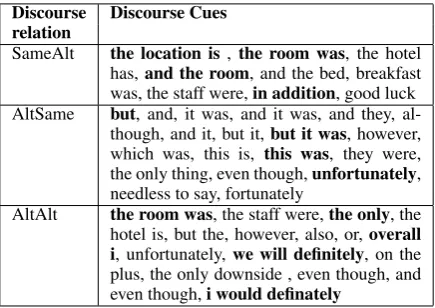
To investigate the quality of the induced discourse structure, we present the most frequent discourse cues extracted for every discourse relation. Ta-ble 6 presents a selection of cues that best explain the discourse relation they have been associated with. A general observation is that among the cues there are not only “traditional” discourse connec-tives likeeven though, although, and, but also cues that are discriminative for the specific application. In relation SameAlt we can mostly observe phrases that tend to introduce a new aspect, since an explicit mention of it is provided (e.gthe loca-tion is, the room was) and more specific phrases likein additionare used to introduce a new aspect with the same sentiment. However, these cues re-veal important information about the aspect of the EDU, and since they are associated with the lan-guage model φ˜, they are not visible anymore to
the language model of aspectsφ.
Cues for the relation AltSame also include
Discourse Discourse Cues relation
SameAlt the location is, the room was, the hotel has,and the room, and the bed, breakfast was, the staff were,in addition, good luck AltSame but, and, it was, and it was, and they,
al-though, and it, but it,but it was, however, which was, this is, this was, they were, the only thing, even though,unfortunately, needless to say, fortunately
AltAlt the room was, the staff were,the only, the hotel is, but the, however, also, or,overall i, unfortunately,we will definitely, on the plus, the only downside , even though, and even though,i would definately
Table 6: Induced cues from the discourse relations
phrases that contain some anaphoric expressions, which might refer to previous mentions of an as-pect in the discourse (i.e. previous EDU). We ex-pect that since there is an anaphoric expression, explicit lexical features for the aspect will be miss-ing, making thus the decision concerning aspect assignment ambiguous for any discourse-agnostic model. Interestingly, we found the expressions un-fortunately, un-fortunately, the only thingin the same relation, since all indicate a change in sentiment. Finally, AltAltcan be viewed as a mixture of the other two relations. Furthermore, for this relation we can find expressions that tend to be used at the end of a review, since at this point we normally change the aspect and often even sentiment. Some examples of these cases are overall, we will defi-nitelyand even the misspelled version of the latter
i would definately.
5.3 Features in supervised learning
As an additional experiment to demonstrate infor-mative of the output of the two models, we de-sign a supervised learning task of predicting sen-timent and topic of EDUs. In this setting, the feature vector of every EDU consists of its bag-of-word-representation to which we add two extra features; the models’ predictions of topic and sen-timent. We train a support vector machine with a polynomial kernel using the default parameters of Weka8and perform 10-fold cross-validation.
Table 7 presents results of this analysis in terms of accuracy for four classification tasks, i.e. pre-dicting both sentiment and topic, only sentiment and only topic for all EDUs, as well as predict-ing sentiment and topic for the “marked” dataset. First, we observe that incorporation of the
topic-8http://www.cs.waikato.ac.nz/ml/weka/
Features aspect+sentiment aspect sentiment Marked only
(28 classes) (10 classes) (3 classes) sentiment+aspect(28 classes)
only unigrams 36.3 49.8 57.1 26.2
unigrams + SentAsp 38.0 50.4 59.3 27.8
[image:8.595.90.491.87.140.2]unigrams + Discourse 39.1 52.4 59.4 29.1
Table 7: Supervised learning at the EDU level (accuracy)
model features on a unigram-only model results in an improvement in classification performance across all tasks (predicting sentiment, predicting aspects, or both); as a matter of fact, our accu-racy results for predicting sentiment are compa-rable to the sentence-level results presented by T¨ackstr¨om and McDonald (2011). We have to stress that accuracies for the joint task (i.e. pre-dicting both sentiment and topic) are expected to be lower since it can also be seen as the product of the two other tasks (i.e. predicting only senti-ment and only topic). We also observe that the fea-tures induced from theDiscourse model result in higher accuracy than the ones from the discourse-agnostic model SentAspboth in the complete set of EDUs and the “marked” subset, results that are in line with the ones presented in Table 4. Fi-nally, the fact that the results for the complete set of EDUs are higher than the ones for the “marked” dataset clearly suggests that the latter constitute a hard case for sentiment analysis, in which exploit-ing discourse signal proves to be beneficial.
6 Related Work
Recently, there has been significant interest in leveraging content structure for a number of NLP tasks (Webber et al., 2011). Sentiment analysis has not been an exception to this and discourse has been used in order to enforce constraints on the assignment of polarity labels at several granular-ity levels, ranging from the lexical level (Polanyi and Zaenen, 2006) to the review level (Taboada et al., 2011). One way to deal with this prob-lem is to model the interactions by using a pre-compiled set of polarity shifters (Nakagawa et al., 2010; Polanyi and Zaenen, 2006; Sadamitsu et al., 2008). Socher et al. (2011) defined a recurrent neural network model, which, in essence, learns those polarity shifters relying on sentence-level sentiment labels. Though successful, this model is unlikely to capture intra-sentence non-local phe-nomena such as effect of discourse connectives, unless it is provided with syntactic information as an input. This may be problematic for the noisy sentiment-analysis domain and especially
for poor-resource languages. Similar to our work, others have focused on modeling interactions be-tween phrases and sentences. However, this has been achieved by either using a subset of relations that can be found in discourse theories (Zhou et al., 2011; Asher et al., 2008; Snyder and Barzi-lay, 2007) or by using directly (Taboada et al., 2008) the output of discourse parsers (Soricut and Marcu, 2003). Discourse cues as predictive fea-tures of topic boundaries have also been consid-ered in Eisenstein and Barzilay (2008). This work was extended by Trivedi and Eisenstein (2013), where discourse connectors are used as features for modeling subjectivity transitions.
Another related line of research was presented in Somasundaran et al. (2009) where a domain-specific discourse scheme is considered. Simi-larly to our set-up, discourse relations enforce con-straints on sentiment polarity of associated sen-timent expressions. Somasundaran et al. (2009) show that gold-standard discourse information en-coded in this way provides a useful signal for pre-diction of sentiment, but they leave automatic dis-course relation prediction for future work. They use an integer linear programming framework to enforce agreement between classifiers and soft constraints provided by discourse annotations. This contrasts with our work; we do not rely on expert discourse annotation, but rather induce both discourse relations and cues jointly with aspect and sentiment.
7 Conclusions and Future Work
In this work, we showed that by jointly induc-ing discourse information in the form of discourse cues, we can achieve better predictions for aspect-specific sentiment polarity. Our contribution con-sists in proposing a general way of how discourse information can be integrated in any LDA-style discourse-agnostic model of aspect and sentiment. In the future, we aim at modeling more flexible sets of discourse relations and automatically in-ducing discourse segmentation relevant to the task.
References
Eneko Agirre and Aitor Soroa. 2007. Semeval-2007 task 02: Evaluating word sense induction and
dis-crimination systems. In Proceedings of the
Se-mEval, pages 7–12.
Nicholas Asher, Farah Benamara, and Yvette Yannick Mathieu. 2008. Distilling opinion in discourse: A
preliminary study. Proceedings of Coling, pages 5–
8.
Samuel Brody and Noemie Elhadad. 2010. An unsu-pervised aspect-sentiment model for online reviews. InProceedings of NAACL, pages 804–812.
Jacob Eisenstein and Regina Barzilay. 2008. Bayesian
unsupervised topic segmentation. InProceedings of
EMNLP, pages 334–343.
Emily B Fox, Erik B Sudderth, Michael I Jordan, and Alan S Willsky. 2008. An HDP-HMM for systems
with state persistence. InProceedings of ICML.
Gayatree Ganu, Noemie Elhadad, and Amelie Marian. 2009. Beyond the stars: Improving rating
predic-tions using review text content. InProceedings of
WebDB.
Sharon Goldwater, Thomas L Griffiths, and Mark John-son. 2009. A bayesian framework for word
segmen-tation: Exploring the effects of context. Cognition,
112(1):21–54.
Thomas L Griffiths and Mark Steyvers. 2004.
Find-ing scientific topics. Proceedings of the National
Academy of Sciences of the United States of Amer-ica, 101(Suppl 1):5228–5235.
Geoffrey E Hinton. 1999. Products of experts. In
Pro-ceedings of ICANN, volume 1, pages 1–6.
Minqing Hu and Bing Liu. 2004. Mining and
sum-marizing customer reviews. InProceedings of ACM
SIGKDD, pages 168–177.
Jagadeesh Jagarlamudi, Hal Daum´e III, and Raghaven-dra Udupa. 2012. Incorporating lexical priors into
topic models. Proceedings of EACL, pages 204–
213.
Yohan Jo and Alice H Oh. 2011. Aspect and senti-ment unification model for online review analysis. InProceedings of WSDM, pages 815–824.
Chenghua Lin and Yulan He. 2009. Joint
senti-ment/topic model for sentiment analysis. In
Pro-ceeding of CIKM, pages 375–384.
William C Mann and Sandra A Thompson. 1988. Rhetorical structure theory: Toward a functional
the-ory of text organization.Text, 8(3):243–281.
Qiaozhu Mei, Xu Ling, Matthew Wondra, Hang Su, and ChengXiang Zhai. 2007. Topic sentiment mix-ture: modeling facets and opinions in weblogs. In Proceedings of WWW, pages 171–180.
Tetsuji Nakagawa, Kentaro Inui, and Sadao Kurohashi. 2010. Dependency tree-based sentiment
classifica-tion using crfs with hidden variables. In
Proceed-ings of NAACL, pages 786–794.
Tahira Naseem, Benjamin Snyder, Jacob
Eisen-stein, and Regina Barzilay. 2009.
Multilin-gual part-of-speech tagging: Two unsupervised
ap-proaches. Journal of Artificial Intelligence
Re-search, 36(1):341–385.
Livia Polanyi and Annie Zaenen. 2006. Contextual
valence shifters. Computing attitude and affect in
text: Theory and applications, pages 1–10.
Rashmi Prasad, Nikhil Dinesh, Alan Lee, Eleni Milt-sakaki, Livio Robaldo, Aravind Joshi, and Bonnie Webber. 2008. The penn discourse treebank 2.0. In Proceedings of LREC.
Kugatsu Sadamitsu, Satoshi Sekine, and Mikio Ya-mamoto. 2008. Sentiment analysis based on proba-bilistic models using inter-sentence information. In Proceedings of ACL, pages 2892–2896.
Benjamin Snyder and Regina Barzilay. 2007. Multiple aspect ranking using the good grief algorithm. In Proceedings of HLT-NAACL, pages 300–307. Richard Socher, Jeffrey Pennington, Eric H Huang,
Andrew Y Ng, and Christopher D Manning. 2011. Semi-supervised recursive autoencoders for
predict-ing sentiment distributions. In Proceedings of
EMNLP, pages 151–161.
Swapna Somasundaran, Janyce Wiebe, and Josef Rup-penhofer. 2008. Discourse level opinion
interpreta-tion. InProceedings of Coling, pages 801–808.
Swapna Somasundaran, Galileo Namata, Janyce Wiebe, and Lise Getoor. 2009. Supervised and unsupervised methods in employing discourse rela-tions for improving opinion polarity classification. InProceedings of EMNLP, pages 170–179.
Radu Soricut and Daniel Marcu. 2003. Sentence level discourse parsing using syntactic and lexical
infor-mation. InProceedings of NAACL, pages 149–156.
Maite Taboada, Kimberly Voll, and Julian Brooke. 2008. Extracting sentiment as a function of
dis-course structure and topicality. Simon Fraser
Uni-versity, Tech. Rep, 20.
Maite Taboada, Julian Brooke, Milan Tofiloski, Kim-berly Voll, and Manfred Stede. 2011.
Lexicon-based methods for sentiment analysis.
Computa-tional Linguistics, 37(2):267–307.
Oscar T¨ackstr¨om and Ryan McDonald. 2011. Semi-supervised latent variable models for sentence-level
sentiment analysis. InProceedings of ACL, pages
569–574.
Ivan Titov and Ryan McDonald. 2008a. A joint model of text and aspect ratings for sentiment
summariza-tion. InProceedings of ACL, pages 308–316.
Ivan Titov and Ryan McDonald. 2008b. Modeling
on-line reviews with multi-grain topic models. In
Pro-ceedings of WWW, pages 112–120.
Rakshit Trivedi and Jacob Eisenstein. 2013. Discourse connectors for latent subjectivity in sentiment
anal-ysis. InIn Proceedings of NAACL.
Peter D Turney and Michael L Littman. 2002. Un-supervised learning of semantic orientation from a hundred-billion-word corpus.
Kimberly Voll and Maite Taboada. 2007. Not all words are created equal: Extracting semantic
orien-tation as a function of adjective relevance. In
Pro-ceedings of Australian Conf. on AI.
Bonnie Webber, Markus Egg, and Valia Kordoni. 2011. Discourse structure and language technology. Natural Language Engineering, 1(1):1–54.
Lanjun Zhou, Binyang Li, Wei Gao, Zhongyu Wei, and Kam-Fai Wong. 2011. Unsupervised discovery of discourse relations for eliminating intra-sentence
polarity ambiguities. InProceedings EMNLP, pages
162–171.