QUASI-INDEXICAL REFERENCE IN PROPOSITIONAL SEMANTIC NETWORKS William J. Rapaport
Department of Philosophy, SUNY Fredonia, Fredonia, NY 14063 Departmeot of Computer Science, SUNY Buffalo, Buffalo, NY 14260
Stuart C. Shapiro
Department of Computer Science, SUNY Buffalo, Buffalo, NY 14260 ABSTRACT
We discuss how a deductive question-answering sys- tem can represent the beliefs or other cognitive states of users, of other (interacting) systems, and of itself. In particular, we examine the representation of first-person beliefs of others (e.g., the ~ / v . ~ ' ~ representation of a u s e r ' A belief that he himself is rich). Such beliefs have as an essential component "'quasi-indexical pronouns" (e.g., 'he himself'), and, hence, require for their analysis a method of represent- ing these pronominal constructions and performing valid inferences with them. The theoretical jus- tification for the approach to be discussed is the representation of nested "'de ditto" beliefs (e.g., the system's belief that user-I believes that system-2 believes that user-2 is rich). We dis- cuss a computer implementation of these represen- tations using the Semantic Network Processing Sys- tem (SNePS) and an ATN parser-generator with a question-answering capability.
I- INTRODUCTION
Consider a deductive knowledge-representation system whose data base contains information about various people (e.g., its users), other (perhaps interacting) systems, or even itself. In order for the system to learn more about these entities--to expand its "'knowledge" base--it should contain information about the beliefs (or desires, wants, or other cognitive states) of these entities, and it should be able to reason about them (cf. Moore
1977,
Creary 1979, Wilks and Bien 1983, Barnden 1983, and Nilsson 1983: 9). Such a data base constitutes the "knowledge" (more accurately, the beliefs) of the system about these entities and about their beliefs.Among the interrelated issues in knowledge representation that can be raised in such a context are those of multiple reference and the proper treatment of pronouns. For instance, is the person named 'Lucy' whom John believes to be rich the same as the person named 'Lucy' who is believed by the system to be young? How can the system (a) represent the person named 'Lucy' who is an object of its own belief without (b) confus- ing her with the person named 'Lucy' who is an object..of. John'~ belief, yet (c) be. ..able to merge its representations of those two people if it is later determined that they are the same? A solution to this problem turns out to be a side effect of a solution to a subtler problem in pro-
nominal reference, namely, the proper treatment of pronouns occurring within belief-contexts.
i. OUASI-INDICATORS
F o l l o w i n g C a s t a ~ e d a ( 1 9 6 7 : 8 5 ) . a n i n d i c , t o t i s a p e r s o n a l o r d e m o n s t r a t i v e p r o n o u n o r a d v e r b u s e d t o make a s t r i c t l y d e m o n s t r a t i v e r e f e r e n c e . and a ouasi-indicator is an expression within a
'believes-that' context that represents a use of an indicator by another person. Consider the fol- lowing statement by person A addressed to person at time ~ and ~lace ~: A says, "I am going to kill you here now. Person ~, who overheard this, c a l l s t h e p o l i c e and s a y s . "A s a i d .to ~ a t ~ a t A t h a t he* was g o i n g t o k i l l him* t h e r e * t h e n * . " The starred words are quasi-indicators representing uses by A of the indicators 'I'. 'you'. 'here', and 'now'. There are two properties (among many others) of quasi-indicators that must be taken into account: (i) They occur only within inten- tional contexts, and (ii) they cannot be
replaced
salva veritate by any co-referential expressions.The general question is: "How can we attri- bute indexical references to others?" (Casta~eda 1980: 794). The specific cases that we are con- cerned with are exemplified in the following scenario. Suppose that John has just been appointed editor of Byte. but that John does not yet know this. Further. suppose that, because o f the well-publicized salary
accompanying
the office of Byte'A editor,(1) John believes that the editor of Byte is rich. And s u p p o s e f i n a l l y t h a t . b e c a u s e o f s e v e r e l o s s e s i n t h e s t o c k m a r k e t .
(2) John believes that he himself is not rich. S u p p o s e t h a t t h e s y s t e m had i n f o r m a t i o n a b o u t e a c h of the following: John's appointment as editor, Johnts (lack of) knowledge of this appointment. and John's belief about the wealth of the editor. We would not want the system to infer
(3) John believes
that
he* is rich(4) He [i.e., that man there] believes that he* is not rich
could just as well have said (2). The first 'he' in (4) is not a quasi-indicator: It occurs outside the believes-that context, and it can be replaced by 'John' or by 'the editor of Byte', salva veri- tare. But the 'he*' in )4) and the 'he himself' in (2) could not be thus replaced by 'the editor of Byte' - given our scenario - even though John is the editor of Byte. And if poor John also suf- fered from amnesia, it could not be replaced by 'John' either.
~. REPRESENTATIONS
Entities such as the Lucy who is the object of John's belief are intentional (mental), hence intensional. (Of. Frege 1892; Meinong 1904; Cas- ta~eda 1972; Rapaport 1978, 1981.) Moreover, the entities represented in the data base are the objects of the ~ y . ~ ' ~ beliefs, and, so, are also intentional, hence intensional. We represent sen- tences by means of propositional semantic net- works, using the Semantic Network Processing Sys- tem (SNePS; Shapiro 1979), which treats nodes as representing intensional concepts (of. Woods 1975, Brachman 1977, Maida and Shapiro 1982).
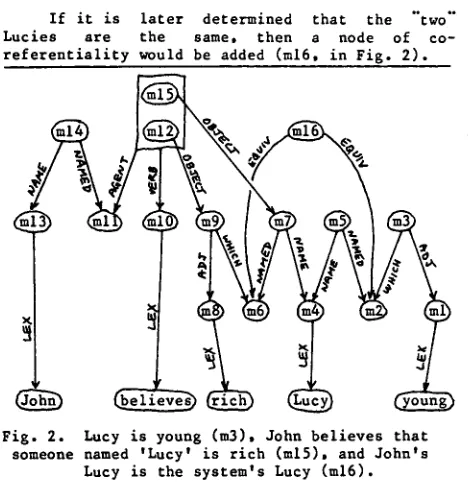
We claim that in the absence of prior knowledge of co-referentiality, the entities within belief-contexts should be represented separately from entities outside the context that might be co-referential with them. Suppose the system's beliefs include that a person named 'Lucy' is young and that John believes that a (possibly different) person named 'Lucy' is rich. We represent this with the network of Fig. I.
Fig. I. Lucy is young (m3) and John believes that someone named 'Lucy' is rich (m12).
The section of network dominated by nodes m7 and m9 is the system's de ditto representation of John's belief. That is, m9 is the system'~ representation of a belief that John might express by 'Lucy is rich', and it is represented as one of John's beliefs. Such nodes are considered as being in the system's representation of John's
i"belief s p a c e " . Non-dominated nodes, such as ml4, m 1 2 , m15, mS, and m3, are the system's representa- tion of its own belief space (i.e., they can be thought of as the object of an implicit 'I believe that' case-frame; cf. Casta~eda 1975: 121-22, Kant 1787: BI31).
If it is later determined that the "two" Lucies a r e the same, then a node of co- referentiality would be added (m16, in Fig. 2).
Fig. 2. Lucy is young (m3), John believes that someone named 'Lucy' is rich (mlS), and John's
Lucy is the system's Lucy (m16).
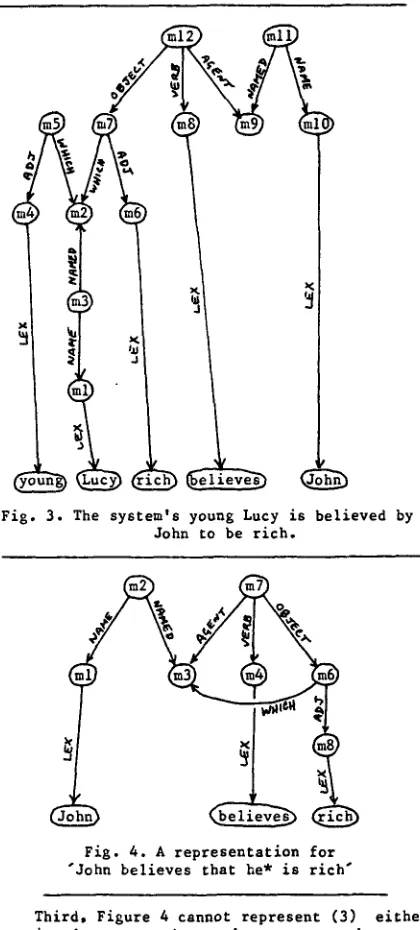
Now consider the case where the system has no information about the "content" of John's belief, but does have information that John's belief is about the ~.7_~/.f.~'E Lucy. Thus, whereas John might express his belief as, 'Linus's sister is rich', the system would express it as, '(Lucy system) is believed by John to be rich' (where '(Lucy sys- tem)' is the system's Lucy). This is a de re representation of John's belief, and would be represented by node ml2 of Figure 3.
The strategy of separating entities in dif- ferent belief spaces is needed in order to satisfy the two main properties of quasi-indicators.
Consider the possible
representations
of sen- tence (3) in Figure 4 (adapted from Maida and Shapiro 1983: 316). This suffers from three major problems. First, it is ambiguous: It could be the representation of (3) or of(5) John believes that John is rich.
But, as we have seen, (3) and (5) express quite different propositions; thus, they should be separate items in the data base.
[image:2.612.334.568.98.339.2] [image:2.612.85.311.314.582.2]Fig. 3. The system's young Lucy is believed by John to be rich.
Fig. 4. A representation for "John believes that he* is rich"
Third, Figure 4 cannot represent (3) either, for it does not adequately represent the quasi- indexical nature of the 'he' in (3): Node m3 represents both 'John' and 'he', hence is both inside and outside the intentional context, con- trary to both of the properties of quasi- indicators.
Finally, because of these representational inadequacies, the system would invalidly "'infer" (6iii) from (6i)-(6ii):
(6) (i) John believes that he is rich. (ii) he = John
(iii) John believes that John is rich.
simply because premise (6i) would be represented by the same network as conclusion (6iii).
Rather, the general pattern for representing such sentences is illustrated in Figure 5. The 'he*' in the English sentence is represented by node m2; its quasi-indexical nature is represented by means of node ml0.
"I
Fig. 5. John believes that he* is rich (m2 is the s~stem's representation of John's "'self-concept , expressed by John as 'I' and by
the system as 'he*')
That nodes m2 and m5 must be distinct follows from our separation principle. But, since m2 is the system's representation of Johnts representa- tion of himself, it m u s t be within the system's representation of John's belief space; this is accomplished via nodes ml0 and m9, representing John's belief that m2 is his "self- representation". Node m9, with its EGO arc to m2, represents, roughly, the proposition 'm2 is me'.
Our representation of quasi-indexical de se sentences is thus a special case of the general schema for d e ditto representations of belief sen- tences. When a d e se sentence is interpreted de re, it does not contain quasi-indicators, and can be handled by the general schema for de r e representations. Thus,
(7) John i s b e l i e v e d by h i m s e l f to be r i c h would be represented by the network of Figure 4.
~. INFERENCES
Using an ATN parser-generator with a question-answering capability (based on Shapiro 1982), we are implementing a system that parses English sentences representing beliefs de re or d e ditto into our semantic-network representations, and that generates appropriate sentences from such networks.
[image:3.612.57.267.51.516.2] [image:3.612.297.524.56.434.2]will treat as valid such inferences as the follow- ing:
(81 (i) John believes that the editor of Byte is rich.
(ii) John believes that he* is the editor of Byte.
Therefore, (iii) John believes that he* is rich In this case, an appropriate inference rule would be:
(9) (¥x,y,z,F)[x believes F(y) b x believes z=y -> x believes FCz)] I n SNePS, i n f e r e n c e r u l e s a r e t r e a t e d as p r o p o s i - t i o n s r e p r e s e n t e d by n o d e s i n t h e n e t w o r k . T h u s , t h e n e t w o r k f o r (9) would be b u i l t by t h e SNePS U s e r Language command g i v e n i n F i g u r e 6 ( c f . Shapiro 1979).
(build
avb ($x $y Sz $F) &ant (build agent *x
verb (build lex believe) object (build which *y
adj (build lex *F))) &ant (build agent *x
verb (find lex believe)
object (build equiv *z equiv *y)) cq (build agent *x
verb (find lex believe) object (build which *z
adj (find lex *F)))) Fig. 6. SNePSUL command for building rule (9),
for argument (8).
~ . ITERATED BELIEF CONTEXTS
Our s y s t e m can a l s o h a n d l e s e n t e n c e s i n v o l v - i n g i t e r a t e d b e l i e f c o n t e x t s . C o n s i d e r
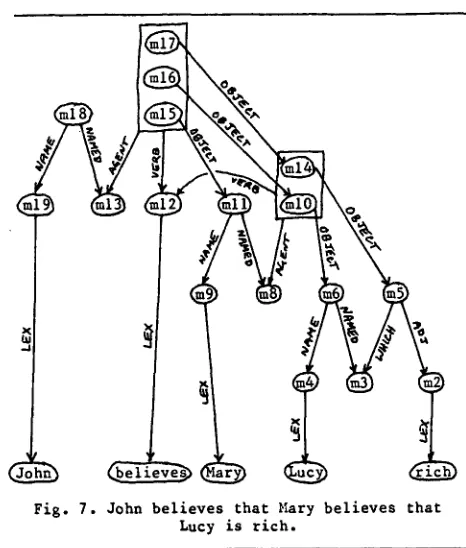
(10) John believes that Mary believes that Lucy is rich.
The interpretation of this that we are most interested in representing treats (I0) as the system's de ditto representation of John's de ditto representation of Mary's belief that Lucy is rich. On this interpretation, we need to represent the system'~ John--(John system)--the system's representation of John'~ Mary--(Mary John system)--and the system's representation of John's representation of Mary'~ Lucy--(Lucy Mary John system). This is done by the network of Figure 7. Such a network is built recursively as fol- lows: The parser maintains a stack of "believers". Each time a belief-sentence is parsed, it is made the object of a belief of the previous believer in the stack. Structure-sharing is used wherever possible. Thus,
(II) John believes that Mary believes that Lucy is sweet
Fig. 7. John believes that Mary believes that Lucy is rich.
would modify the network of Figure 7 by adding new beliefs t o ( J o h n system)'s belief space and tO
(Mary John system)'s belief space, but would use the same nodes to represent John, Mary, and Lucy. ~. NEW INFORMATION
The s y s t e m i s a l s o c a p a b l e o f h a n d l i n g s e q u e n c e s o f new i n f o r m a t i o n . For i n s t a n c e , s u p - p o s e t h a t t h e s y s t e m i s g i v e n t h e f o l l o w i n g i n f o r - m a t i o n a t t h r e e s u c c e s s i v e t i m e s :
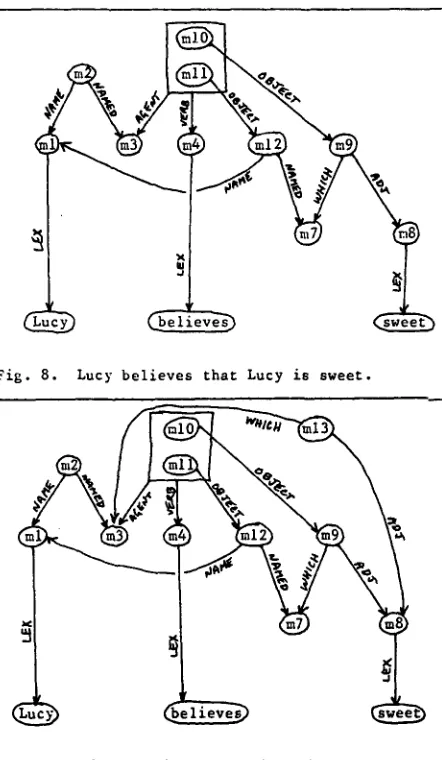
t l : (121 The s y s t e m ' s Lucy b e l i e v e s t h a t L u c y ' s Lucy i s s w e e t .
t 2 : (13) The s y s t e m ' s Lucy i s s w e e t . t 3 : (14) The s y s t e m I s Lucy = L u c y I s Lucy.
Then it will build the networks of Figures 8-I0, successively. At tl (Fig. 8), node m3 represents the systemts Lucy and m7 represents Lucy's Lucy. At t2 (Fig. 9), m13 is built, representing the system's belief that the system's Lucy (who is not yet believed to be--and, indeed, might not be-- Lucy's Lucy) is sweet.[l] At t3 (Fig. II), m14 is built, representing the system's new belief that there is really only one Lucy. This is a merging of the two "'Lucy"-nodes. From now on, all proper- ties of "either" Lucy will be inherited by the "'other", by means of an inference rule for the EQUIV case-frame (roughly, the indiscernibility of id___@enticals).
[image:4.612.329.562.31.305.2] [image:4.612.83.309.44.427.2]Fig. 8. Lucy believes that Lucy is sweet.
I
\
Fig. 9. Lucy believes that Lucy is sweet, and Lucy (the believer) is sweet. i. FUTURE WORK
There are several directions for future modifications. First, the node-merging mechanism of the EQUIV case-frame with its associated rule needs to be generalized: Its current interpreta- tion is co-referentiality; but if the sequence (12)-(14) were embedded in someone else's belief- space, then co-referentiality might be incorrect. What is needed is a notion of "co-refere~tiality- within-a-belief-space'. The relation of consoct- ation" (Casta~eda 1972) seems to be more appropri- ate.
Second, the system needs to be much more flexible. Currently, it treats all sentences of the form
(15) x believes that F(y)
as canonically de dicto and all sentences of the form
(16) y is believed by x t o be F
Fig. I0. Lucy believes that Lucy is sweet, Lucy is sweet, and the system's Lucy is Lucy's Lucy.
as canonically de re. I n ordinary conversation, however, both sentences can be understood in either way, depending on context, including prior beliefs as well as idiosyncracies of particular predicates. For instance, given (I), above, and the fact that John is the editor of Byte, most people would infer (3). But given
(17) John believes that a l l identical twins a r e
conceited.
(18) Unknown to John, he is an identical twin
m o s t p e o p l e w o u l d n o t infer
(19) John believes that he* is conceited.
Thus, we want to allow the system to make the most "reasonable" interpretations (de re vs. de d£cto) of users' belief-reports, based on prior beliefs and on subject matter, and to modify its initial representation as more information is received.
SUNIqARY
[image:5.612.53.274.46.426.2] [image:5.612.302.523.49.245.2]REFERENCES
J. A. Barnden, "Intensions as Such: An Outline," IJCAI-83 (1983)280-286.
R. J. Brachman, "What's in a Concept: Structural Foundations for Semantic Networks," Interna- tional Journal for Man-Machine Studies 9(1977)127-52.
Hector-Neri Casta~eda, "Indicators and Quasi- Indicators," ~ Philosoohical Ouarterlv 4 ( 1 9 6 7 ) 8 5 - 1 0 0 .
_ _ , " T h i n k i n g and t h e S t r u c t u r e o f t h e World" ( 1 9 7 2 ) , P h i l o s o o h i a 4 ( 1 9 7 4 ) 3 - 4 0 .
"Identity and Sameness," PhilosoDhia
5~1975)121-50.
_ _ , "Reference, Reality and Perceptual Fields," Proceedings and Addresses of the ~ e r i c a n
~hilosophical Association
53(1980)763-823.
L. G. Creary, "Propositional Attitudes: FregeanRepresentation and Simulative Reasoning," IJCAI-79 (1979)176-81.
Gottlob Frege, "On Sense and Reference" (1892), in Translations from the Philosophical Writings of ~ottlob Fre~e, ed. by P. Geach and M. Black (Oxford: Basil Blackwell, 1970): 56-78.
Immanuel Kant, Critique of Pure Reason, 2nd ed. (1787), trans. N. Kemp Smith (New York: St. Martin's Press, 1929).
Anthony S. Maida and Stuart C. Shapiro, "Inten- sional Concepts in Propositional Semantic Net- works." C o g n i t i v e Science 6(1982)291-330.
Alexius Meinong, -Ueber Gegenstandstheorie" (1904), in Alexius Meinon~ Gesamtaus~ahe, Vol. II, ed. R. Haller (Graz, Austria: Akademische Druck- u. Verlagsanstalt, 1971): 481-535. English translation in R. Chisholm (ed.), Real- ism and the Background of Phenomenolo~y (New York: Free Press, 1960): 76-117.
R. C. Moore, "'Reasoning about Knowledge and Action," IJCAI-77
(1977)223-27.
Nils J. Nilsson, "Artificial Intelligence Prepares for 2001," AI Ma~azine 4.4(Winter 1983)7-14. William J. Rapaport, "Meinongian Theories and a
Russellian Paradox," NoGs 12(1978)153-80; errata, 13(1979)125.
_ _ , "How to Make the World Fit Our Language: An Essay in Meinongian Semantics," Grazer Philoso- nhische Studien 14(1981)I-21.
Stuart C. Shapiro, "The SNePS Semantic Network Processing System," in N. V. Findler (ed.), Associative Networks (New York: Academic Press,
1979): 179-203.
_ _ , "Generalized Augmented Transition Network Grammars For Generation From Semantic Networks," ~ J o u r n a l o f ~ Linguistics 8(1982)12-25.
Yorick Wilks and Janusz Bien, "Beliefs, Points of View, and Multiple Environments," Cognitive Sci- ence 7(1983)95-119.
William A. Woods, "'What's in a Link: The Semantics of Semantic Networks," in D. G. Bobrow and A. M. Collins (eds.), Reuresentation and ~