• No results found

Kinetic, Thermodynamic , Equilibrium and Optimization Studies for the Biosorption of Nickel from an Aqueous solution on to Madhuca Indica Leaves Powder

N/A
N/A
Protected

Academic year: 2020

Share "Kinetic, Thermodynamic , Equilibrium and Optimization Studies for the Biosorption of Nickel from an Aqueous solution on to Madhuca Indica Leaves Powder"

Copied!
6
0
0

Loading.... (view fulltext now)

Full text

(1)

211 | P a g e

Kinetic, Thermodynamic , Equilibrium and Optimization Studies for the Biosorption of Nickel from an Aqueous

solution on to Madhuca Indica Leaves Powder

K Kumaraswamy 1 , P.King 2 , Y Prasanna Kumar 3

1

Assistant Professor, School of Chemical Engineering, Vignan University, Guntur Andhra Pradesh, (India)

2

Professor, Department of Chemical Engineering, AU, Visakhapatnam,Andhra Pradesh, ( India)

3
Pricipal, Visakha Institute of Engineering & Technology, Visakhapatnam Research Scholar, JNTUK. Kakinada Andhra Pradesh, (India)

ABSTRACT

Many branches of industry these days produce huge amounts of waste containing dangerous and cancer-causing natural and inorganic mixes. The developing issue of water contamination has prompted a lot of enthusiasm for the advancement of inventive and moderately shoddy techniques for removing harmful metals. The present work explores the growing of Madhuca Indica leaves powder on biosorption of Nickel metal present in aquous liquid phase. The effects of various parameters (Time,pH,Dosage,Size,Concentration and Temperature) on biosorption of Nickel are considered .Experimental data gave good fit with Friendlich Isoterm and followed the Langmuir and Temkin Isotherms.

Keywords: Biosorption; Madhuca Indica;Isotherms.

I. INTRODUCTION

Metal contamination has been an awesome worry for as far back as couple of decades. It is trusted that the wide

utilization of man-made chemicals, anthropogenic way of life, and quick industrialization is the significant

wellspring of metal poisonous quality [1]. Nickel is notable as a substantial metal toxin, display in effluents of

electroplating enterprises, purifying, and composite assembling, mining, and refining industries[2]. Nickel has been

ensnared as an embryotoxin and teratogen [3]. The higher grouping of Nickel causes dermatitis, queasiness, heaving,

behavioral, and respiratory issues notwithstanding cyanosis, gastrointestinal trouble, and weakness [4] All these

biological disorder consequences alarm the need of nickel removal from the environment and to bring up its levels

below the threshold limits from its sources. The classical physicochemical methods are commonly used for the

removal of nickel from the industrial effluents, namely, evaporative recovery, filtration, ion exchange, and

membrane technologies. though they are promising to some extent, but these processes have high reagent or energy

requirements and generate toxic sludge that requires careful disposal[5]. Biosorption is a process that uses

inexpensive biomaterials to sequester metals from aqueous solutions and the biomaterials used in this process are

termed as biosorbents. The by-products from agriculture, food and pharmaceutical industries provide economically

(2)

212 | P a g e

viable sources of biosorbent; this makes biosorption an inexpensive alternative treatment method. Recent research on biosorption has shown that biomaterials containing acidic groups such as hydroxyls and carboxyls were effective in binding metal cations [6].

II. MATERIALS & METHODS 2.1 Preparation of the bisorbent

Madhuca indica leaves were collected from a nearby Tenali canal place in Guntur District, Andhra Pradesh, India.

The collected biosorbent was washed with distilled water several times until the dirt particles are removed. After through washing with distilled water, biosorbent was sun dried for ten days until they became crispy, cut into small pieces, powdered and sieved.

2.2 Preparation of Nickel stock solution

Nicl

2

.6H

2

O is used as the source of nickel stock solution. All the required solutions are prepared with double distilled water.1000mg/L of nickel stock solution was prepared by dissolving appropriate amount of Nicl

2

.6H

2

O.Later the mother was solution was diluted to get the test solution like 20,40,80,120&160mg/L.

III. RESULTS AND DISCUSSION 3.1 Effect of agitation time

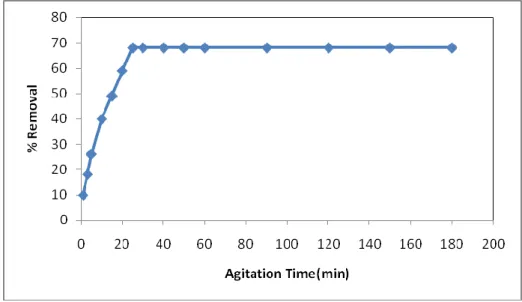
From the Fig.1The maximum percentage of biosorption is attained at 25 min of agitation. The percentage removal of Nickel becomes constant after 25 min indicating the attainment of the equilibrium. Therefore all other experiments are conducted at this agitation time [7,8,9,10].

Fig. 1 Effect of agitation time on % biosorption of nickle using Madhuca Indica at various concentrations(20,40,80,120 &160ppm)

3.2 Effect of biosorbent size

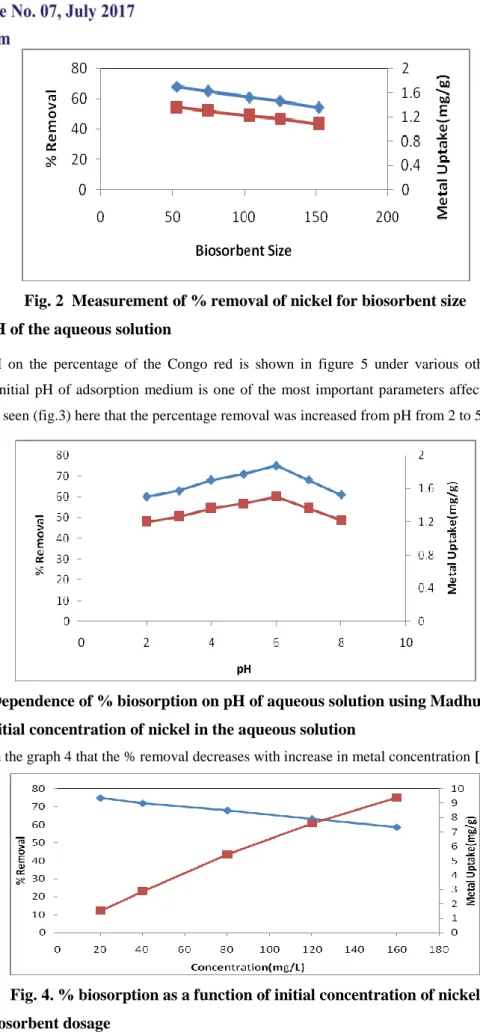
It was observed from fig. 2that the percentage biosorption of nickel as a function of biosorbent size is decreases with

increasing particle size. [11].

(3)

213 | P a g e Fig. 2 Measurement of % removal of nickel for biosorbent size

3.3 Effect of pH of the aqueous solution

The effect of pH on the percentage of the Congo red is shown in figure 5 under various other fixed operating conditions. The initial pH of adsorption medium is one of the most important parameters affecting the adsorption process. It can be seen (fig.3) here that the percentage removal was increased from pH from 2 to 5.[12].

Fig.3 Dependence of % biosorption on pH of aqueous solution using Madhuca indica.

3.4 Effect of initial concentration of nickel in the aqueous solution

It was noted from the graph 4 that the % removal decreases with increase in metal concentration [13].

Fig. 4. % biosorption as a function of initial concentration of nickel 3.5 Effect of biosorbent dosage

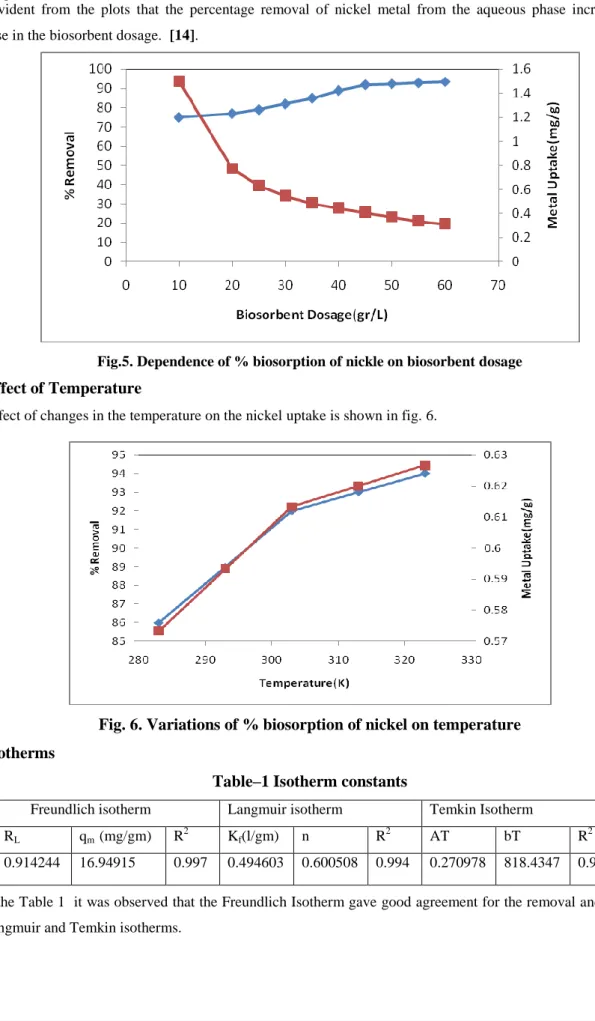
The percentage removal of nickel is drawn against biosorbent dosage for biosorbent size 53µ and shown in figure.5.

(4)

214 | P a g e

It is evident from the plots that the percentage removal of nickel metal from the aqueous phase increases with increase in the biosorbent dosage. [14].

Fig.5. Dependence of % biosorption of nickle on biosorbent dosage 3.6 Effect of Temperature

The effect of changes in the temperature on the nickel uptake is shown in fig. 6.

Fig. 6. Variations of % biosorption of nickel on temperature 3.7 Isotherms

Table–1 Isotherm constants

Freundlich isotherm Langmuir isotherm Temkin Isotherm

R

L

q

m

(mg/gm) R

2

K

f

(l/gm) n R

2

AT bT R

2

0.914244 16.94915 0.997 0.494603 0.600508 0.994 0.270978 818.4347 0.972

From the Table 1 it was observed that the Freundlich Isotherm gave good agreement for the removal and followed

the Langmuir and Temkin isotherms.

(5)

215 | P a g e 3.8 Kinetics of biosorption

Table–2 Equations and rate constants

Order Equation Rate constant R

2

Lagergren first order log (q

e

– q

t

) = 0.129 – 0.040 t 0.09212 min

-1

0.981

Pseudo second order (t/q

t

) = 0.592 t + 5.952 0.0588 g/(mg-min) 0.954

From the Table 2 it was noted that the first order is best fitted than the second order.

3.9 Thermodynamics of Biosorption

Enthalpy is the most commonly used thermodynamic function due to its practical significance. The negative value of ∆H will indicate the endothermic nature of biosorption and the physical/chemical in nature of sorption. It can be easily reversed by supplying the heat equal to calculated ∆H [17].

Fig.7 Vant Hoff’s plot for biosorption

The thermodynamic investigation reveals the spontaneity (∆G = –15431.5), irreversibility (∆S = 50.98884) and endothermic (∆H = 18.09405) nature of biosorption.

IV. CONCLUSIONS

The experimental results were analytically discussed and the following conclusions could be drawn from the study of biosorption of Nickel from aqueous solution using biosorption technique.The equilibrium agitation time for biosorption of nickel is 25 min.

1. The optimum dosage is 45 g/L

2. % biosorption is increased upto pH = 6.

3. The experimental data are well represented by Langmuir (R

2

= 0.997), Freundlich (R

2

= 0.994) and Temkin (R

2

= 0.972) isotherms.

4. The kinetic studies show that the biosorption of nickel is described by both first order (R

2

= 0.981) and pseudo

second order kinetics (R

2

= 0.954). The thermodynamic investigation reveals the spontaneity (∆G = –15431.5),

irreversibility (∆S = 50.98884) and endothermic (∆H = 18.09405) nature of biosorption.

(6)

216 | P a g e REFERENCES

[1] J. Wang and C. Chen, “Biosorbents for heavy metals removal and their future,” Biotechnology Advances, vol.

27, no. 2, pp. 195–226, 2009.

[2] E. Denkhaus and K. Salnikow, “Nickel essentiality, toxicity, and carcinogenicity,” Critical Reviews in Oncology/Hematology, vol. 42, no. 1, pp. 35–56, 2002.

[3] C.-Y. Chen and T.-H. Lin, “Nickel toxicity to human term placenta: in vitro study on lipid peroxidation,” Journal of Toxicology and Environmental Health A, vol. 54, no. 1, pp. 37–47, 1998.

[4] N. Akhtar, J. Iqbal, and M. Iqbal, “Removal and recovery of nickel(II) from aqueous solution by loofa sponge- immobilized biomass of Chlorella sorokiniana: characterization studies,” Journal of Hazardous Materials, vol.

108, no. 1-2, pp. 85–94, 2004.

[5] J. Wild, “Liquid wastes from the metal � nishing industry,” in Surveys in Industrial Waste Water Treatment, D. Barnes, C. F. Forster, and S. E. Hrudey, Eds., pp. 21–62, John Wiley and Sons.

[6] Volesky, B., “Biosorption of Heavy Metals”. CRC. Press. Boca Raton. FL. 1990.

[7] Ferreira, Sérgio LC, et al. "Nickel determination in saline matrices by ICP-AES after sorption on Amberlite XAD-2 loaded with PAN." Talanta 48.5 (1999): 1173-1177.

[8] Mendes, F. D., and A. H. Martins. "Selective sorption of nickel and cobalt from sulphate solutions using chelating resins." International Journal of Mineral Processing 74.1 (2004): 359-371.

[9] Shakirullah, Mohammad, Imtiaz Ahmad, and Sher Shah. "Sorption studies of nickel ions onto sawdust of Dalbergia sissoo." Journal of the Chinese Chemical Society 53.5 (2006): 1045-1052.

[10] Bowman, R. S., M. E. Essington, and G. A. O'Connor. "Soil sorption of nickel: Influence of solution composition." Soil Science Society of America Journal 45.5 (1981): 860-865.

[11] Padmavathy, V., Padma Vasudevan, and S. C. Dhingra. "Thermal and spectroscopic studies on sorption of nickel (II) ion on protonated baker’s yeast." Chemosphere 52.10 (2003): 1807-1817.

[12] Chen, Zhen, Wei Ma, and Mei Han. "Biosorption of nickel and copper onto treated alga (Undaria pinnatifida):

application of isotherm and kinetic models."Journal of hazardous materials 155.1 (2008): 327-333.

[13] Al-Rub, FA Abu, et al. "Biosorption of nickel on blank alginate beads, free and immobilized algal cells." Process Biochemistry 39.11 (2004): 1767-1773.

[14] Poulsen, Inge F., and Hans Chr Bruun Hansen. "Soil sorption of nickel in presence of citrate or arginine." Water, air, and soil pollution 120.3-4 (2000): 249-259.

[15] Perrone, Jane, Blandine Fourest, and Eric Giffaut. "Sorption of nickel on carbonate fluoroapatites." Journal of colloid and interface science 239.2 (2001): 303-313.

[16] Ho, Yuh-Shan, and Gordon McKay. "Pseudo-second order model for sorption processes." Process biochemistry 34.5 (1999): 451-465.

[17] Kalyakina, O. P., et al. "Sorption preconcentration and determination of nickel in wastes of heat power

industry by diffuse reflection spectroscopy."Bulletin of the Korean Chemical Society 24.2 (2003): 173-177.

Figure

Fig. 1 Effect of agitation time on % biosorption of nickle using Madhuca Indica at various  concentrations(20,40,80,120 &160ppm)
Fig. 4. % biosorption as a function of initial concentration of nickel  3.5 Effect of biosorbent dosage
Fig. 6. Variations of % biosorption of nickel on temperature  3.7 Isotherms

References

Related documents

Keywords: Pichia pastoris , SuperMan 5 , OCH1 , Bioreactor, Cellular agglomeration, Flow cytometry, Glycosylation, Horseradish peroxidase, Morphology.. © The

CUAJ ? October 2019 ? Volume 13, Issue 10 ? 2019 Canadian Urological Association E311 ORIGINAL RESEARCH Cite as Can Urol Assoc J 2019;13(10) E311 6 http //dx doi org/10 5489/cuaj

Experimental load-deflection curve for the four-point bending test on aluminium titanate at room temperature (left) - Neutral axis position according to the elastic linear

Objective: We aimed to review the treatment of patients with acute tonsillopharyngitis at the OPAT health care clinic in the Bahrain Defense Force Royal Medical Services (BDF-RMS),

A stable procedure, in particular with respect to the round-o ff error, evaluates the solution in the direction of the solution growth as it is demonstrated in [11].. In the

Elastolytic activity was recovered in the bronchopulmonary lavage fluid up to 4 d after elastase instillation and was associated with the alpha-macroglobulin-pancreatic

article  locates  their  work  within  the  broader  context  of  citizenship  education  in  Ireland,  highlighting  the  extent  to . which  the  exemplars chosen