Empirically Estimating Order Constraints for
Content Planning in Generation
Pablo A. Duboue and Kathleen R. McKeown
Computer Science Department Columbia University 10027, New York, NY, USA
{pablo,kathy}@cs.columbia.edu
Abstract
In a language generation system, a content planner embodies one or more “plans” that are usually hand–crafted, sometimes through manual analysis of target text. In this paper, we present a system that we developed to automati-cally learn elements of a plan and the ordering constraints among them. As training data, we use semantically an-notated transcripts of domain experts performing the task our system is de-signed to mimic. Given the large degree of variation in the spoken language of the transcripts, we developed a novel al-gorithm to find parallels between tran-scripts based on techniques used in computational genomics. Our proposed methodology was evaluated two–fold: the learning and generalization capabil-ities were quantitatively evaluated us-ing cross validation obtainus-ing a level of accuracy of 89%. A qualitative evalua-tion is also provided.
1 Introduction
In a language generation system, a content plan-ner typically uses one or more “plans” to rep-resent the content to be included in the out-put and the ordering between content elements. Some researchers rely on generic planners (e.g., (Dale, 1988)) for this task, while others use plans based on Rhetorical Structure Theory (RST) (e.g., (Bouayad-Aga et al., 2000; Moore and Paris,
1993; Hovy, 1993)) or schemas (e.g., (McKe-own, 1985; McKeown et al., 1997)). In all cases, constraints on application of rules (e.g., plan op-erators), which determine content and order, are usually hand-crafted, sometimes through manual analysis of target text.
In this paper, we present a method for learn-ing the basic patterns contained within a plan and the ordering among them. As training data, we use semantically tagged transcripts of domain ex-perts performing the task our system is designed to mimic, an oral briefing of patient status af-ter undergoing coronary bypass surgery. Given that our target output is spoken language, there is some level of variability between individual tran-scripts. It is difficult for a human to see patterns in the data and thus supervised learning based on hand-tagged training sets can not be applied. We need a learning algorithm that can discover order-ing patterns in apparently unordered input.
We based our unsupervised learning algorithm on techniques used in computational genomics (Durbin et al., 1998), where from large amounts of seemingly unorganized genetic sequences, pat-terns representing meaningful biological features are discovered. In our application, a transcript is the equivalent of a sequence and we are searching for patterns that occur repeatedly across multiple sequences. We can think of these patterns as the basic elements of a plan, representing small clus-ters of semantic units that are similar in size, for example, to the nucleus-satellite pairs of RST.1 By learning ordering constraints over these
ele-1
age, gender, pmh, pmh, pmh, pmh, med-preop, med-preop, med-preop, drip-preop, med-preop, ekg-preop, echo-preop, hct-preop, procedure, . . .
Figure 2: The semantic sequence obtained from the transcript shown in Figure 1.
ments, we produce a plan that can be expressed as a constraint-satisfaction problem. In this pa-per, we focus on learning the plan elements and the ordering constraints between them. Our sys-tem uses combinatorial pattern matching (Rigout-sos and Floratos, 1998) combined with clustering to learn plan elements. Subsequently, it applies counting procedures to learn ordering constraints among these elements.
Our system produced a set of 24 schemata units, that we call “plan elements”2, and 29 order-ing constraints between these basic plan elements, which we compared to the elements contained in the orginal hand-crafted plan that was constructed based on hand-analysis of transcripts, input from domain experts, and experimental evaluation of the system (McKeown et al., 2000).
The remainder of this article is organized as follows: first the data used in our experiments is presented and its overall structure and acqui-sition methodology are analyzed. In Section 3 our techniques are described, together with their grounding in computational genomics. The quan-titative and qualitative evaluation are discussed in Section 4. Related work is presented in Sec-tion 5. Conclusions and future work are discussed in Section 6.
2 Our data
Our research is part of MAGIC (Dalal et al., 1996; McKeown et al., 2000), a system that is designed to produce a briefing of patient status after un-dergoing a coronary bypass operation. Currently, when a patient is brought to the intensive care unit (ICU) after surgery, one of the residents who was present in the operating room gives a brief-ing to the ICU nurses and residents. Several of these briefings were collected and annotated for the aforementioned evaluation. The resident was
2
These units can be loosely related to the concept of mes-sages in (Reiter and Dale, 2000).
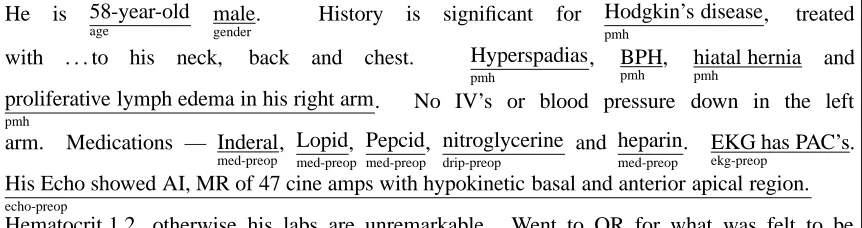
equipped with a wearable tape recorder to tape the briefings, which were transcribed to provide the base of our empirical data. The text was sub-sequently annotated with semantic tags as shown in Figure 1. The figure shows that each sentence is split into several semantically tagged chunks. The tag-set was developed with the assistance of a domain expert in order to capture the different information types that are important for commu-nication and the tagging process was done by two non-experts, after measuring acceptable agree-ment levels with the domain expert (see (McK-eown et al., 2000)). The tag-set totalled over 200 tags. These 200 tags were then mapped to 29 cat-egories, which was also done by a domain expert. These categories are the ones used for our current research.
From these transcripts, we derive the sequences of semantic tags for each transcript. These se-quences constitute the input and working material of our analysis, they are an average length of 33 tags per transcript (min = 13, max = 66, σ = 11.6). A tag-set distribution analysis showed that some of the categories dominate the tag counts. Furthermore, some tags occur fairly regularly to-wards either the beginning (e.g., date-of-birth) or the end (e.g.,urine-output) of the transcript, while others (e.g., intraop-problems) are spread more or less evenly throughout.
Getting these transcripts is a highly expensive task involving the cooperation and time of nurses and physicians in the busy ICU. Our corpus con-tains a total number of 24 transcripts. Therefore, it is important that we develop techniques that can detect patterns without requiring large amounts of data.
3 Methods
During the preliminary analysis for this research, we looked for techniques to deal with analysis of regularities in sequences of finite items (semantic tags, in this case). We were interested in devel-oping techniques that could scale as well as work with small amounts of highly varied sequences.
He is 58-year-old
age malegender
. History is significant for Hodgkin’s disease
pmh
, treated
with . . . to his neck, back and chest. Hyperspadias
pmh
, BPH
pmh , hiatal herniapmh
and
proliferative lymph edema in his right arm
pmh
. No IV’s or blood pressure down in the left
arm. Medications — Inderal
med-preop, Lopidmed-preop
, Pepcid
med-preop
, nitroglycerine
drip-preop
and heparin
med-preop
. EKG has PAC’s
ekg-preop .
His Echo showed AI, MR of 47 cine amps with hypokinetic basal and anterior apical region.
echo-preop
Hematocrit 1.2
hct-preop , otherwise his labs are unremarkable. Went to OR for what was felt to be
2 vessel CABG off pump both mammaries
procedure
[image:3.595.78.509.66.180.2]. . . .
Figure 1: An annotated transcription of an ICU briefing (after anonymising).
terms, a motif is a small subsequence, highly con-served through evolution. From the computer sci-ence standpoint, a motif is a fixed-order pattern, simply because it is a subsequence. The problem of detecting such motifs in large databases has attracted considerable interest in the last decade (see (Hudak and McClure, 1999) for a recent sur-vey). Combinatorial pattern discovery, one tech-nique developed for this problem, promised to be a good fit for our task because it can be pa-rameterized to operate successfully without large amounts of data and it will be able to iden-tify domain swapped motifs: for example, given a–b–c in one sequence and c–b–a in another. This difference is central to our current research, given that order constraints are our main focus. TEIRESIAS (Rigoutsos and Floratos, 1998) and SPLASH (Califano, 1999) are good representa-tives of this kind of algorithm. We used an adap-tation of TEIRESIAS.
The algorithm can be sketched as follows: we apply combinatorial pattern discovery (see Sec-tion 3.1) to the semantic sequences. The obtained patterns are refined through clustering (Section 3.2). Counting procedures are then used to es-timate order constraints between those clusters (Section 3.3).
3.1 Pattern detection
In this section, we provide a brief explanation of our pattern discovery methodology. The explana-tion builds on the definiexplana-tions below:
hL, Wipattern. Given thatΣrepresents the se-mantic tags alphabet, a pattern is a string of
the form Σ (Σ|?)∗Σ, where ? represents a
don’t care (wildcard) position. ThehL, Wi parameters are used to further control the amount and placement of the don’t cares: every subsequence of length W, at least L
positions must be filled (i.e., they are non-wildcards characters). This definition entails thatL ≤ W and also that ahL, Wipattern is also ahL, W + 1ipattern, etc.
Support. The support of patternpgiven a set of sequencesSis the number of sequences that contain at least one match ofp. It indicates how useful a pattern is in a certain environ-ment.
Offset list. The offset list records the matching
locations of a patternpin a list of sequences. They are sets of ordered pairs, where the first position records the sequence number and the second position records the offset in that sequence wherepmatches (see Figure 3).
Specificity. We define a partial order relation on
the pattern space as follows: a pattern p is said to be more specific than a pattern q
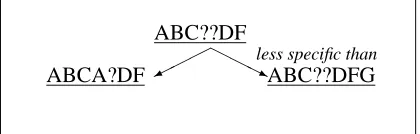
if: (1) p is equal to q in the defined posi-tions ofqbut has fewer undefined (i.e., wild-cards) positions; or (2)qis a substring ofp. Specificity provides a notion of complexity of a pattern (more specific patterns are more complex). See Figure 4 for an example.
Using the previous definitions, the algorithm re-duces to the problem of, given a set of sequences,
pattern: AB?D
0 1 2 3 4 5 6 7 8 . . . ←offset
seqα: A B C D F A A B F D . . . seqβ: F C A B D D F F . . . .
.. .
offset list:{(α,0); (α,6); (β,2);. . .}
Figure 3: A pattern, a set of sequences and an offset list.
ABC??DF
ABCA?DF ABC??DFG
H H
H j
less specific than
Figure 4: The specificity relation among patterns.
threshold, finding maximalhL, Wi-patterns with at least a support of support threshold. Our im-plementation can be sketched as follows:
Scanning. For a given window sizen, all the pos-sible subsequences (i.e., n-grams) occurring in the training set are identified. This process is repeated for different window sizes.
Generalizing. For each of the identified
subse-quences, patterns are created by replacing valid positions (i.e., any place but the first and last positions) with wildcards. Only hL, Wi patterns with support greater than
support threshold are kept. Figure 5 shows
an example.
Filtering. The above process is repeated
increas-ing the window size until no patterns with enough support are found. The list of iden-tified patterns is then filtered according to specificity: given two patterns in the list, one of them more specific than the other, if both have offset lists of equal size, the less spe-cific one is pruned3. This gives us the list of maximal motifs (i.e. patterns) which are supported by the training data.
3
Since they match in exactly the same positions, we prune the less specific one, as it adds no new information.
A B C D E F ←subsequence
AB?DEF . . . ABCD?F ←patterns
H H
[image:4.595.78.288.228.295.2]H j
Figure 5: The process of generalizing an existing subsequence.
3.2 Clustering
After the detection of patterns is finished, the number of patterns is relatively large. Moreover, as they have fixed length, they tend to be pretty similar. In fact, many tend to have their support from the same subsequences in the corpus. We are interested in syntactic similarity as well as simi-larity in context.
A convenient solution was to further cluster the patterns, according to an approximate matching distance measure between patterns, defined in an appendix at the end of the paper.
We use agglomerative clustering with the dis-tance between clusters defined as the maximum pairwise distance between elements of the two clusters. Clustering stops when no inter-cluster distance falls below a user-defined threshold.
Each of the resulting clusters has a single pat-tern represented by the centroid of the cluster. This concept is useful for visualization of the cluster in qualitative evaluation.
3.3 Constraints inference
The last step of our algorithm measures the fre-quencies of all possible order constraints among pairs of clusters, retaining those that occur of-ten enough to be considered important, accord-ing to some relevancy measure. We also discard any constraint that it is violated in any training sequence. We do this in order to obtain clear-cut constraints. Using the number of times a given constraint is violated as a quality measure is a straight-forward extension of our framework. The algorithm proceeds as follows: we build a table of counts that is updated every time a pair of pat-terns belonging to particular clusters are matched. To obtain clear-cut constraints, we do not count overlapping occurrences of patterns.
rele-vancy measure, as the distribution of the tags is skewed. We use a simple heuristic to estimate a relevancy measure over the constraints that are never contradicted. We are trying to obtain an es-timate of
P r(A≺precedes B)
from the counts of
c=A≺˜precededB
We normalize with these counts (wherexranges over all the patterns that match before/after Aor
B):
c1 =A≺˜precededx
and
c2 =x≺˜precededB
The obtained estimates,e1=c/c1ande2 =c/c2, will in general yield different numbers. We use the arithmetic mean between both, e = (e1+e2)
2 , as the final estimate for each constraint. It turns out to be a good estimate, that predicts accuracy of the generated constraints (see Section 4).
4 Results
We use cross validation to quantitatively evaluate our results and a comparison against the plan of our existing system for qualitative evaluation.
4.1 Quantitative evaluation
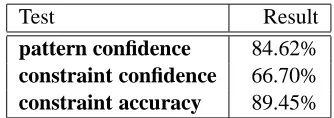
We evaluated two items: how effective the pat-terns and constraints learned were in an unseen test set and how accurate the predicted constraints were. More precisely:
Pattern Confidence. This figure measures the
percentage of identified patterns that were able to match a sequence in the test set.
Constraint Confidence. An ordering constraint
between two clusters can only be checkable on a given sequence if at least one pattern from each cluster is present. We measure the percentage of the learned constraints that are indeed checkable over the set of test se-quences.
Constraint Accuracy. This is, from our
[image:5.595.330.497.89.148.2]perspec-tive, the most important judgement. It mea-sures the percentage of checkable ordering
Table 1: Evaluation results.
Test Result
pattern confidence 84.62%
constraint confidence 66.70%
constraint accuracy 89.45%
constraints that are correct, i.e., the order constraint was maintained in any pair of matching patterns from both clusters in all the test-set sequences.
Using 3-fold cross-validation for computing these metrics, we obtained the results shown in Ta-ble 1 (averaged over 100 executions of the exper-iment). The different parameter settings were de-fined as follows: for the motif detection algorithm hL, Wi =h2,3iand support threshold of 3. The algorithm will normally find around 100 maximal motifs. The clustering algorithm used a relative distance threshold of 3.5 that translates to an ac-tual treshold of 120 for an average inter-cluster distance of 174. The number of produced clusters was in the order of the 25 clusters or so. Finally, a threshold in relevancy of 0.1 was used in the con-straint learning procedure. Given the amount of data available for these experiments all these pa-rameters were hand-tunned.
4.2 Qualitative evaluation
The system was executed using all the available information, with the same parametric settings used in the quantitative evaluation, yielding a set of 29 constraints, out of 23 generated clusters.
mostly occur in the existing plan is very encour-aging.
5 Related work
As explained in (Hudak and McClure, 1999), mo-tif detection is usually targeted with alignment techniques (as in (Durbin et al., 1998)) or with combinatorial pattern discovery techniques such as the ones we used here. Combinatorial pattern discovery is more appropriate for our task because it allows for matching across patterns with permu-tations, for representation of wild cards and for use on smaller data sets.
Similar techniques are used in NLP. Align-ments are widely used in MT, for example (Melamed, 1997), but the crossing problem is a phenomenon that occurs repeatedly and at many levels in our task and thus, this is not a suitable approach for us.
Pattern discovery techniques are often used for information extraction (e.g., (Riloff, 1993; Fisher et al., 1995)), but most work uses data that con-tains patterns labelled with the semantic slot the pattern fills. Given the difficulty for humans in finding patterns systematically in our data, we needed unsupervised techniques such as those de-veloped in computational genomics.
Other stochastic approaches to NLG normally focus on the problem of sentence generation, including syntactic and lexical realization (e.g., (Langkilde and Knight, 1998; Bangalore and Rambow, 2000; Knight and Hatzivassiloglou, 1995)). Concurrent work analyzing constraints on ordering of sentences in summarization found that a coherence constraint that ensures that blocks of sentences on the same topic tend to occur together (Barzilay et al., 2001). This results in a bottom-up approach for ordering that opportunistically groups sentences together based on content fea-tures. In contrast, our work attempts to automati-cally learn plans for generation based on semantic types of the input clause, resulting in a top-down planner for selecting and ordering content.
6 Conclusions
In this paper we presented a technique for extract-ing order constraints among plan elements that performs satisfactorily without the need of large
corpora. Using a conservative set of parameters, we were able to reconstruct a good portion of a carefully hand-crafted planner. Moreover, as dis-cussed in the evaluation, there are several pieces of information in the transcripts which are not present in the current system. From our learned results, we have inferred placement constraints of the new information in relation to the previous plan elements without further interviews with ex-perts.
Furthermore, it seems we have captured order-sensitive information in the patterns and free-order information is kept in the don’t care model. The patterns, and ordering constraints among them, provide a backbone of relatively fixed struc-ture, while don’t cares are interspersed among them. This model, being probabilistic in nature, means a great deal of variation, but our gener-ated plans should have variability in the right po-sitions. This is similar to findings of floating
posi-tioning of information, together with oportunistic rendering of the data as used in STREAK(Robin and McKeown, 1996).
6.1 Future work
We are planning to use these techniques to revise our current content-planner and incorporate infor-mation that is learned from the transcripts to in-crease the possible variation in system output.
The final step in producing a full-fledged content-planner is to add semantic constraints on the selection of possible orderings. This can be generated through clustering of semantic input to the generator.
We also are interested in further evaluating the technique in an unrestricted domain such as the Wall Street Journal (WSJ) with shallow seman-tics such as the WordNet top-category for each NP-head. This kind of experiment may show strengths and limitations of the algorithm in large corpora.
7 Acknowledgments
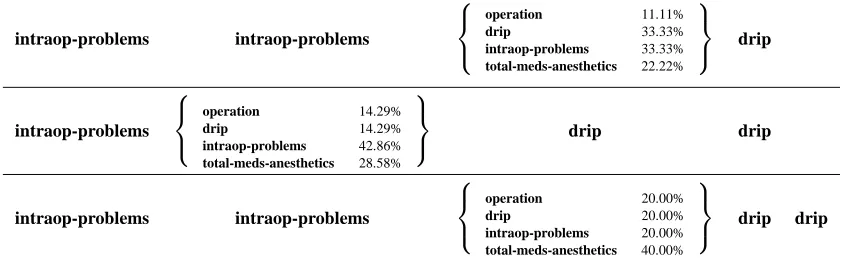
intraop-problems intraop-problems
operation 11.11%
drip 33.33%
intraop-problems 33.33%
total-meds-anesthetics 22.22%
drip
intraop-problems
operation 14.29%
drip 14.29%
intraop-problems 42.86%
total-meds-anesthetics 28.58%
drip drip
intraop-problems intraop-problems
operation 20.00%
drip 20.00%
intraop-problems 20.00%
total-meds-anesthetics 40.00%
[image:7.595.87.508.69.202.2]drip drip
Figure 6: Cluster and patterns example. Each line corresponds to a different pattern. The elements between braces are don’t care positions (three patterns conform this cluster: intraop-problems intraop-problems ? drip,
intraop-problems ? drip dripandintraop-problems intraop-problems drip dripthe don’t care model shown in each brace must sum up to 1 but there is a strong overlap between patterns —the main reason for clustering)
Noemie Elhadad and Smaranda Muresan for help-ful suggestions and comments. The aid of two anonymous reviewers was also highly appreci-ated.
References
Srinivas Bangalore and Owen Rambow. 2000. Ex-ploiting a probabilistic hierarchical model for gen-eration. In COLING, 2000, Saarbrcken, Germany.
Regina Barzilay, Noemie Elhadad, and Kathleen R. McKeown. 2001. Sentence ordering in multidoc-ument summarization. In HLT, 2001, San Diego, CA.
Nadjet Bouayad-Aga, Richard Power, and Donia Scott. 2000. Can text structure be incompatible with rhetorical structure? In Proceedings of the
1st International Conference on Natural Language Generation (INLG-2000), pages 194–200, Mitzpe
Ramon, Israel.
Andrea Califano. 1999. Splash: Structural pattern lo-calization analysis by sequential histograms.
Bioin-formatics, 12, February.
Mukesh Dalal, Steven Feiner, , Kathleen McKeown, ShiMei Pan, Michelle Zhou, Tobias Hollerer, James Shaw, Yong Feng, and Jeanne Fromer. 1996. Nego-tiation for automated generation of temporal multi-media presentations. In Proceedings of ACM
Mul-timedia ’96, Philadelphia.
Robert Dale. 1988. Generating referring expressions
in a domain of objects and processes. Ph.D. thesis,
University of Edinburgh.
Richard Durbin, S. Eddy, A. Krogh, and G. Mitchi-son. 1998. Biological sequence analysis. Cam-bridge Univeristy Press.
David Fisher, Stephen Soderland, Joseph McCarthy, Fangfang Feng, and Wendy Lehnert. 1995. De-scription of the umass system as used for muc-6. In Morgan Kaufman, editor, Proceedings of the
Sixth Message Understanding Conference (MUC-6), pages 127–140, San Francisco.
Eduard H. Hovy. 1993. Automated discourse gener-ation using discourse structure relgener-ations. Artificial
Intelligence. (Special Issue on Natural Language
Processing).
J. Hudak and Marcela McClure. 1999. A comparative analysis of computational motif–detection methods. In R.B. Altman, A. K. Dunker, L. Hunter, T. E. Klein, and K. Lauderdale, editors, Pacific
Sympo-sium on Biocomputing, ’99, pages 138–149, New
Jersey. World Scientific.
Kevin Knight and Vasileios Hatzivassiloglou. 1995. Two-level, many-paths generation. In Proceedings
of the Conference of the Association for Computa-tional Linguistics (ACL’95).
Irene Langkilde and Kevin Knight. 1998. The practi-cal value of n-grams in generation. In Proceedings
of the Ninth International Natural Language Gen-eration Workshop (INLG’98).
Kathleen McKeown, ShiMei Pan, James Shaw, Jordan Desmand, and Barry Allen. 1997. Language gen-eration for multimedia healthcare briefings. In
Pro-ceedings of the 5th Conference on Applied Natural Language Processing (ANLP’97), Washington, DC,
April.
Kathleen R. McKeown. 1985. Text Generation:
Us-ing Discourse Strategies and Focus Constraints to Generate Natural Language Text. Cambridge
Uni-versity Press.
I. Dan Melamed. 1997. A portable algorithm for mapping bitext correspondence. In 35th
Confer-ence of the Association for Computational Linguis-tics (ACL’97), Madrid, Spain.
Johanna D. Moore and C´ecile L. Paris. 1993. Plan-ning text for advisory dialogues: Capturing inten-tional and rhetorical information. Computainten-tional
Linguistics, 19(4):651–695.
Ehud Reiter and Robert Dale. 2000. Building Natural
Language Generation Systems. Cambridge
Univer-sity Press.
Isidore Rigoutsos and Aris Floratos. 1998. Combina-torial pattern discovery in biological sequences: the teiresias algorithm. Bioinformatics, 14(1):55–67.
Ellen Riloff. 1993. Automatically constructing a dic-tionary for information extraction. In AAAI Press / MIT Press, editor, Proceedings of the Eleventh
Na-tional Conference on Artificial Intelligence, pages
811–816.
Jacques Robin and Kathleen McKeown. 1996. Em-pirically designing and evaluating a new revision– based model for summary generation. Artificial
In-telligence, 85(1–2):135–179.
Appendix - Definition of the distance mea-sure used for clustering.
An approximate matching measure is
de-fined for a given extended pattern. The ex-tended pattern is represented as a sequence of sets; defined positions have a singleton set, while wildcard positions contain the non-zero probability elements in their don’t care model (e.g. givenintraop-problems,intraop-problems,{drip10%,intubation
90%},dripwe model this as [{intraop-problems}; {
intraop-problems};{drip,intubation};{drip}}]).
Considerpto be such a pattern,oan offset and
S a sequence, the approximate matching is de-fined by
ˆ
m(p, o, S) =
Plength(p)
i=0 match(p[i], S[i+o]) length(p)
where thematch(P, e)function is defined as 0 if
e ∈ P, 1 otherwise, and where P is the set at
position i in the extended pattern p and eis the element of the sequenceSat positioni+o.
Our measure is normalized to [0,1]. Using this function, we define the approximate match-ing distance measure (one way) between a pattern
p1 and a patternp2as the sum (averaged over the length of the offset list of p1) of all the approxi-mate matching measures ofp2 over the offset list of p1. This is, again, a real number in [0,1]. To ensure symmetry, we define the distance between