Probabilistic Text Structuring: Experiments with Sentence Ordering
Mirella Lapata
Department of Computer Science University of Sheffield Regent Court, 211 Portobello Street
Sheffield S1 4DP, UK
Abstract
Ordering information is a critical task for natural language generation applications. In this paper we propose an approach to information ordering that is particularly suited for text-to-text generation. We de-scribe a model that learns constraints on sentence order from a corpus of domain-specific texts and an algorithm that yields the most likely order among several al-ternatives. We evaluate the automatically generated orderings against authored texts from our corpus and against human sub-jects that are asked to mimic the model’s task. We also assess the appropriateness of such a model for multidocument summa-rization.
1 Introduction
Structuring a set of facts into a coherent text is a non-trivial task which has received much attention in the area of concept-to-text generation (see Reiter and Dale 2000 for an overview). The structured text is typically assumed to be a tree (i.e., to have a hier-archical structure) whose leaves express the content being communicated and whose nodes specify how this content is grouped via rhetorical or discourse re-lations (e.g., contrast, sequence, elaboration).
For domains with large numbers of facts and rhetorical relations, there can be more than one pos-sible tree representing the intended content. These different trees will be realized as texts with different sentence orders or even paragraph orders and differ-ent levels of coherence. Finding the tree that yields the best possible text is effectively a search prob-lem. One way to address it is by narrowing down the search space either exhaustively or heuristically. Marcu (1997) argues that global coherence can be achieved if constraints on local coherence are sat-isfied. The latter are operationalized as weights on
the ordering and adjacency of facts and are derived from a corpus of naturally occurring texts. A con-straint satisfaction algorithm is used to find the tree with maximal weights from the space of all possi-ble trees. Mellish et al. (1998) advocate stochastic search as an alternative to exhaustively examining the search space. Rather than requiring a global op-timum to be found, they use a genetic algorithm to select a tree that is coherent enough for people to understand (local optimum).
The problem of finding an acceptable order-ing does not arise solely in concept-to-text gener-ation but also in the emerging field of text-to-text generation (Barzilay, 2003). Examples of applica-tions that require some form of text structuring, are single- and multidocument summarization as well as question answering. Note that these applications do not typically assume rich semantic knowledge orga-nized in tree-like structures or communicative goals as is often the case in concept-to-text generation. Al-though in single document summarization the posi-tion of a sentence in a document can provide cues with respect to its ordering in the summary, this is not the case in multidocument summarization where sentences are selected from different documents and must be somehow ordered so as to produce a coher-ent summary (Barzilay et al., 2002). Answering a question may also involve the extraction, potentially summarization, and ordering of information across multiple information sources.
re-sults reveal that although the generated orders differ from subject to subject, topically related sentences always appear together. Based on the human study they propose an algorithm that first identifies top-ically related groups of sentences and then orders them according to chronological information.
In this paper we introduce an unsupervised probabilistic model for text structuring that learns ordering constraints from a large corpus. The model operates on sentences rather than facts in a knowl-edge base and is potentially useful for text-to-text generation applications. For example, it can be used to order the sentences obtained from a multidocu-ment summarizer or a question answering system. Sentences are represented by a set of informative features (e.g., a verb and its subject, a noun and its modifier) that can be automatically extracted from the corpus without recourse to manual annotation.
The model learns which sequences of features are likely to co-occur and makes predictions con-cerning preferred orderings. Local coherence is thus operationalized by sentence proximity in the train-ing corpus. Global coherence is obtained by greedily searching through the space of possible orders. As in the case of Mellish et al. (1998) we construct an ac-ceptable ordering rather than the best possible one. We propose an automatic method of evaluating the orders generated by our model by measuring close-ness or distance from the gold standard, a collection of orders produced by humans.
The remainder of this paper is organized as fol-lows. Section 2 introduces our model and an algo-rithm for producing a possible order. Section 3 de-scribes our corpus and the estimation of the model parameters. Our experiments are detailed in Sec-tion 4. We conclude with a discussion in SecSec-tion 5.
2 Learning to Order
Given a collection of texts from a particular domain, our task is to learn constraints on the ordering of their sentences. In the training phase our model will learn these constraints from adjacent sentences rep-resented by a set of informative features. In the test-ing phase, given a set of unseen sentences, we will rely on our prior experience of how sentences are usually ordered for choosing the most likely order-ing.
2.1 The Model
We express the probability of a text made up of sen-tences S1...Snas shown in (1). According to (1), the
task of predicting the next sentence is dependent on its n−i previous sentences.
P(T) =P(S1...Sn)
=P(S1)P(S2|S1)P(S3|S1,S2)...P(Sn|S1...Sn−1)
= ∏n
i=1
P(Sn|S1...Sn−i)
(1)
We will simplify (1) by assuming that the prob-ability of any given sentence is determined only by its previous sentence:
P(T) = P(S1)P(S2|S1)P(S3|S2)...P(Sn|Sn−1)
= ∏n
i=1
P(Si|Si−1)
(2)
This is a somewhat simplistic attempt at cap-turing Marcu’s (1997) local coherence constraints as well as Barzilay et al.’s (2002) observations about topical relatedness. While this is clearly a naive view of text coherence, our model has some notion of the types of sentences that typically go together, even though it is agnostic about the specific rhetorical re-lations that glue sentences into a coherent text. Also note that the simplification in (2) will make the es-timation of the probabilities P(Si|Si−1) more
reli-able in the face of sparse data. Of course estimat-ing P(Si|Si−1) would be impossible if Si and Si−1
were actual sentences. It is unlikely to find the ex-act same sentence repeated several times in a corpus. What we can find and count is the number of times a given structure or word appears in the corpus. We will therefore estimate P(Si|Si−1)from features that
express its structure and content (these features are described in detail in Section 3):
P(Si|Si−1) =
P(hahi,1i,ahi,2i...ahi,nii|hahi−1,1i,ahi−1,2i...ahi−1,mii)
(3)
wherehahi,1i,ahi,2i...ahi,nii are features relevant for
sentence Siandhahi−1,1i,ahi−1,2i...ahi−1,miifor
sen-tence Si−1. We will assume that these features are
independent and that P(Si|Si−1) can be estimated
from the pairs in the Cartesian product defined over the features expressing sentences Si and Si−1: (ahi,ji,ahi−1,ki)∈Si×Si−1. Under these assumptions P(Si|Si−1)can be written as follows:
P(Si|Si−1) = P(ahi,1i|ahi−1,1i)...P(ahi,ni|ahi−1,mi)
= ∏
(ahi,ji,ahi−1,ki)∈Si×Si−1
P(ahi,ji|ahi−1,ki) (4)
Assuming that the features are independent again makes parameter estimation easier. The Carte-sian product over the features in Siand Si−1is an
S1: a b c d
S2: e f g
[image:3.612.146.225.70.132.2]S3: h i
Figure 1: Example of probability estimation
we don’t know a priori what the important feature combinations are, we are considering all possible combinations over two sentences. This will admit-tedly introduce some noise, given that some depen-dencies will be spurious, but the model can be easily retrained for different domains for which different feature combinations will be important. The proba-bility P(ahi,ji|ahi−1,ki)is estimated as:
P(ahi,ji|ahi−1,ki) =
f(ahi,ji,ahi−1,ki)
∑
ahi,ji
f(ahi,ji,ahi−1,ki) (5)
where f(ahi,ji,ahi−1,ki) is the number of times
fea-ture ahi,ji is preceded by feature ahi−1,ki in the
corpus. The denominator expresses the number of times ahi−1,ki is attested in the corpus (preceded
by any feature). The probabilities P(ahi,ji|ahi−1,ki)
will be unreliable when the frequency estimates for
f(ahi,ji,ahi−1,ki) are small, and undefined in cases
where the feature combinations are unattested in the corpus. We therefore smooth the observed frequen-cies using back-off smoothing (Katz, 1987).
To illustrate with an example consider the text in Figure 1 which has three sentences S1, S2, S3,
each represented by their respective features denoted by letters. The probability P(S3|S2) will be
calcu-lated by taking the product of P(h|e), P(h|f), P(h|g),
P(i|e), P(i|f), and P(i|g). To obtain P(h|e), we need
f(h,e)and f(e)which can be estimated in Figure 1 by counting the number of edges connecting e and
h and the number of edges starting from e,
respec-tively. So, P(h|e) will be 0.16 given that f(h,e) is one and f(e)is six (see the normalization in (5)).
2.2 Determining an Order
Once we have collected the counts for our features we can determine the order for a new text that we haven’t encountered before, since some of the features representing its sentences will be familiar. Given a text with N sentences there are N! possi-ble orders. The set of orders can be represented as a complete graph, where the set of vertices V is equal to the set of sentences S and each edge u→v has
a weight, the probability P(u|v). Cohen et al. (1999)
START
H H H H H H
S1
(0.2)
HH
S2
S3
S3
S2
S2
(0.3)
HH
S1
(0.006)
S3
S3
(0.02)
S1
S3
(0.05)
HH
S2
S1
S1
S2
Figure 2: Finding an order for a three sentence text
show that the problem of finding an optimal ordering through a directed weighted graph is NP-complete. Fortunately, they propose a simple greedy algorithm that provides an approximate solution which can be easily modified for our task (see also Barzilay et al. 2002).
The algorithm starts by assigning each vertex
v∈V a probability. Recall that in our case vertices
are sentences and their probabilities can be calcu-lated by taking the product of the probabilities of their features. The greedy algorithm then picks the node with the highest probability and orders it ahead of the other nodes. The selected node and its incident edges are deleted from the graph. Each remaining node is now assigned the conditional probability of seeing this node given the previously selected node (see (4)). The node which yields the highest condi-tional probability is selected and ordered ahead. The process is repeated until the graph is empty.
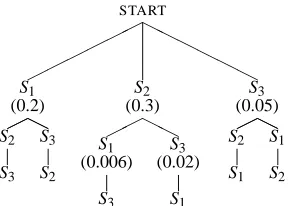
As an example consider again a three sentence text. We illustrate the search for a path through the graph in Figure 2. First we calculate which of the three sentences S1, S2, and S3 is most likely to start
the text (during training we record which sentences appear in the beginning of each text). Assuming that
P(S2|START) is the highest, we will order S2 first,
and ignore the nodes headed by S1 and S3. We next
compare the probabilities P(S1|S2) and P(S3|S2).
Since P(S3|S2)is more likely than P(S1|S2), we
or-der S3 after S2 and stop, returning the order S2, S3,
and S1. As can be seen in Figure 2 for each vertex
we keep track of the most probable edge that ends in that vertex, thus setting th beam search width to one. Note, that equation (4) would assign lower and lower probabilities to sentences with large numbers of features. Since we need to compare sentence pairs with varied numbers of features, we will normalize the conditional probabilities P(Si|Si−1)by the
[image:3.612.355.499.71.174.2]1. Laidlaw Transportation Ltd. said shareholders will be asked at its Dec. 7 annual meeting to approve a change of name to Laidlaw Inc.
2. The company said its existing name hasn’t represented its businesses since the 1984 sale of its trucking operations.
3. Laidlaw is a waste management and school-bus operator, in which Canadian Pacific Ltd. has a 47% voting interest.
Figure 3: A text from the BLLIPcorpus
3 Parameter Estimation
The model in Section 2.1 was trained on the BLLIP corpus (30 M words), a collection of texts from the Wall Street Journal (years 1987-89). The corpus con-tains 98,732 stories. The average story length is 19.2 sentences. 71.30% of the texts in the corpus are less than 50 sentences long. An example of the texts in this newswire corpus is shown in Figure 3.
The corpus is distributed in a Treebank-style machine-parsed version which was produced with Charniak’s (2000) parser. The parser is a “maximum-entropy inspired” probabilistic gener-ative model. It achieves 90.1% average preci-sion/recall for sentences with maximum length 40 and 89.5% for sentences with maximum length 100 when trained and tested on the standard sections of the Wall Street Journal Treebank (Marcus et al., 1993).
We also obtained a dependency-style version of the corpus using MINIPAR (Lin, 1998) a broad coverage parser for English which employs a manu-ally constructed grammar and a lexicon derived from WordNet with an additional dictionary of proper names (130,000 entries in total). The grammar is represented as a network of 35 nodes (i.e., grammat-ical categories) and 59 edges (i.e., types of syntactic (dependency) relations). The output ofMINIPARis a dependency graph which represents the dependency relations between words in a sentence (see Table 1 for an example). Lin (1998) evaluated the parser on theSUSANNEcorpus (Sampson, 1996), a domain in-dependent corpus of British English, and achieved a recall of 79% and precision of 89% on the depen-dency relations.
From the two different parsed versions of the BLLIPcorpus the following features were extracted:
Verbs. Investigations into the interpretation of nar-rative discourse (Asher and Lascarides, 2003) have shown that specific lexical information (e.g., verbs, adjectives) plays an important role in determining the discourse relations between propositions. Al-though we don’t have an explicit model of rhetorical relations and their effects on sentence ordering, we capture the lexical inter-dependencies between
sen-tences by focusing on verbs and their precedence re-lationships in the corpus.
From the Treebank parses we extracted the verbs contained in each sentence. We obtained two versions of this feature: (a) a lemmatized ver-sion where verbs were reduced to their base forms and (b) a non-lemmatized version which preserved tense-related information; more specifically, verbal complexes (e.g.,I will have been going) were iden-tified from the parse trees heuristically by devis-ing a set of 30 patterns that search for sequences of modals, auxiliaries and verbs. This is an attempt at capturing temporal coherence by encoding se-quences of events and their morphology which in-directly indicates their tense.
To give an example consider the text in Fig-ure 3. For the lemmatized version, sentence (1) will be represented bysay, will, be, ask, and approve; for the tensed version, the relevant features will besaid, will be asked, and to approve.
Nouns. Centering Theory (CT, Grosz et al. 1995) is an entity-based theory of local coherence, which claims that certain entities mentioned in an utterance are more central than others and that this property constrains a speaker’s use of certain referring ex-pressions. The principles underlying CT (e.g., conti-nuity, salience) are of interest to concept-to-text gen-eration as they offer an entity-based model of text and sentence planning which is particularly suited for descriptional genres (Kibble and Power, 2000).
We operationalize entity-based coherence for text-to-text generation by simply keeping track of the nouns attested in a sentence without however taking personal pronouns into account. This simpli-fication is reasonable if one has text-to-text genera-tion mind. In multidocument summarizagenera-tion for ex-ample, sentences are extracted from different docu-ments; the referents of the pronouns attested in these sentences are typically not known and in some cases identical pronouns may refer to different entities. So making use of noun-pronoun or pronoun-pronoun co-occurrences will be uninformative or in fact mis-leading.
of the Treebank-style parsed corpus. In cases of noun compounds, only the compound head (i.e., rightmost noun) was taken into account. A small set of rules was used to identify organizations (e.g.,United Lab-oratories Inc.), person names (e.g., Jose Y. Cam-pos), and locations (e.g., New England ) spanning more than one word. These were grouped together and were also given the general categories person,
organization, andlocation. The model backs off
to these categories when unknown person names, lo-cations, and organizations are encountered. Dates, years, months and numbers were substituted by the categoriesdate,year,month, andnumber.
In sentence (1) (see Figure 3) we identify the nounsLaidlaw Transportation Ltd., shareholder, Dec 7, meeting, change, name and Laidlaw Inc. In sentence (2) the relevant nouns arecompany, name, business, 1984, sale, and operation.
Dependencies. Note that the noun and verb fea-tures do not capture the structure of the sentences to be ordered. This is important for our domain, as texts seem to be rather formulaic and similar syn-tactic structures are often used (e.g., direct and in-direct speech, restrictive relative clauses, predicative structures). In this domain companies typically say things, and texts often begin with a statement of what a company or an individual has said (see sentence (1) in Figure 3). Furthermore, companies and individu-als are described with certain attributes (persons can be presidents or governors, companies are bankrupt or manufacturers, etc.) that can give clues for infer-ring coherence.
The dependencies were obtained from the out-put ofMINIPAR. Some of the dependencies for sen-tence (2) from Figure 3 are shown in Table 1. The dependencies capture structural as well lexical infor-mation. They are represented as triples, consisting of a head (leftmost element, e.g., say, name), a modi-fier (rightmost element, e.g.,company, its) and a re-lation (e.g., subject (V:subj:N), object (V:obj:N), modifier (N:mod:A)).
For efficiency reasons we focused on triples whose dependency relations (e.g., V:subj:N) were attested in the corpus with frequency larger than one per million. We further looked at how individ-ual types of relations contribute to the ordering task. More specifically we experimented with dependen-cies relating to verbs (49 types), nouns (52 types), verbs and nouns (101 types) (see Table 1 for exam-ples). We also ran a version of our model with all types of relations, including adjectives, adverbs and
Verb Noun
sayV:subj:Ncompany nameN:gen:Nits representV:subj:Nname nameN:mod:Aexisting representV:have:havehave businessN:gen:Nits representV:obj:Nbusiness businessN:mod:Prepsince
[image:5.612.315.538.161.200.2]companyN:det:Detthe
Table 1: Dependencies for sentence (2) in Figure 3
A B C D E F G H I J
Model 1 1 2 3 4 5 6 7 8 9 10 Model 2 2 1 5 3 4 6 7 9 8 10 Model 3 10 2 3 4 5 6 7 8 9 1
Table 2: Example of rankings for a 10 sentence text
prepositions (147 types in total).
4 Experiments
In this section we describe our experiments with the model and the features introduced in the previous sections. We first evaluate the model by attempting to reproduce the structure of unseen texts from the BLLIP corpus, i.e., the corpus on which the model is trained on. We next obtain an upper bound for the task by conducting a sentence ordering experiment with humans and comparing the model against the human data. Finally, we assess whether this model can be used for multi-document summarization us-ing data from Barzilay et al. (2002). But before we outline the details of our experiments we discuss our choice of metric for comparing different orders.
4.1 Evaluation Metric
Our task is to produce an ordering for the sentences of a given text. We can think of the sentences as objects for which a ranking must be produced. Ta-ble 2 gives an example of a text containing 10 sen-tences (A–J) and the orders (i.e., rankings) produced by three hypothetical models.
A number of metrics can be used to measure the distance between two rankings such as Spear-man’s correlation coefficient for ranked data, Cayley distance, or Kendall’s τ (see Lebanon and Lafferty 2002 for details). Kendall’sτis based on the number of inversions in the rankings and is defined in (6):
(6) τ=1−2(number of inversions) N(N−1)/2
of permutations, thenτcan be interpreted as the min-imum number of adjacent transpositions needed to bring one order to the other. In Table 2 the number of inversions can be calculated by counting the num-ber of intersections of the lines. The metric ranges from−1 (inverse ranks) to 1 (identical ranks). Theτ for Model 1 and Model 2 in Table 2 is .822.
Kendall’s τ seems particularly appropriate for the tasks considered in this paper. The metric is sen-sitive to the fact that some sentences may be always ordered next to each other even though their absolute orders might differ. It also penalizes inverse rank-ings. Comparison between Model 1 and Model 3 would give aτof 0.244 even though the orders tween the two models are identical modulo the be-ginning and the end. This seems appropriate given that flipping the introduction in a document with the conclusions seriously disrupts coherence.
4.2 Experiment 1: Ordering Newswire Texts
The model from Section 2.1 was trained on the BLLIP corpus and tested on 20 held-out randomly selected unseen texts (average length 15.3). We also used 20 randomly chosen texts (disjoint from the test data) for development purposes (average length 16.2). All our results are reported on the test set.
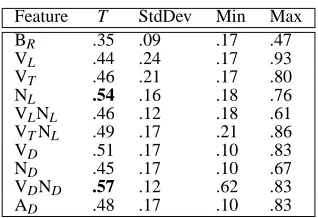
The input to the the greedy algorithm (see Sec-tion 2.2) was a text with a randomized sentence or-dering. The ordered output was compared against the original authored text usingτ. Table 3 gives the average τ (T ) for all 20 test texts when the fol-lowing features are used: lemmatized verbs (VL),
tensed verbs (VT), lemmatized nouns (NL),
lem-matized verbs and nouns (VLNL), tensed verbs and
lemmatized nouns (VTNL), verb-related
dependen-cies (VD), noun-related dependencies (ND), verb and
noun dependencies (VDND), and all available
de-pendencies (AD). For comparison we also report the
naive baseline of generating a random oder (BR). As
can be seen from Table 3 the best performing fea-tures are NLand VDND. This is not surprising given
that NLencapsulates notions of entity-based
coher-ence, which is relatively important for our domain. A lot of texts are about a particular entity (company or individual) and their properties. The feature VDND
subsumes several other features and does expectedly better: it captures entity-based coherence, the inter-relations among verbs, the structure of sentences and also preserves information about argument structure (who is doing what to whom). The distance between the orders produced by the model and the original texts increases when all types of dependencies are
Feature T StdDev Min Max BR .35 .09 .17 .47
VL .44 .24 .17 .93
VT .46 .21 .17 .80
NL .54 .16 .18 .76
VLNL .46 .12 .18 .61
VTNL .49 .17 .21 .86
VD .51 .17 .10 .83
ND .45 .17 .10 .67
VDND .57 .12 .62 .83
[image:6.612.347.506.68.177.2]AD .48 .17 .10 .83
Table 3: Comparison between original BLLIP texts and model generated variants
taken into account. The feature space becomes too big, there are too many spurious feature pairs, and the model can’t distinguish informative from non-informative features.
We carried out a one-way Analysis of Vari-ance (ANOVA) to examine the effect of different fea-ture types. The ANOVA revealed a reliable effect of feature type (F(9,171) = 3.31; p<0.01). We performed Post-hoc Tukey tests to further examine whether there are any significant differences among the different features and between our model and the baseline. We found out that NL, VTNL, VD, and
VDND are significantly better than BR (α=0.01),
whereas NL and VDND are not significantly
differ-ent from each other. However, they are significantly better than all other features (α=0.05).
4.3 Experiment 2: Human Evaluation
In this experiment we compare our model’s perfor-mance against human judges. Twelve texts were ran-domly selected from the 20 texts in our test data. The texts were presented to subjects with the order of their sentences scrambled. Participants were asked to reorder the sentences so as to produce a coherent text. Each participant saw three texts randomly cho-sen from the pool of 12 texts. A random order of cho- sen-tences was generated for every text the participants saw. Sentences were presented verbatim, pronouns and connectives were retained in order to make or-dering feasible. Notice that this information is absent from the features the model takes into account.
Feature T StdDev Min Max VL .45 .16 .10 .90
VT .46 .18 .10 .90
NL .51 .14 .10 .90
VLNL .44 .14 .18 .61
VTNL .49 .18 .21 .86
VD .47 .14 .10 .93
ND .46 .15 .10 .86
VDND .55 .15 .10 .90
AD .48 .16 .10 .83
[image:7.612.107.265.69.175.2]HH .58 .08 .26 .75
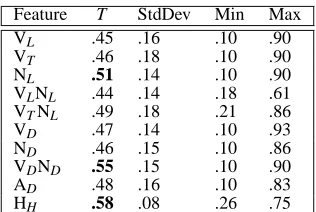
Table 4: Comparison between orderings produced by humans and the model on BLLIPtexts
Features T StdDev Min Max BR .43 .13 .19 .97
NL .48 .16 .21 .86
VDND .56 .13 .32 .86
[image:7.612.105.267.223.276.2]HH .60 .17 −1 .98
Table 5: Comparison between orderings produced by humans and the model on multidocument summaries
Usenet newsgroups.
Table 4 reports pairwise τ averaged over 12 texts for all participants (HH) and the average τ
between the model and each of the subjects for all features used in Experiment 1. The average distance in the orderings produced by our subjects is .58. The distance between the humans and the best features is .51 for NLand .55 for VDND. An ANOVAyielded
a significant effect of feature type (F(9,99) =5.213;
p<0.01). Post-hoc Tukey tests revealed that VL,
VT, VD, ND, AD, VLNL, and VTNL perform
sig-nificantly worse than HH (α =0.01), whereas NL
and VDND are not significantly different from HH
(α=0.01). This is in agreement with Experiment 1 and points to the importance of lexical and structural information for the ordering task.
4.4 Experiment 3: Summarization
Barzilay et al. (2002) collected a corpus of multiple orderings in order to study what makes an order co-hesive. Their goal was to improve the ordering strat-egy of MULTIGEN (McKeown et al., 1999) a mul-tidocument summarization system that operates on news articles describing the same event. MULTIGEN identifies text units that convey similar information across documents and clusters them into themes. Each theme is next syntactically analysed into pred-icate argument structures; the structures that are re-peated often enough are chosen to be included into the summary. A language generation system outputs a sentence (per theme) from the selected predicate
argument structures.
Barzilay et al. (2002) collected ten sets of arti-cles each consisting of two to three artiarti-cles reporting the same event and simulated MULTIGEN by man-ually selecting the sentences to be included in the final summary. This way they ensured that order-ings were not influenced by mistakes their system could have made. Explicit references and connec-tives were removed from the sentences so as not to reveal clues about the sentence ordering. Ten sub-jects provided orders for each summary which had an average length of 8.8.
We simulated the participants’ task by using the model from Section 2.1 to produce an order for each candidate summary1. We then compared the differ-ences in the orderings generated by the model and participants using the best performing features from Experiment 2 (i.e., NL and VDND). Note that the
model was trained on the BLLIPcorpus, whereas the sentences to be ordered were taken from news arti-cles describing the same event. Not only were the news articles unseen but also their syntactic struc-ture was unfamiliar to the model. The results are shown in table 5, again average pairwise τ is re-ported. We also give the naive baseline of choosing a random order (BR). The average distance in the
orderings produced by Barzilay et al.’s (2002) par-ticipants is .60. The distance between the humans and NLis .48 whereas the average distance between
VDNDand the humans is .56. An ANOVAyielded a
significant effect of feature type (F(3,27) =15.25;
p<0.01). Post-hoc Tukey tests showed that VDND
was significantly better than BR, but NLwasn’t. The
difference between VDND and HH was not
signifi-cant.
Although NLperformed adequately in
Experi-ments 1 and 2, it failed to outperform the baseline in the summarization task. This may be due to the fact that entity-based coherence is not as important as temporal coherence for the news articles summaries. Recall that the summaries describe events across documents. This information is captured more ad-equately by VDND and not by NLthat only keeps a
record of the entities in the sentence.
5 Discussion
In this paper we proposed a data intensive approach to text coherence where constraints on sentence or-dering are learned from a corpus of domain-specific
1The summaries as well as the human data are available from
texts. We experimented with different feature encod-ings and showed that lexical and syntactic informa-tion is important for the ordering task. Our results indicate that the model can successfully generate or-ders for texts taken from the corpus on which it is trained. The model also compares favorably with hu-man perforhu-mance on a single- and multiple docu-ment ordering task.
Our model operates on the surface level rather than the logical form and is therefore suitable for text-to-text generation systems; it acquires ordering constraints automatically, and can be easily ported to different domains and text genres. The model is par-ticularly relevant for multidocument summarization since it could provide an alternative to chronolog-ical ordering especially for documents where pub-lication date information is unavailable or uninfor-mative (e.g., all documents have the same date). We proposed Kendall’s τ as an automated method for evaluating the generated orders.
There are a number of issues that must be ad-dressed in future work. So far our evaluation metric measures order similarities or dissimilarities. This enables us to assess the importance of particular feature combinations automatically and to evaluate whether the model and the search algorithm gener-ate potentially acceptable orders without having to run comprehension experiments each time. Such ex-periments however are crucial for determining how coherent the generated texts are and whether they convey the same semantic content as the originally authored texts. For multidocument summarization comparisons between our model and alternative or-dering strategies are important if we want to pursue this approach further.
Several improvements can take place with re-spect to the model. An obvious question is whether a trigram model performs better than the model presented here. The greedy algorithm implements a search procedure with a beam of width one. In the future we plan to experiment with larger widths (e.g., two or three) and also take into account fea-tures that express semantic similarities across docu-ments either by relying on WordNet or on automatic clustering methods.
Acknowledgments
The author was supported byEPSRCgrant number R40036. We are grateful to Regina Barzilay and Noemie Elhadad for making available their software and for providing valuable comments on this work. Thanks also to Stephen Clark, Nikiforos Kara-manis, Frank Keller, Alex Lascarides, Katja Markert, and Miles Osborne for helpful comments and suggestions.
References
Asher, Nicholas and Alex Lascarides. 2003. Logics of Conver-sation. Cambridge University Press.
Barzilay, Regina. 2003. Information Fusion for Multi-Document Summarization: Praphrasing and Generation. Ph.D. thesis, Columbia University.
Barzilay, Regina, Noemie Elhadad, and Kathleen R. McKeown. 2002. Inferring strategies for sentence ordering in multidoc-ument news summarization. Journal of Artificial Intelligence Research 17:35–55.
Charniak, Eugene. 2000. A maximum-entropy-inspired parser. In Proceedings of the 1st Conference of the North American Chapter of the Association for Computational Linguistics. Seattle, WA, pages 132–139.
Cohen, William W., Robert E. Schapire, and Yoram Singer. 1999. Learning to order things. Journal of Artificial Intelli-gence Research 10:243–270.
Grosz, Barbara, Aravind Joshi, , and Scott Weinstein. 1995. Centering: A framework for modeling the local coherence of discourse. Computational Linguistics 21(2):203–225. Katz, Slava M. 1987. Estimation of probabilities from sparse
data for the language model component of a speech recog-nizer. IEEE Transactions on Acoustics Speech and Signal Processing 33(3):400–401.
Kibble, Rodger and Richard Power. 2000. An integrated frame-work for text planning and pronominalisation. In In Pro-ceedings of the 1st International Conference on Natural Lan-guage Generation. Mitzpe Ramon, Israel, pages 77–84. Lebanon, Guy and John Lafferty. 2002. Combining rankings
using conditional probability models on permutations. In C. Sammut and A. Hoffmann, editors, In Proceedings of the 19th International Conference on Machine Learning. Mor-gan Kaufmann Publishers, San Francisco, CA.
Lin, Dekang. 1998. Dependency-based evaluation of MINIPAR. In In Proceedings on of the LREC Workshop on the Evalua-tion of Parsing Systems. Granada, pages 48–56.
Marcu, Daniel. 1997. From local to global coherence: A bottom-up approach to text planning. In In Proceedings of the 14th National Conference on Artificial Intelligence. Prov-idence, Rhode Island, pages 629–635.
Marcus, Mitchell P., Beatrice Santorini, and Mary Ann Marcinkiewicz. 1993. Building a large annotated corpus of english: The penn treebank. Computational Linguistics 19(2):313–330.
McKeown, Kathleen R., Judith L. Klavans, Vasileios Hatzivas-siloglou, Regina Barzilay, and Eleazar Eskin. 1999. Towards multidocument summarization by reformulation: Progress and prospects. In Proceedings of the 16th National Confer-ence on Artificial IntelligConfer-ence. Orlando, FL, pages 453–459. Mellish, Chris, Alistair Knott, Jon Oberlander, and Mick O’ Donnell. 1998. Experiments using stochastic search for text planning. In In Proceedings of the 9th International Work-shop on Natural Language Generation. Ontario, Canada, pages 98–107.
Reiter, Ehud and Robert Dale. 2000. Building Natural Lan-guage Generation Systems. Cambridge University Press, Cambridge.