Self-Organizing Markov Models and
Their Application to Part-of-Speech Tagging
Jin-Dong Kim Dept. of Computer Science
University of Tokyo
Hae-Chang Rim Dept. of Computer Science
Korea University [email protected]
Jun’ich Tsujii Dept. of Computer Science
University of Tokyo, and CREST, JST
Abstract
This paper presents a method to de-velop a class of variable memory Markov models that have higher memory capac-ity than traditional (uniform memory) Markov models. The structure of the vari-able memory models is induced from a manually annotated corpus through a de-cision tree learning algorithm. A series of comparative experiments show the result-ing models outperform uniform memory Markov models in a part-of-speech tag-ging task.
1 Introduction
Many major NLP tasks can be regarded as prob-lems of finding an optimal valuation for random processes. For example, for a given word se-quence, part-of-speech (POS) tagging involves find-ing an optimal sequence of syntactic classes, and NP chunking involves finding IOB tag sequences (each of which represents the inside, outside and
begin-ning of noun phrases respectively).
Many machine learning techniques have been de-veloped to tackle such random process tasks, which include Hidden Markov Models (HMMs) (Rabiner, 1989), Maximum Entropy Models (MEs) (Rat-naparkhi, 1996), Support Vector Machines (SVMs) (Vapnik, 1998), etc. Among them, SVMs have high memory capacity and show high performance, especially when the target classifica-tion requires the consideraclassifica-tion of various features.
On the other hand, HMMs have low memory capacity but they work very well, especially when the target task involves a series of classifications that are tightly related to each other and requires global optimization of them. As for POS tagging, recent comparisons (Brants, 2000; Schr¨oder, 2001) show that HMMs work better than other models when they are combined with good smoothing techniques and with handling of unknown words.
While global optimization is the strong point of HMMs, developers often complain that it is difficult to make HMMs incorporate various features and to improve them beyond given performances. For ex-ample, we often find that in some cases a certain lexical context can improve the performance of an HMM-based POS tagger, but incorporating such ad-ditional features is not easy and it may even degrade the overall performance. Because Markov models have the structure of tightly coupled states, an ar-bitrary change without elaborate consideration can spoil the overall structure.
This paper presents a way of utilizing statistical decision trees to systematically raise the memory capacity of Markov models and effectively to make Markov models be able to accommodate various fea-tures.
2 Underlying Model
The tagging model is probabilistically defined as finding the most probable tag sequence when a word sequence is given (equation (1)).
T(w1,k) = argmax t1,k
= argmax t1,k
P(t1,k)P(w1,k|t1,k) (2)
≈ argmax t1,k
k
Y
i=1
P(ti|ti−1)P(wi|ti) (3)
By applying Bayes’ formula and eliminating a re-dundant term not affecting the argument maximiza-tion, we can obtain equation (2) which is a combi-nation of two separate models: the tag language
model, P(t1,k) and the tag-to-word translation
model,P(w1,k|t1,k). Because the number of word sequences, w1,k and tag sequences, t1,k is infinite, the model of equation (2) is not computationally tractable. Introduction of Markov assumption re-duces the complexity of the tag language model and independent assumption between words makes the tag-to-word translation model simple, which result in equation (3) representing the well-known Hidden Markov Model.
3 Effect of Context Classification
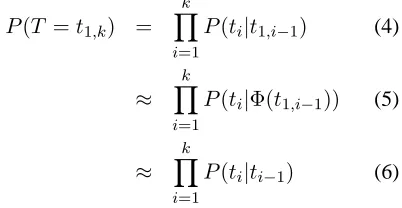
Let’s focus on the Markov assumption which is made to reduce the complexity of the original tag-ging problem and to make the tagtag-ging problem tractable. We can imagine the following process through which the Markov assumption can be intro-duced in terms of context classification:
P(T =t1,k) = k
Y
i=1
P(ti|t1,i−1) (4)
≈ k
Y
i=1
P(ti|Φ(t1,i−1)) (5)
≈ k
Y
i=1
P(ti|ti−1) (6)
In equation (5), a classification functionΦ(t1,i−1)is
introduced, which is a mapping of infinite contextual patterns into a set of finite equivalence classes. By defining the function as follows we can get equation (6) which represents a widely-used bi-gram model:
Φ(t1,i−1)≡ti−1 (7)
Equation (7) classifies all the contextual patterns ending in same tags into the same classes, and is equivalent to the Markov assumption.
The assumption or the definition of the above classification function is based on human intuition.
( conj)
P∗|
( fw conj)
P∗| ,
( vb conj)
P∗| ,
( vbp conj)
P∗| ,
vb
vb
vbp
[image:2.612.315.548.63.142.2]vbp
Figure 1: Effect of 1’st and 2’nd order context
at
at
prep
prep
nn
nn
( prep)
P∗|
(| prep,'in')
P∗
( | prep,'with')
P∗
( | prep,'out')
[image:2.612.314.547.184.297.2]P∗
Figure 2: Effect of context with and without lexical information
Although this simple definition works well mostly, because it is not based on any intensive analysis of real data, there is room for improvement. Figure 1 and 2 illustrate the effect of context classification on the compiled distribution of syntactic classes, which we believe provides the clue to the improvement.
Among the four distributions showed in Figure 1, the top one illustrates the distribution of syntactic classes in the Brown corpus that appear after all the conjunctions. In this case, we can say that we are considering the first order context (the immediately preceding words in terms of part-of-speech). The following three ones illustrates the distributions col-lected after taking the second order context into con-sideration. In these cases, we can say that we have extended the context into second order or we have classified the first order context classes again into second order context classes. It shows that distri-butions likeP(∗|vb, conj) and P(∗|vbp, conj) are very different from the first order ones, while distri-butions likeP(∗|f w, conj)are not.
[image:2.612.99.300.397.501.2]context class (the top one) is classified again by re-ferring the lexical information (the following three ones). We see that the distribution after the prepo-sition, out is quite different from distribution after other prepositions.
From the above observations, we can see that by applying Markov assumptions we may miss much useful contextual information, or by getting a better context classification we can build a better context model.
4 Related Works
One of the straightforward ways of context exten-sion is extending context uniformly. Tri-gram tag-ging models can be thought of as a result of the uniform extension of context from bi-gram tagging models. TnT (Brants, 2000) based on a second or-der HMM, is an example of this class of models and is accepted as one of the best part-of-speech taggers used around.
The uniform extension can be achieved (rela-tively) easily, but due to the exponential growth of the model size, it can only be performed in restric-tive a way.
Another way of context extension is the selective extension of context. In the case of context exten-sion from lower context to higher like the examples in figure 1, the extension involves taking more infor-mation about the same type of contextual features. We call this kind of extension homogeneous
con-text extension. (Brants, 1998) presents this type of
context extension method through model merging and splitting, and also prediction suffix tree learn-ing (Sch¨utze and Slearn-inger, 1994; D. Ron et. al, 1996) is another well-known method that can perform ho-mogeneous context extension.
On the other hand, figure 2 illustrates
heteroge-neous context extension, in other words, this type
of extension involves taking more information about other types of contextual features. (Kim et. al, 1999) and (Pla and Molina, 2001) present this type of con-text extension method, so called selective lexicaliza-tion.
The selective extension can be a good alternative to the uniform extension, because the growth rate of the model size is much smaller, and thus various contextual features can be exploited. In the
follow-V
V
P
P
N
N CC
$
$
$
$ CC NN PP VV
P-1
P-1
[image:3.612.314.559.24.114.2]$ C N P V
Figure 3: a Markov model and its equivalent deci-sion tree
ing sections, we describe a novel method of selective extension of context which performs both homoge-neous and heterogehomoge-neous extension simultahomoge-neously.
5 Self-Organizing Markov Models
Our approach to the selective context extension is making use of the statistical decision tree frame-work. The states of Markov models are represented in statistical decision trees, and by growing the trees the context can be extended (or the states can be split).
We have named the resulting models Self-Organizing Markov Models to reflect their ability to automatically organize the structure.
5.1 Statistical Decision Tree Representation of Markov Models
The decision tree is a well known structure that is widely used for classification tasks. When there are several contextual features relating to the classifi-cation of a target feature, a decision tree organizes the features as the internal nodes in a manner where more informative features will take higher levels, so the most informative feature will be the root node. Each path from the root node to a leaf node repre-sents a context class and the classification informa-tion for the target feature in the context class will be contained in the leaf node1.
In the case of part-of-speech tagging, a classifi-cation will be made at each position (or time) of a word sequence, where the target feature is the syn-tactic class of the word at current position (or time) and the contextual features may include the syntactic
1
V
V
P,*
P,*
N
N CC
$
$
$
$ CC NN W-1W-1 VV
P-1
P-1
$ C N P V
P,out
[image:4.612.74.306.30.110.2]P,out P,outP,out P,*P,*
Figure 4: a selectively lexicalized Markov model and its equivalent decision tree
V
V
P,*
P,*
N
N
(N)C
(N)C
$
$
$
$ P-2P-2 NN W-1W-1 VV
P-1
P-1
$ C N P V
P,out
P,out P,outP,out P,*P,*
(V)C
(V)C
(*)C
(*)C
(*)C
(*)C
(N)C
(N)C (V)C(V)C
Figure 5: a selectively extended Markov model and its equivalent decision tree
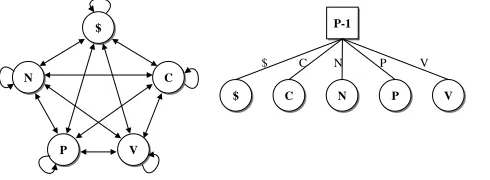
classes or the lexical form of preceding words. Fig-ure 3 shows an example of Markov model for a sim-ple language having nouns (N), conjunctions (C),
prepositions (P) and verbs (V). The dollar sign ($)
represents sentence initialization. On the left hand side is the graph representation of the Markov model and on the right hand side is the decision tree repre-sentation, where the test for the immediately preced-ing syntactic class (represented by P-1) is placed on the root, each branch represents a result of the test (which is labeled on the arc), and the correspond-ing leaf node contains the probabilistic distribution of the syntactic classes for the current position2.
The example shown in figure 4 involves a further classification of context. On the left hand side, it is represented in terms of state splitting, while on the right hand side in terms of context extension (lexi-calization), where a context class representing con-textual patterns ending in P (a preposition) is ex-tended by referring the lexical form and is classi-fied again into the preposition, out and other prepo-sitions.
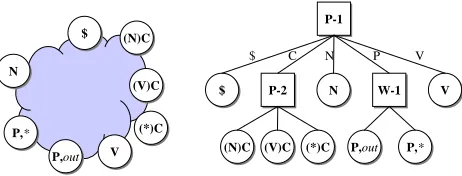
Figure 5 shows another further classification of
2
The distribution doesn’t appear in the figure explicitly. Just imagine each leaf node has the distribution for the target feature in the corresponding context.
context. It involves a homogeneous extension of context while the previous one involves a hetero-geneous extension. Unlike prediction suffix trees which grow along an implicitly fixed order, decision trees don’t presume any implicit order between con-textual features and thus naturally can accommodate various features having no underlying order.
In order for a statistical decision tree to be a Markov model, it must meet the following restric-tions:
• There must exist at least one contextual feature that is homogeneous with the target feature.
• When the target feature at a certain time is clas-sified, all the requiring context features must be visible
The first restriction states that in order to be a Markov model, there must be inter-relations be-tween the target features at different time. The sec-ond restriction explicitly states that in order for the decision tree to be able to classify contextual pat-terns, all the context features must be visible, and implicitly states that homogeneous context features that appear later than the current target feature can-not be contextual features. Due to the second re-striction, the Viterbi algorithm can be used with the self-organizing Markov models to find an optimal sequence of tags for a given word sequence.
5.2 Learning Self-Organizing Markov Models
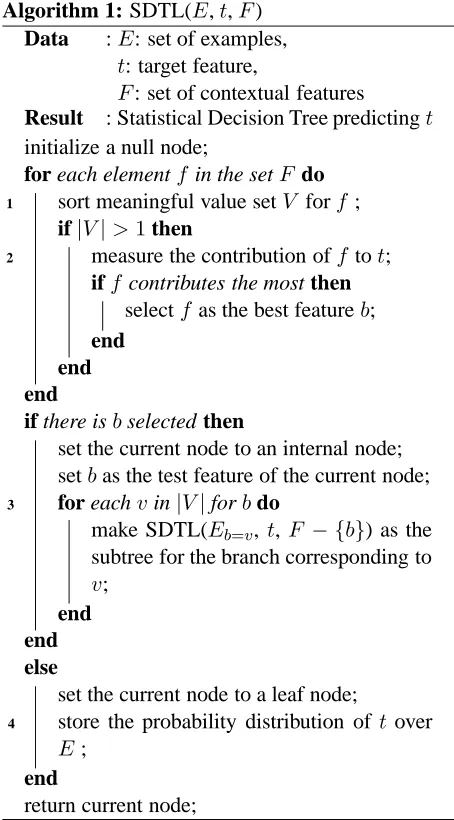
Self-organizing Markov models can be induced from manually annotated corpora through the SDTL algorithm (algorithm 1) we have designed. It is a variation of ID3 algorithm (Quinlan, 1986). SDTL is a greedy algorithm where at each time of the node making phase the most informative feature is se-lected (line 2), and it is a recursive algorithm in the sense that the algorithm is called recursively to make child nodes (line 3),
[image:4.612.74.305.167.255.2]with the growing process and eventually raise the sparse data problem.
To deal with this problem, the algorithm incor-porates a value selection mechanism (line 1) where only meaningful values are selected into a reduced value set. The meaningful values are statistically defined as follows: if the distribution of the target feature varies significantly by referring to the value v,vis accepted as a meaningful value. We adopted theχ2-test to determine the difference between the distributions of the target feature before and after re-ferring to the value v. The use of χ2-test enables us to make a principled decision about the threshold based on a certain confidence level3.
To evaluate the contribution of contextual features to the target classification (line 2), we adopted Lopez distance (L´opez, 1991). While other measures in-cluding Information Gain or Gain Ratio (Quinlan, 1986) also can be used for this purpose, the Lopez distance has been reported to yield slightly better re-sults (L´opez, 1998).
The probabilistic distribution of the target fea-ture estimated on a node making phase (line 4) is smoothed by using Jelinek and Mercer’s interpola-tion method (Jelinek and Mercer, 1980) along the ancestor nodes. The interpolation parameters are estimated by deleted interpolation algorithm intro-duced in (Brants, 2000).
6 Experiments
We performed a series of experiments to compare the performance of self-organizing Markov models with traditional Markov models. Wall Street Jour-nal as contained in Penn Treebank II is used as the reference material. As the experimental task is part-of-speech tagging, all other annotations like syntac-tic bracketing have been removed from the corpus. Every figure (digit) in the corpus has been changed into a special symbol.
From the whole corpus, every 10’th sentence from the first is selected into the test corpus, and the re-maining ones constitute the training corpus. Table 6 shows some basic statistics of the corpora.
We implemented several tagging models based on equation (3). For the tag language model, we used
3
We used 95% of confidence level to extend context. In other words, only when there are enough evidences for improve-ment at 95% of confidence level, a context is extended.
Algorithm 1: SDTL(E,t,F)
Data :E: set of examples, t: target feature,
F: set of contextual features
Result : Statistical Decision Tree predictingt initialize a null node;
for each elementf in the setF do
1 sort meaningful value setV forf ;
if|V|>1then
2 measure the contribution off tot;
iffcontributes the most then
selectf as the best featureb;
end end end
if there isbselected then
set the current node to an internal node; setbas the test feature of the current node; 3 for eachvin|V|forbdo
make SDTL(Eb=v, t, F − {b}) as the subtree for the branch corresponding to v;
end end else
set the current node to a leaf node;
4 store the probability distribution of t over
E;
end
return current node;
1,289,201 68,590
Total
129,100 6,859
Test
1,160,101 61,731
Training
1,289,201 68,590
Total
129,100 6,859
Test
1,160,101 61,731
Training
[image:5.612.312.539.59.469.2]the following 6 approximations:
P(t1,k) ≈ k
Y
i=1
P(ti|ti−1) (8)
≈ k
Y
i=1
P(ti|ti−2,i−1) (9)
≈ k
Y
i=1
P(ti|Φ(ti−2,i−1)) (10)
≈ k
Y
i=1
P(ti|Φ(ti−1, wi−1)) (11)
≈ k
Y
i=1
P(ti|Φ(ti−2,i−1, wi−1)) (12)
≈ k
Y
i=1
P(ti|Φ(ti−2,i−1, wi−2,i−1))(13)
Equation (8) and (9) represent first- and second-order Markov models respectively. Equation (10) ∼(13) represent self-organizing Markov models at various settings where the classification functions Φ(•) are intended to be induced from the training corpus.
For the estimation of the tag-to-word translation model we used the following model:
P(wi|ti)
=ki×P(ki|ti)×Pˆ(wi|ti)
+(1−ki)×P(¬ki|ti)×Pˆ(ei|ti) (14)
Equation (14) uses two different models to estimate the translation model. If the word, wi is a known word, ki is set to 1 so the second model is ig-nored. Pˆ means the maximum likelihood probabil-ity. P(ki|ti)is the probability of knownness gener-ated fromtiand is estimated by using Good-Turing estimation (Gale and Samson, 1995). If the word,wi is an unknown word,kiis set to 0 and the first term is ignored.eirepresents suffix ofwiand we used the last two letters for it.
With the 6 tag language models and the 1 tag-to-word translation model, we construct 6 HMM mod-els, among them 2 are traditional first- and second-hidden Markov models, and 4 are self-organizing hidden Markov models. Additionally, we used T3, a tri-gram-based POS tagger in ICOPOST release 1.8.3 for comparison.
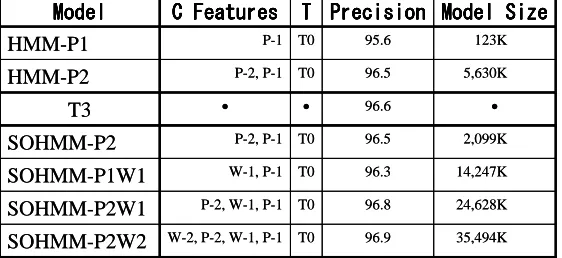
The overall performances of the resulting models estimated from the test corpus are listed in figure 7. From the leftmost column, it shows the model name, the contextual features, the target features, the per-formance and the model size of our 6 implementa-tions of Markov models and additionally the perfor-mance of T3 is shown.
Our implementation of the second-order hid-den Markov model (HMM-P2) achieved a slightly worse performance than T3, which, we are in-terpreting, is due to the relatively simple imple-mentation of our unknown word guessing module4. While HMM-P2 is a uniformly extended model from HMM-P1, SOHMM-P2 has been selectively extended using the same contextual feature. It is encouraging that the self-organizing model suppress the increase of the model size in half (2,099Kbyte vs 5,630Kbyte) without loss of performance (96.5%).
In a sense, the results of incorporating word features (SOHMM-P1W1, SOHMM-P2W1 and
SOHMM-P2W2) are disappointing. The
improve-ments of performances are very small compared to the increase of the model size. Our interpretation for the results is that because the distribution of words is huge, no matter how many words the mod-els incorporate into context modeling, only a few of them may actually contribute during test phase. We are planning to use more general features like word class, suffix, etc.
Another positive observation is that a homo-geneous context extension (SOHMM-P2) and a heterogeneous context extension (SOHMM-P1W1) yielded significant improvements respectively, and the combination (SOHMM-P2W1) yielded even more improvement. This is a strong point of using decision trees rather than prediction suffix trees.
7 Conclusion
Through this paper, we have presented a framework of self-organizing Markov model learning. The experimental results showed some encouraging as-pects of the framework and at the same time showed the direction towards further improvements. Be-cause all the Markov models are represented as de-cision trees in the framework, the models are
hu-4
•
96.6
• •
T3
96.9 96.8 96.3 96.5 96.5 95.6
24,628K T0
P-2, W-1, P-1 SOHMM-P2W1
W-2, P-2, W-1, P-1 W-1, P-1 P-2, P-1 P-2, P-1 P-1
T0 T0 T0 T0 T0
14,247K SOHMM-P1W1
35,494K 2,099K 5,630K 123K
SOHMM-P2
SOHMM-P2W2 HMM-P2 HMM-P1
•
96.6
• •
T3
96.9 96.8 96.3 96.5 96.5 95.6
24,628K T0
P-2, W-1, P-1 SOHMM-P2W1
W-2, P-2, W-1, P-1 W-1, P-1 P-2, P-1 P-2, P-1 P-1
T0 T0 T0 T0 T0
14,247K SOHMM-P1W1
35,494K 2,099K 5,630K 123K
SOHMM-P2
[image:7.612.167.448.26.155.2]SOHMM-P2W2 HMM-P2 HMM-P1
Figure 7: Estimated Performance of Various Models
man readable and we are planning to develop editing tools for self-organizing Markov models that help experts to put human knowledge about language into the models. By adoptingχ2-test as the criterion for potential improvement, we can control the degree of context extension based on the confidence level.
Acknowledgement
The research is partially supported by Information Mobility Project (CREST, JST, Japan) and Genome Information Science Project (MEXT, Japan).
References
L. Rabiner. 1989. A tutorial on Hidden Markov Mod-els and selected applications in speech recognition. in
Proceedings of the IEEE, 77(2):257–285
A. Ratnaparkhi. 1996. A maximum entropy model for part-of-speech tagging. In Proceedings of the
Confer-ence on Empirical Methods in Natural Language Pro-cessing (EMNLP).
V. Vapnik. 1998. Statistical Learning Theory. Wiley, Chichester, UK.
I. Schr¨oder. 2001. ICOPOST - Ingo’s Collection Of POS Taggers. In
http://nats-www.informatik.uni-hamburg.de/∼ingo/icopost/.
T. Brants. 1998 Estimating HMM Topologies. In The
Tbilisi Symposium on Logic, Language and Computa-tion: Selected Papers.
T. Brants. 2000 TnT - A Statistical Part-of-Speech Tag-ger. In 6’th Applied Natural Language Processing.
H. Sch¨utze and Y. Singer. 1994. Part-of-speech tagging using a variable memory Markov model. In
Proceed-ings of the Annual Meeting of the Association for Com-putational Linguistics (ACL).
D. Ron, Y. Singer and N. Tishby. 1996 The Power of Amnesia: Learning Probabilistic Automata with Vari-able Memory Length. In Machine Learning, 25(2-3):117–149.
J.-D. Kim, S.-Z. Lee and H.-C. Rim. 1999 HMM Specialization with Selective Lexicalization. In
Proceedings of the Joint SIGDAT Conference on Empirical Methods in NLP and Very Large Cor-pora(EMNLP/VLC99).
F. Pla and A. Molina. 2001 Part-of-Speech Tagging with Lexicalized HMM. In Proceedings of the
Inter-national Conference on Recent Advances in Natural Language Processing(RANLP2001).
R. Quinlan. 1986 Induction of decision trees. In
Ma-chine Learning, 1(1):81–106.
R. L´opez de M´antaras. 1991. A Distance-Based At-tribute Selection Measure for Decision Tree Induction. In Machine Learning, 6(1):81–92.
R. L´opez de M´antaras, J. Cerquides and P. Garcia. 1998. Comparing Information-theoretic Attribute Selection Measures: A statistical approach. In Artificial
Intel-ligence Communications, 11(2):91–100.
F. Jelinek and R. Mercer. 1980. Interpolated estimation of Markov source parameters from sparse data. In
Pro-ceedings of the Workshop on Pattern Recognition in Practice.
W. Gale and G. Sampson. 1995. Good-Turing frequency estimatin without tears. In Jounal of Quantitative