Munich Personal RePEc Archive
US Worker Co-Operatives and Their
Spans of Management, Decision Making,
and Governance: An Exploratory
Analysis
Lambert, Thomas
University of Louisville, Simmons College of Kentcuky
29 October 2016
Online at
https://mpra.ub.uni-muenchen.de/74816/
1
US Worker Co-Operatives and Their Spans of Management,
Decision Making, and Governance: An Exploratory Analysis
By
Thomas E. Lambert
Chair, Business Programs, Simmons College of Kentucky Louisville, KY 40203
And, Associate Faculty, Economics Department University of Louisville
Louisville, KY 40292 [email protected]
502-776-1443 502-403-9795
Abstract
Much has been written over the years about worker co-operatives as an alternative to traditional forms of
business organization and ownership. The literature has mostly covered the issues of whether worker
co-ops are more productive, more profitable and/or have a longer existence than traditional firms. This paper
tries to fill some gaps in the literature by covering topics rarely if ever mentioned in writings on worker
co-ops by exploring their spans of management, their decision making with regard to investment and
hiring, and the governance input from their local communities. The results from a recent survey are
interesting from an organizational behavior or institutional perspective in that worker co-ops show
themselves generally to be different from most of their counterparts.
Key words: entrepreneurship, community, small business, span of management, worker co-operatives,
JEL Codes: P13, R11
2 Introduction
There is a vast literature on worker co-operatives and their presence in different nations over
time. Worker co-operatives as a business organization are probably as old as many other traditional, legal
forms of business (proprietorships, partnerships, and corporations, for example)1 and yet comprise only a
small portion of most businesses in most countries (Pencavel, Pistaferri, and Schivardi 2006, Wolf 2012,
Ranis 2016). This is especially true in the United States where co-ops have their smallest numbers in the
developed world. There are probably only around 200 to 300 or so in existence in the US (Democracy at
Work Institute 2015, Ranis 2016).
In an older set of studies, Thornley (1981) finds mixed results with regard to the success of
worker coops in the UK, France and Italy and writes that many of the longer lasting ones are confined to
sectors of the economy that were quasi-governmental. Gamson and Levin (1984) note the short lives of
most US worker cooperatives and make recommendations on how their survival rates can be raised.
These authors also identify a lack of governmental policy support that are available to other types of firms
(most importantly different types of worker training by schools) which would otherwise help worker
cooperatives to succeed over the long haul. Jackall and Levin (1984) and Whyte and Blasi (1980) also
note that worker access to unemployment benefits to buy firms for worker coop use would be a boost to
the number of worker coops in the US as well as an avenue to solving US unemployment problems.
Wolff (2012) cites the Marcora laws of Italy as an example of where laid off workers can have access to
unemployment benefits in a lump sum in order to purchase a business with other laid off workers.
According to more recent writings, most co-ops (in the US or elsewhere) tend to be more
productive and efficient (Pencavel 2001 and 2012, Perotin 2015); tend to have lower ratios of managerial
1 Marcuse (2015) writes that co-ops have long been viewed as a form of true socialism and an alternative to
3 to lower level worker pay2 (Pencavel 2001, Perotin 2015, Ranis 2016, Wolff 2012); and tend to have
lower employee turnover and layoff rates and higher morale when compared to their counterparts (Wolff
2012, Ranis 2016). Some writers have speculated that worker coops could be an alternative to welfare
state capitalism (Thomas and Logan 1982, Pencavel 2001). However, worker co-ops have challenges
with regard to obtaining financing and capital from banks and from staying away from outside investors,
and can have risk averse employees, and so supposedly can suffer from under investment (Pencavel 2001,
Adder 2010, US Small Business Administration n.d.). This in turn may be one key reason why most
co-ops are so small and why there are so few co-co-ops in many nations throughout the globe and why co-co-ops
do not invest as heavily as they should in new equipment and technology (Adder 2010, Pencavel 2001
and 2012).3 Additionally, a few argue that some co-ops under invest because many forms of new
equipment and technology could be “labor-saving”, and yet many co-ops are formed as a way of saving
the jobs of employees of a firm about to close and/or have as a goal the retention of as many jobs as
possible of worker-owners (Pencavel 2001, Ranis 2016). That is, any labor saving investments are often
avoided because these innovations could result in a co-op possibly having unnecessary labor, which
would also mean unnecessary owners since co-ops are mostly started by and composed of worker-owners.
Also some worker co-ops have had to face a dilemma that comes with expansion and growth in that a
decision must be made as to whether new employees to the firm should be worker-owners or just workers
who have no stake in ownership and perhaps no or little voting rights in the co-op. The scenario of
adding more workers who have little or no ownership or say in the co-op is often called “degeneration” because the co-op is thought to be moving toward a more traditional form of private sector ownership
where owners and workers are separate (Pencavel 2001 and 2012). Finally, although Rothschild and
Whitt (1986) in their survey of five worker collective in California find that worker co-ops have generally
high levels of morale, comradery, and beliefs in mission, freedom in creativity, and freedom from too
2
Although overall worker pay is lower on average when compared to other comparable firms (Pencavel, Pistaferri, and Schivardi 2006).
3
4 much supervision, they also find less satisfaction among worker co-op members with regard to the
efficiency of decision making in their firms, their levels of job security, and work pressure and stress that
comes from competitors. Stress for members is also found to emanate from the responsibilities of being
both a worker and owner, and having to work in a close-knit operation where everyone knows everyone
else’s business.
A lot of research shows the employees of many co-ops tend to be very homogeneous with regard
to their education, skills and backgrounds (Pencavel 2001 and 2012). These characteristics are noted as
reasons why some co-ops form more easily than others and can last over a longer period of time than
others. That is, it often appears that a more homogenous group can persevere over time more easily than
a more heterogeneous one. Rothschild and Whitt (1986) note that co-op formation often involves a
certain amount of self-selection on the part of co-op members in that many of them are idealistic. Again,
and perhaps more importantly, is the fact that some nations support the formation of worker co-ops
through legislation which grants tax breaks to existing co-ops or gives grants to the unemployed to help
them form worker co-ops. Often the laid off workers are those who have already been together for some
time and know each other and have been thrown out of work by their employer either going bankrupt or
closing a facility. According to Wolff (2012), in this way Italy and other European governments have
traditionally been more supportive of co-ops than many other governments. Ranis (2016) writes about
how Mondragon, a huge worker co-operative in Spain, has received tax breaks and trade protection from
the Spanish government over the years. He also cites instances of one form of government support or
another for co-ops in Argentina and under market reforms recently enacted in Cuba.
In the US, government support for worker co-ops has so far been limited to local government
initiatives in mostly California, New York, and a few other states, which could be another reason for the
small number of co-ops in the US (Alperovitz 2011, Ranis 2016). Ranis (2016), however, still believes
that worker co-ops can still thrive and grow in numbers in the US in the future if local communities use
5 bankrupting) and in turn sell these to the employees after compensating the exiting the firm. According to
Ranis, eminent domain has been used before and upheld by courts as a means for local economic
development in addition to local public interests in health, sanitation and safety. For many years, eminent
domain has been used to condemn and clean up toxic sites and to take over areas prone to flooding.
Recently, local governments have been permitted to use it to take over areas in the name of economic
development, such as building or expanding ports or expanding industrial parks. To save jobs and its tax
base, a local government can take and have taken over property if it serves a compelling interest and
yields a public benefit. In this case, private property rights can be trumped by community interests
through eminent domain if a public interest is served by the government’s taking of private property. Of course, property owners have to be justly compensated.
Many scholars have implied to one degree or another the notion that because worker co-ops
practice democratic decision making, the span of management or number of managers per employees at a
co-op should be less than that of comparable firms (Wolff 2012). Campbell (2011) notes the major
principles of worker participation that characterize the Mondragon conglomerate in which all employees
have a say in management through a culture of participation and the elections of managers.4 In fact, some
have criticized the private sector in the US as having too many managers when compared to other nations
(Gordon 1996) and/or have argued that the main reason for so many managers is that owners do not have
enough confidence in the employees in their firms, and so managers are hired to oversee and monitor
workers (Braverman 1974, Marglin 1974, and Gordon 1996). However, there has been little
measurement regarding the implicit assumption on co-ops having fewer managers per employee. Also,
among most writers, democratic decision making is a given characteristic of co-ops, yet details on how
most co-ops make democratic decisions (majority vote, consensus, elections of boards of directors and/or
management teams, etc.) are not well known and documented. Next, whether many co-ops forego labor
4 Ranis (2016), however, points out that over the last few years, Mondragon has experienced some degeneration
6 saving investments in technology or new equipment in order to avoid losing employees has only been
explored in a few studies of certain co-ops, but has not been researched systematically (Pencavel 2001).
Finally, many writers such as Wolff (2012) and Ranis (2016) have written about certain co-ops, whether
in the US or elsewhere, being involved in their communities and how such involvement is a key to the
long term survival of and proliferation of co-ops. MacLeod (1997) and Cheney (1999) believe that the
Mondragon conglomerate has been successful in part because of its community base, origins, and
involvement as was well as its employee ownership and participation. At the same time, communities are
usually noted as being supportive of local co-op aims and objectives. Yet not much is known about how
common co-op participation is in US communities where co-ops exist, especially if community groups
have a presence on co-op boards or co-op management teams. This exploratory paper attempts to provide
some preliminary findings and information on these issues.
Methods and Results
During the period of September 6, 2016 to September 30, 2016, an e-mail survey and any follow
up or reminder messages to any non-respondents were sent via Survey Monkey to 231 worker co-ops
which are members of the US Federation of Worker Co-operatives (https://usworker.coop/home/ ).
Around 40 to 50 respondents answered most of the questions of the survey for a response rate of
approximately 16 to 21%, which should insure some degree of confidence in the results for some
questions. A copy of the survey is provided in the Appendix.
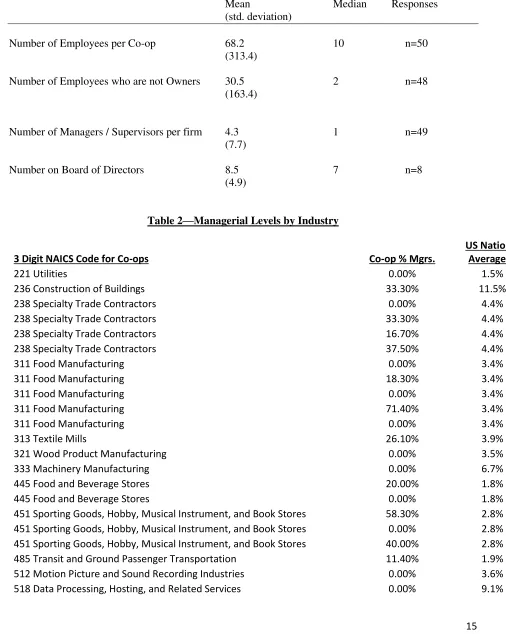
Table 1 shows the descriptive statistics for some of the characteristics of the co-ops responding to
the survey. As can be seen, most of the co-ops are very small. In fact, since the date are skewed by one
op which had over 2,000 employees, perhaps the median is a better indicator of how most of the
co-ops appear in reality. The median number of employees is around ten5 with around two who are not also
owners. Using the median, about 1 in 10 is a manager, and only 8 co-ops out of around 50 responded that
5
7 they have a board of directors. These boards typically have around 7 or 8 members. Given the small size
of the co-ops in general, one would not expect that many to have boards.
(Insert Table 1 around here)
More elaboration is probably needed on the number of managers or supervisors per co-op.
According to the US Bureau of Labor Statistics (BLS) (2015), in May 2015 about 5% of all occupations
in the US were those of managers. The question in the survey for this paper asked respondents how many
employees of the co-op are in a management or supervisory position and have subordinates reporting to
them. The results of the survey show for all 50 firms that there are 208 managers to 3,343 owners and
employees (not owners), which at 6.2% is not so much different from the US average of around 5%.
However, using 2015 BLS data on an industry by industry level, some of the co-ops of the 47 that
identified their principal type of industry showed managerial levels higher than the national averages for
certain industries (see Table 2). This is a surprise given the co-ops’ small sizes and due to the fact that co-ops are supposed to be more democratic than other types of firms which would imply less supervisors
per employee. Even using the overall medians of 1 manager/supervisor per firm and 10 employees per
firm would yield 10% for the overall level of management intensity. Of course, if one uses the mode
from Table 2, then the typical span of management at co-ops is basically zero. In general, and for the
question of how management intensive or what is the overall span of management for co-ops, the survey
shows mixed results, although the large portion of firms reporting no managers at all (23 out of 47
answering the question) would indicate that many have no or very few managers, something that would
be likely expected in a participatory and democratic work setting.
(Insert Table 2 around here)
With regard to how strategic decisions are made in co-ops, Table 3 shows that a majority (around
75%) of the firms either use some type of majority voting or consensus formation. Only around 17 to
18% reported that strategic decisions are made by a board or a top management team. In this case, and in
8 worker co-ops are more like “worker collective” forms of co-ops. Table 4 indicates that a monthly meeting to make decisions is the norm in the workers co-ops Weekly meetings are the second most
common frequency of meetings.
(Insert Tables 3 and 4 around here)
Table 5 shows some interesting results for those who advocate worker co-op involvement and
community input through having community representatives on co-op boards or management teams. Of
the eight firms who indicated that they have boards of directors or management teams, only two said that
they had a board member(s) or member(s) of a management team who represented community interests or
a community group(s). Only one co-op had an active community organization(s) in that co-op’s strategic decision making (see Table 6). Table 7 shows that of two co-ops with community input, one
representative does not have any veto power over co-op decisions whereas the other one does. Finally,
only one co-op with a board answered the question of whether workers can over-ride or ignore board or
top management decisions with an answer of “Disagree” (Table 8). In summary, not many co-ops appear to have boards or top management teams (8 out of 50), and of those, community groups only appear to
have a great deal of influence in one co-op’s decision making.
(Insert Tables 5, 6, 7 and 8 around here)
Around two-thirds of the co-ops indicated that capital decisions are made in such a way so as to
avoid making labor extraneous or redundant (see Table 9), and slightly over 70% either agree or disagree
with the statement that employment stability and avoiding layoffs or cuts in hours take priority over
profitability (Table 10). Finally, Table 11 displays the results of answers to the question of whether
co-ops try to avoid layoffs and terminations when faced with a downturn in business by reducing jobs and/or
hours worked. More than 80% of the respondents either agreed or strongly agreed that this was the case
in their firm. The notion that co-ops are created to save jobs as a first priority of co-op worker-members
9 (Insert Tables 9, 10, and 11 around here)
Additionally co-ops were asked about whether competition from non-cooperatives was a concern
and into which US Census Bureau 3 digit NAICS industry would they classify their main business
operations (Tables 12 and 13 respectively). Around 55% of the co-ops indicated that competition from
non-coops was a concern on their part by indicating either “Agree” or “Strongly Agree” to the question. As can be seen from Table 13, most of the co-ops were in a wide variety of industries with those
industries having the highest frequencies of co-ops as including food services and drinking places, food
and manufacturing and other types of manufacturing (textiles, wood products, machinery), different forms
of retailing, different forms of personal and home services, and professional services. Some of these
industries require a lot of investment in equipment and technology whereas others do not.
Discussion
In this exploratory research, it appears that worker co-ops that responded to the survey do uphold
or believe in the values of job retention of worker-members even if it means the sacrifice of productivity
enhancing investment (at the cost of labor) or greater profits. In general, their span of or intensity of
management appears to be the same as or much less (many indicating 0 managers) than their private
sector counterparts, although some reported higher than average numbers. Many worried about
competition from their non-coop private sector counterparts. The discouraging news for those who
advocate for more worker co-operatives in the US is the lack of those co-ops responding that they have a
representative or several representatives from the local community who serve as board or top
management members, although only around 8 co-ops had boards. This is not to say that co-ops are not
involved in their local communities, and worker-members could be active in their local communities in
different roles and in different civic organizations. However, one purpose of the survey was to assess
how much formal input and support community groups give to co-operatives. It was thought that a
10 that way community organizations would be providing some guidance and direction to the co-ops. This
was not found to be the case. More research would have to be done to discover whether co-ops want
and/or have this type of community input, and if so, to what degree. As pointed out earlier, many believe
that unless co-ops gain political and social support in their local communities, then their futures are
limited in that they will never gain any type of political clout that may help their long term interests and
survival. Such clout can also serve to help with the proliferation of other co-operatives throughout the
US. Of course, many co-ops may be choosing other forms of community input and support rather than
having community board members. In fact, if the survey results from this paper may be generalized, most
do not have boards or top management teams in the first place.
Although the official unemployment rate in the United States as of September 2016 was around
5.0% (US Bureau of Labor Statistics 2016), the underemployment rate (unemployment rate + the portion
of the labor force working part time yet wanting to work full time + those wanting to work but who have
given up looking for work) measured around 9.7% (Shierholz 2016). Perhaps more importantly, after
hovering at around two-thirds of the civilian labor force for several decades, the US employment rate is
now around 63%, although some credit the drop in the rate to the retirement of many members of the
baby-boomer generation (Kiersz 2016). Yet at the same time, despite a wave of baby-boomer
retirements, those members of the civilian labor force in their twenties (the millennial generation, who
now make up the largest age group in the US) have struggled in the labor market and make up a
disproportionate number of the underemployed (Gandel 2016). Therefore, perhaps not all of the drop in
the civilian labor participation rate may be due to large number of baby boomer retirements.
The drop in the civilian labor force participation rate could signal other problems in the US
economy, such as a low job growth rate since the last recession. If employers are not generating enough
jobs and hiring at a rate to absorb all of those able, willing and wanting to work, then perhaps one
alternative path to gaining a livelihood for many individuals is through self-employment or by joining
11 many who have been marginalized in the search for meaningful and gainful employment, and along with
Stern, Wood, and Hammer (1979), MacLeod (1997), Alperovitz (2011), and Ranis (2016), believes that
worker co-ops are one possible solution to the disinvestment by large companies of their capital and
facilities in many communities throughout the US. This disinvestment is occurring in many regions even
though many operations are still profitable (Stern, Wood, and Hammer 1979, Ranis 2016, Wolff 2012).
The problem is that in the eyes of many private sector investors, many of these operations may not be
profitable enough, and so they are moved elsewhere, usually where labor costs are lower, whether in the
US, or more and more frequently, overseas. Although entrepreneurism is very challenging, small start-up
businesses can be successful, especially if a group of people with similar or homogeneous goals and
objectives can collectively share their talents and resources to form a business. Their chances of success
may be higher than if one individual tries by himself or herself whether with or without employees. For
many regions in the US, an increase in the presence of worker co-ops may also help these communities
economically when they faced with capital disinvestment and the resultant job losses (and tax revenue
12 References
Adder, Black. 2010. “Why Aren’t There More Worker Co-ops?” The American Catholic: Politics and Culture from a Catholic Perspective. May 10, 2010. http://the-american-catholic.com/2010/05/10/why-arent-there-more-worker-co-ops/ . Accessed on October 22, 2016.
Alperovitz, Gar. 2011. America Beyond Capitalism: Reclaiming Our Wealth, Our Liberty, and Our Democracy, 2nd Edition. Takoma Park, Maryland and Boston, Massachusetts: Democracy Collaborative Press and Dollars and Sense, respectively.
Braverman, Harry. 1974. Labor and Monopoly Capital: The Degradation of Work in the Twentieth Century. New York, NY: Monthly Review Press.
Campbell, Al. 2011. “The Role of Workers in Management: The Case of Mondragon.” Review of Radical Political Economics, 43(3): 328-333
Cheney, George. 1999. Values at Work: Employee Participation Meets Market Pressure at Mondragon. Ithaca, New York: Cornell University Press.
Democracy at Work Institute. 2015. “US Worker Cooperatives: A State of the Sector.” Democracy at Work Institute Research Publication Series. March 9, 2015. http://institute.coop/news/us-worker-cooperatives-state-sector . Accessed on October 22, 2016.
Gamson, Zelda F. and Henry M. Levin. “Obstacles to the Survival of Democratic Workplaces.” Chapter
9 of Worker Cooperatives in America. Robert J. Jackall and Henry M. Levin, editors. Berkley, California: University of California Press.
Gandel, Stephen. 2016. “OMG, Young Millennials Are the Job Market's Biggest Losers.” Fortune. March 4, 2016. http://fortune.com/2016/03/04/young-millennials-job-market-losers/ . Accessed on October 21, 2016.
Gordon, David M. 1996. Fat and Mean: The Corporate Squeeze of Working Americans and the Myth of
Managerial “Downsizing”. New York, New York: The Free Press.
Jackall, Robert and Henry M. Levin. “The Prospects for Worker Cooperatives in the United States.” Chapter 12 of Worker Cooperatives in America. Robert J. Jackall and Henry M. Levin, editors. Berkley, California: University of California Press.
Kiersz, Andy. 2016. “Labor Force Participation Falls to the Lowest Level of this Year. Business Insider. June 3, 2016. http://www.businessinsider.com/labor-force-participation-rate-may-2016-2016-6 .
Accessed on October 21, 2016.
MacLeod, Greg. 1997. From Mondragon to America: Experiments in Community Economic Development. Sydney, Nova Scotia, Canada: University College of Cape Breton Press.
Marcuse, Peter. 2015. “Cooperatives: On the Path to Socialism?” Monthly Review, 66(9) February 1, 2015. http://monthlyreview.org/2015/02/01/cooperatives-on-the-path-to-socialism/ . Accessed on October 22, 2016.
13 Pencavel, John. 2001. Worker Participation: Lessons from the Worker Co-ops of the Pacific Northwest. New York: Russell Sage Foundation.
Pencavel, John. 2012. “Worker Cooperatives and Democratic Governance.” Stanford Institute for
Economic Policy Research (SIEPR), Stanford University, SIEPR Discussion Paper No. 12-003. http://siepr.stanford.edu/research/publications/worker-cooperatives-and-democratic-governance . Accessed on October 22, 2016.
Pencavel, John, Luigi Pistaferri, and Fabianao Chivardi. 2006. “Wages, Employment, and Capital in Capitalist and Worker-Owned Firms.” Institute for the Study of Labor (IZA), Discussion Paper No 2188, June 2006. Bonn, Germany. https://ideas.repec.org/p/iza/izadps/dp2188.html . Accessed on October 22, 2016.
Perotin, Virginie. 2015. “What Do We Really Know About Workers’ Cooperatives?” ILO-ICA Research Conference on Cooperatives and the World of Work, Antalya (Turkey) 9-10 November 2015. http://ccr.ica.coop/sites/ccr.ica.coop/files/attachments/5.3Virginie%20Perotin%20What%20Do%20we%2 0Really%20Know%20ilo%20ica.pdf . Accessed on October 23, 2016.
Ranis, Peter. 2016. Cooperatives Confront Capitalism: Challenging the Neoliberal Economy. London, UK: Zed Books.
Rothschild, Joyce and J. Allen Whitt. 1986. The Cooperative Workplace: Potentials and Dilemmas of Organizational Democracy and Participation. Cambridge, United Kingdom: Cambridge University Press.
Sherholz, Heidi. 2016. “What is the Real Rate of Unemployment?” US Department of Labor Blog.
September 6, 2016. https://blog.dol.gov/2016/09/06/what-is-the-real-unemployment-rate/ . Accessed on October 21, 2016.
Stern, Robert N., K. Haydn Wood, and Tove Helland Hammer. 1979. Employee Ownership in Plant Shutdowns: Prospect for Employment Stability. Kalamazoo, Michigan: W. E. Upjohn Institute.
Thomas, Henk and Chris Logan. 1982. Mondragon: An Economic Analysis. London, United Kingdom: George Allen and Unwin in co-operation with The Institute of Social Studies at the Hague.
Thornley, Jenny. 1981. Workers’ Cooperatives: Jobs and Dreams. London, United Kingdom: Heinemann Educational Books, Ltd.
US Bureau of Labor Statistics. 2015. Occupational Employment Statistics, May 2015.
http://www.bls.gov/oes/tables.htm . Accessed on October 22, 2016.
US Bureau of Labor Statistics. 2016. “The Employment Situation – September 2016.” News Release, US Bureau of Labor Statistics. October 7, 2016. http://www.bls.gov/news.release/pdf/empsit.pdf . Accessed on October 21, 2016.
US Small Business Administration. No Date. “Choose Your Business Structure: Cooperative.”
https://www.sba.gov/starting-business/choose-your-business-structure/cooperative . Accessed on October 22, 2016.
Whyte, William Foote and Joseph Blasi. 1980. “From Research to Legislation on Employee
Legislation.” Economic and Industrial Democracy 1 (August): 395-416.
14
15 Table 1 – Descriptive Statistics
Mean Median Responses (std. deviation)
Number of Employees per Co-op 68.2 10 n=50
(313.4)
Number of Employees who are not Owners 30.5 2 n=48
(163.4)
Number of Managers / Supervisors per firm 4.3 1 n=49
(7.7)
Number on Board of Directors 8.5 7 n=8
[image:16.612.63.569.110.744.2](4.9)
Table 2—Managerial Levels by Industry
3 Digit NAICS Code for Co-ops Co-op % Mgrs.
US National Average %
221 Utilities 0.00% 1.5%
236 Construction of Buildings 33.30% 11.5%
238 Specialty Trade Contractors 0.00% 4.4%
238 Specialty Trade Contractors 33.30% 4.4%
238 Specialty Trade Contractors 16.70% 4.4%
238 Specialty Trade Contractors 37.50% 4.4%
311 Food Manufacturing 0.00% 3.4%
311 Food Manufacturing 18.30% 3.4%
311 Food Manufacturing 0.00% 3.4%
311 Food Manufacturing 71.40% 3.4%
311 Food Manufacturing 0.00% 3.4%
313 Textile Mills 26.10% 3.9%
321 Wood Product Manufacturing 0.00% 3.5%
333 Machinery Manufacturing 0.00% 6.7%
445 Food and Beverage Stores 20.00% 1.8%
445 Food and Beverage Stores 0.00% 1.8%
451 Sporting Goods, Hobby, Musical Instrument, and Book Stores 58.30% 2.8% 451 Sporting Goods, Hobby, Musical Instrument, and Book Stores 0.00% 2.8% 451 Sporting Goods, Hobby, Musical Instrument, and Book Stores 40.00% 2.8%
485 Transit and Ground Passenger Transportation 11.40% 1.9%
512 Motion Picture and Sound Recording Industries 0.00% 3.6%
16
541 Professional, Scientific, and Technical Services 0.00% 8.4%
541 Professional, Scientific, and Technical Services 60.00% 8.4%
541 Professional, Scientific, and Technical Services 0.00% 8.4%
562 Waste Management and Remediation Services 10.00% 4.9%
722 Food Services and Drinking Places 100.00% 2.3%
722 Food Services and Drinking Places 0.00% 2.3%
722 Food Services and Drinking Places 50.00% 2.3%
722 Food Services and Drinking Places 17.90% 2.3%
722 Food Services and Drinking Places 0.00% 2.3%
722 Food Services and Drinking Places 0.00% 2.3%
813 Religious, Grant-making, Civic, Professional, and Similar Organizations 14.30% 9.9%
Other (please specify) 66.70%
Other (please specify) 1.40%
Other (please specify) 8.50%
Other (please specify) 50.00%
Other (please specify) 0.00%
Other (please specify) 0.00%
Other (please specify) 0.00%
Other (please specify) 0.00%
Other (please specify) 77.80%
Other (please specify) 0.00%
Other (please specify) 0.00%
Other (please specify) 80.00%
Other (please specify) 0.00%
Other (please specify) 41.70%
17 Table 3
Our co-op makes all strategic decisions (product, pricing, capital investment, wages and benefits, etc.) through:
Answer Options Response Percent
Response Count Majority (51% or more) vote of worker-members or
worker-owners without regard to each member’s seniority, hours worked, and/or amount of ownership.
39.1% 18
Majority (51% or more) vote of worker-members or worker-owners with some consideration of each
member’s seniority, hours worked, and/or amount of
ownership. That is, a member votes his/her shares, hours worked, and/or number of years served in the firm.
6.5% 3
Through a board or top management team or another entity elected by worker-members or worker-owners by some type of voting scheme.
17.4% 8
Other (please specify) 37.0% 17 answered question 46
skipped question 5
Other responses:
*Modified Consensus (Consensus minus 1) of worker-owners without regard to each member’s seniority, hours worked, and/or amount of ownership.
*A large portion of our workforce is unionized so wages and benefits for that group are done through a collective bargaining process…outside of the unionized workforce the decisions are made “through a board or top management team or another entity elected by worker-members or worker-owners by some type of voting scheme.
*The board of directors makes all decisions about wages and all board decisions are by majority vote. *Consensus
*Consensus: Consent of all worker-members or worker-owners without regard to each member’s seniority, hours worked, and/or amount of ownership.
*consensus
*Formal consensus (100%) of members and prospective members without regard to each member’s
seniority, hours worked, and/or amount of ownership. *consensus
*Consensus of the full worker-ownership body.
*Through a vote of all members, with 100% of the vote needed to pass. *Consensus (-1)
*Primarily a majority decision making process without regard for seniority, etc. however, we strive for consensus and have only once had a decision occur that wasn’t consensual and instead required the majority vote. Following that decision the dissenting member left, so you might say it’s always consensus based
*consensus decision making process of worker-owners, input welcome by other members, fall back is super majority
*We use Holacracy for governance.
18
*Consensus of all members *consensus among worker owners
Table 4
Our co-op makes strategic decisions (product, pricing, capital investment, wages and benefits, etc.) through:
Answer Options Response Percent
Response Count
Weekly meetings of members (all members or a
quorum of members). 19.0% 4 Monthly meetings of members (all members or a
quorum of members). 57.1% 12 Quarterly meetings of members (all members or a
quorum of members). 0.0% 0
Once a year meetings of members (all members or a
quorum of members). 4.8% 1
No pre-determined meeting dates or schedule. Co-op members meet whenever needed on different issues..
0.0% 0
Other (please specify) 19.0% 4 answered question 21
skipped question 30
Other responses:
*biweekly meetings of members *Bi monthly
*Most day-to-day decisions are made be elected managers with informal consultation with other members as needed. Monthly meetings cover larger issues
19 Table 5
Our board or top management team has a representative or several representatives from a community organization or community organizations or other types of organization(s) who are not worker-owners or worker-members of the co-op nor representatives of creditors or outside investors, etc.
Answer Options Response Percent
Response Count
Yes 12.5% 1
No 75.0% 6
Other (please specify) 12.5% 1 answered question 8
skipped question 43
Other responses:
[image:20.612.298.451.421.551.2]Our board has 3 outside seats (of 6), but our board does not make most of the strategic decisions you described earlier. Our board sets benchmarks for budget, capital, compensation etc., but our 2 Executive Directors make most decisions (products, pricing, salary & benefits). We have a separate Management Team (about 7 Department Directors) who advise the Eds
Table 6
Please indicate your level of agreement or disagreement with the following statement. “The representative(s) of the community organization(s) and/or other group(s) actively participate(s) in the co-op’s strategic decision making.”
Answer Options Response Percent
Response Count
Strongly Disagree 0.0% 0
Disagree 0.0% 0
Neither Agree/Disagree 0.0% 0
Agree 0.0% 0
Strongly Agree 100.0% 1
Other (please specify) 0.0% 0 answered question 1
20 Table 7
Please indicate your level of agreement or disagreement with the following statement. “The
representative(s) of a (the) community group(s) has/have veto power over strategic decisions made by the co-operative. That is, that individual has or those individuals have the power to negate any decisions made by or undertaken by the workers.”
Answer Options Response
Percent Response Count
Strongly Disagree 50.0% 1
Disagree 0.0% 0
Neither Agree/Disagree 0.0% 0
Agree 50.0% 1
Strongly Agree 0.0% 0
Other (please specify) 0.0% 0
answered question 2 skipped question 49
Table 8
Please indicate your level of agreement or disagreement with the following statement. “ Worker-members can override decisions made by the board or top management by vote or can choose to ignore board or top management decisions.”
Answer Options Response
Percent Response Count
Strongly Disagree 0.0% 0
Disagree 100.0% 1
Neither Agree/Disagree 0.0% 0
Agree 0.0% 0
Strongly Agree 0.0% 0
Other (please specify) 0.0% 0
21 Table 9
Please indicate your level of agreement or disagreement with the following statement. “If funding/financing is available, capital investment decisions in plant, equipment, and technology are undertaken without regard to how these investments will impact current or future employment/staffing levels at the co-op. That is,
investment decisions are undertaken regardless of whether the new investment results in the need for less or more labor in terms of hours or people.”
Answer Options Response Percent
Response Count
Strongly Disagree 34.8% 16
Disagree 32.6% 15
Neither Agree/Disagree 10.9% 5
Agree 15.2% 7
Strongly Agree 4.3% 2
Other (please specify) 2.2% 1 answered question 46
skipped question 5
Other responses:
Our mobile catering business does not yet have many opportunities to employ “labor eliminating/saving” technology. In cases where we have, a dough mixer for example, it has been to fill a shortage of labor. No consideration was given to hypothetical future employees who might want to mix dough by hand.
Table 10
Please indicate your level of agreement or disagreement with the following
statement. “At our co-op, employment stability and avoiding layoffs or cuts in hours take priority over profitability.”
Answer Options Response Percent
Response Count
Strongly Disagree 2.2% 1
Disagree 10.9% 5
Neither Agree/Disagree 13.0% 6
Agree 28.3% 13
Strongly Agree 43.5% 20
Other (please specify) 2.2% 1 answered question 46
skipped question 5
Other responses:
[image:22.612.299.454.508.644.2]22 Table 11
Please indicate your level of agreement or disagreement with the following
statement. “If faced with a downturn in business, and if necessary, hours or wages are reduced in the co-op in order to avoid laying off or terminating the employment of worker-members.”
Answer Options Response Percent
Response Count
Strongly Disagree 0.0% 0
Disagree 4.4% 2
Neither Agree/Disagree 4.4% 2
Agree 33.3% 15
Strongly Agree 48.9% 22
Other (please specify) 8.9% 4 answered question 45
skipped question 6
Other responses:
*It truly depends on how bad the downturn is…we have implemented both options at different times depending on how deep the hole was/is. In one case we across the board reductions was sufficient and in another case we had to lay staff off because further reducing hours/wages was not an option.
*Wages have never been reduced, we just now for the first time in 28 years have decided to close one day a week.
*agree in spirit but in practice – we’d implement a hiring and salary freeze first, then layoff temps, before cutting wages or hours.
*don’t know never had a downturn
Table 12
Please indicate your level of agreement or disagreement with the following statement. “Our co-op coop members worry about competition from non-coop enterprises producing same or similar products.”
Answer Options Response Percent
Response Count
Strongly Disagree 8.9% 4
Disagree 17.8% 8
Neither Agree/Disagree 15.6% 7
Agree 40.0% 18
Strongly Agree 15.6% 7
Other (please specify) 2.2% 1 answered question 45
skipped question 6
Other responses:
23 Table 13
Using the drop down tab below, please choose the industrial code which best reflects
your firm’s main area of business.
Answer Options Response Percent
Response Count
221 Utilities 2.3% 1
236 Construction of Buildings 2.3% 1 238 Specialty Trade Contractors 9.1% 4 311 Food Manufacturing 11.4% 5
313 Textile Mills 2.3% 1
321 Wood Product Manufacturing 2.3% 1 333 Machinery Manufacturing 2.3% 1 442 Furniture and Home Furnishings Stores 2.3% 1 445 Food and Beverage Stores 4.5% 2 451 Sporting Goods, Hobby, Musical Instrument,
and Book Stores 6.8% 3
485 Transit and Ground Passenger Transportation 2.3% 1 512 Motion Picture and Sound Recording Industries 2.3% 1 518 Data Processing, Hosting, and Related Services 2.3% 1 541 Professional, Scientific, and Technical Services 6.8% 3 562 Waste Management and Remediation Services 2.3% 1 722 Food Services and Drinking Places 13.6% 6 813 Religious, Grant-making, Civic, Professional,
and Similar Organizations 2.3% 1 814 Private Households 4.5% 2 Other (please specify) 18.2% 8
answered question 44 skipped question 7
Other responses:
*Elder care and companionship *Home Health/Personal Care Services *Supportive Home Care
*Cleaning Services (home or business) *IT support, data recovery, computer repair, etc.
*web development
24 Appendix
Dear Sir/Madam:
You are invited to participate in this survey about worker co-operatives so as to help business educators and researchers better understand the decision making processes at these unique institutions. Your participation in the survey on behalf of your enterprise should take no more 10 minutes. We are truly grateful for your participation.
Human Subjects Statement: This survey does not ask any questions about or to individuals or human subjects. Questions answered are about institutions. Nonetheless, if at any time you feel
uncomfortable as a spokesperson for the institution in answering the questions, please feel free to stop and discontinue the survey. Your answers are anonymous and confidential. You are under no obligation to complete the survey. If you have any questions on the survey, please contact Dr. Thomas Lambert at either [email protected] or 502-776-1443, XT. 181.
1. How many people (full and part time) does your worker co-op have?
2. Of that number, approximately how many are in supervisory or managerial positions in which they have subordinates reporting to them?
3. Of the total number of people working at the worker co-op, approximately how many people are not worker-owners or worker-members? That is, how many are regular employees with no voting and/or ownership rights?
4. Our co-op makes all strategic decisions (product, pricing, capital investment, wages and benefits, etc.) through
1. Majority (51% or more) vote of worker-members or worker-owners
without regard to each member’s seniority, hours worked, and/or
amount of ownership.
2. Majority (51% or more) vote of worker-members or worker-owners
with some consideration of each member’s seniority, hours worked,
and/or amount of ownership. That is, a member votes his/her shares, hours worked, and/or number of years served in the firm.
3. Through a board or top management team or another entity elected by worker-members or worker-owners by some type of voting scheme. 4. Another method.
5. (If answer to 4 is “1” or “2”)
Our co-op makes strategic decisions (product, pricing, capital investment, wages and benefits, etc.) through
1. Weekly meetings of members (all members or a quorum of members). 2. Monthly meetings of members (all members or a quorum of members). 3. Quarterly meetings of members (all members or a quorum of
25 4. Once a year meetings of members (all members or a quorum of
members).
6. (If answer to 4 is “3”).
How many positions do you have for a board or top management team? 7. (If answer to 4 is “3”).
Our board or top management team has a representative or several representatives from a community organization or community organizations or other types of organization(s) who are not worker-owners or worker-members of the co-op nor representatives of creditors or outside investors.
1. Yes 2. No.
8. (If answer to 7 is “1”).
Please indicate your level of agreement or disagreement with the following statement. The representative(s) of the community organization(s) and/or other group(s) actively participate(s) in the co-op’s strategic decision making.
1. Strongly Disagree 2. Disagree
3. Neither Agree/Disagree 4. Agree
5. Strongly Agree.
9. (If answer to 7 is “1”). The representative(s) of a (the) community group(s) has/have veto power over strategic decisions made by the co-operative. That is, that individual has or they have the power to negate any decisions made by the workers.
1. Strongly Disagree 2. Disagree
3. Neither Agree/Disagree 4. Agree
5. Strongly Agree.
10. (If answer to 7 is “1”). Worker-members can override decisions made by the board. 1. Strongly Disagree
2. Disagree
3. Neither Agree/Disagree 4. Agree
5. Strongly Agree.
11. Please indicate your level of agreement or disagreement with the following statement.
26 future employment/staffing levels at the co-op. That is, investment decisions are undertaken regardless of whether the new investment results in the need for less or more labor.
1. Strongly Disagree 2. Disagree
3. Neither Agree/Disagree 4. Agree
5. Strongly Agree.
12. Please indicate your level of agreement or disagreement with the following statement.
At our co-op, employment stability and avoiding layoffs or cuts in hours take priority over profitability.
1. Strongly Disagree 2. Disagree
3. Neither Agree/Disagree 4. Agree
5. Strongly Agree.
13. Please indicate your level of agreement or disagreement with the following statement.
If faced with a downturn in business, and if necessary, hours or wages are reduced in the co-op in order to avoid laying off or terminating the employment of worker members.
1. Strongly Disagree 2. Disagree
3. Neither Agree/Disagree 4. Agree
5. Strongly Agree.
14. Please indicate your level of agreement or disagreement with the following statement.
Our co-op coop members worry about competition from non-coop enterprises producing
same or similar products.
1. Strongly Disagree 2. Disagree
3. Neither Agree/Disagree 4. Agree
5. Strongly Agree.
15. From the list below, please choose the industrial code which reflects your firm’s area of business.
111 Crop Production
112 Animal Production and Aquaculture
113 Forestry and Logging
27
115 Support Activities for Agriculture and Forestry
211 Oil and Gas Extraction
212 Mining (except Oil and Gas)
213 Support Activities for Mining
221 Utilities
236 Construction of Buildings
237 Heavy and Civil Engineering Construction
238 Specialty Trade Contractors
311 Food Manufacturing
312 Beverage and Tobacco Product Manufacturing
313 Textile Mills
314 Textile Product Mills
315 Apparel Manufacturing
316 Leather and Allied Product Manufacturing
321 Wood Product Manufacturing
322 Paper Manufacturing
323 Printing and Related Support Activities
324 Petroleum and Coal Products Manufacturing
325 Chemical Manufacturing
326 Plastics and Rubber Products Manufacturing
327 Nonmetallic Mineral Product Manufacturing
331 Primary Metal Manufacturing
332 Fabricated Metal Product Manufacturing
333 Machinery Manufacturing
334 Computer and Electronic Product Manufacturing
335 Electrical Equipment, Appliance, and Component Manufacturing
336 Transportation Equipment Manufacturing
337 Furniture and Related Product Manufacturing
339 Miscellaneous Manufacturing
423 Merchant Wholesalers, Durable Goods
424 Merchant Wholesalers, Nondurable Goods
425 Wholesale Electronic Markets and Agents and Brokers
441 Motor Vehicle and Parts Dealers
442 Furniture and Home Furnishings Stores
443 Electronics and Appliance Stores
444 Building Material and Garden Equipment and Supplies Dealers
445 Food and Beverage Stores
446 Health and Personal Care Stores
447 Gasoline Stations
448 Clothing and Clothing Accessories Stores
451 Sporting Goods, Hobby, Musical Instrument, and Book Stores
452 General Merchandise Stores
453 Miscellaneous Store Retailers
454 Nonstore Retailers
481 Air Transportation
482 Rail Transportation
483 Water Transportation
484 Truck Transportation
485 Transit and Ground Passenger Transportation
28
487 Scenic and Sightseeing Transportation 488 Support Activities for Transportation
491 Postal Service
492 Couriers and Messengers
493 Warehousing and Storage
511 Publishing Industries (except Internet)
512 Motion Picture and Sound Recording Industries 515 Broadcasting (except Internet)
517 Telecommunications
518 Data Processing, Hosting, and Related Services
519 Other Information Services
521 Monetary Authorities-Central Bank
522 Credit Intermediation and Related Activities
523 Securities, Commodity Contracts, and Other Financial Investments and Related Activities 524 Insurance Carriers and Related Activities
525 Funds, Trusts, and Other Financial Vehicles
531 Real Estate
532 Rental and Leasing Services
533 Lessors of Nonfinancial Intangible Assets (except Copyrighted Works) 541 Professional, Scientific, and Technical Services
551 Management of Companies and Enterprises
561 Administrative and Support Services
562 Waste Management and Remediation Services
611 Educational Services
621 Ambulatory Health Care Services
622 Hospitals
623 Nursing and Residential Care Facilities
624 Social Assistance
711 Performing Arts, Spectator Sports, and Related Industries 712 Museums, Historical Sites, and Similar Institutions
713 Amusement, Gambling, and Recreation Industries
721 Accommodation
722 Food Services and Drinking Places
811 Repair and Maintenance
812 Personal and Laundry Services
813 Religious, Grantmaking, Civic, Professional, and Similar Organizations
814 Private Households
921 Executive, Legislative, and Other General Government Support 922 Justice, Public Order, and Safety Activities
923 Administration of Human Resource Programs
924 Administration of Environmental Quality Programs
925 Administration of Housing Programs, Urban Planning, and Community Development
926 Administration of Economic Programs
927 Space Research and Technology
928 National Security and International Affairs
29 Best regards,