Structure, Thermal Stability and Mechanical Properties of Zr
65Al
7:5Ni
10Cu
17:5Glassy Alloy Rod with a Diameter of 16 mm Produced by Tilt Casting
Q. S. Zhang
1, W. Zhang
1;*, X. M. Wang
1, Y. Yokoyama
1, K. Yubuta
1and A. Inoue
21
Institute for Materials Research, Tohoku University, Sendai 980-8577, Japan
2WPI, Advanced Institute for Materials Research, Tohoku University, Sendai 980-8577, Japan
Bulk glassy alloy rods with a diameter of 16 mm and a length of 40 to 45 mm were produced for Zr65Al7:5Ni10Cu17:5alloy by a tilt casting
method. The alloy specimens taken from the different sites which are away by about 10 mm, 15 mm and 30 mm from the bottom surface of the cast rod consist of a glassy phase and their thermal stability, mechanical properties and fracture mode are almost independent of the specimen sites. The glass transition temperature, temperature interval of supercooled liquid region before crystallization and heat of crystallization are about 643 K, 102 K and 55 J/g, respectively, for the specimens taken from the three different sites. Besides, Young’s modulus, yield strength, fracture strength, yield strain and plastic strain of the specimens are about 87 GPa, 1540 MPa, 1580 MPa, 0.018 and 0.005, respectively. The fracture mode consisting of shear plastic deformation along the maximum shear stress plane, followed by an instantaneous final rupture is also independent of the specimen sites. These data indicate that the cast glassy alloy rod with a diameter of 16 mm has nearly the same characteristics, though the cooling rate is significantly dependent on sample sites. The knowledge of producing the Zr-based bulk glassy alloy rod with nearly the same characteristics in the large diameter range up to 16 mm is encouraging for future applications of bulk glassy alloys as a new type of engineering material. [doi:10.2320/matertrans.MER2008127]
(Received April 10, 2008; Accepted June 19, 2008; Published August 25, 2008)
Keywords: bulk glassy alloy, mechanical property, thermal stability, Zr-based alloy, tilt casting
1. Introduction
For the past two decades, much attention has been paid to bulk glassy alloys because of their scientific and engineering novelties. The trigger of active researches on bulk glassy alloy fields has been attributed to the findings of
multi-component glassy alloys in Mg-,1) lanthanide (Ln)-2) and
Zr-3) based alloy systems exhibiting a large supercooled
liquid region before crystallization which had been achieved for several years between 1988 and 1992. Subsequently, bulk glassy alloys with thicknesses of larger than several milli-meters were produced by conventional casting methods on the basis of high stabilization of supercooled liquid against
crystallization.4–7)It was subsequently proposed in 1994 that
their bulk glassy alloys had following unique three features of
alloy components,8)i.e., (1) multi-component alloy system
consisting of more than three elements, (2) significant atomic size mismatches above 12% among their main three constituent elements, and (3) negative heats of mixing among the main three elements. It is well known that a number of bulk glassy alloy systems such as Ti-, Fe-, Pd-Cu-, Co-, Ni-, Pt- and Cu-based alloys have been developed on the basis of
the three component rules for the past 15 years.9,10)When we
focus on Zr-based bulk glassy alloys containing Zr contents more than 50 at%, their basic alloy systems are limited to
Zr-Al-Ni,3)Zr-Al-Cu,11)Zr-Al-Ni-Cu7,12)and Zr-Al-Ni-Cu-TM
(TM = Ti, Hf, Nb, Pd, Pt, Ag, Au)13)systems. In 1993, the
formation of glassy phase in coexistence with crystalline
phase in Zr65Al7:5Ni10Cu17:5 alloy has been reported in the
rod specimen with a diameter of 16 mm prepared by liquid
quenching the alloy melt in a quartz tube.7) However, the
melting method in quartz tube for the formation of Zr-rich bulk glassy alloys with diameters above 10 mm has not been used at present because of the recognition of significant
harmful reaction between quartz tube and reactive Zr-based alloy liquid. For the past 15 years, it is noticed that the dissolution of oxygen and silicon elements and the mixture of
SiO2 cause harmful influence on the glass-forming ability of
Zr-based alloys through preferential nucleation and growth
reactions caused by SiO2 as well as the reduction of
glass-forming ability due to the dissolution of their elements.14–16)
Considering the previous production process using the
melting method in quartz tube for Zr65Al7:5Ni10Cu17:5alloy,
little is known about a true critical diameter for formation of a bulk glassy alloy at the Zr-rich composition. Besides, there have been no definite data on the compositional dependence of maximum diameter for glass formation for Zr-Al-Ni-Cu system, though the largest diameter of 30 mm has been
obtained for Zr55Al10Ni5Cu30with a much lower Zr
concen-tration by suction casting12)and cap casting17)methods. We
have examined a maximum diameter of Zr65Al7:5Ni10Cu17:5
glassy alloy produced by tilt casting18)which can be regarded
as a kind of conventional copper mold casting methods and noticed that the maximum diameter for formation of glassy phase reaches at least 16 mm. This paper intends to present the formation, thermal stability and mechanical properties of the Zr-Al-Ni-Cu bulk glassy alloy rod with a diameter of 16 mm and to discuss the importance of the bulk glassy alloy as an engineering material with high strength and highly ductile nature.
2. Experimental Procedure
An alloy ingot with composition of Zr65Al7:5Ni10Cu17:5
was prepared by arc melting the mixture of pure metals with purity of 99.9 mass% for Zr and 99.99 mass% for Al, Ni and Cu in an argon atmosphere. The alloy composition represents nominal atomic percentage. Bulk glassy alloy rods of 16 mm in diameter and about 45 mm in length were prepared from the pre-alloyed ingot by using a tilt casting method using a *Corresponding author, E-mail: [email protected]
machine. The gauge dimension for the mechanical test
specimen was224mm3and its strain rate was fixed as
5:0104s1. Deformation shear band and fracture
mor-phology were examined by scanning electron microscopy (SEM).
3. Results
[image:2.595.307.548.73.154.2]3.1 Glass formation
Figure 1 shows outer shape and surface morphology of a
Zr65Al7:5Ni10Cu17:5 alloy rod with a diameter of 16 mm
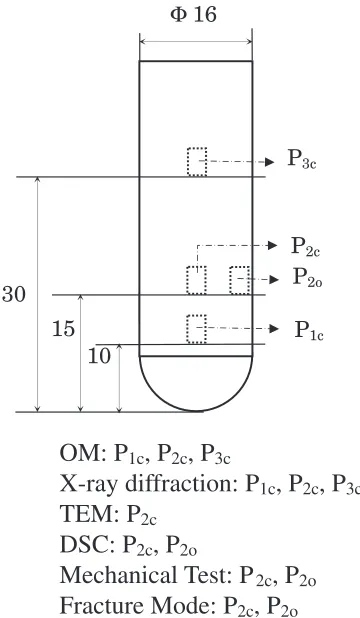
produced by the tilt casting method. The alloy rod exhibits smooth outer surface with good metallic luster and no distinct surface ruggedness due to the precipitation of a crystalline phase is observed. With the aim of confirming the absence of crystalline phase in the glassy alloy rod, the cross sectional structure was examined by optical microscopy, X-ray dif-fraction and high resolution TEM technique. Figure 2 shows optical micrographs of the central region in the transverse cross sections at different sites which are away by about 10 mm, 15 mm and 30 mm from the bottom surface of the cast alloy rod with a diameter of 16 mm. The sites for OM observation specimens are illustrated in Fig. 3, where the sites for the specimens for X-ray diffraction, TEM observa-tion, DSC, mechanical properties and fracture mode are also shown. Even after the etching treatment, no appreciable
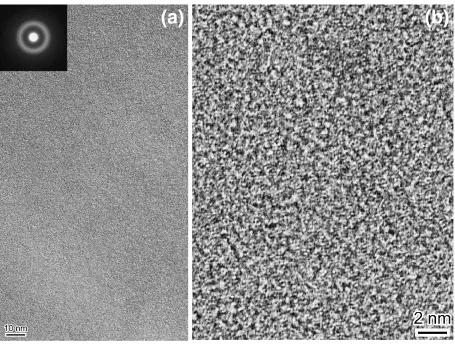
contrast due to the precipitation of crystalline phases is seen over the whole cross sections of the different sites for the alloy ingot. In addition, Fig. 4 shows X-ray diffraction patterns of the central region in the transverse cross sections at different sites which are away by about 10 mm, 15 mm and 30 mm from the bottom surface of the cast alloy rod with a diameter of 16 mm. All the X-ray diffraction patterns consist of broad peaks and no distinct sharp peak due to the existence of a crystalline phase is recognized. We also tried to confirm the absence of any crystalline phase on the basis of high resolution TEM images. As exemplified in Fig. 5(a) and (b), the high resolution TEM images taken from the central region in the transverse cross section which is about 15 mm away from the bottom surface reveal only a modulated contrast typical for a glassy single phase and neither medium-range ordered atomic configurations nor nanoscale
crystal-Fig. 1 Outer shape and surface morphology of Zr65Al7:5Ni10Cu17:5alloy
rod with a diameter of 16 mm and a length of about 45 mm produced by the tilt casting method.
OM: P
1c, P
2c, P
3cX-ray diffraction: P
1c, P
2c, P
3cTEM: P
2cDSC: P
2c, P
2oMechanical Test: P
2c, P
2oFracture Mode: P
2c, P
2o10
15
30
P
3cP
2cP
1cP
2oΦ
[image:2.595.336.516.227.536.2] [image:2.595.55.283.574.745.2]line phase are observed. Besides, the selected-area electron diffraction pattern also consists of only halo rings, indicating the formation of a glassy single phase. These metallographic results indicate that the alloy rod is composed of a glassy phase and the formation tendency of the glassy phase is independent of the site in the cast alloy rod. It is thus
concluded that the Zr65Al7:5Ni10Cu17:5 alloy has the critical
diameter of at least 16 mm.
3.2 Thermal stability
Figure 6 shows DSC curves of the central and outer surface regions in the transverse cross section at the site
Fig. 4 X-ray diffraction patterns of their corresponding regions shown in Fig. 2.
(b)
(a)
Fig. 5 High resolution electron micrographs and selected area electron diffraction pattern of the central region in the transverse cross section taken from the site which is about 15 mm away from the bottom surface of the cast Zr65Al7:5Ni10Cu17:5alloy rod with a diameter
of 16 mm.
[image:3.595.55.283.71.237.2] [image:3.595.308.541.72.246.2] [image:3.595.71.526.314.658.2]which is about 15 mm away from the bottom surface of the alloy rod. One can see a distinct endothermic reaction due
to glass transition at 643 K (Tg), followed by a supercooled
liquid region with a temperature interval of 102 K (Tx¼
TxTg) and then a sharp exothermic peak at the onset
temperature of 745 K (Tx) due to crystallization. Thus, no
distinct difference in Tg, Tx, Tx and Hx between the
central region and outer surface region is recognized on the
DSC curves. The heat of crystallization (Hx) was measured
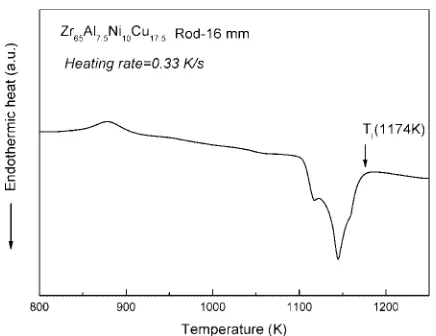
to be 55 J/g at the central region and 57 J/g at the outer surface region. We also measured the liquidus temperature of the cast glassy alloy rod with a diameter of 16 mm by DTA. As shown in Fig. 7, the melting appears to occur through three stages and is completed at 1174 K. The three stages overlap with each other within a temperature interval of about 75 K, indicating that the present quaternary alloy is located near multi-component eutectic point. Based on the
data of Tg and Tl, the reduced glass transition temperature
(Tg=Tl) is evaluated to be as high as 0.55, indicating that
the Zr-based alloy has high glass-forming ability.
3.3 Mechanical Properties
Figure 8 shows compressive stress-strain curves of the
cast Zr65Al7:5Ni10Cu17:5alloy rod with a diameter of 16 mm.
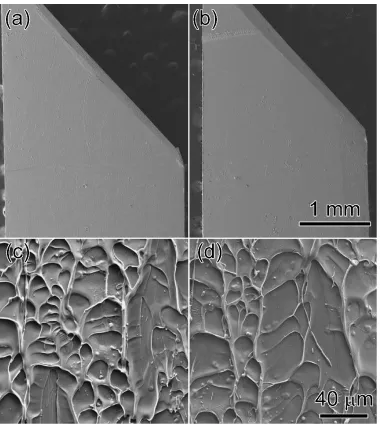
The test specimens were taken from the central and outer surface regions in the transverse cross section at the fixed site which is about 15 mm away from the bottom surface of the alloy rod. The alloy exhibits elastic deformation with a strain up to about 0.018, followed by plastic strains of about 0.003 at the central region and 0.005 at the outer surface region accompanying serration pattern, and then final rupture. The Young’s modulus and yield strength are estimated to be 88 GPa and 1540 MPa, respectively, at the central region and 85 GPa and 1550 MPa, respectively, at the outer surface region. Thus, the mechanical strength appears to be inde-pendent of the sample site in the transverse cross section. Figure 9 shows fracture morphology and fracture surface appearance of the central and outer surface regions. Both the samples fracture along the maximum shear stress plane which is declined by about 45 degrees to the direction of applied load and the fracture surface consists of mainly a well
developed vein pattern. In addition, one can see a number of shear bands on the lateral surface near the fracture site, being consistent with the generation of serrated plastic flow before final rupture.
4. Discussion
All the data in the present paper demonstrate clearly that
the Zr65Al7:5Ni10Cu17:5 alloy has high glass-forming ability
leading to the formation of bulk glassy alloy rods with
diameters up to 16 mm by the tilt casting method18)which can
be regarded as the conventional copper mold casting process. Although a number of bulk glassy alloys with diameters above 16 mm have been reported in metal-metal type alloys,
the bulk glassy alloys except Zr65Al7:5Ni10Cu17:5 include
large amounts (about 45 to 60 at%) of solute elements,
as exemplified for Zr55Al10Ni5Cu30,12,18) Zr41:2Be22:5Ti13:8
-Cu12:5Ni10,19)Zr48Al8Cu36Ag820)and Zr48Al8Cu34Ag8Pd2.21)
Thus, the present Zr65Al7:5Ni10Cu17:5 alloy has the lowest
solute content among the Zr-based bulk glassy alloys with large critical diameters above 15 mm. Very recently, it has
been found22–24) that Zr-based bulk glassy alloys with low
solute contents ranging from 30 to 40 at% in Zr-Al-Cu and Zr-Al-Ni-Cu systems exhibit improved characteristics in compressive ductility, Charpy impact fracture energy, frac-ture toughness and fatigue strength in as-cast and annealed states. Thus, it is important to clarify the possibility of forming a bulk glassy alloy with large critical diameter for Zr-based alloys containing low solute contents less than 40 at%, because reliable mechanical properties are the most important for applications to structural materials.
Besides, it is presumed that the reason for the high glass-forming ability of the Zr-rich bulk glassy alloy with the low solute content of 35 at% is different from that for the bulk glassy alloys with high solute contents exceeding 50 at%.
The high glass-forming ability of the Zr65Al7:5Ni10Cu17:5
glassy alloy seems to result from the combination of a large
supercooled liquid region of 102 K, a rather high Tg=Tl of
0.55 and the composition near the multi-component eutectic point as is evidenced from the overlap of three melting (endothermic) stages within a relatively narrow temperature
Fig. 7 DTA curve of the cast Zr65Al7:5Ni10Cu17:5glassy alloy rod with a
diameter of 16 mm.
[image:4.595.60.278.69.237.2] [image:4.595.311.544.72.228.2]interval of about 75 K. The large supercooled liquid region represents that the supercooled liquid has high resistance against crystallization. The high resistance is presumably because the crystallization occurs through the nearly
simul-taneous precipitation of three crystalline phases, Zr2Cu,
Zr2Ni and Zr6NiAl2,25,26) which require the long-range
redistribution of the constituent elements. It has been pointed that the redistribution of the constituent elements on a long range scale is rather difficult for the supercooled liquid with fully dense random packing consisting mainly of icosahedral short-range ordered atomic configurations in the quaternary alloy system where the three component rules for
stabiliza-tion of supercooled liquid are satisfied.9,10) Experimental
results and computer simulation have shown that the icosahedral type clusters should be the preferred short-range order (SRO) in metallic glass when the atomic size ratio (R) between solute and solvent atoms is close to
0.85.27,28)This is because theR0:85is energetically most
favored in forming icosahedral clusters.27) For the current
Zr65Al7:5Ni10Cu18:5 alloy, R(Cu/Zr)¼0:80, R(Al/Zr)¼0:89,
R(Ni/Zr) ¼0:78. As a result, the icosahedral-type SRO should
be the main underlying topological SRO in the present
Zr65Al7:5Ni10Cu18:5 glassy alloy, which plays an important
role in stabilizing the glass configuration.29) Consequently,
high stability of the icosahedral-type SRO results in the high stabilization of the supercooled liquid, which is associated
with the GFA of the Zr65Al7:5Ni10Cu18:5 glassy alloy. In
addition, the highTg=Tlof 0.55 implies that the viscosity of
the supercooled liquid for the present alloy increases rapidly with decreasing temperature, leading to easy solidification of supercooled liquid into a glassy solid state under the suppression of crystallization reaction.
5. Summary
We examined the possibility of producing a bulk glassy alloy rod with useful characteristics in the large diameter
range up to 16 mm for Zr65Al7:5Ni10Cu17:5 alloy by the tilt
casting method. The results obtained are summarized as follows.
[image:5.595.109.489.69.494.2]plastic strain of the cast glassy alloy rod lie in the narrow range of 85 to 88 GPa, 1540 to 1550 MPa, 0.018 and 0.003 to 0.005, respectively, and are almost independent of sample preparation sites. There was no appreciable change in fracture mode with sample site.
(4) The success of developing a bulk glassy alloy rod exhibiting nearly constant characteristics in the large diam-eter range up to 16 mm for the Zr-based alloy is promising for future advancement of bulk glassy alloy materials.
Acknowledgements
This work was financially supported by Research and Development Project on Advanced Metallic Glasses, Inor-ganic Materials and Joining Technology from the Ministry of Education, Culture, Sports, Science and Technology of Japan.
REFERENCES
1) A. Inoue, K. Ohtera, K. Kita and T. Masumoto: Japan. J. Appl. Phys.27
(1988) L2248–2251.
2) A. Inoue, T. Zhang and T. Masumoto: Mater. Trans., JIM30(1989) 965–972.
3) A. Inoue, T. Zhang and T. Masumoto: Mater. Trans., JIM31(1990) 177–183.
(1997) 473–477.
15) A. Gebert, J. Eckert and L. Schultz: Acta Mater. 46(1998) 5475– 5482.
16) C. T. Liu, M. F. Chisholm and M. K. Miller: Intermetallics10(2002) 1105–1112.
17) Y. Yokoyama, E. Mund, A. Inoue and l. Schultz: Mater. Trans.48
(2007) 3190–3192.
18) Y. Yokoyama, T. Yamasaki, P. K. Liaw, R. A. Buchanan and A. Inoue: Mater. Sci. Eng. A449–451(2007) 621–626.
19) A. Peker and W. L. Johnson: Appl. Phys. Lett.63(1993) 2342–2344. 20) Q. S. Zhang, W. Zhang and A. Inoue: Mater. Trans. 48 (2007)
629–631.
21) Q. S. Zhang, W. Zhang and A. Inoue: Mater. Trans. 48 (2007) 3031–3033.
22) J. B. Qiang, W. Zhang, G. Q. Xie and A. Inoue: Appl. Phys. Lett.90
(2007) 231907-1–3.
23) Y. H. Liu, G. Wang, R. J. Wang, D. Q. Zhao, M. X. Pang and W. H. Wang: Science315(2007) 1385–1388.
24) Y. Yokoyama, T. Yamasaki, M. Nishijima and A. Inoue: Mater. Trans.
48(2007) 1276–1281.
25) J. Saida and A. Inoue: J. Non-Cryst. Solids312–314(2002) 502–507. 26) J. Saida, M. Matsushita and A. Inoue: Mater. Trans. 43 (2002)
1937–1946.
27) H. J. Lee, T. Cagin, W. L. Johnson and W. A. Goddard III: J. Chem. Phys.119(2003) 9858–9870.
28) H. W. Sheng, W. K. Luo, F. M. Alamgir, J. M. Bai and E. Ma: Nature (London)439(2006) 419–425.
29) T. Fukunaga, K. Itoh, T. Otomo, K. Mori, M. Sugiyama, H. Kato, M. Hasegawa, A. Hirata, Y. Hirotsu and A. C. Hannon: Intermetallics