Effect of Solution Treatment on Microstructure Evolution
and Mechanical Properties of Mg-6.0Zn-0.6Y-0.5Zr Alloy
Processed by Equal Channel Angular Extrusion
Weineng Tang
1;2, Rongshi Chen
1;*and Enhou Han
11Environmental Corrosion Center, Institute of Metal Research, Chinese Academy of Sciences,
Shenyang 110016, P. R. China
2Graduate School of the Chinese Academy of Sciences, P. R. China
The effect of solution treatment before equal channel angular extrusion (ECAE) on the evolution of microstructures and mechanical properties in as-cast Mg-6.0Zn-0.6Y-0.5Zr alloy after different ECAE passes has been systematically investigated. The micrographs and tensile results showed that the solution treatment significantly influenced the microstructural evolution, as well as tensile strength and elongation. ECAE processing results in producing finer grain structure both in the as-cast and as-solutionized alloys when the passes increased. However, solution treatment before ECAE provides a significant increase in forming rate of fine recrystallized grains during ECAE at high temperature of 623 K. A fully recrystallized microstructure was observed after 8 passes in the as-solutionized alloy, while it was not finished even after 8 passes in the as-cast alloy. The ductility of as-solutionized alloy is always significantly better than those of the as-cast alloy. However, the strengths of the former are better than those of the later only after the passes beyond 6 passes. [doi:10.2320/matertrans.MC200707]
(Received October 10, 2007; Accepted February 15, 2008; Published April 25, 2008)
Keywords: ECAE, solution treatment, magnesium-zinc-yttrium, microstructure, mechanical properties
1. Introduction
Magnesium alloys have good potential as a kind of structural material for the automotive and aeronautic trans-port industries since magnesium alloy is the lightest structural material. However, the formability of magnesium alloy is limited at near room temperature because of its hexagonal close-packed (hcp) lattice structure, therefore, most magnesium products have been fabricated by casting.1,2)
Superplastic deformation can effectively produce complex engineering components directly from wrought products. In order to further exploit the benefits of magnesium alloy, application of superplasticity on magnesium alloys is ex-pected for the forming of the hard-to-deform magnesium material.2)
Equal channel angular extrusion (ECAE) has been shown to be effective in refining grains in various alloys with improved ductility, strength and superplasticity, including Mg alloys.3) However, questions still exist in the under-standing of the grain refinement mechanisms operating during ECAE, particularly, the effects of important micro-structural variables associated with the initial material, such as the pre-treatment on the initial materials, the role of coarse second-phases and small dispersed particles.4,5) By now,
series of studies about the effect of different heat treatment on ECAE samples have been done with the aluminum alloy. For example, Kimet al.6)discovered that the pre-ECAE solution
treatment together with the post-ECAE low-temperature aging process in 6061-aluminum alloy produced a significant strengthening effect. Another study by Ferrasse et al.7) in
6061 Al alloy showed that the microstructure refinement by ECAEed with peak-aged billets was more effective than that by the billet through over-aged treatment. These studies show that heat treatments on the materials will significantly
influence the microstructure evolution as well as resultant mechanical properties, and that approaching the material with appropriate heat treatment will result in better proper-ties. However, up to nowadays, there are few related studies about the effect of pre-treatment on the evolution of microstructure and mechanical properties during ECAE process in magnesium alloys.
Mg-Zn-Y alloy is a kind of newly developed wrought magnesium alloys, with a quasicrystal icosahedral phase (I-phase) formed upon solidification in this series of alloys when the compositional range up to the eutectic point (where the Zn/Y ratio is around 6),1,8) and even the Zn/Y ratio
increases to about 11.9,10) The icosahedral phase exhibits
better stability than many other phases and shows a strong interface with the matrix and pins grain boundaries and dislocations, which has been used to develop stronger magnesium alloys with better mechanical properties.11) In order to produce a finer solidified microstructure, a small amount of zirconium was added into the Mg-Zn-Y alloys.12) Since a small amount of Zr does not participate in formation of secondary phases,13)the microstructure and main secon-dary phases in Mg-Zn-Y-Zr alloys were considered to be similar to the Mg-Zn-Y alloys without Zr addition.12,14)
Rrecent years, interest in the Mg-Zn-Y(-Zr) alloys with quasicrystal at Zn/Y ratio around or over 6 has been growing,1,8–12,14–18) because these alloys with the I-phase
after going through thermomechanical processing possess excellent yield and ultimate tensile strengths both at room temperature and in a low temperature regime, typically up to 473 K.1,14,16)In the as-cast Mg-Zn-Y(-Zr) alloys, there plenty
of coarse eutectic I-phases locate in the grain boundary region; however, different heat treatment before thermome-chanical processing will change the microstructure.11) Although ECAE was applied on the Mg-Zn-Y(-Zr) alloy to refine the microstructure for achieving high strength and ductility, even superplasticity,17,18) no researches upon the *Corresponding author, E-mail: [email protected]
effect of pre-treatment (such as solution treatment) on the microstructure evolution and mechanical properties of the alloy have been carried out.
In present study, a Mg-6.0Zn-0.6Y-0.5Zr (mass%) alloy mainly with second-phases of I-particles around the grain boundaries was prepared by casting, using addition of a small amount of 0.5 mass% Zr to produce a finer solidified microstructure.12,14)And then the alloy was ECAE processed with 1–8 passes, at an as-cast state (as-cast alloy) with lots of coarse second phase and at a state with few second phases through solution treatment (as-solutionized alloy), respec-tively. The main objective is to examine the effect of solution treatment before ECAE processing on the micro-structures and mechanical properties of the alloy after different ECAE passes.
2. Experimental Procedure
The material used in this study is the Mg-6.0Zn-0.6Y-0.5Zr (in weight) alloy. It was fabricated with pure magnesium (99.9%), pure Zn (99.99%), Mg-25%Y and Mg-33%Zr master alloys by electric resistance furnace melting and then was poured into a steel mold. The samples with a size of 10mm10mm100mm were cut by electric spark from the ingot. Two states of samples were prepared: one part of samples was used directly in the as-cast state (denoted as the as-cast alloy), and another part of samples was homogenized with a solution treatment at 723 K for 10 h following air-cooling (denoted as the as-solutionized alloy). ECAE was conducted using a die with two channels intersection at an angle of 90, which produced true strain of 1.15 per pass according to the following equation:3)
"¼ 1ffiffiffi
3
p 2 cot
2 þ
2
þ cosec
2 þ
2
ð1Þ
MoS2 was used as a lubricant. ECAE experiments were performed at 623 K and at a constant ram speed of 1 mm/s. The billet was held in the entry channel at extrusion temperature for 10 min before ECAE started, and then was carried out though the ECAE channels without rotation between each extrusion cycle (i.e.route A). After each pass, the extrudate was taken out from the exit die and quenched in
water immediately. Both state samples were extruded with 1, 2, 3, 4, 6 and 8 passes, respectively.
Microstructures of the samples before and after ECAE were observed at the center of the X-plane (normal to the extrusion direction) using optical microscope or Philips XL30 scanning electronic microscope (SEM) by the conven-tional metallographic method. Tensile specimens with the gauge length of 10 mm and transverse section of 32mm were machined directly at the center of ECAEed extrudate. And the test was carried out on the universal tensile machine at room temperature and strain rate of1103s1.
3. Results
3.1 Microstructure evolution
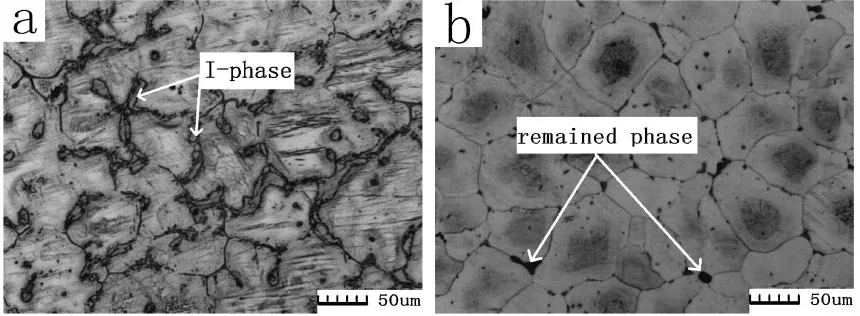
In the initial microstructure of the as-cast alloy (Fig. 1(a)), the average-Mg grain size is about 80mmand lots of white eutectic I-phases were inhomogeneously distributed in the alloy, being concentrated along the -Mg grain boundaries and only some in the-Mg grains interior, as the report by Bae et al.1)After solution treatment at 723 K for 10 hours,
most of the secondary phases in the alloy are removed and the alloy elements was dissolved into the matrix and only few of secondary phases still remained at the boundaries (Fig. 1(b)). The average grain sizes of this alloy, about 100mm, become a little larger than the as-cast alloy due to the grain growth.
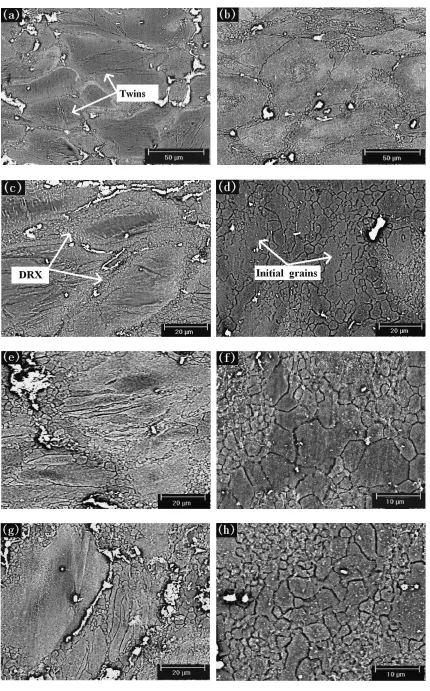
During the first ECAE pass, some twinnings appeared across the big grains and stopped at the grain boundaries in the large grain interiors of the as-cast alloy, as shown in Fig. 2(a). Few small grains appeared along the initial boundaries. However, in the as-solutionized alloy (Fig. 2(b)), twinning almost did not happen in the grains interiors, and a number of small grains appeared along the original grain boundaries due to dynamic recrystallization (DRX), forming the typical ‘‘necklace structure’’.
With further ECAE deformation up to two and four passes, more and more coarse grains were divided into several parts, and the volume of recrystallized grains increased in both states of samples. In the as-cast alloy (Figs. 2(c) and (e)), a lot of new boundaries appeared in the original grain interior and increased with the ECAE strain, but most of them were almost paralleled to each other,
[image:2.595.83.513.73.231.2]suggesting that they may be lower angle boundaries. Plenty of new grains came into being near the old boundaries due to dynamic recrystallization (DRX), especially near the spots with secondary phase; some of new grains also formed nearby the twinning boundaries. Whereas, in the as-solution-ized alloy (Figs. 2(d) and (f)), bands of recrystallas-solution-ized grains were much wider than those in the as-cast alloy and it can be seen that new-formed DRX grains gradually spread to whole area with a few remained initial coarse grains. In addition, it should be noted that, some of the small grains in the samples formed in the earlier passes seem to be a little growth, which maybe was ascribed to the exposure to the high ECAE temperature of 623 K during holding temperature before the followed pass deformation.
As the deformation increasing to eight passes, the volume of the recrystallized grains further increased. Two types of grains existed in the as-cast alloy (Fig. 2(g)): the fine grains less than 10mmnear the coarse second phases and the big grains more than 30mmremained in the initial coarse grain interior. The recrystallization did not complete even after eight passes. However, in the as-solutionized alloy (Fig. 2(h)), the whole area was almost occupied homoge-neously by the recrystallized small grains. Based on the microstructure observation, the forming rate of new recrys-tallized grains during ECAE in the as-solutionized alloy is basically higher than that in the as-cast one.
3.2 Mechanical properties
The yield strength (YS) and ultimate tensile strength (UTS) of both state alloys were gradually improved with the ECAE passes increasing from 1 to 4 (Fig. 3), and the YS and UTS of the as-cast alloy were still higher than, or at least comparable to, that of the as-solutionized alloy when the same pass number was applied. After 4 ECAE passes, the YS and UTS of both alloys were largely improved as compared to that of the initial alloys before ECAE. However, when passes increased from 4 to 8 passes, the YS and UTS in as-solutionized alloy were gradually improved beyond those of the as-cast alloy with the same pass number. After deforma-tion with 8 ECAE passes, the strengths of two state alloys
were no longer to be improved as remarkably as those of the samples with less than 3 ECAE passes, which showed the strengths basally arrive at a steady value when a certain pass number was exceeded.
The elongations to failure of the as-solutionized alloy deformed after08ECAE passes were all larger than those of the as-cast alloy with the same pass number (Fig. 3). Notably, when only one ECAE pass was processed, the elongations of two state alloys decreased obviously although the strength was improved markedly. Contrastively, the elongation of the both state alloys increased greatly when secondary ECAE pass was applied. However, after been ECAEed from 3 up to 8 ECAE passes, values of the elongation in both state alloys were no longer obviously improved, which showed that the elongations reach a steady value as the strength value in two alloys.
4. Discussion
According to the observation (Fig. 2), the grain structure of Mg-6.0Zn-0.6Y-0.5Zr alloy seems to be inhomogeneous after few ECAE passes, no matter its initial microstructure, i.e.coarse grains are usually surrounded by fine grains. This so-called ‘‘bimodal’’ distribution in ECAEed alloys was also observed by Chang.19)Since the slip systems in magnesium
are very limited, some grains with more favorable orienta-tions are deformed then refined first. The inhomogeneity of the deformation in coarser grains may leave some less deformed islands, forming the ‘‘necklace microstructure’’.20) When further ECAE deformation is done, the deformation spreads to the whole microstructure and the microstructure gradually becomes homogeneous.
It can be found that the grain refinement in two different states alloys is discrepant obviously with the number of ECAE passes increasing, i.e. the inhomogeneity of the deformation in the as-cast alloy is much more serious than that in the as-solutionized one. According to the previous study,21)during deformation at conventional strains, it is well
known that hard, micron-scale, second-phase particles can increase the rate of dislocation generation and develop surrounding deformation zones in the matrix that contain large local misorientation gradients. And new high angle boundaries can form within such deformation zones at relatively low strains. In the as-cast alloy, plenty of secondary phases located concentratively along the initial coarse grain boundaries. Since the existence of coarse second-phase particles, a strong strain concentration had taken place around the coarse second-phase particles. It has also been shown by the study of Appset al.22)that, very coarse particles
(micron sized or more) lead to inhomogeneous deformation structures. And such coarse particles can encourage the formation of zones of high dislocation densities locally in the surrounding regions of matrix and may lead to the faster appearance of new high angle boundaries.22)whereas, in the
coarse grain interior of the matrix with few secondary phases, the plastic deformation is less, thus they will be refined slowly. Therefore, strongly inhomogeneous microstructure has been developed with the ECAE number increasing in the as-cast alloy. However, in the as-solutionized alloy, the elements of initial secondary phases were almost totally
[image:4.595.47.290.579.747.2]dissolved into the -Mg matrix, and only few remained phases homogeneously distributed in the alloy. As compared to the as-cast alloy, the particles here will induce the nucleation of the new grains homogeneously. In addition, the presence of a high solute content in the matrix after solution-treatment plays a role in retarding dislocation annihilation and increasing residual dislocation densities, which lowers the dynamic recovery rate.23)Thus, homogeneous
recrystal-lization was preferred to happen in the sample after solution treatment. As compared to the as-cast alloy, in consequence, the efficiency of grain refinement during ECAE deformation is basically higher in the as-solutionized alloy when the same pass number was applied.
The trend in ductility of two state alloys with ECAE passes are similar, which first decreased when one-pass ECAE was applied, thereafter gradually increased before reaching a plateau. The reason maybe that it is related with the difference of the work hardening in the materials with different ECAE passes, like the result in previous study.24)
The ductility of the alloys after only one pass decreased significantly, which is because that of a great deal of dislocations propagated and accumulated during the ECAE processing introduced a strong work hardening into the initial alloys. When pass number was more than two pass, both of the annealing during preheating before next pass and further grain refinement gradually promoted the ductility of two state alloys.
The tensile results show that the strength increased before basically being steady with the passes increasing in both state alloys. The strengthening of materials achieved by ECAE processing has mainly been attributed to grain refinement, considering the strengthening effect of the non-equilibrium boundaries with very high local internal stresses and that of the dislocations as well as their rearrangements.3,25) In
present study, although the grain size decreased monoto-nously with the number of passes increasing during the ECAE process, the increased rate in strengths was incon-sistent with the grain refinement rate, especially at the stage with small pass number. Therefore, the other factors besides grain sizes, such as secondary phases and preferred orienta-tion should also be considered to understand the differences between the as-cast alloy and the as-solutionized alloy.
As a result, in the earlier stage of the ECAE deformation, the strength of the cast alloy is higher than the as-solutionized one, which is attributed to the strengthening due to quasicrystal I-phase. Quasicrystal is isotropic and pos-sesses a specially ordered lattice structure called the quasiperiodic lattice structure with many interesting proper-ties such as low interface energy. The low interfacial energy of quasicrystal provides improved rigid bonding properties at the I-phase/matrix interface,1) which causes an important
strengthening effect in the as-cast alloys. However, a lower strength in the as-solutionized alloys was obtained due to the grain growth and little secondary-phase strengthening after solution treatment. With the ECAE deformation increased in the as-solutionized alloy, some precipitates appeared for the high temperature deformation and dispersed in the grain boundaries and interiors, which resulted in combined strengthening due to precipitates and grain refinement in the alloy after larger ECAE pass number. It has been
confirmed by Zeng et al.14) that, some small precipitates appeared during hot extrusion deformation in this alloy, which makes the strengthening more complicated and effective. This may be one of the reasons for that, when the passes increased to six, the strength in the as-solutionized alloy overwhelmed that in the as-cast alloy.
It is well known that, during hot extrusion at high temperature, Mg-based alloys are prone to developing a preferred orientation with {0001} basal planes and h10-10i directions parallel to the extruded direction, i.e. ED==
h10-10i fiber texture.26) When the magnesium alloys were ECAEed at temperature of higher than 573 K, according to the study of Yoshida et al.,27) a preferred orientation with most basal planes parallel to the ED was also formed after a few pass numbers. A similar texture should be formed in present alloys. As the tensile test was carried out along the ED, the high strain-hardening rate for this preferred orienta-tion will result in a smaller elongaorienta-tion and an improved strength in the alloy, which seems to be consistent with the mechanical properties obtained in the alloys after one ECAE pass, as shown in Fig. 3. However, when the grain refinement gradually increased with the ECAE number increasing, some (0001) basal planes also maybe gradually switch to be parallel to the shear plane during ECAE deformation, with about 45inclined to the extrusion direction.26)This texture is
a softening orientation, which results in the strength lowered and ductility heightened.26,28)Therefore, as the pass number increases, grain refinement gives rise to the improvement in the strength and elongation, and texture softening led to increasing in the elongation while decreasing in strength. When more than two ECAE passes were processed, the continuously improved strength and ductility in the as-solutionized alloys are attributed to the combined effects of the grain refinement strengthening, secondary phase strength-ening and developed preferred orientation (texture). Com-paratively, in the as-cast alloy, the efficiency of the grain refinement was lower and the average grain size did not decrease as significantly as that in the as-solutionized alloy. One hand, the inhomogeneous deformation with less defor-mation in the larger grains led to the incompletely recrystal-lization and then a severe inhomogeneous microstructure; on the other hand, the small recrystallized grains formed in earlier passes were partly grown during reheating for the next ECAE pass. According to the Hall-Petch relationship, the strength improvement in the as-cast alloys was not remark-able due to the limited grain refinement with the ECAE passes increasing, especially beyond 4 passes. Moreover, the texture softening from the basal planes inclined about 45to the extrusion direction gradually developed with the passes increasing,26,28)which gradually overwhelmed the
strength-ening due to grain refinement. These may be the reason of that the strength of the as-cast alloys decreased slightly when the pass number beyond 4 passes.
5. Summary
recrystallized grains during ECAE at high temperature of 623 K. A fully recrystallized grained structure was observed after 8 passes in the as-solutionized alloys, while it was not finished even after 8 passes in the as-cast alloys. The mechanical properties of two states of alloys are different. The ductility of as-solutionized alloys is always significantly better than those of the as-cast alloys. However, the YS and UTS of the as-solutionized alloys are better than those of the as-cast alloys only after the passes beyond 6 passes.
Acknowledgements
Thanks should be given to National Basic Research Program of China (973 Program) for its financial support through project No. 2007CB613704.
REFERENCES
1) D. H. Bae, S. H. Kim, D. H. Kim and W. T. Kim: Acta Mater.50(2002) 2343–2356.
2) H. Watanabe, T. Mukai, M. Kohzu, S. Tanabe and K. Higashi: Acta Mater.47(1999) 3753–3758.
3) R. Z. Valiev, R. K. Islamgaliev and I. V. Alexandrov: Prog. Mater. Sci. 45(2000) 103–189.
4) M. Mabuchi, K. Ameyama, H. Iwasaki and K. Higashi: Acta Mater.47 (1999) 2047–2057.
5) K. Matsubara, Y. Miyahara, Z. Horita and T. G. Langdon: Acta Mater. 51(2003) 3073–3084.
6) W. J. Kim, J. K. Kim, T. Y. Park, S. I. Hong, D. I. Kim, Y. S. Kim and J. D. Lee: Metall. Mater. Trans. A33(2002) 3155–3164.
7) S. Ferrasse, V. M. Segal, K. T. Hartwig and R. E. Goforth: J. Mater. Res.12(1997) 1253–1261.
8) D. H. Bae, S. H. Kim, W. T. Kim and D. H. Kim: Mater. Trans.42 (2001) 2144–2147.
9) M. Y. Zheng, X. G. Qiao, S. W. Xu, K. Wu, S. Kamado and Y. Kojima: Mater. Sci. Forum488–489(2005) 589–592.
10) J. Y. Lee, H. K. Do, H. K. Lim and D. H. Kim: Mater. Lett.59(2005) 3801–3805.
11) A. Singh, M. Watanabe, A. Kato and A. P. Tsai: Scripta Mater.51 (2004) 955–960.
12) D. H. Bae, M. H. Lee, K. T. Kim, W. T. Kim and D. H. Kim: J. Alloys and Compounds342(2002) 445–450.
13) W. F. Smith: Structure and Properties of Engineering Alloys, (McGraw-Hill, New York, 1993) pp. 542.
14) X. Q. Zeng, Y. Zhang, C. Lu, W. J. Ding, Y. X. Wang and Y. P. Zhu: J. Alloys and Compounds395(2005) 213–219.
15) D. K. Xu, L. Liu, Y. B. Xu and E. H. Han: Scripta Mater.56(2007) 1–4. 16) A. Singh, M. Nakamura, M. Wantanabe, A. Kato and A. P. Tsai: Scripta
Mater.49(2003) 417–422.
17) M. Y. Zheng, S. W. Xu, K. Wu, S. Kamado and Y. Kojima: Mater. Lett. 61(2007) 4406–4408.
18) W. N. Tang, H. Yan, R. S. Chen and E. H. Han: Mater. Sci. Forum551– 552(2007) 203–208.
19) S. Y. Chang, S. W. Lee, K. M. Kang, S. Kamado and Y. Kojima: Mater. Trans.45(2004) 488–492.
20) S. Spigarelli, M. El Mehtedi, M. Cabibbo, E. Evangelista, J. Kaneko, A. Ja¨ger and V. Gartnerova: Mater. Sci. Eng., A462(2007) 197–201. 21) F. J. Humphreys: Acta Metall.27(1979) 1801–1814.
22) P. J. Apps, J. R. Bowen and P. B. Prangnell: Acta Mater.51(2003) 2811–2822.
23) S. I. Hong, G. T. Gray and J. J. Lewandowski: Acta Metall. Mater.41 (1993) 2337–2342.
24) I. Gutierrez-Urrutia, M. A. Munoz-Morris and D. G. Morris: Mater. Sci. Eng., A394(2005) 399–410.
25) M. A. Munoz-Morris, C. G. Oca and D. G. Morris: Scripta Mater.48 (2003) 213–218.
26) W. J. Kim, S. I. Hong, Y. S. Kim, S. H. Min, H. T. Jeong and J. D. Lee: Acta Mater.51(2003) 3293–3307.
27) Y. Yoshida, L. Cisar, S. Kamado and Y. Kojima: Mater. Trans.44 (2003) 468–475.