Efficient Multi-pass Decoding for Synchronous Context Free Grammars
Hao Zhang and Daniel Gildea
Computer Science Department University of Rochester
Rochester, NY 14627
Abstract
We take a multi-pass approach to ma-chine translation decoding when using syn-chronous context-free grammars as the trans-lation model and n-gram language models: the first pass uses a bigram language model, and the resulting parse forest is used in the second pass to guide search with a trigram lan-guage model. The trigram pass closes most of the performance gap between a bigram de-coder and a much slower trigram dede-coder, but takes time that is insignificant in comparison to the bigram pass. An additional fast de-coding pass maximizing the expected count of correct translation hypotheses increases the BLEU score significantly.
1 Introduction
Statistical machine translation systems based on synchronous grammars have recently shown great promise, but one stumbling block to their widespread adoption is that the decoding, or search, problem during translation is more computationally demanding than in phrase-based systems. This com-plexity arises from the interaction of the tree-based translation model with ann-gram language model. Use of longern-grams improves translation results, but exacerbates this interaction. In this paper, we present three techniques for attacking this problem in order to obtain fast, high-quality decoders.
First, we present a two-pass decoding algorithm, in which the first pass explores states resulting from an integrated bigram language model, and the sec-ond pass expands these states into trigram-based
states. The general bigram-to-trigram technique is common in speech recognition (Murveit et al., 1993), where lattices from a bigram-based decoder are re-scored with a trigram language model. We ex-amine the question of whether, given the reordering inherent in the machine translation problem, lower order n-grams will provide as valuable a search heuristic as they do for speech recognition.
Second, we explore heuristics for agenda-based search, and present a heuristic for our second pass that combines precomputed language model infor-mation with inforinfor-mation derived from the first pass. With this heuristic, we achieve the same BLEU scores and model cost as a trigram decoder with es-sentially the same speed as a bigram decoder.
Third, given the significant speedup in the agenda-based trigram decoding pass, we can rescore the trigram forest to maximize the expected count of correct synchronous constituents of the model, us-ing the product of inside and outside probabilities. Maximizing the expected count of synchronous con-stituents approximately maximizes BLEU. We find a significant increase in BLEU in the experiments, with minimal additional time.
2 Language Model Integrated Decoding for SCFG
We begin by introducing Synchronous Context Free Grammars and their decoding algorithms when an
n-gram language model is integrated into the gram-matical search space.
A synchronous CFG (SCFG) is a set of context-free rewriting rules for recursively generating string pairs. Each synchronous rule is a pair of CFG rules
with the nonterminals on the right hand side of one CFG rule being one-to-one mapped to the other CFG rule via a permutationπ. We adopt the SCFG nota-tion of Satta and Peserico (2005). Superscript
in-dices in the right-hand side of grammar rules:
X→X1(1)...X(n) n , X
(π(1)) π(1) ...X
(π(n)) π(n)
indicate that the nonterminals with the same index are linked across the two languages, and will eventu-ally be rewritten by the same rule application. Each
Xiis a variable which can take the value of any
non-terminal in the grammar.
In this paper, we focus on binary SCFGs and without loss of generality assume that only the pre-terminal unary rules can generate pre-terminal string pairs. Thus, we are focusing on Inversion Transduc-tion Grammars (Wu, 1997) which are an important subclass of SCFG. Formally, the rules in our gram-mar include preterminal unary rules:
X→e/f
for pairing up words or phrases in the two languages and binary production rules with straight or inverted orders that are responsible for building up upper-level synchronous structures. They are straight rules written:
X→[Y Z]
and inverted rules written:
X→ hY Zi.
Most practical non-binary SCFGs can be bina-rized using the synchronous binarization technique by Zhang et al. (2006). The Hiero-style rules of (Chiang, 2005), which are not strictly binary but bi-nary only on nonterminals:
X → yuX(1)youX(2); haveX(2)withX(1)
can be handled similarly through either offline bi-narization or allowing a fixed maximum number of gap words between the right hand side nonterminals in the decoder.
For these reasons, the parsing problems for more realistic synchronous CFGs such as in Chiang (2005) and Galley et al. (2006) are formally equiva-lent to ITG. Therefore, we believe our focus on ITG
for the search efficiency issue is likely to generalize to other SCFG-based methods.
Without ann-gram language model, decoding us-ing SCFG is not much different from CFG pars-ing. At each time a CFG rule is applied on the in-put string, we apply the synchronized CFG rule for the output language. From a dynamic programming point of view, the DP states are X[i, j], where X
ranges over all possible nonterminals and i and j
range over 0 to the input string length |w|. Each state stores the best translations obtainable. When we reach the top stateS[0,|w|], we can get the best translation for the entire sentence. The algorithm is
O(|w|3).
However, when we want to integrate an n-gram language model into the search, our goal is search-ing for the derivation whose total sum of weights of productions and n-gram log probabilities is maximized. Now the adjacent span-parameterized states X[i, k] and X[k, j] can interact with each other by “peeping into” the leading and trailing
n − 1 words on the output side for each state. Different boundary words differentiate the span-parameterized states. Thus, to preserve the dynamic programming property, we need to refine the states by adding the boundary words into the parameter-ization. The LM-integrated states are represented as X[i, j, u1,..,n−1, v1,..,n−1]. Since the number of variables involved at each DP step has increased to
3 + 4(n−1), the decoding algorithm is asymptoti-callyO(|w|3+4(n−1)). Although it is possible to use the “hook” trick of Huang et al. (2005) to factor-ize the DP operations to reduce the complexity to
O(|w|3+3(n−1)), whennis greater than2, the
com-plexity is still prohibitive.
3 Multi-pass LM-Integrated Decoding
In this section, we describe a multi-pass progres-sive decoding technique that gradually augments the
LM-integrated states from lower orders to higher orders. For instance, a bigram-integrated state
[X, i, j, u, v]is said to be a coarse-level state of a trigram-integrate state [X, i, j, u, u′
, v′
, v], because the latter state refines the previous by specifying more inner words.
gen-eral idea is to use a simple and fast decoding algo-rithm to constrain the search space of a following more complex and slower technique. More specif-ically, a bigram decoding pass is executed forward and backward to figure out the probability of each state. Then the states can be pruned based on their global score using the product of inside and outside probabilities. The advanced decoding algorithm will use the constrained space (a lattice in the case of speech recognition) as a grammatical constraint to help it focus on a smaller search space on which more discriminative features are brought in.
The same idea has been applied to forests for pars-ing. Charniak and Johnson (2005) use a PCFG to do a pass of inside-outside parsing to reduce the state space of a subsequent lexicalizedn-best parsing al-gorithm to produce parses that are further re-ranked by a MaxEnt model.
We take the same view as in speech recognition that a trigram integrated model is a finer-grained model than bigram model and in general we can do an n−1-gram decoding as a predicative pass for the following n-gram pass. We need to do inside-outside parsing as coarse-to-fine parsers do. How-ever, we use the outside probability or cost informa-tion differently. We do not combine the inside and outside costs of a simpler model to prune the space for a more complex model. Instead, for a given finer-gained state, we combine its true inside cost with the outside cost of its coarse-level counter-part to estimate its worthiness of being explored. The use of the outside cost from a coarser-level as the out-side estimate makes our method naturally fall in the framework of A* parsing.
Klein and Manning (2003) describe an A* pars-ing framework for monolpars-ingual parspars-ing and admis-sible outside estimates that are computed using in-side/outside parsing algorithm on simplified PCFGs compared to the original PCFG. Zhang and Gildea (2006) describe A* for ITG and develop admissible heuristics for both alignment and decoding. Both have shown the effectiveness of A* in situations where the outside estimate approximates the true cost closely such as when the sentences are short. For decoding long sentences, it is difficult to come up with good admissible (or inadmissible) heuris-tics. If we can afford a bigram decoding pass, the outside cost from a bigram model is conceivably a
very good estimate of the outside cost using a tri-gram model since a bitri-gram language model and a trigram language model must be strongly correlated. Although we lose the guarantee that the bigram-pass outside estimate is admissible, we expect that it ap-proximates the outside cost very closely, thus very likely to effectively guide the heuristic search.
3.1 Inside-outside Coarse Level Decoding
We describe the coarse level decoding pass in this section. The decoding algorithms for the coarse level and the fine level do not necessarily have to be the same. The fine level decoding algorithm is an A* algorithm. The coarse level decoding algorithm can be CKY or A* or other alternatives.
Conceptually, the algorithm is finding the short-est hyperpath in the hypergraph in which the nodes are states likeX[i, j, u1,..,n−1, v1,..,n−1], and the hy-peredges are the applications of the synchronous rules to go from right-hand side states to left-hand side states. The root of the hypergraph is a special nodeS′[0,|w|,hsi,h/si]which means the entire
in-put sentence has been translated to a string starting with the beginning-of-sentence symbol and ending at the end-of-sentence symbol. If we imagine a start-ing node that goes to all possible basic translation pairs, i.e., the instances of the terminal translation rules for the input, we are searching the shortest hy-per path from the imaginary bottom node to the root. To help our outside parsing pass, we store the back-pointers at each step of exploration.
The outside parsing pass, however, starts from the rootS′
outside cost, it makes sense to maximize over all possible outside costs for a given node, to be con-sistent with the maximization of the inside pass. For the nodes that have been explored in the bottom up pass but not in the top-down pass, we set their out-side cost to be infinity so that their exploration is preferred only when the viable nodes from the first pass have all been explored in the fine pass.
3.2 Heuristics for Fine-grained Decoding
In this section, we summarize the heuristics for finer level decoding.
The motivation for combining the true inside cost of the fine-grained model and the outside es-timate given by the coarse-level parsing is to ap-proximate the true global cost of a fine-grained state as closely as possible. We can make the approx-imation even closer by incorporating local higher-order outside n-gram information for a state of
X[i, j, u1,..,n−1, v1,..,n−1]into account. We call this the best-border estimate. For example, the best-border estimate for trigram states is:
hBB(X, i, j, u1, u2, v1, v2)
=
max
s∈S(i,j)Plm(u2|s, u1)
·
max
s∈S(i,j)Plm(s|v1, v2)
whereS(i, j)is the set of candidate target language words outside the span of (i, j). hBB is the
prod-uct of the upper bounds for the two on-the-border
n-grams.
This heuristic function was one of the admissible heuristics used by Zhang and Gildea (2006). The benefit of including the best-border estimate is to re-fine the outside estimate with respect to the inner words which refine the bigram states into the trigram states. If we do not take the inner words into consid-eration when computing the outside cost, all states that map to the same coarse level state would have the same outside cost. When the simple best-border estimate is combined with the coarse-level outside estimate, it can further boost the search as will be shown in the experiments. To summarize, our recipe
for faster decoding is that using
β(X[i, j, u1,..,n−1, v1,..,n−1])
+ α(X[i, j, u1, vn−1])
+ hBB(X, i, j, u1,...,n, v1,...,n) (1)
whereβis the Viterbi inside cost andαis the Viterbi outside cost, to globally prioritize then-gram inte-grated states on the agenda for exploration.
3.3 Alternative Efficient Decoding Algorithms
The complexity of n-gram integrated decoding for SCFG has been tackled using other methods.
The hook trick of Huang et al. (2005) factor-izes the dynamic programming steps and lowers the asymptotic complexity of then-gram integrated de-coding, but has not been implemented in large-scale systems where massive pruning is present.
The cube-pruning by Chiang (2007) and the lazy cube-pruning of Huang and Chiang (2007) turn the computation of beam pruning of CYK decoders into a top-k selection problem given two columns of translation hypotheses that need to be combined. The insight for doing the expansion top-down lazily is that there is no need to uniformly explore every cell. The algorithm starts with requesting the first best hypothesis from the root. The request translates into requests for thek-bests of some of its children and grandchildren and so on, because re-ranking at each node is needed to get the top ones.
Venugopal et al. (2007) also take a two-pass de-coding approach, with the first pass leaving the lan-guage model boundary words out of the dynamic programming state, such that only one hypothesis is retained for each span and grammar symbol.
4 Decoding to Maximize BLEU
Algorithm 1 OutsideCoarseParsing()
for allX[i, j, u, v]in topological order do
for all children pairs pointed to by the back-pointers do ifX→[Y Z] then
the two children areY[i, k, u, u′]andZ[k, j, v′, v]
α(Y[i, k, u, u′]) = max{α(Y[i, k, u, u′]),
α(X[i, j, u, v]) +β(Z[k, j, v′, v]) +rule(X→[Y Z]) +bigram(u′, v′)} α(Z[k, j, v′, v]) = max{α(Z[k, j, v′, v]),
α(X[i, j, u, v]) +β(Y[i, k, u, u′]) +rule(X→[Y Z]) +bigram(u′, v′)}
end if
if X → hY Zi then
the two children areY[i, k, v′, v]andZ[k, j, u, u′] α(Y[i, k, v′, v]) = max{α(Y[i, k, v′, v]),
α(X[i, j, u, v]) +β(Z[k, j, u, u′]) +rule(X → hY Zi) +bigram(u′, v′)} α(Z[k, j, u, u′]) = max{α(Z[k, j, u, u′]),
α(X[i, j, u, v]) +β(Y[i, k, v′, v]) +rule(X → hY Zi) +bigram(u′, v′)}
end if end for end for
we deal with the mismatch by introducing another decoding pass that maximizes the expected count of synchronous constituents in the tree correspond-ing to the translation returned. BLEU is based on n-gram precision, and since each synchronous con-stituent in the tree adds a new 4-gram to the trans-lation at the point where its children are concate-nated, the additional pass approximately maximizes BLEU.
Kumar and Byrne (2004) proposed the framework of Minimum Bayesian Risk (MBR) decoding that minimizes the expected loss given a loss function. Their MBR decoding is a reranking pass over ann -best list of translations returned by the decoder. Our algorithm is another dynamic programming decod-ing pass on the trigram forest, and is similar to the parsing algorithm for maximizing expected labelled recall presented by Goodman (1996).
4.1 Maximizing the expected count of correct synchronous constituents
We introduce an algorithm that maximizes the ex-pected count of correct synchronous constituents. Given a synchronous constituent specified by the state[X, i, j, u, u′, v′, v], its probability of being
cor-rect in the model is
EC([X, i, j, u, u′
, v′
, v]) = α([X, i, j, u, u′
, v′
, v])·β([X, i, j, u, u′
, v′
, v]),
whereα is the outside probability and β is the in-side probability. We approximateβandαusing the Viterbi probabilities. Since decoding from bottom up in the trigram pass already gives us the inside Viterbi scores, we only have to visit the nodes in the reverse order once we reach the root to compute the Viterbi outside scores. The outside-pass Algo-rithm 1 for bigram decoding can be generalized to the trigram case. We want to maximize over all translations (synchronous trees) T in the forest af-ter the trigram decoding pass according to
max
T
X
[X,i,j,u,u′,v′,v]∈T
EC([X, i, j, u, u′
, v′
, v]).
The expression can be factorized and computed us-ing dynamic programmus-ing on the forest.
5 Experiments
The word-to-word translation probabilities are from the translation model of IBM Model 4 trained on a 160-million-word English-Chinese parallel cor-pus using GIZA++. The phrase-to-phrase transla-tion probabilities are trained on 833K parallel sen-tences. 758K of this was data made available by ISI, and another 75K was FBIS data. The language model is trained on a 30-million-word English cor-pus. The rule probabilities for ITG are trained using EM on a corpus of 18,773 sentence pairs with a to-tal of 276,113 Chinese words and 315,415 English words.
5.1 Bigram-pass Outside Cost as Trigram-pass Outside Estimate
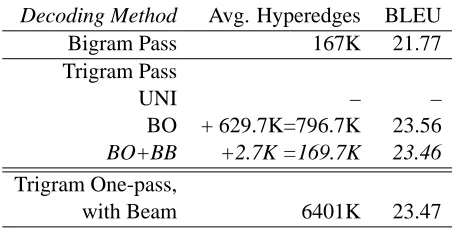
We first fix the beam for the bigram pass, and change the outside heuristics for the trigram pass to show the difference before and after using the first-pass outside cost estimate and the border estimate. We choose the beam size for the CYK bigram pass to be 10 on the log scale. The first row of Table 1 shows the number of explored hyperedges for the bigram pass and its BLEU score. In the rows below, we compare the additional numbers of hyperedges that need to be explored in the trigram pass using differ-ent outside heuristics. It takes too long to finish us-ing uniform outside estimate; we have to use a tight beam to control the agenda-based exploration. Us-ing the bigram outside cost estimate makes a huge difference. Furthermore, using Equation 1, adding the additional heuristics on the best trigrams that can appear on the borders of the current hypothesis, on average we only need to explore 2700 additional hy-peredges per sentence to boost the BLEU score from 21.77 to 23.46. The boost is so significant that over-all the dominant part of search time is no longer the second pass but the first bigram pass (inside pass ac-tually) which provides a constrained space and out-side heuristics for the second pass.
5.2 Two-pass decoding versus One-pass decoding
By varying the beam size for the first pass, we can plot graphs of model scores versus search time and BLEU scores versus search time as shown in Fig-ure 1. We use a very large beam for the second pass due to the reason that the outside estimate for the second pass is discriminative enough to guide the
Decoding Method Avg. Hyperedges BLEU
Bigram Pass 167K 21.77
Trigram Pass
UNI – –
BO + 629.7K=796.7K 23.56
BO+BB +2.7K =169.7K 23.46
Trigram One-pass,
[image:6.612.314.540.59.173.2]with Beam 6401K 23.47
Table 1: Speed and BLEU scores for two-pass decoding. UNI stands for the uniform (zero) outside estimate. BO stands for the bigram outside cost estimate. BB stands for the best border estimate, which is added to BO.
Decoder Time BLEU Model Score
One-pass agenda 4317s 22.25 -208.849
One-pass CYK 3793s 22.89 -207.309
Multi-pass, CYK first
agenda second pass 3689s 23.56 -205.344
MEC third pass 3749s 24.07 -203.878
Lazy-cube-pruning 3746s 22.16 -208.575
Table 2: Summary of different trigram decoding strate-gies, using about the same time (10 seconds per sen-tence).
search. We sum up the total number of seconds for both passes to compare with the baseline systems. On average, less than 5% of time is spent in the sec-ond pass.
In Figure 1, we have four competing decoders.
bitri cyk is our two-pass decoder, using CYK as
the first pass decoding algorithm and using agenda-based decoding in the second pass which is guided by the first pass. agenda is our trigram-integrated agenda-based decoder. The other two systems are also one-pass. cyk is our trigram-integrated CYK decoder. lazy kbest is our top-down k-best-style de-coder.1
Figure 1(left) compares the search efficiencies of the four systems. bitri cyk at the top ranks first. cyk follows it. The curves of lazy kbest and agenda cross
1
In our implementation of the lazy-cube-pruning based ITG decoder, we vary the re-ranking buffer size and the the top-k
list size which are the two controlling parameters for the search space. But we did not use anyLM estimate to achieve early
and are both below the curves of bitri cyk and cyk. This figure indicates the advantage of the two-pass decoding strategy in producing translations with a high model score in less time.
However, model scores do not directly translate into BLEU scores. In Figure 1(right), bitri cyk is better than CYK only in a certain time window when the beam is neither too small nor too large. But the window is actually where we are interested – it ranges from 5 seconds per sentence to 20 seconds per sentence. Table 2 summarizes the performance of the four decoders when the decoding speed is at 10 seconds per sentence.
5.3 Does the hook trick help?
We have many choices in implementing the bigram decoding pass. We can do either CYK or agenda-based decoding. We can also use the dynamic pro-gramming hook trick. We are particularly interested in the effect of the hook trick in a large-scale system with aggressive pruning.
Figure 2 compares the four possible combinations of the decoding choices for the first pass: bitri cyk,
bitri agenda, bitri cyk hook and bitri agenda hook. bitri cyk which simply uses CYK as the first pass
decoding algorithm is the best in terms of perfor-mance and time trade-off. The hook-based de-coders do not show an advantage in our experiments. Only bitri agenda hook gets slightly better than
bi-tri agenda when the beam size increases. So, it is
very likely the overhead of building hooks offsets its benefit when we massively prune the hypotheses.
5.4 Maximizing BLEU
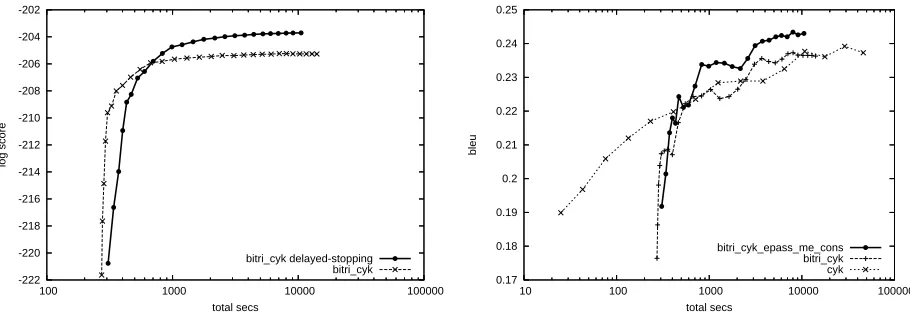
The bitri cyk decoder spends little time in the agenda-based trigram pass, quickly reaching the goal item starting from the bottom of the chart. In order to maximize BLEU score using the algorithm described in Section 4, we need a sizable trigram forest as a starting point. Therefore, we keep pop-ping off more items from the agenda after the goal is reached. Simply by exploring more (200 times the log beam) after-goal items, we can optimize the Viterbi synchronous parse significantly, shown in Figure 3(left) in terms of model score versus search time.
However, the mismatch between model score and BLEU score persists. So, we try our algorithm
of maximizing expected count of synchronous con-stituents on the trigram forest. We find signifi-cant improvement in BLEU, as shown in Figure 3 (right) by the curve of bitri cyk epass me cons.
bi-tri cyk epass me cons beats both bibi-tri cyk and cyk
in terms of BLEU versus time if using more than 1.5 seconds on average to decode each sentence. At each time point, the difference in BLEU between
bitri cyk epass me cons and the highest of bitri cyk
and cyk is around .5 points consistently as we vary the beam size for the first pass. We achieve the record-high BLEU score 24.34 using on average 21 seconds per sentence, compared to the next-highest score of 23.92 achieved by cyk using on average 78 seconds per sentence.
6 Conclusion
We present a multi-pass method to speed up n -gram integrated decoding for SCFG. We use an in-side/outside parsing algorithm to get the Viterbi out-side cost of bigram integrated states which is used as an outside estimate for trigram integrated states. The coarse-level outside cost plus the simple estimate for border trigrams speeds up the trigram decoding pass hundreds of times compared to using no outside es-timate.
Maximizing the probability of the synchronous derivation is not equivalent to maximizing BLEU. We use a rescoring decoding pass that maximizes the expected count of synchronous constituents. This technique, together with the progressive search at previous stages, gives a decoder that produces the highest BLEU score we have obtained on the data in a very reasonable amount of time.
As future work, new metrics for the final pass may be able to better approximate BLEU. As the bigram decoding pass currently takes the bulk of the decod-ing time, better heuristics for this phase may speed up the system further.
Acknowledgments This work was supported by NSF ITR-0428020 and NSF IIS-0546554.
References
-224 -222 -220 -218 -216 -214 -212 -210 -208 -206 -204
10 100 1000 10000 100000
log score
total secs
bitri_cyk cyk agenda lazy kbest
0.17 0.18 0.19 0.2 0.21 0.22 0.23 0.24
10 100 1000 10000 100000
bleu
total secs
[image:8.612.81.535.70.227.2]bitri_cyk cyk agenda lazy kbest
Figure 1: We compare the two-pass ITG decoder with the one-pass trigram-integrated ITG decoders in terms of both model scores vs. time (left) and BLEU scores vs. time (right). The model score here is the log probability of the decoded parse, summing up both the translation model and the language model. We vary the beam size (for the first pass in the case of two-pass) to search more and more thoroughly.
-222 -220 -218 -216 -214 -212 -210 -208 -206 -204
100 1000 10000 100000
log score
total secs
bitri_cyk bitri_cyk_hook bitri_agenda bitri_agenda_hook
0.17 0.18 0.19 0.2 0.21 0.22 0.23 0.24
100 1000 10000 100000
bleu
total secs
[image:8.612.81.535.307.462.2]bitri_cyk bitri_cyk_hook bitri_agenda bitri_agenda_hook
Figure 2: We use different first-pass decoding algorithms, fixing the second pass to be agenda-based which is guided by the outside cost of the first pass. Left: model score vs. time. Right: BLEU score vs. time.
-222 -220 -218 -216 -214 -212 -210 -208 -206 -204 -202
100 1000 10000 100000
log score
total secs
bitri_cyk delayed-stopping bitri_cyk
0.17 0.18 0.19 0.2 0.21 0.22 0.23 0.24 0.25
10 100 1000 10000 100000
bleu
total secs
bitri_cyk_epass_me_cons bitri_cyk cyk
[image:8.612.80.535.516.672.2]David Chiang. 2005. A hierarchical phrase-based model for statistical machine translation. In Proceedings of the 43rd Annual Conference of the Association for Computational Linguistics (ACL-05), pages 263–270. David Chiang. 2007. Hierarchical phrase-based
transla-tion. Computational Linguistics, 33(2).
Michel Galley, Jonathan Graehl, Kevin Knight, Daniel Marcu, Steve DeNeefe, Wei Wang, and Ignacio Thayer. 2006. Scalable inference and training of context-rich syntactic translation models. In Proceed-ings of the International Conference on Computational Linguistics/Association for Computational Linguistics (COLING/ACL-06), pages 961–968, July.
Joshua Goodman. 1996. Parsing algorithms and metrics. In Proceedings of the 34th Annual Conference of the Association for Computational Linguistics (ACL-96), pages 177–183.
Liang Huang and David Chiang. 2007. Faster algorithms for decoding with integrated language models. In Pro-ceedings of ACL, Prague, June.
Liang Huang, Hao Zhang, and Daniel Gildea. 2005. Machine translation as lexicalized parsing with hooks. In International Workshop on Parsing Technologies (IWPT05), Vancouver, BC.
Dan Klein and Christopher D. Manning. 2003. A* pars-ing: Fast exact Viterbi parse selection. In Proceed-ings of the 2003 Meeting of the North American chap-ter of the Association for Computational Linguistics (NAACL-03).
Shankar Kumar and William Byrne. 2004. Minimum bayes-risk decoding for statistical machine translation. In Daniel Marcu Susan Dumais and Salim Roukos, editors, HLT-NAACL 2004: Main Proceedings, pages 169–176, Boston, Massachusetts, USA, May 2 - May 7. Association for Computational Linguistics.
Hy Murveit, John W. Butzberger, Vassilios V. Digalakis, and Mitchel Weintraub. 1993. Large-vocabulary dic-tation using SRI’s decipher speech recognition system: Progressive-search techniques. In Proceedings of the IEEE International Conference on Acoustics, Speech, & Signal Processing (IEEE ICASSP-93), volume 2, pages 319–322. IEEE.
Giorgio Satta and Enoch Peserico. 2005. Some com-putational complexity results for synchronous context-free grammars. In Proceedings of Human Lan-guage Technology Conference and Conference on Empirical Methods in Natural Language Processing (HLT/EMNLP), pages 803–810, Vancouver, Canada, October.
Ashish Venugopal, Andreas Zollmann, and Stephan Vo-gel. 2007. An efficient two-pass approach to synchronous-CFG driven statistical MT. In NAACL07, Rochester, NY, April.
Dekai Wu. 1997. Stochastic inversion transduction grammars and bilingual parsing of parallel corpora. Computational Linguistics, 23(3):377–403.
Hao Zhang and Daniel Gildea. 2006. Efficient search for inversion transduction grammar. In 2006 Conference on Empirical Methods in Natural Language Process-ing (EMNLP), Sydney.