Characteristics of the Cold-Rolling Texture in a Multi-Layered Material
Composed of SUS301 and SUS420J2 Steels
Long Li
1, Fuxing Yin
1, Yoshihisa Tanaka
2, Satoshi Kishimoto
2and Kotobu Nagai
11
Exploratory Materials Research Laboratory for Reliability and Safety, National Institute for Materials Science, Tsukuba 305-0047, Japan
2Hybrid Materials Research Center, National Institute for Materials Science, Tsukuba 305-0047, Japan
A multi-layered composite material composed of alternating SUS301 and SUS420J2 steels, prepared by hot-rolling bonding, shows a superior strength and ductility balance than the components. Few researches have been addressed on texture features of structural multi-layered materials during cold-rolling. In the present work, cold-rolling with three reductions (20%, 40% and 65%) in thickness was conducted on both the two monolithic steels (SUS301 and SUS420J2) and the multi-layered material consisting of SUS301 and SUS420J2 components. Texture and microstructure development during the cold-rolling deformation in both the monolithic steels and multi-layered material were investigated by using EBSD technique. It was found that austenite phase in SUS301 component of the multi-layered material showed weakerh110i==ND
texture as compared to the monolithic SUS301 steel although the similar texture characteristics appeared in both conditions. On the other hand, the martensite phase in SUS420J2 component of the multi-layered material showed strongerf112gh110itexture components than theh111i==ND
andh100i==NDtexture components that were dominant in the monolithic SUS420J2 steel. It is considered that the constraint condition and shear stress at component layer interfaces are significant for the formation of Brass component observed as the final stable orientation of austenite phase of the SUS301 steel in the multi-layered samples, and the formation of thef112gh110itexture of martensite phase of the SUS420J2 steel in the multi-layered samples during the cold-rolling deformation. [doi:10.2320/matertrans.MG200906]
(Received October 13, 2009; Accepted February 18, 2010; Published April 7, 2010)
Keywords: hot-rolling bonding, SUS301, SUS420J2, multi-layered material, cold-rolling, texture
1. Introduction
Multi-layered composite materials consisting of alternat-ing metals or alloys have been developed to improve the mechanical properties including fracture toughness, fatigue behavior, impact behavior, wear, corrosion, and even provide the enhanced deformability for otherwise brittle materials.1)
Multi-layered materials that combine austenitic steels with high ductility and martensitic steels with high strength possess a good balance of high strength and ductility, as well as the good formability compared to the low ductility martensitic steel.2–4)Recently, the uniform elongation of
as-quenched martensitic steel was increased from 6% to more than 50% level by the multi-layered structure design through bonding the martensitic steel sheets with the austenitic steel sheets,4)which enhances the expectation to fabricate high-strength structural materials.
Texture plays an important role in the metal forming of sheet products. Deformation and annealing texture develop-ment in steels have been studied in details.5–10)In cold-rolled
SUS301 steel, it was found that the main texture component was characterized byf110gh112iBrass,f110gh001iGoss and
f112gh111i Copper components.6)In ferritic stainless steels
and martensitic steels,-fiber and-fiber were observed to be the dominant texture components.8–10)Although the
mechan-ical properties of multi-layered materials have been exten-sively studied,1) few reports have been addressed on the
texture development of the structural multi-layered materials during cold-rolling and subsequent annealing. It is consid-ered that the different mechanical properties of the compo-nents in composites will obviously affect the stress and strain states during rolling and further influence the crystallo-graphic texture development in the component steels.11)Up to now, investigations on texture development in
multi-layered materials are only focused on Al alloy during hot-rolling bonding for structural applications11) and functional materials such as multi-layered Ni base tapes in super-conductor application,12) sputter-deposited nano-scale Cu/ Nb multi-layered thin films,13) micro-scale Cu/Nb
compo-site14) and Mg/Al laminated composite fabricated by
accumulative roll bonding.15) In addition, comparative
studies on texture development have not been addressed between monolithic and multi-layered materials, especially for structural steels.
In this study, the main objective is to investigate the microstructure and micro-texture development of layered composite materials during cold-rolling. A multi-layered composite material consisting of 25 alternating layers of SUS301 austenitic and SUS420J2 martensitic steels bonded by hot-rolling was applied. Subsequent cold-rolling deformation on the monolithic and the multi-layered material was conducted with varied reductions (20%, 40% and 65%), and microstructure and texture were studied using scanning electron microscopy equipped with electron back scattered diffraction (EBSD) technique.
2. Experimental Procedures
2.1 Materials and processing
The materials employed in this study is austenitic steel (SUS301), martensitic steel (SUS420J2) and a multi-layered composite material consisting of SUS301 and SUS420J2 steels. The monolithic SUS301 and SUS420J2, which were received as 1 mm thickness in the form of sheet, were subjected to heat treatment at 1273 K for 15 min to obtain a randomly oriented polycrystalline microstructure. The chemical composition of SUS301 and SUS420J2 steels is shown in Table 1.
The multi-layered composite material (MLCM) is com-posed of 25 alternating layers of SUS301 and SUS420J2 steels (13 SUS301 and 12 SUS420J2 layers, 25LCM here-after), which were produced by hot-rolling bonding to a final thickness of 3 mm with a total reduction of 88%. SUS301 and SUS420J2 steels were initially cut in 125mm230mm rectangular pieces, and then surface preparation, stacking and welding at the corner were conducted. The materials were kept at reheating temperature 1473 K for 30 min in argon atmosphere furnace. Then four-pass hot-rolling was carried out and hot-rolling temperature was approximately 1373 K, 1373 K, 1273 K and 1243 K, respectively. Subsequent an-nealing treatment was conducted at 1273 K for 2 min in order to obtain the randomly oriented microstructure. The average thickness of the SUS301 layers and SUS420J2 layers in the composites was about 122mm.
Cold-rolling with three reductions (20%, 40% and 65%) was conducted on both as-annealed monolithic and the multi-layered material. The roll diameter and rolling speed were 120 mm and 5 m/min, respectively. In order to avoid the effect of shear strain on the microstructure and texture at the surface due to friction between the rolls and the work piece, only the normal direction (ND) section at the mid-thickness region of monolithic samples was focused in this work. In order to investigate the effect of interface between two components of multi-layered samples without considering the effects of surface friction between the rolls and the work piece, transverse direction (TD) section of multi-layered samples at the mid-thickness regions containing 7 layers were chosen as a comparison with the monolithic samples.
2.2 Microstructure and texture characterization
The samples were prepared by mechanically grinding and electrochemical polishing in a solution consisting of perchloric acid (HClO4) and acetic acid (95:5) under
2 A/cm2 at 10C for microstructural analysis. The micro-structure and micro-texture were investigated on ND section for the monolithic samples and TD section for the multi-layered material, using a LEO-1550 field-emission scanning electron microscopy equipped with the TSL type automated electron backscattered diffraction (EBSD) system. Particular attention has been paid to the analysis of the matrix grain structures, grain boundary misorientation distribution and crystallographic textures. Acquisition of EBSD data was carried out with an acceleration voltage of 15 kV and working distance of 15 mm. The corresponding data processing was carried out using a Tex-SEM laboratories orientation imaging microscope (OIM) system. Orientation mapping was per-formed on a rectangular grid with a step size of 0.2mm. Microstructure maps show the grains based on misorientation angle and texture maps illustrate the sharpness of crystallo-graphic orientations as inverse pole figure (IPF) and orientation distribution function (ODF).
3. Experimental Results
3.1 Microstructure of SUS301 and SUS420J2 steels in monolithic and multi-layered samples
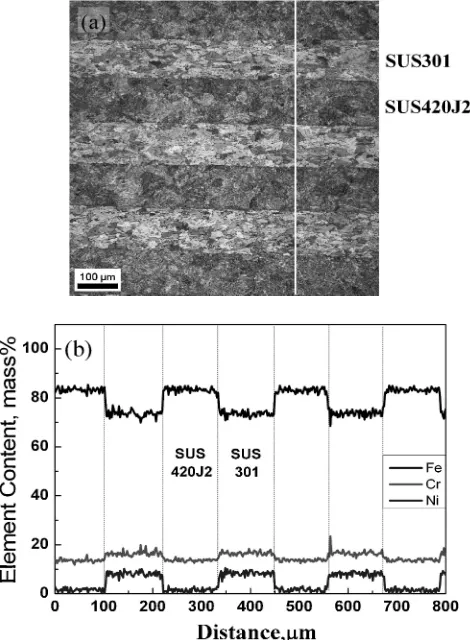
Figure 1 shows the EBSD microstructure of the 7 middle layers in the as-annealed multi-layered material, and the EDS (Energy Dispersive Spectroscopy) line scan results along the line shown in the EBSD mapping. The width of the Fe, Ni and Cr element diffusion layer at the interfaces is in the range of4:06:0mm, and the diffusion zone seems to be homoge-neous in both thickness and length positions.
Figure 2 shows the austenite microstructure of the SUS301 steel at different cold-rolling reductions in both monolithic and multi-layered samples. The microstructural development during cold-rolling is shown in the EBSD mapping of Fig. 2(b)–(d) and Fig. 2(f)–(h), respectively for monolithic and multi-layered samples. The SEM results indicate that the as-annealed samples of monolithic and multi-layered materials before cold-rolling show an equiaxed grain micro-structure on both TD and ND sections. The as-annealed materials possess an average grain size of 24mmand 12mm
[image:2.595.309.544.73.393.2]in monolithic and multi-layered samples, respectively, as illustrated in Fig. 2(a) and Fig. 2(e). With the increased cold-rolling reduction, the austenite microstructure seems to be elongated obviously parallel to the rolling direction as shown in Fig. 2(f)–(h) in SUS301 steels of the multi-layered samples. Additionally, the microstructure of SUS420J2 steels at different cold-rolling reductions in both monolithic and
Table 1 Chemical composition of the component steels used (mass%).
Material C Si Mn P S Ni Cr Bal.
SUS301 0.10 0.66 0.68 0.027 0.003 7.05 17.04 Fe SUS420J2 0.34 0.49 0.57 0.035 0.004 0.12 13.21 Fe
[image:2.595.46.292.82.125.2]multi-layered samples were shown in Fig. 3. Martensite plate can be observed to some extent in the as-annealed samples but it is difficult to distinguish the martensite plate of the samples at higher reduction than 20% due to cold-rolling deformation.
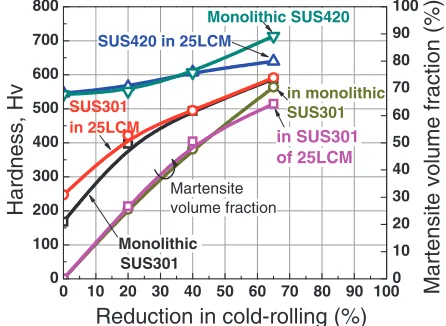
In the present study, the area ratio of martensite phase to all phases is used to denote the volume fraction of martensite phase, which can be directly calculated from OIM data in EBSD mapping by finding the number of crystal structure measurements and dividing it by the total number of measurements. Figure 4 shows the volume fraction of martensite phase in SUS301 steel, and Vickers hardness of SUS301 steel and SUS420J2 steel in monolithic and multi-layered samples. It can be found that the volume fraction of strainduced martensite phase in the SUS301 steel in-creases with the increase in rolling reduction in both monolithic and multi-layered samples, and the hardness of SUS301 steel also increases obviously with the increase in deformation.
It should be pointed out that the hardness of the monolithic SUS301 steel is lower than that of SUS301 in multi-layered sample at reductions less than 40% as shown in Fig. 4. The carbon diffusion from SUS420J2 to SUS301 layer in multi-layered samples seems to be inevitable during hot-rolling bonding since the large difference in carbon content in the two component steels as shown in Table 1, which can be a major factor affecting the hardness of components of multi-layered samples. From Fig. 4, it can be seen that the volume fraction of martensite in SUS301 of the LCM is slightly less than that in the monolithic sample at the rolling reduction of 65%, which may be related to the higher stability of austenite
phase in SUS301 steel probably due to the high carbon content resulting from carbon diffusion, which relies on the precise carbon element analysis. The lower hardness of SUS420J2 steel in the multi-layered samples at the reduction of 65% than monolithic samples may be one of the evidences of carbon diffusion from SUS420J2 to SUS301 components. Lower volume fraction of strain-induced martensite but higher carbon content in SUS301 steel of the multi-layered sample lead to the similar hardness as compared with monolithic sample at 65% reduction (Fig. 4). In fact, the differences in hardness and volume fraction of strain-induced martensite of SUS301 steel between monolithic and
multi-Reduction Austenite in
SUS301 steel 0% 20% 40% 65% Sampling
Monolithic sample
(a) (c) (d)
Multi-layered sample
(e)
(b)
(f) (g) (h)
RD TD
RD ND
Fig. 2 EBSD mapping of austenite phase in SUS301 steel: (a)–(d) monolithic samples; (e)–(h) multi-layered samples.
Reduction Martensite in
SUS420J2
steel 0% 20% 40% 65%
Sampling
Monolithic sample
(a) (d)
Multi-layered sample
(e)
(b) (c)
(f) (g) (h)
RD TD
RD ND
Fig. 3 EBSD mapping of martensite phase in SUS420J2 steel: (a)–(d) monolithic samples; (e)–(h) multi-layered samples.
0 10 20 30 40 50 60 70 80 90 100 0
100 200 300 400 500 600 700 800
0 10 20 30 40 50 60 70 80 90 100
in monolithic SUS301 in SUS301 of 25LCM
Martensite volume fraction
Martensite volume fraction (%)
Monolithic SUS301
SUS301 in 25LCM
SUS420 in 25LCM
Hardness, Hv
Reduction in cold-rolling (%)
Monolithic SUS420 [image:3.595.85.509.72.196.2] [image:3.595.88.507.239.377.2] [image:3.595.315.538.421.584.2]layered samples should be associated with component thickness, carbon diffusion width, hardness indentation size as well as cold-rolling reduction. More detailed work needs to be done in the future.
3.2 Texture of austenite phase in SUS301 steel
Orientation data are extracted from EBSD mapping using orientation distribution function (ODF) notation. Figure 5 shows the ’2¼45 section in the ODF of the austenite in
SUS301 steel of the monolithic and multi-layered samples rolled to different reductions. During cold-rolling deforma-tion, the crystal orientations of the austenite in monolithic SUS301 steel mainly concentrate along-fiber (45 ’
1
90,¼90,’
2¼45). The 20% cold-rolling deformation
leads to the formation of a texture characterized by texture components in monolithic samples: ð110Þ½5557 (’1¼45,
¼90) that is 10 rotated around ND from the exact ð110Þ½1112Brass orientation (’1¼55,¼90) as well as
a weak Copper orientationð112Þ½11111(’1 ¼90,¼35).
With increase in the rolling reduction to 40%, Copper orientation becomes much weaker while the Goss orientation (110)[001] (’1¼90, ¼90) are observed clearly. By
65% rolling reduction, Copper orientation disappears and Brass orientation becomes weak while Goss orientation has developed obviously as shown in Fig. 5(a)–(c). Such a texture is a typical characteristic of as cold-rolled texture of austenitic steels.6)
As shown in Fig. 5(d)–(f), the deformation textures measured for the austenite phase in the SUS301 layers of the multi-layered samples are found to be similar to those of the monolithic SUS301 steel cold-rolled to 40%, although the component intensity is a little weaker than that in monolithic samples. When increasing the rolling reduction to 65%, Brass orientation has developed obviously meanwhile Goss orientation becomes quite weak in the multi-layered sample, which shows an opposite tendency in the texture develop-ment as compared to the monolithic sample. The highest orientation density (maximal value of 8.9) is reached (Fig. 5(c)) at the Goss orientation in the monolithic sample,
while that is only 3.7 at the Brass orientation in the multi-layered sample (Fig. 5(f)). Although EBSD observation was made in two fields for higher than 40% cold-rolled samples, it should be pointed out that there are many unanalyzable points at reductions higher than 40% and the ODFs may be considered to be composed of local textures of analyzable parts with a small area fraction. Therefore, the orientation density may, to some extent, depend on the location and step size in EBSD analysis.
3.3 Texture of martensite in SUS420J2 steel
Figure 6 shows the’2¼45section in the ODF maps of
martensite phase in SUS420J2 steel of both monolithic and multi-layered samples. The texture components are domi-nated by h111i==ND -fiber and h001i==ND in monolithic sample as shown in Fig. 6(a)–(c). The major texture with maximum intensity about 4.6 areð111Þ½1221andð111Þ½11112
at the rolling reduction of 65%. However, texture compo-nents f112gh110i at -fiber are observed and the intensity increase significantly with cold-rolling deformation from 20% to 40% reduction in the multi-layered sample as shown in Fig. 6(d)–(f). Additionally, the rotated Cube ð001Þ½1110
andð001Þ½11110orientations, which are dominant components in monolithic sample, have not been observed in the multi-layered samples when cold-rolled to 40%, although a quite weak rotated Cube ð001Þ½1110 and ð001Þ½11110 can be observed in the multi-layered sample at 65% rolling reduction. At rolling reductions higher than 20%, the development of the texture components seems to be much stronger in multi-layered sample than that in the monolithic sample. The ODF maximum reaches to 7.1 when 40% cold-rolling was conducted; nevertheless it then becomes weaker with the further increase of cold-rolling reduction to 65%.
The maximum intensity development of those main texture components of the SUS420J2 steel in the ODFs, including the rotated Cube ð001Þ½1110 (’1¼0, ¼0,
’2¼45), ð111Þ½0111 (’1 ¼60, ¼55, ’2¼45) in
-fiber components and ð112Þ½1110 (’1¼0, ¼35,
(a) 20% Mono
Max=3.8 Max=5.9 Max=8.9
(b) 40% Mono (c) 65% Mono
Max=3.1
(d) 20% Multi (e) 40% Multi (f) 65% Multi
Max=5.7 Max=3.7
(112)[111] (110)[112] (110)[001]
Fig. 5 ’2¼45sections in ODF of austenite phase in SUS301 steel at different reduction levels. Monolithic (Mono): (a) 20%; (b) 40%;
[image:4.595.112.485.68.263.2]’2¼45) are described in Fig. 7 as a function of cold-rolling
reduction. It is found that the texture of as-annealed SUS420J2 steel remains very weak and the component intensity can be considered as random orientation in EBSD analysis. As shown in Fig. 7(a) and (b), the intensities of rotated Cube and-fiber components in monolithic samples keep increasing during the whole rolling stages and the maximum intensity is always higher than that in the multi-layered sample. However, theð112Þ½1110texture, which has not been observed in the monolithic sample, becomes the dominant component in multi-layered sample (Fig. 7(c)). Additionally, it is interesting that the intensity ofð112Þ½1110
obviously increases up to peak at the 40% rolling reduction and then decreases in multi-layered samples as shown in Fig. 7(c).
4. Discussion
4.1 Texture characters of austenite phase of the SUS301 steel
The present results indicate that -fiber texture in the SUS301 steel, including two pronounced components:
ð110Þ½1112 Brass and (110)[001] Goss orientations, seems
to be an inherent feature of austenite phase in the SUS301 steel deformed by cold-rolling in spite of monolithic and multi-layered sample as shown in Fig. 5. These orientations are typical ones of cold-rolling texture of fcc metals.6,7) However, in the present study, the most important feature in texture is that the Goss component is dominant in monolithic sample (Fig. 5(c)), but Brass orientation becomes prominent in multi-layered samples when cold-rolled to 65% with reduction in thickness (Fig. 5(f)).
The texture development by cold-rolling deformation in fcc materials had been predicted based on Taylor model.16)It
was proposed that crystal orientations first concentrated along -fiber quickly and then rotated into copper orienta-tion. Increased cold-rolling reduction would rotate the copper orientation towards Goss orientation7)or further towards the
Brass orientation.5,16)It is well known that the development
of deformation texture in metals and alloys depends strongly on stress and strain state during deformation.5,11) H. G. Kang11)simulated the stress and strain acted on the five-ply composites of Al/stainless steel during roll-cladding by finite element method, and the results revealed that shear stress formed at the interface between soft component and hard component, leading to microstructural distortions and shear
(a) 20% Mono
Max=3.7 Max=4.3 Max=4.6
Max=3.6
(d) 20% Multi (e) 40% Multi (f) 65% Multi
Max=7.1 Max=5.4
(b) 40% Mono (c) 65% Mono
{001}<110> {111}<110> {111}<112> {112}<110>
Fig. 6 ’2¼45 sections in ODF of martensite phase in SUS420J2 steel at different reduction levels. Monolithic (Mono): (a) 20%;
(b) 40%; (c) 65%; Multi-layered (Multi): (d) 20%; (e) 40%; (f) 65% (Maximum levels shown in the figures are depicted as an arrow head).
0 20 40 60 80
0 1 2 3 4 5 6 7 8
Maximum intensity
Reduction (%)
monolithic multi-layered (001)[110]
0 20 40 60 80
0 1 2 3 4 5 6 7 8
Maximum intensity
Reduction (%)
monolithic multi-layered
(111)[011]
(a) (b) (c)
0 20 40 60 80
0 1 2 3 4 5 6 7 8
Maximum intensity
Reduction (%)
multi-layered monolithic
(112)[110]
[image:5.595.115.485.71.263.2] [image:5.595.73.526.318.462.2]textures. In the case of monolithic sample, the rolling deformation can be considered as plane strain compres-sion17,18)and almost no shear stress was introduced since the
ND section at the mid-thickness region was measured in the present work. Thus the texture of austenite phase of the SUS301 steel in monolithic sample may be considered as the result of plane strain deformation without shear stress. But for the cold-rolled multi-layered samples, the harder SUS420J2 steel may act like an expansion by the work-roll with large diameter; therefore, compared with monolithic samples, the different texture characters of austenite phase of the SUS301 steel in multi-layered samples is mainly attributed to different stress states caused by shear stress at the interface between components.
Actually, during cold-rolling deformation of SUS301 steel strip, the following processes proceed: deformation of austenite, strain-induced transformation of austenite into martensite and deformation of martensite.19) Therefore, the
texture development in SUS301 steel of multi-layered materials is a complicated and multifactor-controlled proc-ess, such as component thicknproc-ess, interface constraint and stress state. The 65% reduction in thickness is not heavy rolling, and since a large part of austenite phase transforms into martensite, the retained austenite probably has Brass orientation. Therefore Brass orientation may be not neces-sarily finally stable in cold-rolling deformation of multi-layered samples, although it is well known that for mono-lithic samples the final stable orientation by cold-rolling is Brass orientation in austenite phase such as for SUS301.6,7)
4.2 Texture development of SUS420J2 steel in the cold-rolled materials
The texture of monolithic SUS420J2 sample is composed of a pronounced and rather homogeneous-fiberh111i==ND
with maximum values near ð111Þ½1110 (’1¼0, ¼55)
and ð111Þ½11112 (’1¼90, ¼55) and an incomplete
-fiber with strong rolling components near ð001Þ½1110 and
ð111Þ½1110. The texture of multi-layered samples show a -fiber accompanied by the ð111Þ½11112 (’1¼90, ¼55)
and ð112Þ½1110 (’1¼0, ¼35) component which
spreads out towards the ð001Þ½1110 orientation. The cold-rolling textures in monolithic SUS420J2 samples are weaker and the texture becomes less sensitive to the cold-rolling deformation although the maximum intensity gradually increases (Fig. 7(a)–(c)). These results are in general similar to the predictions by means of various Taylor type models.5,8)
However, the most striking result of the present cold-rolling textures analysis is the fact that the strong ð112Þ½1110
component is observed in multi-layered samples, which increases and again decreases with increasing cold-rolling reduction as shown in Fig. 6(d)–(f) and Fig. 7(c).
During cold-rolling of the multi-layered materials, there is an identical compressive stress3 induced by the rolling
load in both components SUS301 and SUS420J2. Under the assumption that both components obey Tresca’s yield criterion, if SUS301 steel and SUS420J2 steel in multi-layered materials have shear yield stresses ka and kb, respectively, then in order to sustain the same through-thickness normal stress3 in both components, longitudinal
stress1is induced as the following equation:17)
a1b1¼2ðkakbÞ ð1Þ
wherea
1 and
b
1 is the longitudinal stress of SUS301 layer
and SUS420J2 layer, respectively. In generating these different stresses, a shear stress must develop at the interface.18)From the hardness of the SUS301 and SUS420J2
steel in multi-layered samples as a function of cold-rolling reduction (Fig. 4), it can be found that the hardness between SUS301 and SUS420J2 steel of multi-layered sample becomes close to each other with the increase in cold-rolling reduction as shown in Fig. 4. To some extent, it means that flow stress difference between two components becomes smaller and smaller, and corresponding longitudinal stress gap would become small. Therefore, according to the eq. (1), the shear stress developed at the interface becomes low with increasing cold-rolling reduction. The combination of longi-tudinal stress 1, compressive stress 3, and shear stress
governs the stress state and further influences the texture development during cold-rolling deformation. This may be the main reason why the component intensity in multi-layered samples shows a peak at 40% reduction for
ð112Þ½1110 component in SUS420J2 steel of multi-layered samples as shown in Fig. 7(c). In other words, the texture type and intensity are controlled by both percent reductions in thickness and shear stress level due to the flow stress difference between two components.
In the case of bcc ferrite stainless steel, textureð111Þ½1110
can rotate to ð112Þ½1110 by normal slip with the increase in deformation according to M. Y. Huh’s studies.8) The
ð111Þ½1110 orientation is closely related to the ð112Þ½1110
orientation by a 20rotation aroundh110i==RDaxis. In other
words, it is very possible that the characteristicð112Þ½1110in multi-layered samples as shown in Fig. 6(d)–(f) comes from the rotation of ð111Þ½1110 orientation and consequently results in the weakened-fiber orientation.
It has been well known that the mechanical properties in metals and alloys depend strongly on their texture. Primary processing such as cold rolling generally gives rise to a strong texture f112gh110i in SUS420J2 steel of multi-layered samples rather thanh111i==NDandh100i==NDfiber textures that are dominant in the monolithic SUS420J2 steel. There-fore, the tensile properties of the multi-layered materials would be obviously different from that achieved only by mixture law of monolithic SUS301 and SUS420J2 steel, which should be the focus of future research.
5. Conclusions
(2) The SUS420J2 layer in the multi-layered material shows the strong f112gh110i texture rather than the
h111i==ND and h100i==ND fiber textures that are dominant in the monolithic SUS420J2 steel. With increasing rolling reduction, the intensity of the
ð112Þ½1110 component obviously increases to show a peak at the 40% rolling reduction and then decreases in the multi-layered sample.
(3) The texture component and intensity in SUS301 and SUS420J2 steel of multi-layered materials may be attributed to the combination of longitudinal stress1,
compressive stress 3, and shear stress developed at
the interface between components.
Acknowledgment
This study was conducted as part of the LISM (Layer-Integrated Steels and Metals) Project funded by the Ministry of Education, Culture, Sports, Science and Technology of Japan.
REFERENCES
1) D. R. Lesuer, C. K. Syn, O. D. Sherby, J. Wadsworth, J. J. Lewandowski and W. H. Hunt, Jr.: Int. Mat. Rev.41(1996) 169–197.
2) J. Inoue, S. Nambu, Y. Ishimoto and T. Koseki: Scr. Mater.59(2008) 1055–1058.
3) S. Nambu, M. Michiuchi, J. Inoue and T. Koseki: Compos. Sci. Technol.69(2009) 1936–1941.
4) S. Nambu, M. Michiuchi, Y. Ishimoto, K. Asakura, J. Inoue and T. Koseki: Scr. Mater.60(2009) 221–224.
5) D. Raabe: Acta Mater.45(1997) 1137–1151.
6) H. Abreu, S. Carvalho and P. Neto: Mater. Res.10(2007) 359–366. 7) J. Łuksza, M. Ruminski, W. Ratuszek and M. Blicharski: J. Mater.
Process. Technol.177(2006) 555–560.
8) M. Y. Huh and O. Engler: Mater. Sci. Eng. A308(2001) 74–87. 9) H. Yan, H. Bi, X. Li and Z. Xu: J. Mater. Process. Technol.209(2009)
2627–2631.
10) C. Ghosh, A. Haldar, P. Ghosh and R. K. Ray: ISIJ Int.48(2008) 1626– 1634.
11) H. G. Kang, J. K. Kim, M. Y. Huh and O. Engler: Mater. Sci. Eng. A
452–453(2007) 347–358.
12) P. P. Bhattacharjee, R. K. Ray and A. Upadhyaya: Mater. Sci. Eng. A
488(2008) 84–91.
13) P. M. Anderson, J. F. Bingert, A. Misra and J. P. Hirth: Acta Mater.51
(2003) 6059–6075.
14) S. C. V. Lim and A. D. Rollett: Mater. Sci. Eng. A520(2009) 189–196. 15) H. Chang, M. Y. Zheng, W. M. Gan, K. Wu, E. Maawadc and H. G.
Brokmeier: Scr. Mater.61(2009) 717–720.
16) J. Hirsch and K. Lucke: Acta Metall.36(1988) 2863–2882. 17) I. T. Ferguson and B. Derby: Mater. Sci. Technol.14(1998) 510–
517.
18) S. L. Semiatin and H. R. Piehler: Metall. Trans. A10(1979) 97–107. 19) V. I. Yushkov, R. A. Adamescu, Y. S. Machnev, T. M. Gapeka and