Transliteration Alignment
Vladimir Pervouchine, Haizhou Li Institute for Infocomm Research
A*STAR, Singapore 138632 {vpervouchine,hli}@i2r.a-star.edu.sg
Bo Lin
School of Computer Engineering NTU, Singapore 639798 [email protected]
Abstract
This paper studies transliteration align-ment, its evaluation metrics and applica-tions. We propose a new evaluation met-ric, alignment entropy, grounded on the information theory, to evaluate the
align-ment quality without the need for thegold
standardreference and compare the metric
withF-score. We study the use of
phono-logical features and affinity statistics for transliteration alignment at phoneme and grapheme levels. The experiments show that better alignment consistently leads to more accurate transliteration. In transliter-ation modeling applictransliter-ation, we achieve a mean reciprocal rate (MRR) of 0.773 on Xinhua personal name corpus, a signifi-cant improvement over other reported re-sults on the same corpus. In transliteration validation application, we achieve 4.48% equal error rate on a large LDC corpus.
1 Introduction
Transliteration is a process of rewriting a word from a source language to a target language in a different writing system using the word’s phono-logical equivalent. The word and its
translitera-tion form atransliteration pair. Many efforts have
been devoted to two areas of studies where there is a need to establish the correspondence between graphemes or phonemes between a transliteration
pair, also known astransliteration alignment.
One area is the generative transliteration model-ing (Knight and Graehl, 1998), which studies how to convert a word from one language to another us-ing statistical models. Since the models are trained on an aligned parallel corpus, the resulting statisti-cal models can only be as good as the alignment of the corpus. Another area is the transliteration vali-dation, which studies the ways to validate
translit-eration pairs. For example Knight and Graehl
(1998) use the lexicon frequency, Qu and Grefen-stette (2004) use the statistics in a monolingual corpus and the Web, Kuo et al. (2007) use proba-bilities estimated from the transliteration model to validate transliteration candidates. In this paper, we propose using the alignment distance between the a bilingual pair of words to establish the evi-dence of transliteration candidacy. An example of transliteration pair alignment is shown in Figure 1.
e5 e1 e2 e3 e4
c1 c2 c3
A L I C E
艾 丽 斯
source graphemes
target graphemes
e1 e2 e3
[image:1.595.331.501.343.397.2]grapheme tokens
Figure 1: An example of grapheme alignment
(Al-ice,艾丽斯), where a Chinese grapheme, a
char-acter, is aligned to an English grapheme token.
Like the word alignment in statistical ma-chine translation (MT), transliteration alignment becomes one of the important topics in machine transliteration, which has several unique chal-lenges. Firstly, the grapheme sequence in a word is not delimited into grapheme tokens, resulting in an additional level of complexity. Secondly, to maintain the phonological equivalence, the align-ment has to make sense at both grapheme and phoneme levels of the source and target languages. This paper reports progress in our ongoing spoken language translation project, where we are inter-ested in the alignment problem of personal name transliteration from English to Chinese.
This paper is organized as follows. In Section 2, we discuss the prior work. In Section 3, we in-troduce both statistically and phonologically mo-tivated alignment techniques and in Section 4 we
advocate an evaluation metric,alignment entropy
that measures the alignment quality. We report the experiments in Section 5. Finally, we conclude in Section 6.
2 Related Work
A number of transliteration studies have touched on the alignment issue as a part of the translit-eration modeling process, where alignment is needed at levels of graphemes and phonemes. In their seminal paper Knight and Graehl (1998) de-scribed a transliteration approach that transfers the grapheme representation of a word via the pho-netic representation, which is known as phoneme-based transliteration technique (Virga and Khu-danpur, 2003; Meng et al., 2001; Jung et al., 2000; Gao et al., 2004). Another technique is to directly transfer the grapheme, known as di-rect orthographic mapping, that was shown to be simple and effective (Li et al., 2004). Some other approaches that use both source graphemes and phonemes were also reported with good per-formance (Oh and Choi, 2002; Al-Onaizan and Knight, 2002; Bilac and Tanaka, 2004).
To align a bilingual training corpus, some take a phonological approach, in which the crafted map-ping rules encode the prior linguistic knowledge about the source and target languages directly into the system (Wan and Verspoor, 1998; Meng et al., 2001; Jiang et al., 2007; Xu et al., 2006). Oth-ers adopt a statistical approach, in which the affin-ity between phonemes or graphemes is learned from the corpus (Gao et al., 2004; AbdulJaleel and Larkey, 2003; Virga and Khudanpur, 2003).
In the phoneme-based technique where an in-termediate level of phonetic representation is used as the pivot, alignment between graphemes and phonemes of the source and target words is needed (Oh and Choi, 2005). If source and tar-get languages have different phoneme sets, align-ment between the the different phonemes is also
required (Knight and Graehl, 1998). Although
the direct orthographic mapping approach advo-cates a direct transfer of grapheme at run-time, we still need to establish the grapheme correspon-dence at the model training stage, when phoneme level alignment can help.
It is apparent that the quality of transliteration alignment of a training corpus has a significant impact on the resulting transliteration model and its performance. Although there are many stud-ies of evaluation metrics of word alignment for MT (Lambert, 2008), there has been much less re-ported work on evaluation metrics of translitera-tion alignment. In MT, the quality of training
cor-pus alignment A is often measured relatively to
the gold standard, or the ground truth alignment
G, which is a manual alignment of the corpus or
a part of it. Three evaluation metrics are used:
precision, recall, and F-score, the latter being a function of the former two. They indicate how close the alignment under investigation is to the gold standard alignment (Mihalcea and Pedersen, 2003). Denoting the number of cross-lingual
map-pings that are common in bothAandG asCAG,
the number of cross-lingual mappings inAasCA
and the number of cross-lingual mappings inGas
CG, precision P r is given asCAG/CA, recallRc
asCAG/CGandF-score as2P r·Rc/(P r+Rc).
Note that these metrics hinge on the availability of the gold standard, which is often not available. In this paper we propose a novel evaluation metric for transliteration alignment grounded on the in-formation theory. One important property of this metric is that it does not require a gold standard alignment as a reference. We will also show that how this metric is used in generative transliteration modeling and transliteration validation.
3 Transliteration alignment techniques
We assume in this paper that the source language is English and the target language is Chinese, al-though the technique is not restricted to English-Chinese alignment.
Let a word in the source language (English) be {ei} = {e1. . . eI} and its transliteration in the
target language (Chinese) be{cj} = {c1. . . cJ},
ei ∈ E,cj ∈ C, andE,C being the English and
Chinese sets of characters, or graphemes,
respec-tively. Aligning{ei}and{cj}means for each
tar-get grapheme tokenc¯j finding a source grapheme
token e¯m, which is an English substring in {ei}
that corresponds tocj, as shown in the example in
Figure 1. As Chinese is syllabic, we use a Chinese
charactercj as the target grapheme token.
3.1 Grapheme affinity alignment
Given a distance functionbetween graphemes of
the source and target languagesd(ei, cj), the
prob-lem of alignment can be formulated as a dynamic programming problem with the following function to minimize:
Dij =min(Di−1,j−1+d(ei, cj),
Di,j−1+d(∗, cj),
Di−1,j+d(ei,∗))
Here the asterisk * denotes a null grapheme that is introduced to facilitate the alignment between graphemes of different lengths. The minimum dis-tance achieved is then given by
D= I X
i=1
d(ei, cθ(i)) (2)
wherej=θ(i)is the correspondence between the
source and target graphemes. The alignment can be performed via the Expectation-Maximization (EM) by starting with a random initial alignment
and calculating the affinity matrix count(ei, cj)
over the whole parallel corpus, where element
(i, j) is the number of times character ei was
aligned tocj. From the affinity matrix conditional
probabilitiesP(ei|cj)can be estimated as
P(ei|cj) =count(ei, cj)/ X
j
count(ei, cj) (3)
Alignment j = θ(i) between{ei} and{cj} that
maximizes probability
P =Y i
P(cθ(i)|ei) (4)
is also the same alignment that minimizes
align-ment distanceD:
D=−logP =−X i
logP(cθ(i)|ei) (5)
In other words, equations (2) and (5) are the same
when we have the distance function d(ei, cj) =
−logP(cj|ei). Minimizing the overall distance
over a training corpus, we conduct EM iterations until the convergence is achieved.
This technique solely relies on the affinity statistics derived from training corpus, thus is
called grapheme affinity alignment. It is also
equally applicable for alignment between a pair of symbol sequences representing either graphemes or phonemes. (Gao et al., 2004; AbdulJaleel and Larkey, 2003; Virga and Khudanpur, 2003).
3.2 Grapheme alignment via phonemes
Transliteration is about finding phonological equivalent. It is therefore a natural choice to use
the phonetic representation as the pivot. It is
common though that the sound inventory differs from one language to another, resulting in differ-ent phonetic represdiffer-entations for source and tar-get words. Continuing with the earlier example,
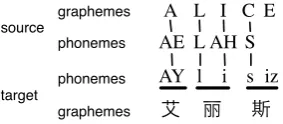
艾
AE L AH S A L I C E
AY l i s iz
丽 斯
graphemes
phonemes
phonemes
graphemes source
[image:3.595.346.488.64.126.2]target
Figure 2: An example of English-Chinese translit-eration alignment via phonetic representations.
Figure 2 shows the correspondence between the graphemes and phonemes of English word “Al-ice” and its Chinese transliteration, with CMU phoneme set used for English (Chase, 1997) and IIR phoneme set for Chinese (Li et al., 2007a).
A Chinese character is often mapped to a unique
sequence of Chinese phonemes. Therefore, if
we align English characters {ei} and Chinese
phonemes {cpk} (cpk ∈ CP set of Chinese
phonemes) well, we almost succeed in aligning English and Chinese grapheme tokens. Alignment
between{ei}and{cpk}becomes the main task in
this paper.
3.2.1 Phoneme affinity alignment
Let the phonetic transcription of English word
{ei}be{epn},epn∈EP, whereEP is the set of
English phonemes. Alignment between{ei} and
{epn}, as well as between {epn} and {cpk} can
be performed via EM as described above. We esti-mate conditional probability of Chinese phoneme
cpkafter observing English characterei as
P(cpk|ei) = X
{epn}
P(cpk|epn)P(epn|ei) (6)
We use the distance function between English
graphemes and Chinese phonemes d(ei, cpk) =
−logP(cpk|ei) to perform the initial alignment
between {ei} and {cpk} via dynamic
program-ming, followed by the EM iterations until
con-vergence. The estimates for P(cpk|epn) and
P(epn|ei)are obtained from the affinity matrices:
the former from the alignment of English and Chi-nese phonetic representations, the latter from the alignment of English words and their phonetic rep-resentations.
3.2.2 Phonological alignment
Alignment between the phonetic representations of source and target words can also be achieved using the linguistic knowledge of phonetic
phonemes and assign various distances between
phonemes of different classes. In contrast, we
make use of phonological descriptors to define the similarity between phonemes in this paper.
Perhaps the most common way to measure the phonetic similarity is to compute the distances be-tween phoneme features (Kessler, 2005). Such features have been introduced in many ways, such as perceptual attributes or articulatory attributes. Recently, Tao et al. (2006) and Yoon et al. (2007) have studied the use of phonological features and manually assigned phonological distance to mea-sure the similarity of transliterated words for ex-tracting transliterations from a comparable corpus. We adopt the binary-valued articulatory at-tributes as the phonological descriptors, which are used to describe the CMU and IIR phoneme sets for English and Chinese Mandarin respectively. Withgott and Chen (1993) define a feature vec-tor of phonological descripvec-tors for English sounds. We extend the idea by defining a 21-element bi-nary feature vector for each English and Chinese
phoneme. Each element of the feature vector
represents presence or absence of a phonologi-cal descriptor that differentiates various kinds of
phonemes, e.g. vowels from consonants, front
from back vowels, nasals from fricatives, etc1.
In this way, a phoneme is described by a fea-ture vector. We express the similarity between two phonemes by the Hamming distance, also called the phonological distance, between the two
feature vectors. A difference in one descriptor
between two phonemes increases their distance by 1. As the descriptors are chosen to differenti-ate between sounds, the distance between similar phonemes is low, while that between two very dif-ferent phonemes, such as a vowel and a consonant, is high. The null phoneme, added to both English and Chinese phoneme sets, has a constant distance to any actual phonemes, which is higher than that between any two actual phonemes.
We use the phonological distance to perform the initial alignment between English and Chi-nese phonetic representations of words. After that we proceed with recalculation of the distances be-tween phonemes using the affinity matrix as de-scribed in Section 3.1 and realign the corpus again. We continue the iterations until convergence is
1The complete table of English and Chinese phonemes
with their descriptors, as well as the translitera-tion system demo is available at http://translit.i2r.a-star.edu.sg/demos/transliteration/
reached. Because of the use of phonological de-scriptors for the initial alignment, we call this
tech-nique thephonological alignment.
4 Transliteration alignment entropy
Having aligned the graphemes between two lan-guages, we want to measure how good the align-ment is. Aligning the graphemes means aligning the English substrings, called the source grapheme tokens, to Chinese characters, the target grapheme tokens. Intuitively, the more consistent the map-ping is, the better the alignment will be. We can
quantify the consistency of alignment via
align-ment entropygrounded on information theory. Given a corpus of aligned transliteration pairs,
we calculatecount(cj,¯em), the number of times
each Chinese grapheme token (character) cj is
mapped to each English grapheme token¯em. We
use the counts to estimate probabilities
P(¯em, cj) =count(cj,e¯m)/ X
m,j
count(cj,¯em)
P(¯em|cj) =count(cj,¯em)/ X
m
count(cj,e¯m)
Thealignment entropyof the transliteration corpus is the weighted average of the entropy values for all Chinese tokens:
H=−X j
P(cj) X
m
P(¯em|cj) logP(¯em|cj)
=−X
m,j
P(¯em, cj) logP(¯em|cj)
(7)
Alignment entropy indicates the uncertainty of mapping between the English and Chinese tokens
resulting from alignment. We expect and will
show that this estimate is a good indicator of the
alignment quality, and is as effective as the F
-score, but without the need for a gold standard ref-erence. A lower alignment entropy suggests that each Chinese token tends to be mapped to fewer distinct English tokens, reflecting better
consis-tency. We expect a good alignment to have a
sharp cross-lingual mapping with low alignment entropy.
5 Experiments
named entity list LDC2005T34 (Linguistic Data Consortium, 2005), containing 673,390 personal name pairs. The LDC corpus is referred to as LDC05 for short hereafter. For the results to be comparable with other studies, we follow the same splitting of Xinhua corpus as that in (Li et al., 2007b) having a training and testing set of 34,777 and 2,896 names respectively. In contrast to the well edited Xinhua corpus, LDC05 contains erro-neous entries. We have manually verified and cor-rected around 240,000 pairs to clean up the corpus. As a result, we arrive at a set of 560,768 English-Chinese (EC) pairs that follow the English-Chinese pho-netic rules, and a set of 83,403 English-Japanese Kanji (EJ) pairs, which follow the Japanese pho-netic rules, and the rest 29,219 pairs (REST) be-ing labeled as incorrect transliterations. Next we conduct three experiments to study 1) alignment
entropy vs. F-score, 2) the impact of alignment
quality on transliteration accuracy, and 3) how to validate transliteration using alignment metrics.
5.1 Alignment entropy vs.F-score
As mentioned earlier, for English-Chinese
grapheme alignment, the main task is to align En-glish graphemes to Chinese phonemes. Phonetic transcription for the English names in Xinhua corpus are obtained by a grapheme-to-phoneme (G2P) converter (Lenzo, 1997), which generates phoneme sequence without providing the exact correspondence between the graphemes and phonemes. G2P converter is trained on the CMU dictionary (Lenzo, 2008).
We align English grapheme and phonetic
repre-sentationse−epwith the affinity alignment
tech-nique (Section 3.1) in 3 iterations. We further
align the English and Chinese phonetic
represen-tationsep−cpvia both affinity and phonological
alignment techniques, by carrying out 6 and 7 it-erations respectively. The alignment methods are schematically shown in Figure 3.
To study how alignment entropy varies accord-ing to different quality of alignment, we would like to have many different alignment results. We
pair the intermediate results from thee−epand
ep − cp alignment iterations (see Figure 3) to
form e − ep − cp alignments between English
graphemes and Chinese phonemes and let them converge through few more iterations, as shown in Figure 4. In this way, we arrive at a total of 114 phonological and 80 affinity alignments of
differ-ent quality.
{cpk} {ei}
English graphemes
{epn} English phonemes
Chinese phonemes
affinity alignment affinity alignment
e−epiteration 1
e−epiteration 2
e−epiteration 3
ep−cpiteration 1
ep−cpiteration 2 ...
ep−cpiteration 6
phonological alignment
ep−cpiteration 1
ep−cpiteration 2 ...
[image:5.595.327.504.77.164.2]ep−cpiteration 7
Figure 3: Aligning English graphemes to
phonemese−epand English phonemes to Chinese
phonemesep−cp. Intermediatee−epandep−cp
alignments are used for producing e−ep −cp
alignments.
e−ep
alignments
ep−cp
affinity / phonological
alignments iteration 1 iteration 2 iteration 3
iteration 1
iteration 2
iteration n ... ...
calculating
d(ei, cpk) affinity alignment
iteration 1 iteration 2
...
e−ep−cp
etc
Figure 4: Example of aligning English graphemes
to Chinese phonemes. Each combination ofe−ep
andep−cpalignments is used to derive the initial
distanced(ei, cpk), resulting in severale−ep−cp
alignments due to the affinity alignment iterations.
We have manually aligned a random set of 3,000 transliteration pairs from the Xinhua train-ing set to serve as the gold standard, on which we
calculate the precision, recall andF-score as well
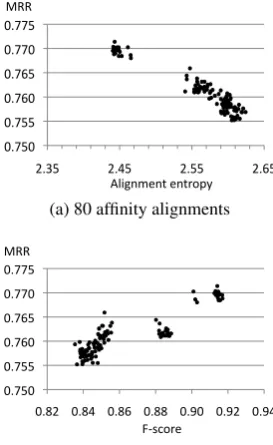
as alignment entropy for each alignment. Each alignment is reflected as a data point in Figures 5a and 5b. From the figures, we can observe a clear
correlation between the alignment entropy andF
-score, that validates the effectiveness of alignment
entropy as an evaluation metric. Note that we
don’t need the gold standard reference for report-ing the alignment entropy.
We also notice that the data points seem to form
clusters inside which the value ofF-score changes
insignificantly as the alignment entropy changes. Further investigation reveals that this could be due to the limited number of entries in the gold stan-dard. The 3,000 names in the gold standard are not enough to effectively reflect the change across
dif-ferent alignments. F-score requires a large gold
[image:5.595.331.504.270.329.2]!"#$% !"#&% !"#'% !"##% !"(!% !"($% !"(&%
$")*% $"&*% $"**% $"'*%
!"#$%&'
()*+,-',./',.&%01 2345 2365
(a) 80 affinity alignments
!"#$% !"#&% !"#'% !"##% !"(!% !"($% !"(&%
$")*% $"&*% $"**% $"'*%
!"#$%&'%()'%(*+,-./01 ./21
3456+*'
[image:6.595.117.244.63.279.2](b) 114 phonological alignments
Figure 5: Correlation betweenF-score and
align-ment entropy for Xinhua training set alignalign-ments. Results for precision and recall have similar trends .
5.2 Impact of alignment quality on transliteration accuracy
We now further study how the alignment affects the generative transliteration model in the frame-work of the joint source-channel model (Li et al.,
2004). This model performs transliteration by
maximizing the joint probability of the source and
target namesP({ei},{cj}), where the source and
target names are sequences of English and Chi-nese grapheme tokens. The joint probability is expressed as a chain product of a series of
condi-tional probabilities of token pairsP({ei},{cj}) =
P((¯ek, ck)|(¯ek−1, ck−1)),k = 1. . . N, where we
limit the history to one preceding pair, resulting in a bigram model. The conditional probabilities for token pairs are estimated from the aligned training corpus. We use this model because it was shown to be simple yet accurate (Ekbal et al., 2006; Li et al., 2007b). We train a model for each of the 114 phonological alignments and the 80 affinity alignments in Section 5.1 and conduct translitera-tion experiment on the Xinhua test data.
During transliteration, an input English name is first decoded into a lattice of all possible En-glish and Chinese grapheme token pairs. Then the joint source-channel transliteration model is used
to score the lattice to obtain a ranked list ofmmost
likely Chinese transliterations (m-best list).
We measure transliteration accuracy as the
mean reciprocal rank (MRR) (Kantor and
Voorhees, 2000). If there is only one correct
Chinese transliteration of the k-th English word
and it is found at therk-th position in them-best
list, its reciprocal rank is1/rk. If the list contains
no correct transliterations, the reciprocal rank is 0. In case of multiple correct transliterations, we take the one that gives the highest reciprocal rank. MRR is the average of the reciprocal ranks across all words in the test set. It is commonly used as a measure of transliteration accuracy, and also allows us to make a direct comparison with other reported work (Li et al., 2007b).
We takem = 20and measure MRR on Xinhua
test set for each alignment of Xinhua training set as described in Section 5.1. We report MRR and the alignment entropy in Figures 6a and 7a for the affinity and phonological alignments respectively. The highest MRR we achieve is 0.771 for affin-ity alignments and 0.773 for phonological align-ments. This is a significant improvement over the MRR of 0.708 reported in (Li et al., 2007b) on the same data. We also observe that the phonological alignment technique produces, on average, better alignments than the affinity alignment technique in terms of both the alignment entropy and MRR.
We also report the MRR andF-scores for each
alignment in Figures 6b and 7b, from which we observe that alignment entropy has stronger
corre-lation with MRR than F-score does. The
Spear-man’s rank correlation coefficients are−0.89and
−0.88 for data in Figure 6a and 7a respectively.
This once again demonstrates the desired property of alignment entropy as an evaluation metric of alignment.
To validate our findings from Xinhua corpus, we further carry out experiments on the EC set of LDC05 containing 560,768 entries. We split the set into 5 almost equal subsets for cross-validation: in each of 5 experiments one subset is used for testing and the remaining ones for train-ing. Since LDC05 contains one-to-many English-Chinese transliteration pairs, we make sure that an English name only appears in one subset.
!"#$!% !"#$$% !"#&!% !"#&$% !"##!% !"##$%
'"($% '")$% '"$$% '"&$%
MRR
Alignment entropy
(a) 80 affinity alignments
!"#$!% !"#$$% !"#&!% !"#&$% !"##!% !"##$%
!"'(% !"')% !"'&% !"''% !"*!% !"*(% !"*)% MRR
F‐score
[image:7.595.111.248.64.287.2](b) 80 affinity alignments
Figure 6: Mean reciprocal ratio on Xinhua test
set vs. alignment entropy andF-score for
mod-els trained with different affinity alignments.
use each iteration of the alignment in the translit-eration modeling and present the resulting MRR along with alignment entropy in Figure 8. The MRR results are the averages of five values pro-duced in the five-fold cross-validations.
We observe a clear correlation between the alignment entropy and transliteration accuracy ex-pressed by MRR on LDC05 corpus, similar to that on Xinhua corpus, with the Spearman’s rank
cor-relation coefficient of−0.77. We obtain the
high-est average MRR of 0.720 on the EC set.
5.3 Validating transliteration using alignment measure
Transliteration validation is a hypothesis test that decides whether a given transliteration pair is
gen-uine or not. Instead of using the lexicon
fre-quency (Knight and Graehl, 1998) or Web statis-tics (Qu and Grefenstette, 2004), we propose vali-dating transliteration pairs according to the
align-ment distance D between the aligned English
graphemes and Chinese phonemes (see equations
(2) and (5)). A distance function d(ei, cpk) is
established from each alignment on the Xinhua training set as discussed in Section 5.2.
An audit of LDC05 corpus groups the corpus into three sets: an English-Chinese (EC) set of 560,768 samples, an English-Japanese (EJ) set of 83,403 samples and the REST set of 29,219
!"#$!% !"#$$% !"#&!% !"#&$% !"##!% !"##$%
'"($% '")$% '"$$% '"&$% MRR
Alignment entropy
(a) 114 phonological alignments
!"#$!% !"#$$% !"#&!% !"#&$% !"##!% !"##$%
!"'(% !"')% !"'&% !"''% !"*!% !"*(% !"*)% MRR
F‐score
(b) 114 phonological alignments
Figure 7: Mean reciprocal ratio on Xinhua test
set vs. alignment entropy andF-score for models
trained with different phonological alignments.
!"#!$% !"#!&% !"#!'% !"#(!% !"#()% !"#($% !"#(&% !"#('% !"#)!%
("*!% )"!!% )"(!% )")!%
!""
[image:7.595.355.477.64.160.2]#$%&'()'*+)'*,-./
Figure 8: Mean reciprocal ratio vs. alignment en-tropy for alignments of EC set.
samples that are not transliteration pairs. We
mark the EC name pairs as genuine and the rest 112,622 name pairs that do not follow the Chi-nese phonetic rules as false transliterations, thus creating the ground truth labels for an English-Chinese transliteration validation experiment. In other words, LDC05 has 560,768 genuine translit-eration pairs and 112,622 false ones.
We run one iteration of alignment over LDC05 (both genuine and false) with the distance
func-tiond(ei, cpk)derived from the affinity matrix of
one aligned Xinhua training set. In this way, each transliteration pair in LDC05 provides an
align-ment distance. One can expect that a genuine
[image:7.595.355.476.354.443.2]length, and the sum of both, producing score1,
score2andscore3respectively.
Miss probability (%)
False alarm pr
obability (%)
2 5 10
1
2
5
10
1 20
20
score2 EER: 4.48 %
score1 EER: 7.13 %
score3 EER: 4.80 %
(a) DET with score1, score2,
score3.
1 2 5 10
1
2
5
10
Miss probability (%)
False alarm pr
obability (%) Entropy: 2.396
MRR: 0.773 EER: 4.48 %
Entropy: 2.529 MRR: 0.764 EER: 4.52% Entropy: 2.625
MRR: 0.754 EER: 4.70%
[image:8.595.317.516.62.138.2](b) DET results vs. three different alignment quality.
Figure 9: Detection error tradeoff (DET) curves for transliteration validation on LDC05.
We can now classify each LDC05 name pair as genuine or false by having a hypothesis test. When the test score is lower than a pre-set threshold, the name pair is accepted as genuine, otherwise false. In this way, each pre-set threshold will present two types of errors, a false alarm and a miss-detect rate. A common way to present such results is via the detection error tradeoff (DET) curves, which show all possible decision points, and the equal er-ror rate (EER), when false alarm and miss-detect rates are equal.
Figure 9a shows three DET curves based on
score1, score2 and score3 respectively for one
one alignment solution on the Xinhua training set. The horizontal axis is the probability of miss-detecting a genuine transliteration, while the verti-cal one is the probability of false-alarms. It is clear
that out of the three,score2 gives the best results.
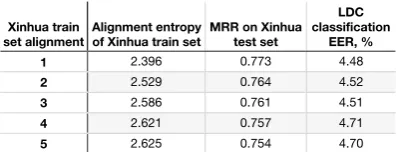
We select the alignments of Xinhua training set that produce the highest and the lowest MRR. We also randomly select three other alignments that produce different MRR values from the pool of 114 phonological and 80 affinity alignments.
Xinhua train
set alignment Alignment entropy of Xinhua train set MRR on Xinhua test set LDC classification
EER, % 1
2 3 4 5
2.396 0.773 4.48 2.529 0.764 4.52 2.586 0.761 4.51 2.621 0.757 4.71 2.625 0.754 4.70
Table 1: Equal error ratio of LDC transliteration pair validation for different alignments of Xinhua training set.
We use each alignment to derive distance
func-tiond(ei, cpk). Table 1 shows the EER of LDC05
validation usingscore2, along with the alignment
entropy of the Xinhua training set that derives
d(ei, cpk), and the MRR on Xinhua test set in the
generative transliteration experiment (see Section 5.2) for all 5 alignments. To avoid cluttering Fig-ure 9b, we show the DET curves for alignments 1, 2 and 5 only. We observe that distance func-tion derived from better aligned Xinhua corpus, as measured by both our alignment entropy met-ric and MRR, leads to a higher validation accuracy consistently on LDC05.
6 Conclusions
We conclude that the alignment entropy is a re-liable indicator of the alignment quality, as con-firmed by our experiments on both Xinhua and
LDC corpora. Alignment entropy does not
re-quire the gold standard reference, it thus can be used to evaluate alignments of large transliteration corpora and is possibly to give more reliable
esti-mate of alignment quality than theF-score metric
as shown in our transliteration experiment. The alignment quality of training corpus has a significant impact on the transliteration mod-els. We achieve the highest MRR of 0.773 on Xinhua corpus with phonological alignment tech-nique, which represents a significant performance
gain over other reported results. Phonological
alignment outperforms affinity alignment on clean database.
[image:8.595.114.247.107.380.2]References
Nasreen AbdulJaleel and Leah S. Larkey. 2003. Sta-tistical transliteration for English-Arabic cross lan-guage information retrieval. InProc. ACM CIKM.
Yaser Al-Onaizan and Kevin Knight. 2002. Machine transliteration of names in arabic text. InProc. ACL Workshop: Computational Apporaches to Semitic Languages.
Slaven Bilac and Hozumi Tanaka. 2004. A hybrid back-transliteration system for Japanese. In Proc. COLING, pages 597–603.
Lin L. Chase. 1997. Error-responsive feedback mech-anisms for speech recognizers. Ph.D. thesis, CMU.
Asif Ekbal, Sudip Kumar Naskar, and Sivaji Bandy-opadhyay. 2006. A modified joint source-channel model for transliteration. In Proc. COLING/ACL, pages 191–198
Wei Gao, Kam-Fai Wong, and Wai Lam. 2004. Phoneme-based transliteration of foreign names for OOV problem. InProc. IJCNLP, pages 374–381.
Long Jiang, Ming Zhou, Lee-Feng Chien, and Cheng Niu. 2007. Named entity translation with web min-ing and transliteration. InIJCAI, pages 1629–1634.
Sung Young Jung, SungLim Hong, and Eunok Paek. 2000. An English to Korean transliteration model of extended Markov window. InProc. COLING, vol-ume 1.
Paul. B. Kantor and Ellen. M. Voorhees. 2000. The TREC-5 confusion track: comparing retrieval meth-ods for scanned text. Information Retrieval, 2:165– 176.
Brett Kessler. 2005. Phonetic comparison algo-rithms. Transactions of the Philological Society, 103(2):243–260.
Kevin Knight and Jonathan Graehl. 1998. Machine transliteration.Computational Linguistics, 24(4).
Jin-Shea Kuo, Haizhou Li, and Ying-Kuei Yang. 2007. A phonetic similarity model for automatic extraction of transliteration pairs. ACM Trans. Asian Language Information Processing, 6(2).
Patrik Lambert. 2008. Exploiting lexical informa-tion and discriminative alignment training in statis-tical machine translation. Ph.D. thesis, Universitat Polit`ecnica de Catalunya, Barcelona, Spain.
Kevin Lenzo. 1997. t2p: text-to-phoneme converter builder. http://www.cs.cmu.edu/˜lenzo/t2p/.
Kevin Lenzo. 2008. The CMU pronounc-ing dictionary. http://www.speech.cs.cmu.edu/cgi-bin/cmudict.
Haizhou Li, Min Zhang, and Jian Su. 2004. A joint source-channel model for machine transliteration. InProc. ACL, pages 159–166.
Haizhou Li, Bin Ma, and Chin-Hui Lee. 2007a. A vector space modeling approach to spoken language identification. IEEE Trans. Acoust., Speech, Signal Process., 15(1):271–284.
Haizhou Li, Khe Chai Sim, Jin-Shea Kuo, and Minghui Dong. 2007b. Semantic transliteration of personal names. InProc. ACL, pages 120–127.
Linguistic Data Consortium. 2005. LDC Chinese-English name entity lists LDC2005T34.
Helen M. Meng, Wai-Kit Lo, Berlin Chen, and Karen Tang. 2001. Generate phonetic cognates to han-dle name entities in English-Chinese cross-language spoken document retrieval. InProc. ASRU.
Rada Mihalcea and Ted Pedersen. 2003. An evaluation exercise for word alignment. InProc. HLT-NAACL, pages 1–10.
Jong-Hoon Oh and Key-Sun Choi. 2002. An English-Korean transliteration model using pronunciation and contextual rules. InProc. COLING 2002.
Jong-Hoon Oh and Key-Sun Choi. 2005. Machine learning based english-to-korean transliteration us-ing grapheme and phoneme information. IEICE Trans. Information and Systems, E88-D(7):1737– 1748.
Yan Qu and Gregory Grefenstette. 2004. Finding ideo-graphic representations of Japanese names written in Latin script via language identification and corpus validation. InProc. ACL, pages 183–190.
Tao Tao, Su-Youn Yoon, Andrew Fisterd, Richard Sproat, and ChengXiang Zhai. 2006. Unsupervised named entity transliteration using temporal and pho-netic correlation. InProc. EMNLP, pages 250–257.
Paola Virga and Sanjeev Khudanpur. 2003. Translit-eration of proper names in cross-lingual information retrieval. InProc. ACL MLNER.
Stephen Wan and Cornelia Maria Verspoor. 1998. Au-tomatic English-Chinese name transliteration for de-velopment of multilingual resources. InProc. COL-ING, pages 1352–1356.
M. M. Withgott and F. R. Chen. 1993. Computational models of American speech. Centre for the study of language and information.
Xinhua News Agency. 1992. Chinese transliteration of foreign personal names. The Commercial Press.
LiLi Xu, Atsushi Fujii, and Tetsuya Ishikawa. 2006. Modeling impression in probabilistic transliteration into Chinese. InProc. EMNLP, pages 242–249.