Towards Robust Context-Sensitive Sentence Alignment for Monolingual
Corpora
Rani Nelken and Stuart M. Shieber Division of Engineering and Applied Sciences
Harvard University 33 Oxford St. Cambridge, MA 02138
nelken,shieber @deas.harvard.edu
Abstract
Aligning sentences belonging to compa-rable monolingual corpora has been sug-gested as a first step towards training text rewriting algorithms, for tasks such as summarization or paraphrasing. We present here a new monolingual sen-tence alignment algorithm, combining a sentence-based TF*IDF score, turned into a probability distribution using logistic re-gression, with a global alignment dynamic programming algorithm. Our approach provides a simpler and more robust solu-tion achieving a substantial improvement in accuracy over existing systems.
1 Introduction
Sentence-aligned bilingual corpora are a crucial resource for training statistical machine trans-lation systems. Several authors have sug-gested that large-scale aligned monolingual cor-pora could be similarly used to advance the perfor-mance of monolingual text-to-text rewriting sys-tems, for tasks including summarization (Knight and Marcu, 2000; Jing, 2002) and paraphras-ing (Barzilay and Elhadad, 2003; Quirk et al., 2004). Unlike bilingual corpora, such as the Cana-dian Hansard corpus, which are relatively rare, it is now fairly easy to amass corpora of related mono-lingual documents. For instance, with the ad-vent of news aggregator services such as “Google News”, one can readily collect multiple news sto-ries covering the same news item (Dolan et al., 2004). Utilizing such a resource requires align-ing related documents at a finer level of resolu-tion, identifying which sentences from one docu-ment align with which sentences from the other.
Previous work has shown that aligning related monolingual documents is quite different from the well-studied multi-lingual alignment task.
Whereas documents in a bilingual corpus are typ-ically very closely aligned, monolingual corpora exhibit a much looser level of alignment, with similar content expressed using widely divergent wording, grammatical form, and sentence order. Consequently, many of the simple surface-based methods that have proven to be so successful in bilingual sentence alignment, such as correlation of sentence length, linearity of alignment, and a predominance of one-to-one sentence mapping, are much less likely to be effective for monolin-gual sentence alignment.
Barzilay and Elhadad (2003) suggested that these disadvantages could be at least partially off-set by the recurrence of the same lexical items in document pairs. Indeed, they showed that a sim-ple cosine word-overlap score is a good baseline for the task, outperforming much more sophisti-cated methods. They also observed that context is a powerful factor in determining alignment. They illustrated this on a corpus of Encyclopedia Bri-tannica entries describing world cities, where each entry comes in two flavors, the comprehensive en-cyclopedia entry, and a shorter and simpler ele-mentary version. Barzilay and Elhadad used con-text in two different forms. First, using inter-document context, they took advantage of com-monalities in the topical structure of the encyclo-pedia entries to identify paragraphs that are likely to be about the same topic. They then took ad-vantage of intra-document context by using dy-namic programming to locally align sequences of sentences belonging to paragraphs about the same topic, yielding improved accuracy on the corpus. While powerful, such commonalities in document structure appear to be a special feature of the Britannica corpus, and therefore cannot be relied upon for other corpora.
similar-ity score based on differentially weighting words according to their Term Frequency-Inverse Doc-ument Frequency (TF*IDF) (Sp¨arck-Jones, 1972; Salton and Buckley, 1988). We treat sentences as documents, and the collection of sentences in the two documents being compared as the document collection, and use this score to estimate the prob-ability that two sentences are aligned using logis-tic regression. Surprisingly, this approach by it-self yields competitive accuracy, yielding the same level of accuracy as Barzilay and Elhadad’s algo-rithm, and higher than all previous approaches on the Britannica corpus. Such matching, however, is still noisy. We further improve accuracy by us-ing a global alignment dynamic programmus-ing al-gorithm, which prunes many spurious matches.
Our approach validates Barzilay and Elhadad’s observation regarding the utility of incorporating context. In fact, we are able to extract more infor-mation out of the intra-document context. First, by using TF*IDF at the level of sentences, we weigh words in a sentence with respect to other sentences of the document. Second, global alignment takes advantage of (noisy) linear order of sentences. We make no use of inter-document context, and in par-ticular make no assumptions about common topi-cal structure that are unique to the Britannica cor-pus, thus ensuring the scalability of the approach.
Indeed, we successfully apply our algorithm to a very different corpus, the threeSynoptic gospels of the New Testament: Matthew, Mark, and Luke. Putting aside any religious or theological signifi-cance of these texts, they offer an excellent data source for studying alignment, since they contain many parallels, which have been conveniently an-notated by bible scholars (Aland, 1985). Our algo-rithm achieves a significant improvement over the baseline for this corpus as well, demonstrating the general applicability of our approach.
2 Related work
Several authors have tackled the monolingual sen-tence correspondence problem. SimFinder (Hatzi-vassiloglou et al., 1999; Hatzi(Hatzi-vassiloglou et al., 2001) examined 43 different features that could potentially help determine the similarity of two short text units (sentences or paragraphs). Of these, they automatically selected 11 features, in-cluding word overlap, synonymy as determined by WordNet (Fellbaum, 1998), matching proper nouns and noun phrases, and sharing semantic
classes of verbs (Levin, 1993).
The Decomposition method (Jing, 2002) re-lies on the observation that document summaries are often constructed by extracting sentence frag-ments from the document. It attempts to identify such extracts, using a Hidden Markov Model of the process of extracting words. The HMM uses features of word identity and document position, in which transition probabilities are based on lo-cality assumptions. For instance, after a word is extracted, an adjacent word or one that belongs to a nearby sentence is more likely to be extracted than one that is further away.
Barzilay and Elhadad (2003) apply a 4-step al-gorithm:
1. Cluster the paragraphs of the training docu-ments into topic-specific clusters, based on word overlap. For instance, paragraphs in the Britannica city entries describing climate might cluster together.
2. Learn mapping rules between paragraphs of the full and elementary versions, taking the word-overlap and the clusters as features.
3. Given a new pair of texts, identify sentence pairs with high overlap, and take these to be aligned. Then, classify paragraphs accord-ing to the clusters learned in Step 1, and use the mapping rules of Step 2 to match pairs of paragraphs between the documents.
4. Finally, take advantage of the paragraph clus-tering and mapping, by locally aligning only sentences belonging to mapped paragraph pairs.
are provided; however, with the release of the an-notated Microsoft Research Paraphrase Corpus,1 it is apparent that Dolan et al. are seeking much more tightly related pairs of sentences than Barzi-lay and Elhadad, ones that are virtually semanti-cally equivalent. In subsequent work, the same au-thors (Quirk et al., 2004) used such matched sen-tence pairs to train Giza++ (Och and Ney, 2003) on word-level alignment.
The recent PASCAL “Recognizing Textual En-tailment” (RTE) challenge (Dagan et al., 2005) fo-cused on the problem of determining whether one sentence entails another. Beyond the difference in the definition of the required relation between tences, the RTE challenge focuses on isolated sen-tence pairs, as opposed to sensen-tences within a doc-ument context. The task was judged to be quite difficult, with many of the systems achieving rela-tively low accuracy.
3 Data
The Britannica corpus, collected and annotated by Barzilay and Elhadad (2003), consists of 103 pairs of comprehensive and elementary encyclope-dia entries describing major world cities. Twenty of these document pairs were annotated by human judges, who were asked to mark sentence pairs that contain at least one clause expressing the same information, and further split into a training and testing set.
As a rough indication of the diversity of the dataset and the difference of the task from bilin-gual alignment, we define the alignment diver-sity measure (ADM) for two texts, T1 T2, to be:
2 matches
T1T2
T1
T2
, where matches is the number of
matching sentence pairs. Intuitively, for closely aligned document pairs, as prevalent in bilingual alignment, one would expect anADMvalue close to 1. The averageADMvalue for the training doc-ument pairs of the Britannica corpus is 026.
For the gospels, we use the King James ver-sion, available electronically from the Sacred Text Archive.2 The gospels’ lengths span from 678 verses (Mark) to 1151 verses (Luke), where we treat verses as sentences. For training and eval-uation purposes, we use the list of parallels given by Aland (1985).3 We use the pair Matthew-Mark
1http://research.microsoft.com/
research/downloads/
2http://www.sacred-texts.com
3The parallels are available online fromhttp://www.
bible-researcher.com/parallels.html.
for training and the two pairs: Matthew-Luke and Mark-Luke for testing. Whereas for the Britannica corpus parallels were marked at the resolution of sentences, Aland’s annotation presents parallels as matched sequences of verses, known aspericopes. For instance, Matthew:4.1-11 matches Mark:1.12-13. We writev pto indicate that versevbelongs to pericope p.4
4 Algorithm
We now describe the algorithm, starting with the TF*IDF similarity score, followed by our use of logistic regression, and the global alignment.
4.1 From word overlap to TF*IDF
Barzilay and Elhadad (2003) use a cosine mea-sure of word-overlap as a baseline for the task. As can be expected, word overlap is a relatively effective indicator of sentence similarity and re-latedness (Marcu, 1999). Unfortunately, plain word-overlap assigns all words equal importance, not even distinguishing between function and con-tent words. Thus, once the overlap threshold is decreased to improve recall, precision degrades rapidly. For instance, if a pair of sentences has one or two words in common, this is inconclusive evidence of their similarity or difference.
One way to address this problem is to differ-entially weight words using the TF*IDF scoring scheme, which has become standard in Informa-tion Retrieval (Salton and Buckley, 1988). IDF was also used for the similar task of directional en-tailment by Monz and de Rijke (2001). To apply this scheme for the task at hand we diverge from the standard IDF definition by viewing each sen-tence as a document, and the pair of documents as a combined collection ofNsingle-sentence docu-ments. For a termtin sentences, we define TFst
to be a binary indicator of whethert occurs ins,5 and DFt
to be the number of sentences in which
toccurs. The TF*IDF weight is:
wst
de f TFs
t
log
N DFt
.
4The annotation of matched pericopes induces a partial
segmentation of each gospel into paragraph-like segments. Since this segmentation is part of the gold annotation, we do not use it in our algorithm.
5Using a binary indicator rather than the more typical
1
0.8
0.6
0.5
0.4
0.276 0.2
0
1 0.8
0.6 0.4
0.2 0
probability
similarity 1
0.8
0.6
0.5
0.4
0.276 0.2
0
1 0.8
0.6 0.4
0.2 0
probability
similarity 1
0.8
0.6
0.5
0.4
0.276 0.2
0
1 0.8
0.6 0.4
0.2 0
probability
[image:4.595.74.285.64.215.2]similarity
Figure 1: Logistic Regression for Britannica train-ing data
We use these scores as the basis of a standard cosine similarity measure,
sims1 s2
s1s2
s1
s2
∑tws1
tws2
t
∑tw2
s1
t∑tw
2
s2
t
.
We normalize terms by using Porter stem-ming (Porter, 1980). For the Britannica corpus, we also normalized British/American spelling differ-ences using a small manually-constructed lexicon.
4.2 Logistic regression
TF*IDF scores provide a numeric measure of tence similarity. To use them for choosing sen-tence pairs, we proceeded to learn a probability of two sentences being matched, given their TF*IDF similarity score, prmatch
1 sim . We expect
this probability to follow a sigmoid-shaped curve. While it is always monotonically increasing, the rate of ascent changes; for very low or very high values it is not as steep as for middle values. This reflects the intuition that while we always prefer a higher scoring pair over a lower scoring pair, this preference is more pronounced in the middle range than in the extremities.
Indeed, Figure 1 shows a graph of this distri-bution on the training part of the Britannica cor-pus, where point x y
represents the fractionyof
correctly matched sentences of similarityx. Over-layed on top of the points is a logistic regression model of this distribution, defined as the function
p
ea
bx
1 e
a
bx ,
where a and b are parameters. We used Weka (Witten and Frank, 1999) to automatically learn the parameters of the distribution on the training data. These are set to a 789 and
b 2756 for the Britannica corpus.
1 2 3 4
a b c
pg2 p
[image:4.595.321.513.68.183.2]g1
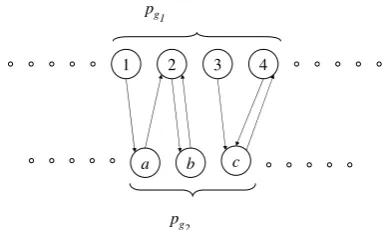
Figure 2: Reciprocal best hit example. Arrows in-dicate the best hit for each verse. The pairs con-sidered correct are 2 b and 4 c .
Logistic regression scales the similarity scores monotonically but non-linearly. In particular, it changes the density of points at different score levels. In addition, we can use this distribution to choose a threshold, th, for when a similarity score is indicative of a match. Optimizing the F-measure on the training data using Weka, we choose a threshold value of th 0276. Note
that since the logistic regression transformation is monotonic, the existence of a threshold on proba-bilities implies the existence of a threshold on the original sim scores. Moreover, such a threshold might be obtained by means other than logistic re-gression. The scaling, however, will become cru-cial once we do additional calculations with these probabilities in Section 4.4.
Applying logistic regression to the gospels is complicated by the fact that we only have a cor-rect alignment at the resolution of pericopes, and not individual verses. Verse pairs that do not be-long to a matched pericope pair can be safely con-sidered unaligned, but for a matched pericope pair, pg1 pg2, we do not know which verse is matched with which. We solve this by searching for the reciprocal best hit, a method often used to find orthologous genes in related species (Mushegian and Koonin, 1996). For each verse in each peri-cope, we find the top matching verse in the other pericope. We take as correct all and only pairs of verses x y, such that x isy’s best match andy is x’s best match. An example is shown in Fig-ure 2. Taking these pairs as matched yields an ADM value of 034 for the training pair of
doc-uments.
We used the reciprocally best-matched pairs of the training portion of the gospels to find logistic regression parametersa 9
a threshold,th
0250. Note that we rely on this
matching only for training, but not for evaluation (see Section 5.2).
4.3 Method 1: TF*IDF
As a simple method for choosing sentence pairs, we just select all sentence pairs withprmatch
th. We use the following additional heuristics:
We unconditionally match the first sentence of one document with the first sentence of the other document. As noted by Quirk et al. (2004), these are very likely to be matched, as verified on our training set as well.
We allow many-to-one matching of tences, but limit them to at most 2-to-1 sen-tences in both directions (by allowing only the top two matches per sentence to be cho-sen), since such multiple matchings often arise due to splitting a sentence into two, or conversely, merging two sentences into one.
4.4 Method 2: TF*IDF + Global alignment
Matching sentence pairs according to TF*IDF ig-nores sentence ordering completely. For bilingual texts, Gale and Church (1991) demonstrated the extraordinary effectiveness of a global alignment dynamic programming algorithm, where the basic similarity score was based on the difference in sen-tence lengths, measured in characters. Such meth-ods fail to work in the monolingual case. Gale and Church’s algorithm (using the implementation of Danielsson and Ridings (1997)) yields 2% pre-cision at 2.85% recall on the Britannica corpus. Moore’s algorithm (2002), which augments sen-tence length alignment with IBM Model 1 align-ment, reports zero matching sentence pairs (re-gardless of threshold).
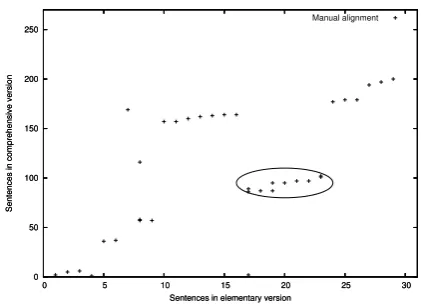
Nevertheless, we expect sentence ordering can provide important clues for monolingual align-ment, bearing in mind two main differences from the bilingual case. First, as can be expected by the ADMvalue, there are many gaps in the alignment. Second, there can be large segments that diverge from the linear order predicted by a global align-ment, as illustrated by the oval in Figure 3 (Figure 2, (Barzilay and Elhadad, 2003)).
To model these features of the data, we use a variant of Needleman-Wunsch alignment (1970). We compute the optimal alignment between sen-tences 1iof the comprehensive text and sentences
1 jof the elementary version by
0 50 100 150 200 250
0 5 10 15 20 25 30
Sentences in comprehensive version
Sentences in elementary version
Manual alignment
0 50 100 150 200 250
0 5 10 15 20 25 30
Sentences in comprehensive version
[image:5.595.307.518.63.216.2]Sentences in elementary version
Figure 3: Gold alignment for a text from the Bri-tannica corpus.
si j
max
s
i
1 j 1 pr
matchi j
si
1 j pr
matchi j
si j
1 pr
matchi j
Note that the dynamic programming sums match probabilities, rather than the original sim scores, making crucial use of the calibration induced by the logistic regression. Starting from the first pair of sentences, we find the best path through the ma-trix indexed by iand j, using dynamic program-ming. Unlike the standard algorithm, we assign no penalty to off-diagonal matches, allowing many-to-one matches as illustrated schematically in Fig-ure 4. This is because for the loose alignment ex-hibited by the data, being off-diagonal is not in-dicative of a bad match. Instead, we prune the complete path generated by the dynamic program-ming using two methods. First, as in Section 4.3, we limit many-to-one matches to 2-to-1, by al-lowing just the two best matches per sentence to be included. Second, we eliminate sentence pairs with very low match probabilities prmatch
0005, a value learned on the training data.
Fi-nally, to deal with the divergences from the lin-ear order, we add the top n pairs with very high match probability, above a higher threshold, th. Optimizing on the training data, we setn 5 and
th 065 for both corpora.
Figure 4: Global alignment
corpus-specific features, our approach gains in ro-bustness.
5 Evaluation
5.1 Britannica corpus
Precision/recall curves for both methods, aggre-gated over all the documents of the testing por-tion of the Britannica corpus are given in Fig-ure 5. To obtain different precision/recall points, we vary the threshold above which a sentence pair is deemed matched. Of course, when practically applying the algorithm, we have to pick a partic-ular threshold, as we have done by choosing th. Precision/recall values at this threshold are also in-dicated in the figure.6
1
0.9
0.8
0.7
0.6
0.7 0.6
0.558 0.5 0.4
0.3
Precision
Recall
TF*IDF + Align 1
0.9
0.8
0.7
0.6
0.7 0.6
0.558 0.5 0.4
0.3
Precision
Recall
TF*IDF 1
0.9
0.8
0.7
0.6
0.7 0.6
0.558 0.5 0.4
0.3
Precision
Recall
Precision @ 55.8 Recall 1
0.9
0.8
0.7
0.6
0.7 0.6
0.558 0.5 0.4
0.3
Precision
Recall 1
0.9
0.8
0.7
0.6
0.7 0.6
0.558 0.5 0.4
0.3
Precision
Recall
[image:6.595.341.492.61.158.2]Precision/Recall @ th
Figure 5: Precision/Recall curves for the Britan-nica corpus
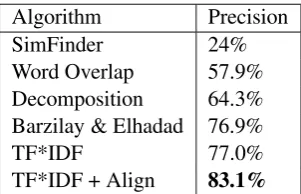
Comparative results with previous algorithms are given in Table 1, in which the results for Barzi-lay and Elhadad’s algorithm and previous ones are taken from Barzilay and Elhadad (2003). The pa-per reports the precision at 55.8% recall, since the Decomposition method (Jing, 2002) only pro-duced results at this level of recall, as some of the method’s parameters were hard-coded.
Interestingly, the TF*IDF method is highly competitive in determining sentence similarity.
6Decreasing the threshold to 0.0 does not yield all pairs,
since we only consider pairs with similarity strictly greater than 0.0, and restrict many-to-one matches to 2-to-1.
Algorithm Precision
SimFinder 24%
Word Overlap 57.9% Decomposition 64.3% Barzilay & Elhadad 76.9%
TF*IDF 77.0%
TF*IDF + Align 83.1%
Table 1: Precision at 55.8% Recall
Despite its simplicity, it achieves the same perfor-mance as Barzilay and Elhadad’s algorithm,7 and is better than all previous ones. Significant im-provement is achieved by adding the global align-ment.
Clearly, the method is inherently limited in that it can only match sentences with some lexical overlap. For instance, the following sentence pair that should have been matched was missed:
Population soared, reaching 756,000 by 1903, and urban services underwent exten-sive modification.
At the beginning of the 20th century, Warsaw had about 700,000 residents.
Matching “1903” with “the beginning of the 20th century” goes beyond the scope of any method relying predominantly on word identity. The hope is, however, that such mappings could be learned by amassing a large corpus of accu-rately sentence-aligned documents, and then ap-plying a word-alignment algorithm, as proposed by Quirk et al. (2004). Incidentally, examining sentence pairs with high TF*IDF similarity scores, there are some striking cases that appear to have been missed by the human judges. Of course, we faithfully and conservatively relied on the human annotation in the evaluation, ignoring such cases.
5.2 Gospels
For evaluating our algorithm’s accuracy on the gospels, we again have to contend with the fact that the correct alignments are given at the resolu-tion of pericopes, not verses. We cannot rely on the reciprocal best hit method we used for train-ing, since it relies on the TF*IDF similarity scores, which we are attempting to evaluate. We therefore devise an alternative evaluation criterion, counting
[image:6.595.72.286.391.542.2]a pair of verses as correctly aligned if they belong to a matched pericope in the gold annotation.
LetGoldg1 g2
be the set of matched pericope
pairs for gospelsg1 g2, according to Aland (1985). For each pair of matched verses,vg1 vg2, we count the pair as a true positive if and only if there is a pericope pair pg
1 pg2 Gold
g1 g2
such that
vgi pgi i 1 2. Otherwise, it is a false positive.
Precision is defined as usual (P t p t p
f p ).
For recall, we note that not all the verses of a matched pericope should be matched, especially when one pericope has substantially more verses than the other. In general, we may expect the num-ber of verses to be matched to be the minimum of
pg
1 and pg
2 . We thus define recall as:
R t p
∑
pg1pg
2
Gold
g1g2
min
pg
1 pg
2 .
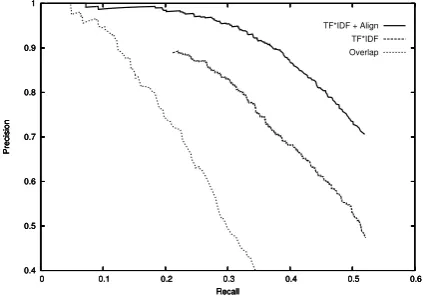
The results are given in Figure 6, including the word-overlap baseline, TF*IDF ranking with lo-gistic regression, and the added global alignment. Once again, TF*IDF yields a substantial improve-ment over the baseline, and results are further im-proved by adding the global alignment.
1
0.9
0.8
0.7
0.6
0.5
0.4
0.6 0.5 0.4 0.3 0.2 0.1 0
Precision
Recall
TF*IDF + Align 1
0.9
0.8
0.7
0.6
0.5
0.4
0.6 0.5 0.4 0.3 0.2 0.1 0
Precision
Recall
TF*IDF 1
0.9
0.8
0.7
0.6
0.5
0.4
0.6 0.5 0.4 0.3 0.2 0.1 0
Precision
Recall
[image:7.595.73.285.425.576.2]Overlap
Figure 6: Precision/Recall curves for the gospels
6 Conclusions and future work
For monolingual alignment to achieve its full po-tential for text rewriting, huge amounts of text would need to be accurately aligned. Since mono-lingual corpora are so noisy, simple but effective methods as described in this paper will be required to ensure scalability.
We have presented a novel algorithm for align-ing the sentences of monolalign-ingual corpora of com-parable documents. Our algorithm not only yields
substantially improved accuracy, but is also sim-pler and more robust than previous approaches. The efficacy of TF*IDF ranking is remarkable in the face of previous results. In particular, TF*IDF was not chosen by the feature selection algorithm of Hatzivassiloglou et al. (2001), who directly ex-perimented and rejected TF*IDF measures as ing less effective in determining similarity. We be-lieve this striking difference can be attributed to the source of the weights. Recall that our TF*IDF weights treat each sentence as a separate docu-ment for the purpose of weighting. TF*IDF scores used in previous work are likely to have been ob-tained either by aggregation over the full docu-ment corpus, or by comparison with an external general collection, which is bound to yield lower discriminative power. To illustrate this, consider two words, such as the name of a city, and the name of a building in that city. Viewed globally, both words are likely to belong to the long tail of the Zipf distribution, having almost indistin-guishable logarithmic IDF. However, in the ency-clopedia entry describing the city, the city’s name is likely to appear in many sentences, while the building name may appear only in the single sen-tence that refers to it, and thus the latter should be scored higher. Conversely, a word that is rela-tively frequent in general usage, e.g., “river” might be highly discriminative between sentences.
We further improve on the TF*IDF results by using a global alignment algorithm. We expect that more sophisticated sequence alignment tech-niques, as studied for biological sequence anal-ysis, might yield improved results, in particular for comparing loosely matched document pairs volving non-linear text transformations such as in-versions and translocations. Such methods could still modularly rely on the TF*IDF scoring.
We reiterate Barzilay and Elhadad’s conclusion about the effectiveness of using the document con-text for the alignment of con-text. In fact, we are able to take better advantage of the intra-document context, while not relying on any assumptions about inter-document context that might be spe-cific to one particular corpus. Identifying scalable principles for the use of inter-document context poses a challenging topic for future research.
es-tablished a simple and robust document alignment method, we leave its application to much larger-scale document sets for future work.
Acknowledgments
We thank Regina Barzilay and Noemie Elhadad for providing access to the annotated Britannica corpus, and for discussion. This work was sup-ported in part by National Science Foundation grant BCS-0236592.
References
Kurt Aland, editor. 1985. Synopsis Quattuor Evange-liorum. American Bible Society, 13th edition, De-cember.
Regina Barzilay and Noemie Elhadad. 2003. Sentence alignment for monolingual comparable corpora. In
Proceedings of the 2003 Conference on Empirical Methods in Natural Language Processing.
Ido Dagan, Oren Glickman, and Bernardo Magnini. 2005. The PASCAL recognising textual entail-ment challenge. In Proceedings of the PASCAL Challenges Workshop on Recognising Textual En-tailment, pages 1–8, April.
Pernilla Danielsson and Daniel Ridings. 1997. Prac-tical presentation of a vanilla aligner. Research re-ports from the Department of Swedish, Goeteborg University GU-ISS-97-2, Sprakdata, February.
Bill Dolan, Chris Quirk, and Chris Brockett. 2004. Unsupervised construction of large paraphrase cor-pora: Exploiting massively parallel news sources. In Proceedings of the 20th International Con-ference on Computational Linguistics (COLING-2004), Geneva, Switzerland, August.
Christiane Fellbaum. 1998. WordNet: An Electronic Lexical Database. MIT Press.
William A. Gale and Kenneth W. Church. 1991. A program for aligning sentences in bilingual corpora. In Meeting of the Association for Computational Linguistics, pages 177–184.
Vasileios Hatzivassiloglou, Judith L. Klavans, and Eleazar Eskin. 1999. Detecting text similarity over short passages: Exploring linguistic feature combi-nations via machine learning. InProceedings of the 1999 Joint SIGDAT conference on Empirical Meth-ods in Natural Language Processing and Very Large Corpora, pages 203–212, College Park, Maryland. Vasileios Hatzivassiloglou, Judith L. Klavans,
Melissa L. Holcombe, Regina Barzilay, Min-Yen Kan, and Kathleen R. McKeown. 2001. SIMFINDER: A flexible clustering tool for sum-marization. In Proceedings of the Workshop on Automatic Summarization, pages 41–49. Associa-tion for ComputaAssocia-tional Linguistics, 2001.
Hongyan Jing. 2002. Using hidden Markov modeling to decompose human-written summaries. Computa-tional Linguistics, 28(4):527–543.
Kevin Knight and Daniel Marcu. 2000. Statistics-based summarization – step one: Sentence compres-sion. In Proceedings of the American Association for Artificial Intelligence conference (AAAI). Beth Levin. 1993. English Verb Classes And
Alterna-tions: A Preliminary Investigation. The University of Chicago Press.
Daniel Marcu. 1999. The automatic construction of large-scale corpora for summarization research. In
SIGIR ’99: Proceedings of the 22nd Annual Interna-tional ACM SIGIR Conference on Research and De-velopment in Information Retrieval, August 15-19, 1999, Berkeley, CA, USA, pages 137–144. ACM. Christof Monz and Maarten de Rijke. 2001.
Light-weight subsumption checking for computational semantics. In Patrick Blackburn and Michael Kohlhase, editors,Proceedings of the 3rd Workshop on Inference in Computational Semantics (ICoS-3), pages 59–72.
Robert C. Moore. 2002. Fast and accurate sen-tence alignment of bilingual corpora. In Stephen D. Richardson, editor, AMTA, volume 2499 of Lec-ture Notes in Computer Science, pages 135–144. Springer.
Arcady R. Mushegian and Eugene V. Koonin. 1996. A minimal gene set for cellular life derived by com-parison of complete bacterial genomes.Proceedings of the National Academies of Science, 93:10268– 10273, September.
S.B. Needleman and C.D. Wunsch. 1970. A general method applicable to the search for similarities in the amino acid sequence of two proteins. J. Mol. Biol., 48:443–453.
Franz Josef Och and Hermann Ney. 2003. A sys-tematic comparison of various statistical alignment models.Computational Linguistics, 29(1):19–51. Martin F. Porter. 1980. An algorithm for suffi x
strip-ping.Program, 14(3):130–137.
Chris Quirk, Chris Brockett, and William B. Dolan. 2004. Monolingual machine translation for para-phrase generation. InProceedings of the 2004 Con-ference on Empirical Methods in Natural Language Processing, pages 142–149, Barcelona Spain, July. Gerard Salton and Chris Buckley. 1988.
Term-weighting approaches in automatic text retrieval. In-formation Processing and Management, 24(5):513– 523.
Karen Sp¨arck-Jones. 1972. Exhaustivity and speci-fi city.Journal of Documentation, 28(1):11–21. Ian H. Witten and Eibe Frank. 1999. Data Mining: