Morphological Disambiguation by Voting Constraints
K e m a l O f l a z e r a n d G S k h a n T f i r
D e p a r t m e n t o f C o m p u t e r E n g i n e e r i n g a n d I n f o r m a t i o n S c i e n c e B i l k e n t U n i v e r s i t y , B i l k e n t , T R - 0 6 5 3 3 , T u r k e y
{ko, tur}©cs, bilkent, edu. tr
A b s t r a c t
We present a constraint-based morpholog- ical disambiguation system in which indi- vidual constraints vote on matching mor- phological parses, and disambiguation of all the tokens in a sentence is performed at the end by selecting parses that receive the highest votes. This constraint applica- tion paradigm makes the outcome of the disambiguation independent of the rule se- quence, and hence relieves the rule devel- oper from worrying about potentially con- flicting rule sequencing. Our results for disambiguating Turkish indicate that using about 500 constraint rules and some addi- tional simple statistics, we can attain a re- call of 95-96~ and a precision of 94-95~ with about 1.01 parses per token. Our sys- tem is implemented in Prolog and we are currently investigating an efficient imple- mentation based on finite state transduc- ers.
1 I n t r o d u c t i o n
Automatic morphological disambiguation is an im- portant component in higher level analysis of natural language text corpora. There has been a large num- ber of studies in tagging and morphological disam- biguation using various techniques such as statisti- cal techniques, e.g., (Church, 1988; Cutting et al., 1992; DeRose, 1988), constraint-based techniques (Karlsson et al., 1995; Voutilainen, 1995b; Vouti- lainen, Heikkil/i, and Anttila, 1992; Voutilainen and Tapanainen, 1993; Oflazer and KuruSz, 1994; Oflazer and T i l l 1996) and transformation-based techniques (Brilt, 1992; Brill, 1994; Brill, 1995).
This paper presents a novel approach to constraint based morphological disambiguation which relieves the rule developer from worrying about conflicting rule ordering requirements. The approach depends on assigning votes to constraints according to their complexity and specificity, and then letting con- straints cast votes on matching parses of a given
lexical item. This approach does not reflect the out- come of matching constraints to the set of morpho- logical parses immediately. Only after all applicable rules are applied to a sentence, all tokens are dis- ambiguated in parallel. Thus, the outcome of the rule applications is independent of the order of rule applications. Rule ordering issue has been discussed by Voutilainen(1994), but he has recently indicated 1 that insensitivity to rule ordering is not a property of their system (although Voutilainen(1995a) states that it is a very desirable property) but rather is achieved by extensively testing and tuning the rules. In the following sections, we present an overview of the morphological disambiguation problem, high- lighted with examples from Turkish. We then present our approach and results. We finally con- clude with a very brief outline of our investigation into efficient implementations of our approach. 2 M o r p h o l o g i c a l D i s a m b i g u a t i o n
In all languages, words are usually ambiguous in their parts-of-speech or other morphological fea- tures, and may represent lexical items of different syntactic categories, or morphological structures de- pending on the syntactic and semantic context. In languages like English, there are a very small number of possible word forms that can be generated from a given root word, and a small number of part-of- speech tags associated with a given lexical form. On the other hand, in languages like Turkish or Finnish with very productive agglutinative morphology, it is possible to produce thousands of forms (or even millions (Hankamer, 1989)) from a given root word and the kinds of ambiguities one observes are quite different than what is observed in languages like En- glish.
In Turkish, there are ambiguities of the sort typically found in languages like English (e.g., book/noun vs book/verb type). However, the ag- glutinative nature of the language usually helps res- olution of such ambiguities due to the restrictions on morphotactics of subsequent morphemes. On the
other hand, this very nature introduces another kind of ambiguity, where a lexical form can be morpho- logically interpreted in many ways not usually pre- dictable in advance. Furthermore, Turkish allows very productive derivational processes and the infor- mation about the derivational structure of a word form is usually crucial for disambiguation (Oflazer and Tiir, 1996).
Most kinds of morphological ambiguities that we have observed in Turkish typically fall into one the following classes: ~
1. the form is uninflected and assumes the default inflectional features, e.g.,
I. taS (made of stone) [ [CAT=ADJ] [ROOT=taS]] 2. taS (stone)
[ [CAT=NOUN] [ROOT=taS]
[AGR=3SG] [POSS=NONE] [CASE=NOM] ] 3. taS (overflow!)
[ [CAT=VERB] [ROOT=t aS] [SENSE=POS] [TAMI=IMP] [AGR=2SQ]]
2. Lexically different affixes (conveying different morphological features) surface the same due to the morphographemic context, e.g.,
1. e v + [ n ] i n ( o f t h e h o u s e )
[ [CAT=NOUN] [ROOT=ev]
[AGR=3SG] [PDSS=NONE] [CASE=GEN] ] 2. ev+in (your house)
[ [CAT=NOUN] [ROOT=ev]
[AGR=3SG] [POSS=2SG] [CASE=NOM] ]
3. T h e root of one of the parses is a prefix string of
t h e root, of t h e o t h e r parse, a n d t h e parse w i t h t h e s h o r t e r r o o t w o r d has a suffix which surfaces as t h e rest o f t h e l o n g e r r o o t word, e.g.,
1. k o y u + [ u ] n ( y o u r d a r k ( t h i n g ) )
[ [CAT=ADJ] [ROOT=koyu] [CONV=NOUN=NONE] [AGR=3SG] [POSS=2SG] [CASE=NOM]] 2. koyun (sheep)
[ [CAT=NOUN] [ROOT=koyun]
[AGR=3SG] [POSS=NONE] [CASE=NOM] ] 3. koy+[n]un (of the bay)
[ [CAT=NOUN] [ROOT=koy]
[AGR=3SG] [POSS=NONE] [CASE=GEN] ] 4. koy+un (ybur bay)
[ [CAT=NOUN] [R00T=koy]
[AGR=bSG] [POSS=RSG] [CASE=NOM]]
2Output of the morphological analyzer is edited for
clarity, and English glosses have been given. We have also provided the m o r p h e m e structure, where [...]s, in- dicate elision. Glosses are given as linear feature value sequences corresponding to the morphemes (which are not shown). The feature names are as follows: CAT-major category, TYPE-minor category, R00T-main root form, AGR -number and person agreement, P0SS - possessive agree- ment, CASE - surface case, CONV - conversion to the cat- egory following with a certain suffix indicated by the argument after that, TAMl-tense, aspect, mood marker 1, SENSE-verbal polarity. Upper cases in morphological o u t p u t indicates one of the non-ASCII special Turkish characters: e.g., G denotes ~, U denotes /i, etc.
5. koy+[y]un (put!)
[ [CAT=VERB] [ROOT=koy] [SENSE=POS] [TAMI=IMP] [AGR=2PL] ]
4. The roots take different numbers of unrelated inflectional and/or derivational suffixes which when concatenated turn out to have the same surface form, e.g.,
I. yap+madan (without having done (it)) [ [CAT=VERB] [ROOT=yap] [SENSE=POS]
[CONV=ADVERB=MADAN] ]
2. yap+ma+dan (from doing (it)) [ [CAT=VERB] [ROOT=yap] [SENSE=POS]
[CONV=NOUN=MA] [TYPE=INFINITIVE]
[AGR=3SG] [POSS=NONE] [CASE=ABL] ]
5. O n e o f t h e ambiguous p a r s e s is a l e x i c a l i z e d form while another is form derived by a pro- ductive derivation as in 1 and 2 below.
6. The same suffix appears in different positions in the morphotactic paradigm conveying different information as in 2 and 3 below.
1. uygulama / ( a p p l i c a t i o n )
[ [CAT=NOUN] [ROOT=uygulama] [AGR=3SG] [POSS=NONE] [CASE=NDM] ] 2. uygula+ma / ((the act of) applying)
[ [CAT=VERB] [ROOT=uygula] [SENSE=POS] [CONV=NOUN=MA] [TYPE=INFINITIVE]
[AGR=3SG] [POSS=NONE] [CASE=NOM] ] 3. uygula+ma / (do not apply!)
[ [CAT=VERB] [ROOT=uygula] [SENSE=NEG] [TAMI=IMP] [AGR=2SG] ]
• The main intent of our system is to achieve mor- phological disambiguation by choosing for a given ambiguous token, the correct parse in a given con- text. It is certainly possible that a given token may have nmltiple correct parses, usually with the same inflectional features, or with inflectional features not ruled out by the syntactic context, but one will be the "correct" parse usually on semantic grounds.
We consider a token fully disambiguated if it has only one morphological parse remaining after auto- matic disambiguation. We Consider a token as cor- rectly disambiguated, if one of the parses remaining for that token is the correct intended parse. We eval- uate the resulting disambiguated text by a number of metrics defined as follows (Voutilainen, 1995a):
# P a r s e s A m b i g u i t y - #Tokens
Recall = #Tokens Correctly Disambiguated #Tokens
Precision = #Tokens Correctly Disambiguated # P a r s e s
text where each token is a n n o t a t e d with all possible parses, 3 the recall will be 1.0, but the precision will be low. T h e goal is to have both recall and precision as high as possible.
3 C o n s t r a i n t - b a s e d M o r p h o l o g i c a l D i s a m b i g u a t i o n
This section outlines our approach to constraint- based morphological disambiguation where con- straints vote on m a t c h i n g parses of sequential to- kens.
3.1 C o n s t r a i n t s o n m o r p h o l o g i c a l p a r s e s We describe constraints on the morphological parses of tokens using rules with two components
R = (Cl,C~.,...,C,~;V)
where the Ci are (possibly hierarchical) feature con- straints on a sequence of the morphological parses, and V is an integer denoting the vote of the rule.
To illustrate the flavor of our rules we can give the following examples:
1. T h e following rule with two constraints matches parses with case feature ablative, preceding a parse m a t c h i n g a postposition subcategorizing for an ablative nominal form.
[ [ c a s e : abl] , [cat : p o s t p , s u b c a t : abl] ]
2. T h e rule
[ [ a g r : ' 2 S G ' , c a s e : g e n ] , [ c a t : n o u n , p o s s : ' 2SG ' ] ]
matches a nominal form with a possessive marker 2SG, following a pronoun with 2SG agreement and genitive case, enforcing the sim- plest form of noun phrase constraints.
3. In general constraints can make references to tile derivational structure of the lexical form and hence be hierarchicah For instance, the fol- lowing rule is an example of a rule employing a hierarchical constraint:
[ [cat : adj, s t e m : [taml : n a r r ] ] , [cat : noun, st em :no] ]
which matches tile derived participle reading of a verb with narrative past tense, if it is followed by an underived noun parse.
3.2 D e t e r m i n i n g t h e v o t e o f a r u l e
There are a number of ways votes can be assigned to rules. For the purposes of this work the vote of a rule is determined by its static properties, but it is certainly conceivable t h a t votes can be assigned or learned by using statistics from disambiguated corpora. 4 For static vote assignment, intuitively, we would like to give high votes to rules t h a t are more specific: i.e., to rules t h a t have
aAssuming no unknown words. 4We have left this for future work.
• higher number of constraints,
• higher number of features in the constraints, • constraints t h a t make reference to nested stems
(from which the current form is derived), • constraints t h a t make reference to very specific
features or values.
Let R = ( C 1 , C 2 , ' " , C ~ ; V ) be a constraint rule. T h e vote V is determined as
n v =
i = l
where V(Ci) is the contribution of constraint Ci to the vote of the rule R. A (generic) constraint has the following form:
C -- [(fl : vl)•(f2 : v2)&5... (fro : vm)] where fi is the name of a morphological feature, and
vi is one of the possible values for t h a t feature. T h e contribution of fi : vi in the vote of a constraint depends on a n u m b e r of factors:
1. The value vi m a y be a distinguished value t h a t has a more i m p o r t a n t function in disambigua- tion. 5 In this case, the weight of the feature constraint is w(vi)(> 1).
2. T h e feature itself m a y be a distinguished feature which has more i m p o r t a n t function in disam- biguation. In this case the weight of the feature is w(fi)(> 1).
3. If the feature fi refers to the stem of a de- rived form and the value part of the feature con- straint is a full fledged constraint C ' on the stem structure, the weight of the feature constraint is found by recursively c o m p u t i n g the vote of C ' and scaling the resulting value by a factor (2 in our current system) to improve its specificity. 4. Otherwise, the weight of the feature constraint
is 1.
For example suppose we have the following con- straint:
[cat :noun, c a s e : g e n ,
stem:[cat:adj, s t e m : [ c a t : v ] , s u f f i x = m i s ] ]
Assuming the value g e n is a distinguished value with weight 4 (cf., factor 1 above), the vote of this constraint is c o m p u t e d as follows:
1. c a t :noun contributes 1, 2. c a s e : g e n contributes 4,
3. s t e m : [ c a t : a d j , stem: [ c a t : v ] , s u f f i x = m i s ] contributes 8 c o m p u t e d as follows:
(a) c a t : a d j contributes 1,
(b) suffYx=mS.s contributes 1,
(c) s t e m : [ c a t : v ] contributes 2 = 2* 1, the 1 being from c a t : v,
(d) the s u m 4 is scaled by 2 to give 8.
4. Votes from steps 1, 2 and 3(d) are added up to give 13 as the constraint vote.
We also employ a set of rules which express pref- erences a m o n g the parses of single lexical form in- dependent of the context in which the form occurs. T h e weights for these rules are currently manually determined. These rules give negative votes to the parses which are not preferred or high votes to cer- tain parses which are always preferred. Our experi- ence is t h a t such preference rules depend on the kind of the text one is disambiguating. For instance if one is disambiguating a manual of some sort, imperative readings of verbs are certainly possible, whereas in normal plain text with no discourse, such readings are discouraged.
3.3 V o t i n g a n d s e l e c t i n g p a r s e s
A rule R = ( C 1 , 6 2 , ' " ,
Cn; V)
will match a se- quence of tokens wi, Wi+l, • •., w i + n - 1 within a sen- tence wl through ws if s o m e morphological parse of every token w j , i < j < i + n - 1 is subsumed by the corresponding constraint C j - i + l . When all con- straints match, the votes of all the matching parses are incremented by V. If a given constraint matches more than one parse of a token, then the votes of all such matching parses are incremented.After all rules have been applied to all token po- sitions in a sentence and votes are tallied, morpho- logical parses are selected in the following manner. Let vt and Vh be the votes of the lowest and high- est scoring parses for a given token. All parses with votes equal to or higher than vt + m * (Vh -- vt) are selected with m (0 _< m _< 1) being a parameter. m = 1 selects the highest scoring parse(s).
4 R e s u l t s f r o m D i s a m b i g u a t i n g T u r k i s h T e x t
We have applied our approach to disambiguating Turkish text. Raw text is processed by a prepro- cessor which segments the text into sentences using various heuristics about punctuation, and then to- kenizes and runs it through a wide-coverage high- performance morphological analyzer developed us- ing two-level m o r p h o l o g y tools by Xerox (Kart- tunen, 1993). The preprocessor module also per- forms a n u m b e r of additional functions such as grouping of lexicalizcd and non-lexicalized colloca- tions, c o m p o u n d verbs, etc., (Ofiazer and Kurubz, 1994; Oflazer and Tiir, 1996). T h e preprocessor also uses a second morphological processor for dealing with unknown words which recovers any derivational and inflectional information from a word even i f the
root word is not k n o w n . This unknown word pro-
cessor has a (nominal) root lexicon which recognizes S +, where S is the Turkish surface alphabet (in the two-level morphology sense), but then tries to in- terpret an arbitrary postfix string of the unknown word, as a sequence of Turkish suffixes subject to all m o r p h o g r a p h e m i c constraints (Oflazer and Tfir, 1996).
We have applied our approach to four texts la- beled A R K , HIST, MAN, EMB, with statistics given in Table 1. The tokens considered are those that are generated after morphological analysis, un- known word processing and any lexical coalescing is done. The words that are counted as unknown are those t h a t could not even be processed by the un- known noun processor as they violate Turkish mor- phographemic constraints. Whenever an unknown word has more than one parse it is counted under the appropriate group. 6 T h e fourth and fifth columns in this table give the average parses per token and the initial precision assuming initial recall is 100%.
We have disambiguated these texts using a rule base of about 500 hand-crafted rules. Most of the rule crafting was done using the general linguistic constraints and constraints that we derived from the first text, ARK. In this sense, this text is our "train- ing data", while the other three texts were not con- sidered in rule crafting.
Our results are summarized in Table 2. The last four columns in this table present results for differ- ent values for the parameter rn mentioned above, m = 1 denoting the case when only t h e highest scoring parse(s) is (are) selected. The columns for m < 1 are presented in order to emphasize t h a t dras- tic loss of precision for those cases. Even at m = 0.95 there is considerable loss of precision and going up to m = 1 causes a dramatic increase in precision without a significant loss in recall. It can be seen that we can attain very good recall and quite ac- ceptable precision with just voting constraint rules. Our experience is that we can in principle add highly specialized rules by covering a larger text base to improve our recall and precision for the m = 1. A p o s t - m o r t e m analysis has shown that cases t h a t have been missed are mostly due to m o r p h o s y n t a c t i c de- pendencies that span a context much wider t h a t 5 tokens that we currently employ.
4.1 U s i n g r o o t a n d c o n t e x t u a l statistics
Text Sent.
ARK 492
HIST 270
MAN 204
EMB 198
Tokens 7928 5212 2756 5177
Parses/ Token
1.823 1.797 1.840 1.914
Init.
Prec. 0
0.55 0.15% 0.56 0.02% 0.54 0.65% 0.52 0.09%
Distribution of
Morphological Parses
1 2 3 4 > 4
49.34% 30.93% 9.19% 8.46% 1.93% 50.63% 30.68% 8.62% 8.36% 1.69% 49.01% 31.70% 6.37% 8.91% 3.36% 43.94% 34.58% 9.60% 9.46% 2.33%
Table 1: Statistics on Texts
Vote Range Selected(m)
T E X T 1.0 0.95 0.8 0.6
ARK Rec. 98.05 98.47 98.69 98.77 Prec. 94.13 87.65 84.41 82.43 Amb. 1.042 1.123 1.169 1.200 HIST Rec. 97.03 97.65 98.81 97.01 Prec. 94.13 87.10 84.41 82.29 Amb. 1.058 1.121 1.169 1.189 'I~IAN Rec. 97.03 97.92 97.81 98.77 Prec. 91.05 83.51 79.85 77.34 Amb. 1.068 1.172 1.237 1.277 EMB Rec. 96.51 97.48 97.76 97.94 Prec. 91.28 84.36 77.87 75.79 Amb. 1.057 1.150 1.255 1.292
Table 2: Results with voting constraints
T E X T V V + R V + R + C
ARK Rec. 98.05 97.60 96.98
Prec. 94.13 95.28 '96.19 Amb. 1.042 1.024 1.008 HIST Rec. 97:03 96.52 95.62 Prec. 94.13 92.59 94.33 Amb. 1.058 1.042 1.013
MAN Rec. 97.03 96.47 95.84
Prec. 91.05 93.08 94.47 Amb. 1.058 1.042 1.014
EMB Rec. 96.51 96.47 95.37
Prec. 91.28 93.08 94.45 Amb. 1.057 1.036 1.009
Table 3: Results with voting constraints and root statistics, context statistics
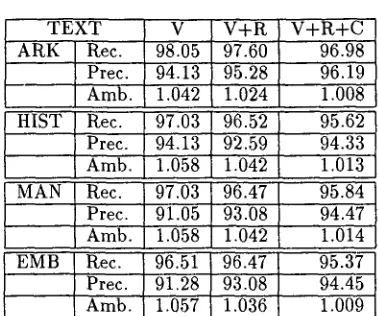
tokens which are still ambiguous with ambiguity re- sulting from different root words, we discard parses if the frequencies of the root words for those parses are considerably lower than the frequency of the root of the highest scoring parse. The results after apply- ing this step on top of voting, with m = 1, are shown in the fourth column of Table 3 (labeled V+R).
On top of this, we use the following heuristic us- ing context statistics to eliminate any further ambi- guities. For every remaining ambiguous token with unambiguous immediate left and right contexts (i.e., the tokens in the immediate left and right are unam- biguous), we perform the following,
by ignoring the
root/stem feature of ~he parses:
1. For every ambiguous parse in such an unam- biguous context, we count how many times, this parse occurs
unambiguously
in exactly the same unambiguous context, in the rest of the text. 2. We then choose the parse whose count is sub-stantially higher than the others.
The results after applying this step on of the previ- ous two steps are shown in the last column of Table 3 (labeled V + R + C ) . One can see from the last three columns of this table, the impact of each of the steps. By ignoring r o o t / s t e m features during this pro- cess, we essentially are considering just the top level
inflectional information of the parses. This is very similar to Brill's use of contexts to induce transfor- mation rules for his tagger (Brill, 1992; Brill, 1995), but instead of generating transformation rules from a training text, we gather statistics and apply them to parses in the text being disambiguated.
5 E f f i c i e n t I m p l e m e n t a t i o n T e c h n i q u e s a n d E x t e n s i o n s
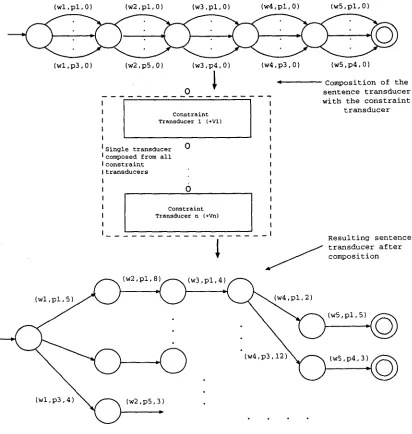
The current implementation of the voting approach is meant to be a proof of concept implementation and is rather inefficient. However, the use of regular relations and finite state transducers (Kaplan and Kay, 1994) provide a very efficient implementation method. For this, we view the parses of the tokens making up a sentence as making up a acyclic a fi- nite state recognizer with the states marking word boundaries and the ambiguous interpretations of the tokens as the state transitions between states, the rightmost node denoting the final state, as depicted in Figure 1 for a sentence with 5 tokens. In Figure 1, the transition labels are triples of the sort (wi,
pj, O)
[image:5.612.116.513.52.133.2] [image:5.612.335.524.171.329.2] [image:5.612.91.300.176.341.2](wl,pl,O) (w2,pl,O) (W3,pl,O) (w4,pl,O) (w5,pl,O)
(wl,p3,0) (W2,p5,0) (w3,p4,0) (W4,p3,0) (W5,p4,0)
Figure 1: Sentence as a finite state recognizer.
tion labels by an appropriate amount. ~ Such trans- ducers ignore and pass through unchanged, parses that they are not sensitive to.
When a finite state recognizer corresponding to the input sentence (which actually m a y be consid- ered as an identity transducer) is composed with a constraint transducer, one gets a slightly modified version of the sentence transducer with possibly ad- ditional transitions and states, where the votes of some of the labels have been appropriately incre- lnented. When the sentence transducer is composed with all the constraint transducers in sequence, all possible votes are cast and the final sentence trans- ducer reflects all the votes. The parse corresponding to each token with the highest vote can then be se- lected. The key point here is that due to the nature of the composition operator, the constraint transduc- ers can be composed off-line first, giving a single con- straint transducer and then this one is composed with every sentence transducer once (See Figure 2).
The idea of voting can further be extended to a path voting framework where rules vote on paths containing sequences of matching parses and the path from the start state to the final stated with the highest votes received, is then selected. This can be implemented again using finite state transducers as described above (except that path vote is appor- tioned equally to relevant parse votes), but instead of selecting highest scoring parses, one selects the path from the start state to one of the final states where the sum of the parse votes is maximum. We have recently completed a prototype implementation of this approach (in C) for English (Brown Corpus) and have obtained quite similar results (Tiir, Of- lazer, and Oz-kan, 1997).
6 C o n c l u s i o n s
We have presented an approach to constraint-based morphological disambiguation which uses constraint voting as its primary mechanism for parse selec- tion and alleviates the rule developer from worrying about rule ordering issues. Our approach is quite general and is applicable to any language. Rules de- scribing language specific linguistic constraints vote on matching parses of tokens, and at the end, parses TSuggested by Lauri Karttunen (private communica- tion).
for every token receiving the highest tokens are se- lected. We have applied this approach to Turkish, a language with complex agglutinative word forms exhibiting morphological ambiguity phenomena not usually found in languages like English and have ob- tained quite promising results. The convenience of adding new rules in without worrying about where exactly it goes in terms of rule ordering (some- thing that hampered our progress in our earlier work on disambiguating Turkish morphology (Oflazer and KuruSz, 1994; Oflazer and Tiir, 1996)), has also been a key positive point. Furthermore, it is also possible to use rules with negative votes to disallow impos- sible cases. This has been quite useful for our work on tagging English (Tfir, Oflazer, and 0z-kan, 1997) where such rules with negative weights were used to fine tune the behavior of the tagger in various prob- lematic cases.
The proposed approach is also amenable to an efficient implementation by finite state transducers (Kaplan and Kay, 1994). By using finitestate trans- ducers, it is furthermore possible to use a bit more expressive rule formalism including for instance the Kleene * operator so that one can use a much smaller set of rules to cover the same set of local linguistic phenomena.
Our current and future work in this framework involves the learning of constraints and their votes from corpora, and combining learned and hand- crafted rules.
7 A c k n o w l e d g m e n t s
This research has been supported in part by a NATO Science for Stability Grant T U - L A N G U A G E . We thank Lauri Karttunen of Rank Xerox Research Centre in Grenoble for providing the Xerox two-level morphology tools on which the Turkish morpholog- ical analyzer was built.
R e f e r e n c e s
Brill, Eric. 1992. A simple-rule based part-of-speech tagger. In Proceedings of the Third Conference on Applied Natural Language Processing, Trento, Italy.
[image:6.612.107.499.52.124.2](wl,pl, 0) (w2,pl, 0) (w3,pl, 0) (w4,pl, 0) (w5.pl, 0)
(wl.p3,0) ( w 2 , p 5 , 0 ) ( W 3 , p 4 . 0 ) ( w 4 , p 3 , 0 ) (W5,p4.0)
t Composition of the
0 sentence transducer
with the constraint transducer
I I I I
t
Isingle transducer Icomposed from all ]constraint ]transducers I
I
'1
I I I I
Constraint Transducer 1 (+VI)
0
Constraint Transducer n (+Vn)
Resulting sentence
/ transducer after
composition
(w2. pl. 8 ~ . ~ (w3 ,pl, 4 ! ~
(wl,p3,4) ~ (w2,p5,3)
[image:7.612.109.521.115.549.2]Twelfth National Conference on Artificial Intel- ligence (AAAI-94), Seattle, Washington.
Brill, Eric. 1995. Transformation-based error-driven learning and natural language processing: A case study in part-of-speech tagging. Computational Linguistics, 21(4):543-566, December.
Church, Kenneth W. 1988. A stochastic parts pro- gram and a noun phrase parser for unrestricted text. In Proceedings of the Second Conference on Applied Natural Language Processing, Austin, Texas.
Cutting, Doug, Julian Kupiec, Jan Pedersen, and Penelope Sibun. 1992. A practical part-of-speech tagger. In Proceedi~gs of the Third Conference on Applied Natural Language Processing, Trento, Italy.
DeRose, Steven J. 1988. Grammatical category dis- ambiguation by statistical optimization. Compu- tational Linguistics, 14(1):31-39.
Hankamer, Jorge. 1989. Morphological parsing and the lexicon. In W. Marslen-Wilson, editor, Lexical Representation and Process. MIT Press.
Kaplan, Ronald M. and Martin Kay. 1994. Regular models of phonological rule systems. Computa- tional Linguistics, 20(3):331-378, September. Karlsson, Fred, Atro Voutilainen, Juha Heikkilii,
and Arto Anttila. 1995. Constraint Grammar-A Language-Independent System for Parsing Unre- stricted Text. Mouton de Gruyter.
Karttunen, Lauri. 1993. Finite-state lexicon com- piler. XEROX, Palo Alto Research Center- Tech- nical Report, April.
Oflazer, Kemal and llker KuruSz. 1994. Tag- ging and morphological disambiguation of Turk- ish text. In Proceedil~gs of the 4 ~h Applied Natural Language Processing Conference, pages 144-149. ACL, October.
Oflazer, Kemal and GSkhan Tilt. 1996. Combin- ing hand-crafted rules and unsupervised learn- ing in constraint-based morphological disambigua- tion. In Eric Brill and Kenneth Church, editors,
Proceedings of the ACL-SIGDAT Conference on Empirical Methods in Natural Language Process- ing.
Tfir, GSkhan, Kemal Oflazer, and Nihat Oz- kan. 1997. Tagging English by path voting constraints. Technical Report BU- CEIS-9704, Bilkent University, Department of Computer Engineering and Information Sci- ence, Ankara, Turkey, March. Available as ftp ://ftp. cs. bilkent, edu. tr/pub/t ech-rep- oft s/1997/BU-CEIS-9704 .ps. z.
Vouti]ainen, Atro. 1994. Three studies of grammar- based surface-syntactic parsing of unrestricted En-
glish text. Ph.D. thesis, Research Unit for Com- putational Linguistics, University of Hetsinki. Voutilainen, Atro. 1995a. Morphological disana-
biguation. In Fred Karlsson, Atro Voutilainen, Juha Heikkil£, and Arto Anttila, editors, Con- straint Grammar-A Language-Independent Sys- tem for Parsing Unrestricted Text. Mouton de Gruyter, chapter 5.
Voutilainen, Atro. 1995b. A syntax-based part-of- speech analyzer. In Proceedings of the Seventh Conference of the European Chapter of the Asso- ciation of Computational Linguistics, Dublin, Ire- land.
Voutilainen, Atro, Juha Heikkil£, and Arto Anttila. 1992. Constraint Grammar of English. University of Helsinki.
Voutilainen, Atro and Pasi Tapanainen. 1993. Am- biguity resolution in a reduetionistic parser. In