langid.py
: An Off-the-shelf Language Identification Tool
Marco Lui and Timothy Baldwin
NICTA VRL
Department of Computing and Information Systems University of Melbourne, VIC 3010, Australia [email protected], [email protected]
Abstract
We presentlangid.py, an off-the-shelf lan-guage identification tool. We discuss the de-sign and implementation oflangid.py, and provide an empirical comparison on 5 long-document datasets, and 2 datasets from the mi-croblog domain. We find that langid.py
maintains consistently high accuracy across all domains, making it ideal for end-users that require language identification without want-ing to invest in preparation of in-domain train-ing data.
1 Introduction
Language identification (LangID) is the task of de-termining the natural language that a document is written in. It is a key step in automatic processing of real-world data, where a multitude of languages may be present. Natural language processing tech-niques typically pre-suppose that all documents be-ing processed are written in a given language (e.g. English), but as focus shifts onto processing docu-ments from internet sources such as microblogging services, this becomes increasingly difficult to guar-antee. Language identification is also a key compo-nent of many web services. For example, the lan-guage that a web page is written in is an important consideration in determining whether it is likely to be of interest to a particular user of a search engine, and automatic identification is an essential step in building language corpora from the web. It has prac-tical implications for social networking and social media, where it may be desirable to organize com-ments and other user-generated content by language. It also has implications for accessibility, since it en-ables automatic determination of the target language for automatic machine translation purposes.
Many applications could potentially benefit from automatic language identification, but building a customized solution per-application is prohibitively expensive, especially if human annotation is re-quired to produce a corpus of language-labelled training documents from the application domain. What is required is thus a generic language identi-fication tool that is usable off-the-shelf, i.e. with no end-user training and minimal configuration.
In this paper, we presentlangid.py, a LangID tool with the following characteristics: (1) fast, (2) usable off-the-shelf, (3) unaffected by domain-specific features (e.g. HTML, XML, markdown), (4) single file with minimal dependencies, and (5) flexible interface
2 Methodology
langid.py is trained over a naive Bayes clas-sifier with a multinomial event model (McCallum and Nigam, 1998), over a mixture of byten-grams
(1≤n≤4). One key difference from conventional text categorization solutions is that langid.py
was designed to be used off-the-shelf. Since
langid.py implements a supervised classifier, this presents two primary challenges: (1) a pre-trained model must be distributed with the classi-fier, and (2) the model must generalize to data from different domains, meaning that in its default con-figuration, it must have good accuracy over inputs as diverse as web pages, newspaper articles and mi-croblog messages. (1) is mostly a practical consid-eration, and so we will address it in Section 3. In order to address (2), we integrate information about the language identification task from a variety of do-mains by usingLDfeature selection (Lui and Bald-win, 2011).
Lui and Baldwin (2011) showed that it is rela-tively easy to attain high accuracy for language
Dataset Documents Langs Doc Length (bytes)
EUROGOV 1500 10 1.7×10⁴±
3.9×10⁴
TCL 3174 60 2.6×10³±
3.8×10³
WIKIPEDIA 4963 67 1.5×10³±
4.1×10³
EMEA 19988 22 2.9×10⁵±
7.9×10⁵
EUROPARL 20828 22 1.7×10²±
1.6×10²
T-BE 9659 6 1.0×10²±
3.2×101
T-SC 5000 5 8.8×101±
[image:2.612.75.301.66.167.2]3.9×101
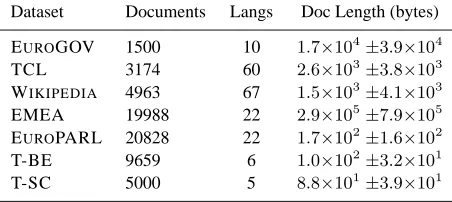
Table 1: Summary of the LangID datasets
tification in a traditional text categorization setting, where we have in-domain training data. The task be-comes much harder when trying to perform domain
adaptation, that is, trying to use model parameters
learned in one domain to classify data from a dif-ferent domain. LD feature selection addresses this problem by focusing on key features that are relevant to the language identification task. It is based on In-formation Gain (IG), originally introduced as a split-ting criteria for decision trees (Quinlan, 1986), and later shown to be effective for feature selection in text categorization (Yang and Pedersen, 1997; For-man, 2003).LDrepresents the difference in IG with respect to language and domain. Features with a highLDscore are informative about language with-out being informative abwith-out domain. For practi-cal reasons, before the IG practi-calculation the candidate feature set is pruned by means of a term-frequency based feature selection.
Lui and Baldwin (2011) presented empirical evi-dence thatLDfeature selection was effective for do-main adaptation in language identification. This re-sult is further supported by our evaluation, presented in Section 5.
3 System Architecture
The full langid.py package consists of the language identifier langid.py, as well as two support modules LDfeatureselect.py and
train.py.
langid.pyis the single file which packages the language identification tool, and the only file needed to uselangid.pyfor off-the-shelf language iden-tification. It comes with an embedded model which covers 97 languages using training data drawn from 5 domains. Tokenization and feature selection are carried out in a single pass over the input document via Aho-Corasick string matching (Aho and
Cora-sick, 1975). The Aho-Corasick string matching al-gorithm processes an input by means of a determin-istic finite automaton (DFA). Some states of the au-tomaton are associated with the completion of one of then-grams selected through LD feature
selec-tion. Thus, we can obtain our document represen-tation by simply counting the number of times the DFA enters particular states while processing our in-put. The DFA and the associated mapping from state ton-gram are constructed during the training phase,
and embedded as part of the pre-trained model. The naive Bayes classifier is implemented using
numpy,1the de-facto numerical computation pack-age for Python.numpyis free and open source, and available for all major platforms. Usingnumpy in-troduces a dependency on a library that is not in the Python standard library. This is a reasonable trade-off, as numpy provides us with an optimized im-plementation of matrix operations, which allows us to implement fast naive Bayes classification while maintaining the single-file concept oflangid.py.
langid.pycan be used in the three ways:
Command-line tool: langid.py supports an interactive mode with a text prompt and line-by-line classification. This mode is suitable for quick in-teractive queries, as well as for demonstration pur-poses. langid.pyalso supports language identi-fication of entire files via redirection. This allows a user to interactively explore data, as well as to inte-grate language identification into a pipeline of other
unix-style tools. However, use via redirection is not recommended for large quantities of documents as each invocation requires the trained model to be unpacked into memory. Where large quantities of documents are being processed, use as a library or web service is preferred as the model will only be unpacked once upon initialization.
Python library: langid.pycan be imported as a Python module, and provides a function that ac-cepts text and returns the identified language of the text. This use of langid.py is the fastest in a single-processor setting as it incurs the least over-head.
Web service: langid.py can be started as a web service with a command-line switch. This
1
allows language identitication by means of HTTP PUT and HTTP POST requests, which return JSON-encoded responses. This is the preferred method of usinglangid.py from other programming envi-ronments, as most languages include libraries for in-teracting with web services over HTTP. It also al-lows the language identification service to be run as a network/internet service. Finally,langid.pyis WSGI-compliant,2so it can be deployed in a WSGI-compliant web server. This provides an easy way to achieve parallelism by leveraging existing technolo-gies to manage load balancing and utilize multiple processors in the handling of multiple concurrent re-quests for a service.
LDfeatureselect.py implements the LD
feature selection. The calculation of term frequency is done in constant memory by index inversion through a MapReduce-style sharding approach. The calculation of information gain is also chunked to limit peak memory use, and furthermore it is paral-lelized to make full use of modern multiprocessor systems. LDfeatureselect.pyproduces a list of byten-grams ranked by theirLDscore.
train.pyimplements estimation of parameters for the multinomial naive Bayes model, as well as the construction of the DFA for the Aho-Corasick string matching algorithm. Its input is a list of byte patterns representing a feature set (such as that se-lected viaLDfeatureselect.py), and a corpus of training documents. It produces the final model as a single compressed, encoded string, which can be saved to an external file and used bylangid.py
via a command-line option.
4 Training Data
langid.py is distributed with an embedded model trained using the multi-domain language identification corpus of Lui and Baldwin (2011). This corpus contains documents in a total of 97 lan-guages. The data is drawn from 5 different do-mains: government documents, software documen-tation, newswire, online encyclopedia and an inter-net crawl, though no domain covers the full set of languages by itself, and some languages are present only in a single domain. More details about this cor-pus are given in Lui and Baldwin (2011).
2
http://www.wsgi.org
We do not perform explicit encoding detection, but we do not assume that all the data is in the same encoding. Previous research has shown that explicit encoding detection is not needed for language iden-tification (Baldwin and Lui, 2010). Our training data consists mostly of UTF8-encoded documents, but some of our evaluation datasets contain a mixture of encodings.
5 Evaluation
In order to benchmarklangid.py, we carried out an empirical evaluation using a number of language-labelled datasets. We compare the empirical results obtained fromlangid.pyto those obtained from other language identification toolkits which incor-porate a pre-trained model, and are thus usable
off-the-shelf for language identification. These tools are
listed in Table 3.
5.1 Off-the-shelf LangID tools
TextCatis an implementation of the method of Cavnar and Trenkle (1994) by Gertjan van Noord. It has traditionally been the de facto LangID tool of choice in research, and is the basis of language iden-tification/filtering in the ClueWeb09 Dataset (Callan and Hoy, 2009) and CorpusBuilder (Ghani et al., 2004). It includes support for training with user-supplied data.
LangDetectimplements a Naive Bayes classi-fier, using a charactern-gram based representation
without feature selection, with a set of normaliza-tion heuristics to improve accuracy. It is trained on data from Wikipedia,3and can be trained with user-supplied data.
CLD is a port of the embedded language identi-fier in Google’s Chromium browser, maintained by Mike McCandless. Not much is known about the internal design of the tool, and there is no support provided for re-training it.
The datasets come from a variety of domains, such as newswire (TCL), biomedical corpora (EMEA), government documents (EUROGOV, EU
-ROPARL) and microblog services (T-BE, T-SC). A
number of these datasets have been previously used in language identification research. We provide a
3
Test Dataset langid.py LangDetect TextCat CLD Accuracy docs/s ∆Acc Slowdown ∆Acc Slowdown ∆Acc Slowdown
EUROGOV 0.987 70.5 +0.005 1.1× −0.046 31.1× −0.004 0.5×
TCL 0.904 185.4 −0.086 2.1× −0.299 24.2× −0.172 0.5×
WIKIPEDIA 0.913 227.6 −0.046 2.5× −0.207 99.9× −0.082 0.9×
EMEA 0.934 7.7 −0.820 0.2× −0.572 6.3× +0.044 0.3×
EUROPARL 0.992 294.3 +0.001 3.6× −0.186 115.4× −0.010 0.2×
T-BE 0.941 367.9 −0.016 4.4× −0.210 144.1× −0.081 0.7×
T-SC 0.886 298.2 −0.038 2.9× −0.235 34.2× −0.120 0.2×
Table 2: Comparison of standalone classification tools, in terms of accuracy and speed (documents/second), relative tolangid.py
Tool Languages URL
langid.py 97 http://www.csse.unimelb.edu.au/research/lt/resources/langid/ LangDetect 53 http://code.google.com/p/language-detection/
TextCat 75 http://odur.let.rug.nl/vannoord/TextCat/
[image:4.612.79.537.206.273.2]CLD 64+ http://code.google.com/p/chromium-compact-language-detector/
Table 3: Summary of the LangID tools compared
brief summary of the characteristics of each dataset in Table 1.
The datasets we use for evaluation are differ-ent from and independdiffer-ent of the datasets from which the embedded model of langid.py was produced. In Table 2, we report the accuracy of each tool, measured as the proportion of documents from each dataset that are correctly classified. We present the absolute accuracy and performance for
langid.py, and relative accuracy and slowdown for the other systems. For this experiment, we used a machine with 2 Intel Xeon E5540 processors and 24GB of RAM. We only utilized a single core, as none of the language identification tools tested are inherently multicore.
5.2 Comparison on standard datasets
We compared the four systems on datasets used in previous language identification research (Baldwin and Lui, 2010) (EUROGOV, TCL, WIKIPEDIA), as well as an extract from a biomedical parallel cor-pus (Tiedemann, 2009) (EMEA) and a corcor-pus of samples from the Europarl Parallel Corpus (Koehn, 2005) (EUROPARL). The sample of EUROPARL we use was originally prepared by Shuyo Nakatani (author ofLangDetect) as a validation set.
langid.pycompares very favorably with other language identification tools. It outperforms
TextCatin terms of speed and accuracy on all of the datasets considered. langid.py is generally
orders of magnitude faster thanTextCat, but this advantage is reduced on larger documents. This is primarily due to the design ofTextCat, which re-quires that the supplied models be read from file for each document classified.
langid.py generally outperforms
LangDetect, except in datasets derived from government documents (EUROGOV, EUROPARL). However, the difference in accuracy between
langid.pyand LangDetect on such datasets is very small, andlangid.pyis generally faster. An abnormal result was obtained when testing
LangDetect on the EMEA corpus. Here,
LangDetect is much faster, but has extremely poor accuracy (0.114). Analysis of the results re-veals that the majority of documents were classified as Polish. We suspect that this is due to the early termination criteria employed by LangDetect, together with specific characteristics of the corpus.
TextCat also performed very poorly on this corpus (accuracy 0.362). However, it is important to note thatlangid.pyand CLDboth performed very well, providing evidence that it is possible to build a generic language identifier that is insensitive to domain-specific characteristics.
pages. The EMEA corpus is heavy in XML markup, whichCLD andlangid.pyboth successfully ig-nore. One area whereCLDoutperforms all other sys-tems is in its speed. However, this increase in speed comes at the cost of decreased accuracy in other do-mains, as we will see in Section 5.3.
5.3 Comparison on microblog messages
The size of the input text is known to play a sig-nificant role in the accuracy of automatic language identification, with accuracy decreasing on shorter input documents (Cavnar and Trenkle, 1994; Sibun and Reynar, 1996; Baldwin and Lui, 2010).
Recently, language identification of short strings has generated interest in the research community. Hammarstrom (2007) described a method that aug-mented a dictionary with an affix table, and tested it over synthetic data derived from a parallel bible cor-pus. Ceylan and Kim (2009) compared a number of methods for identifying the language of search en-gine queries of 2 to 3 words. They develop a method which uses a decision tree to integrate outputs from several different language identification approaches. Vatanen et al. (2010) focus on messages of 5–21 characters, usingn-gram language models over data
drawn from UDHR in a naive Bayes classifier. A recent application where language identifica-tion is an open issue is over the rapidly-increasing volume of data being generated by social media. Microblog services such as Twitter4 allow users to post short text messages. Twitter has a worldwide user base, evidenced by the large array of languages present on Twitter (Carter et al., to appear). It is es-timated that half the messages on Twitter are not in English.5
This new domain presents a significant challenge for automatic language identification, due to the much shorter ‘documents’ to be classified, and is compounded by the lack of language-labelled in-domain data for training and validation. This has led to recent research focused specifically on the task of language identification of Twitter messages. Carter et al. (to appear) improve language identification in Twitter messages by augmenting standard methods
4
http://www.twitter.com
5http://semiocast.com/downloads/
Semiocast_Half_of_messages_on_Twitter_ are_not_in_English_20100224.pdf
with language identification priors based on a user’s previous messages and by the content of links em-bedded in messages. Tromp and Pechenizkiy (2011) present a method for language identification of short text messages by means of a graph structure.
Despite the recently published results on language identification of microblog messages, there is no dedicated off-the-shelf system to perform the task. We thus examine the accuracy and performance of using generic language identification tools to iden-tify the language of microblog messages. It is im-portant to note that none of the systems we test have been specifically tuned for the microblog domain. Furthermore, they do not make use of any non-textual information such as author and link-based priors (Carter et al., to appear).
We make use of two datasets of Twitter messages kindly provided to us by other researchers. The first is T-BE (Tromp and Pechenizkiy, 2011), which con-tains 9659 messages in 6 European languages. The second is T-SC (Carter et al., to appear), which con-tains 5000 messages in 5 European languages.
We find that over both datasets,langid.pyhas better accuracy than any of the other systems tested. On T-BE, Tromp and Pechenizkiy (2011) report accuracy between 0.92 and 0.98 depending on the parametrization of their system, which was tuned specifically for classifying short text messages. In its off-the-shelf configuration, langid.pyattains an accuracy of 0.94, making it competitive with the customized solution of Tromp and Pechenizkiy (2011).
On T-SC, Carter et al. (to appear) report over-all accuracy of 0.90 for TextCat in the off-the-shelf configuration, and up to 0.92 after the inclusion of priors based on (domain-specific) extra-textual information. In our experiments, the accuracy of
We also observe that whileCLDis still the fastest classifier, this has come at the cost of accuracy in an alternative domain such as Twitter messages, where bothlangid.pyandLangDetectattain better accuracy thanCLD.
An interesting point of comparison between the Twitter datasets is how the accuracy of all systems is generally higher on T-BE than on T-SC, despite them covering essentially the same languages (T-BE includes Italian, whereas T-SC does not). This is likely to be because the T-BE dataset was produced using a semi-automatic method which involved a language identification step using the method of Cavnar and Trenkle (1994) (E Tromp, personal com-munication, July 6 2011). This may also explain whyTextCat, which is also based on Cavnar and Trenkle’s work, has unusually high accuracy on this dataset.
6 Conclusion
In this paper, we presentedlangid.py, an off-the-shelf language identification solution. We demon-strated the robustness of the tool over a range of test corpora of both long and short documents (including micro-blogs).
Acknowledgments
NICTA is funded by the Australian Government as rep-resented by the Department of Broadband, Communica-tions and the Digital Economy and the Australian Re-search Council through the ICT Centre of Excellence pro-gram.
References
Alfred V. Aho and Margaret J. Corasick. 1975. Efficient string matching: an aid to bibliographic search.
Com-munications of the ACM, 18(6):333–340, June.
Timothy Baldwin and Marco Lui. 2010. Language iden-tification: The long and the short of the matter. In
Pro-ceedings of NAACL HLT 2010, pages 229–237, Los
Angeles, USA.
Jamie Callan and Mark Hoy, 2009. ClueWeb09
Dataset. Available athttp://boston.lti.cs.
cmu.edu/Data/clueweb09/.
Simon Carter, Wouter Weerkamp, and Manos Tsagkias. to appear. Microblog language identification: Over-coming the limitations of short, unedited and idiomatic text. Language Resources and Evaluation Journal.
William B. Cavnar and John M. Trenkle. 1994. N-gram-based text categorization. In Proceedings of the
Third Symposium on Document Analysis and Informa-tion Retrieval, Las Vegas, USA.
Hakan Ceylan and Yookyung Kim. 2009. Language identification of search engine queries. In Proceedings
of ACL2009, pages 1066–1074, Singapore.
George Forman. 2003. An Extensive Empirical Study of Feature Selection Metrics for Text Classification.
Journal of Machine Learning Research, 3(7-8):1289–
1305, October.
Rayid Ghani, Rosie Jones, and Dunja Mladenic. 2004. Building Minority Language Corpora by Learning to Generate Web Search Queries. Knowledge and
Infor-mation Systems, 7(1):56–83, February.
Harald Hammarstrom. 2007. A Fine-Grained Model for Language Identication. In Proceedings of iNEWS07, pages 14–20.
Philipp Koehn. 2005. Europarl: A parallel corpus for statistical machine translation. MT summit, 11. Marco Lui and Timothy Baldwin. 2011. Cross-domain
feature selection for language identification. In
Pro-ceedings of 5th International Joint Conference on Nat-ural Language Processing, pages 553–561, Chiang
Mai, Thailand.
Andrew McCallum and Kamal Nigam. 1998. A com-parison of event models for Naive Bayes text classifi-cation. In Proceedings of the AAAI-98 Workshop on
Learning for Text Categorization, Madison, USA.
J.R. Quinlan. 1986. Induction of Decision Trees.
Ma-chine Learning, 1(1):81–106, October.
Penelope Sibun and Jeffrey C. Reynar. 1996. Language determination: Examining the issues. In Proceedings
of the 5th Annual Symposium on Document Analysis and Information Retrieval, pages 125–135, Las Vegas,
USA.
J¨org Tiedemann. 2009. News from OPUS - A Collection of Multilingual Parallel Corpora with Tools and Inter-faces. Recent Advances in Natural Language
Process-ing, V:237–248.
Erik Tromp and Mykola Pechenizkiy. 2011. Graph-Based N-gram Language Identification on Short Texts. In Proceedings of Benelearn 2011, pages 27–35, The Hague, Netherlands.
Tommi Vatanen, Jaakko J. Vayrynen, and Sami Virpioja. 2010. Language identification of short text segments with n-gram models. In Proceedings of LREC 2010, pages 3423–3430.
Yiming Yang and Jan O. Pedersen. 1997. A comparative study on feature selection in text categorization. In