Faster and Smaller
N
-Gram Language Models
Adam Pauls Dan Klein Computer Science Division University of California, Berkeley
{adpauls,klein}@cs.berkeley.edu
Abstract
N-gram language models are a major resource bottleneck in machine translation. In this pa-per, we present several language model imple-mentations that are both highly compact and fast to query. Our fastest implementation is as fast as the widely used SRILM while re-quiring only 25% of the storage. Our most compact representation can store all 4 billion
n-grams and associated counts for the Google
n-gram corpus in 23 bits pern-gram, the most compact lossless representation to date, and even more compact than recentlossy compres-sion techniques. We also discuss techniques for improving query speed during decoding, including a simple but novel language model caching technique that improves the query speed of our language models (and SRILM) by up to 300%.
1 Introduction
For modern statistical machine translation systems, language models must be both fast and compact. The largest language models (LMs) can contain as
many as several hundred billion n-grams (Brants
et al., 2007), so storage is a challenge. At the
same time, decoding a single sentence can trig-ger hundreds of thousands of queries to the
lan-guage model, so speed is also critical. As
al-ways, trade-offs exist between time, space, and ac-curacy, with many recent papers considering small-but-approximate noisy LMs (Chazelle et al., 2004; Guthrie and Hepple, 2010) or small-but-slow com-pressed LMs (Germann et al., 2009).
In this paper, we present several lossless
meth-ods for compactly but efficiently storing large LMs in memory. As in much previous work (Whittaker
and Raj, 2001; Hsu and Glass, 2008), our meth-ods are conceptually based on tabular trie encodings
wherein eachn-gram key is stored as the
concatena-tion of one word (here, the last) and an offset encod-ing the remainencod-ing words (here, the context). After presenting a bit-conscious basic system that typifies such approaches, we improve on it in several ways. First, we show how the last word of each entry can be implicitly encoded, almost entirely eliminating its storage requirements. Second, we show that the deltas between adjacent entries can be efficiently en-coded with simple variable-length encodings. Third, we investigate block-based schemes that minimize the amount of compressed-stream scanning during lookup.
To speed up our language models, we present two approaches. The first is a front-end cache. Caching itself is certainly not new to language modeling, but because well-tuned LMs are essentially lookup ta-bles to begin with, naive cache designs only speed up slower systems. We present a direct-addressing cache with a fast key identity check that speeds up our systems (or existing fast systems like the widely-used, speed-focused SRILM) by up to 300%.
Our second speed-up comes from a more funda-mental change to the language modeling interface. Where classic LMs take word tuples and produce counts or probabilities, we propose an LM that takes a word-and-context encoding (so the context need not be re-looked up) and returns both the
probabil-ity and also the context encoding for thesuffixof the
original query. This setup substantially accelerates the scrolling queries issued by decoders, and also exploits language model state equivalence (Li and Khudanpur, 2008).
Overall, we are able to store the 4 billionn-grams
of the Google Web1T (Brants and Franz, 2006)
pus, with associated counts, in 10 GB of memory,
which is smaller than state-of-the-artlossylanguage
model implementations (Guthrie and Hepple, 2010), and significantly smaller than the best published lossless implementation (Germann et al., 2009). We are also able to simultaneously outperform SRILM in both total size and speed. Our LM toolkit, which is implemented in Java and compatible with the
stan-dard ARPA file formats, is available on the web.1
2 Preliminaries
Our goal in this paper is to provide data structures
that map n-gram keys to values, i.e. probabilities
or counts. Maps are fundamental data structures and generic implementations of mapping data struc-tures are readily available. However, because of the
sheer number of keys and values needed forn-gram
language modeling, generic implementations do not work efficiently “out of the box.” In this section, we will review existing techniques for encoding the
keys and values of ann-gram language model,
tak-ing care to account for every bit of memory required by each implementation.
To provide absolute numbers for the storage re-quirements of different implementations, we will use the Google Web1T corpus as a benchmark. This corpus, which is on the large end of corpora typically employed in language modeling, is a collection of
nearly 4 billionn-grams extracted from over a
tril-lion tokens of English text, and has a vocabulary of about 13.5 million words.
2.1 Encoding Values
In the Web1T corpus, the most frequent n-gram
occurs about 95 billion times. Storing this count explicitly would require 37 bits, but, as noted by Guthrie and Hepple (2010), the corpus contains only
about 770 000uniquecounts, so we can enumerate
all counts using only 20 bits, and separately store an
array called thevalue rank arraywhich converts the
rank encoding of a count back to its raw count. The additional array is small, requiring only about 3MB,
but we save 17 bits pern-gram, reducing value
stor-age from around 16GB to about 9GB for Web1T. We can rank encode probabilities and back-offs in the same way, allowing us to be agnostic to whether
1http://code.google.com/p/berkeleylm/
we encode counts, probabilities and/or back-off weights in our model. In general, the number of bits per value required to encode all value ranks for a given language model will vary – we will refer to
this variable asv.
2.2 Trie-Based Language Models
The data structure of choice for the majority of
modern language model implementations is a trie
(Fredkin, 1960). Tries or variants thereof are
implemented in many LM tool kits, including SRILM (Stolcke, 2002), IRSTLM (Federico and Cettolo, 2007), CMU SLM (Whittaker and Raj, 2001), and MIT LM (Hsu and Glass, 2008). Tries
represent collections ofn-grams using a tree. Each
node in the tree encodes a word, and paths in the
tree correspond ton-grams in the collection. Tries
ensure that eachn-gram prefix is represented only
once, and are very efficient when n-grams share
common prefixes. Values can also be stored in a trie by placing them in the appropriate nodes.
Conceptually, trie nodes can be implemented as records that contain two entries: one for the word in the node, and one for either a pointer to the par-ent of the node or a list of pointers to children. At a low level, however, naive implementations of tries can waste significant amounts of space. For exam-ple, the implementation used in SRILM represents a
trie node as a Cstructcontaining a 32-bit integer
representing the word, a 64-bit memory2 pointer to
the list of children, and a 32-bit floating point num-ber representing the value stored at a node. The total storage for a node alone is 16 bytes, with additional overhead required to store the list of children. In total, the most compact implementation in SRILM
uses 33 bytes pern-gram of storage, which would
require around 116 GB of memory to store Web1T. While it is simple to implement a trie node in this (already wasteful) way in programming languages that offer low-level access to memory allocation like C/C++, the situation is even worse in higher level programming languages. In Java, for example,
C-style structs are not available, and records are
most naturally implemented as objects that carry an additional 64 bits of overhead.
2
Despite its relatively large storage requirements, the implementation employed by SRILM is still widely in use today, largely because of its speed – to our knowledge, SRILM is the fastest freely available language model implementation. We will show that we can achieve access speeds comparable to SRILM but using only 25% of the storage.
2.3 Implicit Tries
A more compact implementation of a trie is de-scribed in Whittaker and Raj (2001). In their imple-mentation, nodes in a trie are represented implicitly as entries in an array. Each entry encodes a word with enough bits to index all words in the language model (24 bits for Web1T), a quantized value, and
a 32-bit3 offset that encodes the contiguous block
of the array containing the children of the node.
Note that 32 bits is sufficient to index alln-grams in
Web1T; for larger corpora, we can always increase the size of the offset.
Effectively, this representation replaces system-level memory pointers with offsets that act as logical pointers that can reference other entries in the array, rather than arbitrary bytes in RAM. This represen-tation saves space because offsets require fewer bits than memory pointers, but more importantly, it per-mits straightforward implementation in any higher-level language that provides access to arrays of
inte-gers.4
2.4 Encodingn-grams
Hsu and Glass (2008) describe a variant of the im-plicit tries of Whittaker and Raj (2001) in which each node in the trie stores the prefix (i.e. parent). This representation has the property that we can
re-fer to eachn-gramwn
1 by its last wordwnand the
offsetc(wn1−1) of its prefixw1n−1, often called the
context. At a low-level, we can efficiently encode
this pair (wn, c(wn1−1)) as a single 64-bit integer,
where the first 24 bits refer townand the last 40 bits
3The implementation described in the paper represents each 32-bit integer compactly using only 16 bits, but this represen-tation is quite inefficient, because determining the full 32-bit offset requires a binary search in a look up table.
4Typically, programming languages only provide support for arrays ofbytes, not bits, but it is of course possible to simu-late arrays with arbitrary numbers of bits using byte arrays and bit manipulation.
encodec(wn1−1). We will refer to this encoding as a
context encoding.
Note that typically, n-grams are encoded in tries
in the reverse direction (first-rest instead of last-rest), which enables a more efficient computation of back-offs. In our implementations, we found that the speed improvement from switching to a first-rest en-coding and implementing more efficient queries was modest. However, as we will see in Section 4.2, the last-rest encoding allows us to exploit the scrolling nature of queries issued by decoders, which results in speedups that far outweigh those achieved by re-versing the trie.
3 Language Model Implementations
In the previous section, we reviewed well-known techniques in language model implementation. In this section, we combine these techniques to build simple data structures in ways that are to our knowl-edge novel, producing language models with state-of-the-art memory requirements and speed. We will also show that our data structures can be very effec-tively compressed by implicitly encoding the word
wn, and further compressed by applying a
variable-length encoding on context deltas.
3.1 Sorted Array
A standard way to implement a map is to store an array of key/value pairs, sorted according to the key. Lookup is carried out by performing binary search
on a key. For ann-gram language model, we can
ap-ply this implementation with a slight modification:
we neednsorted arrays, one for eachn-gram order.
We construct keys(wn, c(w1n−1))using the context
encoding described in the previous section, where
the context offsetscrefer to entries in the sorted
ar-ray of (n−1)-grams. This data structure is shown
graphically in Figure 1.
Because our keys are sorted according to their context-encoded representation, we cannot
straight-forwardly answer queries about ann-gramw
with-out first determining its context encoding. We can do this efficiently by building up the encoding in-crementally: we start with the context offset of the
unigramw1, which is simply its integer
representa-tion, and use that to form the context encoding of the
bigramw2
“ran”
w
c
15180053
w
c
24
bits bits40 64 bits
“cat”
15176585
“dog” 6879 6879 6879 6879 6879 6880
6880 6880 6879
00004598 “slept”
00004588 00004568 00004530 00004502
00004668 00004669
00004568 00004577 6879 00004498 15176583
15176585 15176593
15176613 15179801 15180051
15176589 15176591
“had” “the” “left” 1933
. .
. .
. . . . .
.
. .
“slept” 1933
1933 1933
1933 1933 1933 1935
1935 1935
. .
val
val
val
v
bits
. . “dog”
3-grams
2-grams
1-grams
[image:4.612.120.501.52.355.2]w
Figure 1: Our SORTEDimplementation of a trie. The dotted paths correspond to “the cat slept”, “the cat ran”, and “the dog ran”. Each node in the trie is an entry in an array with 3 parts:wrepresents the word at the node;valrepresents the (rank encoded) value; andcis an offset in the array ofn−1grams that represents the parent (prefix) of a node. Words are represented as offsets in the unigram array.
the bigram using binary search, and form the context encoding of the trigram, and so on. Note, however, that if our queries arrive in context-encoded form, queries are faster since they involve only one binary search in the appropriate array. We will return to this later in Section 4.2
This implementation, SORTED, uses 64 bits for
the integer-encoded keys and v bits for the values.
Lookup is linear in the length of the key and
log-arithmic in the number of n-grams. For Web1T
(v = 20), the total storage is 10.5 bytes/n-gram or
about 37GB.
3.2 Hash Table
Hash tables are another standard way to implement associative arrays. To enable the use of our context encoding, we require an implementation in which we can refer to entries in the hash table via array
offsets. For this reason, we use anopen addresshash
map that uses linear probing for collision resolution. As in the sorted array implementation, in order to
insert an n-gram w1n into the hash table, we must
form its context encoding incrementally from the
offset ofw1. However, unlike the sorted array
im-plementation, at query time, we only need to be
able to check equality between the query keywn1 =
(wn, c(wn1−1))and a keyw
0n
1 = (w0n, c(w
0n−1
1 ))in
the table. Equality can easily be checked by first
checking if wn = w0n, then recursively checking
equality between wn1−1 and w01n−1, though again,
equality is even faster if the query is already context-encoded.
This HASH data structure also uses 64 bits for
integer-encoded keys and v bits for values.
How-ever, to avoid excessive hash collisions, we also al-locate additional empty space according to a user-defined parameter that trades off speed and time – we used about 40% extra space in our experiments. For Web1T, the total storage for this implementation
is 15 bytes/n-gram or about 53 GB total.
Look up in a hash map is linear in the length of
of n-grams. Unlike the sorted array implementa-tion, the hash table implementation also permits ef-ficient insertion and deletion, making it suitable for stream-based language models (Levenberg and Os-borne, 2009).
3.3 Implicitly Encodingwn
The context encoding we have used thus far still wastes space. This is perhaps most evident in the
sorted array representation (see Figure 1): all n
-grams ending with a particular word wi are stored
contiguously. We can exploit this redundancy by storing only the context offsets in the main array, using as many bits as needed to encode all context offsets (32 bits for Web1T). In auxiliary arrays, one
for eachn-gram order, we store the beginning and
end of the range of the trie array in which all(wi, c)
keys are stored for eachwi. These auxiliary arrays
are negligibly small – we only need to store2n
off-sets for each word.
The same trick can be applied in the hash table implementation. We allocate contiguous blocks of
the main array forn-grams which all share the same
last wordwi, and distribute keys within those ranges
using the hashing function.
This representation reduces memory usage for keys from 64 bits to 32 bits, reducing overall storage
for Web1T to 6.5 bytes/n-gram for the sorted
imple-mentation and 9.1 bytes for the hashed implementa-tion, or about 23GB and 32GB in total. It also in-creases query speed in the sorted array case, since to
find(wi, c), we only need to search the range of the
array over whichwi applies. Because this implicit
encoding reduces memory usage without a perfor-mance cost, we will assume its use for the rest of this paper.
3.4 A Compressed Implementation
3.4.1 Variable-Length Coding
The distribution of value ranks in language
mod-eling is Zipfian, with far moren-grams having low
counts than high counts. If we ensure that the value rank array sorts raw values by descending order of frequency, then we expect that small ranks will oc-cur much more frequently than large ones, which we can exploit with a variable-length encoding.
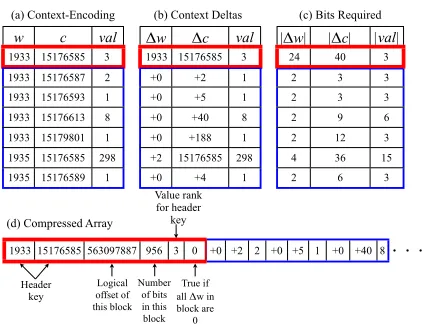
To compressn-grams, we can exploit the context
encoding of our keys. In Figure 2, we show a portion
w c val
1933 15176585 3
1933 15176587 2 1933 15176593 1 1933 15176613 8 1933 15179801 1 1935 15176585 298 1935 15176589 1
1933 15176585 563097887 956 3 0 +0 +2 2 +0 +5 1 +0 +40 8
!w !c val
1933 15176585 3
+0 +2 1
+0 +5 1
+0 +40 8
+0 +188 1
+2 15176585 298
+0 +4 1
|!w| |!c| |val|
24 40 3
2 3 3
2 3 3
2 9 6
2 12 3
4 36 15
2 6 3
. . .
(a) Context-Encoding (b) Context Deltas (c) Bits Required
(d) Compressed Array
Number of bits in this block
Value rank for header
key
Header key
Logical offset of this block
[image:5.612.322.534.57.219.2]True if all !w in block are 0
Figure 2: Compression using variable-length encoding. (a) A snippet of an (uncompressed) context-encoded ar-ray. (b) The context and word deltas. (c) The number of bits required to encode the context and word deltas as well as the value ranks. Word deltas use variable-length block coding withk= 1, while context deltas and value ranks usek= 2. (d) A snippet of the compressed encod-ing array. The header is outlined in bold.
of the key array used in our sorted array implemen-tation. While we have already exploited the fact that the 24 word bits repeat in the previous section, we note here that consecutive context offsets tend to be quite close together. We found that for 5-grams, the median difference between consecutive offsets was about 50, and 90% of offset deltas were smaller than 10000. By using a variable-length encoding to rep-resent these deltas, we should require far fewer than 32 bits to encode context offsets.
We used a very simple variable-length coding to encode offset deltas, word deltas, and value ranks. Our encoding, which is referred to as “variable-length block coding” in Boldi and Vigna (2005), works as follows: we pick a (configurable) radix
r = 2k. To encode a numberm, we determine the
number of digitsdrequired to expressmin baser.
We write din unary, i.e.d−1zeroes followed by
a one. We then write the ddigits of m in base r,
each of which requires kbits. For example, using
k = 2, we would encode the decimal number 7 as
010111. We can choosekseparately for deltas and
value indices, and also tune these parameters to a given language model.
We found this encoding outperformed other
standard prefix codes, including Golomb
and Elias γ and δ codes. We also experimented
with theζ codes of Boldi and Vigna (2005), which
modify variable-length block codes so that they are optimal for certain power law distributions.
We found that ζ codes performed no better than
variable-length block codes and were slightly more
complex. Finally, we found that Huffman codes
outperformed our encoding slightly, but came at a much higher computational cost.
3.4.2 Block Compression
We could in principle compress the entire array of key/value pairs with the encoding described above, but this would render binary search in the array im-possible: we cannot jump to the mid-point of the ar-ray since in order to determine what key lies at a par-ticular point in the compressed bit stream, we would need to know the entire history of offset deltas.
Instead, we employ block compression, a tech-nique also used by Harb et al. (2009) for smaller language models. In particular, we compress the key/value array in blocks of 128 bytes. At the be-ginning of the block, we write out a header consist-ing of: an explicit 64-bit key that begins the block; a 32-bit integer representing the offset of the header
key in the uncompressed array;5 the number of bits
of compressed data in the block; and the variable-length encoding of the value rank of the header key. The remainder of the block is filled with as many compressed key/value pairs as possible. Once the block is full, we start a new block. See Figure 2 for a depiction.
When we encode an offset delta, we store the delta of the word portion of the key separately from the delta of the context offset. When an entire block shares the same word portion of the key, we set a single bit in the header that indicates that we do not encode any word deltas.
To find a key in this compressed array, we first perform binary search over the header blocks (which are predictably located every 128 bytes), followed by a linear search within a compressed block.
Usingk= 6for encoding offset deltas andk= 5
for encoding value ranks, this COMPRESSED
im-plementation stores Web1T in less than 3 bytes per
n-gram, or about 10.2GB in total. This is about
5We need this becausen-grams refer to their contexts using array offsets.
6GB less than the storage required by Germann et al. (2009), which is the best published lossless com-pression to date.
4 Speeding up Decoding
In the previous section, we provided compact and efficient implementations of associative arrays that
allow us to query a value for an arbitrary n-gram.
However, decoders do not issue language model re-quests at random. In this section, we show that lan-guage model requests issued by a standard decoder exhibit two patterns we can exploit: they are highly
repetitive, and also exhibit ascrollingeffect.
4.1 Exploiting Repetitive Queries
In a simple experiment, we recorded all of the language model queries issued by the Joshua de-coder (Li et al., 2009) on a 100 sentence test set. Of the 31 million queries, only about 1 million were unique. Therefore, we expect that keeping the re-sults of language model queries in a cache should be effective at reducing overall language model latency. To this end, we added a very simple cache to our language model. Our cache uses an array of
key/value pairs with size fixed to2b −1 for some
integer b (we used 24). We use ab-bit hash
func-tion to compute the address in an array where we
will always place a givenn-gram and its fully
com-puted language model score. Querying the cache is straightforward: we check the address of a key given
by itsb-bit hash. If the key located in the cache
ar-ray matches the query key, then we return the value stored in the cache. Otherwise, we fetch the lan-guage model probability from the lanlan-guage model and place the new key and value in the cache, evict-ing the old key in the process. This scheme is often
called adirect-mappedcache because each key has
exactly one possible address.
Cachingn-grams in this way reduces overall
la-tency for two reasons: first, lookup in the cache is extremely fast, requiring only a single evaluation of the hash function, one memory lookup to find the cache key, and one equality check on the key. In
contrast, even our fastest (HASH) implementation
may have to perform multiple memory lookups and equality checks in order to resolve collisions.
the cat + fell down
the cat fell
cat fell down
18569876 fell
35764106 down
LM 0.76
LM 0.12
LM
LM
0.76
0.12
“the cat”
“cat fell”
3576410
E
xpl
ic
it
Re
pre
se
nt
at
ion
Cont
ext
E
nc
odi
[image:7.612.97.272.48.171.2]ng
Figure 3: Queries issued when scoring trigrams that are created when a state with LM context “the cat” combines with “fell down”. In the standard explicit representation of ann-gram as list of words, queries are issued atom-ically to the language model. When using a context-encoding, a query from then-gram “the cat fell” returns the context offset of “cat fell”, which speeds up the query of “cat fell down”.
not in the language model, language models with back-off schemes must in general perform multiple queries to fetch the necessary back-off information. Our cache retains the full result of these calculations and thus saves additional computation.
Federico and Cettolo (2007) also employ a cache in their language model implementation, though based on traditional hash table cache with linear probing. Unlike our cache, which is of fixed size, their cache must be cleared after decoding a sen-tence. We would not expect a large performance in-crease from such a cache for our faster models since
our HASH implementation is already a hash table
with linear probing. We found in our experiments that a cache using linear probing provided marginal performance increases of about 40%, largely be-cause of cached back-off computation, while our simpler cache increases performance by about 300%
even over our HASHLM implementation. More
tim-ing results are presented in Section 5.
4.2 Exploiting Scrolling Queries
Decoders with integrated language models (Och and Ney, 2004; Chiang, 2005) score partial translation hypotheses in an incremental way. Each partial hy-pothesis maintains a language model context
con-sisting of at most n−1 target-side words. When
we combine two language model contexts, we create
several newn-grams of length ofn, each of which
generate a query to the language model. These new
WMT2010
Order #n-grams 1gm 4,366,395 2gm 61,865,588 3gm 123,158,761 4gm 217,869,981 5gm 269,614,330 Total 676,875,055
WEB1T
Order #n-grams 1gm 13,588,391 2gm 314,843,401 3gm 977,069,902 4gm 1,313,818,354 5gm 1,176,470,663 Total 3,795,790,711
Table 1: Sizes of the two language models used in our experiments.
n-grams exhibit a scrolling effect, shown in
Fig-ure 3: then−1 suffix words of one n-gram form
then−1prefix words of the next.
As discussed in Section 3, our LM
implementa-tions can answer queries about context-encodedn
-grams faster than explicitly encodedn-grams. With
this in mind, we augment the values stored in our
language model so that for a key (wn, c(wn1−1)),
we store the offset of the suffix c(w2n) as well as
the normal counts/probabilities. Then, rather than represent the LM context in the decoder as an ex-plicit list of words, we can simply store context off-sets. When we query the language model, we get back both a language model score and context offset
c(wˆn1−1), where wˆ1n−1 is the the longest suffix of
w1n−1contained in the language model. We can then
quickly form the context encoding of the next query by simply concatenating the new word with the
off-setc(wˆn1−1)returned from the previous query.
In addition to speeding up language model queries, this approach also automatically supports an equivalence of LM states (Li and Khudanpur, 2008): in standard back-off schemes, whenever we compute
the probability for ann-gram (wn, c(wn1−1)) when
wn1−1is not in the language model, the result will be
the same as the result of the query(wn, c(wˆn1−1). It
is therefore only necessary to store as much of the context as the language model contains instead of
alln−1 words in the context. If a decoder
[image:7.612.311.536.65.155.2]WMT2010
LM Type bytes/ bytes/ bytes/ Total key value n-gram Size
SRILM-H – – 42.2 26.6G
SRILM-S – – 33.5 21.1G
HASH 5.6 6.0 11.6 7.5G
SORTED 4.0 4.5 8.5 5.5G
TPT – – 7.5∗∗ 4.7G∗∗
[image:8.612.314.536.80.143.2]COMPRESSED 2.1 3.8 5.9 3.7G
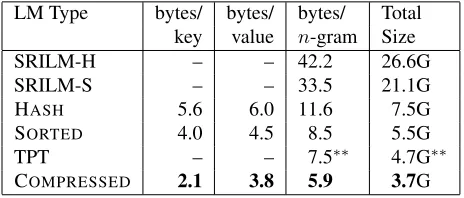
Table 2: Memory usages of several language model im-plementations on the WMT2010 language model. A ∗∗ indicates that the storage in bytes per n-gram is
re-ported for a different language model of comparable size, and the total size is thus a rough projection.
5 Experiments
5.1 Data
To test our LM implementations, we performed experiments with two different language models.
Our first language model, WMT2010, was a
5-gram Kneser-Ney language model which stores probability/back-off pairs as values. We trained this language model on the English side of all
French-English corpora provided6for use in the WMT 2010
workshop, about 2 billion tokens in total. This data
was tokenized using thetokenizer.perlscript
provided with the data. We trained the language model using SRILM. We also extracted a
count-based language model, WEB1T, from the Web1T
corpus (Brants and Franz, 2006). Since this data is provided as a collection of 1- to 5-grams and asso-ciated counts, we used this data without further pre-processing. The make up of these language models is shown in Table 1.
5.2 Compression Experiments
We tested our three implementations (HASH,
SORTED, and COMPRESSED) on the WMT2010 language model. For this language model, there are about 80 million unique probability/back-off pairs,
so v ≈ 36. Note that here v includes both the
cost per key of storing the value rank as well as the (amortized) cost of storing two 32 bit floating point numbers (probability and back-off) for each unique value. The results are shown in Table 2.
6www.statmt.org/wmt10/translation-task.html
WEB1T
LM Type bytes/ bytes/ bytes/ Total key value n-gram Size
Gzip – – 7.0 24.7G
T-MPHR† – – 3.0 10.5G
[image:8.612.71.303.82.181.2]COMPRESSED 1.3 1.6 2.9 10.2G
Table 3: Memory usages of several language model im-plementations on the WEB1T. A† indicates lossy com-pression.
We compare against three baselines. The first two, SRILM-H and SRILM-S, refer to the hash table-and sorted array-based trie implementations pro-vided by SRILM. The third baseline is the Tightly-Packed Trie (TPT) implementation of Germann et al. (2009). Because this implementation is not freely available, we use their published memory usage in
bytes per n-gram on a language model of similar
size and project total usage.
The memory usage of all of our models is
con-siderably smaller than SRILM – our HASH
imple-mentation is about 25% the size of SRILM-H, and
our SORTED implementation is about 25% the size
of SRILM-S. Our COMPRESSED implementation
is also smaller than the state-of-the-art compressed TPT implementation.
In Table 3, we show the results of our COM
-PRESSED implementation on WEB1T and against two baselines. The first is compression of the ASCII
text count files using gzip, and the second is the
Tiered Minimal Perfect Hash (T-MPHR) of Guthrie
and Hepple (2010). The latter is a lossy
compres-sion technique based on Bloomier filters (Chazelle et al., 2004) and additional variable-length encod-ing that achieves the best published compression of
WEB1T to date. Our COMPRESSED
implementa-tion is even smaller than T-MPHR, despite using a
losslesscompression technique. Note that since T-MPHR uses a lossy encoding, it is possible to re-duce the storage requirements arbitrarily at the cost of additional errors in the model. We quote here the
storage required when keys7are encoded using
12-bit hash codes, which gives a false positive rate of
about2−12=0.02%.
7
LM Type No Cache Cache Size COMPRESSED 9264±73ns 565±7ns 3.7G SORTED 1405±50ns 243±4ns 5.5G HASH 495±10ns 179±6ns 7.5G SRILM-H 428±5ns 159±4ns 26.6G HASH+SCROLL 323±5ns 139±6ns 10.5G
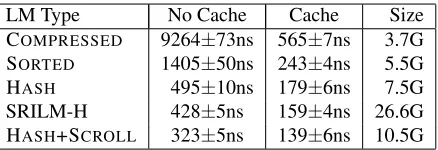
Table 4: Raw query speeds of various language model implementations. Times were averaged over 3 runs on the same machine. For HASH+SCROLL, all queries were issued to the decoder in context-encoded form, which speeds up queries that exhibit scrolling behaviour. Note that memory usage is higher than for HASHbecause we store suffix offsets along with the values for ann-gram.
LM Type No Cache Cache Size
[image:9.612.78.297.56.131.2]COMPRESSED 9880±82s 1547±7s 3.7G SRILM-H 1120±26s 938±11s 26.6G HASH 1146±8s 943±16s 7.5G
Table 5: Full decoding times for various language model implementations. Our HASH LM is as fast as SRILM while using 25% of the memory. Our caching also re-duces total decoding time by about 20% for our fastest models and speeds up COMPRESSED by a factor of 6. Times were averaged over 3 runs on the same machine.
5.3 Timing Experiments
We first measured pure query speed by logging all LM queries issued by a decoder and measuring
the time required to query those n-grams in
isola-tion. We used the the Joshua decoder8 with the
WMT2010 model to generate queries for the first
100 sentences of the French 2008 News test set. This produced about 30 million queries. We measured the
time9 required to perform each query in order with
and without our direct-mapped caching, not includ-ing any time spent on file I/O.
The results are shown in Table 4. As expected,
HASH is the fastest of our implementations, and
comparable10 in speed to SRILM-H, but using
sig-8
We used a grammar trained on all French-English data provided for WMT 2010 using the make scripts provided at http://sourceforge.net/projects/joshua/files /joshua/1.3/wmt2010-experiment.tgz/download
9
All experiments were performed on an Amazon EC2 High-Memory Quadruple Extra Large instance, with an Intel Xeon X5550 CPU running at 2.67GHz and 8 MB of cache.
10Because we implemented our LMs in Java, we issued queries to SRILM via Java Native Interface (JNI) calls, which introduces a performance overhead. When called natively, we found that SRILM was about 200 ns/query faster.
Unfortu-nificantly less space. SORTED is slower but of
course more memory efficient, and COMPRESSED
is the slowest but also the most compact
repre-sentation. In HASH+SCROLL, we issued queries
to the language model using the context encoding, which speeds up queries substantially. Finally, we note that our direct-mapped cache is very effective. The query speed of all models is boosted
substan-tially. In particular, our COMPRESSED
implementa-tion with caching is nearly as fast as SRILM-H
with-out caching, and even the already fast HASH
imple-mentation is 300% faster in raw query speed with caching enabled.
We also measured the effect of LM performance
on overall decoder performance. We modified
Joshua to optionally use our LM implementations during decoding, and measured the time required to decode all 2051 sentences of the 2008 News test set. The results are shown in Table 5.
With-out caching, SRILM-H and HASHwere comparable
in speed, while COMPRESSED introduces a
perfor-mance penalty. With caching enabled, overall
de-coder speed is improved for both HASHand
SRILM-H, while the COMPRESSEDimplementation is only
about 50% slower that the others.
6 Conclusion
We have presented several language model imple-mentations which are state-of-the-art in both size and speed. Our experiments have demonstrated im-provements in query speed over SRILM and com-pression rates against state-of-the-art lossy compres-sion. We have also described a simple caching tech-nique which leads to performance increases in over-all decoding time.
Acknowledgements
This work was supported by a Google Fellowship for the first author and by BBN under DARPA contract HR0011-06-C-0022. We would like to thank David Chiang, Zhifei Li, and the anonymous reviewers for their helpful com-ments.
References
Paolo Boldi and Sebastiano Vigna. 2005. Codes for the world wide web. Internet Mathematics, 2.
Thorsten Brants and Alex Franz. 2006. Google web1t 5-gram corpus, version 1. InLinguistic Data Consor-tium, Philadelphia, Catalog Number LDC2006T13. Thorsten Brants, Ashok C. Popat, Peng Xu, Franz J. Och,
and Jeffrey Dean. 2007. Large language models in machine translation. InProceedings of the Conference on Empirical Methods in Natural Language Process-ing.
Bernard Chazelle, Joe Kilian, Ronitt Rubinfeld, and Ayellet Tal. 2004. The Bloomier filter: an efficient data structure for static support lookup tables. In Pro-ceedings of the fifteenth annual ACM-SIAM sympo-sium on Discrete algorithms.
David Chiang. 2005. A hierarchical phrase-based model for statistical machine translation. InThe Annual Con-ference of the Association for Computational Linguis-tics.
Kenneth Church, Ted Hart, and Jianfeng Gao. 2007. Compressing trigram language models with golomb coding. InProceedings of the Conference on Empiri-cal Methods in Natural Language Processing. Marcello Federico and Mauro Cettolo. 2007. Efficient
handling of n-gram language models for statistical ma-chine translation. InProceedings of the Second Work-shop on Statistical Machine Translation.
Edward Fredkin. 1960. Trie memory. Communications of the ACM, 3:490–499, September.
Ulrich Germann, Eric Joanis, and Samuel Larkin. 2009. Tightly packed tries: how to fit large models into mem-ory, and make them load fast, too. InProceedings of the Workshop on Software Engineering, Testing, and Quality Assurance for Natural Language Processing. S. W. Golomb. 1966. Run-length encodings. IEEE
Transactions on Information Theory, 12.
David Guthrie and Mark Hepple. 2010. Storing the web in memory: space efficient language models with con-stant time retrieval. InProceedings of the Conference on Empirical Methods in Natural Language Process-ing.
Boulos Harb, Ciprian Chelba, Jeffrey Dean, and Sanjay Ghemawat. 2009. Back-off language model compres-sion. InProceedings of Interspeech.
Bo-June Hsu and James Glass. 2008. Iterative language model estimation: Efficient data structure and algo-rithms. InProceedings of Interspeech.
Abby Levenberg and Miles Osborne. 2009. Stream-based randomised language models for smt. In Pro-ceedings of the Conference on Empirical Methods in Natural Language Processing.
Zhifei Li and Sanjeev Khudanpur. 2008. A scalable decoder for parsing-based machine translation with equivalent language model state maintenance. In Pro-ceedings of the Second Workshop on Syntax and Struc-ture in Statistical Translation.
Zhifei Li, Chris Callison-Burch, Chris Dyer, Juri Gan-itkevitch, Sanjeev Khudanpur, Lane Schwartz, Wren N. G. Thornton, Jonathan Weese, and Omar F. Zaidan. 2009. Joshua: an open source toolkit for parsing-based machine translation. In Proceedings of the Fourth Workshop on Statistical Machine Translation. Franz Josef Och and Hermann Ney. 2004. The
align-ment template approach to statistical machine transla-tion. Computationl Linguistics, 30:417–449, Decem-ber.
Andreas Stolcke. 2002. SRILM: An extensible language modeling toolkit. InProceedings of Interspeech. E. W. D. Whittaker and B. Raj. 2001.