Heat Transfer Model for Thin Solidified Material in Continuous Casting
Nobuaki Ito
Advanced Technology Research Laboratories, Nippon Steel Corporation, Futtsu 293-8511, Japan
An asymptotic explicit numerical method was developed for the Stefan problem in which a series of solidification rates and boundary temperatures for the solidified material are given and the boundary heat flux is returned. A spectral method with several basis functions of a specialized shape in the solidification problem was adopted. Combined with multi-dimensional computational fluid dynamics methods for the liquid zone, this method is adequate for resolving the thin solidified material problem for a variety of continuous casting processese.g.thin slab continuous casting, melt-spinning, twin roll casting, and edge-defined film-fed growth. The method is less expensive than conventional numerical methods and as accurate as a direct numerical approach such as the Finite Difference Method especially in the case of the Stefan number1 or in the case of variable material properties. [doi:10.2320/matertrans.MRA2007019]
(Received January 22, 2007; Accepted March 22, 2007; Published May 25, 2007)
Keywords: continuous casting, twin roll casting, Stefan problem, spectral method, basis function
1. Introduction
Heat and flow analysis in continuous casting (C.C.) around the solidification front (S.F.) provides valuable information on appropriate working conditions and morphological con-trol of casting. As shown previously, the multi-domain approach divided with discontinuous S.F. should be applied in the C.C. simulation from the viewpoint of numerical
error.1)In this approach, the entire analysis zone is divided
into a liquid and a solidified material (S.M.) zone. For the liquid zone, multi-dimensional numerical simulation is necessary for most actual process analysis because of complex geometry and variable material properties. How-ever, for S.M. analysis, a simpler approach can be applied under the following assumptions: (1) lateral heat flux is negligible. (2) solid flow is steady. (3) solid deformation is negligibly small as to the heat transfer analysis. These
assumptions are valid for a variety of types of C.C.,e.g.thin
slab casting, twin roll casting, melt spinning, and EFG. Moreover, these assumptions transform the original multi-dimensional steady conduction problem into the one-dimen-sional unsteady conduction problem with a moving
boun-dary,i.e.the Stefan problem.2–5)
As explained later, in the coupling methods between the S.M. zone and the liquid zone, weak coupling by means of a
set of given vm and feeding q00s;m back in the
solid-Stefan-problem is most appropriate. This Stefan solid-Stefan-problem could be
classified as the Inverse Stefan problem.5) However, this
Stefan problem is actually a direct problem in which the problem is always well posed; therefore in the present paper, this Stefan problem is called the Thin-S.M. Problem (TSMP) to distinguish it from the ill-posed inverse Stefan problem.
Hence, the solution method for TSMP is discussed.
1.1 Analytical approach
For the multi-domain approach, the quasi-steady approach
in the S.M. is commonly used.7,8)However, the quasi-steady
approach causes a significantly large numerical error when
Stefan number Ste (¼CpðTmTs;0Þ=Lh) is not very small
(e.g. Ste>1);5) this is typical in the case of, e.g. rapid
cooling. For unsteady governing equations, analytical solu-tions exist only under simple boundary condisolu-tions as in the
Neumann problem,2) which is too simple a condition to
express the actual casting processes.
1.2 Direct numerical approach
The direct numerical approach, in which the original governing equations are directly discretized into a deference equations system, could give a solution for general boundary
conditions. However, a simple and non-iterative (i.e.explicit)
solution method such as the Rung-Kutta method is not applicable to the general boundary conditions in the TSMP
for general C.C. processes, in the case of, e.g.,
time-dependent boundary temperature Ts;0, Tm. Therefore, an
iterative (i.e. implicit) direct numerical approach, e.g. the
finite difference method (FDM),9,10) the finite element
method (FEM),11) or the boundary element method
(BEM)12)is necessary for the TSMP. For this approach, a
significantly large calculation cost is inevitable because a rather small time increment compared with the required casting time is necessary; the time increment is limited by the Courant-Friedrich-Levy (CFL) condition, which governs the calculation stability and accuracy, even in an implicit method because of the special limitation for solidification analysis. This limitation is that the movement of the S.F. in a time step must not exceed the spatial grid interval, which should be
sufficiently small for accuracy.13)Despite the recent
develop-ment of computer technology, this method remains too expensive for an iterative coupling method between the liquid and the S.M. zone; this coupling method is essential as the solution process is stabilized especially for a potentially
unstable problem such as in melt-spinning analysis.14)
1.3 Asymptotic approach
The asymptotic approach includes the classical integral
method,2) the perturbation method,15–17) the inverse
meth-od,18–20) and the spectral method.21) In these methods, the original governing equations are approximately expressed by
a sum of a series of expansion functions of x2 and t; each
expansion function could be decided analytically under the given boundary conditions.
In the perturbation method, the expansion function is
generally assumed to depend only on variable(¼hsx2)
under the assumption ofSte1;15–19)temperature
tionTs½was expressed as then-th power ofSte. Because of
the nature of a power function, n is limited in the second
order at maximum from the view of stability of the function
shape;5)the shape of the final approximated function could be
too simple to express the possible complex curve of Ts
distribution that is caused with, for example, the existence of impinging liquid flow on a specific area of the S.F. (this generally occurs in the C.C.). Moreover, the assumption
Ste1could be invalid for a rather rapid solidification.
Grzymokowski and Slota20)proposed an inverse method in
which the expansion function is expressed with independent
variablesx2andtunder the given history ofhs; the method is
applicable to the wider range of the boundary conditions.
However, this method is limited in the assumption ofSte1
to decompose the expansion function. Fredrick and Greif19)
proposed the inverse method for a general magnitude ofSte.
However, in this method, the expansion function is based on
the Taylor expansion on the S.F.; the pre-defined history ofhs
is limited to a rather simple shape. In addition, in the most inverse Stefan problem, both the temperature and the heat flux on the S.F. have to be given in advance in order to
acquire the field values on the free boundary (i.e.a boundary
where no boundary conditions are given). On the contrary, the heat flux on the S.F. should be a solution variable in the TSMP; the problem to be solved is totally different regarding the inverse problem and the TSMP.
The spectral method was applied to some Stefan problems (but not to TSMP) with Fourier-expansion or
Chebyshev-polynomial approximation.22,23)These studies suggest their
applicability to the general boundary condition. However, the conventional method requires significant cost; implicit solu-tion method and/or tolerable numerical integrasolu-tions for each basis function are necessary. In the conventional method, application to the variable thermal diffusivity is generally difficult. Moreover, by definition, the problem setting in these works differs from the TSMP.
Therefore, none of the above conventional methods is appropriate for solving the TSMP in terms of accuracy or cost efficiency.
In the present paper, a non-iterative (explicit) asymptotic solution method for TSMP based on the spectral method provided with a series of specialized basis function is described. This method is applicable to the general boundary condition and variable material properties even in the case of
Ste>1.
2. Nomenclature
a: model constant
b: adjusting coefficient
Cp: specific heat
g: roll gap
h: thickness
Hr: heat resistance
Ht: heat transfer coefficient
k: heat conductivity
L: length
Lh: latent heat
m: basis function degree index
M,N: total number of basis function degree/time step
q00: heat flux
qA00: steady component heat flux
Ste: Stefan number
T: temperature
Ta,dT: average/deviation component ofT
dT: basis function ofdT
dTf: component ofdT
t: time
t: time step
t0:tt
i1þti=2
u: velocity
Us: pull velocity in C.C.
vA:vm
vm: solidification rate
x: coordinate value
: thermal diffusivity
1,2: model constant
": emissivity
: Boltzmann’s factor : deviation temperature
0,1,2: component of
: viscosity
: relative coordinate : density
(Subscripts)
0: C.D.-S.M. interface
fmr,lat: former/latter half of time step
in: inlet
ini: initial
l: liquid
i: time step index
j: basis function index
m: the S.F. or indexm
out: outlet
r: C.D. (roll)
ref: reference
s: S.M.
1,2: coordinate direction
B1,B2: direction along/vertical to the roll surface
(Superscripts)
o:x2 of discretized point ofdT
3. Mathematical Model
3.1 Liquid-S.M. coupling for TSMP
The strong coupling method (the field values in the liquid and the solid zone are solved simultaneously as a simulta-neous equation system) and the weak coupling method (the field values are solved individually and a coupling method is applied to the zone boundary) are candidate methods, but in this paper, the weak coupling method was adopted because strong coupling is significantly expensive.
3.1.1 Quasi-static fluid case
The TSMP could be reduced to an unsteady one-dimen-sional problem; the solution for the conventional Stefan Problem is applicable. Thus, no further discussion is required here.
3.1.2 Convective fluid in the case ofSte1
The heat transfer rate distributes on the S.F. by means of
with the liquid flow speed and the representative flow length scale that the liquid flow field is almost irrelevant to the S.M. behavior except for the heat boundary condition. Thus, the one-way coupling approach, which implies relatively small calculation cost on TSMP, from the liquid zone to the S.M. zone is applicable. The following present solution method is applicable to this case as well as the conventional method. 3.1.3 Convective fluid in the case of Ste in general
magnitude
A multi-dimensional liquid flow is affected by the S.F. distribution; thus, the two-way coupling method between the liquid and the S.M. zone is necessary. For this case, the following present solution method is appropriate because of the favorable balance of accuracy and cost; the cost is important in the iterative (implicit) solution approach between the calculation zones.
Hence, the favorable coupling boundary values in the weak coupling method are described. In zone coupling, all but one
boundary value out of four variables, i.e.Tm,vm,q00s;m, and
q00
l;m, should be given or dependent on the other boundary
values in each zone so as to make the problem well posed. The remaining variable becomes a solution variable, which must not be common between the two zones. In the boundary
variables,vm,q00
s;m, andq00l;mare dependent on each other by means of the following equation.
sLhvm¼q00s;mq00l;m ð1Þ
In sub-cooled solidification, Tm could be expressed as a
function of vm and the local material composition.24) The
solidification rate vm, which expresses the zone boundary
shape explicitly, should naturally be a solution variable for either zone. This is because the flow field, which governs the heat transfer on the S.F., is highly sensitive to the boundary shape in the multi-dimensional numerical analysis for the liquid zone. On the other hand, in the case of, for example,
Ste1 (i.e. Lh=q00
s;m!0), vm could become highly
unstable whenvmis not a solution variable but is calculated
from the other variables with eq. (1). Thus, vm should be a
solution variable. As forTm, because this variable generally
varies in a smaller range during the calculation process than
the other variables,Tmcould be acquired explicitly by means
of the function of vm as well as by means of an implicit
simultaneous solution method forvmandTm. As forq00s;mand
q00l;m, these variables exist only in the zone to which they
belong respectively;i.e.q00l;mis for the liquid zone,q00s;mis
for the S.M. zone. Thus, two sets of boundary variable
couplings are possible for the S.M. zone: (1)q00
s;mis given
from the liquid zone andvmis fed back to it. (2)vmis given
from the liquid zone and q00
s;m is fed back to it, that is the
TSMP. Although the former method is an orthodox method in
the case ofSte1,6)the latter was adopted in this paper for
the following reason. In the former coupling, the iterative calculation process could become unstable because the zone interior heat is transported only diffusively in the Stefan problem. This limitation of the heat transfer route may cause
problems. For example, vm become infinite when given
q00
s;m!0, orhsbecome close to 0 (under negativevm) when
the given q00s;m is a relatively large value; this situation
commonly occurs during the calculation process. On the contrary, in the latter coupling, the iterative calculation
process is more stable because any givenvmreturns a finite
q00
s;m. In this coupling, the potential calculation instability is
transported from the S.M. zone to the liquid zone calculation. However, the calculation process in the liquid zone is
generally stable for inputq00
l;m, which is calculated from the
givenq00
s;m, because the advective heat transfer in the liquid
zone helps the problem to satisfy the given boundary
conditions; for example, any high given q00
l;m result in a
finitevmoutput, or a negativevmin a rather small magnitude
become an output for the case in which the given q00
l;m becomes zero. Therefore, the TSMP is the most appropriate for the boundary variable coupling.
3.2 Liquid model
In the TSMP,hsis so thin that the actual shape of the S.F.
could be approximated with locally variable exit velocityvA
on the imaginary flat shape S.F..25) This approximation
reduces the analytical cost because exploring the S.F.-position is unnecessary. The boundary conditions on the S.F. become:
u1¼ ðs=lÞUs ð2Þ
u2¼vAðs=lÞ ¼ vmðs=lÞ ð3Þ
T¼Tm ð4Þ
As mentioned previously,q00
l;mis given andvA is a solution
variable.
3.3 S.M. model
The present solution method for the TSMP is described below.
3.3.1 Governing equation The governing equation is:
@Ts=@t¼@=@x2ðs@Ts=@x2Þ ð5Þ
Ts¼Tm; x2¼hs ð6Þ
Ts¼Ts;0; x2¼0 ð7Þ
hs¼
Zt
0
vmdt ð8Þ
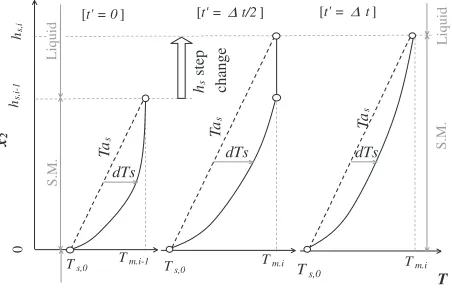
Here,Tsis divided into steady componentTasand deviation
componentdTsassuming a step of change ofhs,Ts;m, andTs;0
at the middle of the time step (Fig. 1). The physical meaning of this decomposition is that the given temperature distribu-tion at the middle of the time step should become that for
steady stateTasalong the time advance when the boundary
Ts,0 Tm.i-1
T
h
s,i-1
h
s,i
x
2
[t' = 0]
hs
step
change
Ta
s
Tm.i Tm.i
Ta
s
dTs
Ta
s
[t' =∆t/2] [t' = ∆t]
Ts,0 Ts,0
S.M.
S.M.
0
Liquid
Liquid
dTs dTs
[image:3.595.316.542.73.218.2]conditionshs,Tm, andTs;0 are kept in the rest time step;dTs correspond to the decaying component. Thus, eq. (5) becomes:
@ðTasþdTsÞ=@t¼@=@x2fs½Ts@ðTasþdTsÞ=@x2g ð9Þ
Assuming TasdTs, which is plausible for most C.C.
processes, lets½Tsbes½Tas; we can divided eq. (9) into
following the steady component and the deviation component equation.
d=dx2ðs½TasdTas=dx2Þ ¼0 ð10Þ
Tas¼Tm; x2 ¼hs ð11Þ
Tas¼Ts;0; x2¼0 ð12Þ
@dTs=@t¼@=@x2ðs½Tas@dTs=@x2Þ ð13Þ
dTs¼0; x2¼hs ð14Þ
dTs¼0; x2¼0 ð15Þ
Here, x2 represents the solidification progressing direction.
The solution of the heat flux on the S.F. in thei-th time step,
q00
s;m;i, is acquired with the sum of the heat flux for the steady
componentqA00s;m;iand the deviation componentdq00s;m;i. The
surface heat flux on the cooling deviceq00
s;0;i, is also acquired in the same way.
3.3.2 Steady component equation
The solution for eq. (10) is expressed only with the
integral of1=s. Thus, many functions forscould easily be
adopted so as to acquire an analytical solution. In the case of,
for example,sis constant,Tasbecomes:
Tas¼ ðTmTs;0Þðx2=hsÞ þTs;0 ð16Þ
In the case ofs¼a1Tasþa2 (thermal properties are often
described in this form of function in material handbooks),Tas
becomes:
Tas¼ a2þ a22þ
x2
hs
a1Tmða1Tmþ2a2Þ þ 1
x2
hs
a1Ts;0ða1Ts;0þ2a2Þ
1=2
1 a1
!
ð17Þ
The heat flux in the steady componentqA00s;m;iandqA00s;0;iis readily acquired analytically with differentiation of eq. (16) or (17)
atx2¼hs;i orx2 ¼0.
3.3.3 Deviation component equation
The collocation spectral method21)is applied to solve eq. (13); in this method, the solution is expressed by means of the sum
of a series of basis functions. The author adopted the following basis functiondTi;j(irepresents thei-th time step,jrepresents
the j-th basis function). In time stepi, the basis functions are initialized at the middle of the time step just after the
above-mentioned step change ofhs andTs. The initial value of the basis function is:
dTi;j;ini¼ ðdToi;j=x2oi;jÞx2 ¼1i;jx2;
0x2x2oi;j ð18Þ
dTi;j;ini¼ fdToi;j=ðhs;ix2oi;jÞg ðhs;ix2Þ
¼2i;jðhs;ix2Þ; x2oi;j<lx2hs;i ð19Þ
The initial basis function is Fourier expanded; them-th expanded term for thej-th basis function,dT f
i;j;m;iniis:
dT fi;j;m;ini¼
2
hs;i
Zi;jhs;i
0
1;i;jx2sin
mx2
hs;i
dx2
þ
Zhs;i
i;jhs;i
2;i;jðhs;ix2Þsin
mx2
hs;i
dx2
sin mx2 hs;i
ð20Þ
¼ 2dT
o i;j
ðmÞ2i;jð1i;jÞ
sin½i;jmsin
mx2
hs;i
Here,i;j¼x2oi;j=hs. The temperature distributiondT fi;j;m;ini always satisfies eq. (14) and (15); therefore, the solution of
eq. (13) for the original initial condition could be expressed with the sum of the solution of eq. (13),dT f
i;j;m, for each initial
conditiondT f
i;j;m;ini. Under constants;i;jfor eachdT fi;j;m, the solution of eq. (13)dT fi;j;mbecomes as follows in the period
of0t0t
i=2,t0¼tti1þti=2.
dT fi;j;m¼
2dToi;j
ðmÞ2i;jð1i;jÞ
sin½i;jmsin
mx2
hs;i
exp m hs;i
2
s;i;jt0
" #
ð21Þ
The partial differentiation ofdT f
i;j;manalytically becomes:
@dT f i;j;m
@x2
¼ 2dT
o i;j
ðmÞ2i;jð1i;jÞ
sin½i;jmcos
mx2
hs;i
exp m hs;i
2
s;i;jt0
" #
ð22Þ
In the spectral method, the deviation heat flux on the S.F. for the latter half of thei-th time step (ti1þti=2tti),dq00s;i;lat,
is approximated with the sum of the basis function dTi;j differentiation, which is expressed with the sum of dT fi;j;m
dq00s;i;lat¼
2
ti
XN
j¼1
XM
m¼1
bi;j
Zti=2
0
@T f i;j;m
@x2
dt0
¼X
N
j¼1
XM
m¼1
bi;j
4hs;idToi;j
ðmÞ3s;i;ji;jð1i;jÞti
sin½i;jmcos½m ð23Þ
1exp m
hs;i
2
s;i;j
ti
2
" #
( )!
bi;j¼
@Tas
@x2
x2¼hs;i
hs;ix2oi;j
Tm;iT2oi;j
ð24Þ
Here,bi;j is an adjusting coefficient against the numerical error caused by regarding the temperature gradient at the S.F. as
linear.
In the former half of the (iþ1)-th time step, no boundary condition changes from the latter half of thei-th time step.
Identical basis functions to those for thei-th latter time step could be adopted to acquire the heat flux. Therefore, the deviation
heat flux on the S.F. for the former half of thei-th time step (ti1<t<ti1þti=2),dq00s;i;fmr, could be expressed with the
basis functions in the (i1)-th time step:
dq00s;i;fmr ¼
XN
j¼1
XM
m¼1
bi;j
4hs;i1dToi1;j
ðmÞ3
s;i1;ji1;jð1i1;jÞðti1þtiÞ
sin½i1;jmcos½m 1exp
m hs;i1
2
s;i1;j
ðti1þtiÞ
2
" #
( )! ð25Þ
Consequently, the deviation heat flux for time step i dq00
s;i becomes:
dq00s;i¼ ðdq00s;i;fmrþdq00s;i;latÞ=2 ð26Þ
The total number of basis functionsNcould change between
the former and the latter time step; in this case, dTo
i;j is
interpolated with newx2oi;j.
The distance between the S.F. and the x2oi;j next to the
S.F.,x2oi;N, should be set no more thanhs;i(¼vmti) to
express the above step change of hs accurately. This
condition limits the minimum number ofM required:
M¼ ðhs;i=hs;iÞ=ð2Þ ð27Þ
Whenhs;iis significantly small,Mcould be a huge value.
However, in this condition, the step change of hs in a time
step is so small that it hardly affects the temperature field; the
calculation could be performed so that no change ofhsoccurs
during the time step. Therefore, the basis function of the last
time step could be carried over; no limitation emerges forM.
Thus,M could be always a finite value.
The thermal diffusivity for thej-th basis function in thei-th
time,s;i;j, could be set:
s;i;j½T ¼s½Taðx2oi;jÞ ð28Þ
Equation (28) generally causes a numerical error. However, because of its function shape, the deviation temperature at
x2oi;j,dTi½x2oi;j, tends to be most affected by its component
dT
i;j½x2oi;j, which gives a plausible s at x2oi;j. Thus, the
numerical error was relatively small as described in the following chapter.
To decompose the initial deviation temperature
dTi½x2;t0¼0 into the N initial basis functions dTi;j;ini,
Nsimultaneous linear equations should be solved so that the
sum of dTi;j;ini½x2oi;j (j¼1;N) agrees with the given
dTi½x2oi;j;t0¼0, which is the collocation method.21) The
inverse matrix for solving the simultaneous equations only
depends on i;j.; the given dTi½x2oi;j;t0¼0fixes the basis
functions.
3.4 Cooling device (C.D.) model
The C.D.-Model is modeled after the heat transfer at the surface (the other side of the liquid side) of S.M. by means of giving the surface temperature. The C.D.-Model could be divided into two cases with the magnitude of the Biot number
Bi (¼Hths=ks or hs=ðHrksÞ); that is the
Surface-Heat-Resistance Dominating Case (Bi<1) and the
Interior-Heat-Resistance Dominating Case (Bi>1).
3.4.1 Surface-heat-resistance dominating case
This is typical in the case of an open casting of ribbon such as EFG. The surfaces of a ribbon are cooled relative weakly with the radiation and the heat advection by atmosphere. The
inner heat resistanceh=ks is relatively small. Thus, the heat
resistance at the surfaces is dominant in total heat transfer. Consequently, the initial surface temperature in casting is close to the melting point. The surface temperature gradually reduces in a wide range to the atmospheric temperature during casting.
The boundary condition at the surface is:
ksð@Ts;0=@x2Þ ¼HtðTs;0TaÞ þ" ðTs;04Ta4Þ ð29Þ
In this boundary condition, surface temperatureTs;0is defined
only implicitly. Therefore,Ts;0should be decided iteratively.
3.4.2 Interior-heat-resistance dominating case
This is typical in the case of the other rather ordinary C.C.
processes, where C.D. (e.g.a mold, a cooling roll) is usually
designed to be composed with highly heat conductive materials for efficient cooling. Most of these C.D. are also accompanied by massive water cooling on their back. To discuss the interior heat resistance, supposing a steady heat transfer for the Stefan problem, the heat flux through the S.M.
q00s¼ ðTmTr;0Þ=ðHrþh=ksÞ ð30Þ
q00s¼ ðTs;0Tr;0Þ=Hr ð31Þ
In most C.C. processes, the heat resistance at the surfaceHris
designed to be smaller than inner heat resistancehs=ksexcept
for at very early solidification (i.e. at very small hs).
Therefore, in most areas, the interior heat resistance is dominant in the total heat transfer.
Because the actual processes correspond to the unsteady Stefan problem, the actual temperature distribution in the S.M. has to be calculated not with eq. (30) but with the S.M.-Model. However, eq. (31) could be valid in the actual processes because the thickness of the heat resistance layer at the C.D. surface is so thin that the local quasi-steady state is expected there.
When the contact between S.M. and C.D. is perfect (i.e.
Hr¼0) and the surface temperature of the C.D. is regarded
as constant valueTr;0, the surface temperature of S.M.Ts;0is
equal to Tr;0. Otherwise, Ts;0 should be decided iteratively
with the combination of eq. (31), the S.M.-Model, and the
C.D. Model (i.e. Implicit-Coupling method) in general.
However, the following plausible assumptions in the C.C. could allow escape from the expensive Implicit-Coupling method to a simple Explicit-Coupling method. The
assump-tions are: (1) Tr;0Tr;ref TmTs;0 (2) ð@Ts;0=@tÞt
TmTs;0. The calculation steps of the Explicit-Coupling
method are: (1) At a certain time step i, the surface
temperature of the C.D. Tr;0 is calculated with the
C.D.-Model, which is explained later. The value of the surface heat
flux of the S.M. at the previous time stepq00s;0;i1 is used as
the heat boundary condition at the C.D. surface. (2) The
surface temperature of the S.M. at time step i Ts;0;i is
calculated with eq. (31) on the condition of q00
s¼q00s;0;i1. (3) The temperature distribution in the S.M. is calculated
with the S.M.-Model. This temperature distribution givesq00
s for the next time step calculation.
The C.D.-Model gives the instantaneous surface temper-ature of the C.D. from the given history of the surface heat flux by way of solving the temperature distribution in the C.D.. In the relevant calculation area, the heat transfer analysis reduces to a boundary value problem for heat conduction in a fixed calculation area. Thus, there are analytical solutions for typical analysis cases. Here, for example, the solution for melt spinning is described.
The material properties of C.D. are set constant because of its relatively less changeable temperature. The C.D. is regarded as a semi-infinite material and the initial temper-ature is uniform. As the actual melt spinning process condition, these assumptions are plausible. The governing equation is as follows.
@r=@t¼ rð@2r=@x22Þ ð32Þ
r¼TrTr;ini ð33Þ
Because of the equation linearity, the temperature
distribu-tion at time stepicould be composed with superposition of
the response deviation-temperature distributions to the rectangular-heat-input at every past time step. Each response deviation-temperature distribution is calculated with a super-position of the response deviation-temperature distributions to two step-heat-input whose beginning time differs. For a
semi-infinite body, the deviation-temperature distribution
of response to a step-heat-input that begins at time tj, 1j,
under the conditions of1j;ini¼0,1jjx2!1¼0,q00r;0 ¼0
(t<tj), andq00r;0¼q00r;0;j(ttj) is as follows.3)
1j½t ¼q00r;0;j0½ttj
0½t ¼ 1 kr
( 2
ffiffiffiffiffiffiffi rt
r
exp x2
2 ffiffiffiffiffiffirt
p
2
" #
x2erfc
x2
2 ffiffiffiffiffiffirt
p
)
ð34Þ
The deviation-temperature distribution of the response to a
rectangular-heat-input, 2j, under conditions of q00r;0 ¼0
(t<tj,t>tjþ1) andq00r;0¼q00r;0;j(tjþ1ttj) is:
2j¼q00r;0;jð0j½ttj 0j½ttjtjÞ ð35Þ
Thus, when each time step is constant (i.e. ti¼t), the
deviation-temperature distribution at time ti (¼it)
be-comes:
r;i¼
Xi
j¼1
2j½titj
¼X
i
j¼1
q00r;0;j0½ðijþ1Þt
X
i1
j¼1
q00r;0;j0½ðijÞt ð36Þ
¼q00r;0;10½it þ
Xi1
j¼1
ðq00r;0;jþ1q00r;0;jÞ0½ðijÞt
Surface temperature Tr;0 is defined at x2¼0 in eq. (36).
Consequently,Tr;0 becomes:
Tr;0 ¼
2
kr
ffiffiffiffiffiffiffiffiffiffiffi rt
r
q00r;0;1
ffiffi i p
þX
i1
j¼1
ðq00r;0;jþ1q00r;0;jÞ
ffiffiffiffiffiffiffiffiffi ij p
( )
þTr;ini
ð37Þ
3.5 Advantage of the present solution method
The present method gives the solution temperature field explicitly without the limitation of time increment. In addition, this method requires less computer memory because of the nature of the one–dimensional method and less limitation for the spatial interval; the limitation occurs only on the S.F.
The present model analytically gives the temperature differentiation, with which the heat flux is expressed, at any
point ofx2. On the contrary, in the finite difference methods,
the differentiation is only acquired with the difference approximation; thus, a micro spatial interval is necessary to achieve accuracy. The present method is also applicable
to the Stefan problem in Ste1; most of the analytical
methods and the perturbation method are incapable of handling this condition. Moreover, the present model
considers general boundary conditions and s variation by
different material properties); on the contrary, the
conven-tional explicit spectral method is weak at the s variation
because of its approximation by means of only a single series of the decomposed functions (each decomposed function corresponds to the basis function). These advantages are due to the shape of the present basis function for the spectral method.
Therefore, the present method is advantageous in the balance of cost and accuracy.
4. Validation
4.1 Schwarz-like problem
A simple and typical Stefan problem, which is similar to
the well-known Schwarz Problem,2) was solved compared
with the conventional method. 4.1.1 Problem description
The one-dimensional unsteady heat conduction problem between a roll and melt (liquid and S.M.) was solved under
the three conditions of Table 1 (x2direction. The origin is the
interface between the melt and the C.D.). These conditions correspond to actual casting processes as ferroalloy casting
with a copper C.D., in whichStecould become the largest.
The intention of the validations for these cases is as follows;
(1) CASE 1: the applicability to the infinite largeSte(Lh¼0
means an amorphous casting). (2) CASE 2: the applicability to the highly variable heat conductivity. (3) CASE 3: the
applicability to the largeHrandLh. As the initial condition,
the temperature for both the melt and the C.D. are set individual reference temperatures. The boundary conditions
atx2;r;ref andx2;s;ref are insulation. Five basis functions with
100-degrees were adopted for eachdT. The time steptis
2 106s; under this value oft, the time integral ofq00
m
proved to be constant fort.
The simulation for the same problems was performed according to a conventional method; That is the finite volume
method (FVM),25)which is the most popular computational
fluid dynamics model for engineering purposes. The FVM
was accompanied by the enthalpy method13) for the
solid-ification model. The mesh number 4000 and the time
increment5 108s were adopted so as to make the integral
of q00
m independent from the discretizing parameters. The
liquidus temperature was set 2 K above the solidus
temper-ature (Tm) for calculation stability. The calculated Tm
position-transition was applied to the present method as the
pre-definedhs.
4.1.2 Results and discussion
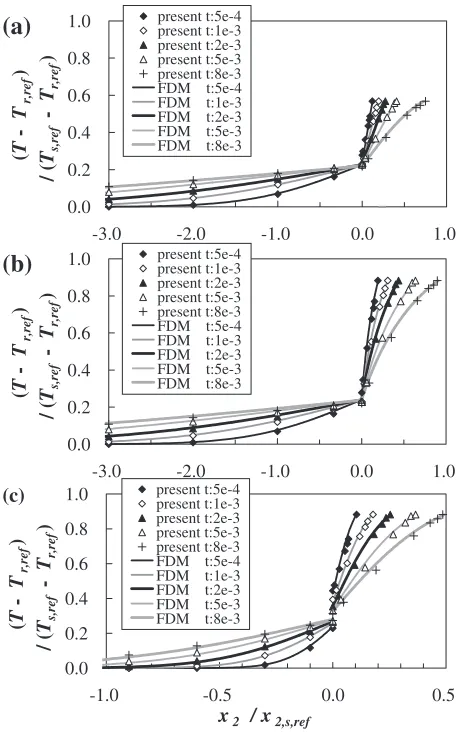
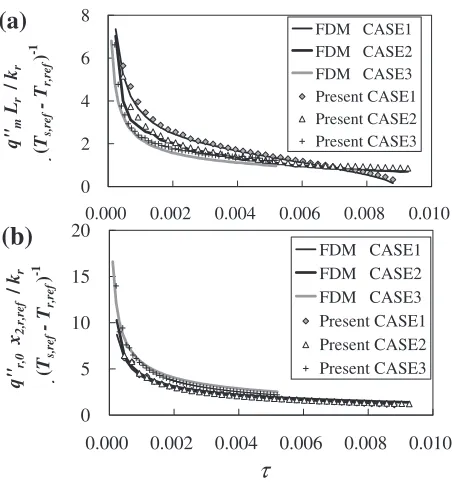
The present temperature distributions agree with the conventional method within 5% (as a local value) for all cases (Fig. 2). The agreement for the heat fluxes is within 10% (as a local value) and 2% (as a time integral value) (Fig. 3). These accuracies are sufficient for ordinary engi-neering purposes. As for calculation time, the conventional
method took 8 min for the casting term of 104s, whereas
only about 1 second is necessary for the present method; in
both calculations, an IntelXeon3 GHz CPU26)was used.
Therefore, the present method is accurate and cost effective
even in the case ofSte1or variable material properties.
4.2 Twin roll casting
A more practical problem was solved compared with the experimental data in the twin roll casting of paraffin
performed by Shiomi & Osakada.27)
4.2.1 Problem description
The geometry and material properties follow those of the
(a)
0.0 0.2 0.4 0.6 0.8 1.0
-3.0 -2.0 -1.0 0.0 1.0
(
T
-
Tr,ref
)
/ (
Ts,ref
-
Tr,ref
)
present t:5e-4 present t:1e-3 present t:2e-3 present t:5e-3 present t:8e-3 FDM t:5e-4 FDM t:1e-3 FDM t:2e-3 FDM t:5e-3 FDM t:8e-3
(b)
0.0 0.2 0.4 0.6 0.8 1.0
-3.0 -2.0 -1.0 0.0 1.0
(
T
-
Tr,ref
)
/ (
Ts,ref
-
Tr,ref
)
present t:5e-4 present t:1e-3 present t:2e-3 present t:5e-3 present t:8e-3 FDM t:5e-4 FDM t:1e-3 FDM t:2e-3 FDM t:5e-3 FDM t:8e-3
(c)
0.0 0.2 0.4 0.6 0.8 1.0
-1.0 -0.5 0.0 0.5
x2 / x2,s,ref
(
T
-
Tr,ref
)
/ (
Ts,ref
-
Tr,ref
)
present t:5e-4 present t:1e-3 present t:2e-3 present t:5e-3 present t:8e-3 FDM t:5e-4 FDM t:1e-3 FDM t:2e-3 FDM t:5e-3 FDM t:8e-3
[image:7.595.312.542.71.437.2]Fig. 2 Temperature Distribution in the x2 direction. (a) CASE 1, (b) CASE 2, (3) CASE 3.
Table 1 Calculation conditions.
CASE 1 CASE 2 CASE 3
Tr;ref /K 300
Ts;ref /K 1573
Tm /K 1023 1423
x2;r;ref /mm 10000
x2;s;ref /mm 30 100
kr /W/mK1 400 150
ks /W/mK1 25 0:019 Tsþ0:1 30
r /kg/m3 8700
s /kg/m3 6700
Cpr /J/kgK1 400
Cps /J/kgK1 700 450
Lh /J/kg 0 2:3 105 0
Hr /mK/W 0 1:0 107
[image:7.595.49.290.82.293.2]experiment.27)The cooling roll rotates at peripheral speedu r 0.012 m/s in the outlet direction. To accommodate the problem to the present method, the entire calculation zone is divided into the liquid and S.M. zone at the S.F. (solidus
temperature Tm) (Fig. 4). The following assumptions are
imposed; (1) the curvatures of the roll and the S.F. are ignored in the S.M. zone. (2) the curvature variation of the S.F. is ignored in the liquid zone. (3) the solidification is expressed with the outflow at the S.F. in the liquid zone as in Ref. 24). (4) no deformation in the S.M. occurs. (5) the heat transfer in the S.M. is regarded as the Stefan problem. The
coordinate system along (the xB1 direction) or vertical (the
xB2direction) to the S.F. is set. The boundary conditions are:
(1) Liquid zone
(inlet) u1;in¼giniur=Lin, (gini¼5 104m), u2;in¼0
T ¼Tin
(the S.F.)uB1¼ur,uB2¼vAs=l,T¼Tm
(outlet) Free outlet (2) S.M. zone
(roll surface)Tr¼288K,Hr¼2 103mK/W
(the S.F.)T¼Tm,hs¼
R vAdt
In the liquid zone, the flow and temperature field was
solved with FVM;25)q00
s;mis given and returnshs(i.e.vA) to
the S.M. zone so that (q00l;msLhvA) agree withq00s;m by
means of adjusting thevAdistribution. Moreover,Linand gap
g is adjusted during the iteration process with mesh
deforming technique28)so as to satisfy the condition of the
outlet velocity u1;out¼ur. In the S.M., the given steady hs
alongxB1is translated into transienthsin the Stefan problem;
and q00
s;m is returned to the liquid zone (i.e. TSMP). The
TSMP is solved with the present method. The iterative calculation between the liquid zone and the S.M. zone is
performed until bothhsandqs;mdoes not change by iteration.
4.2.2 Results and discussion
Despite the rather simple geometry, the calculated velocity field (Fig. 5) and the shape of the S.F. curve (Fig. 6) are complicated because of the existence of a recirculation flow in the liquid zone. The recirculation flow transfers the cooled mush from around the outlet to the inlet direction; this phenomenon was clearly observed in some experimental
cases.27) h
s is rapidly increased around the outlet; this is
because the liquid is so thin (xB2 direction) there that the
temperature of the main stream more rapidly decreases in the
stream (xB1) direction than in the upper-stream. Therefore,
the simplification derived from the assumption of, for example, the static flow field or a classical boundary layer theory (these assumptions were common in the conventional Stefan problem approaches) is inadequate.
The difference ofhsat the outlet between the experimental
and the present result is 7%. The present method seems to express an actual casting process as well as the conventional full-2-dimensional FEM described in Ref. 28), in which the
given material properties were adjusted so that thehsresult
with FEM analysis agree with the experimental data. : u / uB1 = 1.0
the S.F.
Fig. 5 Velocity vector distribution in the liquid zone.
0.0 0.2 0.4 0.6 0.8 1.0
0.0 0.2 0.4 0.6 0.8 1.0
2 x
B1/ D
rh
s/
g
iniPresent
Experimental27)
Fig. 6 The S.F. distribution. the S.F.
Symmetry
Inlet
Outlet 0.045m
φ
0.1m
Gap :
g
0 x1
x2
0
xB1 xB2
(Cooling Roll)
Lin
Fig. 4 Schematic of the system.
(a)
0 2 4 6 8
0.000 0.002 0.004 0.006 0.008 0.010
q"
m
Lr / k
r
.
(
Ts,ref
- T
r,ref
)
-1
FDM CASE1 FDM CASE2 FDM CASE3 Present CASE1 Present CASE2 Present CASE3
(b)
0 5 10 15 20
0.000 0.002 0.004 0.006 0.008 0.010
q"
r,0
x
2,r,ref
/
kr
.
(
Ts,ref
- T
r,ref
)
-1
FDM CASE1 FDM CASE2 FDM CASE3 Present CASE1 Present CASE2 Present CASE3
τ
[image:8.595.56.284.71.312.2] [image:8.595.312.540.77.202.2] [image:8.595.316.541.238.379.2] [image:8.595.57.284.358.471.2]However, the uncertainty analysis regarding neither the experimental data nor the material properties is described in Ref. 28). Thus, the quantitative accuracy estimation is not to be discussed for this case until at least accurate material properties for the experiment are provided.
5. Conclusion
A spectral method in which basis functions are specialized in the solidification problem was developed for the Stefan problem. In combination with the multi-dimensional CFD methods for the liquid zone, this method is adequate for the thin solidified material problem for a variety of continuous casting processes. The method is as accurate as conventional direct numerical methods but less expensive, especially in the
case ofSte1or the variable material properties condition.
REFERENCES
1) N. Ito: J. Thermal Sci. and Technology2(2006) 54–65.
2) H. S. Carslaw and J. C. Jaeger:Conduction of Heat in Solids 2nd Edition, (Oxford university Press, Oxford, 1959) pp. 282–296. 3) B. Gebhart:Heat Conduction and Mass Diffusion, (Mcgraw-Hill, USA,
1993) pp. 173–273.
4) S. C. Gupta: The Classical Stefan Problem, (Elsevier, Amsterdam, 2003) pp. 85–270.
5) L. S. Yao and J. Prusa: Adv. Heat Transfer19(1989) 1–95. 6) P. H. Steen: Annu. Rev. fluid Mechanics29(1997) 373–397. 7) M. S. Sadeghipour, M. N. O¨ zisik and J. C. Mulligan: Trans. ASME J.
Heat Transfer104(1982) 316–322.
8) C. K. Hsieh: Int. J. Heat Mass Transfer38(1995) 71–79.
9) S. Toda, H. Sugiyama, H. Owada, M. Kurokawa and Y. Hori: Proc. Int.
Heat Transfer Conf. 8th, San Francisco (1986) 1745–1750.
10) A. K. Verma, S. Chandra and B. K. Dhindraw: Appl. Math. Comput.
158(2004) 573–584.
11) N. C. W. Kuijpers, F. J. Vermolen, K. Vuik and S. van der Zwaag: Mater. Trans.44(2003) 1448–1456.
12) P. C. Hong, T. Umeda and Y. Kimura: J. Japan Inst. Metals48(1984) 1099–1105.
13) I. Ohnaka: Computer Heat Transfer Solidification Analysis (in Japanese), (Maruzen, Tokyo, 1985) pp. 176–208.
14) D. Ishihara, S. Yoshimura and G. Yagawa: Trans. JSME B68(2002) 2451–2459.
15) R. I. Pedroso and G. A. Domoto: Int. J. Heat Mass Transfer16(1973) 1816–1819.
16) D. Lecomte and J.-C. Batsale: Int. J. Heat Mass Transfer34(1991) 894–897.
17) J. Caldwell and Y. Y. Kwan: Int. J. Heat Mass Transfer46(2003) 1497–1501.
18) N. Zabaras and K. Yuan: Numer. Heat Transfer B26(1994) 97–104. 19) D. Frederick and R. Greif: Trans. ASME J. Heat Transfer107(1985)
520–526.
20) R. Grzymokowski and D. Slota: Int. J. Comput. Math. With Appl.51
(2006) 33–40.
21) A. Kuroda:Analysis of Turbulent Flow, (Univ. of Tokyo Press, Tokyo, 1995) pp. 119–136.
22) R. Spall: Int. J. Heat Mass Transfer38(1995) 2743–2748.
23) Z. Dursunkaya and S. Nair: Trans. ASME J. Appl. Mech70(2003) 633–637.
24) J. K. Carpenter and P. H. Steen: Int. J. Heat Mass Transfer40(1997) 1993–2007.
25) S. R. Mathur and J. Y. Murthy: Numer. Heat Transfer B31(1997) 195– 215.
26) Intel and Xeon are registered trademarks of Intel Corporation. 27) M. Shiomi, K. Mori and K. Osakada: Trans. JSME C61(1995) 3728–
3733.