Process Parameters Optimization in Preparing High-Purity Amorphous
Silica Originated from Rice Husks
Junko Umeda
1, Katsuyoshi Kondoh
1and Yoshisada Michiura
21
Joining and Welding Research Institute, Osaka University, Ibaraki 567-0047, Japan 2Pipe Division, KURIMOTO LTD, Izumi 559-0023, Japan
Rice husk, one of the main agricultural disposals in Japan, China, India, and South-east Asian countries, is employed as useful renewable resources to produce energy and high-purity silica (SiO2), because it consists of 70% organics and about 20% SiO2. The latter, SiO2is obtained by burning rice husks in air. The purity of rice husk ashes, however, is reduced by the remains of both carbon contents originated in organics and original metallic impurities such as K, Na, Ca, P, Al, etc. In the previous works, the utilization of the leaching methods by strong acids with a high concentration for both the remove the metallic impurities and the fragmentation of silica structural network was suggested. As their results, the thermal resolution mechanism of organics was discussed by using TGA showing the mass loss behavior during heating. The objective in this study is to clarify the mechanism of the removal of organic components when applying a dilute H2SO4leaching treatment with 15% solution concentration. In particular, from a viewpoint of the investigation on molecule structural changes of organics, GCMS (Gas Chromatograph Mass Spectrometer) analysis is carried out on acid-leached rice husks. When using only 1% concentration H2SO4solution leaching, a change of cellulose of polysaccharides to levoglucosan via glucose of monosaccharide by hydrolysis and condensation reactions occurred. This reaction accompanied with dehydration always served en endothermic heat, which was found in DTA profile of acid leached rice husk materials. It was also clarified that such a low concentration H2SO4solution was enough to remove alkali metal elements contained in husks. By optimizing the combustion temperature of rice husks after acid leaching, completely amorphous silica ashes, composing of 99.3% SiO2and 0.04% carbon, were obtained. [doi:10.2320/matertrans.MK200715]
(Received July 30, 2007; Accepted September 7, 2007; Published November 25, 2007)
Keywords: rice husk, silica, acid leaching, gas chromatograph mass spectrometer (GCMS) analysis, hydrolysis, dehydration, organics
1. Introduction
Rice husks are agricultural wastes produced in China, India, and South-east Asia countries, and their annual world production amounts to about 120 million tons.1)The major
constituents of rice husks are cellulose, hemi-cellulose, lignin and ash.2)The ash mainly consists of silica (SiO
2) and some
alkali metal impurities. The silicon (Si) atoms exist in the protuberances and hairs on the outer and inner epidermis of the rice husks.3)It indicates that rice husks are available to be
employed as useful fuels and resources due to their organics and silica contents. Formation of silica by directly burning husks in suitable equipments installed in the plant is a simple process.4,5)It is considered one of useful recycling processes
of agricultural disposals or wastes in the world. At the same time, the pollution problems of husks and their ashes burned in the agriculture field are reduced. It serves, however, low purity silica materials including remained carbon originated from organics and some metallic oxides coming from original impurities of husks. Extensive researches have been carried out on the purification of SiO2 materials and their
applications in using rice husks.6–8)In particular, the previous
works show possibilities to use them widely.9)For example,
refractory materials, ceramic or metal matrix composites, semiconductor materials, and additives of cement and concrete are expected.10–13)The recent research also reveals
a possibility to be employed as reinforcements of magnesium alloys by dispersing Mg2Si particles via solid-state
syn-thesis.14)From a viewpoint of the utilization of silica particles originated in rice husks, both of purity and crystalline structure should be controlled. In particular, concerning the latter, the crystallization of natural silica easily occurs during heating. That is, to be expected that amorphous silica contained in original rice husks transforms to crystalline
one such as quarts, cristobalite, and trydymite at high temperature.15)IARC (International Agency for Research on Cancer), one part of WHO (World Health Organization), strongly points that the crystalline SiO2 particles belong to
Group 1 and have carcinogenic risks to humans in 1997.16)
Many researchers had made efforts to purify SiO2 content
and reduce impurities such as carbon and metallic oxides. It is reported that alkali metal impurities of K and Na cause the remained carbons in ashes, originated in organics, after burning rice husk. This is because the eutectic reaction between alkali metals and SiO2 element occurs in burning,
and the carbon remains in the melt SiO2.17,18) The acid
leaching treatment on rice husks before combustion was useful to obtain high purity silica, and also indicated available analytical methods to evaluate the removal of impurities were introduced by using thermogravimetric analysis and scanning electron microscopy observation on acid-leached rice husks. As results in the previous stud-ies,19–23) strong acid leaching treatment can remove the metallic ingredients from husks. In particular, the use of H2SO4solutions with 10–20% concentration causes charring
of the organics (cellulose, hemi-cellulose and lignin) parts which separates out from the silica structural network of rice husks.24)It is also reported that TGA curves of acid-leached
rice husks reveal remarkably large mass loss at 503–643 K due to a thermal degradation of the above organic compo-nents.25) The reason was considered that a strong acid
digestion was effective to break down rice husks into small fragments thus exposing more organic components. That is, their pyrolysis can be accelerated more rapidly due to the increase of their exposed surface areas. In the previous experimental data by using TGA profiles, it is mainly discussed that the acid leaching treatment is effective for the physical removal and thermal resolution of organics by Special Issue on Growth of Ecomaterials as a Key to Eco-Society III
pyrolysis and their separation from silica networks. Another paper reported that the hydrolysis of pulps via HCl leaching process was investigated by level-off degree of polymeriza-tion (LODP). It is useful for a quantitative evaluapolymeriza-tion on the progress of hydrolysis, but can not clarify its mechanism by acid leaching treatment. In other words, there are very few discussions on the effects of acid leaching on the molecule structural changes of organics by chemically thermal resolution. Furthermore, thick strong acid solutions with 520% concentration, which are harmful to the environment, are mostly used in the previous experiments. They would also cause more expensive leaching treatments in mass produc-tion. The objective in this study is to investigate a molecule structural change of organics contained in rice husks by a dilute H2SO4 solution leaching in order to establish the
environmentally benign process of high purity silica ashes. From a viewpoint of the evaluation on changes in the molecule structures of cellulose, not only conventional analytical approach by TG-TDA and SEM observation, but GCMS analysis on rice husk materials is taken place to quantitatively investigate the effect of acid solution concen-tration on the chemical reaction of organics. In particular, the relationship between DTA profiles accompanied with an endothermic heat and GCMS results showing hydrolysis and dehydration reactions is discussed. At the same time, the content of remained impurities and crystalline structures of their ashes after combustion under different temperature is also evaluated by XRF, ICP and XRD analysis, to prepare amorphous silica ashes with high-purity.
2. Experimental Pricedure
Rice husks, harvested in Niigata, Japan are employed as raw materials, and 20 g of them is leached for 15 min. in 500 ml of strong acid (H2SO4) solution; the concentration is
15%, and soaking temperature is kept at 317 K. When using 1020% concentration of thick H2SO4 solutions in the
leaching treatment, it was clarified that the charring of organics remarkably occurred, and the color of husks was completely black, corresponding to the previous study.24)The
ashes after combustion in air contain a lot of sulfur elements of 0.380.75 mass% originated in acid solution. Therefore, a dilute H2SO4 solution with such a low concentration is
employed. The rinsing treatment on acid-leached husks carried out in water bath to remove the acid from them. After rinsing, they are dried at 373 K for 1hour in muffle type furnace. The burning process of dried husks is taken place at 873 K and 1273 K to completely remove organics of cellulose, hemi-cellulose and lignin. The effect of acid leaching treatment on the hydrolysis of organics is evaluated by the exothermic or endothermic heat of each acid-leached rice husks in DTA (Differential Thermal Analysis) profile analyzed by Shimazu DTG-60. It is measured from 293 K to 1273 K with a heating ratio of 10 K/min. GCMS (Gas Chromatograph Mass Spectrometer, Agilent-5973N) is use-ful to analyze the hydrolysis of each organic in heating at 673 K. Quantitative analysis of SiO2, carbon and other
elements included in rice husk ashes is taken place by XRF (X-ray fluorescence) and ICP (Inductively Coupled Plasma) analysis. To clarify the crystallization temperature of silica of
ashes, XRD (X-ray Diffraction) analysis (Shimazu XRD-6100) on acid-leached rice husks burned at various temper-atures is carried out.
3. Results and Discussion
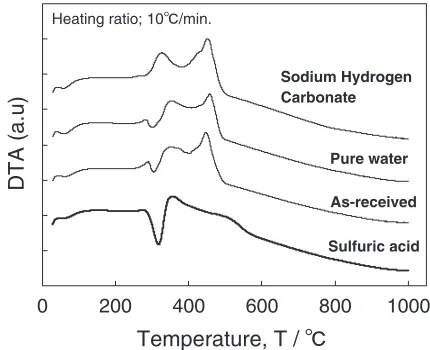
To evaluate the effect of leaching on hydrolysis of organics contained in rice husks, DTA was carried out on husks washed in solutions with different pH (power of hydrogen) value; Sodium hydrogen carbonate (pH¼8:1), pure water (pH¼7), and sulfuric acid (pH¼3:8) were employed. As shown in Fig. 1, when using as-received husks and those via leaching by solutions with pH of 7 and more, the double peaks of exothermic are obviously detected. The previous study reports that the first peak at lower temperature corresponds to degradation of hemi-cellulose and lignin components, and that at higher temperature is due to the thermal degradation of cellulose which has higher molecular mass than the above organics.25) When using the sodium
hydrogen carbonates leaching treatment on rice husks, DTA profile shows no difference with that in using as-received husks, that is, no available effect of this leaching on the removal or resolution of organics. On the other hand, DTA curve of rice husks via the sulfuric acid leaching treatment reveals a large mount of endothermic heat at 543–623 K, and a large mass reduction is detected.
Figure 2 shows DTA profiles of rice husks leached by hot water (a) and H2SO4 solution with 2% (b) and 5% (c)
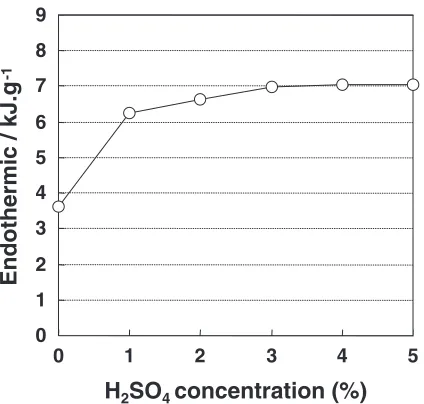
concentration at 317 K for 900 s. Figure 3 indicates the dependence of an endothermic heat on H2SO4concentration
used in the leaching treatment. As shown in Fig. 2(a), when using hot water leaching, a small endothermic heat is detected at 574–620 K. Rice husks leached by H2SO4
solution, shown in (b) and (c), also reveal the endothermic at the same temperature. Furthermore, as shown in Fig. 3, only 1% H2SO4 solution leaching treatment causes a
significant increase of the endothermic heat, compared to hot water washed specimens. Its value gradually increases with increase in H2SO4concentration, and saturates when the
concentration is over 3%. According to the previous researches by using 10–20% concentration acid
solu-Heating ratio; 10 /min.
Sulfuric acid As-received Pure water Sodium Hydrogen Carbonate
DTA (a.u)
0 200 400 600 800 1000
Temperature, T /
[image:2.595.318.533.72.247.2]tions,24,25)the endothermic accompanied with a remarkably large mass loss corresponds to the pyrolysis of cellulose components in rice husks during combustion. This is due to the increase of exposed areas of organics caused by the small rice husk fragments broken down by strong acid leaching. In
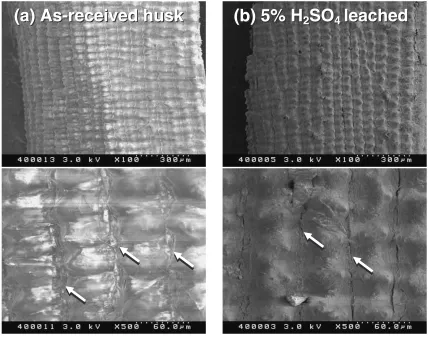
the present study, however, no morphology change of rice husks after the acid leaching by H2SO4 solution with 5%
concentration is shown in SEM observation result in Fig. 4. The appearance of acid washed rice husks is similar to the cone type surface with scale structures, and almost same as as-received raw materials. A few additives on the surface of husks are removed by 5% H2SO4 leaching. However, a
fragmentation of husks into small pieces after acid leaching, as mentioned in the previous work,26)is not observed, that is, the exposed surface areas do not increase significantly. Accordingly, it is concluded that the organics resolution mechanism of rice husks leached by a low concentration H2SO4solution is quite different from that in using a higher
concentration acid leaching process causing the fragmenta-tion of husks as menfragmenta-tioned above.
GCMS analysis on rice husks after H2SO4 leaching
[image:3.595.101.501.69.423.2]treatment with 1% and 5% concentration was carried out at 673 K for 900 s, compared to raw materials without any leaching. The pre-treating temperature of each specimen is decided as 673 K, because a large endothermic is detected at the same temperature range of DTA profile in Fig. 2. Figure 5 reveals GCMS results on each rice husk, where (a) and (d) are via the acid leaching by H2SO4 solution 5%
and 1% concentration, respectively, and (c) is as-received raw materials without any leaching. The n value of each figure corresponds to the total intensity of detected ions spectra in GCMS analysis. As shown in (a) and (b), there is -250
-200 -150 -100 -50
0 50 100 150
200 400 600 800 1000 1200 Temperature, T / K
DT
A /
V
(a)
-250 -200 -150 -100 -50
0 50 100 150
200 400 600 800 1000 1200 Temperature, T / K
DT
A /
V
(b)
-250 -200 -150 -100 -50
0 50 100
200 400 600 800 1000 1200 Temperature, T / K
DT
A /
V
(c)
Fig. 2 DTA profiles of raw rice husks (a), and as-acid leached ones by H2SO4solution of 2% (b) and 5% (c).
0 1 2 3 4 5 6 7 8 9
0 1 2 3 4 5
Endothermic / kJ.g
-1
H
2SO
4concentration (%)
[image:3.595.308.495.75.238.2] [image:3.595.65.277.473.675.2]no significant difference of them, and both reveal a remarkably large peak at retention time of 7.5 min. Spectrum analysis indicates the peak is due to the occurrence of levoglucosan composed of glucose units. It is also detected in the rice husks after the other acids leaching treatment by HCl or HNO3 solutions in our present study. On the other hand,
such a spectrum peak is, however, not observed in using raw materials as shown in Fig. 5(c). In comparing spectra of these materials, they are not significantly different except for the above peak corresponding to levoglucosan components, and eachnvalue is almost same. It means that H2SO4 leaching
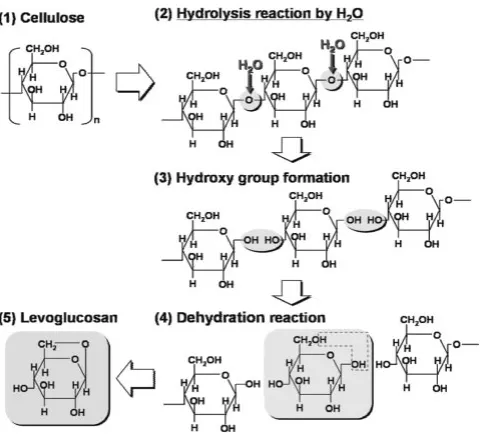
treatment causes the chemically structural change of cellu-lose to levoglucosan only, and has no effect on the other reactions of any components contained in each rice husk. Figure 6 illustrates the molecule structure change of cellu-lose to levoglucosan units via the hydrolysis and dehydration reaction. By soaking rice husk into H2SO4 solution, the
hydrolysis reaction occurs, and cellulose, (C6H10O5)n is
accompanied with H2O to form a monosaccharide of glucose,
C6H12O6with hydroxy groups.27)That is, the polysaccharide
of cellulose, not possessing considerable bonding property, has an easy cleavage of a chemical entity into two parts of the monosaccharide by the action of water. During heating at elevated temperature, the dehydration, which is one of condensation reactions, is easily taken place via a reaction between OH and H, and levoglucosan is formed. Therefore, the formation of levoglucosan is accompanied with an endothermic heat due to its dehydration reaction. In
compar-ing the spectrum quantity of levoglucosan peak shown in Fig. 5(a) and (b), that in 5% concentration H2SO4leaching is
a little larger than that in 1% solution. It means 5% acid solution is more effective to accelerate the hydrolysis of cellulose, and corresponds to the difference in the endother-mic heat of them in Fig. 3. Accordingly, the comparison of this endothermic heat is available to quantitatively evaluate the effect of the acid leaching conditions on the hydrolysis of organics in rice husks. It is also useful to optimize the leaching parameters such as concentration and temperature of acid solutions.
On the other hand, as previous studies pointed, the metallic impurities, in particular alkali metal elements of K and Na, contained in rice husks react with silica, so that the crystallization of silica occurs after combustion of rice husks.17,18,20)Therefore, the removal of these impurities by
acid leaching is necessary to maintain amorphous structures of silica ashes. They have already clarified the effect of high concentration of strong acid leaching on their removal, for example 515% of HCl, HNO3, and H2SO4solutions. In this
study, the relationship between the impurity contents and concentration of dilute H2SO4 solution is investigated in
detail. Since the main impurity of raw husks is Ca, the content of Ca and alkali metal of K and Na is quantitatively analyzed by XRF analysis in using ashes after burning each acid-leached husk at 1073 K for 1.8 ks in air. As shown in Fig. 7, Na content gradually decreases with increase in the acid concentration. That of K and Ca is, however, drastically
(b) 5% H
2
SO
4
leached
(b) 5% H
2
SO
4
leached
(a) As-received husk
(a) As-received husk
[image:4.595.83.512.72.409.2]reduced by only 1% acid leaching, and after that, it also gradually decreases. XRF and ICP results also indicate that SiO2purity and carbon content of ashes is 99.3% and 0.04%,
respectively when using 5% H2SO4 leaching treatment.
Accordingly, very dilute H2SO4 solution is effective to
accelerate not only the hydrolysis of organics, but also the removal of metallic impurities of rice husks to purify silica ash.
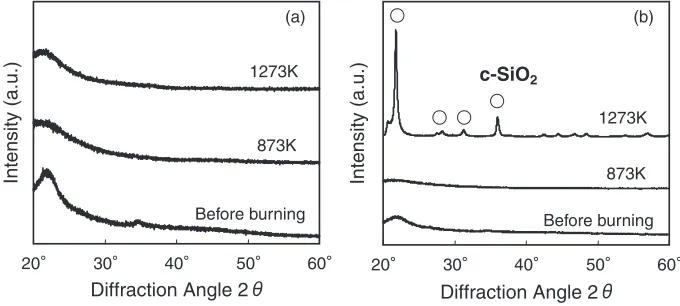
From a viewpoint of a safety in handling silica particles, the optimization of burning temperature of rice husks is necessary to hinder their crystallization and prepare high-purity silica ashes with amorphous structures. The crystalline structure of SiO2 originated in rice husks depends on the
thermal history in burning them. Figure 8 shows XRD profiles of rice husk ashes after burned at different temper-ature in air, when employing (a) rice husks via 5% H2SO4
leaching and (b) as-received ones. The former consists of SiO2with completely amorphous structures, not any
crystal-line ones, in burning at 1273 K or less. In the case of using as-received raw materials, the crystallization transformation to cristobalite, shown by ‘‘c-SiO2’’ in Fig. 8(b), occurs by
1273 K combustion, and both of amorphous and crystalline structures silica ashes are obtained. This is because of the removal of alkali metals as mentioned in Fig. 7, which hinders a eutectic reaction with silica to cause its liquid phase. This result corresponds well to those in the previous reports,28–30)showing that crystallization of silica to cristo-balite or tridymite when burning over 1127 K.
4. Conclusions
The recycling process of rice husk, which is one of major agricultural disposals, to produce high purity amorphous silica has been developed. In using the acid leaching by dilute H2SO4 solution of 15% concentration, GCMS results
indicate that the endothermic heat at about 600 K in DTA profile is due to a molecule structural changes from cellulose to levoglucosan via glucose by hydrolysis and dehydration reactions, not morphology changes of rice husks accompa-nied with small fragments by high concentration acid resolution as mentioned in previous studies. The low concentration less than 3% is also enough to remove metallic impurities of rice husks, in particular alkali metal elements,
0 0 1 2 3 4
(*107)
Abundance / a.u
5 10 15
Retention time, t / min. (a)
0 0 1 2 3 4
(*107)
Abundance / a.u
5 10 15
Retention time, t / min. (b)
0 5 10 15
Retention time, t / min. 0
1 2 3 4
(*107)
Abundance / a.u
(c)
n=4.8*1010
n=4.9*1010
n=5.0*1010
Fig. 5 GCMS results on rice husk after H2SO4leaching of 5% (a), 1% (b), and as-received one (b).
Fig. 6 Molecule structural changes from cellulose to levoglucosan via hydrolysis and dehydration reactions in employing acid leached rice husks.
0 0.2 0.4 0.6 0.8 1 1.2
0 2 4
H2SO4 concentration (%)
Content (mass %)
Na2O
K2O
CaO
1 3 5
[image:5.595.321.532.73.261.2] [image:5.595.65.279.76.412.2] [image:5.595.49.289.463.682.2]for the purification of silica ash. As a result of their removal, the crystallization temperature of original amorphous silica increases, and the formation of cristobalites after burning rice husks at 1273 K is hindered. High purity silica ashes with 99.3% and more are obtained when employing a dilute acid leaching and high temperature combustion.
Acknowledgements
This project is supported by ‘‘Research & Technology Development on Waste Management Research Grant’’, Ministry of the Environment. Authors also thank to Mr. H. Oginuma, a research assistant of JWRI, for his helps in experiments.
REFERENCES
1) A. Karera, S. Nargis, S. Patel and M. Patel: Journal of Scientific and Industrial Research45(1986) 441–448.
2) V. M. H. Govinda Rao: Journal of Scientific and Industrial Research39 (1980) 495–501.
3) B. D. Park, S. G. Wi, K. H. Lee, A. P. Singh, T. H. Yoon and Y. S. Kim: Biomass and Bioenergy25(2003) 319–327.
4) P. C. Kapur: Powder Technology44(1985) 63–67.
5) T. C. Luan and T. C. Chou: Industrial & Engineering Chemistry Research29(1990) 1922–1927.
6) M. Nehdi, J. D. Quette and A. E. Damatty: Cement and Concrete Research33(2003) 1203–1210.
7) R. V. Krishnarao and M. M. Godkhindi: Ceramics International18 (1992) 185–191.
8) M. K. Naskar and M. Chatterjee: Journal of the European Ceramic Society24(2004) 3499–3508.
9) L. Sun and K. Gong: Industrial & Engineering Chemistry Research40 (2001) 5861–5877.
10) E. Mizuki, S. Okumura, H. Saito and S. Murao: Bioresource
Technology44(1993) 47–51.
11) M. Ishimaru, R. M. Dickerson and K. E. Sickafus: Nuclear Instruments and Methods in Physics Research B390(2000) 166–167.
12) M. F. de Souza, P. S. Batista, I. Regiani, J. B. L. Liborio and D. P. F. De Souza: Materials Research3(2000) 25–30.
13) L. M. Russell, L. F. Johnson, D. P. H. Hasselma and R. Ruh: Journal of the American Ceramic Society70(1987) c-226–229.
14) K. Kondoh, H. Oginuma, J. Umeda and T. Umeda: Materials Transactions46(2005) 2586–2591.
15) W. D. Kingery, H. K. Bowen and D. R. Uhlmann: Introduction to Ceramics, 2nd ed, (New York John Wiley & Sons, Ltd, 1976), 84. 16) IARC Monographs on the Evaluation of Carcinogenic Risks to Humans
58(1993) 41–61.
17) Concha Real, Maria D. Alcala and Jose M. Criado: Journal of the American Ceramic Society79(1996) 2012–2016.
18) A. M. Venezia and V. La Parola: Journal of Solid State Chemistry161 (2001) 373–378.
19) L. P. Hunt, J. P. Dismukes and J. A. Amick: Journal of the Electrochemical Society, Solid-State Science and Technology: 131 (1984) 1683–1686.
20) A. Chakraverty, P. Mishra and H. D. Banerjee: Journal of Materials Science23(1988) 21–24.
21) U. Kalapathy, A. Proctor and J. Shultz: Bioresource Technology72 (2000) 257–262.
22) N. Yalci and V. Sevinc: Ceramics International27(2001) 219–224. 23) R. Conradt, P. Pimlhaokham and U. L. Adisorn: Journal of
Non-Crystalline Solids145(1992) 75–79.
24) M. Patel, A. Karera and P. Prasanna: Journal of Materials Science22 (1987) 2457–2464.
25) I. A. Rahman, J. Ismail and H. Osman: Journal of Materials Chemistry: 7(1997) 1505–1509.
26) EL. S. Mohamed and L. H. Mohammad: Carbohydrate Polymers67 (2007) 1–10.
27) F. Shafizadeh: Journal of Analytical and Applied Pyrolysis3(1982) 283–305.
28) Y. Nakata, M. Suzuki, T. Okutani, M. Kikuchi and T. Akiyama: Journal of the Ceramic Society of Japan97(1989) 842–849.
29) C. Real, M. C. Alcala and J. M. Criado: Journal of the American Ceramic Society:79(1996) 2012–2016.
30) Y. Shinohara and N. Kohyama: Industrial Health42(2004) 277–285.
20 30 40 50 60
Diffraction Angle 2
Intensity (a.u.)
873K 1273K
Before burning (a)
20 30 40 50 60
Diffraction Angle 2
Intensity (a.u.) 873K
1273K
Before burning c-SiO2
(b)
[image:6.595.127.467.73.226.2]