A Community-Wide
Restorative Practices Programme:
Implementation Guide
CHILDHOOD DEVELOPMENT INITIATIVE
Claire Casey
How to cite this report
Any citation of this report should use the following reference:
Childhood Development Initiative (2014) A Community-wide Restorative Practices Programme: Implementation Guide. Dublin: Childhood Development Initiative (CDI).
Copyright © Childhood Development Initiative, 2014 Tallaght West Childhood Development Initiative Ltd. St. Mark’s Family and Youth Centre
Cookstown Lane Fettercairn Tallaght Dublin 24
Tel: +353 (0)1 494 0030 Fax: +353 (0)1 462 7329 E-mail: [email protected] Web: www.twcdi.ie
Published by Childhood Development Initiative, Dublin ISBN 978-0-9928763-1-9
Disclaimer
While every care is taken to ensure that this Guide is as up-to-date and accurate as possible, no responsibility can be taken by the Childhood Development Initiative for any errors or omissions contained herein. Furthermore, responsibility for any loss, damage or distress resulting from adherence to any advice, suggestions or recommendations made available through this Guide, howsoever caused, is equally disclaimed by the Childhood Development Initiative m.
All text, images, graphics, and other materials in this Guide are subject to the copyright and other intellectual property rights of the Childhood Development Initiative, unless otherwise stated.
You are free to share, copy, distribute and transmit the content of this work under the following conditions:
• Attribution: you must attribute to the work by citing the author and publisher, but not in a manner that suggests that they endorse you or your use of the work;
• Non-commercial: you may not use this work for commercial purposes; and • No derivative works: you may not alter, transform or build upon this work.
INTRODUCTION 1 The Childhood Development Initiative (CDI) 1 CDI’s Restorative Practices Programme 2 Introduction to Implementation 3 How to use this Implementation Guide 3 Introduction to Logic Modelling 4
SECTION 1: Phase 1:
EXPLORING AND PREPARING 8
1.1 Introduction 8
1.2 An Overview of Restorative Practices 8 1.2.1 Benefits of the RP approach 9 1.2.2 Evidence of RP as best practice 9 1.3 Developing an RP Programme Logic Model 10
1.4 Community Readiness 10
1.5 Identifying Key Stakeholders 13 1.5.1 Importance of Leaders 14 1.6 Consulting with Stakeholders 14 1.7 Champions of RP Programme 15
1.8 Achieving Buy-in 15
1.9 Checklist and Next Steps 15
SECTION 2: Phase 2:
PLANNING AND RESOURCING 17
2.1 Introduction 17
2.2 Gathering Resources 17
2.3 Establishing a Steering Committee 18 2.4 Memorandum of Understanding 18
2.5 Action Planning 19
2.6 Checklist and Next Steps 21
SECTION 3: Phase 3:
IMPLEMENTING AND OPERATIONALISING 23
3.1 Introduction 23
3.2 Delivering Restorative Practice Training 23 3.2.1 RP Toolkit and Training 25 3.2.2 Training Programme Design 26 3.3 Training Children and Young People 26
3.4 Training of Trainers 27
3.5 Promotional Materials 27
3.6 Resource Materials 27
3.7 Communities of Practice 28 3.8 Evaluation Mechanisms 30
3.9 Monitoring Progress 30
3.10 Checklist and Next Steps 31
SECTION 4: Phase 4:
BUSINESS AS USUAL 33
4.1 Introduction 33
4.2 Quality Assurance 33
4.3 Reflective Practice 33
4.4 Bedding RP in as a Way of Working 34 4.4.1 Bedding RP into Groups or Organisations 34 4.4.2 Bedding RP into the Community 34 4.5 Ongoing Review and Development 35 4.6 Checklist and Next Steps 35
SECTION 5: Some Things for Consideration 37
References 38
Appendix 1: CDI’s Restorative Practice
Programme – Overview and Key Findings 40 Impacts of RP in Tallaght 44
Key Findings 44
Feedback 45
Appendix 2: Sample RP Consultation Survey 46 Appendix 3: Developing a Memorandum of
Understanding (MoU) Checklist 48 Appendix 4: Terms of Reference for a
Restorative Practices Team 50 Appendix 5: Training of RP Trainers
Application Form 51
Appendix 6: Examples of Evaluation Questions 53 Appendix 7: Sample RP Fidelity Checklists 55 Appendix 8: Feedback Form Template 57
List of Tables
Table 1: Logic model for a Community-Wide
Restorative Practices (RP) Programme 6 Table 2: Community Readiness Checklist 11 Table 3: Phase 1 – Exploring and Preparing Checklist 16 Table 4: RP Action Plan Template 20 Table 5: Phase 2 – Planning and Resourcing Checklist 22 Table 6: Transfer of Skills or Knowledge from
Professional Development Training 29 Table 7: Phase 3 – Implementing and
Operationalising Checklist 32 Table 8: Phase 4 – Business as Usual Checklist 36
List of Figures
Booster training: Follow-up training for practitioners subsequent to, and complementary of, initial training.
Evidence-based programme: Programmes that are based on research and are proven to work.
Evidence-informed practice: Use of the best available research and practice knowledge to guide programme design and implementation.
Fidelity: The degree to which a programme is delivered compared to the essential elements of the original programme.
Manualised: Service delivery is guided by a manual. The manual should contain clearly defined outcomes to be achieved, clear target criteria, a strong logic model and well-defined service components.
Quality: The standard of something as measured against other things of a similar kind.
ABC Area-Based Childhood Programme AP The Atlantic Philanthropies CDI Childhood Development Initiative CES Centre for Effective Services COP Community of Practice
DCYA Department of Children and Youth Affairs FETAC Further Education and Training Awards Council FRESH Fair, Respectful, Engaging, Safe and Honest HCRP Hull Centre for Restorative Practice
HR Human Resources IG Implementation Guide
IIRP International Institute for Restorative Practices MoU Memorandum of Understanding
PEIP Prevention and Early Intervention Programme PLC Professional Learning Community
QQI Quality and Qualifications Ireland RP Restorative Practices
Acknowledgements
CDI wish to sincerely thank Joyce Cahill who managed our Restorative Practice (RP) Programme for its first three years and drafted much of this Guide. Thanks also to Joan Byrne (City Wide Drugs Crisis Campaign), Niamh Crudden (Ballyfermot & Chapelizod Partnership) and Gwen Doyle (City of Dublin Youth Service Board) for their assistance and feedback on the document.
Much of the material in this Guide has been gleaned from our learning in partnership with two key groups of people. We are sincerely grateful to the members of the FRESH (Fair, Respectful, Engaging, Safe, Honest) team who trained as RP Trainers with us, namely: Michelle Costello, Jean Courtney, Niamh Fowler, Jean Gilmore, Stephen Hunter, Linda Leavy, John Madigan, Margaret McGarrigle, Catherine McIntyre, Ollwyn Moran, Sharone Samuels, Tony Stewart, Michelle Stowe, Pat Teehan and Cornelius Young. We are also very grateful for the support of the RP Management Committee – Kieran O’Dwyer (Chair), Eithne Coyne, Peter Keely, John Laurens, Ronan Lawlor, Sarah O’Gorman, Aine O’Keeffe, Valerie Scully, Ruth Shortall and Liz Waters. CDI simply could not have done it without you, so our heartfelt thanks go to one and all.
CDI gladly acknowledge and thank the many, many children, young people and adults of Tallaght West who are using restorative practices in their lives and work. You know who you are! The Restorative Practices Programme would not exist without the support of so many innovative leaders living and/or working in Tallaght West who are actively building a strong, safe and healthy community for all.
Finally, this Guide would not have been possible without the financial support of the Department of Children and Youth Affairs and The Atlantic Philanthropies. Their focus on prevention and early intervention to support children and families has provided a solid policy context within which CDI has been able to develop its work. We acknowledge and thank them for both the resources provided and their support for using evidence-informed approaches to improving outcomes for children and families.
Introduction
This Implementation Guide describes the steps involved in establishing a community-wide Restorative Practices (RP) Programme. This is not a manual for delivering RP training; rather, this Guide will explain the recommended steps for setting up and implementing an RP programme aimed at establishing a cohesive, community-wide approach, and what is required in terms of ongoing support to ensure both effective service delivery and ongoing sustainability of the programme. (Information about 1.1 training provision in Ireland is available from www.restorativepracticesireland.ie).
The Guide is presented in six sections, with accompanying appendices, as follows:
• This Introduction provides an overview of the Childhood Development Initiative (CDI) and its Restorative Practices Programme, and then goes on to discuss implementation, how to use this Guide and logic modelling.
• Section 1 provides an overview of Restorative Practices (RP), the benefits that RP have been shown to accrue for communities that use these practices and a brief outline of evidence of RP as a best practice approach in communities. It goes on to outline the steps to be taken in
exploring and preparing for the introduction of a community-wide RP programme by discussing community readiness, the identification of key stakeholders, the importance of leaders, consulting with stakeholders, identifying RP champions in the community and achieving buy-in for a community-wide RP programme.
• Section 2 looks at what is involved in planning and resourcing a community-wide RP
programme, including gathering resources,
a Memorandum of Understanding and putting an effective plan of action in place.
• Section 3 is about implementing and
operationalising your RP programme. It discusses the delivery of RP training, supporting the training of local RP trainers, developing local promotional and resource materials, and the importance of ongoing quality assurance processes, Communities of Practice and robust evaluation mechanisms.
• Section 4 concerns ‘business as usual’ and discusses reflective practice and its role in bedding down RP as a way of working, methods of promoting RP in the community, ongoing monitoring and development of the RP programme, and what it takes to become a restorative organisation and a restorative community.
• Section 5 concludes the Guide with a list of things to consider to keep your RP programme running smoothly, and to maximise its’ sustainability.
The Childhood Development
Initiative (CDI)
CDI is funded under the Government’s Area-Based Childhood (ABC) Programme, which builds on the learning to date from the Prevention and Early Intervention Programmes (PEIP). The ABC aims to break the cycle of child poverty in areas where it is most deeply entrenched and to improve the outcomes for children and young people (DCYA, 2013).
of 23 concerned individuals and organisations in the community, who had a vision of a better place for children. Through innovative partnerships, they brought together the science of evidence-based practice and rigorous evaluation, with the spirit of an approach focused on the identified needs of children and families.
CDI was initially established through a partnership between the Department of Children and Youth Affairs (DCYA) and The Atlantic Philanthropies (AP) under the Prevention and Early Intervention Programme (PEIP), which was set up with the objective of testing innovative ways of delivering services and early interventions for children and young people, including the wider family and community settings.
CDI designed, delivered and evaluated a suite of programmes across a spectrum of local needs on language, literacy, health, early years, conflict management and community safety. All CDI programmes are evidence-informed and manualised, and are delivered through existing structures and services. This Implementation Guide draws on the independent evaluations of CDI’s programmes (available at www.twcdi.ie/resources-information-centre/evaluation-reports) and lengthy experience in supporting the delivery of high-quality evidence-informed services.
CDI’s Restorative Practices
Programme
The aim of restorative practices is to build strong, happy communities and to manage conflict or tensions by actively developing good relationships and easily resolving conflict in a healthy manner. In 2010, CDI identified the work of the Hull Centre for Restorative Practices (HCRP) (see www.hullcentreforrestorativepractice.co.uk) as being relevant to the Tallaght West context and offering a model that could meet locally identified needs. An approach that
supports everyone to build healthy relationships, to look at where we are accountable and to take responsibility for our actions was regarded as an appropriate fit with the dynamics and relationships within Tallaght West, and the HCRP solution-focused model offered an evidenced, outcomes-based and sustainable intervention.
CDI’s Restorative Practices Programme got underway in mid-2010 when CDI established an RP Programme Management Committee to oversee the roll out of training, the development of supports and the independent evaluation of the work. Training was delivered by the UK Office of the International Institute for Restorative Practices (see http://uk.iirp.edu) on a monthly basis and targeted all of the agencies with responsibility for children and young people (including schools, Early Years services, youth services, education welfare staff, local authority staff, probation services, community centres, community Gardaí, adult education services), as well as parents and young people themselves. Between July 2010 and September 2013, 971 people from Tallaght West and other communities received training (including 109 young people, aged 14-20) and 14 people living and/or working in Tallaght West were accredited as RP trainers as part of building capacity to sustain the programme in Tallaght and to develop RP approaches in Ireland as a whole.
relation to resolving conflict. This result has had obvious follow-on benefits for the work that is being done for and with children and families in Tallaght West, the details of which are discussed in more detail in Appendix 1.
Introduction to implementation
Implementation refers to the process of carrying out a plan and focuses on the ‘how’ rather than the ‘what’ of the programme in question (Burke et al, 2012). It relates to all aspects of putting a programme into operation and bridges the gap between theory or training and using practice or an approach at an individual or organisational level.An Implementation Guide sets out the ‘how to’ of getting programme delivery underway. It supports the set-up phases and guides the user through a step-by-step process to bring the programme to the ‘business as usual’ phase. Implementation is seen as crucial in the delivery of a programme since it can have a huge impact on whether or not the programme achieves its intended outcomes. This Implementation Guide draws on work done by the Centre for Effective Services (CES) in that the implementation phases described in the following sections are adopted from An Introductory Guide to Implementation: Terms, Concepts and Frameworks (Burke et al, 2012).
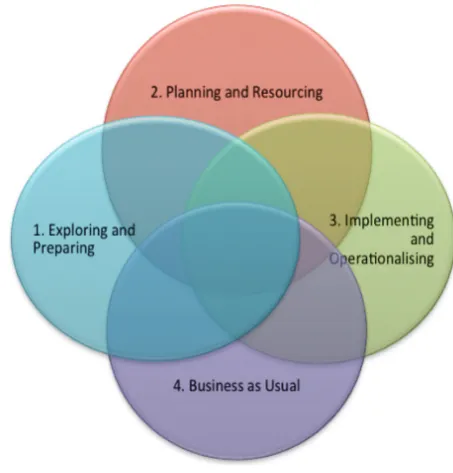
[image:9.595.308.535.76.313.2]This Guide is presented in four phases, focusing on (1) start-up of programme (exploring and preparing); (2) planning and resourcing; (3) implementing and operationalising; and (4) sustaining the programme (‘business as usual’). These phases operate in a parallel rather than linear fashion, and so the community or organisation may move back and forth between phases. Each of these phases, as they relate to a community-wide RP programme, is described in detail in the following sections of the Guide.
Figure 1: The Four Phases of Implementation
Source: Burke et al (2012)
How to use this Implementation
Guide
The information contained in this Implementation Guide is based on CDI’s experience of establishing a Restorative Practices Programme within a community, where community safety was identified as a priority for development (see Appendix 1). Working with various stakeholders to make the programme a success, CDI drew on international research and best practice in relation to the delivery of evidence-based programmes.
possible service is developed and delivered. Each phase of the implementation process concludes with a checklist to track progress as well as to act as a way of identifying any areas in need of further support.
While the work of implementing an RP programme is described in discrete phases, these may merge and be revisited a number of times, whilst some aspects of implementation will be ongoing throughout. It is therefore recommended to read the entire Guide at the outset of the programme and to refer back to the relevant sections for detailed consideration as implementation progresses.
Introduction to Logic Modelling
Logic modelling is a relatively new term for child and family services, and is a central element of developing and implementing evidence-based programmes. Many organisations, having experienced the benefits that come with the clarity and focus of a logic model, have now integrated logic modelling into their management processes. Some organisations have been using similar methods, such as developing a theory of change or even a business plan, and processes that include identifying specific objectives, activities to achieve them and the rationale for the activities. All of these are very similar to the logic model approach.A logic model is defined as a framework or tool that may be used for programme planning, implementation and evaluation (Alter and Egan, 1997; Julian, 1997; McLaughlin and Jordan, 1999). It links the evidence (i.e. what research and best practice tells us about a programme – issues/ anticipated outcomes), inputs (i.e. the resources available to and required by the programme) and activities (i.e. what you deliver) to the anticipated outputs and outcomes
(Hernandez, 2000; McLaughlin and Jordan, 1999). In other
words, the logic model process provides the rationale for delivering specific programme activities (i.e. that X will lead to Z if Y is implemented).
Figure 2: Logic Model Elements
Source: Murphy et al (2011)
The clear description of a programme’s goals, tasks or activities, and anticipated outcomes provides an opportunity to involve programme managers, staff and other key stakeholders in the identification of the necessary resources (i.e. what do we need?), the assignment of responsibilities (i.e. who is responsible for what?) and the clarification of relationships between specific activities and expected outcomes (i.e. will implementing these activities produce the desired results?) (Millar et al, 2001). However, it is important to note that an examination of existing practice in terms of, for example, how resources are allocated, the way in which activities are implemented or whether anticipated outcomes are achieved may encounter resistance at an organisational or individual level (Kaplan et al, 2004) and so we need to be prepared for this.
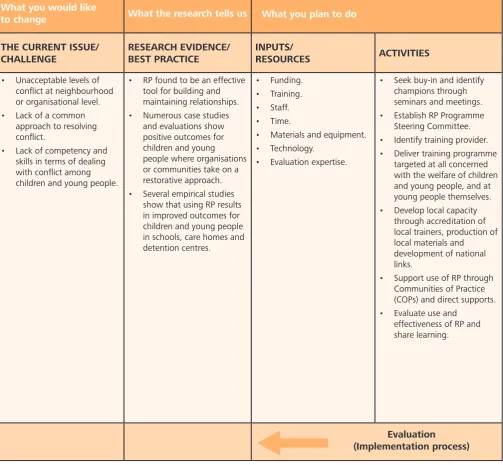
Table 1 provides a detailed example of a logic model for a community-wide restorative practices (RP) programme.
The current situation i.e. the situation
that requires changing
Research evidence i.e. what the
research or best practice
tells us
Inputs i.e. the resources necessary to
bring about the change
Activities i.e. the activities expected to occur or be delivered
Outputs i.e. what is expected to occur or be produced
Outcomes i.e. changes in
attitudes, behaviour, knowledge
Table 1: Logic Model for a Community-Wide Restorative Practices (RP) Programme
What you would like
to change What the research tells us
THE CURRENT ISSUE/ CHALLENGE
RESEARCH EVIDENCE/ BEST PRACTICE
INPUTS/
RESOURCES ACTIVITIES
• Unacceptable levels of conflict at neighbourhood or organisational level. • Lack of a common
approach to resolving conflict.
• Lack of competency and skills in terms of dealing with conflict among children and young people.
• RP found to be an effective tool for building and maintaining relationships. • Numerous case studies
and evaluations show positive outcomes for children and young people where organisations or communities take on a restorative approach. • Several empirical studies
show that using RP results in improved outcomes for children and young people in schools, care homes and detention centres.
• Funding. • Training. • Staff. • Time.
• Materials and equipment. • Technology.
• Evaluation expertise.
• Seek buy-in and identify champions through seminars and meetings. • Establish RP Programme
Steering Committee. • Identify training provider. • Deliver training programme
targeted at all concerned with the welfare of children and young people, and at young people themselves. • Develop local capacity
through accreditation of local trainers, production of local materials and development of national links.
• Support use of RP through Communities of Practice (COPs) and direct supports. • Evaluate use and
effectiveness of RP and share learning.
What you plan to do
OUTPUTS
SHORT-TERM OUTCOMES Years 1 – 2
INTERMEDIATE OUTCOMES Years 3 – 4
LONG-TERM OUTCOMES Years 5+
• X seminars for managers.
• X seminars for key stakeholder groups. • X meetings with
potential champions. • Steering Committee established.
• X number of staff working with children and young people receive training. • X number of parents
receive training. • X number of young
people receive training. • X number of local
trainers accredited. • X COPs.
• DVDs, publicity materials, evaluation report, policy papers. • X RP champions in the community.
• X number of restorative groups/organisations
established in the community.
• Increased confidence among participating parents in managing their children’s behaviour and being solution-focused. • Improved capacity among
participating children and young people for dealing with conflict and managing problems.
• Buy-in to RP programme across a range of stakeholders. • Key organisations
committed to an integrated approach.
• Improved staff morale within participating organisations.
• Improved interagency collaboration among front- line staff.
• Improved relationships between service providers and residents.
• Increased confidence of front-line staff in dealing with conflict situations. • Increase in use of a
common approach and language across sectors and disciplines.
• Increased reporting of anti- social behaviour/crime. • Increased satisfactory
resolution of
neighbourhood disputes. • The community is widely
recognised as a restorative one.
• RP is ‘business as usual’ in the community.
• All children and young people in the community are dealt with restoratively by the adults in their lives. • RP training modules
are included in professional development training courses.
• Relevant professional associations and support organisations recognise RP as a core skill for the continuing professional development of people with responsibility for children and young people. • RP comprises an integral
element of training for all those working with children, young people and communities.
SECTION 1:
Phase 1: EXPLORING AND
PREPARING
1.1 Introduction
‘Exploring and preparing’ refers to the process of identifying local needs and then finding a programme that addresses these needs. Having identified RP as an appropriate response, developing a logic model for the programme will be helpful since it links the evidence, literature, inputs and activities to the intended outcomes and outputs for the programme, and this will be a first step in establishing what an RP programme in your community or organisation will aim to do.
The first phase of implementation will focus on how to begin developing the RP programme, once it has been decided that this is the appropriate mechanism by which to respond to local needs. Reading all of this Implementation Guide is an important part of Phase 1 since the information contained in it will assist you in exploring what restorative practices can offer individuals, organisations and communities in terms of improved outcomes. When starting up a new RP programme, the initial steps will include preparing the ground, identifying the key people to consult with and developing promotional materials. Consultation with key stakeholders is important at this stage because it will promote buy-in and help to identify programme champions who can, in turn, support and drive the implementation of the programme (Burke et al, 2012).
By the end of Phase 1, you will have:
• developed an understanding of restorative practices;
• recognised the benefits of taking a RP approach and the evidence of RP as a model of best practice;
• developed a logic model for an RP programme; • completed your Community Readiness analysis; • identified the key stakeholders and potential
programme leaders specific to your community, organisation or service;
• consulted with the key stakeholders and established their necessary buy-in to the programme;
• sourced potential champions for the RP programme.
1.2 An Overview of Restorative
Practices
Restorative practices (RP) is both a philosophy and a set of skills that have the core aim of building strong relationships and resolving conflict in a simple and emotionally healthy manner. The word ‘restorative’ comes from the word ‘restore’. Being restorative means being able to easily and effectively restore broken relationships and, more importantly, consciously prevent relationships breaking down in the first place.
framework for using those skills more consistently and, consequently, more effectively. Using the skills acquired to improve outcomes in your life or work is supported by participating in ongoing meetings called Communities of Practice (COPs), where people come together to share experiences and learning, and by taking part in booster training from time to time if a new need arises and to keep the approach fresh and focused.
1.2.1 Benefits of the RP Approach
People who are using RP as a way of working report that it makes their professional relationships easier, more enjoyable and more effective. Parents report better relationships with their children, residents report better relationships with their neighbours and young people report increased confidence and better relationships with their teachers, their families, their friends and their peers.
The use of RP has the potential to positively influence human behaviour and strengthen social capital within communities and throughout society as a whole. This has considerable implications for all aspects of our lives, including families, schools, prisons, workplaces, associations and statutory agencies, because RP can improve relationships among these constituents and develop more effective work practices.
1.2.2 Evidence of RP as Best Practice
Research carried out in Tallaght (Fives et al, 2013) found that there was a 43% reduction in overall disputes in home, schools and families through the use of restorative practices. The same report shows that 87% of those that had undertaken RP training reported being better able to manage conflict and 82% reported being better able to manage other problems within their workplace or family structure as a result of undertaking the training.Restorative techniques like mediation and conferencing have been used to solve conflicts between neighbours and within families (Gellin and Joensuu, 2011). In schools, restorative techniques have been shown to improve the attitudes of students towards learning, boost their morale, encourage them to take responsibility for their actions, improve relationships between teachers and students, enhance school culture, and improve pupils’ grades (Wearmouth et al, 2007; Gellin, 2011).
Research from the United Kingdom (Mirsky, 2009; Carlile, 2008) has demonstrated a wide range of benefits arising from the integration of restorative practice across disciplines and sectors. These have included:
• improved school attendance (primary and secondary);
• improved school attainment (primary and secondary);
• improved behaviour and attitudes among students (primary and secondary);
• reduction in the number of young people categorised as ‘Not in Education, Employment or Training’;
• improved attendance and morale among teachers and school staff (primary and secondary);
• increased stability in foster care placements and residential care;
• increased resolution of community disputes and reduction in disorder at community level;
1.3 Developing an RP Programme
Logic Model
Developing a logic model for your RP programme will be a very helpful start to the process of implementation. It acts as a framework to provide guidance through the early stages of implementation and will be useful in communicating the intentions and potential benefits of the RP programme to stakeholders. Basically, you need to think about your RP programme under the following five headings:
1. Current situation (i.e. the situation that requires changing).
2. Research evidence (i.e. what the research or best practice tells us about the situation).
3. Inputs (i.e. the resources necessary to bring about the change required).
4. Activities (i.e. the activities expected to occur or be delivered).
5. Outcomes (i.e. changes in attitudes, behaviour, knowledge and perceptions).
You will find a detailed description and example of how to develop and maintain a logic model in CDI’s Quality Services, Better Outcomes (Murphy et al, 2011), which acts as a companion to this Guide. Essentially this requires completing a template as shown in Table 1; this process should involve all key stakeholders and result in a realistic and achievable overview of the RP programme.
It is important to remember that a logic model is a live, working document and therefore should be reviewed at regular intervals and updated in line with developments. It is highly recommended that the RP Steering Committee, once established, commits to an annual review of the RP programme’s logic model.
1.4 Community Readiness
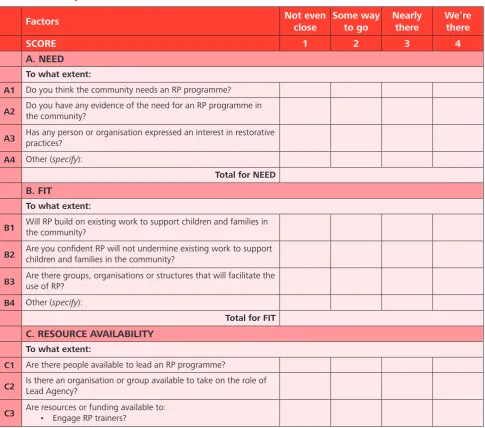
An important initial step in implementing an evidence-informed programme involves checking for community readiness by assessing the needs of the community and answering the questions ‘Are we up for this?’, and ‘Do we have what it takes?’ (CES, 2012). In order to assist you and your community to answer these questions, we recommend using an adaptation of work by the National Implementation Research Network (Blase et al, 2013). This is a method that helps communities and agencies to systematically evaluate new and existing interventions by considering six broad factors:
• need (what are the priority unmet needs in our community?);
• fit (to what extent will introducing restorative practices address unmet needs?);
• resource availability (what resources will be needed and where can they be sourced?); • evidence (what is the evidence that this is the
appropriate initiative at this time?);
• readiness for replication (what level of relevant skill and expertise is already present in the community?); • capacity to implement (what level of interest,
energy and enthusiasm is there for adopting restorative practices?).
The organisational readiness assessment tools described by Barwick (2011) have also been adapted to fit the Irish context and the Community Readiness Checklist
in championing RP in the community, identifying potential resources for implementing the programme, or gathering
Factors Not even close Some way to go Nearly there We’re there
SCORE 1 2 3 4
A. NEED
To what extent:
A1 Do you think the community needs an RP programme?
A2 Do you have any evidence of the need for an RP programme in the community?
A3 Has any person or organisation expressed an interest in restorative practices?
A4 Other (specify):
Total for NEED
B. FIT
To what extent:
B1 Will RP build on existing work to support children and families in the community?
B2 Are you confident RP will not undermine existing work to support children and families in the community?
B3 Are there groups, organisations or structures that will facilitate the use of RP?
B4 Other (specify):
Total for FIT
C. RESOURCE AVAILABILITY
To what extent:
C1 Are there people available to lead an RP programme?
C2 Is there an organisation or group available to take on the role of Lead Agency?
C3 Are resources or funding available to:• Engage RP trainers?
[image:17.595.57.543.100.528.2]the evidence of the outcomes from using RP in a similar community.
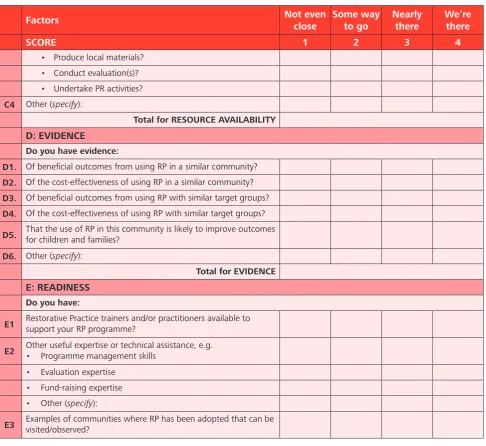
Factors Not even close Some way to go Nearly there We’re there
SCORE 1 2 3 4
• Produce local materials? • Conduct evaluation(s)? • Undertake PR activities?
C4 Other (specify):
Total for RESOURCE AVAILABILITY
D: EVIDENCE
Do you have evidence:
D1. Of beneficial outcomes from using RP in a similar community?
D2. Of the cost-effectiveness of using RP in a similar community?
D3. Of beneficial outcomes from using RP with similar target groups?
D4. Of the cost-effectiveness of using RP with similar target groups?
D5. That the use of RP in this community is likely to improve outcomes for children and families?
D6. Other (specify):
Total for EVIDENCE
E: READINESS
Do you have:
E1 Restorative Practice trainers and/or practitioners available to support your RP programme?
E2 Other useful expertise or technical assistance, e.g.• Programme management skills
• Evaluation expertise • Fund-raising expertise • Other (specify):
[image:18.595.57.544.62.508.2]Factors Not even close Some way to go Nearly there We’re there
SCORE 1 2 3 4
E4 The necessary support in the community to initiate and implement an RP programme, e.g.
• People with RP skills • Leaders
• Individual champions
• One or more ‘champion’ organisations (specify number) • Other (specify):
E5 Other (specify):
Total for READINESS
F. CAPACITY
To what extent:
F1. Are individuals and organisations in the community open to new learning and ways of working?
F2. Will the use of RP in the community be easily maintained and developed over time?
F3. Other (specify):
Total for CAPACITY
Source: Adapted from Blase et al (2013); Barwick (2011)
1.5 Identifying Key Stakeholders
Where you wish to incorporate restorative practices will determine who you need to target to get buy-in to the programme. The list below is based on developing a restorative community, for smaller or more targeted settings, the list will be different. Key stakeholders in any setting will include leaders and champions, as discussed below.When identifying stakeholders for developing a restorative community, consider the inclusion of all
organisations with a remit for supporting children and families, together with identified leaders in the community. The key stakeholder agencies and constituent groups that will need to be included are:
• schools (primary and secondary);
• out-of-school services such as Youthreach; • youth organisations and services;
[image:19.595.54.546.64.366.2]• An Garda Síochána; • probation services;
• the Local Authority (particularly the section(s) responsible for Housing, Social Work, Environment and Social Inclusion);
• Tusla, Child and Family Agency (particularly School Completion, Social, Family and Community Workers);
• Health Service Executive (particularly Public Health Nurses);
• County Childcare Committee; • County Partnership;
• Early Years Services;
• community projects and centres;
• addiction and mental health services and projects; • restorative justice or restorative practice groups
already present in the community; • parents;
• young people.
This phase of implementation will be assisted by having an understanding of the programme’s logic model, thereby having clarity about the objectives, research underpinning the approach, the outcomes you can expect and the required activities to deliver an RP programme. Understanding these will help communications with stakeholders since you will have a clear overview of what the programme sets out to do and what it takes to achieve this. In addition, knowing the findings from the independent evaluation of CDI’s RP Programme will also help to engage stakeholders in the early stages because it is a proven programme with a set of robust findings; the report by Fives et al (2013) is available at: http://www.twcdi.ie/images/uploads/general/ CDI-RP_Report_-Web.pdf.
1.5.1 Importance of Leaders
Enhancing our skills by learning restorative practices will require altering the way we normally work. Transforming organisational or community structures and cultures, such as revising our values and opinions or changing our everyday practice, is undeniably challenging. Such change requires time, commitment and self-belief on the part of those working for change, in addition to good planning and a shared vision on the part of leaders, enabling the delivery of consistent messages in relation to the transformation that is anticipated.
Leaders play a vital role in organisational and community activities and in creating a shared vision among all staff or community members. They are therefore a key determinant of success or failure in the implementation of an RP programme. Leaders have the ability to embed RP processes because once the training is delivered, they can play a huge part in further developing and bedding down RP approaches.
In the process of consulting with stakeholders and during training, leaders will stand out and are easily identifiable because they clearly ‘get it’ – i.e. they understand the potential of RP and express the enthusiasm and drive to promote its adoption and use across the community.
Once you have identified your stakeholders, the next step is to consult with them in a meaningful way, which may include:
• individual meetings;
• information sessions for groups of stakeholders; • workshops that give an overview of RP and
explore its possible benefits for the community; • circulation of an information leaflet about RP
along with a survey to establish levels of interest in taking on a restorative approach (see Appendix 2 for a Sample Consultation Survey).
When consulting with stakeholders, it is useful to think about the type of information each agency, organisation or person will need and how best to communicate this to them. Think through how to present their potential involvement in the RP programme as an opportunity for them – what the benefits to them will be and that this is a win–win proposal. In every case, it is important to be clear about what you are asking of stakeholders and what they can expect from you. For example, depending on the context, it may be very important to have one or more agencies, organisations or individuals centrally involved in planning and delivering the RP programme (e.g. schools, youth services, the Gardaí) and you will need to be especially clear about what you will be offering them and asking of them.
1.7 Champions of RP Programme
Look among your targeted stakeholders for potential RP champions who may join the Steering Committee for the RP programme. These will be people who have credibility and influence with their peers, experience of working in partnership with others and an interest in their organisation or community developing as a restorative one. For a community-wide process, it will be very helpfulto start with a few ‘champion’ groups or organisations that are interested in taking on and modelling the use of RP for other groups and agencies. These are the people and groups that you should approach first as part of your stakeholder consultation in order to seek their agreement to championing an RP approach and obtain their assistance in identifying, consulting and engaging with other key stakeholders.
1.8 Achieving Buy-in
Achieving buy-in is essentially about making others an offer that they are happy to receive and in which they can immediately see one or more benefits to them. Different stakeholders may need to be involved in the process in different ways, so it will be useful to offer a variety of options for participation that are relevant to and workable for the agency, organisation or individual. For example: Do they need to attend every meeting? How often can they attend meetings? Is it sufficient that they receive regular updates and opportunities for input by e-mail?
It will also be very helpful to agree clear lines for ongoing communication with and involvement by your stakeholders. For example: How will you follow up after the initial consultation with them? What level of involvement will they have in the ongoing management of the programme? When and how can they expect to hear back from you?
1.9 Checklist and Next Steps…
Track your progress throughout this Phase 1 by completing the Exploring and Preparing Checklist given in Table 3. This will help to ensure that the essential steps have all been considered, taken or progressed during this first phase.Table 3: Phase 1 – Exploring and Preparing Checklist
Activity Description
Has the local community/target group been identified as having a need for an RP programme?
Has the Community Readiness Checklist (Table 2) been completed?
Are you familiar with restorative practices? Are you familiar with the RP programme’s logic model?
Have the key stakeholders for the RP programme been identified?
Are you confident that the community will yield leaders?
Have leaders within key organisations and sectors been identified and approached?
Have you met the relevant stakeholders and shared information regarding RP and how they can be involved in developing a restorative community?
Have you found individual champions for the RP programme?
Have you found any agencies or organisations interested in championing the RP approach?
Have you secured the buy-in of the relevant stakeholders?
Have you secured the buy-in of a sufficient number of stakeholders to get the RP programme underway?
Implementation Status: Comments/Actions Required
Community readiness
FULL PARTIAL AT ALLNOT
Understanding of Restorative Practices and the RP programme Identifying key stakeholders Leaders
Consulting with stakeholders
Programme champions
Achieving buy-in
SECTION 2:
Phase 2: PLANNING AND
RESOURCING
2.1 Introduction
The second phase of implementation focuses on gathering the resources for the RP programme, preparing documents and ensuring that the elements needed for delivery are in place. This phase will also involve ensuring that the structures to support delivery are established. These will include establishing a Steering Committee, securing funding, confirming the budget and putting in place the necessary resources (Burke et al, 2012).
At the end of Phase 2, you will have:
• gathered together the required resources for the RP programme;
• established a Steering Committee; • developed and agreed a Memorandum of Understanding;
• agreed an Action Plan for the programme.
2.2 Gathering Resources
A community-wide RP programme will require resources. The good news is that the resources required are very probably already present in the community or easily accessible with a little effort.
One important resource to identify and agree is a ‘home’ for the RP programme in an organisation (statutory, voluntary or community) that will act as the Lead Agency
for the programme. The Lead Agency should be able to
greatly benefit from having:
• community development experience and
experience of engaging communities in initiatives similar to the RP programme;
• project management, administration,
implementation and evaluation experience and expertise;
• communication skills; • organisational skills; • facilitation skills; • IT skills;
• report-writing skills.
The responsibilities of the Lead Agency can vary over the lifetime of the RP programme and, depending on the engagement and expertise of local partners, may include:
• coordinating and supporting the programme’s Steering Committee;
• sourcing and managing funding for the programme;
• facilitating others to be involved;
• implementing elements of the RP Action Plan, such as appointing trainers, recruiting trainees, coordinating Communities of Practice and developing resources;
• managing the involvement of any external expertise/consultancy engaged to assist the RP programme;
• managing the evaluation of the RP programme; • preparing reports as needed.
be charged for; public sector grants can be applied for; and private sector company or individual donations can be sought. In addition, once a local panel of RP trainers has been established, the cash costs of the RP programme will be greatly diminished, if not eliminated.
2.3 Establishing a Steering
Committee
At the start of an RP programme, it is very useful to establish a Steering Committee to oversee its implementation and to monitor and drive progress. Membership of the Steering Committee can be determined from the stakeholder list you have developed and from the potential RP champions identified through the consultation process. Senior management from each sector can nominate the appropriate person to sit on the Steering Committee.
The ideal is to have a Steering Committee that includes members from the community and from a range of key agencies or organisations, who will be able to:
• consider the big picture (i.e. collectively possess knowledge of the community as a whole and have a common vision of what the long-term goals are);
• develop and implement the RP action plan; • monitor and evaluate current programme activities
and plans;
• be accountable for the programme’s overall work; • link what the programme is planning and doing
to developments, problems and opportunities in the wider community;
• plan and work for sustainability (i.e. that the programme will be maintained within the community, without additional resourcing, in the future).
2.4 Memorandum of
Understanding
A Memorandum of Understanding (MoU) can be very helpful as a mechanism for being explicit about the expectations of stakeholders working towards a common goal. An MoU is simply an agreement between two or more parties that expresses a clear and common understanding of the intended line of action. It is appropriate to use an MoU when a number of agencies are involved in leading the introduction of RP approaches across a community (see Appendix 3 for checklist in developing an MoU). For individual organisations or in smaller settings, it will only be necessary to develop Terms of Reference (ToR) for the work of the group steering the process (see Appendix 4 for checklist in developing a ToR).
An MoU should include the following:
• aims and objectives of the Steering Committee; • timeframes for completing activities;
• the commitment expected from each partner; • management and operational arrangements (e.g. resources);
• reporting structures;
• restorative conflict resolution mechanisms; • governance issues (e.g. reporting lines and
decision-making processes); • monitoring and evaluation;
• quality assurance procedures and mechanisms.
Steering Committee will be in a position to address these issues proactively and continue to work effectively.
2.5 Action Planning
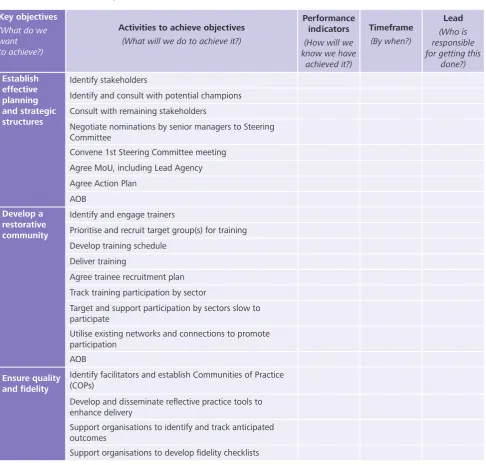
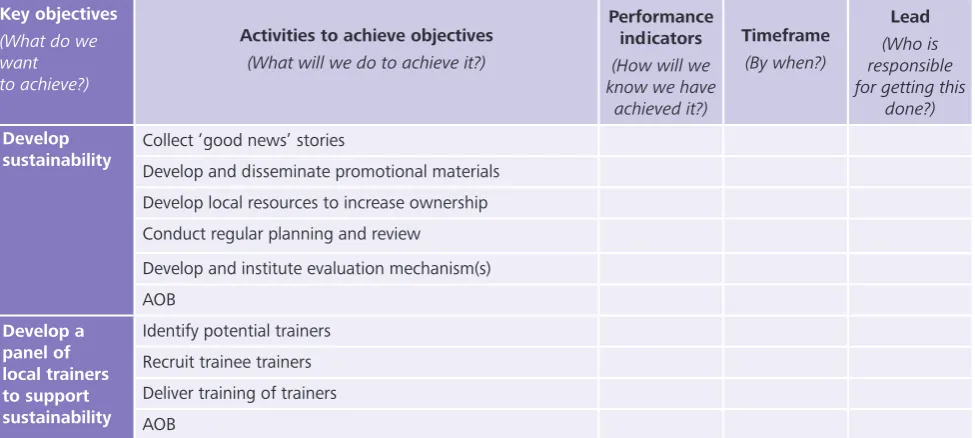
CDI’s work over the years has greatly benefitted from using a straightforward form of action planning as its general modus operandi. An action plan is simply a list that includes the activities to be undertaken, the timeframe for each activity, what output or outcome will be achieved through each activity (a performance indicator) and who will be responsible for ensuring that the activity is undertaken as planned.
There are a number of aspects of the action planning process that will be highly beneficial to the Steering Committee (indeed, to any group adopting RP as a way of working), including:
• Action planning will translate overall objectives into a series of achievable activities.
• Developing an action plan will enable everyone to be explicit about both their responsibilities for and contribution to getting the work done. • Agreeing an action plan means making concrete
decisions about what activities will happen, when they will happen and who will be responsible for making them happen.
• When the Steering Committee is meeting on a regular basis, an action plan will show regular progress in the work, which is good for maintaining motivation among members. • The action plan process will also show where
there are blocks to getting work done, enabling the committee to adjust plans appropriately. • Using an evolving action plan gives everybody in
the group the chance to both take responsibility
for getting work done and to be acknowledged for the work that they do. Again, this is a very good way of maintaining motivation in the group.
Table 4: RP Action Plan Template
Key objectives (What do we want to achieve?)
Activities to achieve objectives
(What will we do to achieve it?)
Performance indicators
(How will we know we have
achieved it?)
Timeframe
(By when?)
Lead
(Who is responsible for getting this
done?) Identify stakeholders
Identify and consult with potential champions Consult with remaining stakeholders
Negotiate nominations by senior managers to Steering Committee
Convene 1st Steering Committee meeting Agree MoU, including Lead Agency Agree Action Plan
AOB
Identify and engage trainers
Prioritise and recruit target group(s) for training Develop training schedule
Deliver training
Agree trainee recruitment plan Track training participation by sector
Target and support participation by sectors slow to participate
Utilise existing networks and connections to promote participation
AOB
Identify facilitators and establish Communities of Practice (COPs)
Develop and disseminate reflective practice tools to enhance delivery
Support organisations to identify and track anticipated outcomes
Support organisations to develop fidelity checklists Establish
effective planning and strategic structures
Develop a restorative community
2.6 Checklist and Next Steps …
Track your progress throughout this Phase 2 by completing the Planning and Resourcing Checklist given in Table 5. This will help to ensure that the essential steps have all been considered, taken or progressed during this second phase.
Now you can move on to Phase 3 – Implementing and Operationalising your RP programme.
Key objectives (What do we want to achieve?)
Activities to achieve objectives
(What will we do to achieve it?)
Performance indicators
(How will we know we have
achieved it?)
Timeframe
(By when?)
Lead
(Who is responsible for getting this
done?) Collect ‘good news’ stories
Develop and disseminate promotional materials Develop local resources to increase ownership Conduct regular planning and review
Develop and institute evaluation mechanism(s) AOB
Identify potential trainers Recruit trainee trainers Deliver training of trainers AOB
Develop sustainability
[image:27.595.56.544.68.287.2]Develop a panel of local trainers to support sustainability
Table 5: Phase 2 – Planning and Resourcing Checklist
Activity Description
Have you agreed a Lead Agency? Have you identified resources available and/or secured funding for your RP programme?
Have you secured the commitment of the key stakeholders needed to drive your RP programme?
Have you established a Steering Committee?
Has your Steering Committee agreed a Memorandum of Understanding?
Has your Steering Committee agreed an Action Plan for at least the first year of operation of your RP programme?
Implementation status:
Gathering resources
Establishing Steering Committee
Memorandum of Understanding Action Plan
Other
Other
Comments/Actions Required
SECTION 3:
Phase 3: IMPLEMENTING
AND OPERATIONALISING
3.1 Introduction
Programme delivery begins in Phase 3. This may be the first time that RP is introduced to the group or community you are working with and it may be introduced on a pilot basis before being rolled out to the whole community (Burke et al, 2012).
By the end of Phase 3, you will have:
• delivered RP training to your targeted community or groups;
• developed a panel of local trainers;
• developed local promotional materials and resources;
• established mechanisms for ongoing supports to individuals and groups taking on RP as a way of working;
• have evaluation mechanisms in place.
3.2 Delivering Restorative
Practice Training
There are a number of considerations that need to be taken into account in order to make decisions about the delivery of training in restorative practices (RP). These include:
Choosing a training programme
There are a number of RP models that are in operation in different parts of the world and a range of training
available in Ireland. The different RP models fall into three broad categories. Two of these are purely justice-focused models, one of which emphasises support for victims of crime, while the other emphasises supporting offenders to change their behaviour. The third RP model, developed in Northern Ireland since the mid-1990s, is known as the Balanced Model because it emphasises equal support for victims, offenders and the wider community. In addition, the Balanced Model moves beyond a justice focus in that it promotes restorative practices that help to prevent conflict as well as resolve it, and caters for conflicts that are ‘victimless’ (i.e. where everybody has responsibility for a conflict and therefore a part to play in it being resolved). When planning the delivery of RP training, it will therefore be useful to ‘shop around’ for the training that will be the best fit for your community.
Identifying trainers
Although RP training can be sourced from a number of places worldwide, Ireland is currently building itself as a comprehensive resource in RP. Using Irish trainers can help keep the focus local and relevant to the audience. It may also be more cost-effective. RP is used widely across Ireland and there are a number of trainers and training agencies delivering the training (see www.restorativepraticesireland. ie for a list of resources and trainers in Ireland).
Cost of training
of any organisation to become trainers and who can, in turn, deliver RP training to their fellow-residents.
Costs for training will include promotion costs, trainer’s fees, venues and materials. For some target groups, provision of childcare may be a training cost. Accreditation of RP trainers will be a cost in itself and different training providers may have licensing arrangements for accreditation of trainers whereby there will be ongoing charges for keeping an RP trainer’s accreditation active. Careful planning of budgets will therefore include identifying the most cost-effective accreditation route for local RP trainers, along with negotiating with key stakeholders for access to venues and administration resources for the provision of training (e.g. using school or community halls; photocopying facilities on site).
Accreditation processes
In planning the provision of RP training, it is important to consider what is needed by your community in terms of accreditation of any training being delivered. It may be the case that there are individuals in your community who are keen to gain restorative skills without necessarily acquiring any accreditation for the training they receive. For example, a parent seeking skills in improving communication with their children may not be concerned about being accredited for training received. However, given the option, most people will accept accreditation if it is on offer. In addition, accreditation is an important element of quality assurance of any training being delivered, so thinking it through when planning your training will support you in taking a quality-focussed approach (see Section 4.2).
Currently, there are a number of ways to be accredited in the use of RP or as an RP Trainer and these accreditation options include:
• certificates of attendance at training, which provide documentation for building CVs or a learning portfolio;
• training certificates, which provide documentation of continuing professional development;
• FETAC1 modules awarded by Quality and Qualifications Ireland (QQI);
• modules within courses provided by Irish universities, third-level institutions or professional bodies (e.g. The Law Society);
• accreditation by private commercial training providers based in Ireland or abroad.
The Restorative Practices Strategic Forum (an all-Ireland Forum for RP organisations and practitioners) is working to develop and promote Irish accreditation routes (see www.restorativepraticesireland.ie for details and updates).
Potential for local organisations to deliver training In planning an RP training programme, the potential for local delivery should be taken into consideration. The Action Plan should include identifying potential RP trainers from key sectors that have the prospect of delivering to work colleagues and in the wider community. For example, it will be very useful to have a teacher trained as a trainer who can then be available to deliver training to schools. This will require negotiation with managers for staff to be freed up to both undergo training as a trainer and subsequently to deliver the training within their own organisation, as well as to provide quid pro quo by delivering an agreed number of training sessions in other community settings. Developing a panel of local trainers will cut the costs of the RP programme, build local resources and maintain buy-in and a collective sense of responsibility for the ongobuy-ing support of the programme.
Pilot phase
At the outset of delivering RP training in a community, it is highly recommended that the training be piloted with the Steering Committee before being offered more widely. This will accomplish a number of important implementation tasks. Firstly, this approach ensures that the Steering Committee are all ‘skilled up’ as restorative practitioners and therefore have credibility when asking others to undertake the training. Second, it will also afford the Steering Committee the opportunity to provide constructive feedback to trainers on how to ensure that the training is a good fit for the community. Finally, it will mean
that all members of the Steering Committee are aware of the content of the RP training they are promoting in the community and are able to explain it to other members of the community.
3.2.1 RP Toolkit and Training
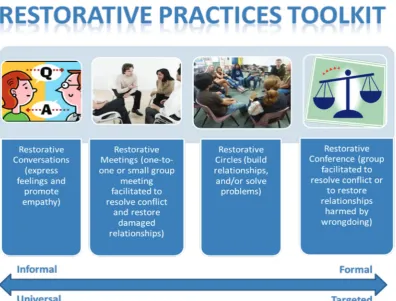
[image:31.595.104.501.254.555.2]The range of tools used in restorative practice are summarised in Figure 3 and there are a number of levels of RP training that will equip a practitioner or organisation with some or all of these tools.
As outlined in Figure 3, the tools used in restorative practice range from informal conversations (which promote emotional intelligence, empathy and stronger relationships) to highly structured conferences. Restorative
circles can be used in a group or organisational setting to actively build good relationships and to solve problems effectively as they arise. Restorative meetings can be used in families, groups or organisations that are committed to working restoratively; they will involve small numbers of people constructively resolving conflict as it arises. Formal restorative conferences can be used to resolve serious conflicts in groups and communities or to restore the harm caused by a criminal offence; in either case, they seek to support the needs of every participant in devising a resolution to the conflict that everyone can live with.
The skills required to work in a restorative manner include listening, communication, facilitation, planning and evaluation skills. RP training provides a framework for using all of these skills to build relationships consciously and to resolve conflict easily. As mentioned above, there are a number of trainers and training courses available and these include training for the range of levels of restorative practices (from the informal to the formal), as well as courses aimed at particular target groups, such as schools, parents, youth workers and Gardaí (see www.restorativepraticesireland.ie for further information).
3.2.2 Training Programme Design
Different groups and organisations will be interested in different levels, and types, of RP training. However, a rule of thumb for groups or organisations wishing to adopt a restorative approach is for all members of the group or organisation to do basic training, which provides an overview of RP and offers practical tools for conducting restorative conversations and meetings.
This is an important first stage of becoming a restorative group or organisation since it ensures that everyone has an understanding of how RP works and can be part of integrating the approach in the group or organisation. It is important to stress that ‘all members’ means just that – for example, in a school it will mean all members of the Board of Management; the teaching staff; the classroom support staff; the administration, catering and maintenance staff; and any other personnel who regularly work with the school, such as youth workers or School Completion Programme staff.
In addition, for schools and a whole range of other organisations providing services for children, young people and their parents (e.g. childcare services, youth services, community development services), ‘all members’ includes these service users. It will be important for the children, young people and parents using a service to receive the basic training when the organisation or group is embarking on becoming restorative.
Following on from this basic RP training, it is usual (and recommended) for at least 10% of the members of a group or organisation to do further training in the use of restorative circles and the facilitation of conferences. These will be people in the group or organisation who have a particular interest in or passion for RP, who have leadership positions, or who have responsibility for discipline or human resources (HR) functions.
3.3 Training Children and Young
People
respond extremely well to restorative practices and that young people need less training in the approach than their adult counterparts to take it on.
It will be very helpful to include training for young people from the start of your RP programme because these young people will naturally evolve as role models and mentors for their peers, their juniors – and their seniors. Young leaders will be identified through this process and these RP ‘champions’ should be supported to become RP trainers, who can and will be very effective in delivering further training to other children and young people.
3.4 Training of trainers
As mentioned above, it will greatly enhance the ongoing sustainability of a community-wide RP programme to have people in the community who are trained as RP trainers. There are currently a variety of routes available for doing so (see www.restorativepracticesireland.ie). Potential RP trainers can be identified during the delivery of RP training or can be self-selecting from those who are interested.
In Tallaght, CDI advertised places on Training of Trainers (ToT) courses and also approached particular people who had undergone training and were using RP in their work or home and who were within key organisations or target groups (e.g. teachers, youth workers and residents were priorities). Due to the large number of applications received to do this training, CDI had to make a short-list of applicants and conduct group interviews (see Appendix 5 for the application form used for this ToT selection process).
3.5 Promotional Materials
Promotional materials are important in raising awareness of restorative practice and promoting the benefits of its use throughout the community. There are a range of videos, leaflets and brochures freely available on the Internet (see www.restorativepraticesireland.ie) that will be of use at the outset of your RP programme. In a local context, the best promotional materials you can have are the stories that people tell you about how they are using RP and the results they are getting. It is highly recommended that you have a system for collecting these stories right from the start.
The promotional materials you develop may include leaflets, brochures, newsletters, webpages, posters, DVDs and slide shows. It is extremely helpful to have a plan in place for photographing or filming the delivery of your training, and the conduct of RP circles or conferences when they begin to occur. However, it is important to remember that you will need the permission of the people recorded in this way (and the permission of parents/guardians of young people under the age of 18) for any photos or films to be published in any form, whether in print, digitally or online, etc.
3.6 Resource materials
It is very useful if development of local resource materials
is an explicit element of the RP programme since doing so will contribute to building the capacity of your community to take on and sustain restorative practices as a way of working and living. The kinds of materials that can and should be developed locally will include posters and training materials.
Practices (Europe) describes RP as taking a FRESH approach, where FRESH signifies that we are consciously striving to be:
F Fair
R Respectful
E Engaging
S Safe
H Honest
In CDI’s RP Programme, schools, youth groups and community centres in Tallaght developed a variety of posters using this theme, by either spelling out FRESH or expressing these values with graphics. The process of producing posters has itself been part of promoting RP within these organisations.
Similarly, organisations have been producing materials that they are using to train children and young people in the use of RP. Part of the restorative approach is about being able to express emotions constructively. It can be a challenge for children and young people to accurately name what they are feeling and schools, youth groups and parents have found it useful to develop wall charts, flash cards or posters illustrating emotional scales and a range of words for different feelings. Again, the process of developing these materials along with the children and young people is itself restorative and educational.
3.7 Communities of Practice
A Community of Practice (COP) is a space where a group of people come together to share their experiences and knowledge in creative ways that foster new and improved approaches to delivering services and programmes (Wenger and Snyder, 2000). COPs intend to be a key support for service providers and may include sessions involving invited
speakers on relevant topics, case study presentations or facilitated sessions on issues identified as affecting service delivery.
The objectives of Communities of Practice include:
• to support fidelity to a manual/programme;
• to provide technical assistance in programme delivery, particularly in terms of connecting practice and theory;
• to offer a space for reflection, consideration and sharing the learning;
• to identify and respond to training and support needs;
• to collectively identify solutions to issues impacting on service delivery;
• to inform the development of best practice guidelines for services;
• to improve practice and programme delivery.
RP Communities of Practice can be organised in a number of ways:
• Where an organisation or group is developing as a restorative one, the RP COP will effectively be in-house (e.g. in schools RP champions have organised their COP as a Professional Learning Community (PLC); other organisations have established RP Implementation Teams or Committees).
• People who have undergone training can be offered the opportunity to meet together to share information