No. 49 September-October 1989
THE
M
liD, liD,
It's
Off
To
Work We·
Go
Want to know where the hackers are? They're busy automating industrial processes. It's easy. Very easy.
Building A Controller
page 8The Easy Way
Motorola's 6805 contains everything you heed for I/O control - except the A/D convertor.
Programmable Logic
page 23Controllers
Driving Steppers
page 28Low Cost
110
page 42For The PC
Bruce looks at off-the-shelf I/O boards.
And More
PostScripta1.S
• • •
How Larry produced this cover.
Writing TSR Programs
Interfacing 16-Bit Devices
Much, Much
,
More
.
..
09
a 7447019388 3
page 16
page 33 page 83
$3.95
TECHNICAL
JOURNAL
rI
LIMITED OFFER
I
~rndill~
Q(lw
0
0
0
cmE
QmB0@
dill
udJ
UD
dJcnm
LD
Twelve function keys
for
increased automatic operation.Erasable template to label )flUr function key assignments. Switch allows
)flU to swap position of Ctrl and Caps Lock.
Switch-selectable
for all IBM XT,
AT, PSI2 and compatible systems.
rJ
Separate numeric keypad that switches to a multifunction business calculator with tilt-up LCD display. Includes memory, square root and percent keys.Keyboard and cakulator status indicator lights.
Solar panel to
power
thecakulator-$149:
5buys you
both
the hot-selling
spread
-QLJATrRO
itJsitive tactile-feedback, "click" keys.
charge your spreadsheet and typing performance.
Like our famous tactile, positive-response keys that give you a much better feel for the road. So you can type
sheet
and
the
TurboCalc-111
Keyboard/
Calculator.
For just $149.95-less than Quattro's street price, and a lot less than its $247.50 sug-gested retail price, you can now get both
Bor-!I
'p,~
..• ..~
:.'.':~
. ".' i" .~
faster with fewer mistakes than ever before.
And the new, enhanced ffiM"lOl-key layout with some logical improve-ments-including separate numeric and cursor keys that let you cruise through
land's best-seller and "fe",:;,!!}""";,.;""";",:,'!':!!,:"""""",,,,
spreadsheet data entry without ever having to shift Num Lock. the keyboard you need "MlJre than 1-2-3" at
to drive it at top speed. less than half the cost"
Namely, the Turbo- Thats what PC M@azine
Ca1c-llr Keyboard! says about Quattro," the
Get better mileage from your desktop.
Calculator from lwt-seiling spreadsheet
Datadesk. from B!YrlaruJ. Imagine
In case you haven't noticed already, the keypad doubles as a full-function business calculator com-plete with its own pop-up LCD display. Which saves
Boost your what theyU say about
overall perfonnance. this e:cf:r,deam;,dinary
With its built-in, au
presentation-quality graphics, intelli-gent recalcs, unlimited macros, easy installation and compatibility with leading spreadsheet and database software, Quattro is made to order for your business.
And ThrboCalc-ill is made to order for Quattro. Or for any other software you like to drive.
Because, as you can see, it's loaded with features d~signed to
turbo-space on your desktop and lets you perform any calculation with a single keystroke-no matter what software you're driving.
What's more, the keypad packs a solar panel, so you can start up the calculator even when your computer. is idle.
We wouldn't steer you wrong.
Frankly, getting into a Datadesk
key-Reader Service Number 8
'<,
';
,.'
...
"\ :,
•• ';:
. ... ,'
even when
the
com-puteris
turned
off!
board would be an inspired idea at this price even if you didn't get Quattro in the bargain.
After all, as InfoWor/d says, "if you haven't looked at Datadesk's key-boards, you ought to~'
According to the Washington Post, "for ingenuity of design and sheer
dollar value, Datadesk can't be beae' And when it comes to your peace of mind, nothing beats our two-year warranty.
send them back within 30 days and we'll cheerfully refund your $149.95.
No questions asked.
How, you ask, can you take advan-tage of this remarkable offer? Just fill
out the coupon and send it in. Better yet, call us toll-free. And tell us to step on it.
d
What's more, if Quattro and Turbo-Calc-ill don't blow the doors off the
vehicles you're currently drlvillg,just
DATADESK
All individual trademarks and copyrights are acknowledged.r,: -l ,;}§t~
J-$149
95
Bundle includes Datadesk's ThrboCalc-111 0 -Keyboard/Calculator formw
and compatibles and Borland's Quattro sllreadsheet. Add $10 s~ing and handling per urut (Continental U.S. only). CA reSidents please add $9.75 es tax per unit.# of Units: Amount Enclosed:
Com~uter Type*: Disk Size: D3W'
o
5lA"*1£ p 12, include additional $5 for cable adapter.
Payment: 0 VISA DMC
o
AMEX 0 CHECKMe
Card No: Exp.Date:
Na_
Company Name
Daytime Teleplume Addms
City State Zip
Mail to: Datadesk, 7651 Haskell Ave., Van Nuys, CA 91406. FAX: (818) 780·7307
Or Call:
(800) 826-5398. In CA, Call: (800) 592-9602t.=
-\
'II}@AW~~r<oo.UJAUfA~~\\i~ I.' " : " . .
'"
, . : .. . '
QuickMod V2.0 Compiler. ..
Just think what the two
of
you
can
do.·
You can make software engineering faster and easier than it's ever been before. The high performance QuickMod by Stony Brook delivers a compilation speed that exceeds 15000 lines per minute on AT machines. And it's a true two-pass, Modula-2 compiler with an intelligent environment that determines dependen-cies automatically and builds your pro-gram with a single keystroke. You do little more than enter the program text-then let Stony Brook handle the work load. QuickMod is more than a supercharged compiler-it is a fully supported package backed up by a text editor. a linker. a library manager. a symbolic debugger and a runtime library that offers more
func-tionaity than anything else on the market. All for $95. Versions available for DOS and OS/2.
© 1989 Gogesch Micro Systems. Inc.
And when you need more horsepower. you can move into the Professional Modula-2, Stony Brook's fully optimized compiler. You get the same high productiv-ity environment with code generation and flexibility you can't find in any other product in the industry.
Stony Brook-we design our products specifically to improve developer perfor-mance. And we know software engineer-ing. Put us to work for you.
Call us direct and we'll mail product information to you within 24 hours.
800/624-7487
805/496-5837
;~~it~~~~ational805/496-7429
FaxReader Service Number 152
SOFIWARE
Your
Partner
in Software Development
187 East Wilbur Road, Suite 9, Thousand Oaks, CA 91360
ENAllY.
A debugging
tool tough enough to
handle the DOS
Nasties.
New Version 2.0
Nasty over-write? No sweat!
Soft -ICE memory range break points help you track down memory over-write problems whether you are doing the over-writing or another program is over-writing you.
Hung program? No problem!
When the system hangs, you now have hope. With Soft-ICE you can break out of hung programs no matter how bad the system has been trashed. And with Soft-ICE's back trace ranges you can re-play the instructions that led up to the crash.
Program too large? Not with Soft-ICE!
Soft-ICE runs entirely in extended memory. This means you can debug even the largest DOS programs. And since your program runs at the same address whether Soft-ICE is loaded or not you can find those subtle bugs that change when the starting address of your code changes.
System debugging? Soft-ICE is a natural!
Soft-ICE is ideal for full source level debugging of TSRs, interrupt service routines, self booting programs, DOS loadable device drivers, real-time kernels, non-DOS O/Ss and ROMs. Soft-ICE can even debug within DOS &: BIOS.
How Soft-ICE Works
Soft-ICE uses the power of the 80386 to sur-round your program in a virtual machine. This gives you complete control of the DOS environment, while Soft-ICE runs safely in protected mode. Soft-ICE uses the 80386 to provide real-time break points on memory locations, memory ranges, execution,
II
0 ports, hardware &: software interrupts. With Soft-ICE you get all the speed and power of a hardware-assisted debugger at a software price. Don't want to switch debuggers?You don't have to!
Soft-ICE can run stand-alone or it can add its powerful break points to the debugger you already use. Use your favorite debugger until you require Soft-ICE. Simply pop up the Soft-ICE window to set powerful real-time break points. When a break point is reached, your debugger will be activated automatically.
MagicCV with Soft-ICE
Using Soft-ICE with CodeView gives you the features necessary for professional level systems debugging. MagicCV and Soft-ICE can work in concert with Code-View to provide the most powerful debugging platform you will find anywhere.
"These may be the only two products I've seen in the last two or three years that exceeded my wildest cX'Pcctations for power, compatibility and case-of-use."
-Paul Mace
Paul Mace Software
New Soft-ICE 2.0 features
Soft-ICE
o
Back Trace Ranges MagicCV
MagicCV for Windows
$386 $199
$199
o
D Symbolic EMS 4.0 support with special EMS &: Source level debugging Buy Soft-ICE &: MagicCV(W)-Save $86. Buy MagicCV and MagicCVW
-Save $100. Buy All 3
30 day money-back guarantee Visa. MasterCard and
AmEx accepted
-Save $186.
• ,. T •
debugging commands
o
Windowed user interfaceTMjV
Nu-Mega
\J-TECHNOLOGIES
CALL TODAY (603) 888-2386 or FAX (603) 888-2465
P.O. BOX 7607 • NASHUA, NH • 03060- 7607
Reader Service Number 110
2 MICRO CORNUCOPIA, #49, Sept-Oct 1989
Code View is a great integrated debugger. but it uses over 200K of conventional memory. MagicCV uses advanced features of the 80386 to load Code View and symbols in extended memory. This allows MagicCV to
run Code View in less than 8K of conven-tional memory on your 80386 Pc.
NEW-Version 2.0 includes EMS 4.0 driver. Attention Windows Developers!
THE M I C R 0 TECHNICAL JOURNAL
MICRO CORNUCOPIA
8
16
23
28
33
42
83
Karl Lunt
Building A Controller The Easy Way
Monitor/controller projects llsed to be hardware/software marathons. Fortunately, chip manufacturers have discovered there's a huge demand for processors that take the pain out of these desig1ls. Here's a close look at Motorola's latest.
Larry Fogg
PostScriptals
Interested in creating the world's highest resolution fractal? (The gauntlet is
down.)
Ron Hicks
Programmable Logic Controllers
Programmable logic came into vogue during the days when industrial controllers were made lip of boxes full of relays. Now we use the same logic with microprocessor controlled equipment. (But it's a lot quieter.)
David Metz
Driving Stepper Motors
How does a controller positio1l a1l arm, or move a belt, or open a window? Usually via stepper motors.
Edwin Thall
Writing TSR Programs
Here's the real scoop on TSRs.
Bruce Eckel
Low Cost 110 For The PC
You can get really versatile I/O interface cards for the PC for under $300. Bruce takes a look at three winners.
William K. Rohwedder and Wayne L. Everhart
Interfacing 16-Bit Devices
You have a 16-bit computer. Why not talk to it 16 bits at a time?
SEPTEMBER/OCTOBER 1989 -ISSUE #49
50
C'ing Clearly57
86 World64
Culture Corner66
ShareWare68
On Your Own77
Units and Modules90
Techtips86
Tidbits96
Last PageCover PostScriptal by Larry Fogg.
THE MICRO TECHNICAL JOURNAL
MICRO CORNUCOPIA
Editor and Publisher
David ]. Thompson
Associate Editors
Gary Entsminger Larry Fogg Cary Gatton
Contributing Writers
Anthony Barcellos Bruce Eckel Michael S. Hunt
Scott Ladd Laine Stump
Advertising & Distribution
]effHopper
Accounting
Sandy Thompson
Order Department
Tammy Westfall
Graphic Design
Carol Steffy
MICRO CORNUCOPIA (lSSN 0747-587X) is published bi-monthly for $18 per year by Micro Cornucopia, Inc. 155 NW Hawthorne, Bend, OR 97701. Second-class postage paid at Bend, OR and additional mailing offices. POSTMASTER: Send address changes to MICRO CORNUCOPIA, PO Box 223, Bend, OR 97709.
SUBSCRIPTION RATES:
1 yr. (6 issues) $18.00 2 yr. (12 issues) $34.00 3 yr. (18 issues) $48.00 1 yr. Canada & Mexico $26.00 1 yr. Other foreign (surface) $36.00 1 yr. Foreign (airmail) $50.00
Make all orders payable in U.S. funds on a U.S. bank, please.
CHANGE OF ADDRESS: Please send your old label and new address to:
MICRO CORNUCOPIA
P.O. Box 223 Bend, Oregon 97709
CUSTOMER SERVICE: For orders and subscription problems call 503-382-8048, 9 am to 5 pm, Pacific time, M-F.
TECHNICAL ASSISTANCE For help calI 503-382-8048, 9 am to noon Pacific time, M-F
BBS - 24 hrs. 300-1200-2400 baud 8 Bits, No Parity, 1 Stop Bit 503-382-7643
Copyright 1989 by Micro Cornutopia, Inc. All rights reserved
~~~
ft
Audit Bureau 01OJ
Circulations4 MICRO CORNUCOPIA, #49, Sept-Oct 1989
AROUND
THE BEND
~© lS1«;~~
(0)11
[D)~~~®
Hard Drives
By
David
J.
Thompson
I've been having trouble with my little 20 meg 3 1/2" Miniscribe. Just use it for text mostly (not the heavy stuff that uses all eight bits), but I began hearing this siren sound as the spindle motor slowed down and then came back to speed. I called MicroSphere.
"Make sure the DC power connector is firmly at~
tached. Take needle nosed pliers and push in the little metal connectors."
That seemed reasonable, but the symptoms got worse. Then, not content with slowing down, the motor began speeding up (trying to improve transfer rate I suppose). Certainly not a power problem.
Ah well, I backed up everything (using Fastback) and trucked the little hummer back to MicroSphere (aren't warrantees nice?). Within half an hour I was back at Micro C with another 20 meg 3 1/2" 8425. (I
really like the little drives because they're very quiet.) Fired up the system, booted off floppy, did a low level format (g=c800:5), FDISK. ... Whoa, wait a minute. I'm the guy who tells people to let their drives run at least half an hour before formatting. This would be a great excuse to sit back and ....
I started another low level format, made a cup of tea, and glanced through an article in the Wall Street Journal
about Compaq's new 33 MHz 386 system. (Something about beating IBM, whoever they are, in the perform-ance race.)
Boy, formats go fast when you're reading something light. After the second format finished, I started a third. That's three low-level formats in a row. I followed up with FDISK and then ran DOS FORMAT-twice. If
those little platters aren't impressed, they'll never be. Finally I restored the files using FASTBACK and the drive was back. So far this one has run flawlessly. I must say, though, humming along with the other one was much more interesting.
Nondestructive Reformatting, Again
It seems like every time I say something about hard drives, I get mail. This time I got lots of mail and Gib-son Research pulled its ad for SpinRite.
It's not Gibson's fault that some XT controllers have problems doing a single-track format. Gibson has to talk through the controller just like everyone else.
Lattice
1
:
R
i~
BJ
,k
on Top!
. 70
I
I
fThe Leader in Performance
I I toollmk,
which is an advancedLattice C 6.0 for DOS and OS/2 is I
I
I version of the UNIXmake
utility.the fastest compiler overall o n '
Build, diff, extract, file, splat, touch,
the ei~ht PC
Magazine
bench- 1 I andwc
enable you to easilymain-marks in both large and small ! I tain your source files, and
cxref
model. Lattice C is over 10% ' produces comprehensive
cross-faster than Microsoft 5.1 and over
I
II' reference reports.Lbind
producesresults are due to our new op- run under both DOS and OS/2.
15% faster than Borland 2.0. These 11 family-mocfe executables that can
timizer and the many perform-
I
Lattice is the productivity leader.
ance improvements in the library. ,1
I
The Leader in Libraries
You can make your applications
run even faster by using our new II. lOur library has often been praised
register variable support and _., II for its comprehensive and
sophis-b '1 . f . L ' 6 O· I I :;;; : ,ticated features. Now we include
UI t-In unctions.
attlce . lS t l e . ; ; - ,
II:=
I~·-.f. I
d
l() 'l~'I=U
graphics, communications,
andper,ormance ea er.
,
.~ 'I ;:-->~,~ 1 _ ' : : '-
-
._....::
curses
libraries. Thecommunica-The Leader in Compatibility
,~;
1 ... _ _.",_~:..J >~I! ,~~,
tions
library supports XMODEM,Lattice C is fully comwliant with 0 - ANTSl YMODEM, KERMIT and ASCII
Pcrfonnancc 1 )'br'lfl'cs" 1 Th h' l'b
the ANSI standard. e pass not - . ( ' , protoco s. e
grap ICS
I raryonly the
Computer Language
ANSIAnd
the benchmarks
provides a graphic windowingTest Suite but 100% of the model.
Curses
provides a UNIXPlum Hall Test Suite Version 1.09.
h
et
compatible screen manager.Lattice is the compatibility leader.
S OW I •
Lattice is the library leader.
The Leader in Debugging
The Leader in OS/2
The Leader in Convenience
Lattice C includes CodePRobe™, a Lattice C includes bindings and Lattice C uses an automated
installa-new full-screen symbolic debugger header files so that you do not need tion procedure that has been praised
for DOS and OS/2. CodePRobe fias to buy an expensive OS/2 develop- by reviewers.Thecompiler
automati-the familiar look of automati-the CodeView, ment kit. Tne library also supports cally configures itself so that you do
and can be used with a mouse. It also multithread programming with no not need to specify complicated
enables you to easily debug family built-in limits to the number of options. Yet, a full set of options is
mode prosrams, Presentation Man- threads. The Lattice linker, librarian, available to the professional who
ager applIcations, and OS/2 mul- editor, debugger and utilities run in needs to customize to a particular
tithreao applications. And, for those DOS, OS/2 and family mode.
Lattice
environment.Lattice is tlie
conven-humongous programs and system
is the
OS/2leader.
ience leader.
killer bugs, CodePRobe can be used
remotely from a different PC.
Lattice
The Leader in Productivity
The Leader in Documentation
is the leader in debugging.
The Lattice C Development System LatticeC includes over 1500 pages ofnow includes the utilities that high quality documentation in ring
The Leader in Innovation
our customers-professional C pro- binders. It contains all theinforma-Lattice has long supported popular grammers-use most often. Of course, tion that professional programmers
language extensions such as
near, far,
the system is based upon our C com- need in a tboroughly ina.exed format.and
pascal.
In our previous version, piler, editor, linker, librarian, and de-Lattice is the documentation leader.
we Introduced
align, chip, volatile,
bugger. In addition, we now includeinterrupt, nopad,
andpad
to handle our powerful project maintenanceThe Leader in Support
imEortant memory management Best of all, Lattice support comes free
Eroblemsin DOS, OS/2,and embed- with Lattice C. Lattice's bulletin
oed systems. Version 6 continues board and telephone support are the
this evolution with
critical
and best in the business.Lattice is the
private. Critical
defines a function~~<>
support leader.
that must run as a critical section,
O~<>
andprivatedefinesdatathatmustbe
0
30
Day Money Back Guarantee
replIcated for each execution thread.
La1t;,ce
Lattice C 6.0 is available for $250. ToFuture versions will continue to ~ order, send check or money order to:
improve the language for use in Lattice, Inc., 2500 S. Highland A
ve-cutting-edge environments such as Professional Programming Tools Since 1981 nue, Suite 300, Lombard, IL 60148.
OS/2 and AmigaDOS.
Lattice is the
2500 S. Highland Avenue, Lombard,IL 60148 Or order by credit card at (800)444-innovation leader.
4309. FAX # (312) 916-1190, TELEX532253.
~ *Send to Lattice for a free complete report on the benchmark analysis.
Reader Service Number 153
Letters
Large Video Characters
Regarding large characters for those with vision impairments: a big monitor would be ideal, of course. On my Zenith lap-top, and probably most CGA-compatible machines, "MOPE BW 40" or "MODE C040" makes the characters double width. Not double height, but considerably bigger.
This works for all DOS commands (more or less) and probably some appli-cation programs, older ones more likely. A modern text editor which seems to work acceptably in this mode (scrolls the line horizontally and so forth) is my copy of the estimable QEdit. I think it's still available as shareware.
J.
G. Owen 21 Glenview Ave. Fort Salonga, NY 11768Talking Amigas
Issue #48 was very interesting (as usual). I have a comment on Debee Norling's article, "Selecting a Talking Computer for a Blind Friend."
Although the IBM PC family is the
business computer family, I was sur-prised to see no (zero, nada) references to the Amiga computer. Every Amiga can talk, right out of the box-no special hardware or software required. At a command line prompt, just
type-say {string to speak}
The general purpose text-to-speech al-gorithm seems pretty good, at least to me. If it isn't, you can send it phonemes instead. This speech capability is also available as a system level device, just like a printer or a serial port. You con-trol the volume, speed, voice type (male, female, robotic), pitch/frequency, and rate.
Some Amiga applications take advantage of this ability to talk. If these do not meet your needs, there are a number of programmable text editors
6
MICRO CORNUCOPIA, #49, Sept-Oct 1989and applications that might work. The widespread adoption of the ARexx language, with its interprocess communications ports, also facilitates linking applications together in novel ways. At a programmer's level, it's rela-tively simple to insert a task into the chain of event handlers (e.g., to speak keystrokes, including ctrl/ alt/ shift) and to access the speech libraries from within a program. The Amiga's true multitasking and ability to play high quality sampled sounds without any extra hardware are bonuses.
The Amiga has capabilities for the sight-impaired as well. It has become the standard computer for "Desktop Video." Its standard NTSC (or PAL) output and low-cost GenLoc options mean it can interface to a wide variety of video equipment. Its standard analog RGB output will drive the newer large analog monitors (or TV/monitors).
The bit-mapped display and system fonts mean you can select larger fonts for many applications. There's even a little public domain "magnifying glass" tool that lets you enlarge any portion of the screen.
In conclusion, the Amiga is a very capable machine and certainly in the running as a blind or disabled person's "window to the world."
Kurt Wessels 917 N. 87th Seattle, WA 98103
Letters From The Editor
Debee's articles in Issue #48 generated lots of interest. One thing we didn't tell you: the products mentioned are available through Debee and Christy at their company, Grassroots Computing. Obviously, they can sup-port the products from the perspective of experienced users. Or you can con-tact the manufacturers directly.
DECtalk-Digital Equipment Corp. Contact: Bill Metcalf
2525 Augustine Dr. Santa Clara, CA 95054 (415) 651-5474
Echo PC-Street Electronics Corp. Contact: Mark Pfeffer
6420 Via Real Carpinteria, CA 93013 (805) 684-4593
Video Voice-Grassroots Computing P.O. Box 460
Berkeley, CA 94701 (415) 644-1855
BBS Phone # Correction
In the list of alternative BBSes for downloading Micro C's issue listings, published last issue, we embedded an incorrect phone number for the Genera-tion 5 BBS in Washington, D.C. The cor-rect number
is-Generation 5 BBS (301) 495-2932
This is a subscription board, but you don't have to be a subscriber to download Micro C code.
Good Magazine, But. ...
I've really appreciated your ma-gazine for the past few years. You have
Finally, you can choose the best editor for your needs without compromising performance or paying too much. And organiza-tions that want the "same" editor for everyone can pick VEDIT® for most users a"nd VEDIT PLUS for their power users. The new family of VEDIT text editors are upwards compatible, easy to use and offer exceptional performance, flexibility and stunning speed. (3 to 30 times faster than the competition on large files where speed really counts.)
Call for your free evaluation copy today. See why VEDIT has been the #1 choice of programmers, writers and engineers since 1980.
VEDIT Jr.- Unmatched performance for only $29.
All VEDIT editors include a pull-down menu system with "hot keys:' context sensitive on-line help, pop-up status and ASCII table, a configurable keyboard layout and flexible, unlimited keystroke macros. Edit files of any size and any line length. Perform block operations bycharacter, line, fileorcolumn. Undo up to 1000 keystrokes- keystroke by keystroke, line by line, or deletion by deletion. Automatic indent, block indent and paren-theses matching speed program development. Word wrap, paragraph formatting, justification, centering, adjustable mar-gins and printing for word processing. Run DOS programs. VEDIT-A best value atonly $69.
Simultaneously edit up to 36 files and split the screen into win-dows. Search/replace with regular expressions. Includes the best compiler support available- menu driven, easy selection of compiler options, supports "Include" files and MAKE utilities. VEDIT PLUS-Ultimate programmer's tool for only $185. VEDIT PLUS adds the most powerful macro programming language of any editor. It eliminates repetitive editing tasks and permits creating your own editing functions. The macro language includes testing, branching, looping, user prompts, keyboard input, string and numeric variables and control over the size, pOSition and color of windows. Source level macro debugging with breakpoints and tracing. Macros developed with VEDIT PLUS also run under VEDIT.
30 day money-back guarantee. Call for pricing of XENIX, OS/2 and FlexOS versions. Very attractive quantity pricing is avail-able for schools, hardware and software vendors.
VEDIT and CompuView are registered trademarks of CompuView Products, Inc. BRIEF is a trademark of UnderWare, Inc. Norton Editor is a trademark of Peter Norton Computing Inc. OEdit is a trademark of SemWare.
"Supports IBM PC, XT, AT, PS/2 and clones with CGA, MGA, EGA, VGA, Wyse 700, Amdek 1280 and other displays. Also supports Concurrent DOS, DESOview, Microsoft Windows, PC-MOS/38G and most networks.
"Also available for MS-DOS (CRT terminals), TI Professional and others.
Introducing .••
The 1st Family of
Low Cost, Powerful
Text Editors
VEDIT
Jr.
VEDIT
VEDIT PLUS
$
29
$
69
$185
FREE Evaluation Copy*
Call1·800·45·VEDIT
Compare Features and Speed
VEDIT BRIEF 2.10 Norton 1.3 QEdit 2.07 Pull-Down menus Yes No No Yes Pop-Up ASCII table Yes No No No Keystroke macros 100+ 1 No 100+ Regular Expressions Yes Yes No No "Cut and Paste" buffers 36 1 1 100 Text (book) markers 10 10 No No Undo keystroke by keystroke Yes Yes No No Undo line by line Yes No No No Normal/max Undo levels 500/1000 30/300
-
-Variable tab positions Yes Yes No No Configurable keyboard Yes Yes No Difficult Integrated mouse support Yes No Yes No FILE LIMITSEdit files larger memory Yes Yes Difficult No Maximum line length >8096 512 65,535 512 Maximum lines/file 8,388,607 65,535 >65,535 20,000 COMPILER SUPPORT None None Menu driven Yes No
-
-Select Compiler options Menu Difficult-
-Support "Include" files Yes No
-
-BENCHMARKS 5DK FILESimple search 0.2 sec 1 sec 1 sec 0.3 sec Save and continue 1 sec 2 sec 2 sec 1 sec 1000 replacements 3 sec 19 sec 17 sec 2.5 sec BENCHMARKS 3 MEG FILE
Simple search 1:40 min 1:36 min Cannot Cannot Save and continue 1:05 min 3:23 min Cannot Cannot 60,000 replacements 3:18 min 1:44 hour Cannot Cannot Block-column copy (40 x 200) 2 sec 30 sec Cannot 2 sec Insert 1 Meg file in
middle of 1 Meg file 1:11 min 15:13 min Cannot Cannot PRICE $69 $195 $75 $54.95
CompuView
"Free evaluation disk is fully functional and can edit small files. Reader Service Number 7
1955 Pauline Blvd., Ann Arbor, MI 48103 (313) 996-1299, Fax (313) 996-1308
[image:9.595.26.296.19.230.2]8
MICRO CORNUCOPIA, #49, Sept-Oct 1989---Not satisfied with undocumented 68000 systems, Karl switches to a very well docu-mented, very low power, low chip count controller. Sounds like Motorola has a real winner.
T
he Motorola 68HC705 micro-con-troller unit (MCU) contains enough EPROM, RAM, and I/O power to solve many controller prob-lems. Use it with the Motorola 68HC05PGMR development board to build single-chip projects such as bur-glar alarms, robotics sensors, data ac-quisition units ... just about anything you can dream up.Take a look at the example design, complete with assembly language source code. The project provides 11 channels of A/D, maintains an internal time-of-day clock, controls three LEDs, consumes just 30 rnA from a battery supply, and uses only two ICs!
The Chip's Hardware
The 'HC705 MCU is the latest addi-tion to Motorola's line of 6805 micro-con-trollers. Being CMOS, it typically draws about 4.7 rnA at 5.0 volts, making it ideal for low-power (e.g., remote) projects. The on-board 7.7K EPROM and 176 bytes of RAM provide room for surprisingly powerful programs. Since each of the 24 bidirectional I/O pins can drain up to 25
rnA, the 'HC705 interfaces directly to LEDs, beepers, LCD displays, and other low-current devices.
You can run this chip with an external crystal of up to 4.2 MHz (V dd = 5.0 volts); the internal bus runs at half the crystal frequency. I/O and option registers (special-purpose addresses) give you software control of the CPU's RAM/EPROM layout, I/O ports, counter / timer, and communication sys-tems.
By
Karl Lunt
4730 W. Menadota Dr. Glendale, AZ 85308 (602) 869-6146 (work)
(602) 582-5863 (home)
e . • • • • • • • • • e • • • • • • • • • • • ~
.
.
. .
~•
" :.!
•
• •
•
•
•
~6~'fl
' . £ ( 1 : (
( . f f C ' f l i
f l ( C l t e '
I) ~(I(C('C
II . f ' ( C • • .. C ( f
~
.
.
. . .
.
. .
.
.
•
• • •
• •
•
• •
•
•
•
• •
•
•
•
•
•
•
•
·
"•
•
•
•
. .
. .
. ~ '.
Proto Board for Example Project-Small, Right?
The on-board Serial Communication Interface (SCI) handles asynchronous se-rial I/O, though you must provide your own RS-232 level shifting (+12 V to -12 V). You control baud rate and port setup through I/O registers. A Serial Peripheral Interface (SPI) adds high-speed syn-chronous I/O, up to 1.05 Mbit/sec.
You can use the internal 16-bit counter / timer system as part of a real-time clock, frequency counter, or waveform generator. You can select from a wide variety of interrupts on the counter / timer.
For those really critical functions, the chip contains a Computer Operating Properly (COP) timer. When enabled, this feature will force a reset should your program fail to periodically refresh the COP register. Additionally, the chip can provide a reset if the system clock falls below 200 KHz.
The 'HC705 also offers two ~dditional
low-power modes (as if 4.7 rnA isn't low enough!). WAIT suspends CPU operation
but keeps the timer, SCI and SPI running. Any of these three systems can bring the CPU back to full RUN mode.
WAIT consumes about 1.7 rnA; the STOP mode typically uses only 2.8 JlA (no, that's not a typo). STOP shuts down all internal processing; only an external interrupt or reset can bring the CPU back to life.
The on-chip EPROM erases with a standard shortwave UV lamp. If you bum your program into the MCU and find it doesn't work, just erase the MCU, change the software and try again.
When it comes time to ship your final product, Motorola also offers the MCU as a one-time programmable device (OT-PROM). This plastic package does not have a UV erasing window-once you've programmed it, you've pro-grammed it.
Inside The Programming Model At first glance, the 'HC705 program-ming model seemed like a cruel joke. The
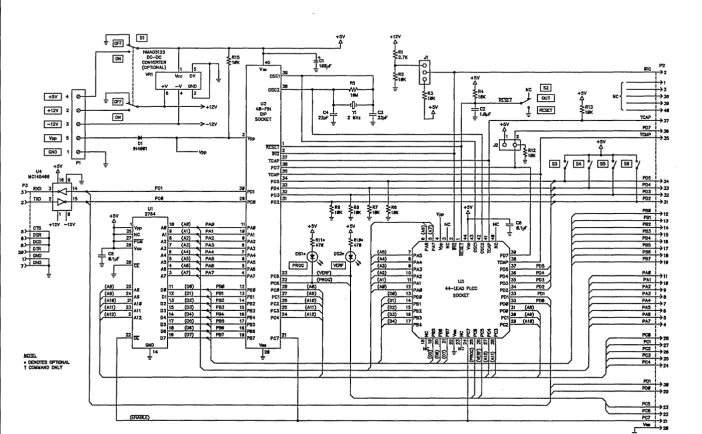
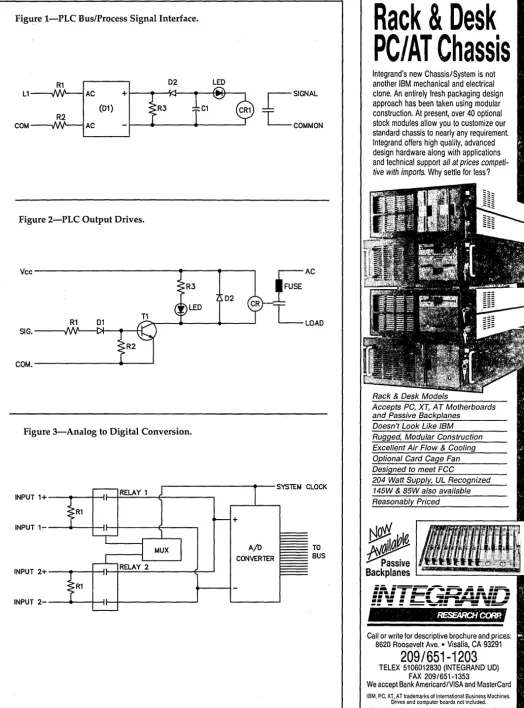
Figure l-PGMR Board Schematic Diagram.
~
r---
NI,IAO~1Z~,
oc-oc,
CONvtRlER I
(OpnOHAl)
I
,
'oR!,
-=~ ~,
I I,
,
,
'+I2V 12 -}
~
~'S
'-12V 1:5 , ~ I
~
) -12V~5
[§J 1 L...I
U4
~+5V
PIMCI464I11 111 9 _
;~ RXD J ../I 14- - .
!
01
tl48et
c~
~
r
111<l=E
OSC2U2 46-PIN DIP SOQ(ET l, Vpp
mET~
1RlJ2 TCAP,:nTCMP~
po~ 34-PCI P04
31 POl 32
1+C1
~lnl""
+5V
l'
R!I
~
..
DI-C4 YI..LCl
22I:F
J
211HzJ
22pF +12V RI 2.7K R2 11K .IIm
+SVRl 11K
cr
RQ
.,.
P2 I @]~{
[§J +~V
~ 'RESET'
~~3
11K~ H ~3e ~;w j--+4I +5V J2 R11 PD7 +~V
t
~• ,38
~35
~
2
•
_'II<
@}f ffi]f
@J
f
ffilr ...
~----+---~~~~
~----+---~~~~
---+---~~~32
D.2!,
;i
20 PCIIml
POl :"" ~---~--~--_+--~~---~_+--~+_r_---r_+__b~---~~~++~
liIlm.
• CENtnES CPl10NAL
T COMMAND ONLY
UI
+5V 2764
~tlE
OND
-p
(ER;Qn)
~(~
AI 0 -:-~~"",,,,,,,,;:,=----:;,'ilO (AI) '1 PAl PAl
,., 8 -:-: (A2) '1 r,,-, • PAZ
"2 17 (Al)
AJ III ;~~~~~~ (A4) _ _ _ _ _ ~8 PAl
7PM
;~~~L....~.l~'~---~'PA5
A4rs--(Ali) Alil4 (All)
~:f3 (A7)
)1"':' ":1 r,w 5 PAS 'I r~' 4 PA7
'r "'I D.ft1 (Ill) I
112 (D1)
:1 113 (021
12 PSI
,t:L!1-~!L+-~-=::---;'~3 PHI
It: "'I r~ 14 PS2
D~f1S (OJ)
D4~~~ ~:~ ;~~..1E~+-'4i"'lr.=---;,iA1, "'I ~~ 15 PB3 17 PS5 PB4
::,8
(0&)D711t C07l
"'I r..u 18 PSII
l!!. __ ~LI-~:...::..:.. __ ---,II· PB7
' t "'I
v.
1
3
PC7.n.--: ; 12
~ ~I :
PB3 I
PB4 i 15
PBS' 1&
PBII I 17 PB7 i 18
F-____ ...:.PC5.:::-"I I III
1=---...:.~:::;3:;JJ ~~ : ' II
E-_ _ PD2~.J PAZ I ~.
~ _ _ ..;.;PD1;;..;...,. PAl '-"8
PM ; ..
PAIi I
~
I .. :
PAS ,
P"7
I ' I
~28 ~27 PC2 I
_211
~25 ~24
I
PD1 I
. • 311
~20
,
~I
pee
! ::
~21
~211
Reprinted from the Programmer Board User's Manual with permission from Motorola.
0'\
00
~
~
~ Q)
single accumulator and single index reg-ister each hold only eight bits. The fixed-position stack wraps after only 64 bytes. The entire address space is a mere 8192 bytes. Quite a change from my 68000.
The more I used the instruction set and studied the internal design, the more respect I gained for the chip's developers. This stripped-down model offers plenty of power for the jobs it will be asked to do. Ten addressing modes, with heavy emphasis on bit manipulation, give you lots of control over the many I/O regis-ters. The flexible interrupt and timing systems move much of the clock-watch-ing and baby-sittclock-watch-ing duties into hard-ware, freeing up the CPu.
Using the SPI and SCI for real-world communications amplifies the chip's power considerably. These systems handle sophisticated interface jobs smoothly, with minimum CPU time.
Even the pint-sized stack won't get in your way. Since a subroutine call uses two bytes and an interrupt only costs five, the stack provides plenty of elbow-room. Keeping the stack size small frees up more of the valuable zero-page RAM (the stack runs from $FF down to $CO)
CAPITAL
V
for your programs. (Accessing zero-page RAM saves a cycle per instruction, since the CPU knows the operand's address lies in the lowest 256 bytes.)
The bottom line: this chip's stream-lined architecture is fun to work with. Don't be fooled by the paucity of regis-ters and tiny stack-you can handle seri-ous control projects with the 'HC705.
The Development Board
The 'HC705 does not support external RAM or ROM, so programming can be a problem. Fortunately Motorola offers the M68HC05PGMR development board. Used with a PC-based interface program (PROG7-supplied by Motorola with the 'PGMR board), you can download soft-ware to the 'HC705, program the EPROM, and test your code. So the board constitutes a complete 'HC705 development system.
The 'PGMR board contains little more than R5-232 level shifters, a crystal oscil-lator, LEDs and pullups, and necessary connectors. (See Figure 1.) All timing and control for EPROM programming and serial I/O get done by PROM code in the 'HC705.
The 'PGMR board sets up easily. Con-nect a serial cable to your PC, plug an 'HC705 into the processor socket, and supply +5, +12 and -12 volts. Program-ming the processor's EPROM requires adding a switchable +15.5 volts (V pp).
After burning your software into the MCU's EPROM, you can reconfigure the 'PGMR board as a test bed for debug-ging. All 40 pins of the MCU socket ap-pear at an IDC connector on the card's edge. By connecting a ribbon cable to a 40-pin header, you can "plug" the development board's MCU into an exter-nal circuit. Since the 'PGMR's oscillator and R5-232 port remain connected, your prototype only needs to provide interface circuitry.
The 'PGMR can even serve as a low-volume production facility. You simply plug a 2764 EPROM containing your finished program into the on-board 28-pin socket. Next, reconfigure the 'PGMR board to perform an automatic <;:opy on reset. Put an erased MCU into the socket, apply all voltages (including' V pp) and bring the 'PGMR board out of reset. Firmware in the erased MCUco'pies the 2764's contents into the MCU's·EPROM.
The Complete Diagnostics Solution for Your PC/XT, PC/AT, or Compatible
INCLUDES ...
DRIVE TESTS-Complete diagnostics for Hard and Floppy drives, including controller cards. Tests read, write, and format capability as well as seek timings, hysteresis and rotation timings.
I/O PORTS-For both parallel and serial ports, confirms internal and external loopback capabilities at all baud rates and configurations.
MEMORY-Performs over eight different tests to check standard. extended, and expanded memory.
KEYBOARD-Verifies that all keys send correct key codes, including shift. CNTL and AL T modes.
CPU. NUMERIC COPROCESSOR-Verifies that all single and multiple instructions perform correctly and accurately, as well as testing all internal registers.
VIDEO DISPLAY-Checks video controller cards. Confirms attributes, graphics, colors (if applicable), and CRT alignment patterns.
REAL TIME CLOCK-Verifies correct timing, all internal registers, and battery backed-up RAM.
_and many more features to Insure the Integrtty of your computer.
PCIXT System Diagnostic Software
PCIXT Disk Diagnostics (wI test diskettes)
PCIXT I/O Loopback Test Plugs
COMPLETE PCIXT DIAGNOSTICS SET (save 528)
PCI AT System Diagnostic Software
PCI AT Disk Diagnostics (wI test diskettes)
PCI AT I/O Loopback Test Plugs
COMPLETE PCI AT DIAGNOSTICS SET (save 528) BOTH PCIXT and PCI AT SETS (save 575)
$ 29
$ 29 $ 19 $ 49
I
$:29
$
29
$ 19
$ 49
$ 79
Capital Software presents the definitive disk-based diagnostics package for the IBM PC AT and Xl Atechnical tool detailed enough for the repair technician. A friendly interface that places problem-solving skills in the hands of the end user. An uncompromising solution.
SEND CHECK OR MONEY ORDER TO CAPITAl SOFTWARE
951-2 OLD COUNTY ROAD SUITE 224 BELMONT, CALIFORNIA 94002 FOR INFORMATION CALL:
408-293-5279
USE YOUR VISA OR MASTERCARD CALL TOLL FREE (800) 541-0898
The Power Of The SPI
Motorola's high-speed SPI adds a new dimension to micro-controller design. By replacing the older 8-bit parallel interface with the SPI's three-wire synchronous bus (serial in, serial out, and clock), wir-ing complexity between the MCU and support chips drops significantly. /'
For example, the Motorola MC145041 serial AID chip puts 11 channels of 8-bit AID in a 20-pin package. It takes only five wires, including ground, to interface this chip to the 'HC705. The '041 boasts a maximum cycle time of 40 Ilsec.
The Motorola MCI4499 LED display driver (again, with serial interface) con-trols a four-digit display. You provide the common-cathode seven-segment dis-plays, eight resistors (seven segments plus decimal point), and four driver tran-sistors. The '499 translates serial data from the MCU into the display pattern, and even handles digit multiplexing. You can also cascade additional LEDs.
Motorola also offers several SPI-con-trolled PLL frequency synthesizers, such as the MC145159-1. The MCU can vary the reference counters in this 20-pin dev-ice; add a loop filter and VCO, and you have a frequency synthesizer.
Wiring the 'HC705 SPI to a peripheral chip is simple; you connect the two serial data lines, the clock line, ground, and chip enable between the devices. The first three signals come from ,declicated pins on the MCU. You !}ormally use one of the MCU's outputsas a chip enable line.
To transfer~ta between the two dev-ices, simply drop the chip enable line, load the proper data into the MCU's SPI data register, and wait for the transfer complete bit in the SPI's status register to go high. Return the chip enable line high to deselect the device, then read the data transmitted by the device from the MCU's SPI data register. Piece 0' cake!
-- The M68HC05 Microcontroller Applica-tions Guide, available from Motorola,
gives a sample thermostat project using an 'HC705 MCU and MC145041 serial
AID. I used the same connections
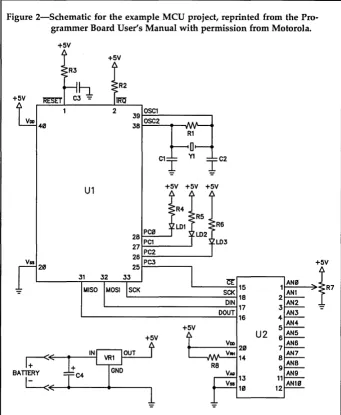
be-tween _these chips in my example design; for details, see Figure 2.
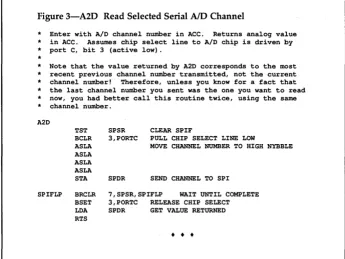
The Guide contains full source listings for the thermostat software; source code is also available from the Motorola FREEWARE BBS. The routine A2D (see Figure 3) contains all the 68HC705 code needed to interact with the MCI45041, using the circuitry shown.
The Example Project
I wanted a simple demo project, using
[image:14.595.210.551.34.448.2]12
MICRO CORNUCOPIA, #49, Sept-Oct 1989Figure 2-Schematic for the example MeU project, reprinted from the Pro-grammer Board User's Manual with permission from Motorola.
+5V
R3
+5V
VrJO 40
+5V
2 39 OSCl
38 OSC2 Rl
C1
T
Y1T
C2U1
pc"
28 PC1 27
26 PC2
PC3 Va
20 25
+5V
IN
r+
BATIERY C4
~~-~---.
+5V +5V +5V
R4 R5 LD1 R6
LD2 LD3
~
SCI<
DIN Dour
+5V
R8 15 18 17 16
U2
;
~~~
3 AN2l
~~1
11 AN9 12 AN1B
Wiring layout is not critical; a Radio Shack experimenter's board (276-168A) works well. Use high-quality sockets for both ICs. The battery voltage can be between 8 and 30 volts.
the 'HC705 MCU and the MC145041 se-rial AID. SO, I defined a small,
one-chan-nel voltage sensor.
The sensor samples channel 0 of the
AID once per second. The AID returns
an 8-bit value from $00 to $FF. Depend-ing on the value returned, a specific two-LED pattern will be displayed: if the value lies from $00 to $3F, a green LED lights; if the value lies from $40 to $7F, the green LED blinks once per second; if the value lies from $80 to $BF, a red LED lights; if the value lies from $CO to $FF, the red LED blinks once per second.
I wrote the assembly language code on my PC clone, using the SideKick notepad editor. The PC-based AS5 as-sembler, available from the Motorola FREEWARE BBS, took care of assem-bling the code. I then used the PROG7 interface program to move the code into the 'HC705 EPROM.
The project's software uses less than 256 bytes of EPROM, but offers consider-able flexibility and power. It should serve as an excellent starting point for other micro-controller projects. (You'll find a lot of example 'HC705 programs on the FREEWARE BBS.)
The A2D routine shows how to con-trol the AID converter chip with the
MCU. Upon entry, the accumulator (ACC) should hold the channel number in the low nybble.
An Example
Let's say you've just read AID
chan-nel 1 and now you're asking for data from channel 2. When you ask for chan-nel 2, A2D returns the voltage reading from channel 1. This is most important-a cimportant-all to A2D does not return the re-quested channel's value, but the value of the previously requested channel.
-OEST Facsimile Pac™
The
B&!!
thing, as reviewed in PC Magazine, April 11, 1989.
Features:
1CFull CCITI Group III
(9600 baud)capability
1CTrue Background operation
1CTelephone port
1CKeeps daily activity log
1CStores speed dial numbers
1CAutomatic requeuing, Broadcast mode
1CCompatible with IBM PC™
xTfM
ATTM
PS/2 Model 30™ and compatibles
SPECIAL·
PURCHASE!
1CDEST scanner input
SORR
1<3.5" and 5.25" Software diskettes
t
"'0
II..I..US.,.,
.
114
7'/
0,",
~V~/'
...
~131..~!
1CPOP-Up Menu for ease of use
*Comprehensive instruction manual
Now, for the cost of a clone, the real thing, a full featured fax card that supports a
wide variety of printers (Epson-Okidata-HP LaserJet+ (150
&
300 dpi) and others).
Incoming fax can be printed during reception, spooled, or saved to disk for selective
printing after review on your graphics display.
This single slot card is supplied with the normally
optional
Hayes TM compatible
300/1200 baud plug-on modem to permit sharing the same phone line between the
FAX and your normal modem tasks.
This is not some OEM packed unit, It is the real thing,
(current list price $995.00)Our.
low price is
$379.00
(optional 300/1200 baud modem provided at no additional cost!)Quantities are limited. Order Now!
REQUIRES DOS 2.0 AND ABOVE. DEDICATED PRIVATE RJ-11 SINGLE PHONE LINE. 640K RAM. HARD DISK. GRAPHIC DISPLAY (CGA EGA.OR HERCULES TM)
ALSO AVAILABLE AT HSC ELECTRONIC SUPPLY OF SACRAMENTO (916) 338-2545 AND
HSC
ELECTRONIC SUPPLY OF SANTA ROSA (707) 792-2277Toll Free (Orders Only) California Residents HSC FAX Line
HSC Electronic Resource BBS Customer Service
(SOD) 4-HAL TED (408) 732-1573 (408) 732-6428 (408) 732-2814 (408) 732-1854
~~~'~II0/l/89
I
Shipping: UPS Surface unless otherwise spociliod by purchaser. "Ultems subjf!ctlo prior sale. Orders shipped by means olher than UPS Surface will be althe prevailing carrier rale plus $5.00 surcharge. All orders under $20 subjeclto $2.00 fee, our minimum order is $10 + shipping. All orders shipped FOB Santa Clara. California. Orders 10 APO and FPO addresses are
shipped via U.S. Maif. Reader Service Number 11 (l) 1989 HSC Electronic Supply a Hailed Specialties Company
A2D, first clears the SPI data transfer flag by reading the SPI status register. It
then pulls the AID chip enable line low by clearing bit 3 of MCV port C. Next, the AID moves the channel number to the high nybble as expected. The MCV
transmits the channel number to the
AID by writing to the SPI data register. The loop at SPIFLP simply waits for the data transfer flag to go true, indicat-ing that the two chips have exchanged data. The MCV then pulls the chip enable line high, deselecting the AID. Fi-nally, the byte transferred from the AID
loads into' the ACC and control returns to the calling program.
This, explains why the AID always lags the MCV by one conversion. Each SPI operation exchanges data between the MCV and the AID. Following the ex-change, the AID reads and converts the voltage, on the newly selected channel. The vaiue it reads on that channel isn't returned to the MCV until the next SPI exchange.
Burning And Testing
Once you've written the software, it's time to: download the program into the
MCV's EPROM. I hooked up my 'PGMR
board to the PC, started the PROG7 pro-gram and applied power to the 'PGMR unit. It only took a few minutes to bum
the MCV's EPROM.
After programming the MCV, I in-stalled it in my test board (see Figure 2). I hooked' up a Radio Shack experimenter's board as a test bed, using a 5K poten-tiometer across V dd and ground for my
voltage input to the AID chip.
Applying battery power caused the
MCV to go through its reset sequence; it immediately began running my program. If I varied the setting on the potentiome-ter, the LEDs blinked in the appropriate pattern. I measured the followin
p
vol-tages, using an analog YOM: 1 Sthre-shold (green LED starts blinking) = 1.2 volts; 2~a threshold (red LED lights) = 2.4 volts; 3rd threshold (red LED starts blink-ing)
=
3.7 volts; full scale voltage (analog reference voltage)=
5.0 volts.I need to stress a point about CMOS circuit design. Motorola recommends that you tie all unused input pins of the
MCV to V dd through 10K resistors. Several. such pins exist in the example design, but the schematic does not show any pullups.
While you can usually get away with this in the prototype stage of noncritical designs, it' is.not good practice. Your pro-ject is more vulnerable to static damage
[image:16.595.207.552.29.287.2]14
MICRO CORNUCOPIA, #49, Sept-Oct 1989Figure 3-A2D Read Selected Serial AiD Channel
* Enter with AID channel number in ACC. Returns analog value
* in ACC. Assumes chip select line to AID chip is driven by
* port C, bit 3 (active low). *
* Note that the value returned by A2D corresponds to the most
* recent previous channel number transmitted, not the current * channel number! Therefore, unless you know for a fact that
* the last channel number you sent was the one you want to read
* now, you had better call this routine twice, using the same * channel number.
A2D
TST SPSR CLEAR SPIF
BCLR 3,PORTC PULL CHIP SELECT LINE LOW
ASLA MOVE CHANNEL NUMBER TO HIGH NYBBLE ASLA
ASLA ASLA
STA SPDR SEND CHANNEL TO SPI
SPIFLP BRCLR 7,SPSR,SPIFLP WAIT UNTIL COMPLETE BSET 3,PORTC RELEASE CHIP SELECT LDA SPDR GET VALUE RETURNED RTS
and may draw significantly more cur-rent.
Talk About Support
Motorola is really supporting the 6805 family. I purchased the 'PGMR develop-ment board through my local Motorola distributor for less than its normal $168.05 (a promotion by Motorola). Even at list, this development board is a bar-gain. Any shop building custom MCV
projects should check out this system. I have mentioned the FREEWARE BBS often; Motorola sponsors this BBS as a way to distribute technical information, software, support tools, and literature updates. You can access the BBS at (512) 891-3733. It uses the standard eight bits, no parity, one stop bit at 300, 1200, or 2400 baud.
The BBS carries a variety of well-writ-ten software modules for many different 68xx(x) machines. For example, you can find the source code for the Motorola BVFFALO monitor for the 68HC11; a full floating-point package for the 'HC11 and 6809; cross-assemblers for chips from the 6800 to the 68HC11; even a few fully-developed MCV designs, complete with source code. If you're interested in the Motorola chips, be sure to try this BBS.
Motorola also carries quite a library of application notes on the 6805 family. Some sample titles include:
A General Purpose Frequency Counter Using an M6805 HMOS/M146805 CMOS Family Microcomputer (AN885)-describes
a five-chip frequency counter using
four-•
•
•
digit LED display. Gives schematic and full assembler source code.
Telephone Dialing Techniques Using the MC6805 (AN940)-shows how to use an
MCV as a telephone dialer. Covers pulse and DTMF dialing. Includes schematic and assembler source code.
You should be able to order applica-tion notes from your local Motorola dis-tributor. You can also contact:
Motorola Literature Center P.O. Box 20912
Phoenix, AZ 85036
Where From Here?
I've become fascinated by the power available in such a small package. Build-ing instruments such as VOMs and frequency counters would be a snap. Be-cause the 'HC705 directly interfaces to switch matrices and multi-character LCD displays, you can easily build a large-dis-play digital meter that monitors up to 11 voltages, using only two chips.
The FREEWARE BBS and application notes provide more design possibilities and information than I have time to deal with right now. However, I know I'll stay with this chip for a while. There is simply too much serious fun here to pass up!
Editor's Note
for prototype boards and parts and asked if they carried Motorola's 6805 develop-ment kit.
"Nope." responded Phil Clyde. "But we have something you might like better. It's the Hitachi 68P05V07 with a built-in piggyback socket."
It turns out that the chip is compatible with Motorola's 6805 but you don't need a custom development kit. You just bum your code into a standard 2732 and piggy back the ROM onto the 68P05. To change the code you bum a new ROM. Plus, the chip costs only $19.95.
Hitachi has a data book and a pro-gramming book for this new release and I understand they supply cross assem-blers that run on the PC as well as sample 6805 code.
Anyway, once you finish the proto-type, whether it's on the Motorola development board or on the Hitachi piggyback version you have quite a number of options.
Both Motorola and Hitachi make a plethora of code-compatible parts in CMOS or NMOS, flat packs or dips-all available with more I/O lines, fewer I/O lines, more fast, less fast, more internal
RAM, less internal RAM.... You get the picture.
For more information on the Hitachi 68P05 contact Phil Clyde at United Pro-ducts 206-682-5025 or:
Hitachi America Ltd.
2210 O'Toole Ave San Jose, CA 95131
(408) 435-8300
Additional Information
CMOS/NMOS Special Functions
Data-Motorola publication DL130.
Technical Summary:
MC68HC705C8-Motorola publication BR594/D.
M68HC05 Microcontroller Applications Guide-No Motorola publication number
available; contact the Motorola Literature Distribution Center (address above).
Microprocessor, Microcontroller and Pe-ripheral Data, Volume l-Motorola
publi-cation DL139.
M68HC05PGMR Programmer Board User's Manual #2-Motorola publication
M68HC05PGMR2/D1.
• • •
REFURBISHED SEAGATE HARD DRIVES
ST-125
ST-125N
ST-138
ST-138R
ST-138N
ST-151
ST-157N
ST-157R
ST-225
ST-225N
ST-225R
ST-238R
ST-250R
ST-25l
ST-25l-l
ST-251N
ST-277R
ST-277N
ST-277R-l
ST-296N
ST-4053
ST-4096
ST-4l44R
20
20
30
32
32
40
49
50
20
21
21
30
40
40
40
40
65
65
85
85
40
80
122
Meg
Meg
Meg
Meg
Meg
Meg
Meg
Meg
Meg
Meg
Meg
Meg
Meg
Meg
Meg
Meg
Meg
Meg
Meg
Meg
Meg
Meg
Meg
MFM
SCSI
MFM
RLL
SCSI
MFM
SCSI
RLL
MFM
SCSI
RLL
RLL
RLL
MFM
MFM
SCSI
RLL
SCSI
RLL
SCSI
MFM
MFM
RLL
HH
HH
HH
HH
HH
HH
HH
HH
HH
HH
HH
HH
HH
HH
HHHH
HH
HH
HH
HH
FH
FH
FH
28MS
28MS
28MS
40MS
40MS
40MS
40MS
40MS
65MS
70MS
65MS
65MS
70MS
40MS
28MS
40MS
65MS
65MS
28MS
28MS
28MS
28MS
28MS
$175.00
$230.00
$215.00
$195.00
$235.00
$315.00
$270.00
$235.00
$160.00
$195.00
$150.00
$160.00
$190.00
$240.00
$260.00
$290.00
$275.00
$325.00
$310.00
$370.00
$310.00
$410.00
$500.00
Listed above are refurbished SEAGATE
hard drives.
Warranty on these units
is 90 days or the remainder of the
factory warranty, whichever is greater.
Most drives have six (6) months plus
remaining warranty.
THE ABOVE DRIVES SUBJECT TO STOCK
ALL SALES FINAL ON REBURISHED DRIVES
Controllers and cables in stock.
Please call for current price.
MODEL
MODEL
MODEL
MODEL
MODEL
MODEL
MODEL
CITIZEN PRINTERS
120 CPS
9"
180 CPS
9"
124 24 PIN
9"
224 24 PIN
15"
240 CPS 15"
120D
180D
TRIBUTE
TRIBUTE
MSP-45
MSP-50
MSP-55
300 CPS
9"
300 CPS 15"
$
155~00$ 175.00
$ 359.00
$ 599.00
$ 399.00
$ 279.00
$ 379.00
CASCADE ELECTRONICS, INC.
ROUTE 1
BOX 8
RANDOLPH, MN
55065
507-645-7997
Please ADD Shipping on all Orders
COD Add $3.00
Credit Cards ADD 5%
MN Add 6% Sales Tax
Subject to change
Reader Service Number 15
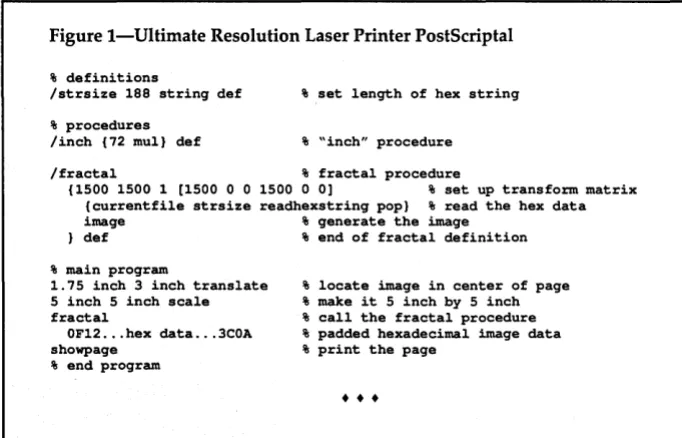
PostScriptals
Ultimate Fractals Via
PostScript-A Cover Story
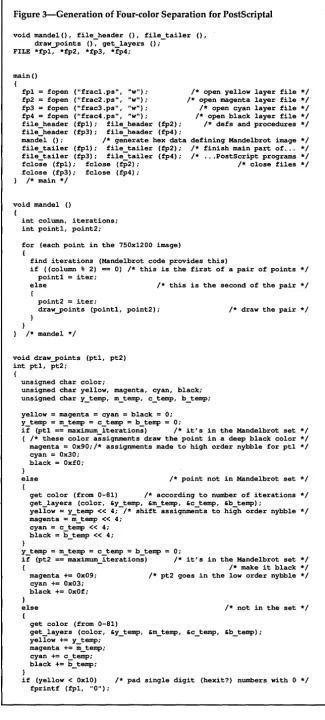
Larry's created the ultimate fractal-2540 dots per inch. (Unfortunately our print shop couldn't reproduce that kind of resolution, so we toned it down for the cover.) Here's how Larry created it.
I
t's hard to say when the notion first occurred; notions have a habit of sneaking in the door when I'm not paying attention, and later announcing their presence with a rude, "Where's dinner?" But sometime in the not too distant past, very high resolution printed output and fractals got linked up in my head.See, the good folks at Salem Type (the ones responsible for typesetting Micro C)
use a Linotype Linotronic 300, capable of printing 2540 dots per inch. That metal monster digests PostScript quite happily, and didn't I see some PostScript manuals
16
MICRO CORNUCOPIA, #49, Sept-Oct 1989lying around the office somewhere? Think of it: 2540 d pi. Figure one of them fancy graphics cards displays 2K dots on a screen that measures around
10". That's something like 200 dpi. You can see why I started to daydream about printing the highest resolution fractals
ever seen by earthlings. Right here on the
cover of Micro C, too. Of course, it didn't quite tum out that way. So just slide your lawn chairs on up to the campfire and I'll tell you all about it.. ..
PostScript
'What's a PostScript anyway," you ask. "And shouldn't it be at the end of this article?" Not really. PostScript is a page description language used to com-municate with electronic printing devices. PostScript can describe all manner of graphic shapes, binary images, and printed text (in any orientation).
We use Ventura Publisher to generate
PostScript output describing the pages of
Micro C.
I never thought I'd be doing anything
remotely FORlH-like, but you can't talk
about PostScript without at least men-tioning FORTH. That's because Post-Script, like FORlH, is a stack-oriented language. Pascal, C, and many other high level languages might
say-c
=
a + bwhere a, b, and c all have distinct loca-tions in memory, apart from the stack.
But in PostScript, we
have-a b have-add
PostScript strives to be device inde-pendent. And, as far as I can tell, it succeeds very well-no mean achieve-ment in the world of hard-copy output devices. It does this by means of a Post-Script interpreter within each printer. The interpreter hides all device dependencies, giving your PostScript code true portabil-ity.
You can change a device's default par-ameters from within your program, thereby mucking up the program's porta-bility. And, of course, that's exactly what
we'll do. But, I'm getting ahead of my story.
The Basics
Adobe Systems created PostScript and wrote three books that make up the Post-Script Rosetta stone. They do read a bit like an IBM Technical Reference, but with a much better plot. (Anyone who quotes Woody Allen and Napoleon in the same book can't be all bad.) If you want to do serious work with a PostScript applica-tion, buy these books.
To work! Let's build the cover
illustra-tion for this issue of Micro C. Press-folk
need alignment lines-called crop
marks-to keep the work from being printed sideways. So first we need line drawing capability.
PostScript defines a page with origin at the lower left comer, a comfy spot for the mathematically inclined among us. The default measure is the point, with 72 , points to the inch. Printers like points, but I grew up with inches. The PostScript
line--linch {72 mull def
By
Larry
Fogg
Micro C Staffteaches the interpreter the meaning of inch. The slash keeps the interpreter from interpreting inch. Instead, both "inch" and "{72 mu!}" get pushed onto the stack for use by the def operator. def pops the two arguments off the stack and pushes them onto another stack called the current dictionary .
We've just created a PostScript proce-dure. The curly brackets delimit the pro-cedure body. The next time the interpre-ter sees something like "5 inch," it pushes 5 onto the stack, searches through
the current dictionary until it finds "inch," and pushes its definition onto the stack also. So, "5 inch" becomes "5 72 mul," or 360 points. Just right.
Variable assignments work the same way.
Ipi 3.1416 def
assigns a value to pi in the current dic-tionary.
The term current dictionary implies that not-so-current dictionaries exist. That's the way the scope of variables and
procedures can be controlled; variables and procedures exist only within the dic-tionary of their birth.
Line Drawing
To draw a line in PostScript, we deal with paths. The following code draws the first crop mark in the lower left comer of the page.
newpath
0.01 inch setlinewidth 1 inch 0.9 inch moveto
o inch -0.5 inch rlineto 0.9 inch 1 inch moveto
-0.5 inch 0 inch rlineto
stroke showpage
The newpath initialization deletes any path that might be lurking about. set-linewidth overrides the default width for lines. moveto does just what you'd ex-pect. It takes the x-coordinate (1 inch), then the y-coordinate (0.9 inch) and moves to that position. (This x,y order for parameters remains consistent for all PostScript operators.)
rlineto stands for "relative line to" and constructs a line path to a point 0 inches along the x-axis, and -0.5 inches along the y-axis, relative to the point we moved to in the third line of code. You can also use an absolute coordinate version called lineto. But I prefer rlineto since you never really have to know where you are.
By the way, don't yield to the tempta-tion to code something like "NewPath"; PostScript's case sensitivity will shoot you down in flames.
stroke actually draws the line; until now it was defined, but invisible. As you can see from the example, a path need not be connected. Finally, showpage out-puts our efforts to the printer-at least it does in theory.
The Un-text File
PostScript interpreters take pure ASCII text. I made the rash assumption that my trusty Turbo Pascal editor could generate PostScript programs. Well, it can-except for the last byte.
When I found that even a single line