No. 11-17 Washington, DC, 16 November 1992
Chemical and Biological
Contamination Avoidance
Table of Contents
Change 1 HEADQUARTERS DEPARTMENT OF THE ARMY Washington, DC, 29 September 1994
Chemical and Biological Contamination Avoidance
FM 3-3/FMFM 11-17, 16 November 1992, is changed as follows: 1. New or changed material is indicate by a BAR ( ).
US MARINE CORPS
2. Distribution restriction statement identified on this change replaces the one shown on basic publication dated 16 November 1992.
3. Remove old pages and insert new pages as indicated below: 4. File this transmittal sheet in front of the publication.
Remove Old Pages Insert New Pages
1-5 thru 1-6 1-5 thru 1-6
2-1 thru 2-2 2-1 thru 2-2
2-3 thru 2-4 2-3 thru 2-4
3-3 thru 3-4 3-3 thru 3-4
3-5 thru 3-6 3-5 thru 3-6
3-9 thru 3-10 3-9 thru 3-10
3-11 thru 3-12 3-11 thru 3-12
3-13 thru 3-14 3-13 thru 3-14
3-15 thru 3-16 3-15 thru 3-16
3-17 thru 3-18 3-17 thru 3-18
3-19 thru 3-20 3-19 thru 3-20
3-21 thru 3-22 3-21 thru 3-22
4-1 thru 4-2 4-1 thru 4-2
4-13 thru 4-14 4-13 thru 4-14
4-15 thru 4-16 4-15 thru 4-16
5-3 thru 5-4 5-3 thru 5-4
5-11 thru 5-12 5-11 thru 5-12
5-17 thru 6-0 5-17 thru 6-0
A-15 thru B-0 A-15 thru B-0
B-1 thru B-2 B-1 thru B-2
Glossary-1 thru Ref-0 Glossary-1 thru Ref-0 Ref-1 thru Index-0 Ref-1 thru Index-0
DISTRIBUTION RESTRICTION: Distribution is authorized to US government agencies only to protect technical or operational information from automatic dissemination under the International Exchange Program or by other means. This determination was made 2 May 1994. Other requests for this document will be referred to Commandant, US Army Chemical School, ATTN: ATZN-CM-FNB, Fort McClellan, AL 36205-5020.
Official:
MILTON H. HAMILTON Administrative Assistant to the
Secretary of the Army
07244
GORDON R. SULLIVAN General, United States Army
Chief of Staff
By Order of the Marine Corps:
CARL E. MUNDY, JR. Commandant United States Marine Corps
DISTRIBUTION:
Active Army, USAR, and ARNG: To be distributed in accordance with DA Form 12-11 E,
Preface
The mission of the Chemical Corps is to prepare the Army to survive and win in a Chemical and Biological (CB) warfare environment by
-Developing doctrine, organizations, training products, and equipment for CB defense, chemical retaliation, and smoke and flame operations.
Minimizing the impact of CB weapons through contamination avoidance, protection, and decontamination.
Employing smoke. Employing flame.
This manual is one of five that explains the fundamentals of NBC defense:
FM 3-3, Chemical and Biological Contamination Avoidance.
FM 3-3-1, Nuclear Contamination Avoidance. FM 3-4, NBC Protection.
FM 3-5, NBC Decontamination. FM 3-7, NBC Handbook
A general overview of these fundamentals is given in FM 3-100, NBC Operations. This manual, FM 3-3, defines and clarifies the entire process of CB contamination avoidance. Another manual, FM 3-3-1, outlines contamination avoidance procedures for nuclear operations. This manual has limited distribution specially for separate brigades, division, and corps level NBC Control Centers. Unless otherwise stated, whenever the masculine gender is used, both men and women are included.
FM 3-3 details the NBC Warning and Reporting System, how to locate and identify CB contamination, and how to operate in and around NBC contamination. This manual is designed and intended to be an
easy-to-read, step-by-step manual depicting the manual method of calculating CB contamination avoidance procedures for chemical officers and NCOs. However, subject matter discussed in Chapters 1 and 2 and Appendices A and C are of general use for all branches and MOS.
Chapter 1 defines the CB Threat, how to reduce unit vulnerability, and implements STANAG 2984, graduated levels of NBC Threat and minimum protection.
Chapter 2 defines how we warn our troops of an enemy CB attack and how we warn of a friendly chemical attack.
Chapters 3, 4, 5, and 6 detail procedures for detecting, identifying, evaluating and plotting hazards while operating in an CB environment. These chapters are essential for battalion, brigade, and division chemical personnel.
Appendix A provides operational situation guidelines for the principles of contamination avoidance in the form of a checklist.
Appendix B provides supplemental information on biological agents and a list of country codes used in processing biological samples.
Chemical personnel must be familiar with and be able to apply the information in this manual.
The proponent of this manual is the U.S. Army Chemical School. Submit changes for improving this publication on DA Form 2028 (Recommended Changes to Publications and Blank Forms) and forward to:
Commandant
US ACML&MPCEN&FM ATTN: ATZN-CM-FNB 5th Avenue, Bldg 1081
Fort McClellan, AL 36205-5020.
Introduction
Contamination avoidance is the best defense against enemy use of chemical and biological (CB) weapons. Avoidance reduces the risk of being targeted by CB agents and minimizes the effects of CB contamination hazards. Knowing where contamination exists or how long the hazard may persist is essential to avoiding the hazard. Enemy use of CB weapons make battlefield operations more difficult and time consuming. Combat, combat support, and combat service support operations may be more difficult to perform in a CB environment. Tasks/missions may take more time, but they require prior training in Mission Oriented Protective Posture (MOPP) gear because of the problems created by CB contamination. CB attacks may cause casualties, materiel losses, and creation of many obstacles. Training will reduce the problems caused by CB attacks on the unit. Units must locate clean areas as well as locate contamination in an CB environment. Contaminated units will have to perform decontamination (decon) operations.
To survive and accomplish the mission, individuals and units must take precautions to avoid or minimize effects of initial and residual CB hazards. The threat of contamination may force individuals and units into MOPP gear or into collective protection. Wearing MOPP gear results in heat buildup and degrades individual performance. Using collective protection requires special procedures that are time consuming. See FM 3-4 for information on what measures or steps an enemy CB attack may affect friendly forces. FM 3-3 outlines how to anticipate an enemy CB attack and minimize the effects on friendly forces.
Contamination Avoidance
There are four steps to contamination avoidance: implement passive defensive measures, warn and report CB attacks, locate, identify, track and predict CB hazards, and limit exposure to CB hazards. If the mission permits, avoiding CB hazards completely is the best course of action. This is not always possible. The mission may force you to occupy or cross a contaminated area. This manual outlines procedures to use when working or training to work in a contaminated environment. Using these procedures, which are summarized by the four steps of contamination avoidance, units can minimize performance degradation.
Implement Passive
Defensive Measures
Passive defensive measures are those measures taken to reduce the probability of being hit by a CB attack or, if hit, to reduce the effects of the attack. Operational security measures such as good communication procedures, light discipline, and good camouflage reduce the chances of a unit being targeted. Dispersion, hardening of positions and equipment, and using overhead cover reduces the effectiveness of an attack. Passive measures are discussed in more detail in Chapter 1.
Warn and Report
Once a CB attack has occurred everyone who might be affected by the hazard must be warned. This gives units time to protect themselves against a possible hazard. The NBC Warning and Reporting System (NBCWRS) is used for warning and reporting CB hazards. These messages and their use are standardized and kept simple so they can be passed rapidly and be easily understood. The NBCWRS is discussed in Chapter 2. The Automated NBC Information System (ANBACIS) will assist in speeding this process.
Locate and Identify,
Track and Predict
NBC Hazards
By locating, identifying, tracking, and/or predicting CB hazards, commanders can make informed decisions for operating in or around NBC hazards. Planning CB reconnaissance is discussed in Chapter 5. Tactics and techniques of CB reconnaissance are contained in FM 3-19, NBC Reconnaissance. Techniques for predicting CB hazards are given in Chapters 3 and 4. A portion of ANBACIS provides for the automatic calculation of hazard areas due to chemical or biological weapons using or creating all NBC 1 through NBC 5 Reports.
Limit Exposure
for such crossings and FM 3-19, NBC Reconnaissance, describes the techniques for finding the best crossing route.
Protection and
Decontamination
If a unit is unable to avoid CB hazards, the individual soldier and unit must take protective measures. Actions that minimize equipment losses and limit the spread of contamination are discussed in this manual. Measures taken to aid in protection are covered in FM 3-4.
If a unit is unable to avoid contamination, then some form of decon will be necessary. Decon reduces the immediate CB hazard. It may allow troops to reduce their MOPP level and operate in a contamination-free environment. Decon is discussed in FM 3-5.
Tactical Considerations
If CB weapons are used, individual and collective protective measures must be taken. Time-consuming and manpower-intensive tasks such as CB reporting, and chemical recon, surveys, and decon may be necessary.
Mission
CB contamination forces the commander to reconsider how best to accomplish the mission with the available resources. The commander has five options. In order of preference, these are:
First, do the mission in a clean area. The commander must decide whether the mission can be accomplished while staying out of contaminated areas.
Second, do the mission in a contaminated area using a higher MOPP level, but take more time.
Third, do the mission in a contaminated area using a higher MOPP level, and use more soldiers or equipment. Fourth, delay the mission until the contamination has weathered.
Fifth, do the mission in the same amount of time with the same number of soldiers, but take a greater risk by using a MOPP level that does not provide maximum protection.
Enemy
In addition to trying to determine what the enemy plans to do, the commander also must determine how and where the enemy is most likely to use CB weapons. For example, if the enemy is attacking, expect biological agents (pathogens) to be used as early as one to two weeks prior to the attack. Expect nonpersistent chemical agents and biological toxins to be used against front-line units, and persistent agents and toxins to be used on
combat service support units and to protect the flanks of attacking maneuver units by contaminating the terrain to restrict movement.
Terrain
Terrain modifies CB weapons’ coverage. Hills disrupt the normal dispersion of chemical and biological agents.
Troops
The physical condition of troops is very important. Tactical decisions must consider how troops will be affected. CB weapons and wearing MOPP 4 impacts psychologically and physiologically on troops.
Time
Tasks may take longer in a CB environment. Routine tasks may be more difficult when troops are in MOPP gear if they have not been trained to do them. Adding CB requirements to conventional recon adds time to the mission. Decon operations are also time-consuming.
Anticipating the timing of CB attacks is important. Chemical and biological attacks are most likely to occur during the night and early morning or evening hours.
Training
Commanders must understand the importance that training has on a soldier’s and unit’s ability to complete the mission. When troops are well trained, they can survive and fight on a contaminated battlefield. Poorly trained troops may not be able to recognize a CB attack, and be less conditioned to wearing MOPP gear for extended periods. Well-trained troops can do their jobs, while in an CB environment. They know tasks take longer while wearing MOPP gear, but are able to adjust their procedures and/or work rate accordingly.
Chapter 1
Vulnerability Analysis
The focus of this field manual is Chemical and Biological (CB) Contamination Avoidance. Like most concepts in the Army, contamination avoidance is a process. This process involves—
Assessing the threat facing friendly forces. Identifying whether friendly units are a target. Understanding the field behavior of CB contamination.
Locating CB hazards on the battlefield.
By identifying and locating CB hazards on the battlefield, units will be able to either avoid the hazard or implement those protective procedures outlined in FM 3-4 to minimize the effects of the hazard on unit performance.
However, before we begin the discussion of contamination avoidance, we must first discuss two critical, often overlooked, aspects of successful operations on the contaminated battlefield. These two aspects are CB threat assessment and vulnerability analysis. Both are described in this chapter.
The CB threat now and in the future will be global from low to high intensity. Terrorists may be encountered at any level of conflict. The proliferation of CB capable nations in all contingency regions and the availability of toxic CB materials increase the liklihood of US forces being direct or inadvertent targets of attack. These attacks may range from limited use in terrorist actions to planned targeting in support of military operations.
As Chapter 1 of FM 3-100 points out, CB proliferation is increasing. Deploying US forces must be capable of accurately assessing the CB threat imposed by the opposing force and be capable of addressing unit vulnerability to attack. Chapter 2 in FM 3-100 describes in detail how CB agents may be used and how their use may shape the battle.
When planning operations, commanders must consider the potential effects of CB weapons on personnel and equipment. In conventional operations, concentration of forces increases the chance for success, but this same concentration increases the effects of CB attacks and the likelihood of their occurrence. Consider the timing of force concentration to reduce the effects from a CB attack.
To assess a unit’s vulnerability to CB attack, the commander determines how well protected the unit is
and the type and size of weapon likely to be used against it. The commander then weighs various courses of action and determines which presents an acceptable risk to allow accomplishment of the mission. This whole process starts with the Intelligence Preparation of the Battlefield (IPB) with an initial assessment of the CB threat.
The IPB Process
The IPB process is a staff tool that helps identify and answer the commander’s priority intelligence requirements (PIR), it’s part of the operational planning that is necessary for battle management.
IPB is initiated and coordinated by the S2 and used to predict battlefield events and synchronize courses of action. IPB is designed to reduce the commander’s uncertainties concerning weather, enemy, and terrain for a specific geographic area in a graphic format. It enables the commander to see the battlefield: where friendly and enemy forces can move, shoot, and communicate where critical areas lie; and where enemy forces (and his own) are most vulnerable. IPB guides the S2 in determining where and when to employ collection assets to detect or deny enemy activities. These assets, working collectively, fulfill intelligence requirements and answer the PIR. IPB is the key for preparing for battle. It analyzes the intelligence data base in detail to determine the impact of enemy, weather, and terrain on the operation and presents this information graphically. It is a continuous process which supports planning and execution for all operations. IPB consists of a systematic five-function process involving—
Evaluation of the battlefield (areas of operation and influence).
Terrain analysis. Weather amlysis. Threat evaluation. Threat integration.
On the battlefield, units will have incomplete intelligence concerning enemy chemical and biological capabilities and/or intentions. However, commanders, must ensure that the IPB becomes an integrated process through which key members of the staff contribute. IPB is a process involving intelligence and operations personnel. It must also be integrated
Chemical officers and NCOs, in coordination with the S2/3, must address CB warfare during all phases of the battle. This is accomplished only by direct participation in the IPB process. Working with the S2, the chemical staff should—
Template potential chemical targets or areas of contamination.
Designate templated areas that effect the scheme of maneuver as named areas of interest (NAI).
Include NAIs into the collection plan and identify indicators.
Include designated NAIs into the reconnaissance and surveillance plan (R&S) and designate responsibility for confirming or denying the template.
Using the IPB process, the chemical officer/NCO provides the commander updates on the CB situation, as well as flame and smoke operations.
Based on the time periods of interest, the chemical staff will provide the battle commander with—
Detailed information on enemy CB capabilities based on the type of units and weapons the enemy has available in the area of operations/area of influence (AO/AI) during a selected time period.
How the enemy would employ chemical, biological, flame, or smoke to support his battle plan.
Areas of likely employment based on threat employment doctrine.
Detailed analysis of terrain and weather in the unit’s AO during each period of interest and how they could impact on CB, flame, and smoke warfare.
MOPP guidance for each period of interest (such as, minimum MOPP, automatic masking).
Alternative actions the commander can initiate prior to the phase time line in question so as to minimize degradation of forces.
Continuous monitoring of intelligence messages and radio traffic for any CB related information which could be important to the unit’s mission.
It is important that the chemical officer/NCO be succinct during the commander’s briefing or have his information presented by the S3 during his portion of the briefing. Therefore, for input to be addressed, chemical personnel must be a player in the IPB process. Although it is developed under the direction of the S2, once completed, the decision support template (DST) becomes an operational document and is briefed to the commander by the S3. As active participants in the IPB process, the CB concerns will be included in the threat analysis and shown usually on the IPB template. It is through this participation that the chemical staff best serves the commander as special staff warfare experts, for the appropriate templates of IPB process will include CB concerns and visually present them, in a
user-friendly manner, to the commander.
During battle management activities, the chemical staff advisor works with the S2 on the IPB. He coordinates with the intelligence officer to analyze and identify chemical targets based on threat, terrain, and the AO. Potential threat chemical targets could be key terrain, choke points, command and control facilities, counterattack routes, mobility corridors, troop concentrations and rear area assembly points.
A CB vulnerability assessment constitutes an important part of battlefield assessment and risk analysis and is a primary means through which the chemical staff advisor participates in the battlefield assessment process.
In this assessment, the chemical officer must develop information for integration into the various staff estimates. From the S2, the chemical officer/NCO obtains—
Time period of interest.
Threat probable courses of action and intent.
Names areas of interest (NAIs) and target areas of interest (TAIs).
Summary of enemy activity, including any CB attacks, movements of CB equipment or material, or presence and level of training of threat forces, and indicators of enemy CB warfare comments such as queuing up weather radar.
Specific items of interest from the S2 would be: Direction and speed of prevailing winds.
Average temperature and humidity and how these weather conditions may effect CB warfare agents, terrain, availability of water sources, transportation assets (railways, airfields, road networks) available for shipment of CB munitions, and the availability and location of industrial assets capable of producing and/or weaponizing CB warfare agents, availability of CB agents and delivery systems, and location of stockpiles.
From the Fire Support Officer (FSO), the chemical officer obtains information on casualty percentages from friendly and threat conventional munitions. Examples of information obtained might include—
Casualty percentages based on target size Casualty percentages based on weapon systems The chemical staff should also prepare a list of information that is compiled from various sources (news bulletins, spot reports, intelligence summaries (INSUMs), and is general in nature. This information, when viewed as a single event, may appear to be meaningless. However, when added to other pieces of information it may provide the key that connects the information and present the best view of the enemy’s intent. Items of general information include, but is not limited to the following—
Availability of CB defense equipment to enemy
forces. If no protective equipment is available (such as MOPP, antidotes, masks) it may indicate that the enemy does not intend on using CB weapons.
Amount of overhead cover or collective protection shelters or systems; if enemy forces seek overhead cover or move into collective protection shelters, it may indicate that the enemy intends on using CB weapons.
Stated national policy or philosophy on the use of CB weapons. Has the enemy declared a no use, first use or limited use only for retaliation in kind policy? Does the enemy consider the use of flame or smoke as CB agents?
Leadership—Is the enemy’s national or military leadership willing to use CB weapons on their own territory or expose their own populations to the hazards generated from CB munitions?
If the enemy does not possess CB munitions, the capability to produce agents or expertise to employ munitions; have attempts been made to gain this ability? Reports indicating the presence of advisors from other nations working with enemy forces, international trade agreements or shipments of agricultural equipment (such as sprayers, fertilizers, insecticides or raw chemicals) may provide insight to the enemy’s intent.
Once information is gathered, it will provide input to the formulation of the CB Threat Status.
CB Threat Status
US forces may not have to carry CB defense equipment (such as MOPP) based on the initial threat estimate. If the threat condition were to change and indicators were present to suggest the possible use of CB agents by the threat forces, CB defense equipment would be deployed forward (such as division support area or to the brigade support area). These stocks may be prepalletized for immediate deployment by aircraft to the affected unit if required. However, this decision must be made based on available aircraft or other transportation systems. This could be done so that the forces would not have to carry the mission oriented protective posture (MOPP) ensemble in their field pack, ALICE (ruck sacks).
The minimum CB threat status is set at division or separate brigade level and is a flexible system determined by the most current enemy situation, as depicted by the continuously updated IPB process. This allows local commanders to increase the threat status as conditions change in their area of operations. Threat status governs the initial deployment of chemical assets (such as equipment or units) and the positioning of those assets on the battlefield or in the operational area. The CB threat status serial numbers are for planning purposes in accordance with STANAG 2984. These numbers, however, may be substituted for a color code (serial 0 =
white; serial 1 = green.). It does, however, require chemical personnel at brigade and division level to stay abreast of the intelligence picture. The CB threat status is outlined below—
a. Serial 0 (none).
1. The opposing force does not possess any CB defense equipment, is not trained in CB defense or employment and do not possess the capability to employ CB warfare agents or systems. Further, the opposing force is not expected to gain access to such weapons and if they were able to gain these weapons, it is considered highly unlikely that the weapons would be employed against US forces.
2. Under this status a deploying force would not have to carry CB defense equipment nor decon assets. However, protective masks should be carried. Chemical personnel should concentrate efforts in smoke,
herbicides, flame field expedients (FFE) and monitoring threat communication channels for CB threat indicators.
b. Serial 1 (low).
1. The opposing force has an offensive CB capability, has received training in defense and
employment techniques, but there is no indication of the use of CB weapons in the immediate future. This indication may be based on whether CB munitions are dispersed or deployed, or the stated objectives and intent of opposing forces.
2. Given this threat status, all personnel carry their individual defense equipment or chemical defense equipment stockpiles are identified and would be readily available for deployment to the operational area if the threat status should increase. NBC reconnaissance systems deploy to the operational area of interest to provide a monitoring capability. Chemical personnel continue to concentrate their efforts on NBC planning and analysis for threat indicators.
c. Serial 2 (medium).
1. The opposing force is equipped and trained in CB defense and employment techniques. CB weapons and employment systems are readily available. CB weapons have been employed in other areas of the theater. Continued employment of CB weapons is considered probable in the immediate future. Indicators would be—
CB munitions deployed to either field storage sites or firing units.
Enemy troops wearing or carrying protective equipment.
CB recon elements observed with conventional recon units.
CB decon elements moved forward.
issued to the soldiers responsible for use within the unit. Individual soldiers should beat MOPP levels 1 or 2; MOPP 0, if MOPP gear is readily available. Erect collective protection shelters if the tactical situation permits. Personnel and equipment should be kept under cover as much as possible to protect them from
contamination. Chemical Downwind Messages (CDMs) should be sent to subordinate units. Decontamination assets, CB recon assets and smoke support should be deployed as part of the force structure. Detection and monitoring (such as CAM) equipment should be issued to the operators. Unit should fill M11 and M13 Decontamination Apparatuses (DAP) and mount on vehicles.
d. Serial 3 (high).
1. The opposing force possesses CB warfare agents and delivery systems. CB defense equipment is available and training status is considered at par or better than that of the United States. CB weapons have already been employed in the theater and attack is considered imminent. Indicators are—
CB attack in progress but not in your area of operation.
CB warnings/signals to enemy troops.
CB munitions delivered to firing units within range of friendly forces.
Movement of surface-to-surface missiles to a launch site.
2. US forces should deploy with CB defense equipment in the unit load. Soldiers should either carry the overgarments in their rack sacks, CB bag, or wear the overgarments. This will depend on the CB threat to the airfield or port on which they land. Soldiers should change protective mask filters prior to deployment. Decontamination and CB recon assets should be task organized and moved forward. Contingency stocks of CB defense equipment may be moved forward to the battalion trains. CDMs are initiated and place collective protection systems into a state of readiness including those systems in combat vehicles.
This threat status can be used as a single number representing both C and B or as individual C and B statuses. It is possible to have a C status of three and a B status of zero. This threat status provides the commander with guidance for deployment and operational purposes. It allows the commander to tailor chemical units to fit any situation.
Threat status can change rapidly. Although a C status of zero may exist during deployment, the opposing force may seize industrial chemicals or obtain warfare agents from a sponsoring nation. Therefore, the ground commander must be capable of upgrading the CB defense posture quickly.
To assist in the formulation of the threat status, the chemical staff, (in conjunction with the S2) must analyze all information received. A tool in this analysis is the threat status matrix depicted in figure 1-1.
Use X’s to mark applicable boxes or degree of threat. Total columns and use serial number with largest number of X‘s as the current threat status.
More than one matrix may be necessary to determine the threat status for chemical and biological attack.
To use the matrix, place an “x” in the appropriate block. Add each column; and whichever column has the most “x’s” provides a means to identify what threat status serial number could be used to identify an indication of the enemy force intent. If an overall threat status cannot be determined due to an informational shortfall, collection assets should be reallocated or positioned to gain the needed information.
Once the threat status estimate has been assessed the chemical staff must analyze the protection level required for friendly forces. This is accomplished by using MOPP analysis—key factors include analyzing mission, environment, and soldier factors—as discussed in FM 3-4 and the factors listed below.
Understanding the mission and commander’s intent for friendly forces.
Capabilities and level of training of friendly forces. MOPP analysis and work degradation factors contained in FM 3-4.
Availability of chemical defense equipment and decontamination assets. In this regard, information may be obtained from the S2 or G5.
Other factors include—
Location and availability of desalination plants (for arid areas).
Location of civilian chemical manufacturing and storage facilities. Chemicals at these facilities may be used, through civilian contract, for supplementary decon supplies. Further, chemicals or hazardous materials stored in these facilities may produce areas of contamination if storage containers leak (either intentional or unintentional). To assess these hazards and how such a leak may impact on operations refer to Department of Transportation (DOT) Regulation 5300.3, Emergency Response Guidebook or the Department of Defense (DOD) Regulation 4145.19-R-1, Hazardous Materials Storage and Handling criteria.
Availability of civilian contracted labor and water transport for decon operations.
For urban areas, location of car washes. These car washes may be used in lieu of hasty decon stations. Obtain data on local fire hydrants (such as location, hookups). Hydrants may be used to provide water for decon operations.
The chemical staff must properly prepare the threat status and identify the protection level required for friendly forces to withstand an CB attack. This information is vital to the commander and for the successful accomplishment of the mission. The commander may be required to reallocate or position units on the battlefield to reduce vulnerability to an attack.
Chemical Vulnerability
Analysis
There is no difference in vulnerability analysis procedures between chemical agents and biological toxins. The following applies to both.
Unit vulnerability to a CB attack depends primarily on the protection the unit has taken and the type and amount of chemical agents delivered. For nonpersistent agents, the risk of casualties to units in MOPP 4 is negligible. This is also true for persistent agents if appropriate and timely decon measures are taken. Persistency, as defined in FM 3-9, is an expression of the duration of effectiveness of a chemical agent. This is dependent on physical and chemical properties of the agent, weather, methods of dissemination, and conditions of terrain. Nonpersistent agents generally include: choking agents, blood agents, and G-series nerve agents. Persistent agents generally include: blister agents, VX, GD and thickened nerve agents. If personnel are forced to stay in MOPP gear, performance is degraded and heat casualties may occur. Refer to FM 3-4 for detailed information on
degradation factors. The commander must achieve a balance between reducing the number of casualties from the attack, avoiding heat casualties, and reducing individual performance degradation.
Analyzing chemical vulnerability is difficult. Casualties can result from on-target attacks, off-target attacks, downwind hazards, and residual liquid contamination. Table 1-1 is a guide to help evaluate chemical hazard vulnerability. The chart is safesided and assumes a direct attack on troops in MOPP 1 or 2. Use the chart in the same manner as the radius of vulnerability tables for nuclear weapons. Remember that chemical weapons are delivered as battery or battalion volleys and not single munitions as with nuclear weapons.
If troops are wearing MOPP 4 at the time of the attack, reduce these percentages to a negligible level.
The figures in Table 1-1 are for employment under optimum attack conditions. Optimum conditions for employment of chemical weapons is generally considered to be stable or neutral temperature gradients and light winds less than 10 kmph. If troops are in some form of shelter such as a building, the percentages initially will be less. The percentages will also be less if high winds exist or during hot temperatures.
contamination detected on M9 Chemical Agent Detection Paper is depicted in Figures 1-2 and 1-3.
Chemical agent persistency data given for surface winds of 10 kmph. For other surfaces use the following multiplication factors for the times given alkyd paint = 1.3, bare soil = 4.0. Agent HL is not shown. To approximate HL use GD persistency times. To convert C0
to F0
; F0
= 1.8C+32. To convert FO
to C°; C = (F - 32) ÷ 1.8. All concentrations of contamination is considered to be heavy (10 grams square meter). One week is considered to be 168 hours. One month (30 days) is equal to 720 hours. One year (365 days) is equal to 8640 hours.
The information presented in tables 1-1 and 1-2 provide a quick planning guide for chemical agent persistency. For a more detailed discussion of chemical agent persistency, see FM 3-4, Chapter 3.
Biological Vulnerability
Analysis
The effects of biological agents are very unpredictable, unlike nuclear and chemical weapons. Biological agents are effective in low concentrations, and personnel outside the target area may be affected. Vulnerability reduction methods include
Employ a good immunization program before deployment
Ensure personnel wear MOPP gear.
Eat food only from protective wrappers and sealed containers.
Drink only purified water.
Report and seek treatment for illness promptly. Ensure personnel practise good personnel hygiene. For a more detailed discussion on biological warfare agents, their properties and effects, refer to Chapter 4.
Vulnerability Reduction
Active measures prevent the enemy from using CB weapons; passive measures increase survivability. Individual and unit collective measures are only discussed briefly here. See FM 3-4 for detailed information.
Active Measures
Active measures are those measures taken to find and destroy either the munitions or the delivery systems. Destruction of delivery systems and munitions is the best method of reducing the chances of being attacked.
The destruction of stockpiles of CB munitions and production facilities is usually beyond the capabilities of lower level commanders. Echelons above corps have the responsibility and sufficient assets for finding and destroying these targets.
Corps and divisions do not have the capability to locate and destroy stockpiles or production facilities; but they do have the capability to find and destroy delivery systems. Recon flights, counterbattery radar, and other intelligence collection assets are used to find delivery systems such as long-range cannons and missile systems.
Passive Measures
It is not possible to destroy all threat CB munitions and/or delivery systems; units must always take precautions to avoid being targeted or to reduce the effects of an attack if one does occur. These are passive measures. All units must use passive measures as part of normal operations to reduce the effects of operating under CB conditions. These measures include—
Plan ahead. Avoid detection. Provide warning. Maintain discipline. Seek protection. Disperse. Remain mobile.
Cover supplies and equipment. Prevent spread of contamination. Follow unit SOPs.
Camouflage.
Plan Ahead
Tasks may become more complicated in a CB environment due to the degradation of protective equipment. Again, FM 3-4 contains tables to help commanders estimate how long it takes to accomplish missions in an CB environment. Commanders must take time to carefully think out Courses Of Action (COA’s) and allow for the additional time requirement. This is commonly referred to as wargaming. A bad decision could cause the unit to become needlessly contaminated or suffer casualties. Use the CB threat status for planning and stocking CB defense/equipment. Units must prepare to continue the mission after an CB attack. Following an enemy CB strike, commanders must quickly assess the damage and reconstitute lost or weakened units.
Avoid Detection
Avoiding detection is the best way to prevent CB attacks. Do this by employing good operational security (OPSEC) measures. These include camouflage, light discipline, and especially, signal security. Both active and passive measures must be used to prevent the enemy from gaining target information. Use defensive electronic warfare (ECM and ECCM) to reduce the chances for identification and location. Once a CB attack is detected or suspected, commanders should consult higher headquarters for guidance if unit displacement is necessary.
Provide Warning
Maintain Discipline
The unit must maintain discipline and confidence in their ability to survive and operate if they are to overcome the shock of an CB attack and continue the mission. Troops must be conditioned physically and mentally to wear and function in MOPP gear for extended periods of time. Commanders must be able to rely on their troops to wear MOPP gear when required and to remain in MOPP until told to reduce the level. Again, plan ahead. Develop MOPP acclimation plans within the unit. Use these plans whenever possible during unit training. Use the information contained in FM 3-4 to assist in developing a unit acclimation plan.
Seek Protection
Natural terrain may provide shelter from the effects of CB weapons. However, ditches, ravines, and natural depressions allow accumulation of chemical agents. Heavy forests and jungles protect against liquid chemical agents, but vapor hazards will increase.
Foxholes with overhead cover and shelters offer good protection against the explosive and liquid effects of CB weapons. However, any overhead cover such as tents, tarpaulins, and ponchos offer at least some protection from liquid chemical agents. Use NBC protective covers (NBC-PC) whenever possible.
Disperse
Combat service support (CSS) installations and troops in compact assembly areas are vulnerable to CB weapons. Commanders must determine how much dispersion is needed. Dispersion must reduce vulnerability but not hinder operations or prevent the unit from concentrating when necessary. Supplies especially food, POL, and ammunition must be dispersed so they will not all be destroyed at once. The more dispersed a unit is, the longer it will take to do even routine tasks. The degree of acceptable dispersion depends upon mission, enemy, terrain, troops, and time available (METT-T).
Remain Mobile
Tactical mobility gives the commander the best chance for avoidance. Constant movement prevents the enemy from pinpointing locations and accurately employing CB weapons. However, the battlefield will be a difficult place in which to maneuver. Contaminated areas, tree blowdown, urban rubble, fires, flooding, fallout, and craters are obstacles that will have to be dealt with. CB recon teams and the serving S2/G2 can provide useful information. The best source of information on mobility routes, however, is the Movement Control Center (MCC).
Cover Supplies and Equipment Store supplies and equipment under cover to prevent contamination. Buildings offer excellent protection. NBC protective covers (NBC-PC), tarpaulins, pallets, packing materials, dunnage, and plastic (sheets, bags, and rolls) all can be used. Field expedient covers, especially canvas and cardboard, provide protection from liquid agents for a short period of time. Contamination seeps through all such covers, however, the NBC-PC will provide protection for up to 24 hours. Units must replace the covers as soon as possible after heavy contamination. Canvas will keep out more than 95 percent of liquid contamination if it is removed within 60 minutes after the attack. Although these covers may provide protection against liquid agents, a contact hazard will remain until the agent on the ground and the protective cover has weathered.
Limit Exposure
All plans should include postattack procedures for limiting exposure to CB hazards. The longer a person is exposed to chemical contamination, the greater the chance of becoming a casualty. Only personnel required to accomplish a mission are sent into a contaminated area.
Limit exposure with time. By waiting to enter a contaminated area, the contamination level will usually be reduced and with it the chance of exposure. Exposure can also be accidental. Personnel may not know that equipment is contaminated. Usually, this can be prevented by always marking contaminated equipment. But there are places where CB contamination hazards can accumulate such as in air filters. All engines have air filters which trap CB contaminants. These contaminants accumulate. So even if the hazard area is small, it can be deadly. Persons working around equipment should be aware of hidden hazards. Always dispose of contaminated collectors, such as air filters, as contaminated waste.
Prevent Spread of Contamination Limit the number of personnel and amount of equipment in the contaminated area. Confine CB contamination to a small area as possible. This begins with monitoring to determine the amount and extent of contamination. Units moving from a contaminated area into a clean area should decontaminate at or near the edge of contamination. Mark all contaminated areas and report them to higher headquarters and adjacent units to prevent them from entering the contaminated area unknowingly.
If the situation permits, contaminated material can be left and allowed to weather. If the equipment is mission essential, it must be decontaminated or brought back to
the rear for decontamination.
Decontaminate as far forward as possible. If contaminated material must be moved, the unit runs the risk of transferring contamination to road networks or ground surface which is proportional to the amount of contamination on the material, location of the contamination, type of contamination, and type of surface on which the contamination is present. When moving this equipment:
Notify the MCC of contaminated vehicles or contaminated routes.
Use as few transport vehicles as possible.
Use one route (especially around congested areas). Monitor the route periodically for contamination. Cover the material to keep contamination from being blown onto the road. (Weigh the risk of ground contamination with additional burden of decontamination/disposing of potentially contaminated covering material).
Warn personnel downwind if a vapor hazard is
present.
Monitor and decontaminate transport vehicles before transporting noncontaminated material.
Ensure transport crews wear appropriate MOPP gear.
Chapter 2
NBC Warning and Reporting System
(NBCWRS)
The primary means of warning units of an actual or predicted CB hazard is the NBC Warning and Reporting system (NBCWRS). It is a key in limiting the effects of CB attacks. The NBCWRS allows units to determine required protective measures and plan operations. Units take action depending on the mission and type of hazard present. If the mission allows, affected units alter plans to avoid the hazard. Otherwise, the units upgrade protective measures and occupy or cross the hazard area
Standard NBC Reports
The NBCWRS consists of six reports. Each is standardized by ATP 45/STANAG 2103 Change 4, dated Jan 89 and the United States Message Text Format (USMTF). The U.S., NATO and British, Canadian, and Australian use the same message formats. The six standard reports are—
NBC 1-Initial report, used for passing basic data compiled at unit level.
NBC 2-Report used for passing evaluated data. NBC 3-Report used for immediate warning of predicted contamination and hazard areas.
NBC 4-Report used for passing monitoring and survey results.
NBC 5-Report used for passing information on areas of actual contamination.
NBC 6-Report used for passing detailed information on chemical or biological attacks.
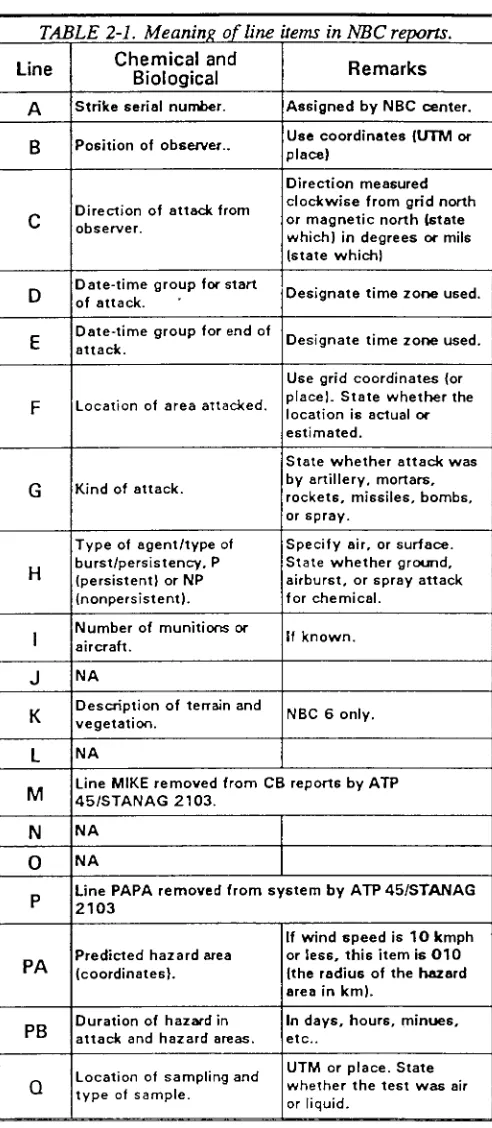
[image:19.610.334.580.138.702.2]The reports use standard formats to shorten the message being passed. The warning and reporting system is based on a code letter system. The meaning of each letter used to transmit an NBC message is described in Table 2-1 and GTA 3-6-5. The following paragraphs described each report. Specific instructions for acquiring the information and sending the report are discussed later in this chapter. Refer to Chapter 4 for specific use of the NBCWRS for biological attacks.
NBC 1 Report
The NBC 1 Report is the most widely used report. The observing unit uses this report to provide CB attack data. All units must be familiar with the NBC 1 Report format and its information. The unit must prepare this report quickly and accurately and send it to the next higher headquarters.
Battalion and higher elements decide which NBC 1
Precedence of the NBC 1 Report depends on whether or not it is an initial report. The initial use report is FLASH precedence, all others are IMMEDIATE precedence.
Individuals identified by unit SOP submit observations to the unit NBC defense team at company/battery or troop level. They need not use the NBC 1 Report format or individual line items of the NBCWRS to pass this data to the NBC Defense Team. (This report is generally in the form of a SPOT report or SALUTE report). The unit NBC defense team normally consists of the unit chemical NCO (54B20) or an NBC NCO that has been school trained at an area NBC defense two week school, an officer and an enlisted soldier (Specialist 4 or above) that has attended the same two week school. These soldiers will have the expertise at unit level of advising the commander on NBC defense matters and formating NBC reports.
Normally, the unit NBC defense team formats NBC 1 Reports. This ensures the content of the report is known to the commander or his or her representative. It also ensures that the report is in the proper format and is as correct as possible.
All data is sent in a single, complete NBC 1 Report. Do not divide data into two parts to create a subsequent report. NBC 1 Reports are not attack notifications, they simply pass data. Separate procedures must be developed for attack notification and are beyond the scope of this manual. Attack notification may take the form of a SALUTE, SPOT or SITREP Report and should be addressed in detail in unit SOPs.
Initial Use Report
The first time a CB weapon is used against US forces FLASH precedence. Each intermediate headquarters will forward the report with a FLASH precedence (or Reports to forward to the next higher headquarters. If IMMEDIATE precedence if a previous NBC 1 Report several reports are received on the same biological or has been forwarded). If the report is of a second attack chemical attack, then a consolidated NBC 1 Report is within the division, use IMMEDIATE.
forwarded. This reduces the number of reports to a The observer determines the date-time group of the manageable level. If the NBC 1 Report, however, is attack, location of the attack, means of delivery, type of based on a chemical agent alarm going off and there is no burst (air or ground), and if possible, type of agent. The other indication of an attack (such as in-coming artillery NBC defense team then formats the NBC 1 Report and rounds) the battalion chemical staff should inform higher forwards it to the next higher headquarters. All units headquarters, but request that the sending unit verifies the
attack with two or more sampler/detector tickets from a Battalion and higher headquarters screen NBC 1 M256 Chemical Agent Detector Kit. The attack should be Reports and decide which report(s) to forward. If the verified at this level before the NBC 1 Report is sent to headquarters receives several reports pertaining to the higher headquarters. This helps to eliminate a false report same attack, it forwards a consolidated NBC 1 Report from causing an entire brigade task force or division to go instead of separate reports. All reports must include line into Mission Oriented Protective Posture (MOPP). NBC items Bravo (position of observer), Delta (date/time
1 Reports are not routinely) passed to corps or higher
NBC centers (NBCC) except for the initial use report. group), Hotel (type of burst), and either Charlie(direction of attack) or Foxtrot (location of attack). Use the observing unit will send the NBC 1 Report with a
other line items if the information is known. If the unit is capable of providing local weather information as listed in line items Yankee (downwind direction of hazard and wind speed) and Zulu Alpha (significant weather phenomena) this information should be included in the report.
NBC 2 Report
The NBC 2 Report is based on one or more NBC 1 Reports. It is used to pass evaluated data to higher, subordinate, and adjacent units. Division NBCC is usually the lowest level that prepares NBC 2 Reports. Brigade and battalion NBC personnel may prepare the NBC 2 Report if they have sufficient data. However, these units will not assign a strike serial number.
Units use the NBC 2 as a factor in determining whether to adjust MOPP levels, and to assist in planning future operations. Line items Alfa (strike serial number), Delta (date/time group), Foxtrot (location), Golf (means of delivery), and Hotel (type of burst) are always contained in the NBC 2 Chemical or Biological Report. Items Yankee (downwind direction speed), Zulu Alfa (weather), and Zulu Bravo (remarks) should be included in the chemical or biological report. Line item Zulu Bravo (remarks) should include the type and case of attack, if known. Use other line items if the information is known.
NBC 3 Report
Division NBCC uses the NBC 2 Reports and the current wind information to predict the downwind hazard area. This is sent as an NBC 3 Report. It is sent to all units that could be affected by the hazard. Each unit plots the NBC 3 Report and determines which of its subordinate units are affected and warns those units accordingly.
The NBC 3 Report is a prediction of a downwind hazard area. This prediction is safesided to ensure that a militarily significant hazard will not exist outside of the predicted hazard area. Commanders should use the report as battlefield intelligence when considering courses of action. When a unit is in a downwind hazard area, the commander must decide whether to stay or move. This decision is based on the mission, and higher headquarters guidance. As the Automated Nuclear, Biological, and Chemical Information System (ANBACIS) is improved, the commander will be able to view the modeled hazard area on a computer screen instead of basing his decision On the safe-sided STANAG plots. This will provide a more realistic depiction of the hazard area. ANBACIS is addressed in more detail later in this chapter.
Units within the chemical downwind hazard area must adjust their MOPP level, if necessary, They must ensure
that chemical agent alarms are placed far enough upwind to provide adequate warning. The NBC 3 Chemical Report is re-evaluated every two hours. The hazard prediction could change significantly. Units currently affected and those previously affected must be notified that they are in (or are no longer in) the hazard area. Line items Alfa (strike serial number), Delta (date/time group), Foxtrot (location), Hotel (type), Papa Alfa (predicted hazard area), Papa Bravo (duration of hazard) (if ground contamination is present), Yankee (downwind hazard and speed), and Zulu Alfa (weather) are used for a chemical hazard prediction. In order that a recipient of an NBC 3 Chemical Report be able to plot the downwind hazard area easily and quickly, Line Zulu Bravo may contain the following information-type and case of attack, or the downwind hazard distance (DHD). use other line items if the information is known.
NBC 4 Report
Actual contamination is reported using an NBC 4 Report. Separate NBC 4 Reports are plotted on the tactical map to show where the hazard exists. If monitoring information is incomplete, a survey may be directed. Line items Hotel (type of attack), Quebec (location of sample), and Sierra (date/time of contamination was detected) are reported for a chemical hazard. These items are used as often as necessary to complete the report. Other items may be included if available and necessary to complete the report. A contamination overlay is sent to all units by computer data base update, electrical facsimile, messenger, liaison officer, and the NBC 5 Report.
NBC 5 Report
The NBC 5 Report is prepared from the contamination plot. This report is last in order because it consists of a series of grid coordinates. Often this message must be sent on FM radio nets. This requires lengthy transmission. The recipient is required to plot each coordinate and redraw the plot. Complete details can follow later on the facsimile or messenger-delivered plot.
For CB contamination, line items Alfa (strike serial number), Delta (date/time group), Hotel (type of burst), Sierra (date/time of sample), Tango (date/time of latest survey), and X-Ray (area of actual contamination) are reported.
With the exception of line item Alfa, when a user has previously received data through other NBC reports, the data need not be repeated on the NBC 5.
This message may be sent before or after a contamination plot has been received. The NBC 5 Report
is also used to report the closure of a decontamination site. The NBC 5 Report should include coordinates for the site and sump so as to notify other units of the contamination area.
NBC 6 Report
This report summarizes information concerning a chemical or biological attack(s) and is prepared at battalion level, but only if requested by higher headquarters. It is used as an intelligence tool to help determine enemy future intentions. The NBC 6 Report is submitted to higher headquarters. It is written in narrative form, with as much detail as possible under each line item. The NBC 6 Report may also be used to warn and report suspected biological attacks. Information concerning this use of an NBC 6 Report is described in detail in Chapter 4.
Managing the NBC
Warning and Reporting
S y s t e m
Managing the NBCWRS is crucial for the success of a command. To be useful, CB information must be collected, reported, and evaluated. Once evaluated, it can be used as battlefield intelligence. Obtaining and converting CB information into usable CB intelligence does not just happen. The volume of information that needs to be collected and reported could easily disrupt both communications and tactical operations if not
hazards will be. This prediction (NBC 3 Report) is only an estimation of the hazard area. Feedback is needed from units to determine exactly where the contamination is located.
This feedback comes from monitoring, survey and recon (NBC 4 Reports). Monitoring and recon operations give the initial location of CB hazards to the NBCC. Initial monitoring and recon reports are generally forwarded through intelligence channels to the NBCC. This information may also be sent to the NBCC by ANBACIS. ANBACIS is the Automated NBC Information System and is described later in this chapter. The NBCC plots the information on the situation map. If more information is needed, the NBCC recommends a unit (picked because of its location and/or capability) to collect and forward the necessary data. This unit may be an organic unit NBC defense team or an NBC reconnaissance platoon from the divisional chemical defense company. Special operations forces will depend on special forces operational detachments (SFOD) with attached LB teams, special forces group (SFG) chemical detachments, or organic unit NBC defense teams. The reconnaissance platoon may be tasked organized to support a maneuver brigade in NBC reconnaissance collection efforts.
Collecting CB information is a joint effort between units and the NBCC. The unit does the actual collecting of information. The NBCC plans for and directs the collection effort. The division FSOP/OPORD/OPLAN should describe who collects and forwards CB information for evaluation. More detailed information concerning this collection effort is addressed in Chapter properly managed. This section describes what
information is available and how that information gets to or in FM 3-19. the person or unit needing it.
Collecting CB Information
The first step in managing the NBCWRS is to determine what information is available and who is available to collect it. Two types of data must be collected. Observer data provides information that an CB attack has occurred. Monitoring, survey, and recon data provide information on where the hazard is located.
Observer Data
Every unit is responsible for observing and recording CB attacks. But every unit does not automatically forward NBC 1 Reports. Any unit aware of a chemical or biological attack promptly prepares and forwards an NBC 1 Chemical or Biological Report.
Monitoring, Surveyr and Reconnaissance
Data
NBC 1 Reports allow the NBCC to predict where the
Evaluating
CB Information
The CB data must be collected and evaluated by the NBCC and used as battlefield intelligence. Units and intermediate headquarters use the raw data to develop CB intelligence for their own use until detailed results are available from the NBCC.
Unit Procedures
Unit procedures for determining the location of contamination are simplified and less accurate than NBCC procedures. Emphasis is on speed rather than accuracy.
With-exception of designated observer reporting units, intermediate headquarters (such as battalion and brigade) consolidate and screen NBC reports to reduce the number sent to the NBCC.
Procedures used by the NBCC are more detailed and complex than those at unit level.
NBC 2, NBC 3, and NBC 5 Reports from division NBCC supersede those done by subordinate units.
Transmitting
CB Information
Procedures used to transmit CB information to and from the NBCC are an important part of the CB information system. Figure 2-1 shows the direction that various NBC reports travel. Usually the flow is through the chain of command—from company to battalion to brigade to division. There are exceptions to this—
The NBCC may request data such as survey information. The unit doing the survey may report directly back to division. The monitoring unit must also send an information copy back to the parent unit for command and control (C2
) and for reordering CB defensive stocks.
Attached or OPCON units may have no direct contact with a parent unit. In these cases the headquarters to which they are OPCON passes CB information.
Units that operate independently (such as military police or engineers) will report through the controlling headquarters.
The method of transmitting information depends on the tactical situation and mission of the unit. Methods are specified in FSOP/OPLAN/OPORD and unit SOP. At brigade and higher headquarters, NBC Reports usually
are passed on the intelligence net rather than the command net. At battalion level and lower there is generally only one FM net available. This net is required to communicate command information. Therefore, NBC Reports should be formatted ahead of time and be as short and concise as possible. In this case, wire communications are best. Support units use Admin-Log nets. However, these units need to also inform the brigade TOC or division TOC when operating in that units Area of Operations (AO). Wire communications are excellent, if available. There are numerous methods to communicate CB information. One of which is ANBACIS, which accesses information from the maneuver control system (MCS). The NBCC should evaluate all possible methods and select those that best suit the purpose. Again, this information should be contained in the unit SOP or current operations order.
Each unit and command element has a specific function in a CB environment. This function is in addition to normal combat functions. The exception to this is the NBCC whose primary function is NBC operations. The preceding pages described procedures and requirements for collecting, evaluating, and transmitting CB information. This section describes responsibilities at each command level and is intended to be only a guide.
Actions at Unit Level
Unit level collection, processing, and analysis techniques are designed for rapid evaluation of CB data. The results are not as accurate as those obtained by the NBCC, but they are sufficient for planning until replaced by data from the NBCC. Although analysis techniques are similar for company, battalion, and brigade, each has specific responsibilities for collecting and processing CB information. The responsibilities are discussed here. Analysis techniques are explained in the appropriate chapter.
The major portion of CB information is collected and reported by company/ battery/troop-level units. These units must be trained and equipped to—
Report CB attack data using the NBC Warning and Reporting System.
Monitor for chemical agents. Plot simplified downwind hazards. Identify toxic chemical agents.
Collect and forward soil and water samples.
Conduct chemical and biological surveys/reconnaissance.
Organization and training of personnel to perform these tasks will be in accordance with AR 350-42.
Battalion Level
The battalion monitors the information gathering of
subordinate units. Battalion chemical personnel ensure each subordinate unit is trained. Battalion personnel also are trained to—
Consolidate and forward NBC reports. Estimate effects of CB hazards.
Disseminate information on CB activities.
Coordinate unit CB recon elements with and through the battalion S2/S3 sections and the chemical company platoon leader tasked to support the battalion.
Coordinate with Brigade to obtain additional smoke or decon assets, if required.
Advise the commander on how to employ CB assets. Plan and supervise decentralized CB surveys. Maintain a CB situation overlay.
Defense training status.
Types of defensive equipment used by soldiers.
Chemical Attack Warning
(CHEMWARN)
The CHEMWARN message is very similar to the NBC 3 Chemical Report. The meaning and use of each line item are shown in Table 2-2. Figure 2-2, on page 2-7, shows some examples of CHEMWARN messages.
Two hazard areas exist for a chemical attack—the attack area and the downwind hazard area. Under normal conditions, a chemical attack will not be carried out if friendly troops are within the attack area. Personnel in the Brigade/Task Force Level downwind hazard area may don MOPP gear.
The chemical personnel at brigade must perform the same functions as battalion chemical personnel. Brigade personnel also must—
Coordinate with all attached NBC units.
Coordinate with other staff sections and advise them on CB matters.
Plan and supervise decentralized CB surveys.
Collect information from and assist CB personnel within the task force.
NBCC Level
NBCC techniques involve more complicated procedures and are based upon the comparison of data from many sources. Much of this data is not available to a single unit. In addition to performing dettailed analysis, the NBCC also —
Receives, collates, evaluates, and disseminates reports of enemy CB attacks.
Prepares and disseminates wind messages.
Estimates the effects of enemy and friendly chemical and enemy biological attacks, including hazard predictions.
Coordinates recon and survey activities with higher, lower, and adjacent units.
Maintains a CB situation map.
Provides advise to G2 on CB intelligence matters. Provides technical assistance to all staff levels. Coordinates with other staff sections and advises those staff sections on CB matters.
Provides technical assistance in the interrogation of POWs on CB matters. This technical assistance is generally in the form of providing the interrogator with a list of questions to ask the prisoner. The questions may include—
Employment tactics. CB munitions.
Types of agents available.
Automated Nuclear,
Biological, and Chemical
Information System
(ANBACIS)
chemical units (squad to brigade) with the communication, recordkeeping, and calculation of NBC warning and reports, tactical decision aids, and databases essential to accomplish their tasks. One module is the NBCWRS which is an automation of the manual data processing as described in this manual. ANBACIS was designed to operate on the Army common hardware and also to operate in the stand alone mode on any IBM compatible computer. ANBACIS is user friendly with drop down windows and is operated by chemical staff personnel.
It can receive any number of NBC 1 Reports and create the correct number of NBC 2 Reports. It will then convert the NBC 2 Reports to NBC 3 Reports utilizing the correct weather information that has been previously received electronically from the staff weather officer. It will take the basic wind report and create the Chemical Downwind Report in seconds.
ANBACIS supports battle management by—
Reducing human error on assisting in soldier
endurance. By relieving the chemical staff from repetitious and intensive calculational tasks, the soldiers will be able to apply their skills more effectively at assisting the commanders and other staff members. By not expending time and effort on those tasks, they will be more mentally alert and less subject to making mistakes.
Calculate the NBC 3 and 5 Reports from the NBC 1 and 4 Reports and then display them on the electronic map (E-MAP) with the units, boundaries, and other map information. This overlay information will be available to the other terminals for use in their planning and operations.
Communication capability. ANBACIS will not have any inherent communications capability. It is designed to use the communications from the maneuver control system or army common hardware and software packages.
Found at all force level staff sections (such as battalion, brigade, division), and chemical units down to squad level.
Handle all NBC Reports 1 through 5. It utilizes many checks and constraints to prevent false information from being used. It will automatically look-up and utilize the correct weather information contained in the database. In addition, it will create flame field expedient plans, smoke plans, and NBC 4 Reports from monitor and survey reports.
Operated by the normal Chemical Corps staff or unit representative, all enlisted and officers.
ANBACIS is designed to work best in the maneuver control system organization. A stand-alone capability will be maintained to work on most IBM compatible computers. This will allow continuity of operations and allow work to be accomplished when separated from the MCS environment. When the operator returns to the MCS, he can load the plans into the MCS-ANBACIS using a diskette.
It has other modules including smoke plan creation and flame field expedients (FFE), and others.
For additional information on ANBACIS, refer to the ANBACIS User’s Guide.
Chapter 3
Chemical Agents
Avoidance of chemical agents requires a completeunderstanding of physical characteristics, employment, and weather and terrain conditions. Units can then estimate when and where specific type of chemical agents will be used, where the hazards are, and how best to avoid them.
Threat forces are equipped, structured, and trained to conduct chemical operations. We expect them to use chemical agents as part of their conventional fighting capability because so much of their training revolves around the use of such agents.
The basic threat principle is to use chemical agents on unprotected troops to create casualties. Against protected troops, the primary purpose is to make the use of equipment, terrain, and operations more difficult. The use of chemical weapons by the threat forces initially may require a decision at the same level as nuclear weapons. But they most likely will be used more freely once the initial use has been authorized. Threat forces consider chemical weapons as an extension of conventional warfare. If units understand the uses of chemical agents, they will be better able to avoid chemical hazards.
T y p e s o f C h e m i c a l A g e n t s Chemical agents may be classified persistent, nonpersistent and dusty. Threat forces classify chemical agents according to their effect on the body. They identify six major types—nerve, blood, blister, choking, psychochemical, and irritants.
Persistent
Threat forces are known to stockpile persistent and nonpersistent agents.
Persistent agents are used to impede the use of critical terrain, channelize the attacking force, or contaminate materiel. Persistent chemical agents are used to produce casualties (immediate or delayed). Immediate casualties occur when the soldier inhales the vapor. Delayed casualties occur and is absorbed through the skin demonstrating the need for protective equipment.
Persistent agents are used to— Contaminate rear area supply depots. Defend avenues of approach.
Neutralize personnel defending a strong point. Protect flanks.
Degrade unit efficiency, To avoid persistent
agents-contamination which may be persistent for several daysAvoid areas heavily splashed with liquid (depending on weather and type of agent). See FM 3-6 for more details.
Cover personnel, equipment, and supplies whenever possible.
Monitor for the chemical agent for 2 to 10 days (depending on weather and type of agent). See FM 3-6 for more details.
Concentrate on finding clean areas and routes (recon units).
Cross contaminated areas in MOPP 4. Mark contaminated areas.
Avoid contact with unknown liquids. Nonpersistent
Threat forces currently stockpile blood agents, choking agents, psychochemical agents and nerve agents such as Tabun (GA), Sarin (GB), and Soman (GD). Although G-series nerve agents (GA, GB, GD and GF) are classified as nonpersistent agents, some G agents may persist for hours to days. Refer to Table 1-2 in Chapter 1 of this Field Manual or FM 3-4 for persistency data. Nonpersistent agents should be expected along the forward line of troops (FLOT), and against units in contact with the attacking echelon. These agents are used to immobilize, injure, or hinder activities of the unit under attack. For example, threat may use a blood agent at a critical moment in battle to force troops into a higher MOPP level. Forcing troops into a higher MOPP level reduces morale and degrades performance. Another advantage is that the threat would not need to decontaminate the area before occupying it. Nonpersistent agents act through the respiratory system or through skin absorption.
Nonpersistent agents are used to— Create favorable fighting conditions. Produce casualties prior to an assault.
Degrade and suppress troops by forcing them into a higher MOPP level.
Allow occupation without decontamination. To avoid nonpersistent
agents-Avoid low areas and enclosed spaces where vapors lingers.
Dusty
Dusty agents, (toxic dust or dust-impregnated agents as they may be referred to) are not new. These agents have been subjected to extensive scientific research since the 1930’s. These agents are primarily mustard (HD) and the nerve agent sarin (GB) impregnated onto a solid sorbent (usually on silica) and dispensed as aerosols. These agents generally have a lower vapor pressure and a dramatic increase in inhalation toxicity.
Vapors off gassing from the solid sorbent may be detected by the M256 Chemical Agent Detector Kit, Chemical Agent Monitor (CAM) or when mixed in water, by the M272 Water Test Kit.
Detection and Identification
Following OPSEC measures, the next most important step in chemical contamination avoidance is detecting and locating chemical agents. Once agents are detected units can be warned to take app