B-GL-304-003/TS-003
OPERATIONAL TRAINING
VOLUME 3
PART THREE
RANGE CLEARANCE HANDBOOK
(THIS PUBLICATION SUPERSEDES B-GL-304-003/TS-003 DATED 1981-03-16)
THIS PUBLICATION CONTAINS INFORMATION
AFFECTING THE DEFENCE OF CANADA, AND SHALL BE PROTECTED IN ACCORDANCE WITH THE REGULATIONS PRESCRIBED FOR THE SECURITY CLASSIFICATION APPEARING HEREON. RELEASE OF THIS PUBLICATION, OR INFORMATION CONTAINED HEREIN, TO ANY PERSON NOT AUTHORIZED TO RECEIVE IT, IS PROHIBITED BY THE OFFICIAL SECRETS ACT.
OPI: FMC HQ 1982-04-30
LIST OF EFFECTIVE PAGES
Insert latest changed pages; dispose of superseded pages in accordance with applicable orders. NOTE - On a changed page, the portion of the text affected by the latest change is indicated by a vertical line in the margin of the page. Changes to illustrations are indicated by miniature
pointing hands, or black vertical lines.
Total number of pages in this order is 86 consisting of the following:
Page No. Change No. Page No. Change No.
Cover 0
Title Page 0
A Page 0
iii/iv 0
v/vi 0
vii to ix/x 0
1-1 to 1-6 0
2-1 to 2-8 0
2A-1 to 2A-3/2A-4 0
2B1-1 to 2B-3/2B-4 0
2B1-1/2B1-2 0
3-1 to 3-27/3-28 0
3A-1/3A-2 0
3A1-1/3A1-2 0
3B-1 to 3B-3/3B-4 0
3B1-1 to 3B1-25/3B1-26 0
Zero in Change No. column indicates an original page.
FOREWORD
1. B-GL-304-003/TS-003, Operational Training, Volume 3, Part Three, Range Clearance Handbook, is issued on the authority of the Chief of the Defence Staff.
2. This publication is effective upon receipt and supersedes B-GL-304003/TS-003 dated 1981-03-16.
3. Any loss or suspected compromise of this publication, or portions thereof, shall be reported in accordance with A-SJ-100-001/AS-000, Chapter 34.
PREFACE
1. B-GL-304-003/TS-001, Ranges and Training Safety, will eventually be published in three parts:
a. Part One - Training Safety. Has been published. It covers all aspects of range utilization and training safety.
b. Part Two - Range Construction and Maintenance. This publication deals with the technical aspects involving safety for range construction and maintenance (not yet published).
TABLE OF CONTENTS
CHAPTER 1 - GENERAL Section 1 - Introduction
Background Purpose Terminology References
Section 2 - Post-Firing Range Sweeps Requirement
Clearance Responsibilities Range Records
Reporting
Section 3 - Principles of Range Clearance Levels of Range Clearance
Safety Training
CHAPTER 2 - SAFETY AND TRAINING Section 1 - Safety
General
Control Measures Qualifications
Safety Briefings and Refresher Training Clearance Procedures, Drills and Formations Medical
Section 2 - Training General
Scope and Conduct of Training Purpose of Training
ANNEXES
CHAPTER 3 - RANGE CLEARANCE PROCEDURES Section 1 - Planning Phase
Concept of Operation Reconnaissance
Estimate of the Situation The Plan
Orders
Section 2 - Clearance Procedures Common to Both Level One and Level Two Operations
General
Command and Control Range Preparation Setting Out
Sweeping Operations
Dud Marking, Reporting and Control Scrap Transport Vehicles
Scrap Disposal Dud Destruction After Action Report
Section 3 - Procedures Unique to level One Operations Purpose
Organization
Sweeping Operations Sweep Formations
Section 4 - Procedures Unique to Level Two Operations Purpose
Organization and Responsibilities
Modified Level Two Clearance Operations Range Clearance Equipment
ANNEXES
LIST OF FIGURES
FIGURE TITLE
3-1 Example of a Control Map 3-2 Marking and Reporting a Dud
3-3 Battalions Level One Clearance Organization 3-4 Company Level One Clearance Organization 3-5 Battalion Level One Clearance Communications 3-6 Platoon Sweep Team
3-7 Section Sweep Team
3-8 Company in Arrowhead Formation in Open Terrain
3-9 Company in Platoon Sector Formation in Close or Broken Terrain 3-10 Troop/Platoon Level Two Clearance Organization
3-11 Level Two Basic Platoon Formations
CHAPTER 1
GENERAL
SECTION 1 - INTRODUCTION Background
1. Large tracts of training areas used for live firing have become contaminated over the years with duds in unknown quantities and of various natures. These areas must be cleared periodically to render them safe for manoeuvre, to restore them to their original state, to permit development, or to return them to their original owners. The principle of clearance to a level acceptable for the intended use must provide the guidance for clearance operations. Even after a clearance operation it is impossible to certify that an area is totally free of duds.
2. Range clearance operations, particularly for the Army, have in the past been treated as land-mine clearance operations incorporating similar techniques and safety procedures. Procedures peculiar to range clearance have sufficiently evolved so that they can now be consolidated into one publication.
Purpose
3. This publication provides guidance to all personnel concerned with the conduct and supervision of range clearance operations. Organization and procedures for clearance tasks are specified.
4. THE SAFETY INSTRUCTIONS SPECIFIED ARE CONSIDERED AS MINIMAL AND THEIR APPLICATION IS MANDATORY.
Terminology
5. The following terms are used in this manual:
a. Clearance - refers to the destruction of duds and the removal of scrap from an area of land.
b. Range clearance operation - refers to annual or periodic clearance operations undertaken to clean up ranges. It also includes extensive operations for the purpose of returning land to its original use or to its original owner. It does NOT include post-firing range sweeps.
c. Post firing range sweeps - refers to the destruction of duds and clean up of a range undertaken after a unit has terminated its exercise or firing activities on a range. See section 2 of this chapter.
e. Munition scrap - refers to all by-products resulting from the functioning of
ammunition. This covers empty shell casings, projectiles, shrapnel, pieces of fuse, and all such objects. Target vehicles, although of a non-munition origin, shall be considered as munitions scrap because of the risk of hidden or residual munitions or items of an explosive nature.
f. Duds - technically a dud is an explosive munition which failed to arm as intended or did not function as intended after being armed. For the purpose of this manual, "dud" is used as a generic term to describe all natures of munitions that may be found on a range. It includes the following
-(1) munitions that have not been primed but inadvertently lost, (2) munitions that have been improperly primed,
(3) munitions that have been properly primed but failed to function, (4) munitions that have only partially fired, and
(5) pieces of metal including target vehicles that may still have pieces of explosives adhering to them.
g. Qualification description -(1) UH - officer, basic EOD,
(2) MILE 45A - Military Engineer Officer, (3) TE - officer, All Arms Demolition, (4) HA - man, basic EOD,
(5) HB - man, advanced EOD, (6) HE - man, All Arms Demolition, (7) CM - All Arms Mine Warfare, (8) 011 - Crewman,
(9) 021 - Artilleryman, (10) 031 - Infantryman, (11) 041 - Field Engineer,
(12) 031.13 - Assault Pioneer, and (13) 031.14 - Advanced Assault Pioneer. References
6. Personnel commanding range clearance operations shall have available, in addition to this publication, CFTO C-09-008-002/FP-000, Destruction of Duds and Misfired Ammunition, and where necessary user manuals for the type of weapon or ammunition suspected to have been used on the range.
SECTION 2 - POST-FIRING RANGE SWEEPS Requirement
8. To ensure that all facilities are safe for other user units, it is essential that they remain free of all duds. The primary means of doing this is to conduct post-firing range sweeps.
Clearance Responsibilities
9. This manual does not cover post-firing range sweeps and consequently, the procedures, formations and personnel qualifications are not intended to apply to these sweeps. Post firing range sweeps are contained in B-GL-304-003/TS-001 Ranges and Training Safety. This topic will also be included in Range Standing Orders for the applicable ranges. Good post-firing sweeps and maintenance of records, however, will reduce the amount of dud contamination and facilitate future range clearance operations. For this reason the responsibilities for post-firing range sweeps are summarized below.
10. Range User - It is the range user's responsibility, unless otherwise detailed in local range standing orders, to conduct post-firing range sweeps and destroy duds immediately after range firing has ceased or during range firing as the situation warrants.
11. Range Control Agency - It is the range control agency's responsibility to:
a. ensure users conduct immediate post-firing range sweeps (unless local range standing orders remove this responsibility from the units);
b. provide assistance as required in conducting post-firing range sweeps (including doing the post-firing range sweep if local range standing orders so dictate); and c. maintain range records.
Range Records
12. General - Range records in Canada are virtually nonexistent and this has made range clearance operations extremely difficult. In order to alleviate this problem in the future, range control agencies must ensure user units report the data in paragraph 14 immediately after completion of post firing range clearance.
13. Use of Data - The data must be compiled by range control agencies so that the following information can be provided at any time:
a. use of ranges by unit, weapon, ammunition nature, and number of rounds; b. exact location and marking of located but undestroyed duds;
Reporting
14. Users must report the following data to the range control agency on completion of their post-firing range sweep:
a. target area;
b. number of rounds fired;
c. number of duds located and destroyed;
d. number of duds which could not be destroyed, their location, and the marking used; and
e. number of duds which could not be located, and their approximate location. NOTES - 1 Good post-firing sweeps reduce dud contamination.
SECTION 3 - PRINCIPLES OF RANGE CLEARANCE Levels of Range Clearance
15. General - Range clearance operations are of three distinct types depending on the depth below surface to which clearing is conducted. Naturally, many more resources are required to clear a range to a specified depth than just to complete a visual surface sweep. Commanders must trade off the resources required to clear a range to a particular level against the possible risk to troops using the range for a particular type of training after clearance.
16. Level One Clearance - Level One Clearance is completed to destroy all surface duds and remove scrap visible on the surface. The benefits of a Level One Clearance must be considered in terrain where brush or undergrowth prevents a clear view of the ground. The possibility of frost action pushing buried items to the surface, thus requiring further clearance, must be considered. Chapter 3 describes Level One Clearance procedures.
17. Level Two Clearance - Level Two Clearance is conducted immediately below the surface to locate and destroy duds and to remove larger scrap. The depth is limited by the detection range of the MINEX 4C in-service electronic mine detectors which have a range of 30 to 45 cms. The possibility of frost action must again be considered. Chapter 3 describes Level Two Clearance procedures.
18. Level Three Clearance - Level Three Clearance is conducted at depths below that cleared by a Level Two Clearance to locate and destroy duds and to remove scrap. These procedures are beyond the scope of this manual.
Safety
19. Safety of troops involved in a clearance operation is of paramount importance. Range clearance operations can be carried out safely when all personnel are aware of safety
requirements, are trained to know their jobs and remain alert. Accidents are caused by ignorance of task, stupidity and lack of alertness.
20. The commander alone is responsible for the safe and efficient conduct of the operation. He must personally be satisfied that the preliminary training is adequate and that all personnel are capable of completing their tasks safely. He must ensure that personnel remain alert and avoid boredom. In heavily contaminated areas frequent breaks are advisable. In prolonged clearance operations a day of rest per week is recommended.
21. Chapter 2 gives the minimum safety requirements and procedures for range clearance operations, at all times common sense and experience must prevail. Chapter 2 also details the minimum acceptable qualifications for personnel employed in range clearance.
Training
22. Training before range clearance operations is mandatory for all personnel. The training must be given by appropriate qualified personnel, and must include the widest possible variety of training aids and techniques.
23. Time and resources must be allocated for the conduct of preliminary training and rehearsal immediately prior to the clearance operation. Details regarding the planning, preparation, and conduct of the training are contained in Chapter 2. The importance of this training cannot be overemphasized; it represents a most important element in the conduct of safe clearance operations.
24. There are two phases of training. One phase covers the safety aspect and it is conducted by specialists. The other phase covers the rehearsal of formations and drills to be used. This latter phase is a line function and is conducted within the chain of command.
CHAPTER 2
SAFETY AND TRAINING
SECTION 1 - SAFETY General
1. As stated before, range clearance can be a hazardous task. Potential accidents can be avoided if all personnel are aware of safety requirements, know their job, and remain alert. It is impossible to describe detailed safety regulations that would cover all situations - the lie of the land, the state of the vegetation, swamps and other land features will make each clearance operation unique.
2. The safety requirements given in this publication are the minimum; others may be required to deal with particular circumstances. These general regulations must be applied with experience and common sense, adapting them to the particular piece of land.
3. Safety can best be assured by the following and each is discussed in greater detail in subsequent paragraphs:
a. enforcing strict control;
b. ensuring personnel possess the proper qualifications for the assigned job;
c. ensuring all personnel receive safety briefings immediately prior to the clearance operation stressing alertness and boredom/fatigue;
d. ensuring all specialist personnel receive refresher training immediately prior to the clearance operation;
e. teaching and enforcing strict clearance procedures and drills ensuring alertness; and
f. ensuring proper medical attention is available with well rehearsed drills known by all.
NOTE - These safety requirements are the minimum, use common sense. Control Measures
4. Chain of Command - The first means of enforcing safety is by respecting an established command structure. Military forces are trained to work together whether it be at the section level or battalion level. Personnel get to know how their peers operate and how their leader thinks, they work as a team, therefore, the structure of a range clearance organization must be based on formed units and sub-units.
6. Safety Organization - A safety organization will be formed of personnel experienced in range clearance operations who hold the qualifications listed in Annex A to this chapter. The safety organization is superimposed on the clearance organization, and REPORTS DIRECTLY TO THE OPERATION COMMANDER - the members of this organization are empowered to cease any activity that does not conform to the safety rules in effect. ONLY THE OPERATION COMMANDER CAN OVERRULE SUCH DECISIONS. The members of the safety
organization are not to be used in the actual clearance task but must remain free to observe. Qualifications
7. Another means of ensuring safety is to ensure personnel are qualified to undertake the assigned job. The minimum qualifications and training required by personnel performing the following duties are listed below and summarized in tabular form at Annex A to this chapter:
a. Unit Conducting Range Clearance Operation (Sweep Teams) - All service personnel must be qualified TQ 3 and have received training in dud recognition from their dud recognition adviser or from an Ammunition Technical Officer (ATO), as well as drill/formation training from the normal chain of command immediately prior to the start of the operation.
b. Dud Recognition Advisers - These advisers employed at the sweep team level augment the sweep teams and will have the following qualifications in addition to receiving dud recognition refresher training from an (ATO) or Ammunition Technician TQ 6B or above immediately prior to the operation
(1) UH or HA/HB
(2) 041 FD ENGR TQ5A or above, (3) 031.14 Advanced Assault Pioneer, and
(4) any classification or trade All Arms Demolition (TE/HE).
c. Safety Organization - This is composed of personnel preferably experienced in range clearance having received refresher training from an ATO or Ammunition Technician TQ 6B or above and be qualified
-(1) officer UH/45A/TE, (2) HA MCpl or above, (3) HB Mcpl or above, (4) 041 Mcpl or above, or (5) HE Mcpl or above.
d. Setting Out Teams - These are composed of personnel having been adequately trained in dud recognition by an ATO or Ammo tech TQ 6B or above immediately prior to the operation. They must be supervised by personnel familiar with the ordnance likely to be encountered.
-(1) Members - will be of 011, 021, 031 or 041 trades with minimum of TQ3 training, the members will receive training in prodding techniques from the prodding team commander.
(2) Commander - will be minimum of HA/ HB MCpl, 041 TQ513, 031.13 MCpl, 031.14 MCpl or CM MCpl. The team commander will receive specialist training in excavation drills and dud recognition from an ATO or Ammo Tech TQ613 or above.
f. Screening Team - Must be Ammunition Technician 921 TO 5A or above having received refresher training from an ATO or Ammunition Technician TQ 6B or above.
g. Dud Destruction Team - Destruction procedures will be in accordance with CFTO C-09-008-002/FP-000. The dud destruction team will receive refresher training in dud recognition and destruction techniques as per the above CFTO from an ATO or Ammunition Technician TQ 6B or above immediately prior to the operation. The team will be qualified as follows
(1) Members
-(a) for a range with a single type of ordnance, they will be qualified personnel who would normally undertake such a task as part of the normal post-firing range sweep,
(b) for a range with a mixture of ordnance, they will be qualified as follows
-i. Ammo Tech 921 TQ 5 or above, ii. FD ENGR 041 TQ 5A or above,
iii. Advanced Assault Pioneer or Assault Pioneer TQ 5A or above, and
iv. any trade with HE qualification.
(2) Commander - The commander will always be an officer (UH) or an HA/HB MCpl or above.
NOTES - 1 Personnel must have the proper qualifications for their task. 2 All personnel must receive training immediately prior to the range
clearance operation.
8. Personnel assigned to command and control, safety, and medical duties will perform only those roles throughout the operation. Other clearance personnel may be rotated through different tasks or perform two tasks provided they are qualified and appropriately trained for each task. Safety Briefings and Refresher Training
personnel at selected times (e.g. coffee breaks, lunch, etc). These briefings should include descriptions of mis-identification of duds, and warnings of particularly heavy densities of a particular type of dud; in short, anything that will keep the clearance personnel aware and currently advised. Errors must be corrected immediately after they are identified.
10. Purpose of Safety Briefings - Safety briefings are given to all personnel and take the form described below:
a. An all ranks briefing - This should be done by the Commander of the base/camp responsible for the range to be cleared for smaller operations or by the operational commander for larger operations. It should specify the background or reason for the operation, exactly what the task is, and place the emphasis on safety including a review of accidents to range users and any specific incidents occuring during previous clearances. He will stress the need to stay alert and to avoid indifference, fatigue and boredom.
b. Ammunition Safety Briefing - This is given by an Ammunition Technical Officer to familiarize all personnel with the nature of ammunition and associated hazards that may be encountered on that particular range, so that munitions and non-munitions scrap may be differentiated from possible duds. It is important that this briefing be rehearsed, it includes a display of typical munitions, at the same time as the ATO gives his presentation, these munitions are held up in front of each sub-unit by the ATO's staff. Another method of conducting this briefing is for the ATO to give the briefing to all the specialist personnel (including the dud
recognition advisors) who in turn then give the same briefing to the
platoons/sections to which they are attached. A suggested safety briefing is at Annex B to this chapter.
c. Demonstrations of Drills/Formations - Once the personnel have been given their mission and shown what to look for, they must be taught how to proceed. This topic is covered in Section 2.
Clearance Procedures, Drills and Formations
11. General - Another means of increasing safety is to establish and follow set drills and formations. Set drills exist for the procedures outlined in the following paragraphs.
12. Screening - Screening of scrap is crucial, especially where scrap is to be sold, in order to ensure that duds do not reach the scrap compound. To ensure this there are three stages of screening:
a. First Screening - This screening is done at the moment the scrap is found. The sweepers pick up non-munition scrap and any safe munition scrap. If they are in doubt the dud recognition adviser is called over and renders a judgement. b. Second Screening - This screening is done by an ammunition technician as he
who has made the mistake. Corrective action can be immediately taken to point out his mistake and further enlighten him on additional things to look for. c. Third Screening - This screening is done by a Senior NCO Ammunition
Technician at the dump. This person should be the most experienced Ammunition Technician, as he unloads the scrap he inspects every piece to ensure it is safe. 13. Dealing with Duds and Scrap - The following principles must be applied when dealing with duds and scrap:
a. Duds and suspected duds will NEVER be moved or disturbed;
b. PRIOR to picking up any item on a range, POSITIVE identification of the item as scrap must be made. If ANY doubt exists, the item will be marked as a suspected dud,
c. Large items of scrap or scrap partially buried will not be moved by unqualified personnel unless it can be determined that no duds or suspected duds are present underneath or contained within the scrap. Checking of such items will be the responsibility of the dud recognition advisor, and
d. Disposal of scrap items will be in accordance with Chapter 3.
14. Dud Destruction - Duds will be destroyed in-situ by explosive means. Destruction of duds will be as detailed in CFTO C-09-008-002/FP-000, destruction of ammunition such as TOW and Blowpipe will be done in accordance with the relevant CFTO.
Medical
15. Medical requirements must be a primary consideration in the planning and conduct of clearance operations. The following minimum medical requirements must be provided for any operation:
a. First aid must be available at each station and team level (e.g., sweep, dud destruction and setting out teams);
b. An immediate response capability is required for life sustaining aid by qualified medical personnel;
c. Rapid evacuation capability to permanent medical facilities must be available, including helicopters if the distance so warrants;
d. If white phosphorus ammunition (WP) has been used on the range, immediate treatment for WP casualties must be available.
16. Drills, for immediate response, peculiar to the particular operation must be known and practised. All participating personnel must know the emergency procedures to be followed in the event of an accident.
SECTION 2 - TRAINING General
18. As previously stated, safety can be achieved by ensuring all personnel receive training immediately prior to the clearance operation.
Scope and Conduct of Training
19. General - The training is conducted in three phases: a lecture portion, rehearsals of formations and drills taught in the lecture portion and a range presentation.
20. Lecture - The lecture can be given either in a classroom or outside. If outside, the ideal location is on a high piece of ground overlooking the range to be cleared. It is conducted at the same time as the safety briefing and flows from the safety briefings discussed in paragraph 9. 21. Rehearsal - This is conducted, within the chain of command, to develop teamwork and knowledge of formations and drills.
22. Range Presentation - This is done by having personnel train on an area seeded with inert items and scrap that is representative of what will be encountered. It develops confidence and permits clarification of points of doubt on certain natures of scrap. For Level Two operations, the inert items and scrap must be buried. Care must be taken to record all buried items to facilitate recovering those items not detected.
Purpose of Training
23. General - The purpose of training is as follows:
a. to update and refresh the technical knowledge of the specialist advisors; b. to familiarize the sweep team personnel with the natures of ammunition and
associated hazards that they may encounter on that particular range, (this topic was covered in paragraph 9);
c. it teaches personnel drills and formations to be used.
24. Specialist Advisors Refresher Training - Specialists are considered to be the safety
25. All Ranks Display of Drills and Formations - The best way to do this is by the use of a demonstration platoon which has previously been rehearsed. By using this platoon it is possible to show the different formations that will be employed on different pieces of ground. It is also possible to demonstrate the duties of individuals, the drills used on detection of a dud or
suspected dud, dud marking, procedure for disposal of scrap (munition and non-munition scrap bags and vehicles), screening procedures, and mine detector and prodder procedures (for Level Two). By showing all personnel all the drills, it permits a rotation through different jobs, thus helping to reduce boredom. It is important to note that this is a demonstration only. The actual rehearsals are done as chain of command functions.
ANNEX A, CHAPTER 2
QUALIFICATIONS OF PERSONNEL EMPLOYED ON RANGE CLEARANCE OPERATIONS
SERIAL POSITION QUALIFICATIONS REMARKS
1 Sweep Team Members - All service members qualified TQ3
or above
1. Must receive dud recognition briefing from an ATO or from the Dud Recognition Advisor.
2. Must receive formation and drill training from normal chain of command.
2 Dud Recognition Advisor - UH or HA/HB
- 041 FD ENGR TQ5A or above - 031.14 Advanced Assault Pioneer - any trade TE/HE
1. Must receive refresher training in dud recognition from ATO or Ammo Tech 6B or above.
3 Safety Organization - officer with
- UH/45A/TE
- HA/HB MCpl or above - 041 FD ENGR MCpl or above
- HE MCpl or above
1. Must receive refresher training from ATO or Ammo Tech 6B or above.
4 Prodding Teams 1. Members:
- 011 TQ3 or above - 021 TQ3 or above - 031 TQ3 or above - 041 TQ3 or above
2. Commanders:
- HA/HB MCpl or above - 041 TQ513 or above - 031.13 MCpl or above
1. Must receive training in prodding drills from the team commander.
- 031.14 MCpl or above - CM MCpl or above
Ammo Tech TQ6B or above.
5 Screening Team 921 TQ5A or above 1. Must receive refresher training
from an ATO or Ammo Tech 6B or above.
6 Dud Destruction Team 1. Members:
a. for range with single type of ordnance, they will be qualified personnel who would normally undertake such a task as part of a routine post-firing range sweep.
b. for range with a mixture of ordnance, they will be qualified as follows: - 921 Ammo Tech TQ5 or above
- 041 FD ENGR TQ5A or above
- 031.13/031.14 TQ5A or above
- any trade HE
2. Commanders:
- UH officer
- HA/HB MCpl or above
1. All members including the team commander will receive refresher training in dud recognition and destruction technique from an ATO or Ammo Tech TQ6B or above.
ANNEX B, CHAPTER 2
DUD RECOGNITION AND SAFETY BRIEFING - SUGGESTED
CONTENT
Part I
1. General - It is imperative that this briefing leave no doubt in the minds of the sweepers as to precisely what they can, and cannot, pick up from the range.
2. Aim - To familiarize sweep teams with the natures of ammunition and associated hazards that are likely to be found on the range, so that duds and suspected duds may be recognized and marked and munitions and non-munitions scrap may be removed safely.
3. Definition - You are going to be conducting a LEVEL ONE clearance operation. LEVEL ONE is a surface clearing procedure. Therefore you are only interested in identifying items that are visible. Anything partially buried is to be marked but not disturbed.
4. Tasks - As sweepers, your job is to locate and recognize all visible objects whether live ammunition, suspected live ammunition, or munitions or non-munitions scrap and to remove the positively identified scrap. UH/HA/HB/Engr/Pnr Specialists form part of the clearing
organization and are there to assist in the recognition of objects and to enforce the safety of your activity.
5. Briefing Format - This briefing will consist of a talk, visual display of scrap, and a slide presentation.
6. Dud Recognition - Most ammunition found on the range will be in a deteriorated state. It will be discoloured, distorted, rusty, broken or otherwise very unlike what you have seen coming out of its shipping container. It will blend in with the ground so that extreme caution must be taken to spot everything. On the range, you may encounter both land and air ammunition. This doesn't imply that they are treated differently - it merely alerts you to expect unusual things. The objects you encounter may be less than perfect in appearance. It will also be helpful to know some of the types of ammunition fuses you may encounter so that you may further appreciate the hazards involved. Fuses are used to arm ammunition at the appropriate moment before delivery to the target. Therefore any fused ammunition that is found on the range must be considered armed and set to function. Fuses operate by combinations of springs, ball bearings, set-back forces, spin and impact. They are very sensitive to any sort of disturbance after they have been armed during delivery. Two types of fuses are in general use in projectiles: the nose fuse and the base fuse. Beware of objects that appear to have no fuse, because the fuse may be buried in the ground or recessed in the base of a projectile. You may find some nose fuses lying on the ground all by themselves. These contain high explosives and are dangerous. Treat them as duds.
7. Scrap Identification - Scrap may be munitions or non-munitions scrap. Munitions scrap results from the complete functioning of a munition where no further hazard exists.
steel pickets, sandbags, soft drink cans, pieces of target vehicles, wooden planks, etc. Munitions scrap or non-munitions scrap not POSITIVELY identified as such must be treated as a dud until the dud recognition advisor has confirmed that it is truly scrap. Pieces of target vehicles, though non-munition in origin, will be treated as munition scrap since hidden or residual munitions or items of an explosive nature may be imbedded.
Part II
8. Slide Presentation - A standard slide presentation has been produced and is available through applicable CHQs.
9. Final Points are as follows:
a. "Smoke In The Bag" - This point must be clarified based on previous experience. If you pick up "scrap" which still has white phosphorous or smoke composition stuck to it, and during the operation your scrap bag begins to generate smoke, don't panic. Just place the bag on the ground, notify your commander and carry on using another bag;
b. Handout (if used) - On the sheet handed out are a few key reminders. Refer to it frequently so that you may be continually reminded of your responsibilities. Not only you but your team members may be seriously injured or killed, through your carelessness.
10. Important to Remember:
a. Duds and suspected duds will never be moved or disturbed;
b. Prior to picking up any item on the range, positive identification of the item as scrap must be made. If any doubt exists mark the item as a suspected dud or request the advice of the Dud Recognition Advisor;
c. Be careful of large items of scrap. They may cover, contain or otherwise conceal duds. Again, leave the large scrap alone, mark and move on;
d. Handle all scrap carefully - it can injure;
e. All intact projectiles must not be touched - mark them and move on;
f. This task can be boring and tiresome. Carelessness may set in within two hours of the start of the operation. Beware of this attitude and at all costs, stay alert. It is carelessness that kills;
APPENDIX 1 ANNEX B, CHAPTER 2
SAMPLE TIME TABLE
CRSE NAME: UNIT SAFETY BRIEFING - OP RANGE CLEARANCE
DATE TIME PO/EO SUBJECT DETAIL INSTRUCTOR LOCATION DRESS REMARKS
0800 - 0815 1.0 RV for Candidates ATO Range A Cbt RV GR 965454 at GP Hut.
Individual tpt arrangements. 0830 - 0900 2.0 Intro/Welcome/Identification of
Task
Camp Comd/Op Comd/ATO
Range A GP Hut Cbt
0900 - 0930 3.0 Description of Ammunition Items Likely to be Found on Range
ATO Range A GP Hut Cbt
0930 - 1000 4.0 Safety Briefing ATO Range A GP Hut Cbt
1000 - 1030 Coffee Individuals to provide own
mugs. 1030 - 1200 5.0 Discussion & Examination of
Specimens of Munitions and Non-munitions scrap.
ATO Range A GP Hut
1200 - 1300 Lunch Box lunch
1300 - 1630 6.0 Walk through of prepared area and uncleared range area
ATO Staff Range A GP Hut Cbt 5 stands each manned by ATO Staff.
CHAPTER 3
RANGE CLEARANCE PROCEDURES
SECTION 1 - PLANNING PHASE Concept of Operation
1. General - Range clearance operations are no different than other military operations. They are based on all arms teams, tailored to the particular mission, using normal battle procedure to mount the operation.
2. Organizations - As in any other operation a unit will be selected as the nucleus of the team. It possesses its own command and control structure, combat personnel, and support personnel. To this unit are added specialists and additional support personnel as required to round out the team.
3. Battle Procedure is as follows:
a. The commander of the team, using normal battle procedure, will plan and execute his mission. During the reconnaissance phase he estimates the situation,
consulting his supporting specialists, to finally arrive at his plan. He prepares and delivers his orders which are passed on to all personnel, resources are amassed, reorganization occurs and rehearsals are undertaken. When his team is ready, the operation is launched. During the operation he monitors the progress, re-evaluates the situation and reorganizes his forces to meet the changing circumstances. He must constantly monitor the morale and well-being of his men.
b. In range clearance a unit is tasked to conduct the operation. The team is rounded out by the addition of safety, dud recognition, dud destruction and screening specialists. The support personnel such as medical, vehicle maintenance, cooks and traffic control come from within the unit's support elements. On larger operations this support can be augmented from outside the unit. The commander during his reconnaissance, estimate and planning phases consults his safety, dud recognition, and dud destruction specialists. These specialists perform a "staff" function and advise on their specialty. The training of the troops and conduct of the operation remain a "line" function.
Reconnaissance
undertaken to return land to its original owner, the operational commander should conduct the preliminary reconnaissance personally. The preliminary reconnaissance should ideally be conducted far in advance (as much as a year) in order to fully analyze the results of the different sources of information listed below. Previous operations of this type have shown that virtually no records exist for older ranges. Consequently, the following avenues must be explored:
a. Historical records - maximum use of the limited records must be made when they exist.
b. Random samples - this method is vital in identifying possible dud contaminated areas. It consists of sweeping test strips (50 m x 6 m) with mine detectors and reporting all finds. These finds are all plotted on a map, by analysis, the high contamination areas become apparent. The dud contaminated area cannot be determined by the numbers of duds found but rather on the degree and type of shrapnel discovered - this is a very accurate method for defining impact areas. During recent operations, approximately 250 test strips per square kilometre were used and this figure is a good planning guide.
c. Interviews - interviews with retired range users such as FOOs, FCs and Range Control personnel are of extreme value. This is done independently of all other methods mentioned above and serves to confirm data accumulated through these other means.
d. Remote sensing - this procedure involves the use of aerial cameras using normal and infra-red film. Impact areas contain many craters, most of which are not easily identifiable from the ground because of the growth of grass and brush. These craters have tended to accumulate more water than surrounding areas and as a result have supported more lush growth of grass and underbrush. Film analysis can reveal these areas and can confirm the results of the other methods of reconnaissance and may reveal areas that have been overlooked. Although this procedure is still in its infancy, it has been successfully used in previous clearance operations.
5. Detailed reconnaissance - This is undertaken after it has been decided to conduct the operation. The detailed reconnaissance examines the area characteristics such as terrain, vegetation, routes, and natural control features so that a detailed plan can be written. It is
normally conducted by the Operation Commander and should include those officers commanding the troops who will actually clear the area.
Estimate of the Situation
6. No two operations will be identical since no two pieces of land will be the same. Based on the findings of the reconnaissance, the commander will do his estimate. The principal factors to be considered and some of the deductions that will ensue are listed below:
b. Number of Duds/Size of Area - This will affect the rate of work, the formations to be employed, the number of specialists and scrap vehicles, and the extent of training required;
c. Terrain Analysis - This is probably the main factor to be considered. Is the land open or tree covered, how much undergrowth is there? Are there any swamps, streams or rivers? Is the land dry, or wet and marshy? Is the land easily accessible with many trails or roads? This will affect;
(1) the type of formations to be used, the number of personnel required, the rate of work and overall length of the operation, and the amount of support required,
(2) the need to pre-burn or not, and
(3) the use of the Range Surface Clearance Vehicle.
d. Resources Available - Will affect time required to do the work and may indicate outside resources required to meet the deadline. For prolonged clearance
operations it may become necessary to replace entire units. A simulated relief-in-line operation has proven to be very successful in previous operations.
The Plan
7. From his estimation the commander will formulate his plan. The plan will include the following:
a. Organization and responsibilities - The plan must be specific in detailing authorities, responsibilities, control measures to be employed, and a method of assuring quality control and safety throughout the operation.
b. Clearance rates - Since ground and the number of duds vary locally within the area to be cleared, clearance rates cannot be established initially with any degree of accuracy. The plan must cater for major variations in individual section and platoon rates of clearing. Care must be taken to ensure that personnel safety and quality of clearance are not reduced by imposing high clearance rates.
c. Specialist requirements - Most units do not possess the number of specialists required for clearance operations. The specialist requirements must be assessed at an early stage in the planning in order to have them provided from outside sources if necessary.
d. Preliminary training and rehearsals - Preparation for training must begin prior to the actual clearance to ensure that the required technical data, training aids and areas for rehearsal are available. Instructors and a demonstration platoon, if used, must be detailed, prepared and rehearsed to conduct the necessary training. Liaison with range control and base ammunition sections is necessary to determine ammunition natures on the range involved, preparation of training packages and availability of ammunition training aids.
f. Base support and logistics - Requirements are similar to most operations conducted in a training area, with special consideration of
-(1) stores and equipment to mark boundaries, reference points, and routes, (2) dud markers (pickets and mine or surveyor's tape),
(3) lane control tape (mine or surveyor's tape),
(4) scrap collection bags (ideally they should permit visual examination without dumping contents, eg, mesh bags or wide-mouth sacks - however sandbags are acceptable),
(5) explosives and demolition accessories for dud destruction, and
(6) range clearance equipment as summarized in Section 4 below for Level Two operations.
Orders
SECTION 2 - CLEARANCE PROCEDURES COMMON TO BOTH LEVEL ONE AND LEVEL TWO OPERATIONS
General
9. This section deals with procedures common to Level One and Level Two clearance operations. It must be read in conjunction with section 3 or 4 depending on the level of clearance being undertaken.
Command and Control
10. General - Control measures are of great importance if a high standard of safety is to be maintained. The procedures and responsibilities of each element of a clearance operation are given for a battalion task. They can be modified for a company-sized operation.
11. Command Structure - Each level of a clearance operation is based on elements of unit organization (i.e., battalion, company, platoon, section or equivalents). The normal command structure is the first control measure. The command element consists of the Operation
Commander and the staff required to plan, direct, control and record the operation. The
operational commander is responsible for the overall conduct, including training, and safety of the operation. Command is executed through the normal chain of command.
12. Area Layout and Control - The range to be cleared is divided into areas and each area into sectors and the responsibility is assigned to subunits. An Operation Command Post (CP) is established to control the entire operation and a number of Area Control and Sector Headquarters may be established and, if necessary, co-located. The Operation CP must be set up in a safe area, and must provide for visitors. The Area Control and Sector Headquarters are based on the company and platoon headquarters respectively. It is imperative that all levels of headquarters retain accurate up-to-date records of activity and dud locations.
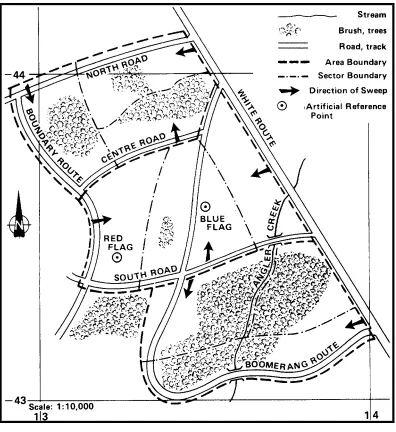
13. Control Map - An enlarged map of the area showing topographical detail, sector and area boundaries, and troop and dud locations is used as the control map. The scale should be about 1:10,000. An enlargement produced by a base photo section or formation Intelligence Section is ideal. Dud locations may be shown by flat-headed pins marked with the dud control number, or, if the number of duds recorded is too large, by pins relating to a Dud Control Record. As sector searches are completed, areas are shaded in. Such maps will be kept at the Operation CP for the entire task area and in each area commander's CP for each individual area. An example of a map is shown in Figure 3-1.
Figure 3-1 Example of a Control Map Range Preparation
15. Range Preparation - The effectiveness of the clearance operation especially for a Level One operation, will be improved by burning-off grass and shrubs prior to setting-out. Without burning, both the quality and the speed of the operation will be seriously down graded. The best time to conduct range clearance is in the early spring as soon as the ground is sufficiently dry. Undergrowth has not yet begun to grow and allows for preliminary burning of dead grass, leaves and underbrush. Ideally, burning should take place approximately two weeks prior to the
Setting Out
16. General - Area and sector boundaries, artificial reference points, in and out routes as well as any other control points are sited by setting-out teams prior to sweep operations. Setting-out may be done concurrently with sweeping operations but must be well ahead of the sweep teams. Since setting-out is done over unswept ground, team movement must be controlled.
17. Setting-Out Teams - These teams are used to set out and maintain area and sector boundary markings, establish artificial reference points and determine in and out routes. These markings should as much as possible use existing features such as roads or tracks or follow natural features. They must be visible, and durable enough to remain for the duration of the operation. Since setting-out is done in unswept areas, the teams must have received adequate training from an ATO or Ammo Tech TQ 6B minimum and be supervised by personnel familiar with the ordnance likely to be encountered. They should have, and be able to use, mine detectors to check areas before stakes are driven, if the degree of hazard warrants this precaution - the decision to permit the driving of stakes without electronic clearance is the commander's. The setting-out teams should also be capable of identifying, reporting, and marking any duds they locate. Marking stores are cumbersome and thus each team requires a vehicle which should be tracked and armoured; if the area is highly contaminated.The teams are also required to check visually the path which their foot - or vehicular traffic - will follow, in order to establish the boundary line. Area and sector boundary markings must be of different colours. Another means of marking area boundaries is to cut a swath through underbush and wooded areas with an APC dozer.
Sweeping Operations
18. Composition and Formations - The composition of the sweep teams and the formations employed to conduct the sweeps will vary according to the level of sweep being undertaken. They will also be affected by the lie of the land, the vegetation cover and other obstacles such as swamps and streams. This subject is covered in detail for both Level One and Level Two
operations in subsequent sections. Dud Marking, Reporting and Control
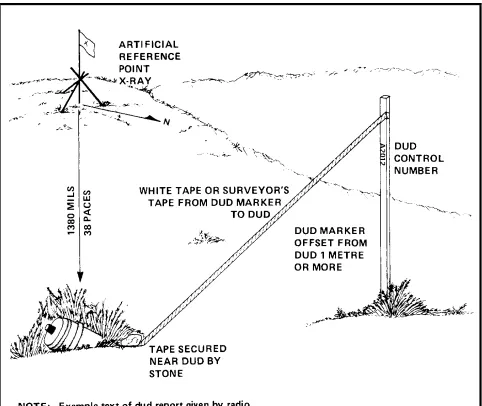
19. Duds, when found by sweep teams are reported and marked by a wooden stake driven into the ground at least one metre from the dud. Tape is laid from the top of the marker to a spot near the dud, but not touching it, and weighted down in position. The marker stake should be about 1.8 m long, and made visible by fluorescent paint, a flag or survey tape streamers. Dud numbers are marked on the stake with a felt pen or grease pencil. Dud control numbers are assigned in blocks to each area and sector, with prefixes and suffixes to identify units and sub-units. Dud records (see Annex A to this chapter) are maintained by the Operations CP,
area/sector CPs and may also be held by the sweep platoon. In addition to filling in the form, the information is passed by radio. The dud destruction teams verify the information as they
Figure 3-2 Marking and Reporting a Dud Scrap Transport Vehicles
20. The ideal situation is to have separate munition and non-munition scrap vehicles. Munition scrap identified on site will be removed to a munition scrap vehicle which has
need not again be checked but it will not, while loaded, enter an ammo compound or other area, other than a non-munition scrap area. When impractical to have separate vehicles, a single vehicle may be used. However, it is imperative that this vehicle contain separate, clearly identified containers for munition and non-munition scrap. As above, an Ammo Tech will personally inspect all scrap and place It in the proper containers.
Scrap Disposal
21. The scrap that is picked up during the sweeping operation must be screened as described in chapter 2, paragraph 12. before being consigned to a scrap area. Munition scrap will always be separated from other scrap and be removed to a secure compound. It will never be buried. Access to such munition scrap piles must be controlled so that the munition scrap pile remains
completely free of explosives hazards. Non-munition scrap can be disposed of in a garbage dump. Munition scrap compounds will be clearly signed as to their purpose.
Dud Destruction
22. The dud destruction teams are formed of personnel qualified as stipulated in Chapter 2. Duds will be destroyed in place and never moved. The demolition safety distance for unprotected troops normally prohibits dud destruction at the same time as sweeping operations. The
destruction of duds must be done after the sweep operation is completed and when all other personnel have left the area. However, dud destruction teams may conduct a reconnaissance while the sweep organizations are still in the area. Suspected duds that prove to be non-explosive can be removed immediately, cancelled from the dud record form and reported as such. Those suspected duds that prove to be explosive in nature are left in place and destroyed after all personnel have left. This procedure ensures that dud destruction teams can destroy during daylight hours all duds found during that clay.
After Action Report
SECTION 3 - PROCEDURES UNIQUE TO LEVEL ONE OPERATIONS Purpose
24. This type of clearance operation is completed to destroy all duds and remove scrap visible on the surface. This section describes responsibilities, organizations, formations and drills for locating and dealing with these objects.
Organization
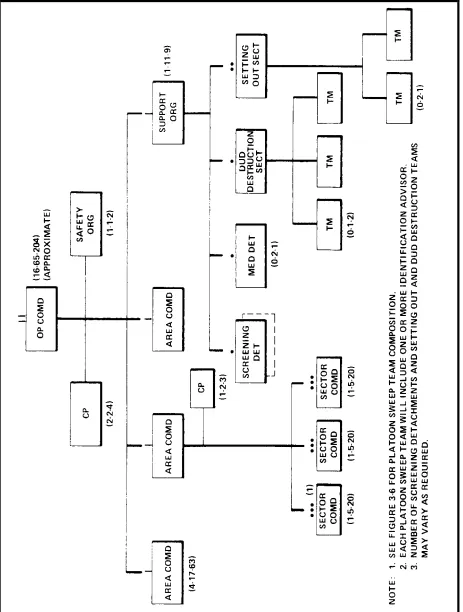
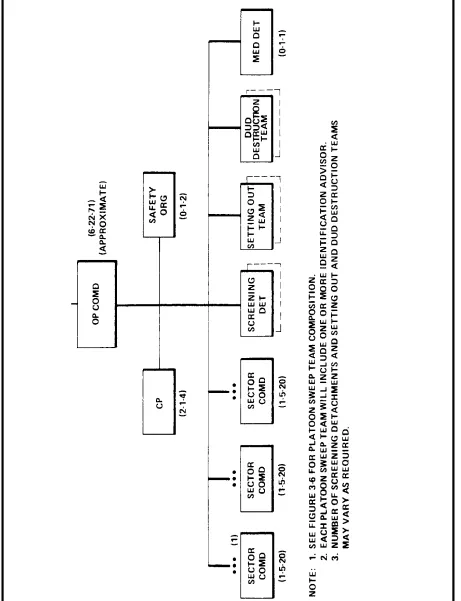
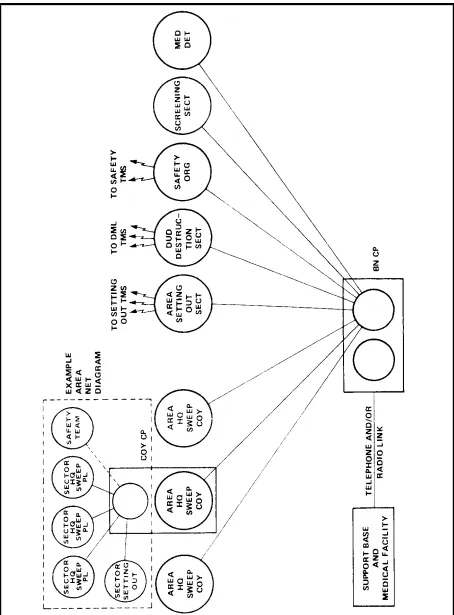
25. This type of clearance operation can be undertaken by a battalion or company-size group, Figures 3-3 and 3-4 show suggested organizations for both but they can be modified to meet the local conditions. Care Must be taken to maintain the normal chain of command. The number of dud destruction, setting-out and screening teams depends on the area to be cleared and the anticipated number of duds. The exact number of teams will be determined by judgement and experience. A suggested communications net is shown in Figure 3-5 for a battalion-size task. This can be modified for a company-size task.
Sweeping Operations
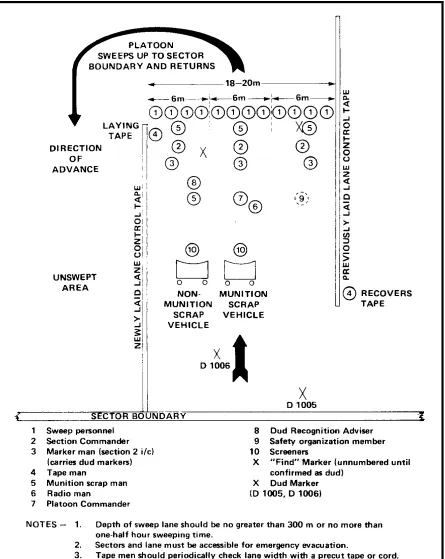
26. Organization - The size of the sweep teams will be dictated by the area to be swept and by the state of the land (lie, trees, underbrush, swamps). Sweep platoons/sections augmented by a Dud Recognition Adviser, are responsible for clearing all scrap from the sector and marking, recording and reporting the location of all duds. They are riot responsible for dud destruction. Areas that cannot be searched due to terrain constraints such as excessive vegetation and swamps must be clearly marked and recorded. Distance between sweepers is based on the vegetation cover and types of dud, but should not exceed 3 m.
28. Procedure for Sweep:
a. Possible Dud The procedure on detection of a possible dud is as follows -(1) Sweeper stops, holds up hand, and points to possible dud,
(2) Marker man (section 2 i/c) drives in an unmarked marker stake 1 m from the "find" and moves on,
(3) Section Commander does not involve himself with placement of stake; he concerns himself only with the uniform movement and control of the whole section,
(4) Platoon warrant officer and Dud Recognition Advisor move to the
unmarked "find" marker and confirm the object. If the object is scrap, it is picked up by the munition scrap man accompanying the Dud Recognition Advisor and the marker is removed; if it is a dud, the marker is numbered and recorded, and the dud reported.
(5) The Platoon Commander concerns himself with the movement and control of the whole platoon.
b. Scrap The procedure on detection of possible scrap is as follows -(1) sweeper pauses, positively identifies the object as non-munition or
munitions scrap,
(2) if identified as munitions scrap, and found to be safe, he picks it up and passes it to the munition scrap man to his rear. The munition scrap bags should be marked with a red tag. For whole projectiles, the Dud
Recognition Advisor must confirm the object as safe,
(3) if munition scrap, he places it in the bag he is carrying. The non-munition scrap bags should be marked with green tags,
(4) full non-munitions scrap bags will be placed on the ground for later pick up by the non-munitions scrap vehicle thus maintaining the integrity of the sweep line. The location of these bags must be apparent and quite visible to ensure none are missed by the non-munition scrap vehicle.
(5) full munitions scrap bags will be taken to the munitions scrap vehicle by the munition scrap man.
Sweep Formations
29. General - Formations to be adopted will be dictated by ground conditions. Only a detailed reconnaissance and experience can determine what is to be used and even then it will be
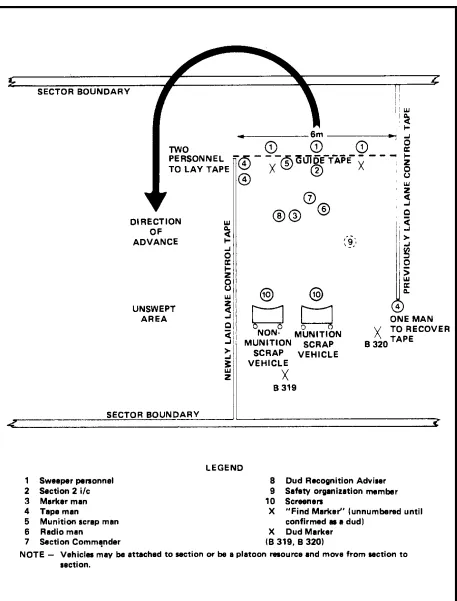
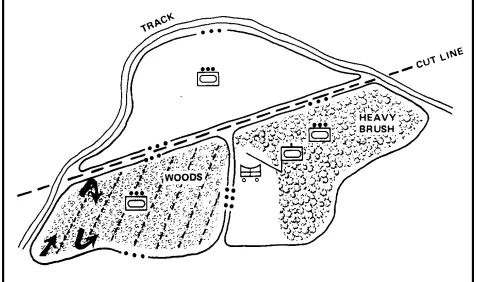
30. Sweep Section - In close country, it may not be possible for a platoon to sweep safely or effectively in line. Operations in these conditions will be carried out as a section sweep as shown in Figure 3-7, Possible formations that have proven effective in the past are as follows:
a. open terrain - arrowhead;
[image:42.612.66.551.150.435.2]b. close or broken terrain - the platoon sector.
Figure 3-8 Company in Arrowhead Formation in Open Terrain
31. Arrowhead - This formation is good for open terrain, See Figure 3-8, It is the most flexible, is good for command and control and is conducive to safety. It allows by-pass by other platoons should one platoon encounter obstacles or a heavily dud-contaminated area. The
Figure 3-9 Company in Platoon Sector Formation in Close Broken Terrain
SECTION 4 - PROCEDURES UNIQUE TO LEVEL TWO OPERATIONS Purpose
33. Level Two clearance operations are normally carried out after a Level One operation in order to locate and destroy all duds located immediately below the surface. It is not mandatory to conduct a Level One clearance prior to a Level Two clearance unless these is a high level of surface contamination that will affect mine detector readings. Should a Level Two type of operation need to be undertaken because vegetation/undergrowth prevent an effective visual search, refer to paragraph 38.
Organization and Responsibilities
34. General - The sequence of events, command and control and training outlined in chapter 2 and sections 1 and 2 of this chapter must be read in conjunction with this section prior to the conduct of Level Two Clearance operations. The composition and responsibilities of sweep teams changes slightly and thus the procedures adopted by the sweep teams are different. This section provides guidance on this aspect of Level Two operations.
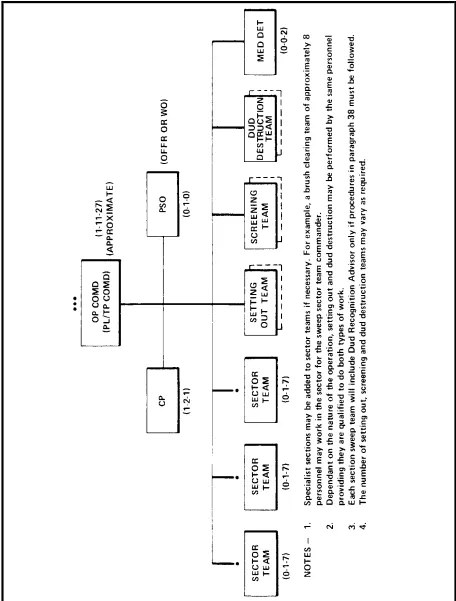
35. Platoon Formations - Level Two Clearance operations are best conducted based on a troop/platoon organization deployed by sections, with the section commander assuming sector responsibility. Since it is unlikely that there will be surface duds or scrap remaining after a Level One clearance operation, Level Two clearance operations will not normally require a Dud Recognition Advisor. A suggested organization is shown in Figure 3-10 and suggested platoon formations that have proven to be successful in the past are shown at Figure 3-11.
36. Sweep Team - The sweep team sweeps the lane to locate buried objects. It is not this section's function to excavate and identify the buried find. Once the detector man locates an object it is marked with a "find" marker and he moves on, A find marker can be a nail with a piece of tape or a picket laid on the ground with the head pointing to the area of the mine detector's reading. Since there may be duds left over from the visual sweep the section
commander must be familiar with duds that may be encountered. Detector men must be spaced far enough apart to minimize electronic interference with adjacent detectors. Approximately one meter is recommended. The sweeping motion used by the detector men must overlap with the sweep of the adjacent detector and/or lane control tape to ensure no duds are missed. Detector men should be rotated frequently to avoid fatigue induced carelessness. Figure 3-12 illustrates sweep section composition deployment and operation.
37. Prodders - Once the detector men move on and are a safe bound away, prodders come forward to investigate the buried find. As part of the prodding team, there should be an individual with a Forester-type bomb locator. This instrument will pin-point the reading originally detected by the No 4C mine detector and consequently reduce the amount of time spent prodding.
Figure 3-13 Prodding and Soil Layer Removal
Modified Level Two Clearance Operations
39. The modified Level Two Clearance operation is undertaken when
vegetation/undergrowth prevents an effective visual search (Level One Clearance) of an area. In such a case a Dud Recognition Adviser must be added to each sweeping section. He will be located immediately behind the section commander. In addition, munitions scrap men, non-munitions scrap men and non-munitions scrap and non-non-munitions scrap vehicles must be provided for each sweep team. The scrap men will follow the mine detector operators and the procedures for surface munitions scrap and non munitions scrap pick up as well as dud disposal are as per paragraph 20.
Range Clearance Equipment
40. General - There have been advances in recent years in the area of range clearance equipment. However, some of the equipment was designed for other purposes. Despite this, the equipment currently employed during range clearance is capable of successfully conducting Levels One and Two clearance.
41. In-service Mine Detector - The current in-service electronic mine detector is the Detector, MINEX, No. 4C. It is designed to locate buried metallic objects by generating an audible note in a pair of headphones, hence it can detect buried duds. The depth of detection varies with the size of the duds and soil conditions, however, tests have shown that it can detect a 20 mm round buried 25 cm deep and a 105 mm round buried 60 cm deep. The detector is described and instructions given for its operation in the User Handbook, however, a short training course should be given to operators by a 041 FD ENGR.
42. Forester Search Instrument - The models held by the CF are the FEREX 4.015 and 4.021. It is a one-man operated device capable of detecting ferro-magnetic objects at depths greater than that of the No. 4C. It is able to pinpoint the location of an object with much greater accuracy than the No. 4C, thus speeding up the work of the prodding team.
43. VARIAN V92 Magnetometer - This instrument is held in extremely limited quantities by the CF. It is a one-man operated device capable of detecting ferrous objects at depth to equal to that of the Forester and determining the actual depth of burial. However, the very rigid search pattern required when using the V92 does not lend itself to a general Level Two range clearance. It is more suitable for a Level Three clearance or a Level Two clearance in a small area where the surface is so heavily contaminated with shrapnel that it is not practicable to pick it up.
ANNEX A, CHAPTER 3
POST OPERATION REPORTS
1. On completion of a clearance operation a Post Operation Report must be completed. The report covers the operation in detail and includes maps, photographs, Dud Record Sheets, and other records as necessary. As a minimum the following information is included in the report:
a. unit(s) and groups carrying out the operation; b. period of time the operation was conducted;
c. the area cleared (m2) and level of decontamination (e.g., Level One); d. number of personnel used, identified by units and groups;
e. the man-hours expended in the operation;
f. the types and numbers of duds found and destroyed; g. a map indicating the general locations of duds;
h. an estimate of scrap removed (kilograms of munition and non-munition scrap); j. location of secure scrap compound;
k. the lessons learned;
m. comments and suggestions to improve procedures or techniques; and
APPENDIX 1 ANNEX A, CHAPTER 3
DUD REPORT AND RECORD SHEET
UNIT/SUB UNIT: NAME & CALL SIGN:
FOR USE OF DUD DESTRUCTION TEAMS ONLY
CONTROL NO OF DUD & UNIT/ SUB-UNIT CALL SIGN
GRID REF LOCATION
TYPE OF DUD AND LOCATION (see note 4)
ACTION TAKEN
SIGNATURE OIC
DESTRUCTION TEAM
NOTES - 1. Fill in this sheet at sector level and report to Area Control CP by radio (C/S of sub-sub-unit - grid - dud type - location).
2. To be delivered to Area Control CP by xxxx hrs daily by OC of sector. 3. Dud Destruction Teams are to pick up at Area Control CP at xxxx hrs and
return at the end of the day indicating that all duds have been identified and destroyed and dud marker stakes have been recovered.
ANNEX B, CHAPTER 3
SUGGESTED OUTLINE ORDERS
(Based on Battalion Level One Clearance operations)
(To be modified for smaller Level One task, or Level Two Clearance.) 1. Situation
a. Gen. History of range use, purpose of the operation, previous clearance operation results and lessons learned, anticipated nature and frequency of duds.
b. Atts and Dets. Engrs, ATOs and Ammo Techs, Base Range Staff pers, med, avn. 2. Mission. To clear range____ of duds and scrap to level____ by date.
3. Execution
a. Gen Outline: Task org down to sweep pl and specialist team level, incl gen tasks of each.
(1) Phase I - Trg for dud recognition advisers, screen and dud destruction teams and safety org.
(2) Phase II Setting-out, trg for remainder of pers. (3) Phase III Clearance op.
(4) Phase IV - Destruction of duds.
b. Trg Cadre. In accordance with timetable and briefings already issued. To include rehearsals for demonstration platoon if one is used.
c. A Coy, B Coy, etc. (1) Grouping.
(a) Under comd - truck for scrap.
(b) In Sp - dud recognition advisor, screeners.
(2) Tasks: Clear Area____ within bdrys, mark all suspected duds, remove all scrap.
d. Setting-Out Team. (1) Grouping.
e. Screening Team. (1) Grouping.
(2) Tasks. Check all scrap as it is loaded on vehicles to ensure no duds are incl and again at munition scrap dump.
f. Dud Destruction Team. (1) Grouping.
(2) Tasks. Destroy all duds or suspected duds. g. Safety Org.
(1) Grouping.
(2) Tasks. Observe all safety aspects throughout op, order activities ceased as nec.
h. Base Range Staff. (1) Grouping. (2) Tasks. j. Coord Instrs.
(1) Timings.
(a) Phase I, II, III, IV
(b) approx rate of adv____ M2/hr. (2) Work hrs - meals, rest, halts.
(3) Dud destruction team timings. (4) Markings.
(a) Area, Sector bdrys (b) Ref pts
(c) sweep lanes (d) safe routes
(e) secure compound for munition scrap (f) scrap vehicles
(g) extent of progress (for halts) (h) duds
(5) Alloc Dud Con Nos - A Coy - A1 to A1000 etc. (6) Coord - Final coord conference.
(7) Debriefings - Daily at____ for this OGp.
(9) Dud reporting procedure - Form, con nos, rad reports.
(10) Scrap vehs - Marked with Coy/Pl/Sect ident and as munition or non-munition.
(11) Alloc of stores - Dud markers, scrap bags, mine tape, surveyor tape, detectors.
4. Service Support.
a. Tpt - Safe routes, veh markings.
b. Pers dress and eqpt - Headwear, water bottle, gloves, rainwear. c. Meals and cottee.
d. Med. Org, loc, evac procedure. e. Fire fighting. Eqpt, loc, drills.
f. Explosives and accessories. Dud destruction team allotments. 5. Command and Control
a. Comd. Op, Areas/Sectors, spec teams. b. CP locs.
c. Rad.
(1) net diagram. (2) freq.
(a) comd nets (b) range safety (c) other (e.g. air) (3) net checks.
(4) hours of op. d. Tele. loc and no
e. CP op.
(1) ops log.
6. Safety
a. Safety org and task. b. Med evac drills. c. Rate of adv.
d. Procedures. Setting out, object location, destroying duds, screening scrap, WP "smoke in bag".
APPENDIX 1 ANNEX B, CHAPTER 3
SAMPLE OF OPERATION ORDER
Task Force Headquarters Palomino Rge/Harvey Bks GP, 957544 26 Aug 81 OP BILBO
1 CBG OO NO 1
Refs: A. Camp Wainwright 3350-165 (Op Roulette Ph 1 Report) dated 26 Jun 81 B. FMCHQ Ops 8124 211240Z Jul 81
C. 1 CBG Ops 744 312030Z Jul 81 D. B-GL-304-003/TS-003
E. Map, Sarcee, Alta, Ed MCE Trg 79 1:25,000 F. CFTO C-74-050-005/MX-000
G. CFTO C-74-050-002/MS-000 H. A-PD-123-004/PQ-001 J. CFP 153 (2)
K. After-Action Rep OP SCHACKLE 78 27 Jul 78 M. After-Action Rep OP SCHACKLE 79 17 Jul 79 N. OP BILBO ADM 0 NO 1 dated 24 Aug 81
1. SIT
a. Gen
(1) Backgrd. Sarcee Trg Area has been used as a mil trg area for live wpn use since 1908. Wpn use rges from Boer war arty to air wpns. Virtually every type of wpn used by the Cdn Army has been fired live in the Sarcee Area. Ref A contains natures.
(2) Lease Expiry. The DND/Sarcee Band Lease expires T Oct. 1 CBG, with under comd elms from SSF, 5 GBC and throughout FMC, has been ordered to clr live ord from the area prior to rtn to the Sarcee Band. (3) Preliminary Recce. OP BILBO is based on recce conducted in Jun 81. See
Ref A.
(1) Formal Instr/TEWT to estb a standardization of trg and knowledge and familiarization of the particular ammo types to be found, for all specialists (HA/HB/HE/Fd Engr/Adv Pnr) is essential.
(2) Briefings, trg and rehearsals by units/sub-units, using grd and typical trg "duds", are vital to the success and safety of the op.
c. Atts and Dets. Under comd one coy each SSF, 5 GBC and att specialists FMC and CF.
d. Firm, positive and timely ldrship, exercised at all levels of comd through the normal chain of comd, is vital to the SAFETY and EFFECTIVENESS of the op. e. Tps and comds become complacent/over-familiar/careless after a few hrs of clr.
They must be routinely reminded of safety, (during breaks for coffee/lunch), by comds at all levels through short "reminder" in situ briefings to their men. After one hr of the op in progress, comds are encouraged to have a short break/briefing in situ by pl/tp/coy/sqn comds.
2. MSN. 1 CBG will cir to Levels One and Two contained in Zones 2 and 1 respectively by 30 Sep 81 (see Anx L - not included).
3. EXEC
a. Gen Outline. See Anxs A and L (not included). Level One and Two ops will be conducted concurrently between 0830-1545 with duds destroyed between 1800-2100 hrs daily. Drills will be IAW Ref D explained through Anxs C, D, E, G and H.
b. LdSH (RC) Sqn (and tp).
(1) Gp. Under comd from 1800 27 Aug 81 4 Ident Advisers 1 Amb 1 Fd Amb
Det under comd 1 PPCLI forthwith One 50 man pl
Det under comd TFHQ 2 dvrs for Range
Surface Clearance Vehicle (2) Tasks. Within bdrys with pri to Zone 1-4:
(a) Mark suspected surface duds/misfired ammo; (b) Remove tpt, surface garbage/scrap metal;
c. GBC Coy.
(1) Gp. Under comd from 1800 27 Aug 81 4 Ident Advisers 1 Amb,
1 Fd Amb (2) Tasks. Within bdrys cir Zone asg:
(a) Mark suspected surface duds/misfired ammo; (b) Remove tpt, surface debris/scrap metal;
(c) Commence clr ops along fire gd N to S, work progressing to West ie clr open areas first; and
(d) Be prep to be relieved on order for rotation.
d. SSF Coy
(1) Gp. Under comd from 1800 27 Aug 81 4 Ident Advisers 1 Amb,
1 Fd Amb (2) Tasks. Within bdrys with pri to Zone 1 - 1
(a) Mark suspected surface duds/misfired ammo; (b) Remove tpt, surface debris/scrap metal;
(c) Clr open area Zone 1 - 1 before bushed area; and
(d) On order be prep to train 2 PPCLI Coy on site, be relieved for R & R and then relieve LdSH (RC) Sqn,
e. 2 PPCLI Coy.
(1) Gp. Under comd on order: 4 Ident Advisers
1 Amb, 1 Fd Amb (2) Tasks. On order, relieve SSF Coy (see above) and, within bdrys
(a) Mark suspected surface duds/misfired ammo; (b) Remove tpt, surface debris/scrap metal;
(c) Be prep to be relieved for R Et R by LdSH (RC) Sqn. f. 1 PPCLI Coy.
(1) Gp. Under comd forthwith: Tp LdSH(RC)
(50 men)
Under comd 1800 26 Aug Pl 3 PPCLI
(50 men)
Under comd 1800 27 Aug 20 Ident